

Summary Yes. A blocked diesel particulate filter can shorten a turbocharger’s life and, left long enough, finish it — but it is usually a contributor rather than the whole cause. A loaded filter raises the pressure and heat the turbine works against, forces exhaust gas into the turbocharger’s centre housing, and through repeated regenerations thins the oil its bearings run on.
If you are holding a failed turbo, the order of the repair matters more than the diagnosis. The reason the filter choked, the filter itself and the oil it diluted all have to be dealt with before a rebuilt unit goes back on, and some of those jobs undo each other if they are done in the wrong order.
A particulate filter can take a long time to block and a turbocharger very little time to fail behind it, so a unit refitted without the filter being checked inherits the conditions that finished the one before.
The Short Answer: Yes, but Usually as a Contributor
A blocked DPF can cause turbo failure. Melett, which manufactures turbocharger repair components, goes further than most sources: its failure guidance says the particulate filter is behind more turbo failures than people expect, and that a filter which has taken a long time to block — sometimes years — can bring on a turbo failure very quickly once it has.
“Contributor” is the accurate word for most cars. The filter rarely breaks a healthy turbocharger on its own. It changes the conditions the turbocharger works in — hotter, at higher pressure behind the turbine, on thinner oil — and whatever else was marginal, from a partly coked oil feed to a tired bearing, gives up sooner than it otherwise would.
That has two practical consequences, and the rest of this page is built on them. A blocked filter is itself a symptom, with a cause of its own further up the engine. And a replacement turbo bolted on behind it inherits the same working conditions. Our Audi A4 TDI turbocharger rebuild page works through the relationship on one car; this page is the general diesel answer, and it ends with the sequence of work that stops the next turbo going the same way.
How a Loaded DPF Works Against the Turbine
The particulate filter sits downstream of the turbine, and every bit of exhaust gas the turbine discharges has to pass through the filter’s walls before it reaches the tailpipe. As soot builds up in those walls, the gas cannot get through at the rate the engine is producing it. Pressure and temperature rise in the turbine housing, and the turbocharger is left working against a restriction it was never designed around.
How the boost-control system responds to that pressure is covered on our A4 TDI page. What follows is what the raised pressure and heat do inside the unit itself, as Melett’s failure guidance describes it.
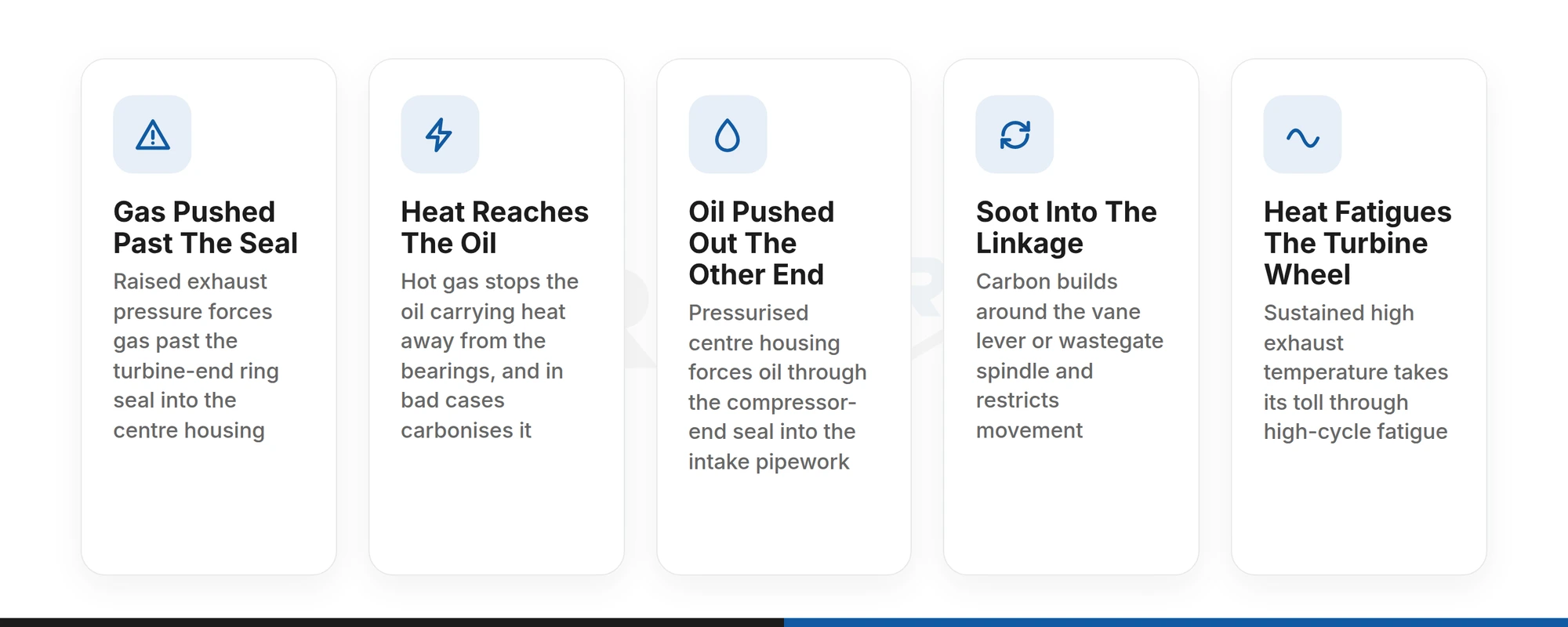
Gas is pushed past the turbine-end seal. The seal between the turbine and the centre housing is a ring seal that works by keeping the pressure across it in balance, not a gasket. Raise the pressure on the exhaust side far enough and exhaust gas is forced past it into the centre housing, where the bearings and the oil are.
Heat reaches the oil. The oil in the centre housing is there to lubricate the bearings and carry heat away from them. Hot exhaust gas arriving from the turbine side stops it doing the second job, and in bad cases carbonises it, which restricts the oil passages and starts the bearings wearing.
Oil is pushed out of the other end. Once exhaust gas is pressurising the centre housing, the oil there has to go somewhere. Some is forced through the compressor-end seal into the compressor housing and on into the intake pipework, which is why a filter problem can present as an oily intercooler.
Soot gets into the control linkage. Gas under pressure finds the smallest clearances, including those around the lever arm of a variable-vane mechanism and the spindle of a wastegate. Carbon builds up there and restricts movement, and the driver feels it as lag or as an overboost.
The turbine wheel carries the heat. Sustained high exhaust temperatures take their toll on the turbine wheel itself, and Melett lists turbine wheel failure through high-cycle fatigue among the outcomes.
None of that happens in a single drive. The car usually keeps going, the turbo still makes some boost, and the gradual loss of response gets put down to age. By the time a turbo symptom is obvious, the filter has normally been loading for a long while.
Failed Regenerations, Oil Dilution and the Bearing Side
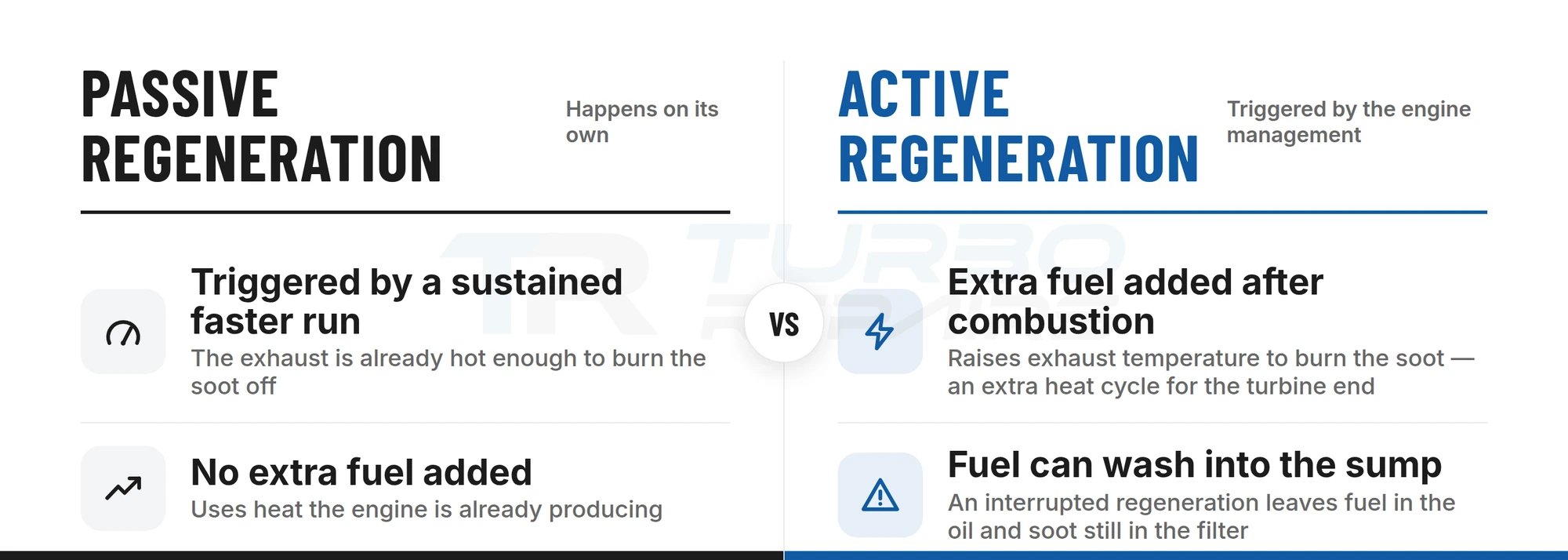
A particulate filter clears itself by burning its soot off, which is called regeneration. Passive regeneration happens on its own when the exhaust is hot enough, typically on a sustained faster run. Active regeneration is triggered by the engine management, which adds fuel after combustion to raise the exhaust temperature and burn the soot. Most manufacturers rely heavily on active regeneration because so many cars never see enough long runs for the passive kind to keep up.
Both forms of cleaning cost the turbocharger something, and a filter that loads quickly makes it pay more often.
Heat. The hotter gas produced for a regeneration passes through the turbine housing on its way to the filter. Every regeneration is an extra heat cycle for the turbine end, and a car that regenerates frequently puts its turbocharger through many more of them than the same engine on a steady motorway commute.
Fuel in the oil. Some of the fuel injected late in the cycle for an active regeneration washes past the piston rings into the sump. When a regeneration is interrupted, because the engine is switched off part-way through, the soot stays in the filter, the fuel stays in the oil, and the car simply tries again on the next journey. A car used only for short trips can repeat that pattern many times over, adding a little more fuel to the sump each time.
The bearing side. A turbocharger shaft does not touch its housing; it floats on a pressurised film of engine oil, and thinner oil makes a weaker film. Put fuel-diluted oil together with the heat-carbonised oil described above and the bearings are being attacked from both directions at once. The damage they show looks like an oil failure, and Melett notes that DPF-related turbo damage is often mistaken for lack of lubrication or contaminated oil. That misreading matters, because the fix for an oil-supply fault and the fix for a choked exhaust are different jobs.
Two things are worth noticing from the driver’s seat. A DPF warning light that keeps coming back means regenerations are not finishing. An oil level that creeps up between changes, rather than going down, suggests fuel is getting into the sump. On the question of how to drive so regenerations complete, published advice varies widely on speed, revs and duration, so follow the conditions your own vehicle handbook describes rather than a general figure.
Which Failed First? Reading the Evidence Both Ways
By the time a turbo has failed on a car with a loaded filter, both components are usually involved, and the useful question is which one started it. That decides what has to be fixed as well as the turbocharger. Oil leaving a failing turbo loads a filter too, which is the loop our A4 TDI page sets out. The job here is telling the two orders apart.
The evidence sits in two places: the car’s history, and the turbocharger once it is on a bench.
| What you find | What it points towards |
|---|---|
| DPF warnings or failed regenerations recorded before any complaint about boost, noise or smoke | Filter first |
| Blue smoke, rising oil use or oil in the charge pipes before the DPF light ever came on | Turbocharger first — oil into the exhaust loads the filter with residue regeneration cannot burn |
| Heat discolouration in the centre housing, spreading from the turbine side, with the rotating assembly otherwise intact | Excessive exhaust temperature — filter first |
| Carbon packed into the turbine-end seal ring groove; soot on the back face of the seal plate | Exhaust gas forced in from the turbine side — filter first |
| Carbon binding the vane lever or wastegate spindle | Consistent with a restricted exhaust, but short-journey use does this too — not conclusive alone |
| Scored bearings and a coked oil feed, with no heat marking from the turbine side | Oil supply or contamination first — the filter may be a bystander |
| Oil in the compressor housing | Either order: worn bearings or a pressurised centre housing both produce it |
The last two rows are why the filter should not be convicted on circumstantial evidence. Our Ford Focus 1.6 TDCi turbo failures page covers an engine where the particulate filter routinely takes the blame and the carbon starving the turbo is documented as coming from the injector seals instead.
Fault codes record a condition, not an order. A car with both problems will often hold filter codes such as P2002 (particulate filter efficiency below threshold) or P2463 (soot accumulation) alongside an underboost code such as P0299. That tells you the two conditions were present, not which arrived first. For the sequence, look at the service record, the dates of any forced regenerations or filter cleans, and what the driver noticed first. Our guide to overboost and underboost codes explains what the boost codes can and cannot tell you.
Check the filter reading before condemning the filter. The engine management judges how loaded the filter is largely from a pressure sensor measuring across it. A failed sensor, or a split or blocked sensor pipe, can report a load that is not there, so the filter’s actual state needs confirming before money is spent on it. A loaded filter also makes a car feel exactly like it has a tired turbo — one of several faults that imitate turbo failure.
The bench settles the turbocharger half. Discolouration, carbon in the seal groove and the pattern of bearing wear are all readable once the unit is apart, which is why we tell you what the strip found as well as what we renewed.
Turbo Repairs · Epsom workshop
Let the old turbo show which way the damage ran
Post the failed unit in and we strip it, check the centre housing for heat marking from the turbine side, and measure the bearings and seals. You find out whether the wear reads as a choked exhaust or a starved oil supply before anything else on the car gets replaced.
Lifetime, unlimited-mileage warranty · Mail-in from the UK and internationally · Bench-tested and calibrated before it ships
What to Fix Before a Rebuilt Turbo Goes Back On
Melett is blunt about the risk: if the filter is not checked when a replacement turbo is fitted, there is a very high chance the new unit fails the same way, because it goes back into the same operating conditions. The fix is not complicated, but it is a sequence, and the order is the point. Clean the wrong thing first and you can undo a job you have already paid for.
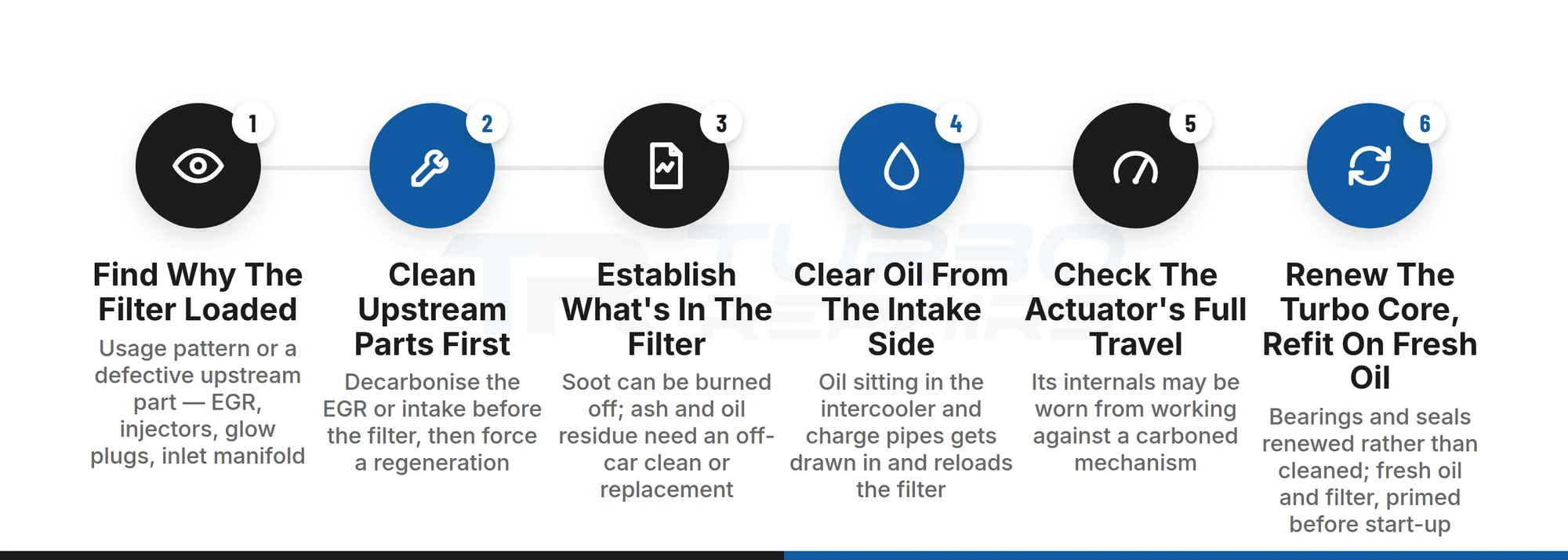
- Find out why the filter loaded. Particulate filters are rarely faulty in themselves. European Exhaust & Catalyst, a UK maker of particulate filters, puts most blockages down either to how the car is used — short or stop-start journeys that never let a regeneration finish — or to a defective component further up the engine, such as the EGR valve, injectors, glow plugs or inlet manifold. Clean a filter without finding which applies and it simply loads again.
- Clean upstream parts before the filter, not after. If the EGR valve or intake is being decarbonised, do that first. The same manufacturer advises a forced regeneration straight after cleaning anything upstream, because the carbon that comes loose lands in the filter and can set hard there if it is left.
- Establish what is actually in the filter. Soot burns, so a filter loaded with soot can often be recovered by a forced regeneration carried out with diagnostic equipment. Ash and oil residue do not burn, and a filter loaded with them needs an off-car clean or replacement. If it is replaced, the quality of the replacement matters: Melett warns that a low-cost filter may not flow as well as the original and can recreate the conditions of a blocked one. We do not remove particulate filters and we do not advise it; a car with its filter removed will not pass an MOT, and removal does nothing for a turbocharger that has already worn.
- Clear the oil out of the intake side. Oil pushed through the compressor-end seal sits in the intercooler and charge pipework. Leave it there and the engine draws it in and burns it, and what it leaves behind goes straight into the filter you have just cleaned.
- Check the boost-control actuator’s full travel. Melett singles this out, particularly for electronic actuators, whose internal components may be worn from working against a carboned mechanism. If the actuator is the weak link, our electronic turbo actuator repairs cover it, from £100 + VAT.
- Renew the turbocharger’s core rather than cleaning it. Melett’s advice where the filter was blocked is to replace the core assembly to prevent oil leaks, because the seals and bearings have been working in conditions they were not built for. Our turbo rebuild renews the bearings and seals at both ends, frees and measures the vane or wastegate mechanism, balances the rotating assembly and runs the unit on the bench. Rebuilds start from £185 + VAT and are typically one to three working days on the bench.
- Refit onto fresh oil and a clear supply, and prime it. The regenerations have put fuel in the old oil, so the oil and filter are changed as part of the refit, to the specification in your handbook. The feed pipe, drain and the rest of the pre-refit checks, along with priming by cranking for ten to fifteen seconds without letting the engine start, are in our guide to refitting and priming a turbocharger.
- Let the first regeneration finish, then look again. Give the car the kind of run its handbook says a regeneration needs, and have the filter reading checked afterwards. A DPF light that returns quickly means the cause from step one has not been found yet, and it is far cheaper to find it now than after a second turbo.
Most of that list is work on the car rather than on the turbocharger, and it falls to whoever is doing the fitting. Our part of the job is step six, carried out on your own unit. That is also where the evidence for step one usually turns up.
Blocked DPF and Turbo Failure FAQ
Can a blocked DPF cause turbo failure?
Yes. A loaded filter raises the pressure and temperature in the turbine housing, forces exhaust gas past the turbine-end seal into the centre housing, and through repeated regenerations dilutes the oil. It is usually a contributor rather than the whole cause, shortening the life of a turbocharger that something else was already wearing.
Doesn’t limp mode protect the turbo from a blocked DPF?
Only partly. Limp mode cuts power once the engine management has decided the fault is serious, which reduces the load while the fault stands. The damage described on this page builds up over the long loading period before that point and through every interrupted regeneration, so a car that has not yet gone into limp mode is not proof that the turbo has been spared.
Will cleaning the DPF save my turbo?
It removes the restriction from then on, which protects a turbocharger that is still healthy. It does not reverse wear that has already happened to the bearings and seals. And if the turbo is already passing oil, a clean filter starts loading again straight away, so the turbo has to be dealt with too.
Can a cheap replacement DPF damage a turbo?
It can. Melett warns that lower-cost filters often do not operate as efficiently as the original and can recreate the conditions of a blocked one, putting the same back-pressure on the turbine as the filter they replaced.
Is removing the DPF a fix for turbo problems?
No. We do not remove particulate filters and we do not advise it. A car with its filter removed will not pass an MOT, and removing it does nothing for a turbocharger whose bearings and seals are already worn.
Is it the turbo or the DPF making my car slow?
From the driver’s seat the two can feel identical. Check the filter’s actual state and the boost side for leaks first, because both are cheaper to rule out than a turbocharger. If the turbo has to come off, the strip shows whether the damage came from the exhaust side or the oil side.
Final Thoughts
The question on this page has a short answer, and the short answer is the least useful part of it. Yes, a blocked filter can kill a turbo. What matters to someone with a failed unit in their hands is that the filter did not block by accident either, and that a new or rebuilt turbocharger is the one part in the chain that cannot fix anything around it.
So the turbo goes on last. Find why the filter loaded, clean in the right order, clear the oil it diluted and the oil it pushed into the intake, check the actuator, then fit a unit whose core has been renewed. Done that way round, the replacement gets the working life the first one should have had.
Turbo Repairs · Epsom workshop
Rebuild the turbo once, after the filter is sorted
Send the failed unit in with your registration, engine details and a note of any DPF warnings, regenerations or filter cleans in its history. We strip it, read the wear, renew the core on genuine OE or OEM-grade parts, balance it and bench-test it before it comes back ready to refit.
Lifetime, unlimited-mileage warranty · Mail-in from the UK and internationally · Bench-tested and calibrated before it ships