

Summary A hybrid turbo is a turbocharger built from a mix of parts, usually starting from the original unit for a particular engine and changing one or more components — most often the compressor wheel, the turbine wheel, the bearings or the housings — so that it behaves differently from the turbo the car was built with, normally by moving more air. The word describes how the turbo was put together, not a separate kind of turbocharger, and it has nothing to do with hybrid petrol-electric cars.
The specialists who build them are clear that a hybrid on its own will not necessarily add much power: it is made to work alongside a remap and higher boost, and there is usually a trade between top-end flow and low-speed response. Below is what the term covers, a side-by-side table against an original-fit turbo, what a hybrid changes, an honest answer on whether a standard car needs one, and what we rebuild instead. We do not build or supply hybrid turbos.
The same word covers a turbo with one non-standard thrust bearing and a turbo with larger wheels in machined housings, so “hybrid” tells you a turbo differs from its original, not how far.
What Is a Hybrid Turbo?
A turbocharger has two wheels on one shaft. Exhaust gas spins the turbine wheel, the turbine turns the compressor wheel, and the compressor pushes air into the engine. The shaft runs in bearings inside an oil-fed centre housing, and each wheel sits inside a housing shaped closely around it. Our guide to how a turbo works goes through each of those parts in turn.
A hybrid turbo keeps that layout but changes some of the parts. One UK turbo specialist defines it as a turbo made from a mixture of parts from different turbochargers, usually based on the original unit for a specific application. Another describes it as a non-standard turbo that combines parts from different frame sizes, and in some cases from different manufacturers. A third defines it by its result: an original, standard unit modified by changing one or more parts so that it gives different results from the original.
Put together, those three definitions agree on the essentials. A hybrid starts from a real turbocharger, normally the one designed for that engine. Parts are swapped or modified. And the aim is a turbo that does something the original did not.
The parts most often changed
One specialist sets out what changes on a basic-level hybrid, and the list is a useful map of where the differences sit:
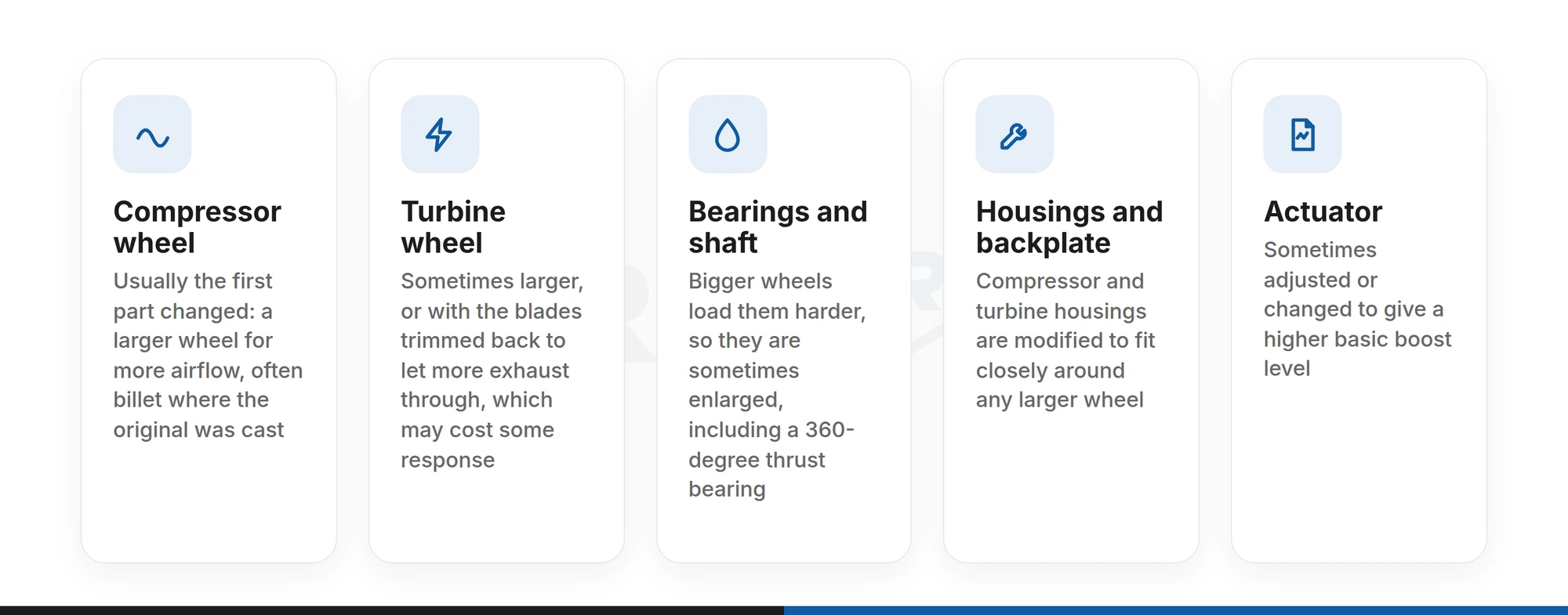
- Compressor wheel. Usually the first part changed, normally for a larger wheel to increase airflow, and often for one machined from solid (billet) where the original was cast, for strength.
- Turbine wheel. Sometimes replaced with a larger one, or, as a lower-cost route, the blades are trimmed or cut back to let more exhaust through, which the same source notes may cost some response.
- Bearings and shaft. Bigger wheels move more gas, which loads the shaft and bearings harder, so these are sometimes enlarged or modified, including fitting a 360-degree thrust bearing where the original did not have one.
- Compressor housing and backplate. These fit closely around the compressor wheel, so they have to be modified if a larger wheel goes in.
- Turbine housing. Modified for the same reason if the turbine wheel grows.
- Actuator. Sometimes adjusted or changed to give a higher basic boost level.
Hybrid Turbo Meaning: Why the Word Is Used
“Hybrid” is used in its plain sense: something bred from two parents. According to one long-established builder, the practice began as mixing and matching components between different configurations of the same type of turbo to get a particular performance characteristic. As more turbo models and more aftermarket components became available, the range widened, and the same builder now describes “hybrid” as covering everything from a minor uprate to a completely redesigned turbo.
There is no fixed standard for the word
Nothing defines how much has to change before a turbo counts as a hybrid. One specialist says there are no hard and fast rules on hybrid designs, and takes the broadest possible reading: fitting just a 360-degree thrust bearing, or a different style of piston-ring seal, technically makes a turbo a hybrid, because it no longer matches the manufacturer’s standard specification.
Where an uprated part fits in
This is the part of the definition that matters most to an owner with a worn turbo, so it is worth being precise. Under the broadest reading above, any non-standard component makes a turbo a hybrid. Under the definition that turns on results, the question is whether the turbo has been built to do something different from the original — usually to flow more air and run more boost.
An uprated part fitted to cure a known weakness, such as a wastegate pivot, a bearing or a seal that fails early in its original form, is there so the turbo keeps doing its original job for longer. It does not change the wheels or housings that decide how much air the turbo moves, and it does not ask the engine for more boost. That is the difference between a rebuild with uprated parts and a hybrid. Because the word is used so loosely, the reliable test with any supplier is the same: ask exactly which parts differ from the original, and why.
Hybrid Turbo vs Normal Turbo
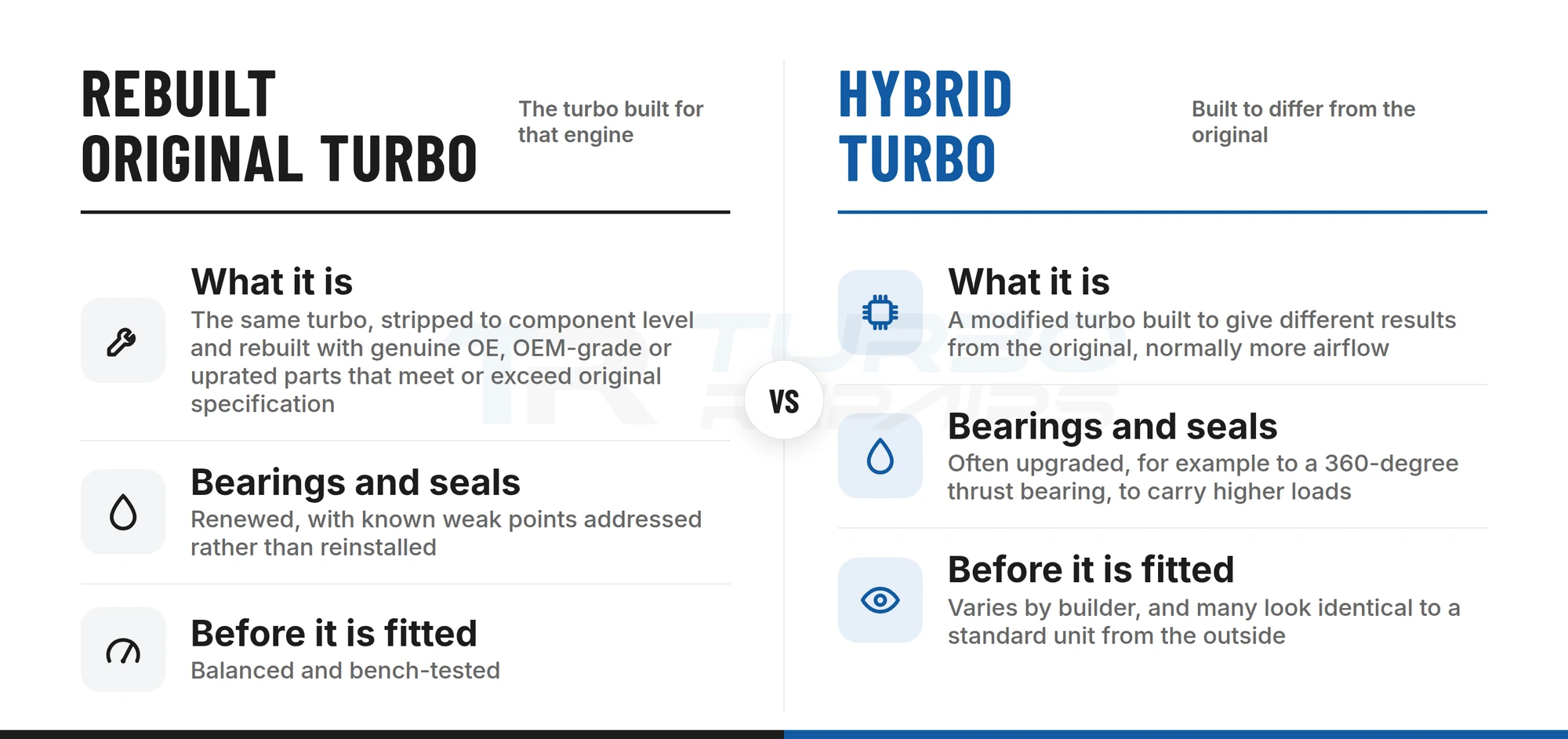
The table sets a hybrid against the turbo a car leaves the factory with, and against that same turbo once we have rebuilt it. The hybrid column reflects what the specialists who build them describe; the details vary from one hybrid to the next.
| Point of comparison | Original-fit turbo | Rebuilt original turbo | Hybrid turbo |
|---|---|---|---|
| What it is | The turbo the vehicle manufacturer fitted to that engine | The same turbo, stripped to component level and rebuilt with genuine OE, OEM-grade or uprated components that meet or exceed original specification | A modified turbo built to give different results from the original, normally more airflow |
| Compressor wheel | Original size and construction | Checked, and renewed where worn or damaged | Often larger, and often billet where the original was cast |
| Turbine wheel | Original | Checked, and renewed where worn or damaged | Sometimes larger, or with trimmed or cut-back blades |
| Housings | Original | Checked, and renewed where needed | Machined or changed to suit larger wheels |
| Bearings and seals | Original design | Renewed with genuine OE, OEM-grade or uprated parts, with known weak points addressed rather than reinstalled | Often upgraded, for example to a 360-degree thrust bearing, to carry higher loads |
| Before it is fitted | Supplied new with the vehicle | Balanced and bench-tested | Varies by builder |
| Who supplies it | The vehicle manufacturer | A turbo rebuild specialist, such as our workshop | Performance turbo specialists |
One point the table cannot show is what a hybrid looks like. One builder notes that many hybrids look identical to standard units from the outside, because the changes are inside: different compressor and turbine wheel designs and different bearing systems. A turbo’s label tells you what it was built as, and our guide to finding your turbo part number shows where to read it, but the label cannot tell you what has been changed inside since.
What a Hybrid Turbo Changes: Boost, Lag and Wear
Boost and airflow
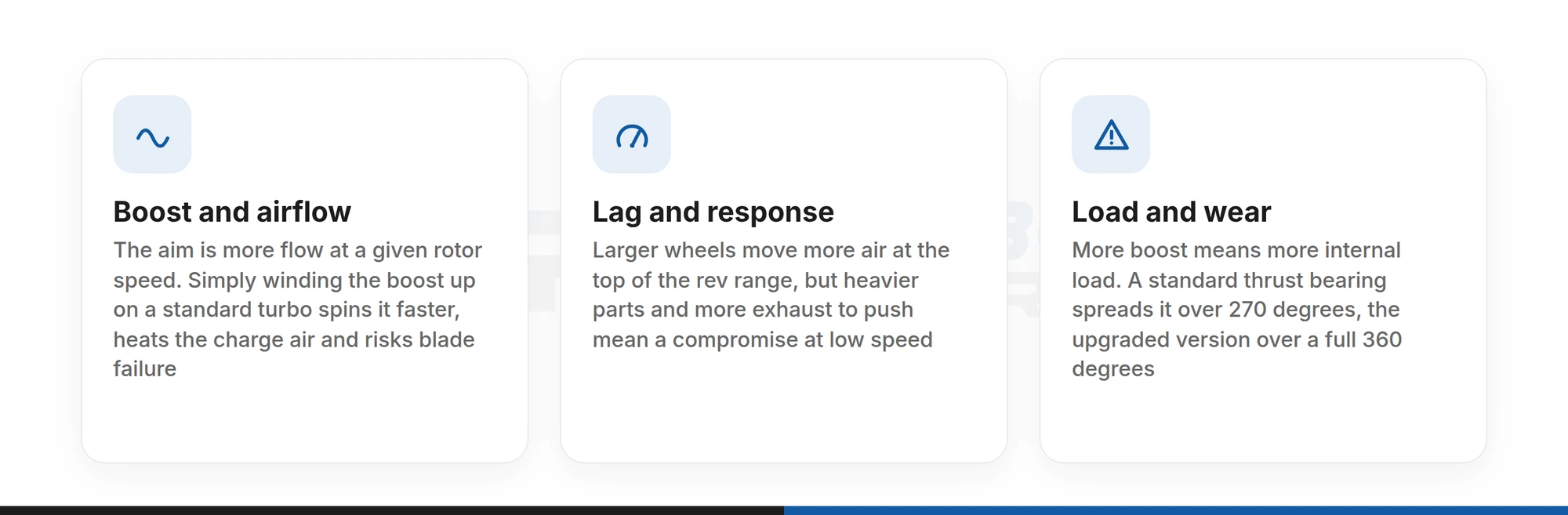
One specialist puts the aim of a hybrid simply: more flow from the turbo at a given rotor speed, from larger or more efficient compressor wheels, compressor covers of a different size, cut-back turbine blades or larger turbine housings. The same source warns that just “winding the boost up” on a standard turbo is not the answer. Making a standard turbo produce more pressure means spinning it faster, which can take the turbine past its maximum reliable speed and risk blade failure, and running the compressor faster lowers its efficiency, so the air leaving it is hotter. Hotter charge air raises the risk of pre-detonation and limits the power available.
A properly designed hybrid, on that account, reaches the extra flow and pressure at a safe turbine speed with a more efficient compressor. Another supplier adds a matching caution about proportions: a compressor wheel much larger than the turbine can feed is pointless in many cases, and going beyond the turbine wheel’s size can cause surge and possible engine or turbo damage.
Lag and low-speed response
Larger wheels and freer-flowing housings move more air at the top of the rev range, but the rotating parts are heavier and the exhaust has more to push. One builder says there is always an element of compromise between power capability and low-speed response. Another names the trade-off directly as turbo lag, with the exception of the latest ball-bearing turbos and variable-nozzle diesel turbos, and says it is very difficult to improve response all through the rev range on a standard journal-bearing turbo while also getting a big output at the top. On a variable-geometry diesel turbo the vane ring is what narrows the gas path at low engine speed; our VNT turbo guide explains how it works.
Wear on the turbo
More boost means more load inside the turbo. One builder says raising the boost increases the internal loading enough that it often needs a change to the bearing system, typically a 360-degree thrust bearing, and that those loads would otherwise destroy a standard bearing very quickly. Another explains why: a standard thrust bearing spreads the load over 270 degrees, the upgraded version over the full 360.
Do You Need a Hybrid Turbo? The Honest Answer for a Standard Car
If your car is standard — no remap, no other engine modifications — and its turbo has failed, the answer is no. That is not a sales position; it follows from what the people who build hybrids say about them.
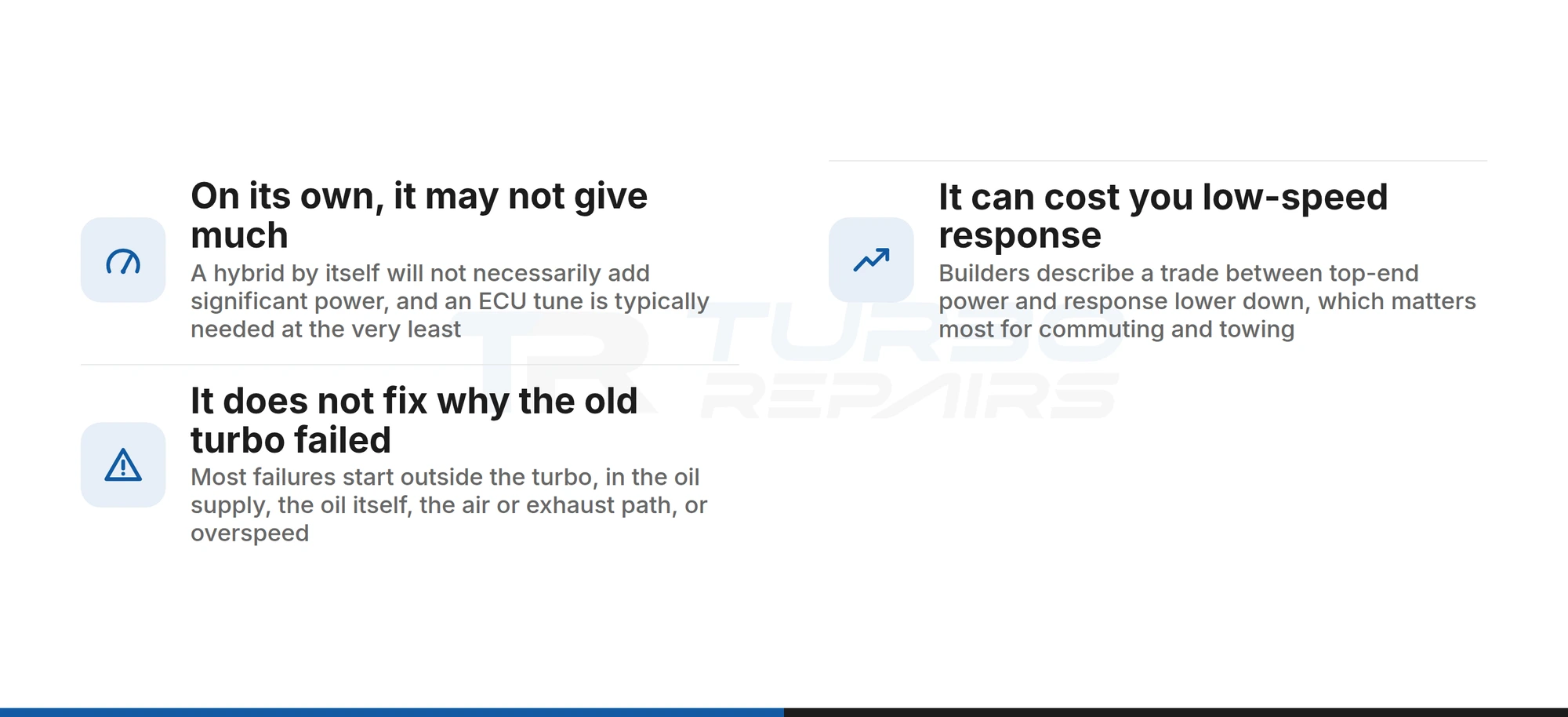
- On its own, it may not give you much. One builder states plainly that a hybrid turbo by itself will not necessarily give a significant power increase, and that an ECU tune is typically needed at the very least. A standard engine calibration asks for the boost the engine was designed around, so a turbo built to deliver more has nothing to deliver it to.
- It can cost you low-speed response. Both builders quoted above describe a trade between top-end power and response lower down. For a car used for commuting, towing or carrying loads, low-speed response is usually the part you use most.
- It does not fix why the old turbo failed. Most turbo failures start outside the turbo, in the oil supply, the oil itself, something entering the air or exhaust path, or the turbo being made to overspeed. Our guide to what causes turbo failure covers each one. A hybrid fitted to an engine with the same oil supply fault fails for the same reason as the original.
Hybrids are built for a different owner: someone who has remapped the engine, or plans to, and has reached the point where the original turbo is the limit. One supplier describes the purpose of its entry-level stage as strengthening the turbo so the vehicle can be remapped and the boost raised without the turbo becoming weak. That is performance tuning, and it belongs with a performance specialist and the tuner calibrating the engine.
If you have bought a used car and are not sure whether its turbo has already been changed, the part number on the label is the place to start, with the caution from the table section above: a hybrid can wear an unchanged label. Any service history or receipts from the previous owner are the better evidence. If the turbo is showing signs of trouble now, our guide to blown turbo symptoms helps you judge how urgent it is.
Turbo Repairs · Epsom workshop
Standard car, failed turbo: rebuild the one built for it
Post the turbo your car has in to our workshop and it is stripped to component level and rebuilt with genuine OE, OEM-grade or uprated parts that meet or exceed its original specification. It comes back bench-tested and ready to refit.
Lifetime, unlimited-mileage warranty · Mail-in from the UK and internationally · Bench-tested and calibrated before it ships
What We Rebuild: Components That Meet or Exceed Original Specification
We rebuild the turbocharger your car already has, so that it does the job it was designed for. Our in-house workshop in Epsom is staffed by turbo specialists, and every rebuild follows the same sequence.
- Stripped to component level. The turbo is taken apart completely and every part is measured.
- Renewed, not reinstalled. Worn parts are replaced with genuine OE, OEM-grade or uprated components that meet or exceed the original specification. Where the original design has a known weak point — wastegate pivots, bearings, actuators and seals are the usual ones — that root cause is addressed rather than fitted again.
- Balanced. The rotating assembly is balanced before the turbo is reassembled.
- Bench-tested. The finished unit is tested on our own bespoke test platforms before it leaves the workshop, and goes back to you ready to refit.
Turbo rebuilds typically take one to three working days once the unit reaches us, and every rebuild carries a lifetime, unlimited-mileage warranty. If the vehicle cannot wait for its own turbo to come back, a reconditioned exchange turbocharger is the alternative. You can see the makes and models we work on in our turbo rebuild section.
The uprated parts in step two are where a rebuild and a hybrid are most often confused, so to be exact: they are chosen to make a known weak point last, not to make the turbo flow more air or run more boost.
One step sits on the car rather than on our bench. Whatever wore the old turbo — a restricted oil feed, a blocked drain, a boost leak — has to be put right before the rebuilt unit goes back on, or it inherits the same problem. How long a healthy turbo should then last, and the habits that decide it, are covered in our guide to how long turbos last.
Hybrid Turbo FAQ
Is a hybrid turbo the same as the turbo on a hybrid car?
No. A hybrid car combines an engine with an electric motor, and if that engine is turbocharged its turbo is an ordinary production part. A hybrid turbo is a turbocharger built from a mix of parts to behave differently from the original. The two only share a word.
Will a hybrid turbo give more power on its own?
Not necessarily. One builder states that a hybrid by itself will not necessarily give a significant power increase and that an ECU tune is typically needed at the very least, along with upgrades to any restrictive parts of the intake or exhaust.
Does a hybrid turbo have more lag?
It often trades some low-speed response for top-end flow. Builders describe a compromise between power capability and response lower down, and one names it as turbo lag, with the exception of the latest ball-bearing and variable-nozzle diesel turbos. A well-designed hybrid aims to keep that compromise small.
Is an uprated turbo the same as a hybrid?
It depends what has been uprated. The word “hybrid” is used loosely, and one specialist counts even a single non-standard thrust bearing. In practice, a hybrid is built to flow more and run more boost than the original; a rebuild that fits an uprated bearing, seal or wastegate pivot to cure a known weakness is built to do the original job for longer. Ask any supplier exactly which parts differ and why.
Can you tell a hybrid turbo by looking at it?
Often not. One builder notes that many hybrids look identical to standard units from the outside, because the changes are to the wheels and bearings inside. The label shows what the turbo was built as, not what has been changed since, so receipts or service history are better evidence.
Do you build or supply hybrid turbos?
No. We rebuild the turbocharger your car already has, with genuine OE, OEM-grade or uprated components that meet or exceed its original specification, and we repair electronic turbo actuators. Hybrid and upgrade turbos are performance work for a tuning specialist.
Final Thoughts
“Hybrid” is a description of difference. It tells you a turbo has stopped matching its original specification, but not by how much, which parts changed or what the result is meant to be, and the builders themselves use it for anything from one bearing to a redesigned turbo. The useful questions are always the same: which parts, and to what end.
For a standard car with a failed turbo, the end is already decided: find what wore the old one out, put that right, and give the engine back the turbo it was built for — with the known weak points made stronger along the way.
Turbo Repairs · Epsom workshop
Your engine’s own turbo, rebuilt for the job it was designed to do
Remove the turbo, complete the repair form and post it to our workshop. It is rebuilt to meet or exceed its original specification, balanced and bench-tested, typically within one to three working days of arriving.
Lifetime, unlimited-mileage warranty · Mail-in from the UK and internationally · Bench-tested and calibrated before it ships