

Showing 1–28 of 203 results
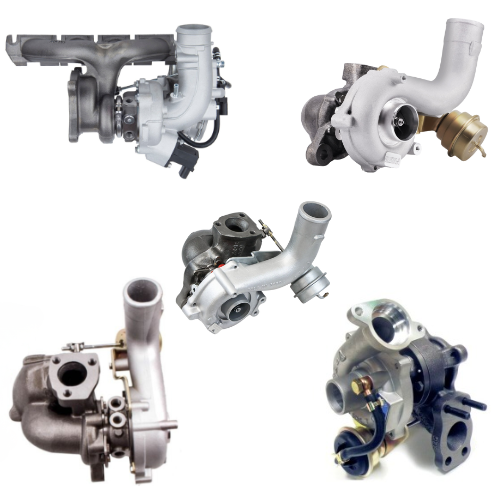

Summary Every listing in this shop books the rebuild of the turbocharger already fitted to your vehicle. You order against your car, post the unit to our Epsom workshop, and it comes back stripped to component level, measured against the tolerances it was built to, rebuilt on genuine OE-grade or uprated parts, balanced and run up on the bench before it is boxed.
Nothing is dispatched from a shelf and there is no core to return. What differs from one listing to the next is the vehicle it is ordered against; the work behind it does not.
A listing here names a vehicle rather than a part in a box — so what you are buying is the standard the rebuild is held to, and that is the same on every listing in the shop.
Here is what a reconditioned turbo buys on this page, in the order it happens — the work itself, how to order against the right vehicle, and what happens when a unit turns out to be beyond rebuilding.
What you are ordering when you buy from this shop
Nothing travels to you. Your own turbocharger travels to us, and the same unit goes back on the car afterwards. Order the listing that matches your vehicle, take the turbocharger off, box it and post it to the workshop in Epsom.
Most owners have the removal done by the garage that diagnosed the fault, and there is no reason it has to be you — our guide to removing and refitting a turbocharger sets out what that job involves. Independent garages, workshops and main dealers send units in on a customer’s behalf as a matter of routine, so a trade job runs no differently from a private one.
Mail-in works from anywhere in the UK and internationally: the unit travels and you do not. How to pack and post it is set out on the FAQs page, and it is worth reading before you seal the box — a compressor wheel bent in transit tells us nothing about how the turbo was running.
Because a rebuild returns your own turbocharger, there is no core to return afterwards. If yours is past rebuilding, a reconditioned exchange turbocharger is the alternative.
The standard every listing is held to
Your turbocharger is dismantled to component level on arrival. Nothing is judged by eye: every part that can be measured is measured against the tolerances the unit was built to, and anything outside them is scrapped rather than cleaned up and put back.
Bearings and seals are renewed regardless of how they measure. What goes back in is genuine OE-grade or uprated on it, and where a component carries a known weakness in its original design — a wastegate pivot, a bearing arrangement, a seal — the rebuild addresses that weakness rather than reinstating it. A turbocharger rebuilt exactly as it left the factory is a turbocharger with its original failure mechanism intact.
The rotating assembly is then balanced and the finished unit run up on the bench before it is packed. Balance is not a finishing touch: at the speeds a turbine shaft works at, an imbalance far too small to feel by hand is a load the bearings carry every second the engine runs.
That sequence is what reconditioned means here, and it does not vary by listing. The vehicle decides which parts are involved. It does not decide the standard.
How to order against the right vehicle
Model year and badge get you close and then let you down. One model name can run across more than one turbocharger, and a car old enough to need this service may no longer carry the unit it was built with. The BorgWarner K03 and K04 are the obvious example: one design family at two sizes, and the badge on the boot does not settle which of them is bolted to the engine.
The reference that does settle it is on the unit itself. A turbocharger carries an identification plate, usually on the compressor housing, stamped with the manufacturer’s part number for the unit actually fitted. Read it before you order, and photograph it before you box anything up.
If the plate is unreadable — heat and corrosion take them eventually — or nothing in the shop obviously matches, use the repair form rather than guessing. It reaches the same bench.
When a turbocharger is beyond rebuilding
Not every unit that arrives can be rebuilt, and nothing published on a product page can tell you in advance whether yours is one of them.
What puts a unit past the point is usually damage rather than wear. A compressor or turbine wheel that has made contact with its housing, or lost material from its blade tips, is replaced rather than dressed back: a wheel is a balanced rotating part, and once material has left it, it is not a repairable one. A bearing bore worn past its limit, or a housing cracked by heat, is the same decision reached the same way.
Each of those is a measurement rather than an opinion, which is why the condition of your unit is established on the bench and not described on a web page. It is also why the stripping and the measuring come first on every unit, whatever the listing said.
If your vehicle is not listed
A vehicle that does not appear in the shop is not a vehicle we cannot rebuild. Turbochargers outside the listings go through the repair form instead, and the route is identical: the unit comes to Epsom, is stripped, measured, rebuilt, balanced and bench-run, then goes back to you.
The turbo rebuild service covers that side of the workshop. If the fault sits on the electronic actuator rather than on the turbocharger itself, electronic turbo actuator repairs are a separate route, and one worth ruling in or out before a turbocharger is taken off anything.
Common questions about reconditioned turbos
Is a reconditioned turbo as reliable as a new one?
A properly rebuilt unit is measured against the same tolerances a new one is built to, so the mechanical standard it leaves on is the same. Where a rebuild can do better is on design weaknesses: a new or used original reproduces whatever flaw was there to begin with, whereas a rebuild can uprate the part responsible. On some units that makes a rebuild the more durable route rather than simply an alternative to buying one.
Do you send a reconditioned turbo out, or do I send mine in?
You send yours in. Ordering a listing books the rebuild of your own turbocharger, and the unit you post is the unit that comes back to you. Nothing is dispatched from a shelf, and there is no core to send back afterwards.
How do I know which listing matches my vehicle?
Work from the identification plate on the turbocharger rather than from the model year. It carries the manufacturer’s reference for the unit actually fitted to your car, which the badge and the build year between them can only narrow down. If the plate is gone, or nothing matches, the repair form is the safer route.
Do I have to remove the turbocharger myself?
It has to come off the car, but it does not have to be you who takes it off. Most owners have the removal done by the garage that diagnosed the fault, and plenty of garages handle the whole job — removal, sending the unit in, and refitting it — on a customer’s behalf.
Will a rebuilt turbo last if I fit it back to the same car?
That depends on what ended the first one. A turbocharger is usually the casualty of a condition elsewhere on the engine — a restricted oil feed, something drawn in through the intake, a restriction downstream of the turbine — and a rebuilt unit bolted back into those conditions runs the same clock the original ran. Use the time the unit is away to establish the cause; our guide to common turbocharger problems is the place to start.
Turbo Repairs · Epsom workshop
Order against your vehicle, then post us the turbo
The listing books the work; your own turbocharger decides the parts, once it has been stripped and measured on the bench. If nothing in the shop matches your vehicle, the repair form starts exactly the same job.
Lifetime, unlimited-mileage warranty · Mail-in from the UK and internationally · Bench-tested and calibrated before it ships