

Summary We rebuild the Hella electronic turbo actuator from Volvo’s 2.4-litre diesel, the five-cylinder D5, as listed for the XC90, XC60, XC70, V70, S60 and the other models in the table below. Repairs start from £100 + VAT. You or your garage take the actuator off and post it to our workshop. It comes back rebuilt at component level, bench-tested and ready to refit without coding, typically after one to two working days on the bench, and every rebuild carries a lifetime, unlimited-mileage warranty.
Settle which part you are holding first. A search for a Volvo turbo actuator turns up three different parts: a boost-operated wastegate can for the petrol T5, a heavy-duty unit for Volvo’s truck engines, and the electronic Hella actuator on the diesel’s Garrett turbocharger. This page rebuilds the third.
An XC90 D5 and an XC60 2.4 are listed with different Hella actuators on different Garrett turbochargers, G-40 on the XC90’s GTB2056V and G-38 on the XC60’s 787630, so the two SUVs do not share the part.
A Volvo diesel that loses power, lights the engine management lamp and drops into limp mode, then drives normally again after a restart, is showing the pattern the actuator listings describe for the D5. The fault comes and goes at first, then settles in for good. This page covers which Volvo diesels carry the electronic unit, how to tell it apart from the other parts sold under the same name, the labels worth photographing, and the hand test that separates a failed actuator from seized vanes before anything is posted.
- Engine covered: Volvo’s 2.4-litre five-cylinder diesel (D5), listed at 163–180 hp (120–132 kW) from 2006, plus the XC60, S80 and V70 listed on a Garrett 787630-0001 turbocharger
- Actuator G-40: Hella 6NW009228 with 730314, on a Garrett GTB2056V (turbo 762060). Listed for the C30, C70, S40, S60, S80, V50 and XC90
- Actuator G-38: Hella 6NW009543 with 763797, on a Garrett 787630-0001. Listed for the XC60, S80 and V70
- XC70: the first-generation car is listed with a Hella actuator on a Garrett turbocharger, with no references published
- Codes listed for the XC60 unit: 1517 turbo overboost, 1507 turbo control pressure too low, 1540 turbo control pressure too high
- Not covered here: petrol T5 wastegate cans, Volvo truck engines, and any actuator worked by a hose rather than a wiring plug
- Our service: your own actuator rebuilt from £100 + VAT, typically 1–2 working days, no coding on refit, lifetime unlimited-mileage warranty
Three Different Parts Are Sold as a Volvo Turbo Actuator
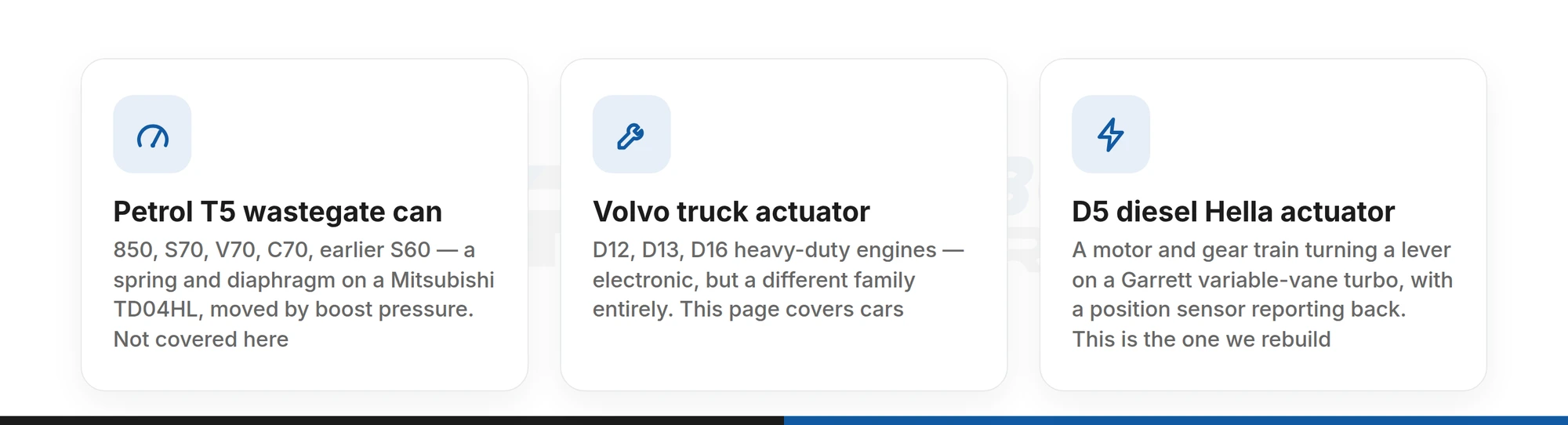
“Volvo turbo actuator” covers three parts that share a badge and very little else. They sit on different engines, they are worked in different ways, and only one of them is an electronic actuator rebuild. Work out which one is on your vehicle before you order, price or post anything.
| Vehicle | What the actuator is | How it moves | Covered on this page? |
|---|---|---|---|
| Petrol T5 cars: 850, S70, V70, C70 and the earlier S60 | A wastegate actuator can with a spring and diaphragm, on a Mitsubishi TD04HL turbocharger | Boost pressure against a spring, pushing a rod that opens the wastegate | No |
| Volvo trucks: the heavy-duty D12, D13 and D16 engines | An electronic actuator on a variable-geometry turbocharger | Commanded by the engine control module to set the turbine vanes | No. This page covers cars |
| 2.4-litre diesel cars: the five-cylinder D5 and the 2.4 diesel listings | A Hella electronic actuator on a Garrett variable-vane turbocharger | An electric motor and gear train turning a lever that sets the vanes, with a position sensor reporting back | Yes |
The petrol T5 is where most of the confusion starts, because it shares model names with the diesels. Its actuator is a can on a rod, with a spring inside chosen for a pressure. The parts trade sells it with a choice of spring rates, and with a straight or bent rod to suit the flange of the turbocharger it bolts to. That is a different part and a different job, set out on our wastegate actuator repair page.
Volvo’s truck engines are a separate case again. Their actuators steer the vanes of a variable-geometry turbocharger much as the car’s do, but they belong to a heavy-duty engine family with its own diagnostic equipment, and everything below is written for the cars.
A plug on the housing settles it
On the car, the quickest test is to look. The D5’s actuator is a moulded housing with a wiring connector clipped into it and a lever linked to the turbocharger. A metal can with a small hose and no wiring is a pressure- or vacuum-worked actuator, and it is not what this service rebuilds. If a unit reaches us that we cannot rebuild, we tell you before any work is done.
The D5’s Two Listed Actuators: G-40 and G-38
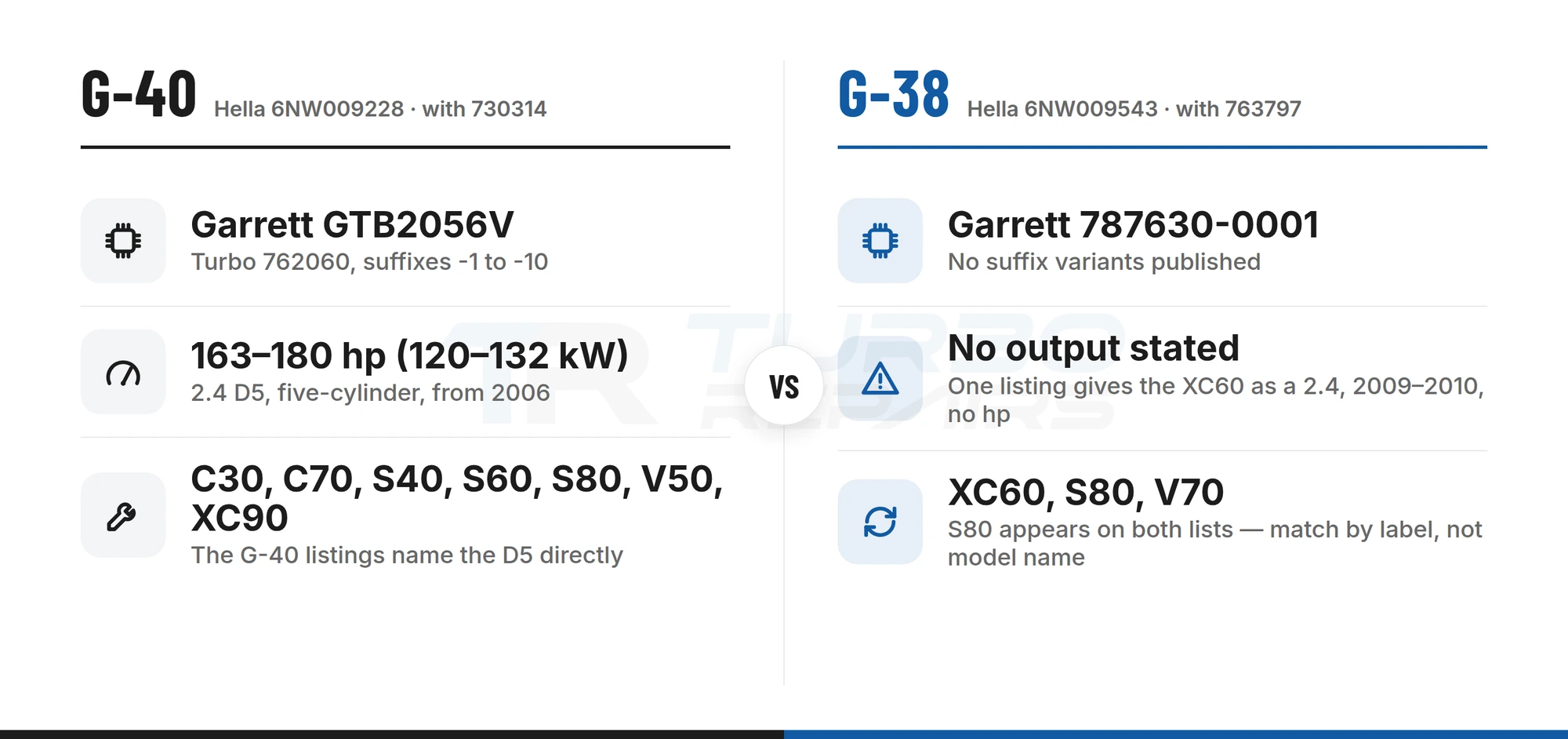
Across the listings we hold, Volvo’s 2.4 diesel is catalogued with two Hella electronic actuators, each on a different Garrett turbocharger. Which one a car carries follows the turbocharger. The model name gets you part of the way there, and on one model it gets you nowhere.
| Actuator | References as listed | Turbocharger as listed | Vehicles as listed |
|---|---|---|---|
| G-40 | Hella 6NW009228, with 730314 | Garrett GTB2056V, turbo 762060 (with suffixes including -1 to -10) | 2.4 D5, five-cylinder, 163–180 hp (120–132 kW), from 2006: C30, C70, S40, S60, S80, V50 and XC90 |
| G-38 | Hella 6NW009543, with 763797 | Garrett 787630-0001 | XC60, S80 and V70. One listing gives the XC60 2.4 as 2009–2010 |
| Not published | Hella; no references given | Garrett; no number given | XC70, first generation |
Read the table as a record of what the catalogues say rather than a guarantee about any one car. Three things in it are worth knowing before you buy or post anything.
The XC90 and the XC60 sit in different rows. They are listed on different turbochargers with different actuators, so a unit taken off one is no evidence that it suits the other, whatever a second-hand seller says about both being D5s.
The S80 appears in both rows. One listing puts it with the G-40 on the GTB2056V and another with the G-38 on the 787630. Neither says which build years or outputs divide them, so on an S80 the model name cannot choose between the two. The labels on the actuator and the turbocharger can.
The G-38 listings give no engine name. They name the XC60, S80 and V70 and the turbocharger they share, and one gives the XC60 as a 2.4, but none of them states an output. The G-40 listings are the ones that name the five-cylinder D5 directly.
Where the listings stop
The G-40 listings start at 2006, and none that we hold covers an earlier D5. None names a D4 either. If your car sits outside the table, it may still carry an electronic actuator, and it may not. Check the housing for a wiring plug, then photograph the labels described below and we will identify it from those.
How an Actuator Fault Shows Up on a D5
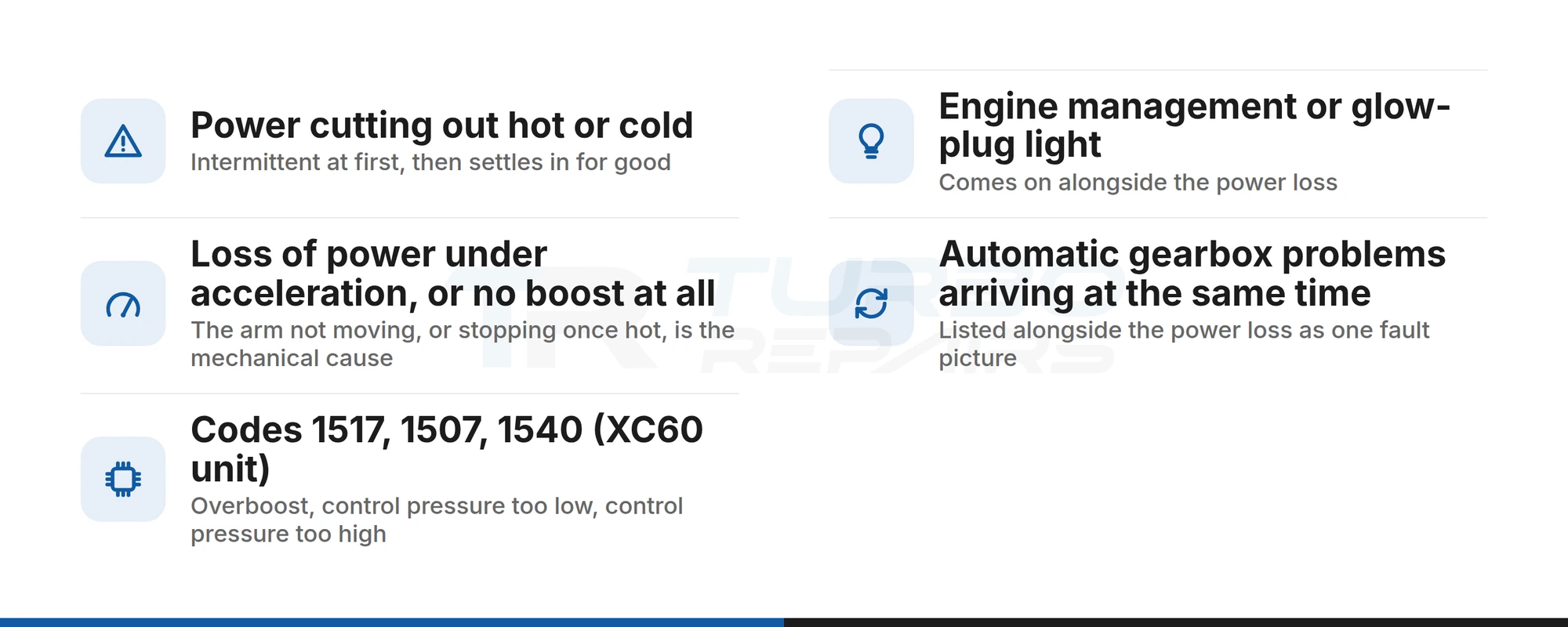
The listings for these actuators describe a fault that starts intermittently. The car loses power and drops into limp mode on some journeys and not others, and eventually it stays there until the actuator is repaired or replaced. Alongside the power loss, they list:
- power cutting out when the engine is hot, and also when it is cold;
- the engine management light, or the glow plug (coil) light, coming on with the fault;
- loss of power under acceleration, or no boost at all;
- the actuator arm not moving at all, or stopping once the engine is hot;
- on automatic cars, gearbox problems arriving at the same time as the power loss.
None of these is unique to the actuator. A split boost hose, a failing sensor or vanes sticking inside the turbocharger can produce most of the same list, which is why the lever test further down matters more than any single symptom.
The codes listed for the XC60 unit
One specialist listing for the XC60 2.4’s G-38 actuator gives three codes that may be stored: 1517 – turbo overboost, 1507 – turbo control pressure too low and 1540 – turbo control pressure too high. Taken together they are a useful clue. A boost pressure that reads too low at one moment and too high at another is what happens when the vanes are not where the engine asked them to be. A failed actuator can cause that. So can vanes that bind inside the turbocharger.
A generic scanner may report the same condition as P0234 for overboost or P0299 for underboost. Our guide to overboost and underboost codes explains why a code of either kind names a direction rather than a part. For what to note down before anyone clears the codes, see our guide to turbo actuator symptoms.
The Labels to Photograph Before It Comes Off
A D5 actuator carries its references on its own housing. One seller’s listing notes that the Hella G-code is found on the aluminium side of the unit. Photograph every label on the actuator, and the plate on the turbocharger as well, because one is often easier to read than the other.
- The G-code: G-40 or G-38 on the D5 listings. This is the reference the trade catalogues these units by.
- The Hella number: 6NW009228 or 6NW009543.
- The base number: 730314 or 763797, printed alongside the Hella number.
- The turbocharger number: 762060 on the GTB2056V, or 787630-0001.
Match on the whole set, never on one number. Neither Hella number belongs to Volvo alone. 6NW009228 with 730314 is also catalogued for BMW, Mercedes, Jeep and VW diesels under other G-codes, and 6NW009543 with 763797 appears under different G-codes on the Mercedes Sprinter 2.2 and on Jeep Grand Cherokee 3.0 CRD listings from 2013 to 2016. One replacement-actuator seller asks that the original match all three of its numbers before anyone orders, which is the right standard. Our BMW 5 Series actuator page sets out why the G-code, rather than the Hella number, identifies the unit.
If you are sending us your own actuator, none of this has to be settled before it goes in the post. The unit on your car already suits its turbocharger, and we read its references when it arrives. The labels matter most when you are weighing up a replacement, because a replacement has to match your turbocharger and your own unit already does.
Is It the Actuator or the Vanes? A Hand Test on the Lever
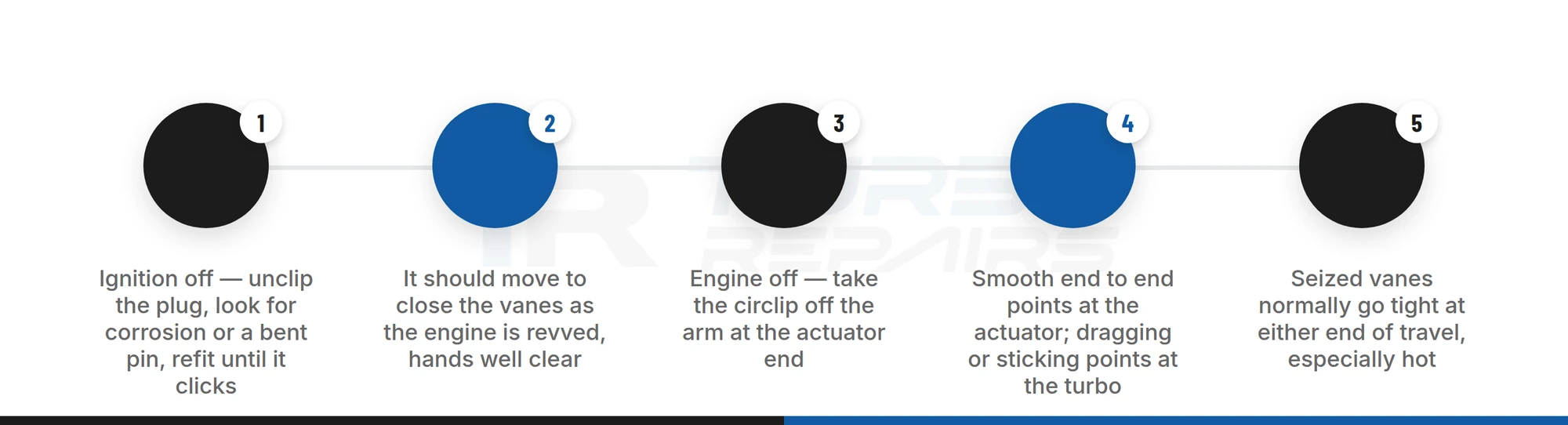
The same codes and the same limp mode can come from a failed actuator or from the vane mechanism it moves inside the turbocharger. A rebuilt actuator will not free seized vanes; it will strain against them from its first mile. So this test is worth doing before anything is unbolted.
- Check the connector. With the ignition off, unclip the actuator’s plug and look for corrosion, a bent or pushed-back pin, or a cracked latch. Refit it until it clicks home.
- Watch the arm, if you have a helper. One repair specialist’s guidance is to check that the actuator arm moves to close the vanes as the engine is revved. Watch from a safe position, with hands and clothing well clear of the belts and fan. An arm that does not move at all points at the actuator or the vane mechanism, and the next steps separate the two.
- Disconnect the rod. With the engine off, follow the fitting advice published with the G-40 listing: take the circlip off the arm at the actuator end, so the actuator is no longer linked to the rod that runs into the turbocharger.
- Move it by hand through its full range. Push and pull the rod gently. If it travels smoothly from end to end without sticking, the vane mechanism is free and the actuator is the suspect. If it drags, sticks or stops short, the fault is inside the turbocharger.
- Pay attention to the ends. The same listing warns that where the vanes stick, they normally go tight at either end of their travel, especially when hot. A rod that is smooth in the middle and tight at the ends has not passed.
That listing recommends checking with the engine warm, because heat is when the sticking shows. The exhaust side of a turbocharger gets hot enough to burn, so make the first check cold. If the rod passes cold but the fault only ever appears on a hot engine, have a garage repeat the check warm with proper protection. Refit the circlip before the car is driven, because with the rod disconnected nothing is controlling the vanes.
If the vanes are seized, the turbocharger is the part that needs the work, not the actuator. It can come to us through our turbocharger rebuild service, with the actuator still attached.
Turbo Repairs · Epsom workshop
Lever moves freely? Then the D5 actuator is what we need
Post it in with photographs of its labels, the codes the car stored and what the lever test showed. We check its references against your Volvo and test it as received, before it is opened.
Lifetime, unlimited-mileage warranty · Mail-in from the UK and internationally · Bench-tested and calibrated before it ships
How We Rebuild a Volvo D5 Actuator
You or your garage remove the actuator and post it to our workshop at Unit 102 Reaver House, 12 East Street, Epsom, Surrey, KT17 1HX, United Kingdom. Our team of turbo specialists and electronic engineers then works through it in the same order every time. Independent garages and dealers send actuators in for their customers’ cars the same way.
- Tell us about the car. On the repair form, give the registration, the model and engine, photographs of the actuator and turbocharger labels, any stored codes, and what the lever test showed. If the fault only appears hot, say so.
- Pack it properly. Leave the connector intact and the housing unopened. Wrap the actuator in foam or bubble wrap inside a rigid box, with your repair reference on a note inside. Our FAQs page covers packing and postage in more detail.
- We identify it. The G-code, Hella and base numbers are checked against your registration. If the unit turns out to be a pressure-worked can, or one we cannot rebuild, we tell you before any work is done.
- We test it before it is opened. Bench-testing the unit as received means the fault we report is the one we found, not the one we expected.
- We rebuild it at component level. The motor, gear train, position sensor and seals are renewed as needed, and the circuit board is reworked. Components with a known weakness in the original design are replaced with uprated parts, so the unit meets or exceeds its original specification.
- We calibrate it and send it back. The rebuilt actuator is checked across its full travel on dealer-level diagnostic and calibration tooling, then posted back ready to refit with no coding. Once it is on the car, clear the stored codes with a diagnostic tool.
Repairs start from £100 + VAT. The exact price is confirmed once the unit has been identified and tested, so you know it before any work goes ahead. Turnaround is typically one to two working days from the actuator reaching us, plus postage each way, and units come to us from across the UK and from overseas. Every rebuild carries a lifetime, unlimited-mileage warranty, with no mileage cap and no time limit. The other vehicles we cover are listed on our electronic turbo actuator repairs hub.
Volvo Turbo Actuator Repair FAQ
Is the turbo actuator on a Volvo D5 electronic?
On the listings we hold, yes. The 2.4 D5 at 163–180 hp from 2006 is listed with Hella G-40 on a Garrett GTB2056V, and the XC60, S80 and V70 on the Garrett 787630-0001 with Hella G-38. None of our listings covers a D5 built before 2006. On an older car, look for a wiring plug on the actuator housing: a plug means electronic, a hose means it is not.
Does the XC60 use the same turbo actuator as the XC90?
Not according to the listings. The XC90 D5 is listed with G-40 on a GTB2056V, and the XC60 2.4 with G-38 on a 787630-0001. The two actuators carry different Hella numbers and sit on different turbochargers, so one is no substitute for the other.
My car is an S80 D5. Which actuator does it have?
The S80 is listed with both, G-40 on one listing and G-38 on another, and neither says which years or outputs divide them. The G-code on the actuator’s housing, together with the number on the turbocharger, tells you which one your car carries. If you send us the unit, we confirm it on arrival.
Is the turbo actuator on a petrol Volvo T5 the same kind of part?
No. The T5 in the 850, S70, V70, C70 and earlier S60 uses a wastegate actuator can, with a spring and diaphragm, on a Mitsubishi TD04HL turbocharger. It has no motor or wiring plug and is not rebuilt through this service.
Can a failing actuator cause gearbox problems on an automatic?
The actuator listings for the D5 include automatic gearbox problems among the symptoms, arriving alongside the loss of power. Treat them as one fault picture: read the engine codes first, and if they point at boost control, carry out the lever test on the turbocharger before anyone starts on the gearbox.
Will the car need coding once the rebuilt actuator is fitted?
No. The actuator comes back calibrated and ready to refit without coding. Once it is on, clear the stored fault codes with a diagnostic tool so the engine management starts from a clean record.
How much does a Volvo D5 actuator repair cost, and how long does it take?
Repairs start from £100 + VAT, with the exact price confirmed once the unit has been identified and tested. Turnaround is typically one to two working days from arrival, plus postage each way, and every rebuild carries a lifetime, unlimited-mileage warranty.
Final Thoughts
Most of the difficulty with a Volvo turbo actuator is in the name. It covers a petrol wastegate can, a truck engine’s actuator and a diesel car’s electronic unit, and only the last is a D5 part. Once you know you have that one, with a plug on the housing and a lever on the turbocharger, the question narrows quickly: the listings give two units, G-40 and G-38, and the labels on your own car decide between them.
Before anything goes in the post, move the lever by hand and pay attention to the ends of its travel. If the vanes are free and the codes point at boost control, the actuator already bolted to your turbocharger is the one to rebuild.
Turbo Repairs · Epsom workshop
Your Volvo’s own actuator, rebuilt for its own turbocharger
Post us the unit with its label photographs and the codes the car stored. It is identified, tested before it is opened, rebuilt at component level and calibrated, then sent back ready to refit without coding.
Lifetime, unlimited-mileage warranty · Mail-in from the UK and internationally · Bench-tested and calibrated before it ships