

Summary We rebuild the turbochargers from the Land Rover Defender’s diesel engines. That covers the 300Tdi and Td5 that Land Rover built itself, the 2.4 and 2.2 Ford Puma engines fitted from 2007 until production ended in 2016, and the earlier 200Tdi and 2.5 Diesel Turbo. You send the turbocharger in, and we strip it to component level, rebuild it on genuine OE or OEM-grade parts, balance it, bench-test it and post it back ready to refit. Rebuilds start from £185 plus VAT and replacement units from £450 plus VAT. Bench time is typically one to three working days, and every rebuild carries a lifetime, unlimited-mileage warranty.
Two things set a Defender turbo apart. Its type changed part-way through the vehicle’s life, from wastegated units on the Tdi and Td5 to a variable-geometry unit on the Puma. The vehicle also works in water, dust and steep ground that no road car sees, so where your Defender has been matters when a failed unit is read.
A 2007-on Defender can be picked out before the bonnet is opened: Land Rover pressed a bulge into the bonnet to clear the taller Puma engine, the first Defender engine sold with a variable-geometry turbocharger.
This page covers the Defender built from 1983 to 2016, the 90, 110 and 130 and their Ninety, One Ten and One Two Seven predecessors. It tells you which turbocharger your engine carries, how to confirm it from the unit itself, what wears on it in the way a Defender is actually used, and what a rebuild involves and costs.
- Engines covered: the 300Tdi (1994–1998), Td5 (1998–2007), 2.4 Puma (2007–2012) and 2.2 Puma (2012 model year to 2016), plus the earlier 200Tdi and 2.5 Diesel Turbo
- Boost control: a wastegate on the 300Tdi and Td5 turbos; variable geometry on both Puma engines
- Identify it by: the reference on the turbocharger’s own label. Catalogues file the Tdi and Td5 units inconsistently, and “Td4” on a listing also names Freelander engines
- Price: rebuilds from £185 plus VAT; replacement units from £450 plus VAT
- Turnaround: typically one to three working days on the bench, plus postage each way
- Warranty: lifetime and unlimited mileage, with no time limit
- 2020-on Defender: a different vehicle with different engines; the 2.0 diesel is covered on our Ingenium 2.0 diesel turbo page
Which Defender Engine Do You Have?
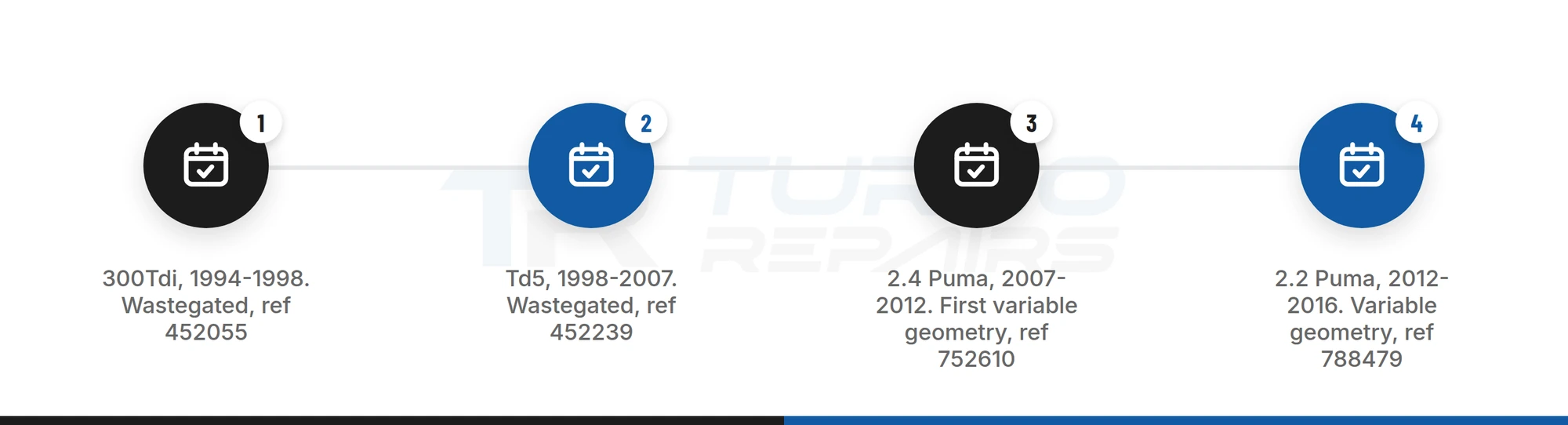
The Defender stayed on sale long enough to carry several different diesel engines, and each one has its own turbocharger. The body barely changed while the engine underneath was replaced several times, so the badge on the tailgate does not tell you which unit you have.
The quickest way to narrow it down is by what you can see and count:
- Five cylinders means a Td5, Land Rover’s own electronically controlled diesel, fitted from 1998 until spring 2007.
- A bulge pressed into the bonnet and a full-width dashboard mean a 2007-on vehicle with a Ford Puma engine. The bonnet was reshaped to clear the taller engine, and the old dashboard layout was replaced at the same time.
- A diesel particulate filter on a Puma Defender points to the 2.2, introduced for the 2012 model year. It was the first Defender fitted with one.
- Four cylinders and the original flat-topped bonnet mean one of the older engines: the 300Tdi from 1994, the 200Tdi before it, or on a Ninety or One Ten the 2.5 Diesel Turbo of 1986 to 1990.
The registration date on your V5C and the engine number will confirm what you find. The table below sets out the turbocharger references that UK suppliers list against each engine. Treat it as a guide to what you are likely to find rather than a fitment list, because the label on your own unit always has the final say.
| Engine | In the Defender | Turbocharger references listed | Land Rover or Ford numbers listed |
|---|---|---|---|
| 2.5 Diesel Turbo (19J) | 1986–1990, Ninety and One Ten | 452005 (452005-5001S) | ERR0332 |
| 200Tdi | 1990–1994 | 465171 (465171-5002S); 465175 (465175-5001S) | ETC8751; ETC7461 |
| 300Tdi | 1994–1998 | 452055 (452055-5004S, 452055-0004) | ERR4893 |
| Td5 | 1998–2007 | 452239 (452239-5009S, 452239-0003) | LR017315, PMF100460, PMF500040 |
| 2.4 Puma (ZSD-424) | 2007–2012 | 752610 (752610-0032, 752610-5035S) | 6C1Q6K682EN, LR018396 |
| 2.2 Puma (ZSD-422) | 2012 model year to 2016 | 788479 (788479-0006, 788479-5006S) | BH1Q6K682CB |
The numbers themselves show who designed the engine. The Tdi and Td5 units carry Land Rover’s own ERR, ETC, PMF and LR numbers. The two Pumas are Ford engines and carry Ford-style numbers such as 6C1Q6K682EN, with a Land Rover LR number alongside on the 2.4.
Where the listings disagree
The catalogues do not agree on how to file these units. One UK supplier lists both 452055 and 452239 against a combined “2.5 TDI / Td5” heading for the Defender and Discovery, while another files 452055 under the 300Tdi and 452239 under the Td5. On the older engines, one 200Tdi-era reference is listed for the Defender alone and another for the Range Rover, Defender and Discovery together.
The engine names are loose too. Listings call the 2.4 Puma “Td4”, “TDCi” and “Duratorq” interchangeably, but “Td4” is also the name on the Freelander’s 2.0 and 2.2 diesels, which carry entirely different turbochargers. If you searched for a Freelander 2, its 2.2 has its own turbo repair page.
Before the unit is cleaned or packed, photograph its label and put every number on it onto the Repair Form. If the label has burned off or cannot be read, send the turbo anyway, because it can be identified on the bench before any work starts.
300Tdi and Td5: The Wastegated Turbos
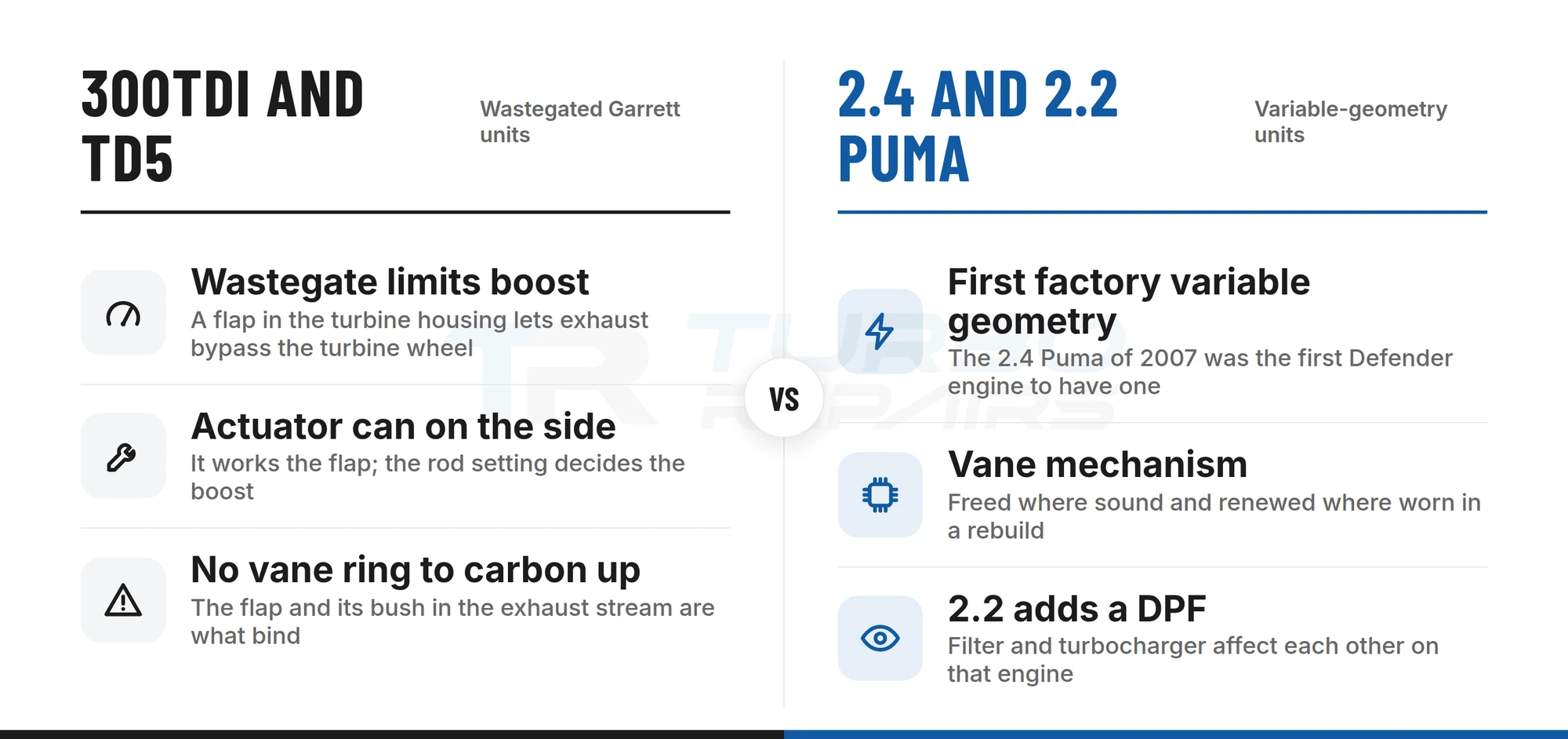
Both of Land Rover’s own later diesels use a Garrett turbocharger whose boost is limited by a wastegate. That is a flap in the turbine housing which opens to let some exhaust gas bypass the turbine wheel, worked by an actuator can on the side of the unit. The Td5 is not a variable-geometry turbo, and it is not the Garrett GT2052V used on the later 2.4. Variable-vane units sold for the Td5 are aftermarket conversions and do not replace a standard part like for like.
A wastegated unit has no vane ring to carbon up. What it does have is a wastegate flap, and the shaft that flap turns on runs in a bush inside the exhaust stream. A flap that binds in its bush, or an actuator that no longer holds it shut firmly enough, shows up as boost that overshoots or never arrives. That fault is often blamed on a healthy turbo, or on a healthy can. Our wastegate actuator repair page covers how to tell a seized flap from a failed can before anything is ordered.
The 300Tdi, and the Tdi installation in a Defender
The 300Tdi arrived in 1994. Although it had the same capacity as the 200Tdi, it was largely a new engine, and the Defender and the Discovery received it in the same state of tune. The earlier 200Tdi shows why a shared engine is not the same as a shared installation, though. When it went into the Defender, Land Rover detuned it slightly because of changes to the turbo position and the exhaust routing.
For identification, that means a Tdi turbo listed for a Discovery is a lead, not a match. The two vehicles shared engines, but they did not always share the way the turbo was installed. Read the label on the unit that came off your vehicle rather than working from the model name.
The Td5
The Td5 replaced the Tdi in 1998 because the older engine could not meet the coming Euro III emissions limits. It used electronic engine control, and it was the last engine Land Rover built in-house at Solihull. The Discovery of the same period used it too.
That is why most Td5 turbo listings name both vehicles, and why the same reference can turn up under either name. If your Td5 has already had one replacement turbo, write down what is on the label now rather than what the service history says was fitted.
2.4 and 2.2 Puma: The Variable-Geometry Turbos
From spring 2007 the Defender used Ford’s Puma diesel, a version of the 2.4-litre four-cylinder engine also fitted to the Transit. It was replaced for the 2012 model year by the 2.2, essentially a smaller version of the same engine, with power and torque unchanged. Both drive a variable-geometry turbocharger, and that turbo is what raised the engine’s torque over the Td5’s and spread it more widely, at the same rated power.
The 2.4 unit is catalogued as a Garrett GT2052V core, and our Garrett GT2052V page covers that unit, how its vane mechanism works and what fails in it. For how the engine behaves in a working van, and the fitting instruction reported for it, see the same Puma engine in the Transit.
One difference is specific to the Defender. Land Rover adapted the engine’s lubrication and sealing for wet, dusty conditions and to keep it lubricated at the extreme angles found off-road. Advice written for the van is still a useful guide, but it was written for a different installation.
Listings for these units also cross over between the two vehicles. One supplier’s 752610 unit is listed for the Transit 2.4 TDCi and the Defender 2.4 together, at the Transit’s outputs, while the Defender 2.4 is catalogued elsewhere under other suffixes. A shared family number is where the search starts, and the suffix on your own label is what decides the fitment.
The 2.2 is the only one of these engines with a diesel particulate filter. On that engine the filter and the turbocharger affect each other, and our guide to how a blocked DPF affects the turbo sets out the order in which to put things right.
What Wears on a Defender Turbo: Oil, Heat and Water
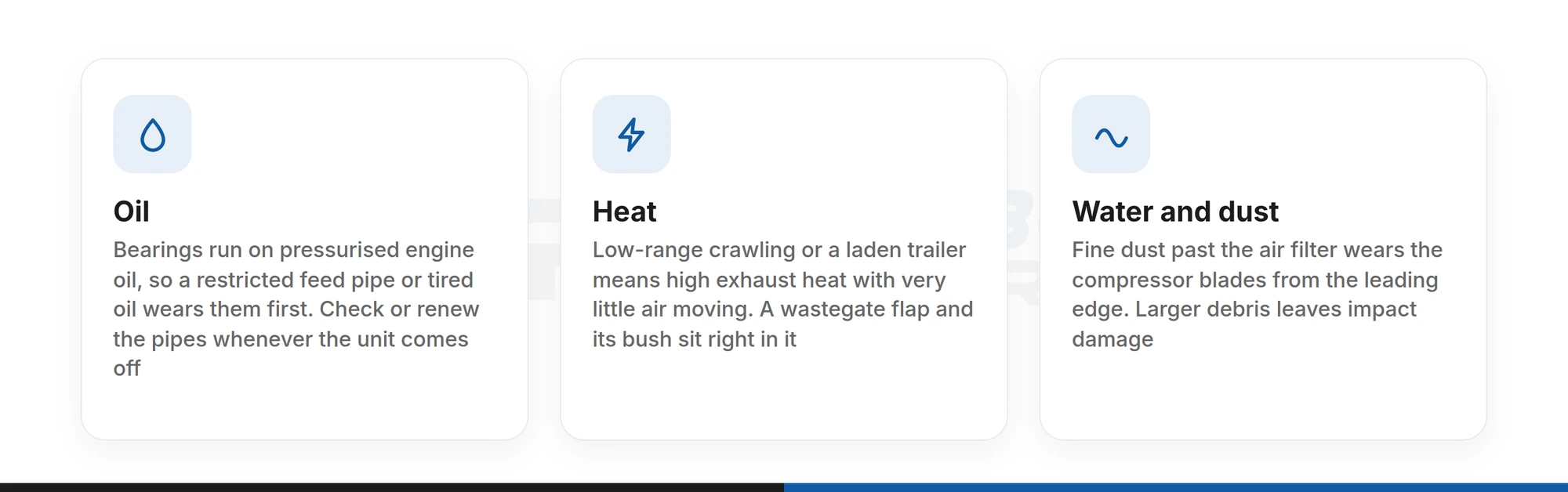
Every turbocharger runs on the engine’s oil, turns on the engine’s exhaust and breathes the air that reaches it through the filter. A Defender is unusual only in what it asks of those three inputs. A road car rarely drives through a ford, crawls up a gradient in low range or runs for a day on a dusty track, but a Defender may do all three in a single week.
Oil: the supply, and what reaches the intake
The bearings in the turbo’s centre housing run on a film of pressurised engine oil, so a restricted feed pipe or tired oil wears them first. On any Defender old enough to be on a Tdi or Td5, the oil feed and return pipes to the turbo may well be as old as the engine, and they should be checked or renewed whenever the unit comes off.
Not every trace of oil in the intake comes from the turbo. On the original 2.5 Diesel Turbo, the engine re-breathing its own sump oil through the breather was a known weakness, and it was only cured when the 200Tdi added an oil separator. On the Td5, the turbo inlet hose is sold both with and without a breather connection. Where crankcase gases join the air ahead of the compressor, a film of oil in that hose does not by itself prove the compressor seal has failed.
Heat: work without speed
A Defender can load its engine hard at walking pace, crawling up a slope in low range or pulling a laden trailer off a field. That means high exhaust heat with very little air moving through the engine bay. The turbine side takes that heat, and on a wastegated unit the flap and its bush sit right in it.
Water and dust
Wading and dust are the two things a Defender turbo is exposed to that a road car’s is not, and both leave marks. Fine dust or grit getting past the air filter wears the compressor blades from the leading edge. Anything larger that is drawn in leaves impact damage instead, and a turbo fed through a damaged intake will be damaged in the same way again.
So on the Repair Form, tell us where the Defender works. Say whether the fault appeared after wading, a spell on dusty ground, heavy towing or long low-range work, and whether the air filter or its housing has been disturbed. We read those answers against what the strip shows, and they often decide what has to be put right on the vehicle before the rebuilt unit goes back on. Our guide to turbo failure symptoms sorts each symptom by where in the unit it starts, and lists the cheaper faults worth ruling out first.
A Standard Rebuild, Not an Upgrade
Search for a Td5, 300Tdi or Puma turbo and most of what comes back are hybrid turbos, uprated units and variable-vane conversions sold as performance parts. We do not supply, build or fit any of them. We rebuild the turbocharger your Defender left the factory with, to its original specification.
That is not the same as putting the original weaknesses back. During the rebuild, worn parts are renewed with genuine OE or OEM-grade components, and where a part has a known design weakness it is uprated rather than reinstated. The aim is a unit that lasts in the job it was designed for, not one that makes more boost.
If your Defender has already had a hybrid or a conversion fitted, the unit on it is no longer the standard part and this page’s references do not apply to it. Say so on the Repair Form before you post anything, with photographs of the unit and its label, so we can tell you what can be done before it travels.
Turbo Repairs · Epsom workshop
Put your Defender’s own turbo back to factory specification
Send in the turbocharger from your Tdi, Td5 or Puma Defender and we will identify it from its label, strip it and measure every part before we confirm the price. It comes back as the standard unit it was built as, with its worn parts renewed.
Lifetime, unlimited-mileage warranty · Mail-in from the UK and internationally · Bench-tested and calibrated before it ships
Our Defender Turbo Rebuild
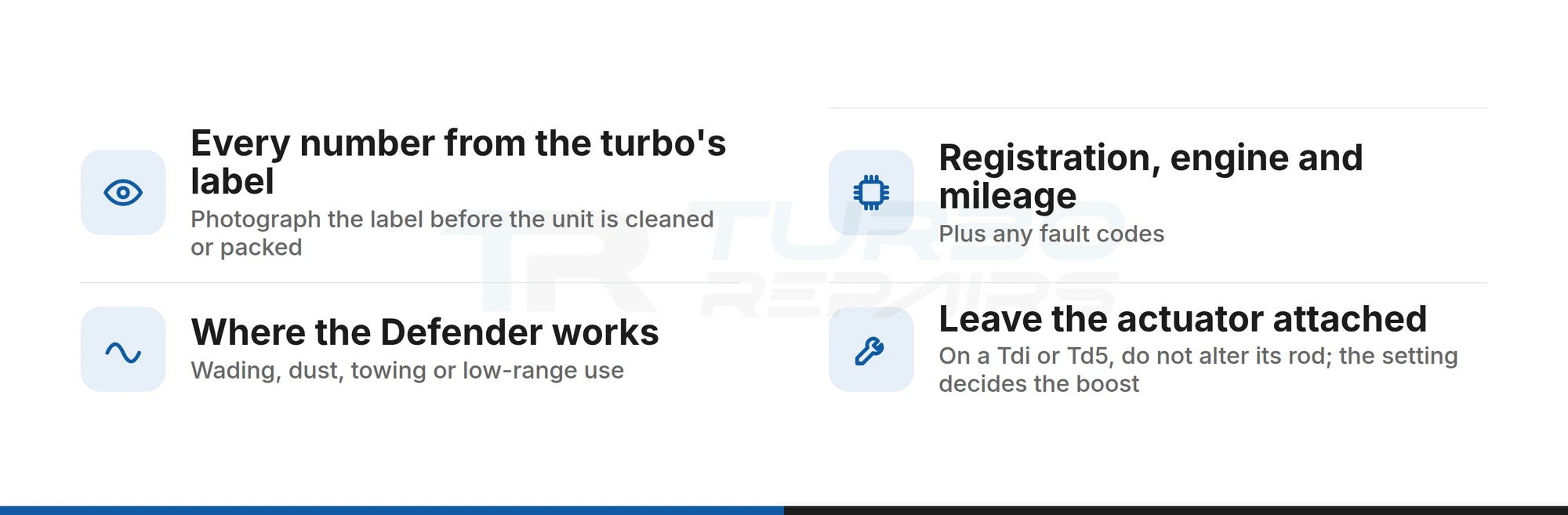
You, or the garage that looks after the vehicle, take the turbocharger off and send it in. We rebuild it and post it back. Independent garages, workshops and main dealers send units in the same way owners do. The job runs in this order:
- Complete the online Repair Form. Give the registration, engine, mileage and any fault codes, every number from the turbo’s label, and where the Defender works: wading, dust, towing or low-range use.
- Remove the unit complete. On a Tdi or Td5, leave the wastegate actuator attached and do not alter its rod, because the rod setting decides the boost. On a Puma, leave the boost-control hardware attached exactly as it came off.
- Pack and post it with every port sealed, to Unit 102 Reaver House, 12 East Street, Epsom, Surrey, KT17 1HX, United Kingdom. Our FAQs page covers packing and postage.
- Identification and strip. The unit is matched to its label, or identified on the bench if the label has gone. It is then stripped to component level by specialists whose core work is turbochargers and turbo actuators.
- Measurement and rebuild. The shaft, wheels, bearing surfaces and housings are measured against original specification. Bearings, seals and thrust parts are renewed, and a wheel, shaft or housing that fails inspection is replaced. The wastegate flap and bush, or on a Puma the vane mechanism, is freed where it is sound and renewed where it is worn.
- Balance, test and return. The rotating assembly is balanced and boost control is set up. The unit is run on the bench before it is boxed and posted back ready to refit.
What it costs
- Rebuild of your own turbocharger: from £185 plus VAT.
- Replacement turbocharger from us: from £450 plus VAT.
How far a rebuild lands above £185 depends on what has survived inside. A unit that needs only bearings, seals and thrust parts sits near the floor, and each wheel, shaft or housing that fails inspection adds to it. Your price is confirmed after inspection and before the rebuild goes ahead. Neither figure includes removing and refitting the turbo, which is charged by whoever does that work. The full breakdown is in our guide to turbo repair and replacement prices.
Bench time is typically one to three working days from arrival, plus postage each way. You get your own turbocharger back rather than an exchange unit, with a lifetime, unlimited-mileage warranty that has no time limit. Before it is refitted, change the oil and filter, check or renew the feed and return pipes, and prime the oil feed before the first start. Our guide to refitting and priming a turbocharger takes you through the sequence.
Land Rover Defender Turbo FAQ
Is the Td5 turbo a variable-geometry (VNT) turbo?
No. The standard Td5 turbocharger is a wastegated Garrett unit, and a wastegate flap controls its boost. Variable-vane turbos sold for the Td5 are aftermarket conversions. The first Defender engine with a variable-geometry turbo from the factory was the 2.4 Puma of 2007.
Which turbo does a 300Tdi Defender have?
UK listings give the 300Tdi a Garrett unit in the 452055 family, with the Land Rover number ERR4893 against it. Some catalogues file the 452055 and the Td5’s 452239 together under one heading, so check the label on your own unit rather than trusting the heading.
Is the Defender 2.4 turbo the same as the Ford Transit 2.4’s?
The engines are closely related, and one supplier lists a single 752610 unit for both vehicles. The two are catalogued at different outputs, though, and the Defender 2.4 also has references of its own, such as 752610-5035S with Ford number 6C1Q6K682EN. The suffix on your label decides it.
Can you rebuild a 200Tdi or 2.5 Diesel Turbo unit?
They come in through the same Repair Form as every other turbocharger. Photograph the label; listings give the 200Tdi 465171 and 465175 references and the Diesel Turbo 452005. Whether a particular core can be rebuilt is decided on the strip, as it is for any unit, and we tell you before any work goes ahead.
My Defender is a 2020-on model. Is it covered here?
No. The 2020-on Defender is an all-new vehicle that shares no components with the one on this page. Its 2.0 diesel is covered on our Ingenium 2.0 diesel turbo page. For any other engine, complete the Repair Form with the details from the turbo’s label.
How much does a Defender turbo rebuild cost?
Rebuilding your own turbocharger starts from £185 plus VAT, and a replacement unit from us starts from £450 plus VAT. The rebuild price depends on what has survived inside and is confirmed after inspection. Neither figure includes removing and refitting the turbo.
How long does a rebuild take, and what is the warranty?
Bench time is typically one to three working days from arrival, plus postage each way. Every rebuild carries a lifetime, unlimited-mileage warranty with no time limit.
Final Thoughts
A Defender turbo is easier to identify than most once you know what to look for. Count the cylinders and look at the bonnet, and you are down to one engine and one turbocharger family. Then read the label, because the catalogues file these units loosely and the name “Td4” leads to the wrong vehicle as often as the right one.
What makes a Defender different is the work, not the turbo. Water, dust, low-range loads and old oil pipes all reach the turbocharger through the air, oil and exhaust it depends on. Tell us where your Defender has been and what it was doing when the fault appeared, put right on the vehicle whatever the strip points to, and the rebuilt unit goes back to the job it was built for.
Turbo Repairs · Epsom workshop
Get your Tdi, Td5 or Puma turbo back to the work it was built for
Complete the Repair Form with your Defender’s engine, the numbers on the turbo’s label and where the vehicle works, then send the turbocharger in complete. We identify it, strip it, rebuild it, balance it and bench-test it, and post it back ready to refit.
Lifetime, unlimited-mileage warranty · Mail-in from the UK and internationally · Bench-tested and calibrated before it ships