

Summary We rebuild the turbochargers from BMW’s 3.0-litre six-cylinder diesels, the M57 and the N57 that replaced it, as fitted to the 325d, 330d and 335d, the 525d, 530d and 535d, the X3 and the X5. You or your garage remove the turbo and post it to us. It is stripped to component level, measured, rebuilt on genuine OE or OEM-grade parts, balanced and bench-tested, then returned ready to refit. Rebuilds start from £185 + VAT, bench time is typically one to three working days, and every rebuild carries a lifetime, unlimited-mileage warranty.
These engines were built with one turbocharger, with two, and at the very top of the N57 range with three, and the layout changes the maker as well as the count. In our fitment data every single-turbo M57 and N57 carries a Garrett variable-vane unit, and every multi-turbo set is BorgWarner.
At 375 bhp our fitment data lists three consecutive BMW turbocharger numbers, 11658516123 to 11658516125, against a single N57 engine code: two BorgWarner BV45 units and a B2G.
This page is for owners and garages dealing with a failing turbocharger on a BMW 3.0 diesel, whether that is a 330d, a 530d, an X5 3.0d or one of the twin-turbo 335d and 535d cars. It shows how to tell which layout your engine has, which turbochargers our fitment data lists for each, what wears out inside them, where a turbo fault ends and an actuator fault begins, and how a rebuild runs from the form to the refit.
- Covered here: the M57 and N57 3.0-litre six-cylinder diesels, including the updated versions our data files as M57TU, M57N and TU2, in the 3, 4 and 5 Series, the X3 and the X5
- Not covered here: the four-cylinder 2.0d, which has its own page for the 2.0d N47, and the later B57 six, which carries different turbochargers
- Single-turbo cars: Garrett variable-vane units, from the GT2556V and GT2256V on the earliest M57 to the GTB2056VZK on the later N57
- Multi-turbo cars: BorgWarner sets, a KP39 with a K26 on the M57, a K26 with a BV40 on the N57, and BV45 and B2-family units at the top of the N57 range
- The quickest tell: the maker’s name and number format on the turbo’s label, read alongside the badge
- Price: rebuilding your own turbocharger from £185 + VAT; a replacement turbocharger from £450 + VAT; an electronic actuator repair on its own from £100 + VAT
- Turnaround: typically one to three working days on the bench, plus postage each way
- Warranty: lifetime and unlimited mileage
- Getting started: the online Repair Form
Which BMW 3.0d Engine and Turbo Layout Do You Have?
Start by setting the logbook’s engine size aside, because on these cars it tells you nothing. Trade listings give the M57 as 2993 cc, and every M57 and N57 row in our fitment data is filed as a 3.0 six-cylinder, whether the car is a 325d, a 330d or a 535d. The capacity is the one figure every car on this page shares.
What separates them is the engine family and the turbo layout. BMW built the M57 first, then updated it in stages that our data labels M57TU, M57N and TU2, and replaced it with the N57. Across both families the layout runs from a single turbocharger to a two-stage pair and, on the highest-output N57, three units.
| Layout | Engine codes in our data | Turbochargers listed | Maker | Example references |
|---|---|---|---|---|
| Single, early M57 | M57D306D1 | GT2556V; GT2256V | Garrett | 454191-0015; 704361-0006 |
| Single, M57TU / M57N | M57TU, M57ND306D2 | GTA2260V; GTA2260VK | Garrett | 728989-0018; 725364-0021; 742730-0018; 750773-0015 |
| Single, M57 TU2 | M57D306D3, M57N2D306D3 | GTB2260VK | Garrett | 758351-0024; 758352-0022; 758353-0020 |
| Single, N57 | N57D30A | GTB2260VK; GTB2056VZK; GTB2056VZ | Garrett | 777853-0006; 806094-0007; 817763-0003 |
| Two-stage, M57 | M57D306D5, M57 Top, M57 TU2 at 261 to 285 bhp | KP39 with K26, listed as an R2S set; S200G on one early row | BorgWarner | 1000-970-0013; 5439-970-0088; 5326-971-0003 |
| Two-stage, N57 | N57D30B, N57SD30B | K26 with BV40 | BorgWarner | 5326-970-0010 with 5440-970-0010 |
| Three units, N57 | N57D30C at 375 bhp; N57D30S1 at 380 bhp | Two BV45 with a B2G; B2 | BorgWarner | 5303-970-0310; 5303-971-0284; 1273-971-0009 |
The maker is the quickest tell
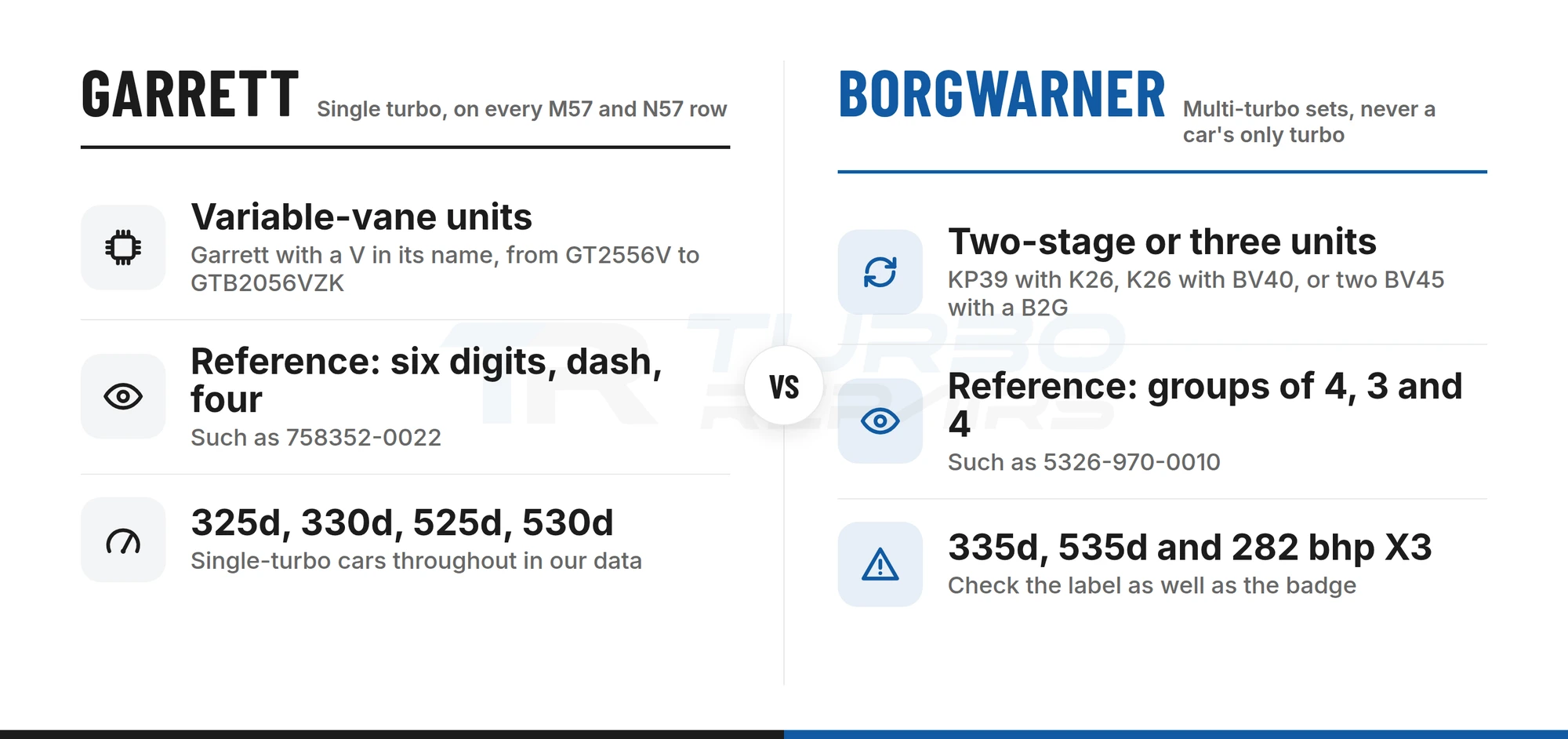
Read down the maker column and the pattern is complete. On the M57 and the N57, no Garrett reference in our data belongs to a multi-turbo set, and no BorgWarner reference is listed as a car’s only turbocharger. So the name on the label tells you which kind of job you are holding before anyone has counted what is on the engine.
The number format gives it away even when the maker’s name has burned off. The Garrett references here are six digits, a dash and four more, such as 758352-0022. The BorgWarner references run in groups of four, three and four, such as 5326-970-0010, with a 1000-970 number where a two-stage set is listed as one assembly. BMW’s own numbers for all of them begin 1165 when written in full, as in 11657802587.
One boundary on that rule: it belongs to these two engines only. The B57 that replaced the N57 is listed in our data with single turbochargers from both makers, so nothing in this section should be used to identify a B57.
Why the power figure will not settle it
On many engines the output on the V5C narrows the search. On the 3.0d it overlaps too much to lean on. Our data lists the two-stage M57D306D5 at 282 bhp, and it also lists single-turbo N57D30A rows at the same 282 bhp, so a power figure alone can point at either layout.
The badge does better. The twin-turbo cars in our data are the 335d, the 535d and the 282 bhp X3; the 325d, 330d, 525d and 530d are single-turbo cars throughout. Read the badge first, confirm it on the label, and if the two disagree, tell us on the Repair Form before anything comes off.
Single-Turbo 30d Engines
Every single-turbo 3.0d in our data runs a Garrett with a V in its name, a variable-vane design with a ring of vanes in the turbine housing that is moved to control boost. The design principle stayed constant for the whole run; the frame did not. The turbocharger changed at almost every engine update, and a reference from one generation does not cover another.
The early M57: GT2556V and GT2256V
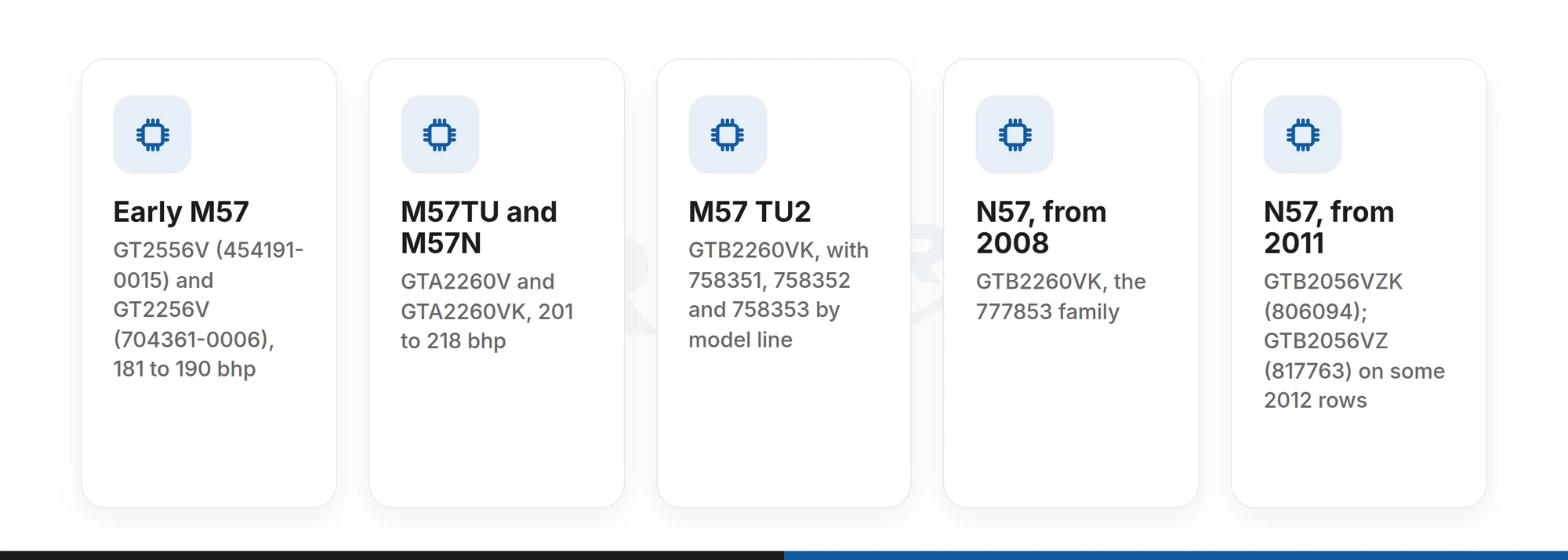
The first M57 appears in our data on 5 Series rows from 1998 to 2000 at 181 to 190 bhp, carrying a GT2556V (454191-0015), and on 3 Series rows at 181 bhp carrying a GT2256V (704361-0006 and 704361-0010). Trade listings put the E46 330d and the first X5, the E53 3.0d at 184 hp, on the same 704361 family.
The M57TU and M57N: GTA2260V and GTA2260VK
The first update moved every model line in our data onto the GTA2260 frame. The 3 Series and X3 are listed at 201 to 214 bhp with 728989 and 750773 references; the 5 Series at 208 to 218 bhp with 725364 and 742730. Our page for 5 Series and X5 actuator references lists the same 742730 family against the E60 525d and 530d and the X5 E53, which is why an X5 of that era is identified exactly like a 530d.
The M57 TU2: GTB2260VK
The TU2 moved to the GTB2260VK, with a separate reference family for each model line: 758351 on the 5 Series at 194 to 232 bhp, 758352 on the 3 Series at 194 to 228 bhp, and 758353 on the X3 at 208 to 215 bhp. Trade listings attach 758352 to the E90-family 325d, 330d and 330xd alike, so on this generation the 325d is a 3.0 with the 330d’s turbocharger, not a smaller engine.
The N57: GTB2260VK, then GTB2056VZK
The single-turbo N57, engine code N57D30A in our data, is listed first with another GTB2260VK, the 777853 family, on 3 and 5 Series rows from 2008. Trade listings name that family for the 325d, 330d, 330xd, 525d, 530d and 530d GT. From 2011 the rows change to a GTB2056VZK, 806094, across the 3, 4 and 5 Series and the X3, with a GTB2056VZ, 817763, on some 2012 5 Series rows.
The point of walking through the list is not to have you memorise it. A “330d turbo” bought on the model name could belong to any of five frames, and only the reference on your own unit, or the unit itself on the bench, says which.
Twin-Turbo 35d Engines: Two Turbos, Two Jobs
A 335d or 535d is not a 330d with a bigger turbocharger. It has two turbochargers of different sizes working in sequence, the arrangement usually called two-stage: a smaller high-pressure unit and a larger low-pressure unit, with the engine management deciding how the work is shared between them. Both are complete turbochargers, each with its own shaft, bearings, seals and wheels.
That is why the job is two jobs. Each stage has its own reference, its own condition and its own rebuild, and a fault on the engine does not, on its own, tell you which of the two has worn.
The M57 two-stage set: KP39 with K26
On the M57, our data lists the set as a single R2S assembly, a BorgWarner KP39 with a K26, under reference 1000-970-0013 at 282 bhp on the 3 Series, 5 Series and X3, with BMW numbers 11657802587, 11657802588 and 11657811404. Other 5 Series rows between 261 and 285 bhp list the two stages separately as well: a KP39 as 5439-970-0088 under BMW 7811405, and a K26 as 5326-971-0003 under BMW 7809863.
So the same pair of turbochargers can reach you, and a quote, described either as one assembly or as two parts. Neither description changes what is on the engine.
The N57 two-stage set: K26 with BV40
The N57 twin keeps the K26 and pairs it with a BorgWarner BV40. At 308 bhp, on engine code N57D30B, our data lists the K26 as 5326-970-0010 under BMW 11658510942 and the BV40 as 5440-970-0010 under BMW 11658510943, the two numbers running consecutively, across the 3, 4 and 5 Series and the X3. Earlier 5 Series rows at 295 bhp, filed as N57SD30B, list the same pairing under different references: 5326-970-0005 with 5440-970-0009.
Three turbochargers at the top of the N57 range
At 375 bhp, on engine code N57D30C, the 5 Series rows list three BMW numbers in sequence, 11658516123 to 11658516125: two BorgWarner BV45 units, 5303-970-0310 and 5303-971-0284, and a B2G, 1273-971-0009. A separate 380 bhp row, N57D30S1, lists a B2 as 1273-970-0001. This is the most involved turbo job on the page, and it is one to talk through with us before anything is removed.
What to send from a multi-turbo engine
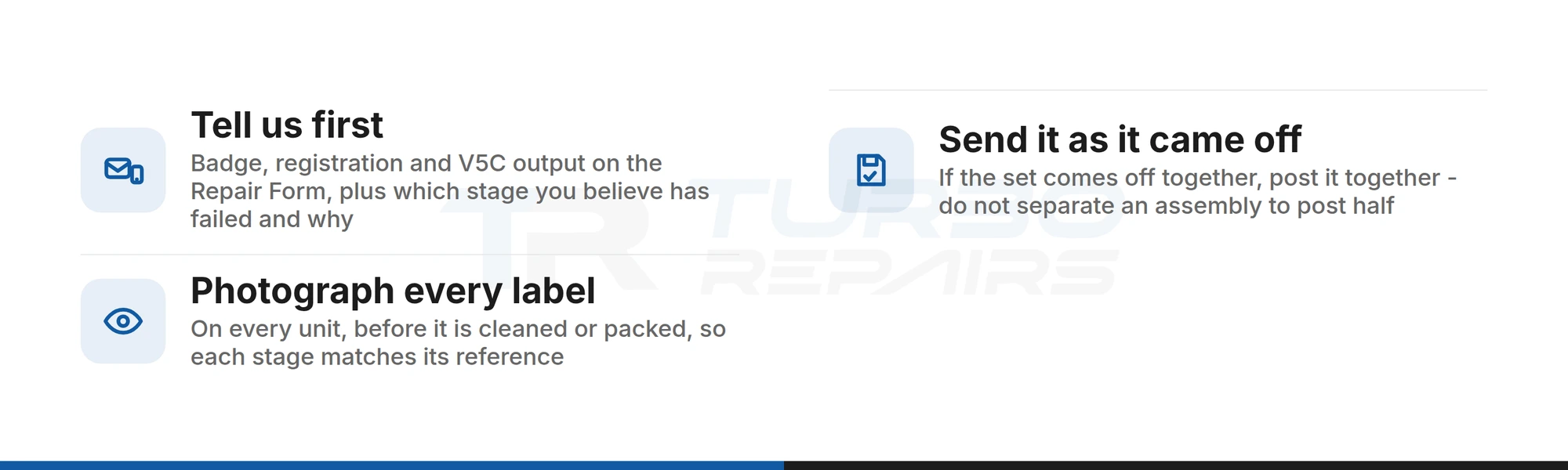
- Tell us first. Put the badge, the registration and the V5C output on the Repair Form, say which stage you or your garage believe has failed and why, and we will tell you what to send before any spanner is picked up.
- Send it as it came off. If the set comes off the engine together, post it together. Do not separate an assembly to post half of it.
- Photograph every label on every unit before it is cleaned or packed, so each stage can be matched to its reference.
Turbo Repairs · Epsom workshop
One Garrett or a BorgWarner set, your 3.0d turbo is rebuilt as found
Tell us the badge and the output on the Repair Form, then post in what came off the engine. Each unit is identified from its own label, stripped and measured, and priced on what it actually needs before any work goes ahead.
Lifetime, unlimited-mileage warranty · Mail-in from the UK and internationally · Bench-tested and calibrated before it ships
What Fails on a BMW 3.0d Turbo
Whichever maker built it, each of these turbochargers is a turbine wheel and a compressor wheel on one shaft, running in a bearing housing on a film of pressurised engine oil, with a seal at each end. The bearings, thrust parts and seals are the parts designed to wear. The wheels, the shaft and the housings are meant to outlast them, and in most failed units they still can.
Failure usually moves outwards from the bearings. A worn bearing lets the shaft run off-centre, the seals stop holding oil back, and oil reaches the intake on one side and the exhaust on the other. Driven on for long enough, a wheel touches its housing, and a compressor wheel that has rubbed is replaced rather than repaired. How much of the unit survives is decided mostly by how long it kept running after the first sign of trouble.
The variable-vane units add one more wear point. Carbon from the exhaust builds up around the vane ring until the vanes stiffen, and short journeys that never bring the turbine housing fully up to heat make it worse. That shows as a boost fault even when the rotating assembly is sound; our guide to the VNT turbo and its vane mechanism covers why a sticking ring that frees itself has not been cured.
On a two-stage engine there are two rotating assemblies to wear rather than one, both fed from the same engine oil. The symptoms themselves, and the cheaper faults that imitate a failed turbocharger, are sorted by where in the unit they start in our guide to turbo failure symptoms, so check that list before anything is unbolted.
Rebuilt to the original specification, not upgraded
A good share of what comes up when you search for a 330d turbo is upgrade and hybrid turbochargers, with bigger wheels and higher power ratings. That is a different job from this one. We rebuild the turbocharger your engine was built with, to its original specification, and we do not supply or fit upgrade or hybrid units.
Turbo or Actuator? Where the Actuator Pages Take Over
Many of these variable-vane turbochargers carry an electronic actuator on their side to position the vanes. It is a separate repair, from £100 + VAT, and a faulty one can make a sound turbocharger look failed. If the actuator on yours has no electrical connector, it is not an electronic unit and this split does not apply. Where it does, the evidence usually leans one way:
- Towards the turbocharger: a whine or siren that rises with engine speed, oil use or blue smoke, oil pooled in the intake pipework after the turbo, or play you can feel at the compressor nut with the intake pipe off.
- Towards the actuator: a boost fault that clears on a restart and comes back, often worse, with no oil loss and no mechanical noise from the rotating assembly.
- Towards neither yet: a boost code on its own. It records a pressure disagreement, and a split intercooler hose can store the same code.
If the evidence points at the actuator alone, the turbocharger does not need to come off. Our pages for the BMW 3 Series actuator repair and the 5 Series and X5 references linked above cover how to identify the unit and what its rebuild involves, and every model we cover is on our electronic turbo actuator repairs page. If it points at the turbocharger, send the unit complete with the actuator attached, and say on the form whether you want the actuator assessed too.
Rebuild or Replacement: What a 3.0d Turbo Costs
| Route | Price with us | What it covers |
|---|---|---|
| Rebuild of your own turbocharger | From £185 + VAT | The unit that came off your engine, stripped, measured, rebuilt, balanced and bench-tested |
| Replacement turbocharger | From £450 + VAT | A reconditioned or new exchange unit, where yours is too far gone to rebuild |
| Electronic actuator repair | From £100 + VAT | The actuator alone, where the turbocharger itself is sound |
| Removal and refitting | Not included | Charged by whoever does the work on the car |
Your price is confirmed once the unit has been stripped and measured, before any further work is done. A bearings-and-seals rebuild sits at the bottom of the range; a wheel, shaft or housing that fails inspection moves it up. On a two-stage engine each stage is a turbocharger in its own right, so the price follows how many units need work and what each of them needs.
The labour on the car is the same whichever unit goes back on, so the choice between rebuilding and replacing can wait until the old one is off. A rebuild returns the turbocharger already matched to your engine, which on a line with five single-turbo frames and three multi-turbo arrangements takes the matching question away entirely. When too much of a unit has gone for a rebuild to make sense, we say so and recommend a replacement. The wider picture, including the parts and labour that sit around the unit, is in our guide to turbo repair prices.
Our BMW 3.0d Turbo Rebuild
You, or the garage that looks after the car, remove the turbocharger and post it to us at Unit 102 Reaver House, 12 East Street, Epsom, Surrey, KT17 1HX, United Kingdom. Independent garages and dealers send units in for their customers the same way. From there, our turbocharger rebuild service runs in this order:
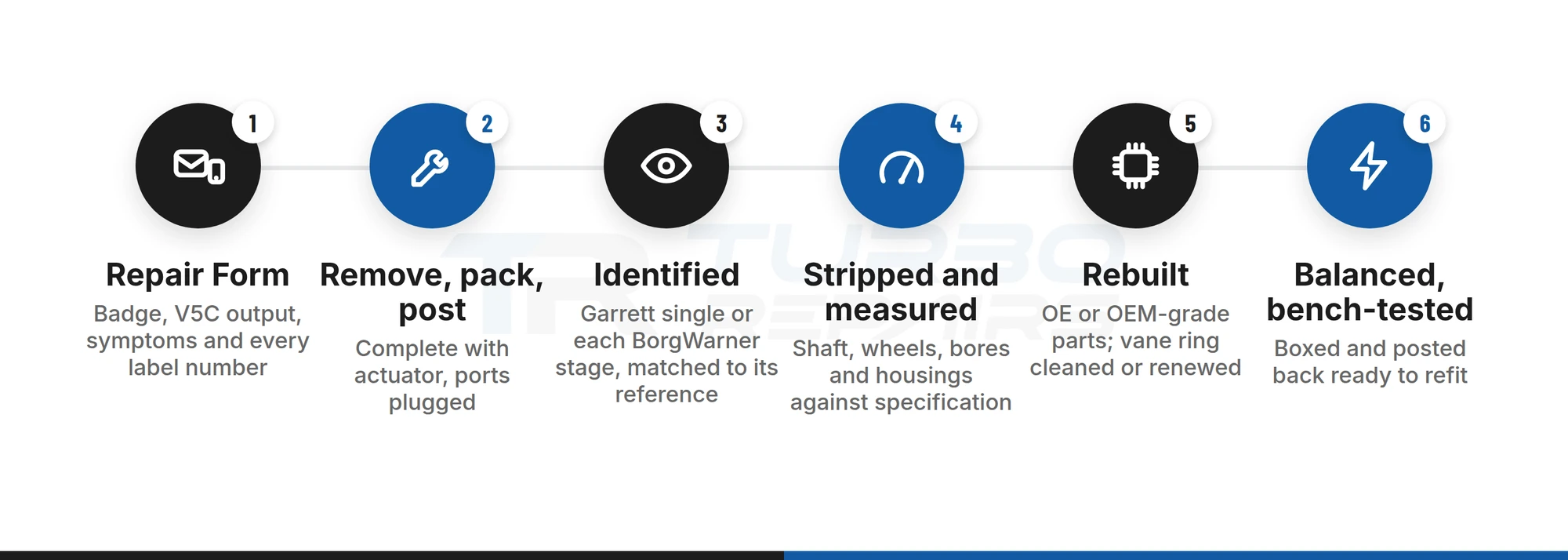
- Complete the online Repair Form with the registration, the badge, the power output from the V5C, the mileage, the symptoms, any stored fault codes and every number on each label. On a 335d, 535d or other multi-turbo car, say so before anything is removed.
- Remove, pack and post. Our guide to removing and refitting a turbocharger covers the job, including priming the oil feed on the first start. Send the unit complete, actuator attached and every port plugged; our FAQs page covers packing and postage.
- Identified before it is opened. Each unit is matched to its reference from the label, or on the bench where the label has gone, so a Garrett single and each stage of a BorgWarner set are all set against the right specification.
- Stripped and measured. Turbo specialists take it down to component level and measure the shaft, wheels, bearing bores and housings against the original specification.
- Rebuilt. Bearings, thrust parts and seals are renewed with genuine OE or OEM-grade components that meet or exceed the original, and a part with a known design weakness is uprated rather than put back. On a variable-vane unit the vane ring is cleaned and freed where it is sound and renewed where it is not.
- Balanced, bench-tested and returned. The rotating assembly is balanced and the unit is run on the bench, then boxed and posted back ready to refit.
Bench time is typically one to three working days from arrival, with postage each way on top, and every rebuild carries a lifetime, unlimited-mileage warranty. One answer on the form is worth giving in full: whether the failure followed an oil warning, a missed service or recent engine work, because a bearing that wore out on clean oil looks different on the bench from one that ran short of it.
BMW 3.0d Turbo FAQ
How much does a BMW 330d turbo replacement cost?
Rebuilding your own turbocharger with us starts from £185 + VAT, and a replacement turbocharger from us starts from £450 + VAT. Removal and refitting are charged separately by whoever does the work, and your exact price is confirmed after the unit has been inspected.
Does my BMW 3.0d have one turbo or two?
In our fitment data the 325d, 330d, 525d and 530d are single-turbo cars throughout, and the 335d, 535d and 282 bhp X3 are two-stage. The label confirms it: on the M57 and N57 a Garrett reference means a single turbocharger, and a BorgWarner reference means you are looking at one stage of a set. If the badge and the label disagree, tell us before anything comes off.
Is the 335d turbo the same as the 330d turbo?
No. The 330d runs a single Garrett variable-vane unit, and the 335d runs a BorgWarner two-stage set, a KP39 with a K26 on the M57 and a K26 with a BV40 on the N57. None of the references is shared between the two cars in our data.
Can you rebuild just one stage of a twin-turbo set?
Each stage is a complete turbocharger with its own reference, and each is rebuilt to its own specification. Tell us on the Repair Form which stage you believe has failed and what the car was doing when it did, and we will advise what to send before anything is removed.
Do you cover the BMW X5 3.0d?
Yes. The first X5 3.0d, the E53, is listed on the same Garrett families as the 3 and 5 Series of its era. For later X5s our data does not break the turbochargers out separately, so send the numbers from the label with the Repair Form and we will identify the unit.
Do you fit upgrade or hybrid turbos for the M57?
No. We rebuild the turbocharger your engine was built with, to its original specification. Upgrade and hybrid turbochargers are a different job, and we do not supply or fit them.
Could the fault be the actuator rather than the turbo?
Yes, where the turbo carries an electronic actuator. A boost fault that clears on a restart and returns, with no oil loss and no whine, points at the actuator, which is its own repair from £100 + VAT. Oil smoke, oil in the intake pipework or a whine that rises with the revs points at the turbocharger itself.
How long does it take, and what is the warranty?
Bench time is typically one to three working days from arrival, plus postage each way. Every rebuild carries a lifetime, unlimited-mileage warranty with no time limit.
Final Thoughts
BMW’s 3.0 diesel looks like one engine on paper, with one capacity across every badge. Underneath, it spans five single-turbo Garrett frames and three BorgWarner multi-turbo arrangements, and the two groups do not share a reference. The badge tells you which group you are in, and the maker’s name on the label confirms it.
Once you know that, the rest is ordinary turbo work done carefully: rule out the actuator and the cheaper imitators, take the unit off before a worn bearing can take the wheels and shaft with it, and on a multi-turbo engine talk to us before you decide what to send. A rebuild of the unit that came off leaves nothing to match.
Turbo Repairs · Epsom workshop
Single or two-stage, keep the turbo your BMW was built with
Complete the Repair Form with the badge, the power output and every number from the label, then post the unit in complete. We identify it, strip, measure, rebuild, balance and bench-test it, and send it back ready to refit.
Lifetime, unlimited-mileage warranty · Mail-in from the UK and internationally · Bench-tested and calibrated before it ships