

Summary A failing electronic turbo actuator on a BMW 3 Series diesel causes power loss, limp mode and boost-control fault codes — and BMW will only quote you a complete replacement turbocharger because the actuator is not sold separately. We rebuild your own Hella or Garrett actuator to component level, calibrate it to your turbo and return it plug-and-play, from £100, with a lifetime unlimited-mileage warranty.
A ticking or clicking from the turbo area is the actuator’s motor and worn gear train hunting for a vane position it can no longer hold.If your BMW 3 Series diesel has dropped into limp mode, lost half its power on the motorway or thrown a charge-air pressure fault, the electronic turbo actuator is one of the first parts to suspect. It is a small motor-and-gearbox unit bolted to the side of the turbo, and it is one of the most common failure points on these engines. The frustrating part is what happens next: because BMW does not sell the actuator on its own, the dealer quote comes back as a complete replacement turbocharger — a four-figure bill for a fault in a part the size of a matchbox.
We repair the actuator you already have. Below we explain exactly what the actuator does on your engine, how to recognise a failing one, the fault codes it triggers, why it fails, and how our mail-in rebuild returns it to you calibrated, tested and ready to refit.
- Common models: 318d, 320d, 325d, 330d, 335d — E90 / E91 / E92 / E93 and F30 / F31 / F34
- Engines: M47 and N47 (2.0d), M57 and N57 (3.0d)
- Key problem: electronic VNT actuator failure — motor, drive gears, position sensor or circuit board
- Symptoms: power loss, limp mode, engine-management light, clicking from the turbo
- Common codes: 3F57, 4191, P0234, P0299, P2263
- Our solution: component-level actuator rebuild — from £100, no coding, lifetime unlimited-mileage warranty
What the Electronic Turbo Actuator Does on a BMW 3 Series
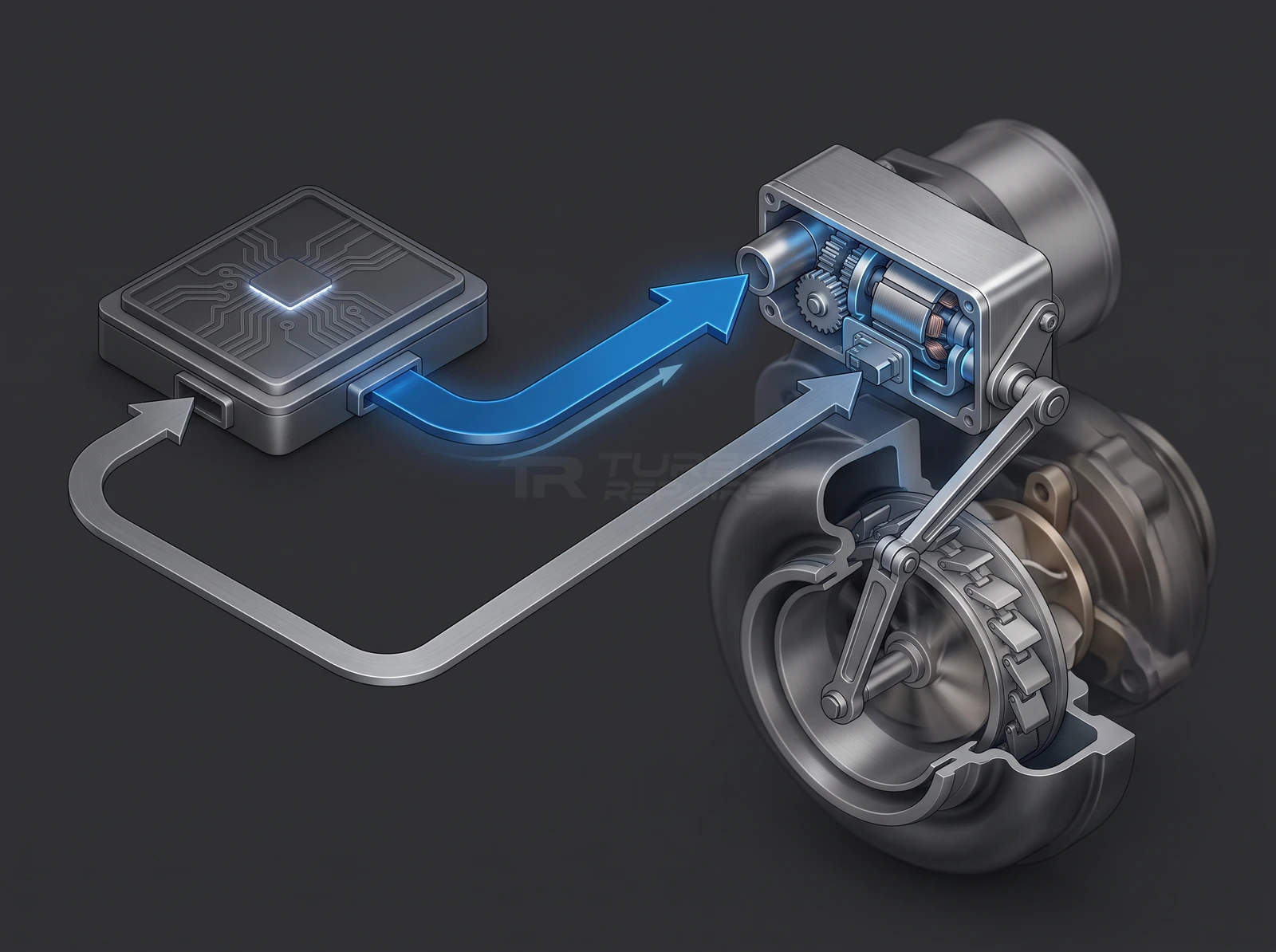
The turbocharger fitted to your 3 Series diesel is a variable-geometry unit — a VNT or VGT turbo. Inside the turbine housing is a ring of movable vanes, the nozzle ring, that changes the angle at which exhaust gas strikes the turbine wheel. At low engine speed the vanes close down to accelerate the gas and build boost early, which is what gives these engines their strong low-down pull and keeps lag to a minimum. As the revs rise the vanes open out so the gas can flow freely and the engine is protected from over-boosting.
The electronic actuator is the component that moves those vanes. It houses a small direct-current motor, a reduction gear train and a non-contact position sensor, all governed by a circuit board. Your engine control unit — the DDE on a BMW diesel — sends the actuator a target vane position many times every second; the actuator drives its lever to match, and the position sensor reports the actual position back so the ECU can close the loop and hold boost precisely.
Compared with the older vacuum-operated diaphragm actuators, this electronic control is quicker and far more accurate — actuation is roughly a third faster — which is exactly why BMW adopted it. The trade-off is durability. This is a motor, a set of gears and a delicate circuit board living within inches of a glowing exhaust manifold, cycling constantly every time you touch the throttle. On the 3 Series diesels most of these actuators are made by Hella (the 6NW-series part numbers), with some Garrett-branded units, and on the six-cylinder 3.0-litre cars the same electronic actuator governs the larger VNT turbo. Wherever it sits, it takes a hard life — and that is why it wears out.
BMW 3 Series Models and Engines We Cover
We rebuild electronic turbo actuators across both modern 3 Series generations: the E90 saloon, E91 Touring, E92 coupé and E93 convertible (2005–2013), and the F30 saloon, F31 Touring and F34 Gran Turismo (2012–2019). On the diesels these split into two engine families — the 2.0-litre four-cylinders (the M47TU and later N47, powering the 318d and 320d) and the 3.0-litre six-cylinders (the M57 and later N57, powering the 325d, 330d and 335d).
The table below lists the actuators and turbos we most often see on these cars. Treat it as a guide, not gospel: the exact actuator depends on your car’s build date and the specific turbo fitted, so the safest approach is always to read the numbers off the actuator body and send them to us to confirm.
| Model & engine | Generation | Turbo | Common actuator / part references |
|---|---|---|---|
| 320d 2.0d (M47TU) | Early E90 (carried over from E46) | Garrett GT1749V / GT1752V | Hella G-103 / G-206, 731877, 733701-5009S |
| 318d / 320d 2.0d (N47) | E90 / E91 / E92 / E93, F30 / F31 | Garrett / Mitsubishi TF035 | Hella 6NW010430-04, 6NW010099-02, 49335-19400, K006T50171 / K006T50172 |
| 325d / 330d 3.0d (M57 → N57) | E90 / E91 / E92 / E93, F30 / F31 | Garrett GT-series VNT | Hella electronic actuator (e.g. G-185 / 750773 on M57N) |
| 335d 3.0d (M57 / N57, twin-turbo) | E90 / E92 | Garrett VNT (primary charger) | Electronic actuator on the primary variable-geometry turbo |
If your exact variant is not shown — or you are unsure which engine you have — that is not a problem. Send us the part numbers stamped on the top of the actuator along with your registration and we will confirm the fit before anything is booked in.
Symptoms of a Failing BMW 3 Series Turbo Actuator
A failing actuator rarely dies all at once. It usually announces itself gradually, and the pattern is distinctive enough that most owners recognise it once it is described. The most common signs on a 3 Series diesel are:
- Sudden or intermittent loss of power. The car feels as though it has lost a large slice of its power — many owners describe it as roughly half — because the ECU can no longer trust the boost the turbo is delivering.
- Limp mode. When the delivered boost stops tracking the target, the ECU caps power to protect the engine and holds you in a reduced-power limp-home state until the fault is cleared.
- The engine-management light, often alongside the amber reduced-power warning on the dash.
- A fault that clears and returns. Switch off, leave the car a while and restart, and normal power often comes back — then the fault returns and gets worse over the following weeks. That come-and-go behaviour that steadily deteriorates is the classic actuator signature.
- A ticking or clicking noise from the turbo area, as the actuator motor and gears hunt for a vane position they can no longer reach or hold.
- Black smoke on acceleration and a flat spot as you climb through the rev range, most noticeable under load — pulling away uphill, overtaking, or towing.
Some cars show no obvious change in how they drive at all, and the only clue is a stored fault code picked up at a service or MOT. However it shows up, the underlying story is the same: the vanes are no longer being moved accurately, so charge-air pressure drifts away from what the ECU is commanding, and the car reacts to protect itself.
Common BMW 3 Series Turbo Actuator Fault Codes
The codes that point to a turbo actuator problem fall into two groups: the BMW-native codes you read with an INPA or ISTA-type diagnostic tool, and the generic OBD-II P-codes a standard scanner will show. The ones we see most often on the 3 Series diesels are:
- 3F57 — Charge Air Pressure Controller (a control-deviation fault)
- 4191 — Charge Air Pressure Actuator
- P0234 — turbocharger overboost condition
- P0299 — turbocharger underboost (boost below the commanded target)
- P2263 — turbo boost system performance
A generic “charge air pressure control” plausibility fault is also common. It is worth being honest about what these codes mean: they flag the boost-control system as a whole, not the actuator specifically. A sticking nozzle ring inside the turbo, a split intercooler pipe or a tired EGR valve can all throw the same codes. That is precisely why we bench-test rather than assume — and why it pays to send us the actual codes with your unit, along with any part numbers, so we can interpret them against what we find on the test bench.
Why BMW 3 Series Turbo Actuators Fail
These actuators fail for reasons that are baked into where they sit and how they are used, and understanding the cause matters — because a like-for-like replacement inherits every one of the same weaknesses.
Heat. The actuator is mounted on the exhaust side of the turbo. Years of heat-soak cook the circuit board, crack solder joints and cause the position sensor’s electronics to drift, so the ECU can no longer trust the feedback it is receiving.
Sticking vanes from soot. This is the classic BMW 3 Series chain of events. Carbon and soot — fed by the EGR system and made far worse by short, low-speed urban journeys where the engine never gets fully hot — build up on the variable nozzle ring. The vanes stiffen. The actuator then has to push harder on every single cycle to move them, and that constant strain is what eventually kills the motor brushes, wears or strips the plastic reduction gears, or overloads the drive electronics.
Gear and motor wear. Once the internal gears wear, the motor can spin without the output lever following properly — which is often the source of that clicking or ticking noise. Moisture and corrosion getting past aged seals, and simple vibration over high mileage, finish the job.
When we rebuild your actuator we address these root causes rather than reinstalling the same weak points — renewing the motor, gears, sensor and seals, reworking the board, and uprating components that are known to be marginal. One important point of honesty, though: if your symptoms are being driven by a genuinely seized nozzle ring inside the turbo itself, the actuator rebuild alone will not be the whole answer, and we will tell you that when we test the unit. Repairing the actuator is the right fix in the great majority of cases, but only when it is actually the actuator at fault.
Repair or Replace? What the Dealer Quote Really Means
Here is the part that catches most 3 Series owners out. BMW and the main dealers do not supply the electronic actuator as a separate part. So when yours fails, the only route they can offer is a complete replacement turbocharger with the actuator attached — a four-figure part, plus the labour to fit it, and typically only a 12-month warranty at the end of it. You are effectively scrapping a perfectly good turbo to cure a fault in the small unit bolted to its side.
Used actuators do exist, but they are a poor bet. A second-hand unit is already the known weak point, so there is no way to know how much life is left in it, they often need adjusting or coding to work correctly, and they usually come with only a 30-to-90-day warranty.
Rebuilding the actuator you already have avoids all of that. Your original turbo — correctly sized and already matched to your engine — stays on the car. The repair starts from £100, is turned around in one to two working days, needs no coding when you refit it, and is covered by a lifetime, unlimited-mileage warranty. You fix the actual fault, keep the good parts you already own, and you are not left wondering how long a used component will last.
Turbo Repairs · Epsom workshop
Send us your 3 Series actuator instead of buying a whole turboComplete the online Repair Form, post the unit in, and our engineers strip it, renew the failed parts and calibrate it to your turbo on the bench. Typically one to two working days, and it refits plug-and-play — no coding, no dealer visit.
Lifetime, unlimited-mileage warranty · Mail-in from the UK and internationally · Bench-tested and calibrated before it ships
Our BMW 3 Series Actuator Rebuild Service
Each BMW 3 Series actuator is rebuilt at component level — worn motor, drive gears and position sensor renewed, the circuit board reworked — then closed-loop calibrated to your turbo’s vane sweep and signed off on our test bench, so it refits without coding and is warrantied for life.
It is a mail-in service, run from our in-house workshop in Epsom, Surrey, and staffed by turbo specialists and electronic engineers who work on these units day in, day out. You do not need to bring the car anywhere. The process is straightforward:
- Remove the actuator. On most 3 Series diesels the actuator unbolts from the side of the turbo without having to remove the turbocharger itself — a job most competent independent garages can handle quickly, or that a confident DIY owner can tackle. You are sending us the actuator only, not the whole turbo.
- Complete the online Repair Form and post it in. Send it from anywhere in the UK or internationally, and include your fault codes, your engine and registration, and any part numbers stamped on the actuator so we can match it before it arrives.
- We strip, test and rebuild it. The unit is taken down to component level and bench-tested to find the fault. We renew the DC motor and brushes, the reduction gears, the position sensor and the seals as needed, rework the circuit board, and uprate any component that is a known weakness so the rebuilt unit meets or exceeds the original specification. It is then calibrated to your turbo’s vane range and proven under live boost targets on our test bench.
- We return it plug-and-play. It comes back ready to bolt straight on and drive — no dealer coding, no programming, no calibration on the car. Turnaround is typically one to two working days once it reaches us, and every actuator rebuild carries our lifetime, unlimited-mileage warranty.
Because the calibration is done here, on the bench, against the vane sweep the unit will actually be controlling, there is nothing left for you or your garage to set up when it goes back on the car.
Why Choose Turbo Repairs for Your BMW Actuator
Turbo actuators are not a sideline for us — rebuilding turbochargers and electronic turbo actuators is what our workshop does. That focus shows in the detail: we document the real BMW part numbers, engine variants and fault codes for each model we cover, rather than treating every actuator as the same generic box.
What that means for your 3 Series:
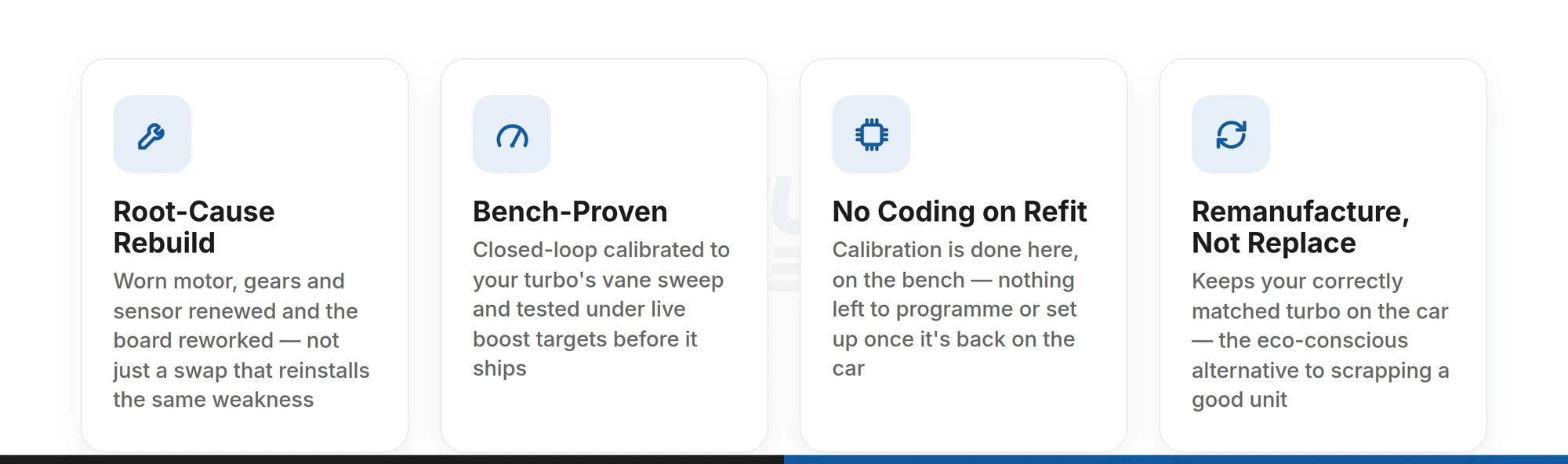
- A root-cause rebuild, not a swap. We renew the parts that fail and uprate the ones that are marginal, so you are not simply reinstalling the original weakness.
- Calibrated and bench-proven before it ships, tested under live boost targets so it behaves correctly the moment it is refitted.
- No coding on refit, and a lifetime, unlimited-mileage warranty behind the work.
- Remanufacture over replacement — the cost-effective route that keeps your matched turbo on the car and is the more eco-conscious choice than scrapping a good unit.
We rebuild the same electronic actuators across the wider BMW range too, so if a family member or a customer’s car needs the same work you will find dedicated pages for our BMW 5 Series turbo actuator repairs and BMW X3 2.0d turbo actuator repairs. You can also see the full range of models we cover on our electronic turbo actuator repair service, or explore the wider turbo repair service. To get started, complete the online Repair Form and post your actuator in, or get in touch with your fault codes and vehicle details for advice first.
BMW 3 Series Turbo Actuator Repair FAQ
Will my BMW 3 Series actuator need coding or programming after the repair?
No. The rebuilt actuator is calibrated to your turbo on our bench and comes back completely plug-and-play. There is no coding, programming or on-car calibration to do — you refit it and drive.
Do I need to remove the whole turbo, or just the actuator?
On most 3 Series diesels you only need to remove the actuator, which unbolts from the side of the turbocharger. The turbo itself can usually stay on the car. You send us the actuator alone.
How long does the repair take?
Turnaround is typically one to two working days once your actuator reaches our workshop, excluding postage each way.
How much does a BMW 3 Series turbo actuator repair cost?
Repairs start from £100. We confirm the exact price once we have seen the unit and your fault codes, so you know the cost before any work goes ahead.
Which BMW 3 Series models and engines do you cover?
We cover the E90, E91, E92 and E93 (2005–2013) and the F30, F31 and F34 (2012–2019) diesels — 318d, 320d, 325d, 330d and 335d — running the M47, N47, M57 and N57 engines.
My fault cleared after I restarted the car — is the actuator still faulty?
Almost certainly, yes. An intermittent fault that clears on a restart and then returns and worsens over time is the classic pattern of a failing actuator. It will not repair itself.
What warranty do you offer on the repair?
Every electronic turbo actuator rebuild is covered by a lifetime, unlimited-mileage warranty — no time limit and no mileage cap.
What if it turns out my actuator is not the fault?
We test every unit before we rebuild it. If your actuator is not actually faulty we will tell you — the cause may be a sticking nozzle ring in the turbo itself, a boost leak or an EGR problem — so you are not paying to fix something that is working correctly.
Final Thoughts
The awkward thing about a 3 Series actuator is that it does not behave like a broken part. It clears on a restart, gives you a normal drive home, and creeps back weeks later — so the first episode gets written off, or blamed on fuel or a sensor. The codes do not settle it either: 3F57, P0299 and the rest name the boost-control system, not the worn component inside it.
So treat the come-and-go pattern as the diagnosis it is: it worsens, it does not settle. Read the references off the actuator body rather than the model badge — the 318d and 320d alone span more than one actuator family. And be honest about the journeys the car does: soot from short, cold runs stiffens the nozzle ring, and stiff vanes are what wear the motor and gears out.
Turbo Repairs · Epsom workshop
Ready to get your BMW back to full boost?Fill in the Repair Form with your fault codes and vehicle details and post your actuator in. If you would rather talk it through first, send us the codes and we will tell you honestly whether the actuator is the fault before you remove anything.
Lifetime, unlimited-mileage warranty · Mail-in from the UK and internationally · Bench-tested and calibrated before it ships