

Summary We rebuild the electronic turbo actuator from the Land Rover Freelander 2 2.2 diesel, early TD4 and later TD4 and SD4 alike, from £100 + VAT. Turnaround is typically one to two working days, your own unit comes back needing no coding, and every rebuild carries a lifetime, unlimited-mileage warranty. Before you buy, order or post anything, work out which of the car’s two actuators you have, because the parts listings for this car are a poor guide to it.
Freelander 2 actuator listings usually print the name of the turbocharger’s maker, not the actuator’s: a Hella unit is sold as Garrett, and a unit with Continental references is sold as Mitsubishi.
A Freelander 2 that shows “Performance Restricted”, loses its pull and drops into limp mode has, more often than not, an actuator fault. The actuator is the electronic unit bolted to the side of the turbocharger that positions its vanes, and it can be removed and rebuilt without the turbocharger coming off the engine. What makes this car awkward is not the repair. The trouble is that the Freelander 2 was built with two unrelated actuators, and the listings selling them describe the wrong thing on the label.
- Vehicle: Land Rover Freelander 2 (L359), 2.2 diesel, badged TD4 or SD4
- Early cars: 2.2 TD4, engine code DW12B, listed at 152 hp from 2006 and 160 hp from 2007. Hella actuator 6NW009483, coded G-62, on a Garrett turbocharger (753546)
- Later cars: 2.2 TD4 and SD4, listed 2010–2015. Actuator catalogued as Land Rover LR065510, with Continental references (A2C) published for repair. The same unit is listed for the first-generation Range Rover Evoque 2.2 and the Discovery Sport 2.2
- Warning on the dash: “Performance Restricted”, with or without the engine management light
- Codes listed against the fault: P259E, P0046, P0047, P0048, P2263, with P0237/P0238 and P2562 also reported
- Our service: component-level rebuild of your own unit from £100 + VAT, typically 1–2 working days, no coding on refit, lifetime unlimited-mileage warranty
Which Actuator Is on Your Freelander 2? Settle the Type First
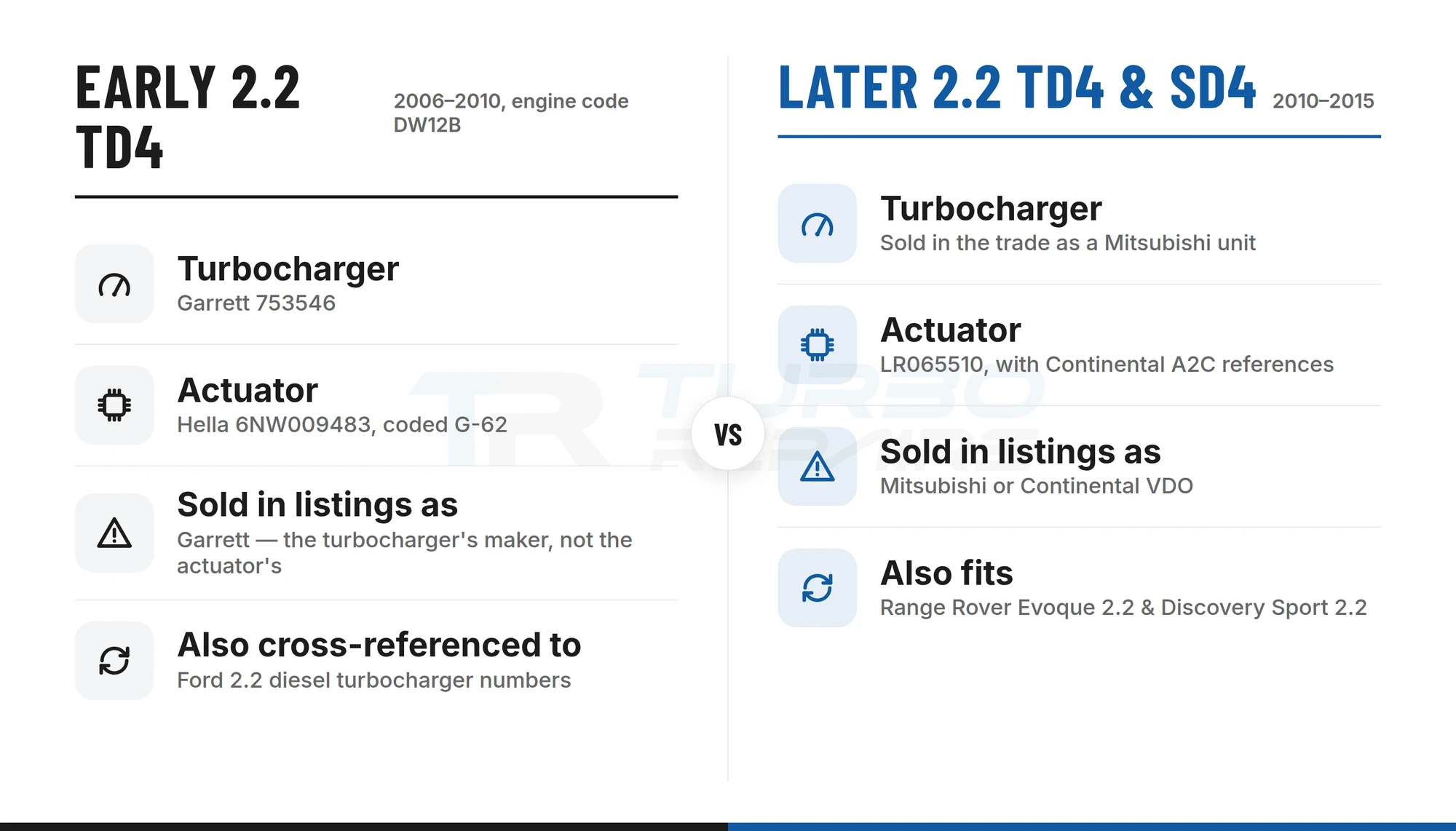
There are two different 2.2 diesel actuator arrangements on the Freelander 2, not two versions of the same part. Specialist listings describe an early car and a later car, and each has its own turbocharger, its own actuator and its own part numbers. A replacement, a used unit or a diagnosis will go wrong until you know which one is bolted to yours.
| Early 2.2 TD4 | Later 2.2 TD4 and SD4 | |
|---|---|---|
| Years as listed | 2006–2010 (152 hp); the 160 hp version from 2007 | 2010–2015 on one listing, 2011–2014 on another |
| Engine as listed | 2.2 TD4, engine code DW12B | 2.2 diesel, listed under the Duratorq name |
| Turbocharger | Garrett 753546 (with -0014, -0023 and exchange suffixes); Land Rover LR006862 and LR003578 among the cross-references | Sold in the parts trade as a Mitsubishi 2.2 TD4 turbocharger for the Freelander 2, Evoque and Discovery Sport |
| Actuator | Hella 6NW009483, G-code G-62 | Land Rover LR065510, with related numbers LR022358, LR038322, LR065510A and LR065511; Continental references A2C53367342, A2C84388800 and A2C91749100 |
| Shared with | Ford 2.2 diesels: Ford-style turbocharger numbers 6G9Q6K682CA and 6G9Q6K682CB appear in the same cross-reference list, alongside 9684856680 | First-generation Range Rover Evoque 2.2 and Discovery Sport 2.2 |
Two things in that table decide how you go about this. First, the years overlap: 2010 is claimed by both columns, so a car from 2010 or 2011 could carry either unit, and the registration year is a guide rather than an answer. Second, the TD4 badge appears on both sides. An SD4 badge points to the later arrangement, because the listings for the early unit name only the TD4, but a TD4 badge on its own settles nothing.
The early car’s engine is catalogued as DW12B, the engine code our Ford S-Max 2.2 TDCi page is written around. Its actuator carries the same Hella base number, 6NW009483, but under G-62 here, where the S-Max listing carries G-50. Same base part, different set-up, so do not assume an S-Max actuator suits a Freelander. The electrical side is a different matter: the supply-and-earth tests on our S-Max page, checking the boost-control circuit, apply to an early Freelander 2 as written, so they are not repeated here.
Mitsubishi, Hella or Garrett? Why the Listings Disagree
Search for a Freelander 2 actuator and you meet a question the listings raise but never answer: is it a Mitsubishi or a Hella? One specialist sells LR065510A as a Mitsubishi turbo actuator. Another lists the Hella 6NW009483 with its brand field reading Garrett. A third sells LR065510 under both Continental VDO and Mitsubishi labels, and then lists the same LR065510 number a second time as a complete Mitsubishi turbocharger.
Read side by side, those listings follow a pattern. The brand on a Freelander 2 actuator listing is usually the maker of the turbocharger the actuator bolts to. Garrett is the name on the early turbocharger, and the early actuator is a Hella. Mitsubishi is the name the trade puts on the later turbocharger, while the references published for the later actuator are Continental numbers.
A brand name on a listing therefore tells you roughly which era the seller believes they are selling for. It does not tell you what is in the box, and it cannot tell you which of the two actuators your car has. Only the label on your own actuator can.
The Vane-Position Fault Behind “Performance Restricted”
Both Freelander 2 turbochargers are variable-geometry units. Instead of opening a wastegate, the actuator turns a ring of vanes inside the turbine housing, and the engine control unit sets boost by telling the actuator where to put them. A position sensor inside the actuator reports back where the vanes actually went. The recognised Freelander 2 fault is a breakdown in that exchange. Internal components in the actuator fail, and the vanes are no longer held where the control unit sent them.
On the later cars the fault is documented as intermittent at first and persistent later. The early episodes show as a sudden loss of power and a “Performance Restricted” message in the instrument cluster. As it develops, the car goes into limp-home mode and the engine management light stays on. Specialist listings for the early car describe the same progression: the engine cuts out and loses power when hot and when cold, a warning lamp comes on, and in the end it stays in limp mode until the actuator is repaired or replaced.
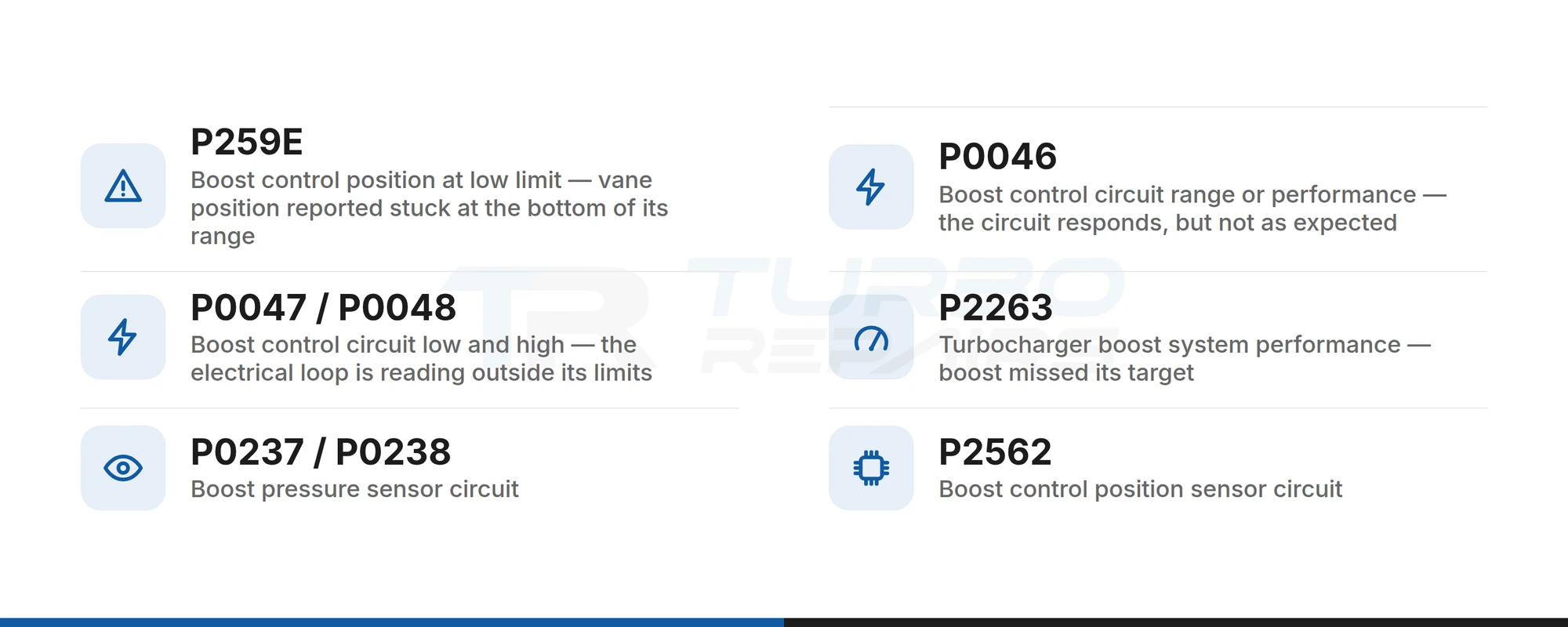
These are the codes listed against the fault:
- P259E: turbocharger boost control position at low limit. The control unit sees the reported vane position stuck at the bottom of its range.
- P0046: boost control circuit range or performance. The circuit responds, but not as expected.
- P0047 and P0048: boost control circuit low and high. The electrical loop is reading outside its limits.
- P2263: turbocharger boost system performance. Boost missed its target, for whatever reason.
- P0237, P0238 and P2562: the boost pressure sensor circuit, and the boost control position sensor circuit.
P259E is the code most closely tied to this car. It is a statement about position: the vanes are being reported at one end of their travel and are not leaving it. That can mean a motor or gear train that no longer drives, or a position sensor reporting a place the vanes are not in. It can also mean a vane mechanism holding the arm where it is. The code cannot tell those apart. The hand check further down this page can.
Symptoms, and What Each One Narrows Down
No single symptom identifies the part. Each one takes some suspects off the list and leaves others on it, and the table below shows which.
| What you notice | What it narrows down |
|---|---|
| “Performance Restricted” in the cluster | The engine management has cut power to protect the engine because a fault is stored. It confirms that a fault exists but does not name a part. Read the codes before anything is cleared. |
| Power comes back after a restart, then goes again | An intermittent fault, which is the early stage of internal actuator failure on this car. A connection that makes and breaks behaves the same way, so check the connector before blaming the unit. |
| Worse when the engine is hot | Both the electronics and the mechanism are more marginal at temperature. The early-car listings note that the vanes tend to tighten at either end of their travel, especially when hot. |
| P0046, P0047 or P0048 stored | The electrical side of the loop: connector, loom or the actuator’s internals. The connector costs nothing to inspect, so it comes first. |
| P259E stored | The position is stuck at the low limit. It is either the actuator or the vanes, and sweeping the vanes by hand separates the two. |
| P2562 stored | The position feedback circuit. The position sensor sits inside the actuator, so this points more firmly at the unit or its wiring than the pressure codes do. |
| P0237 or P0238 stored | The boost pressure sensor, which measures the result of the actuator’s work. It is a separate part, and it often lands in the same scan. |
| Flat, but no message and no position code | Look at the intake pipework before the actuator. A split intercooler hose or a slipped clamp loses boost and produces the same flat feel. |
If your notes point at the actuator, our guide to turbo actuator symptoms explains how to read the pattern around the symptom (when it appears, and whether a restart clears it) before anything is unbolted.
Reading the References Off Your Own Actuator
You settle the early-or-later question with the label on the actuator itself. The actuator sits on the turbocharger, where there is not much room, so a torch and a phone camera do most of the work, and the photographs can be read on a screen afterwards. Wipe the housing first, because heat and road dirt make these labels hard to read.
On an early car, look for a Hella label. Hella references on these actuators are found on the aluminium side of the unit. The two to find are the Hella number, 6NW009483, and the G-code, G-62. Record every other number on the label as well.
On a later car, the numbers listed against the actuator are the Land Rover LR065510 family (LR065510, LR065510A, LR065511, LR022358, LR038322) and the Continental references A2C53367342, A2C84388800 and A2C91749100. Any of those on your label puts you in the later column.
The Jaguar XF 2.2 diesel, listed 2012–2015, carries an actuator catalogued as 4947719610 / A2C91749100, also referenced 3514195 and 42340513. A2C91749100 is one of the Continental references in the later column above, so an XF 2.2 with that label belongs in that column too.
Three mistakes cost Freelander 2 owners money at this stage:
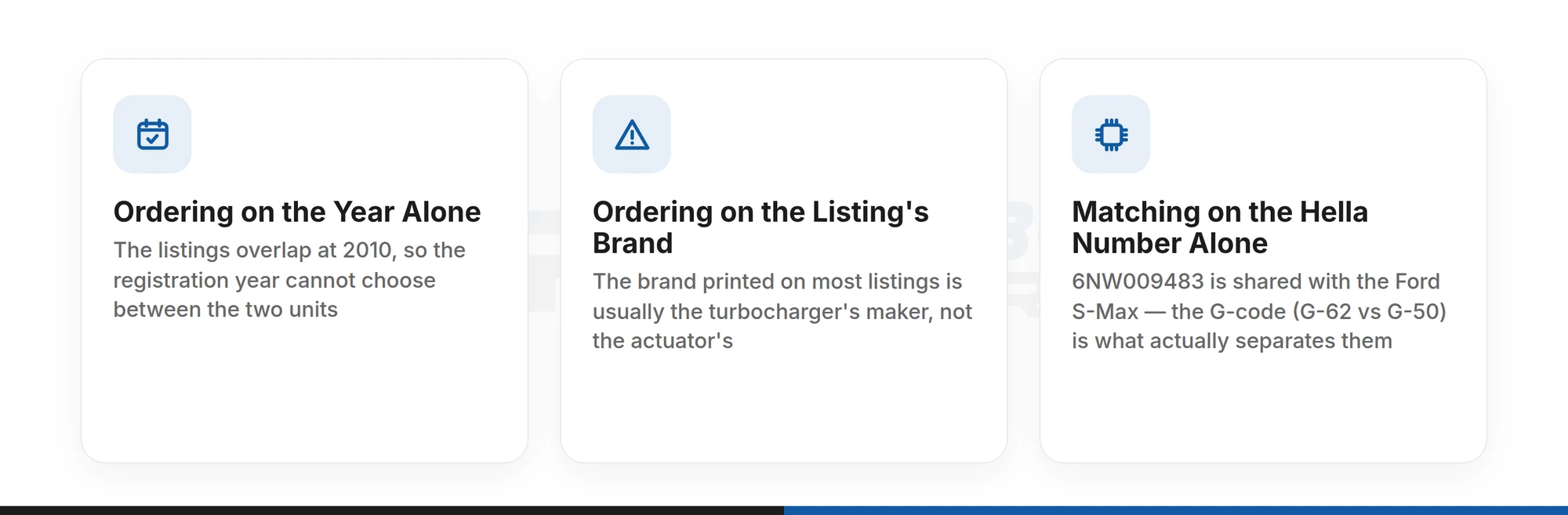
- Ordering on the registration year. The listings overlap at 2010, so the year cannot choose between the two units.
- Ordering on the brand in the listing title. As set out above, that is usually the turbocharger maker’s name.
- Ordering an S-Max or other Ford unit on the Hella number alone. 6NW009483 is a base number shared across set-ups, and the G-code is what separates them.
If the label is missing, unreadable or carries a number that is not in either column, photograph what is there and send it with your registration. The unit is then identified on the bench, where nobody has to guess.
Actuator or Turbocharger? Proving the Vanes Move
A stored P259E and a flat Freelander 2 can come from a failed actuator or from the vane mechanism it drives. The check that separates them takes a few minutes, needs no special tools, and is worth doing before anything goes in the post. Let the engine and turbocharger cool properly before you reach in, because the turbine housing gets hot enough to burn.
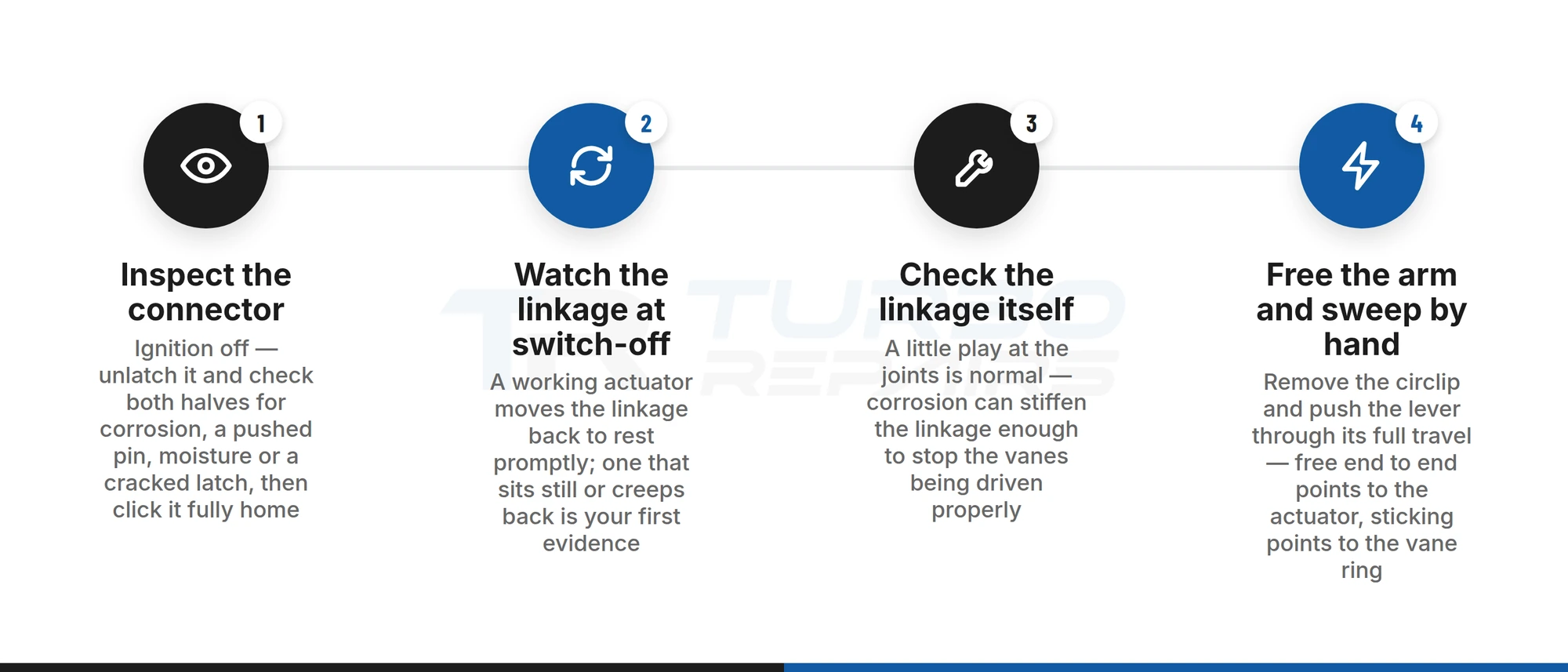
- Inspect the connector. With the ignition off, unlatch the actuator’s connector and look at both halves for corrosion, a pin pushed back or spread, moisture under the seal or a cracked latch. Then make sure it clicks fully home. On the early DW12B cars, the supply and earth tests are on the S-Max page linked above.
- Watch the linkage at switch-off. A working actuator moves the linkage back to its rest position promptly when the engine is switched off. A linkage that sits still, or creeps back, is your first real evidence.
- Check the linkage itself. Look at each end of the link between the actuator and the turbocharger’s vane lever. A small amount of play is normal. Corrosion on the joints can stiffen the linkage enough to stop the vanes being driven properly.
- Free the arm and sweep the vanes by hand. Remove the circlip that holds the actuator arm to the turbocharger’s lever, keeping hold of it because it is small and easy to lose, then push and pull the lever gently through its full travel. If it moves freely end to end, the vanes are free and the actuator is your suspect. If it sticks, catches or stops short, the vane ring is the problem.
A free sweep on a cold engine is good evidence, but it is not proof. On these turbochargers the vanes are known to tighten at the ends of their travel when hot. If the fault only ever appears once the engine is fully warm, say so on the repair form. That tells us what the bench test has to look for, and it means you do not have to reach round a hot turbocharger to find out.
If the vanes are stiff or seized, rebuilding the actuator will not cure the car. A rebuilt unit fitted to a mechanism that will not move fights the same resistance from its first mile. That work belongs to our turbocharger rebuild service; for these engines, see the Freelander 2 turbo rebuild. Whatever the result, do not drive the car with the actuator unplugged or removed to see what happens, because the control unit can then no longer position the vanes at all.
Turbo Repairs · Epsom workshop
Vanes sweep freely? Then the actuator is the part to send
Photograph the label, note which column of the table it puts you in, and post the actuator in with your registration and stored codes. The turbocharger stays on the engine, and we confirm the identification against your car before the unit is opened.
Lifetime, unlimited-mileage warranty · Mail-in from the UK and internationally · Bench-tested and calibrated before it ships
Our Freelander 2 Actuator Rebuild
A franchised dealer will normally quote a complete turbocharger for this fault. That is not obstruction: the actuator is not supplied separately through the dealer parts system, so the turbocharger with the actuator already fitted is the only thing on the screen to sell. On this car, though, the problem often lies entirely within the actuator, so replacing a serviceable turbocharger to reach it costs far more than it needs to.
The later actuator raises a second point. It is coded at manufacture to its turbocharger, and a new unit contains the same internal components that commonly fail in the original. When we rebuild your own actuator, its original programming and data stay in it. It goes back onto the same turbocharger it came off, already matched to it, and it refits without any reprogramming.
The work is carried out at our own workshop at Unit 102 Reaver House, 12 East Street, Epsom, Surrey, KT17 1HX, United Kingdom, by a team of turbo specialists and electronic engineers. It is a mail-in service, so the car stays with you.
- Complete the repair form. Give us your registration, the badge, which column of the table your label points to, photographs of every reference, the stored codes, whether a restart clears the fault, and what the hand sweep felt like.
- Remove the actuator and post it. It unbolts from the turbocharger, which stays on the engine. Pack it in foam or bubble wrap inside a rigid box. Our FAQs page has more on packing and postage.
- We identify it against your car. The references are checked against the registration and the column you gave us. If they point to the other arrangement, we tell you before any work is done.
- We bench-test it as received. The unit is tested before it is opened, so what we report is what actually failed.
- We rebuild it at component level. Motor, gear train, position sensor and seals are renewed as required, and the circuit board is reworked. Components with a known weakness in the original design are replaced with uprated parts, so the unit meets or exceeds original specification.
- We calibrate and prove it. The rebuilt actuator is checked across its full travel on dealer-level diagnostic and calibration tooling and our own test platforms, then returned ready to refit. Once it is back on, clear the stored codes with a diagnostic tool.
Repairs start from £100 + VAT, and the exact price is confirmed once the unit has been identified and tested, so you know it before any work goes ahead. Turnaround is typically one to two working days from the unit reaching us, plus postage each way. Every rebuild carries a lifetime, unlimited-mileage warranty, with no mileage cap and no time limit. We accept units from anywhere in the UK and from overseas. The full range we work on is on our electronic turbo actuator repairs hub.
Land Rover Freelander 2 Turbo Actuator Repair FAQ
Is the Freelander 2 turbo actuator a Mitsubishi or a Hella?
It depends on the car. Early 2.2 TD4 cars (DW12B) carry a Hella actuator, 6NW009483 coded G-62, on a Garrett turbocharger. Later TD4 and SD4 cars carry an actuator catalogued as LR065510, with Continental references, on a turbocharger the trade sells as a Mitsubishi. Listings that call the actuator “Mitsubishi” or “Garrett” are usually naming the turbocharger. Read the label on your own unit to be sure.
Can the actuator be replaced without replacing the turbocharger?
Yes. The actuator unbolts from the outside of the turbocharger and is joined to the vane lever by an arm held with a circlip. A dealer quotes a complete turbocharger because the actuator is not supplied separately through the dealer parts system, not because it cannot come off on its own.
Does the Range Rover Evoque 2.2 use the same actuator?
The later Freelander 2 actuator is listed for the first-generation Range Rover Evoque 2.2 and the Discovery Sport 2.2 as well, under the same LR065510 family of numbers. If your Evoque’s actuator carries one of those references, the rebuild is the same. The Evoque listings name only the later unit, not the early Hella one.
What does P259E mean on a Freelander 2?
Turbocharger boost control position at low limit: the control unit sees the vane position stuck at the bottom of its range. The cause can be a failed motor or gear train, a position sensor reporting wrongly, or vanes that will not move. Unclip the arm and sweep the vane lever by hand. If it moves freely, the actuator is the suspect.
Will a rebuilt Freelander 2 actuator need coding or calibrating?
No. You get your own unit back with its original programming and data retained, going onto the same turbocharger it came off, so it refits without reprogramming. Clear the stored fault codes with a diagnostic tool once it is fitted.
Is an early Freelander 2 actuator the same as a Ford S-Max one?
Not necessarily. Both are listed on the DW12B 2.2 and both carry the Hella base number 6NW009483, but the Freelander 2 listing carries G-62 and the S-Max listing G-50. A shared base number with a different G-code is a different set-up, so match on the full label, not the base number.
How much does a Freelander 2 actuator repair cost, and how long does it take?
Repairs start from £100 + VAT, with the exact price confirmed once the unit has been identified and bench-tested. Turnaround is typically one to two working days from arrival, plus postage each way, and every rebuild carries a lifetime, unlimited-mileage warranty.
Final Thoughts
The Freelander 2 actuator fault itself is well understood: an intermittent loss of power and a “Performance Restricted” message that settle into permanent limp mode, with P259E or a boost-circuit code behind them. What goes wrong is the purchase. The car was built with two unrelated actuators, the years overlap, the TD4 badge covers both, and the brand printed on most listings belongs to the turbocharger rather than the part being sold.
So take the three facts from the car itself before spending anything. The label tells you which actuator you have, the codes tell you how the fault behaves, and the hand sweep tells you whether the actuator or the vanes are to blame. With those settled, the unit already bolted to your turbocharger is the one that fits it, and it is the one we rebuild.
Turbo Repairs · Epsom workshop
Rebuild the Freelander 2 actuator already matched to your turbo
Early Hella or later LR065510, send us the unit you have, with the label photographs and your stored codes. It is identified, tested before it is opened, rebuilt at component level and calibrated, then returned ready to refit without coding.
Lifetime, unlimited-mileage warranty · Mail-in from the UK and internationally · Bench-tested and calibrated before it ships