

Summary We rebuild Ford Focus 1.6 TDCi turbochargers at component level — your own unit stripped, measured, rebuilt on genuine OE or OEM-grade parts, balanced, bench-tested and posted back ready to refit, under a lifetime, unlimited-mileage warranty. What makes this car its own job is that the turbocharger is rarely the part that failed first: it is the part that ran out of oil, and the carbon that stopped the oil reaching it is documented as starting at the injector seals.
In one documented workshop case on this engine, oil pressure measured at the turbocharger was 0.8 bar at idle against a 2.3 bar minimum — and 3.4 bar once the blocked gauze in the oil feed was taken out.
A Ford Focus 1.6 TDCi that has already destroyed one turbocharger will usually destroy the next one, and the turbocharger is not the reason. It is the component that runs out of oil, and what stopped the oil arriving is still on the car when the replacement goes on.
- Engine: the PSA-designed 1.6 TDCi 16-valve diesel, shared with Peugeot, Mini, Volvo and Suzuki
- Documented root cause: a failed injector sealing washer and injector sleeve oil seal, putting carbon into the engine oil
- How the turbo dies: that carbon blocks the gauze filter in the turbo oil-feed banjo bolt and starves the bearing
- What you notice: power loss, whining under throttle, white-blue smoke, oil in the inlet, play in the shaft
- What we do: component-level rebuild of your own unit — measured, balanced and bench-tested before it is boxed
- Warranty: lifetime and unlimited mileage, with no time limit
- How it works: mail-in from anywhere in the UK or internationally, via the online Repair Form
Which Ford Focus 1.6 TDCi Years Are Affected?
The question owners ask most about this engine is which build years are safe, and it is the wrong question — which is why it never gets a settled answer.
The 1.6 TDCi is a PSA-designed diesel that Ford shares with several other manufacturers — the same engine appears in the Peugeot 307 1.6 HDi, the Mini Cooper D 1.6 and the Volvo S80 1.6D DRIVe, and Suzuki has used it too. A failure mechanism that crosses five badges is not a Ford model-year problem; it belongs to the engine.
What decides whether a particular car is heading for a turbo failure is a condition rather than a date: whether the oil is carrying carbon, and whether the feed to the turbocharger is still passing what the bearing needs. Neither is visible in a build year, a mileage figure or a service book. That is uncomfortable if you are buying, and useful if you already own one, because a condition can be checked.
Where the Carbon in the Oil Comes From
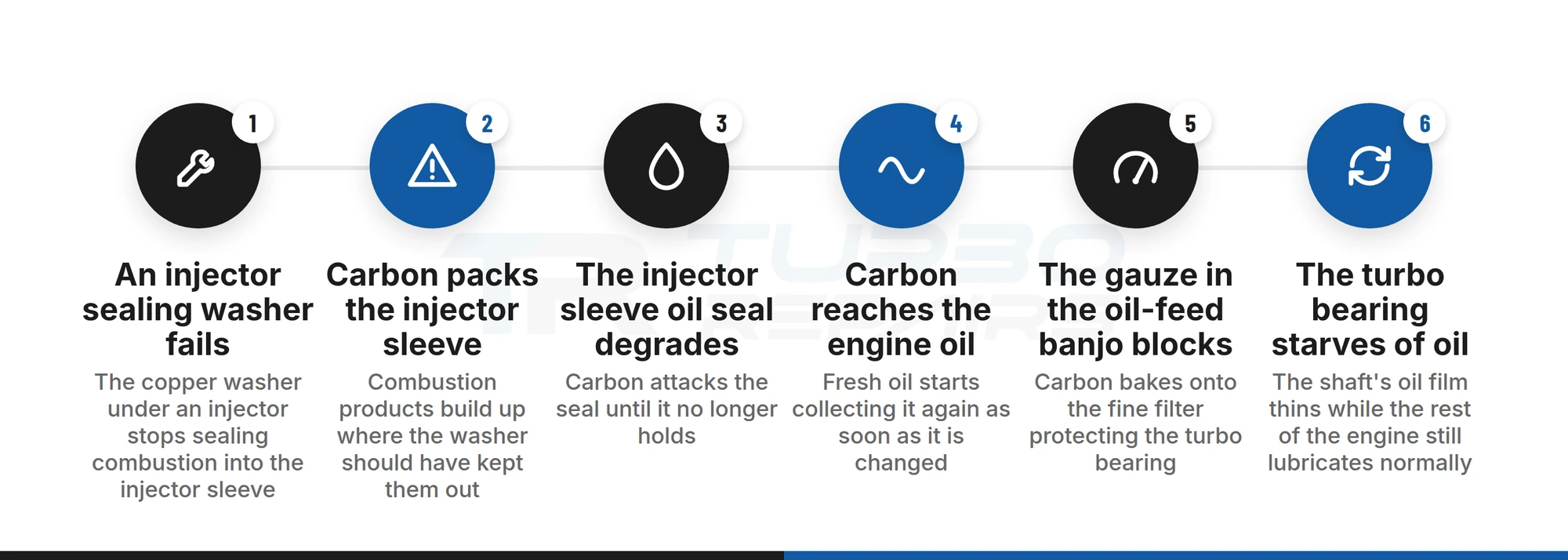
The most detailed published account of this failure on the PSA 1.6 TDCi is a workshop case study in the UK trade title Autotechnician. It puts the origin at the injectors, not at the turbocharger.
The chain it describes runs like this. The copper sealing washer under an injector fails, combustion products escape into the injector sleeve and pack it with carbon, and that carbon attacks the injector sleeve oil seal until it is no longer sealing. From there the carbon has a route into the engine oil, and once it is in the oil it goes wherever the oil goes.
Two things follow, and both matter more than the failure itself. First, the contamination has an active source — this is not oil that has simply aged. Fresh oil in an engine with a failed injector sleeve seal starts collecting carbon again straight away, which is why a shorter service interval protects a healthy engine and does little for one that has already let go. Second, the same case study records a replacement turbo fitted without the injector seals being dealt with. It failed within two weeks.
The particulate filter takes the blame for this failure more often than anything else, and the way this model is described invites it. The filter does belong on the clean-up list, because a turbocharger passing oil sends that oil into it — but the carbon that reaches the bearing arrives from the engine side. We do not remove particulate filters and we do not advise it.
How the Carbon Stops Oil Reaching the Turbocharger
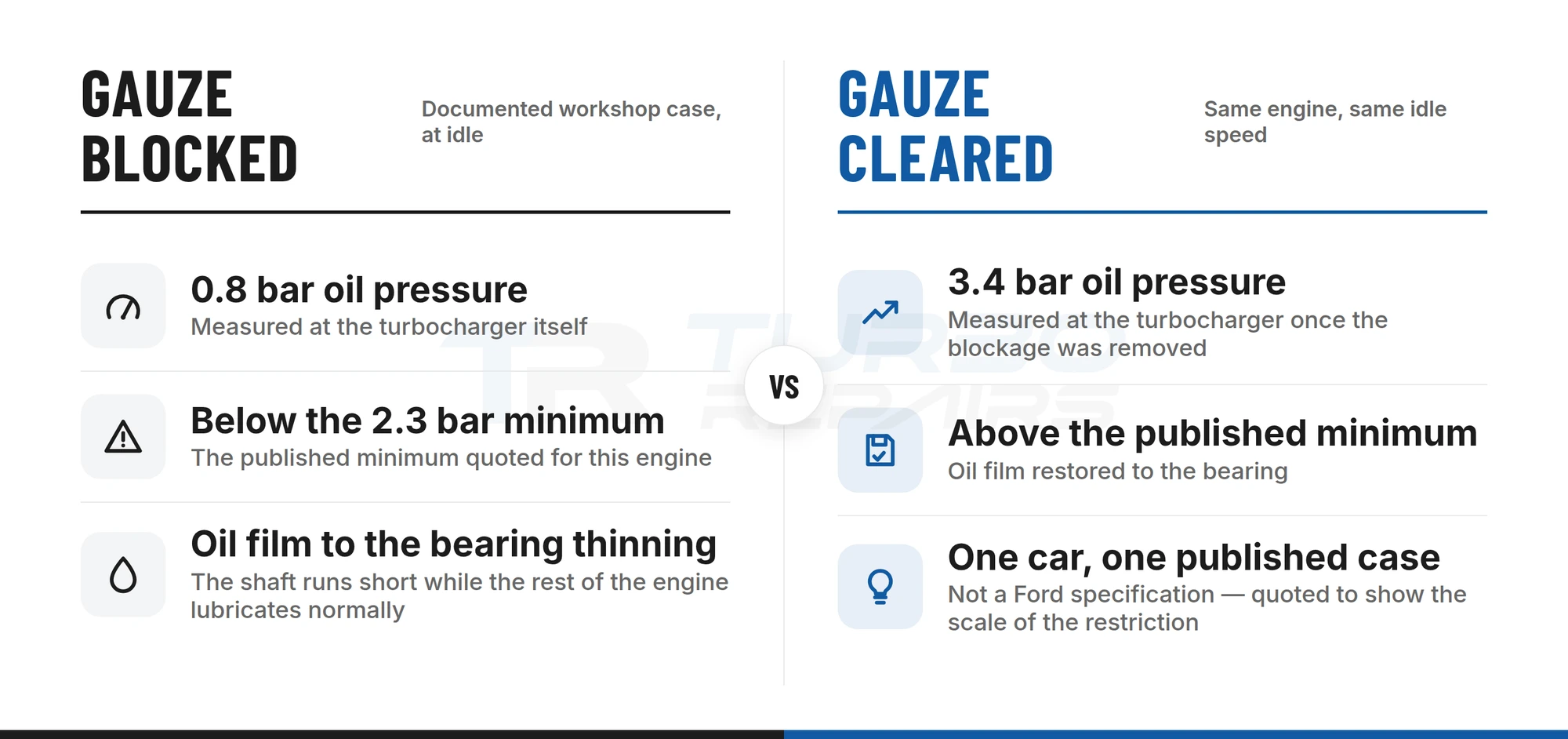
A turbocharger bearing never touches its housing. The shaft floats on a pressurised film of engine oil, and that film is the only thing between a shaft turning at well over a hundred thousand revolutions a minute and the metal around it. Thin the supply and the film thins with it.
On this engine the oil reaches the turbocharger through a feed whose banjo bolt contains a fine gauze filter. It is there to keep debris out of the bearing, and it does that until the debris arrives faster than it can pass. Carbon bakes onto the gauze, the aperture closes, and the bearing is left short of oil while the rest of the engine is still being lubricated normally.
That restriction is invisible unless the pressure is measured at the turbocharger itself, which is what the case study did. On that vehicle the reading was 0.8 bar at idle against the 2.3 bar minimum the article quotes; with the blocked gauze out, the same engine gave 3.4 bar. Those are one car’s measurements from one published job — not a Ford specification, and not a figure to test your own engine against; they are quoted to show the scale of the restriction.
In that case the technician also left the gauze out afterwards, once everything else had been cleaned. That was a judgement made in front of one specific engine, and we do not publish it as a general step.
The Symptoms, and What Each One Narrows Down
Power loss, with nothing arriving when you ask for full throttle. This says only that the engine did not reach the boost it commanded. A split boost hose or a loose clip produces it as convincingly as a worn turbocharger and costs far less to rule out, so it goes first.
A whine or siren that rises with throttle. A whistle climbing smoothly with load is usually air escaping from the pressure side; a metallic siren or grinding note that tracks engine speed is the rotating assembly, and that unit has to come off.
White-blue smoke that hangs in the air. Oil crossing the turbocharger’s seals. Do not confuse it with the thin white vapour a cold diesel makes on a winter morning, which thins out as the engine warms and smells of nothing.
Oil in the inlet pipework or the intercooler. A finding rather than a symptom — nobody sees this from the driver’s seat. It confirms oil is passing the seals but not why: bearing wear, a restricted oil return and crankcase pressure all produce it. It also has to be cleaned out before a rebuilt unit goes on.
Play in the shaft. Movement you can feel by hand is already far past worn. The measurement that decides whether a core can be rebuilt is taken on the bench in thousandths of a millimetre, not by hand on the car.
Three of those five only exist once something is off the vehicle, which is why the diagnosis firms up when the unit reaches us. Where a boost fault sits in the boost-control hardware instead of the turbocharger, that is a different repair — see our turbo actuator repairs.
Turbo Repairs · Epsom workshop
Let the old unit tell you what happened to the car
Post your Focus turbocharger in and we will strip it, measure the bearing surfaces and shaft, and tell you whether the wear reads as ordinary mileage or as a starved and contaminated oil supply. That answer decides what else has to be put right before anything goes back on.
Lifetime, unlimited-mileage warranty · Mail-in from the UK and internationally · Bench-tested and calibrated before it ships
Our Ford Focus 1.6 TDCi Turbocharger Rebuild
Your turbocharger is stripped to component level at our own workshop — Unit 102 Reaver House, 12 East Street, Epsom, Surrey, KT17 1HX, United Kingdom — by specialists who do this work daily. Shaft and wheels, bearing surfaces, seals, housings and the boost-control linkage are cleaned, inspected and measured against original specification.
Worn components are renewed with genuine OE or OEM-grade parts that meet or exceed the original specification, and anything carrying a known design weakness is uprated rather than reinstated in the form that failed. The rotating assembly is balanced, the unit is set up, and it is run on the bench before it is boxed.
The strip is also evidence. A bearing that has worn out on clean oil does not look like one that has run short of oil or run on contaminated oil, and on this engine that difference points straight back at the car. You get your own turbocharger back rather than an exchange unit off a shelf, with a lifetime, unlimited-mileage warranty that has no time limit. Turnaround is confirmed once your unit has been assessed. Start with the online Repair Form.
Why This Is a Bigger Job Than a Turbo Swap
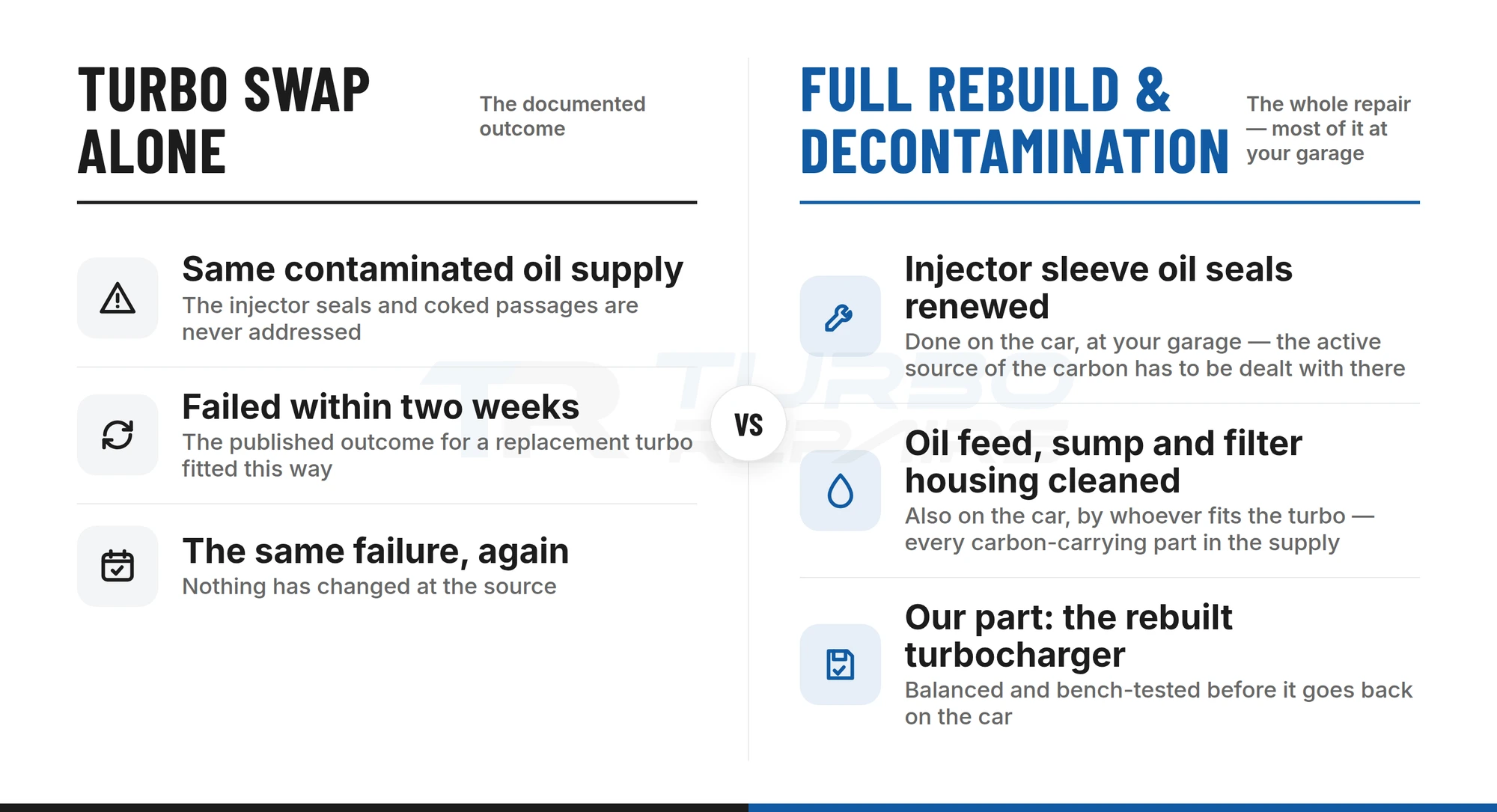
A rebuilt turbocharger is one item in a longer job, and the rest of that job is what decides whether the repair holds.
The same case study lists what the replacement turbo’s own fitting instructions required alongside it: the oil feed pipe and banjo bolts renewed, the sump removed and cleaned, the oil pick-up and strainer replaced, the oil filter housing and cooler cleaned, the intercooler cleaned, the exhaust checked for blockages, the particulate filter cleaned, the vacuum pump cleaned, the turbo oil return pipe cleaned, and fresh oil and filter fitted. The author then adds the item he says is most often skipped — the injector sleeve oil seals.
That is not a set of instructions for you to work through, and we are not the people fitting it. It is what the job contains, so you can recognise a quote that covers it. A Focus 1.6 TDCi turbo quote that accounts only for the turbocharger is usually a quote for doing this again.
Ford Focus Turbo Failure FAQ
Which Ford Focus 1.6 TDCi years suffer turbo failure?
There is no safe build year: the mechanism belongs to the engine rather than to a model year, and the same 1.6 diesel appears under several other badges. What decides it on an individual car is the condition of the oil and of the feed to the turbocharger.
Why did my replacement turbo fail again?
Because the thing that starved the first one was still on the car. In the published case, a replacement fitted without the injector sleeve seals being renewed and the oil system decontaminated lasted two weeks.
Can a Focus 1.6 TDCi turbocharger be rebuilt, or does it have to be replaced?
Most are rebuildable. Bearings, seals, the shaft and wheel assembly and the boost-control hardware are all serviceable. What rules a core out is a cracked housing, or wheel damage severe enough that the geometry has gone — decided after the strip, not before it.
Do I send the whole turbocharger?
Yes — complete, with the boost-control hardware attached, exactly as it came off. Do not strip it and do not clean the identification plate. Where the fault sits in an electronic boost-control module rather than the turbocharger, that part can travel on its own: see our turbo actuator repairs, and our Ford Transit electronic turbo actuator page for the same work on a different Ford vehicle and a different part.
What warranty comes with the rebuild?
Every rebuild carries a lifetime, unlimited-mileage warranty — no mileage cap and no time limit. Postage, packing and what happens at each stage are covered in our FAQs.
Final Thoughts
Almost everything written about this failure treats the turbocharger as the subject. On the 1.6 TDCi it is the object — the part that shows the damage first, and the most expensive item in a chain of much cheaper ones.
Read that way, the repair stops being a purchase and becomes a sequence: find out what the wear on the old unit is telling you, deal with what put the carbon in the oil, and only then put a properly rebuilt turbocharger back on a supply that can feed it.
Turbo Repairs · Epsom workshop
Have your Focus turbocharger rebuilt, not swapped
Send the unit in with your registration, engine details and everything readable on the plate, and tell us when the oil was last changed and whether the feed pipe has ever been renewed. We strip it, measure it, rebuild it on genuine OE or OEM-grade parts, balance it and bench-test it before it goes back in the box.
Lifetime, unlimited-mileage warranty · Mail-in from the UK and internationally · Bench-tested and calibrated before it ships