

Summary We rebuild the twin turbochargers from the Range Rover’s two V8 diesels, the 3.6 TDV8 and the 4.4 SDV8. Your garage takes off the unit that failed, or both, and posts them to us; each one is stripped, measured, rebuilt, balanced and run on the bench, then sent back ready to refit. Rebuilds start from £185 plus VAT per turbocharger, and every one carries a lifetime, unlimited-mileage warranty.
On the 3.6 TDV8 the parts trade sells the turbochargers by side, left or right, and the manifold gaskets and fitting kits that go with them are handed too.
- Covered here: the 3.6 TDV8 and 4.4 SDV8 diesels, as listed for the Range Rover and the Range Rover Sport
- The 3.6 as listed: filed under the Range Rover L322, turbochargers listed from 2007, sold as a left-hand and a right-hand unit
- The 4.4 as listed: filed as the 4.4 TDV8, engine code 448DT, for the Range Rover from 2010 and the Range Rover Sport from 2011, at 308 or 335 hp
- Makers named: BorgWarner, for both 3.6 units; none of the 4.4 listings we read names a maker
- Bench time and warranty: typically one to three working days; lifetime, with no mileage limit
Which Range Rover Engine Do You Have? 3.6 TDV8 or 4.4 SDV8
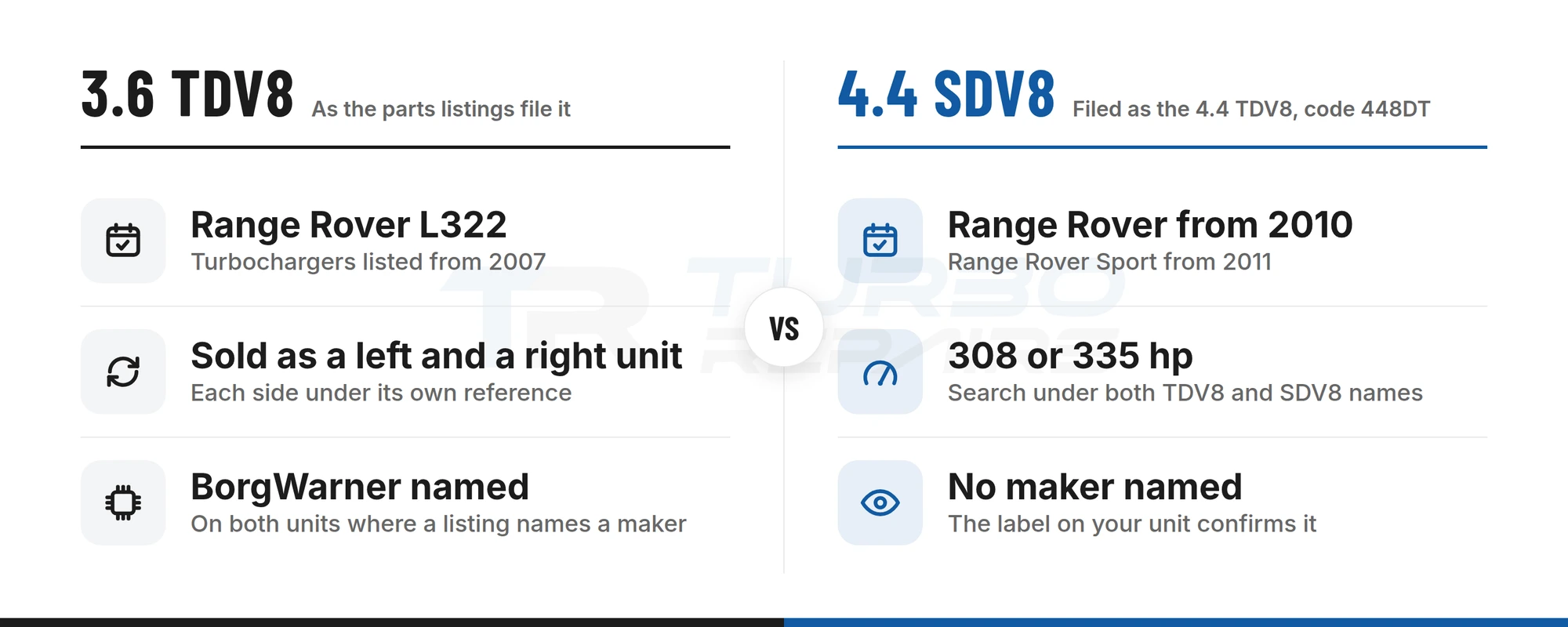
Two V8 diesels appear in the Range Rover parts listings, and the listings keep them separate. One Land Rover parts retailer carries the 3.6 TDV8’s turbochargers in its 2009 to 2012 L322 range and describes them as fitting from 2007. The 4.4 is listed for the Range Rover from 2010 and for the Range Rover Sport from 2011.
Those dates meet around 2010, so the badge and the model year cannot settle it on their own. The engine capacity on your V5C does, and the label on each turbocharger confirms it once the units are off.
Names are a trap too. Our pages call the larger engine the 4.4 SDV8, while the parts listings we read file it as the 4.4 TDV8, so search under both. One retailer lists a 3.6 TDV8 drain pipe gasket for the Range Rover Sport as well as the L322, but every 3.6 turbocharger listing we read is for the L322; if yours came off a Sport, the label decides.
Not a V8? The other Range Rover diesels
The 3.0 TDV6 and SDV6 are covered on our Range Rover 3.0 TDV6 and SDV6 turbo rebuild page. The BMW-based 3.0 Td6 diesel in the L322 is not covered here, so send its label through the Repair Form. Every other diesel is routed from our Land Rover turbo rebuild page.
Two Turbochargers, Two Roles: How Each V8 Pair Is Catalogued
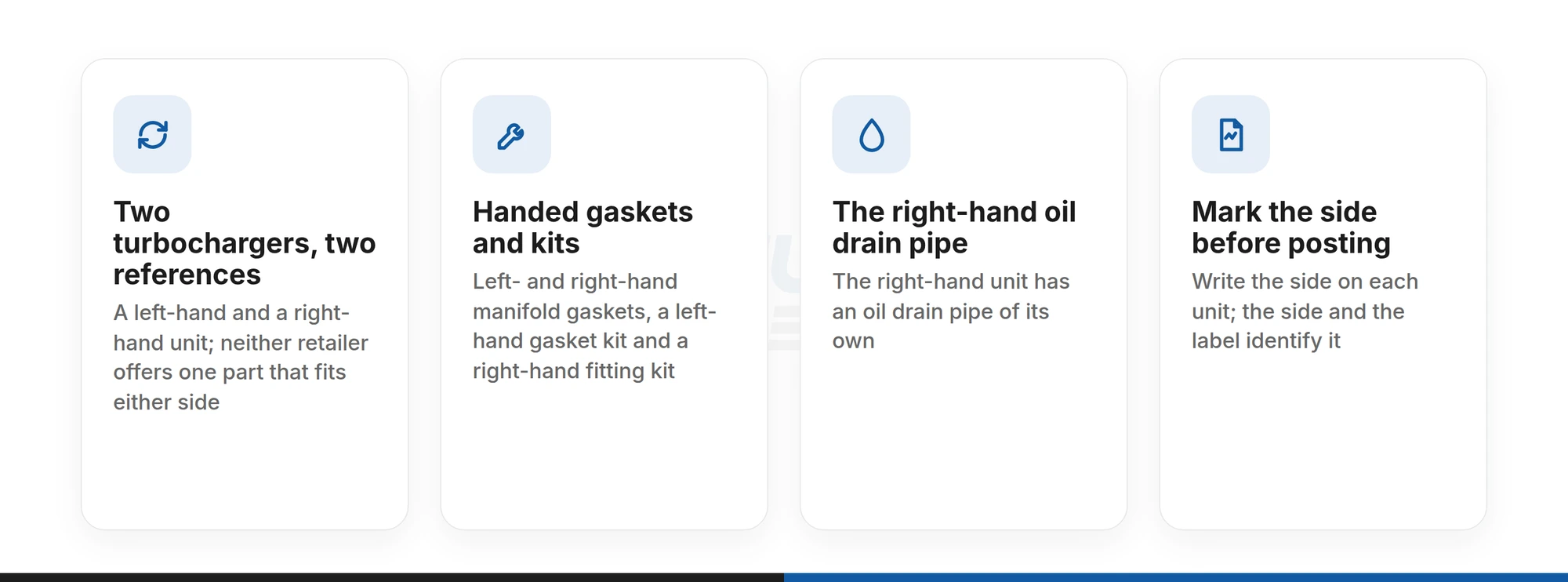
On the 3.6, the role of each turbocharger is a side. Both Land Rover parts retailers we read sell a left-hand unit and a right-hand unit, each under its own reference, and neither offers one part that fits either position. The handing carries on into the parts around them: the gasket between each turbo and its manifold comes in left- and right-hand versions, one retailer sells a left-hand gasket kit and a right-hand fitting kit, and the right-hand unit has an oil drain pipe of its own.
Where a listing names a maker for the 3.6, it is BorgWarner. One retailer labels both its left-hand and right-hand units BorgWarner, and a turbo specialist’s 3.6 listing names BorgWarner as well. That specialist describes its unit as variable geometry, and its references match the left-hand side. None of the listings we read states the geometry of the right-hand unit, so we take that from the turbocharger itself.
The 4.4 pair is catalogued less consistently. One retailer sells a reconditioned right-hand 4.4 assembly with a matching fitting kit, while two turbo specialists list 4.4 units under references that differ from each other, without naming a side or a maker. What each of your two 4.4 units does in the system is not something those listings tell us, so we read it from the label and confirm it on the bench.
On either engine, mark each unit with the side it came off before it goes in the box: the side and the label identify it, where the vehicle alone does not.
What Fails on the TDV8 and SDV8 Turbos
Each of the pair is a complete turbocharger, with a compressor wheel and a turbine wheel on a common shaft turning in oil-fed bearings. The two fail separately, and the wear falls into three tiers on either side.
- Bearings, thrust parts and seals. Wear items, renewed in every rebuild. Once they wear, the shaft moves, oil gets past the seals as blue smoke or oily intake hoses, and if the engine keeps running the blades start to touch their housing, which you hear as a whine or siren.
- The vane mechanism. On a variable-geometry unit, carbon collects on the vanes until the nozzle ring stops moving freely, showing as lost power, limp mode and over-boost or under-boost codes.
- Wheels, shaft and housings. Built to outlast the wear parts. The turbine wheel is welded to its shaft, so the two are renewed as one, and a cracked housing decides whether a rebuild or an exchange unit is the better buy.
Oil is the common thread: a restricted feed, dirty oil from late services, or coking when a hot engine is switched straight off. Our guide to what causes turbo failure shows how each cause marks the parts, and blown turbo symptoms covers the warning signs.
Finding the side that failed
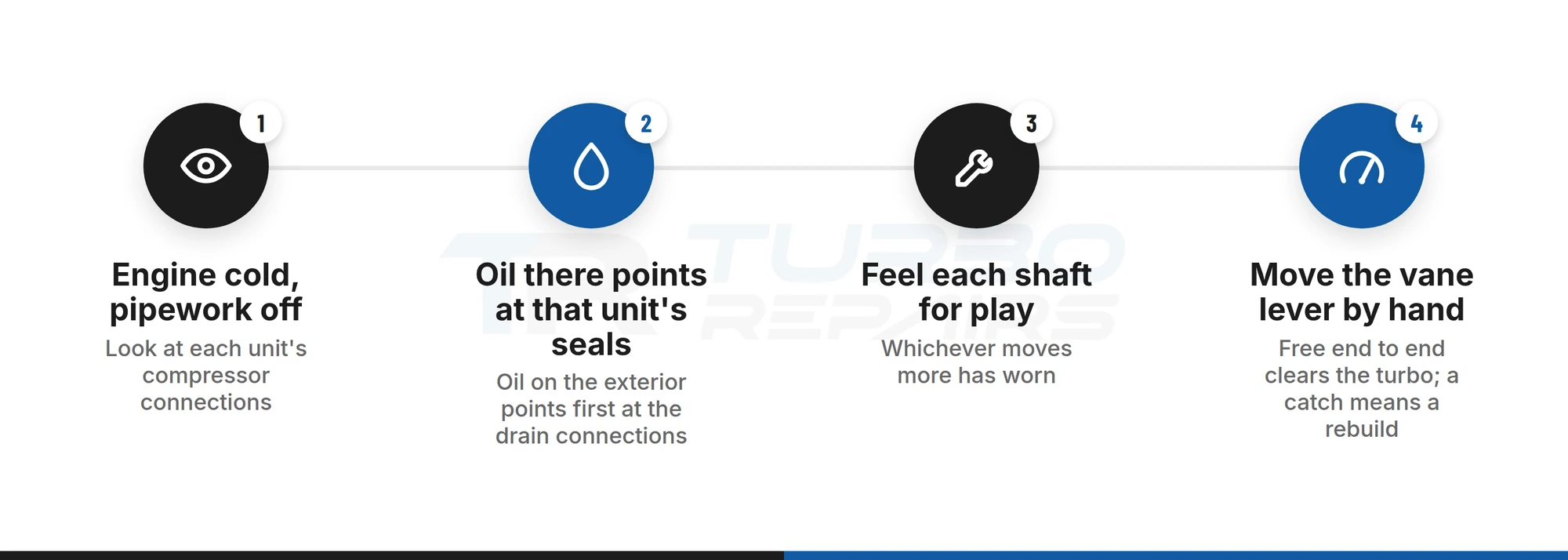
A stored code or a flat engine tells you the system has a fault, not which unit. With the engine cold and the intake pipework off, look at each unit’s compressor connections: oil there points at that unit’s seals. Then feel each shaft for play by hand; whichever moves more has worn. Oil coating a unit’s exterior points first at its drain connections, which is an engine-side repair rather than a rebuild, and for the 4.4 a genuine modified left-hand drain hose is catalogued separately.
Turbo or actuator?
A flat engine that neither smokes nor whines may not have a turbo fault at all. One retailer sells the 3.6’s actuator rod as a genuine part on its own, and a worn or badly set actuator leaves the vanes short of where the engine asks, raising the same codes as a sticking vane ring. Disconnect the actuator and move the vane lever by hand: free from end to end clears the turbo, while a lever that catches means the turbo needs the rebuild. Our electronic turbo actuator repairs start from £100 plus VAT; the listings we read do not say which actuator your units carry, so tell us what is fitted.
Rebuild Both, or Just the One? Each Unit Is Judged on Its Own
There is no blanket rule we can give you honestly, so here is what the decision rests on.
- Both units run on the same engine oil. Both units draw on the same engine oil, so an oil-feed or contamination fault is checked at both before either goes back on.
- Each unit is assessed separately. Send both and each gets its own strip-down, findings and price, because a unit with play at the seals and one inside tolerance are two different jobs.
- The checks above decide what to send. If oil or shaft play shows at one unit only, that unit comes to us. If it shows at both, send both.
Ask your garage to note what it finds at each unit and put those notes on the Repair Form. A pair of new units replaces the healthy one with the failed one; a rebuild renews only what has worn.
What a Range Rover Turbo Costs to Rebuild or Replace
- Rebuilding your own unit: from £185 plus VAT per turbocharger, where the housings, wheels and shaft can be reused. On a pair, each unit is priced on its own.
- Replacement turbocharger: from £450 plus VAT, a reconditioned exchange turbocharger or new unit for when yours is not worth rebuilding, checked against your label before we supply it.
- Actuator-only repair: from £100 plus VAT.
The rebuild figure follows the strip-down. Wear parts alone keep it close to £185 plus VAT; a wheel, shaft or housing that measures out of tolerance raises it. Removal and refit, gaskets, fresh oil and a filter, and any repair to the cause sit on your garage’s bill. What every turbo rebuild includes is set out on our hub.
Turbo Repairs · Epsom workshop
Mark the side, then send the unit that failed
Write the side on each unit, add its label reference and your stored codes to the Repair Form, and post it in. Every unit is stripped and measured, and its price reaches you before any rebuild work begins.
Lifetime, unlimited-mileage warranty · Mail-in from the UK and internationally · Bench-tested and calibrated before it ships
How to Send Your TDV8 or SDV8 Turbos In
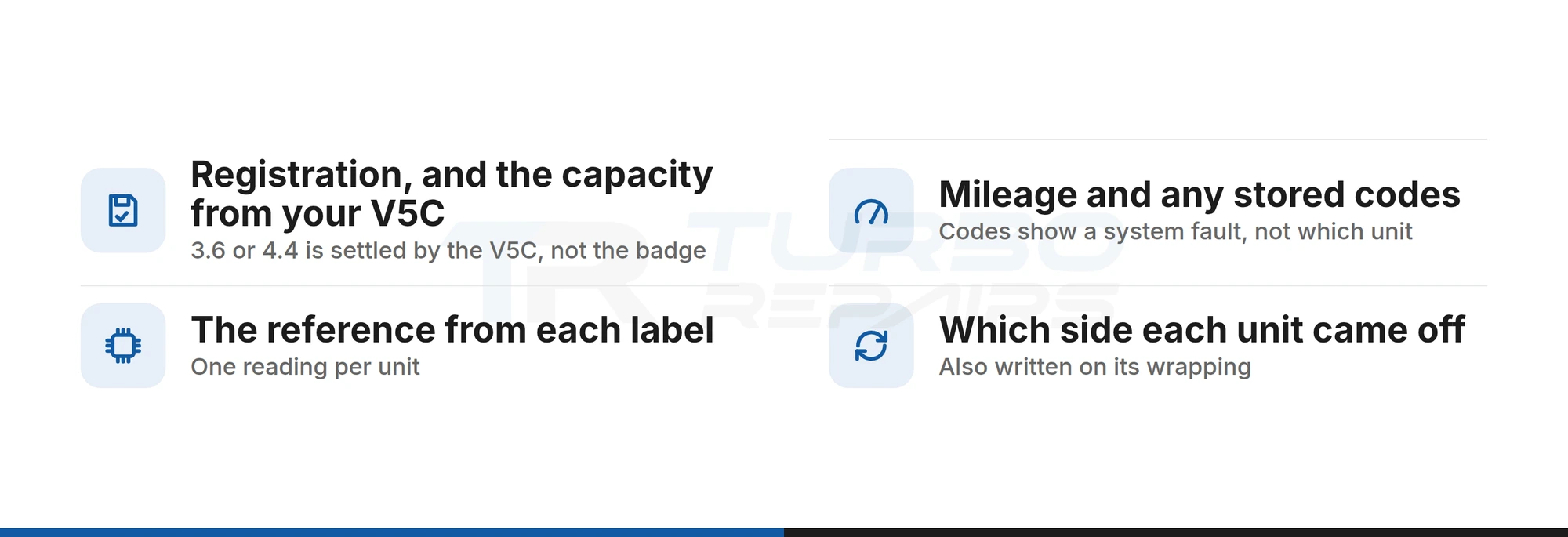
- Complete the online Repair Form with the registration, the capacity from your V5C, the mileage, any stored codes, the reference from each label, and which side each unit came off.
- Leave each actuator on its unit. Removal and refitting can be done by your own garage.
- Pack and post them. Blank every oil and air port, wrap each unit on its own with its side written on the wrapping, and pad both wheel ends inside a rigid box. Send it to Unit 102 Reaver House, 12 East Street, Epsom, Surrey, KT17 1HX, United Kingdom.
- On the bench. Each unit is identified, stripped and measured. Bearings, thrust parts and seals are renewed as standard, anything outside tolerance is replaced with a genuine OE or OEM-grade part, and the core is balanced, its boost control set and the unit run.
- Back to you. Bench time is typically one to three working days, plus postage each way.
At refit, the oil feed is renewed or flushed, the gaskets replaced, the oil and filter changed, and each turbo primed with fresh oil before the engine first runs.
Range Rover TDV8 and SDV8 Turbo FAQ
How much does a Range Rover turbo replacement cost?
A rebuild of your own unit starts from £185 plus VAT per turbocharger, and a replacement unit from £450 plus VAT. On a V8 each of the pair is priced separately, once it has been stripped. Your garage charges separately for removal and refitting.
Do I need to replace both turbos on a TDV8?
Not as a rule. Send the unit that shows oil or shaft play, or both if both do. Because the pair shares the engine’s oil, the cause is checked for both either way.
Are the left and right 3.6 TDV8 turbos the same part?
No. They are sold under separate references, and even their manifold gaskets are handed. Mark each unit with its side before you post it.
Who makes the Range Rover TDV8 turbos?
The listings that name a maker for the 3.6 name BorgWarner, for both sides. None of the 4.4 listings we read names one, so the label on your unit confirms it.
Final Thoughts
A turbo fault on a V8 Range Rover is a question about one of two parts that are not interchangeable, and on the 3.6 the trade sells even the gaskets by side. That makes the side the first thing to record, ahead of the badge, the model year or the price of a new pair.
After that, the bench decides more than the engine does. Both units feed from the same oil, so the cause is checked for both; each is then measured, priced and rebuilt on its own findings, and the unit that comes back is the one that left your engine.
Turbo Repairs · Epsom workshop
Have your 3.6 TDV8 or 4.4 SDV8 turbos rebuilt
Send one unit or both, each marked with its side, with the label reference and your stored codes on the Repair Form. Each is identified, stripped, rebuilt and balanced, then run on the bench and boxed for its trip home.
Lifetime, unlimited-mileage warranty · Mail-in from the UK and internationally · Bench-tested and calibrated before it ships