

Summary We rebuild Audi A4 TDI turbochargers at component level — your own unit stripped, measured, rebuilt on genuine OE or OEM-grade parts, balanced, bench-tested and posted back ready to refit, under a lifetime, unlimited-mileage warranty. What makes this car its own job is what sits behind the turbine: on the filtered TDI cars the turbine discharges into a diesel particulate filter, which puts the state of that filter inside the turbocharger’s working conditions.
The A4 was sold with TDI engines on both sides of the particulate filter’s arrival, so two cars carrying the same TDI badge give their turbochargers quite different working lives.
Search for a turbocharger for an Audi A4 TDI and every route offered ends the same way: a different unit bolted to the car. Almost nothing explains what wore the first one out, and much of that wear comes from conditions the replacement inherits on its first drive.
- Engines we rebuild: 1.9 TDI (1896 cc) and 2.0 TDI (1968 cc) A4 saloon, Avant and Cabriolet
- Turbo families: Garrett variable-nozzle units on references such as 717858, 758219 and 818987; BorgWarner variable-geometry units on 5303-988- numbers
- Outputs catalogued: 130 PS to 197 bhp, on at least five distinct turbocharger references
- What you notice: limp mode, power loss under load, black or blue smoke, a whine or metallic siren, an underboost code such as P0299
- What we do: component-level rebuild of your own unit, bench-tested before it is boxed
- Warranty: lifetime and unlimited mileage, with no time limit
- How it works: mail-in from anywhere in the UK or internationally, via the online Repair Form
What Wears Out on an A4 TDI Turbocharger
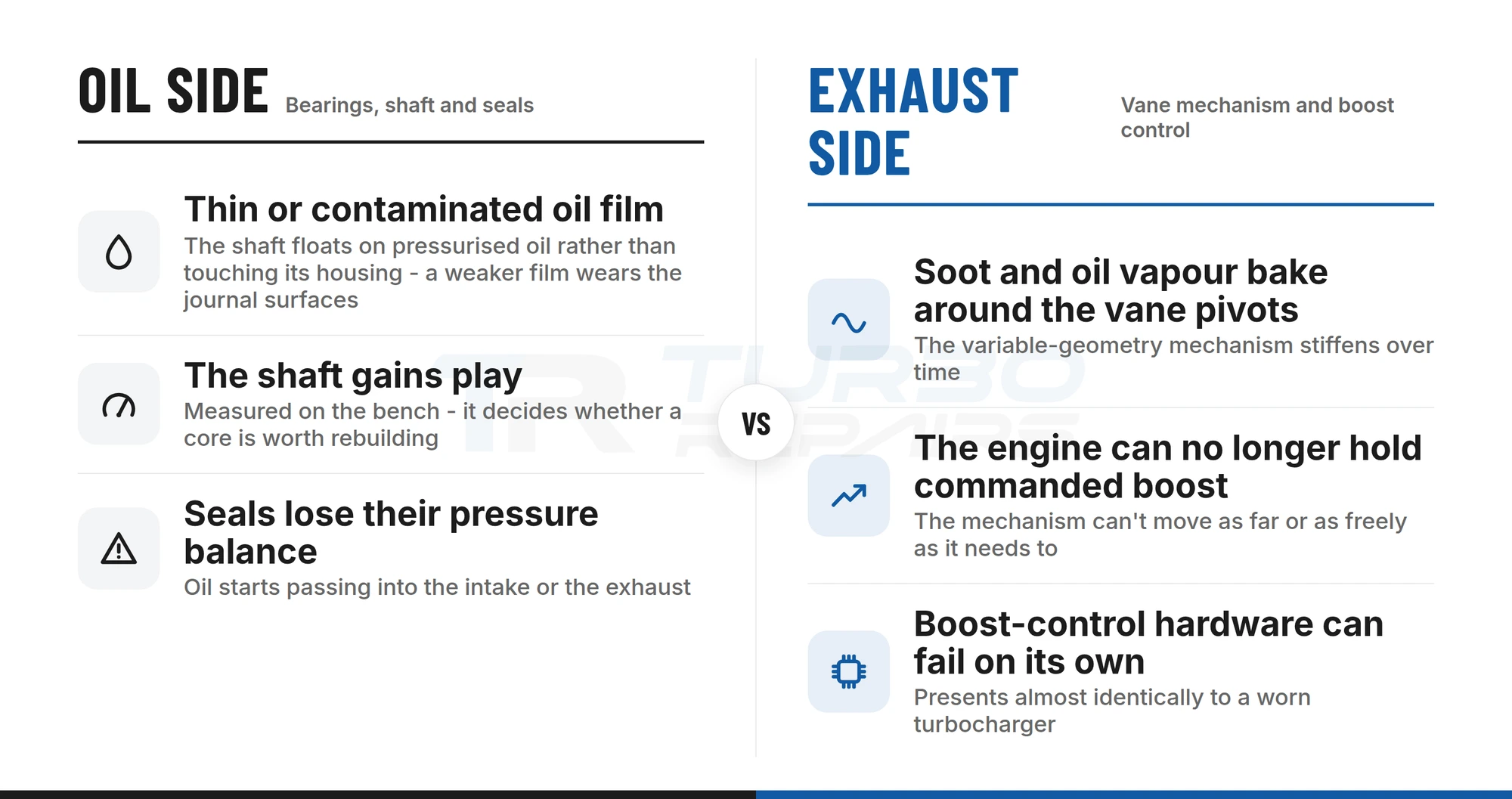
Damage reaches these units from two directions: the oil arriving from above, and the exhaust gas arriving from behind.
Bearings, shaft and seals. The shaft floats on a pressurised film of engine oil rather than touching its housing, so thin or contaminated oil makes a weaker film. Journal surfaces wear, the shaft gains play, and the seals lose the pressure balance they depend on — at which point oil starts passing into the intake or the exhaust. Play is measured on the bench, and it decides whether a core is worth rebuilding.
The vane mechanism. These are variable-geometry turbochargers: a ring of moving vanes around the turbine wheel narrows and opens to control boost. Soot and oil vapour bake around the vane pivots until the mechanism stiffens and the engine can no longer hold the boost it commands. The same architecture runs across Garrett’s diesel range — our Garrett GT2052V page covers another unit built the same way.
The boost-control hardware. Whatever moves that mechanism can fail on its own and presents almost identically to a worn turbocharger. If the vanes sweep freely, see our turbo actuator repairs.
The Filter Behind the Turbine Changes the Job
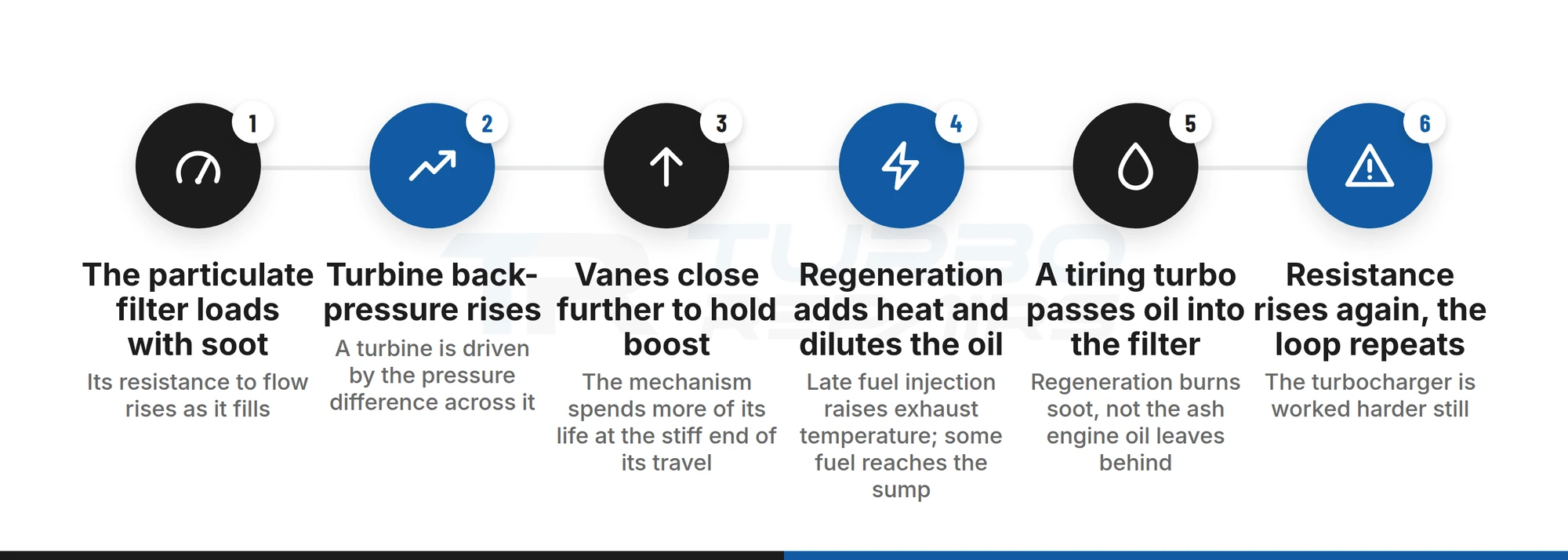
A diesel particulate filter sits downstream of the turbine, so everything the turbine pushes out passes through the filter before it reaches the tailpipe. That fact of layout puts the filter inside the turbocharger’s operating environment, and it works in both directions.
One way: as the filter loads with soot, its resistance to flow rises and so does the pressure the turbine discharges into. A turbine is driven by the pressure difference across it, so when the pressure behind it climbs, the boost-control system closes the vanes further to hold the same target — and the mechanism spends more of its life at the stiff end of its travel. Regeneration adds heat on top. To burn the trapped soot off, the engine injects fuel late in the cycle to raise exhaust temperature, and that heat reaches the turbine housing before it reaches the filter. Some of that late fuel also washes past the rings into the sump, thinning the oil the bearings depend on.
The other way: a turbocharger passing oil past its seals sends that oil into the filter behind it. Regeneration burns soot; it does not burn the incombustible ash engine oil leaves. A tiring turbo therefore loads the filter with residue that will not come out again, resistance rises, the vanes close further, and the turbocharger is worked harder still. That loop is why a smoking unit on this car is not a wait-and-see fault.
None of this is an argument for taking the filter out. We do not remove diesel particulate filters and we do not advise it: a road car that has had its filter removed will not pass an MOT, and removal does nothing for a turbocharger that has already worn.
Which A4 TDI Turbocharger Is on Your Car
“A4 TDI” covers two displacements and at least five distinct turbocharger references, catalogued roughly as follows.
1.9 TDI, 1896 cc. The B5 and B6 cars to the end of 2004, the last of them at 96 kW / 130 PS. Garrett units, listed against Audi references 035145702H, 035145702K and 038145702H.
2.0 TDI, 1968 cc. From the B7 in late 2004: 100 kW / 136 PS and 103 kW / 140 PS, saloon, Avant and Cabriolet. The Garrett 717858 base reference is catalogued against both those cars and the 130 PS 1.9 TDI B6, so the displacement badge is not where the turbochargers divide.
The higher-output 2.0 TDI cars. Garrett 758219 against 03G145702F at 177 bhp, engine codes BRE, BRF, BVF and BVG, 2004 to 2008. BorgWarner 5303-988-0109 against 03G145702H at 170 bhp, codes BRD and BVA, 2006 to 2008. BorgWarner 5303-988-0189 and 5303-988-0190 on 03L145701 and 03L145702 numbers at 141 and 170 bhp, codes CAGA, CAGB, CAGC and CAHA, 2008 to 2012. Garrett 818987 against 03L145721BV100 at 197 bhp, codes CGLC and CMBG, from 2011. BorgWarner units come to the same bench as those on our BorgWarner K03/K04 repair page.
Treat that as a shortlist to check, not a fitment guarantee: references supersede and catalogues disagree. The plate on your own compressor housing settles it, so photograph the whole plate rather than transcribing part of it. A reference missing from the list above is not one we cannot rebuild.
Turbo Repairs · Epsom workshop
Find out what actually wore out, before you buy anything
Post your A4 turbocharger in and we will strip it, measure the shaft and bearing surfaces, and tell you whether the wear points at the oil or at the exhaust side.
Lifetime, unlimited-mileage warranty · Mail-in from the UK and internationally · Bench-tested and calibrated before it ships
Symptoms, and What Each One Narrows Down
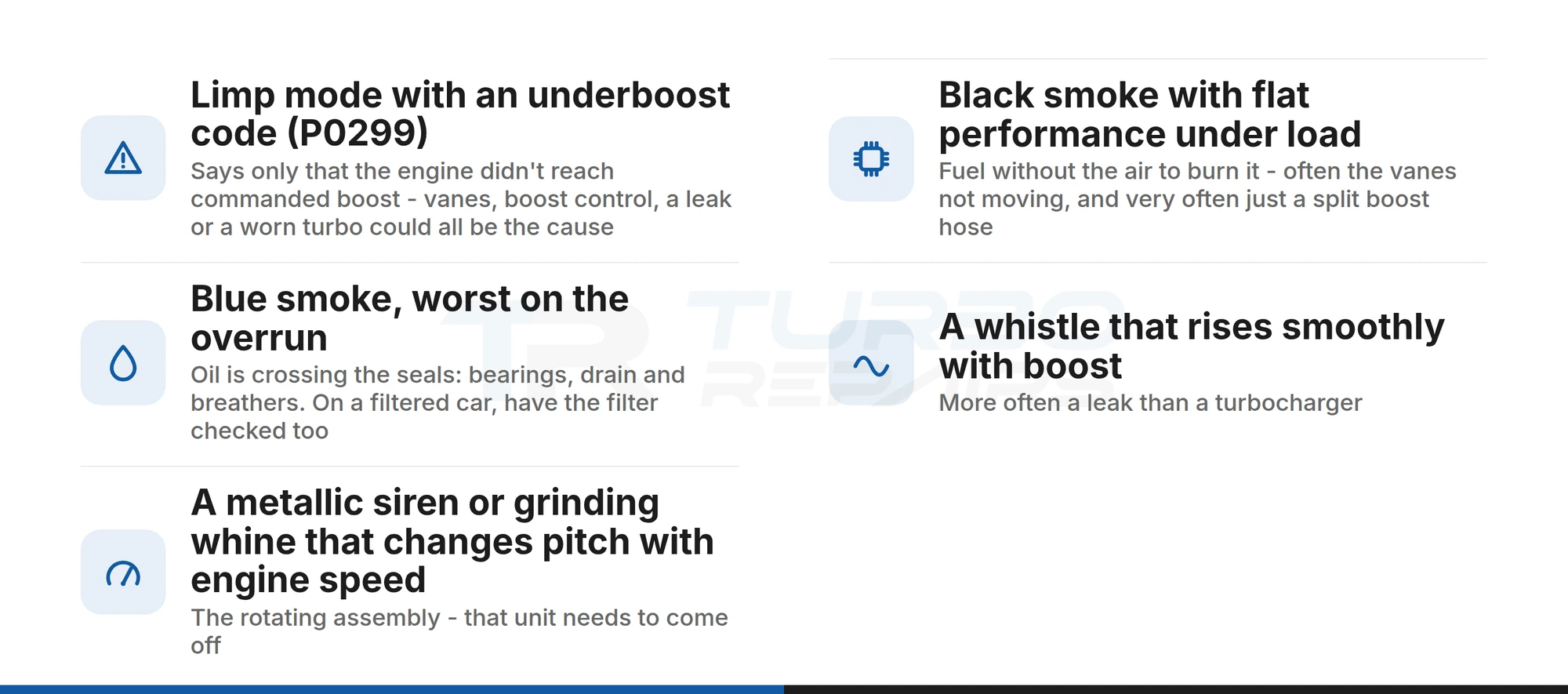
Limp mode with an underboost code. P0299 is the generic underboost fault, and your car may store it under a VAG-specific number too. It says only that the engine did not reach the boost it commanded, which covers a stiff vane mechanism, a boost-control fault, a pressure-side leak and a worn turbo alike.
Black smoke with flat performance under load is fuel without the air to burn it. On a variable-geometry unit that usually means the vanes are not going where they are told — and it is very often a split boost hose before it is anything expensive.
Blue smoke, worst on the overrun or as boost arrives, means oil is crossing the seals: bearings, drain and breathers. On a filtered car, have the filter checked as well.
Noise. A whistle rising smoothly with boost is more often a leak than a turbocharger. A metallic siren or a grinding whine that changes pitch with engine speed is the rotating assembly, and that unit needs to come off.
Our Audi A4 TDI Turbocharger Rebuild
Your unit is stripped to component level at our Epsom workshop by turbo specialists who do this work daily. Every part is cleaned, inspected and measured against original specification: shaft and wheels, bearing surfaces, seals, the nozzle ring and vane mechanism, the housings and the boost-control linkage.
Worn components are replaced with genuine OE or OEM-grade parts that meet or exceed original specification, and a component with a known design weakness is uprated rather than reinstated in the form that failed. Housings are machined where needed, the rotating assembly is balanced, and the unit is run on the bench before it is boxed.
You get your own turbocharger back rather than an exchange unit off a shelf. Every rebuild carries a lifetime, unlimited-mileage warranty with no time limit, and K03/K04-family units are typically two to three working days from arrival.
Making the Rebuilt Unit Last
A rebuilt turbocharger goes back into the same engine, with the same oil, filter and driving pattern.
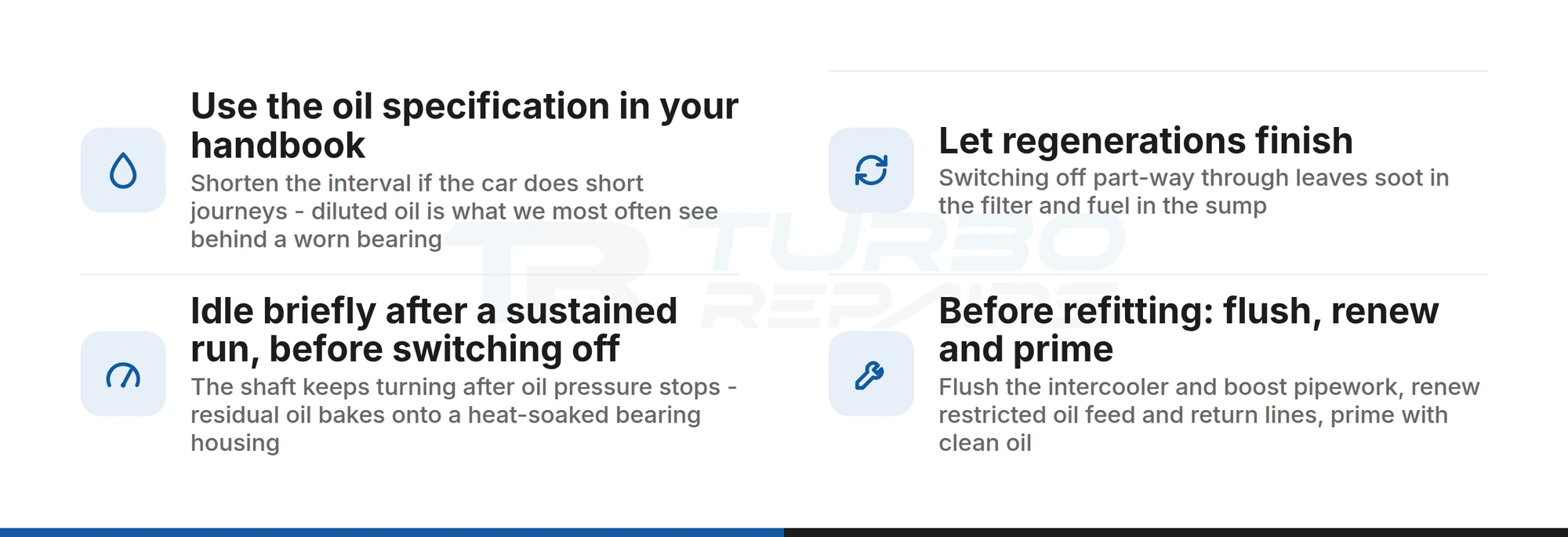
- Use the oil specification in your handbook, and shorten the interval if the car does short journeys. Filtered diesels are specified on low-ash oil for a reason, and diluted oil is what we most often see the consequences of on a bearing.
- Let regenerations finish. Switching off part-way through leaves soot in the filter and fuel in the sump, and the car simply tries again on the next run.
- After a sustained run, let it idle briefly before switching off. The shaft keeps turning after oil pressure stops, and residual oil in a heat-soaked bearing housing bakes onto the surfaces it was meant to protect.
- Before refitting, flush the intercooler and boost pipework, renew restricted oil feed and return lines, and prime the turbocharger with clean oil.
Audi A4 TDI Turbo FAQ
Did the DPF cause my A4 TDI turbo to fail?
Usually it is a contributor rather than the whole cause. A loaded filter raises the pressure the turbine exhausts into and makes the boost-control system work the vane mechanism harder, while frequent regeneration adds heat and dilutes the oil. It runs the other way too: a turbo passing oil loads the filter with ash regeneration cannot burn off. The two wear each other, so both are worth assessing together.
Can an A4 1.9 or 2.0 TDI turbocharger be rebuilt, or does it have to be replaced?
The large majority are rebuildable. Bearings, seals, the shaft and wheel assembly, the nozzle ring and the vane mechanism are all serviceable. What rules a core out is a cracked housing, or wheel damage severe enough that the geometry has gone — and we can tell you which after the strip, not before it.
Do I have to replace the particulate filter at the same time?
Not automatically. If the turbocharger has been passing oil, have the filter’s condition and back-pressure checked: ash loading is permanent, and a heavily loaded filter puts the rebuilt turbo back into the conditions that wore out the first one. We do not remove filters and we do not advise removing them.
How long does it take, and what warranty comes with it?
K03/K04-family units are typically two to three working days from arrival, plus postage each way, confirmed once yours has been assessed. Every rebuild carries a lifetime, unlimited-mileage warranty — no mileage cap, no time limit. Postage and packing are covered in our FAQs.
Final Thoughts
Almost everything published about A4 TDI turbochargers is about acquiring one. That is reasonable if the turbocharger is an item to be bought, and a poor guide if it is a component whose life is being shortened by something still bolted to the car.
On a filtered TDI it usually is. Strip the old unit, read what the wear is telling you, and put the causes right at the same time as the turbocharger.
Turbo Repairs · Epsom workshop
Have your A4 TDI turbocharger rebuilt, not swapped
Post the unit in with your registration, engine code and the references off the plate. We strip it, measure it, rebuild it on genuine OE or OEM-grade parts, balance it and bench-test it — then tell you what the wear says about the car it came off.
Lifetime, unlimited-mileage warranty · Mail-in from the UK and internationally · Bench-tested and calibrated before it ships