

Summary A VNT turbo is a turbocharger with a ring of moving vanes around its turbine wheel instead of a fixed passage. Garrett calls its version VNT, BorgWarner calls its version VTG, and Holset and most of the trade say VGT: three names for one idea, and one set of problems.
Those vanes stick because soot and oil residue bake onto their pivots and onto the ring that turns them, and it happens fastest on cars that spend their lives on short journeys. A sticking ring is fixed by taking the turbocharger apart, freeing the mechanism and renewing the nozzle ring if its pivots have worn. A clean on its own, a hard run or a new actuator does not fix it.
The carbon that jams a variable-vane turbo does not care whether the housing says VNT, VGT or VTG, so the fault and the repair are the same under all three names.
VNT, VGT, VTG: One Idea Under Several Names
Each manufacturer uses its own letters. Garrett sells its design as VNT, for variable nozzle turbine. BorgWarner calls its version VTG, for variable turbine geometry. Holset uses VGT, for variable geometry turbocharger, and VGT is also the loose term most of the trade uses for the whole family. IHI and Mitsubishi build variable-vane turbochargers as well.
The terms overlap so much that Garrett’s own VNT product page calls the same unit a “Variable Geometry Turbo” and a VNT in one sentence. So if a parts listing says VGT, your garage’s invoice says VNT and the diagnostic tool reports “variable turbine geometry”, all three are describing the same kind of part. They are not three different faults, and they do not need three different repairs.
Here is the mechanism in brief. The vanes sit in a ring around the turbine wheel and all pivot together. Closed down, they narrow the path so the small amount of exhaust gas available at low engine speed reaches the wheel fast and boost comes in early. Opened up, they widen it so the turbine cannot overspeed at high revs. We explain how the variable vane mechanism works in full on our Garrett GT2052V page, and our actuator guide covers what the actuator moves and how it is controlled.
Three practical points follow from the naming:
- Where you will find one. Variable-vane turbochargers are fitted to most diesel cars and vans, and to a growing number of petrol engines. Garrett states that its VNT suits single-turbo engines from 1.0 to 3.0 litres, and that its first high-volume petrol version went into production with Volkswagen in 2017.
- How a Garrett name tells you. A trailing V in a Garrett designation, as in GT2052V, marks the variable nozzle turbine. The designation is still a size code, not a part number. Your unit is identified by the plate on the compressor housing.
- Why the wastegate is usually missing. Because the vanes regulate the turbine themselves, most variable-vane turbochargers have no conventional wastegate. A listing that sells a “wastegate actuator” for one is almost always selling the part that turns the vane ring.
Why Variable Vanes Stick
The vanes sit in the exhaust stream, between the manifold and the turbine wheel, and unlike the wheel they do not spin freely: they have to hold precise positions. Each vane turns on its own pivot, and all of them are linked to a unison ring behind the nozzle ring. The gaps that allow the vanes to be set precisely are small, so it does not take much deposit to close them.
The deposit comes from two sources. The first is soot, which diesel combustion always makes. The second is oil residue, from exhaust gas recirculation and from crankcase breather vapour. Exhaust heat bakes the two together into a hard layer on the vane pivots, the unison ring and the faces of the nozzle ring. If the turbo is also passing oil at its turbine-side seal, that end gets a supply of its own. Long spells of very high exhaust temperature make things worse: the deposit bakes harder, and the nozzle ring can distort.
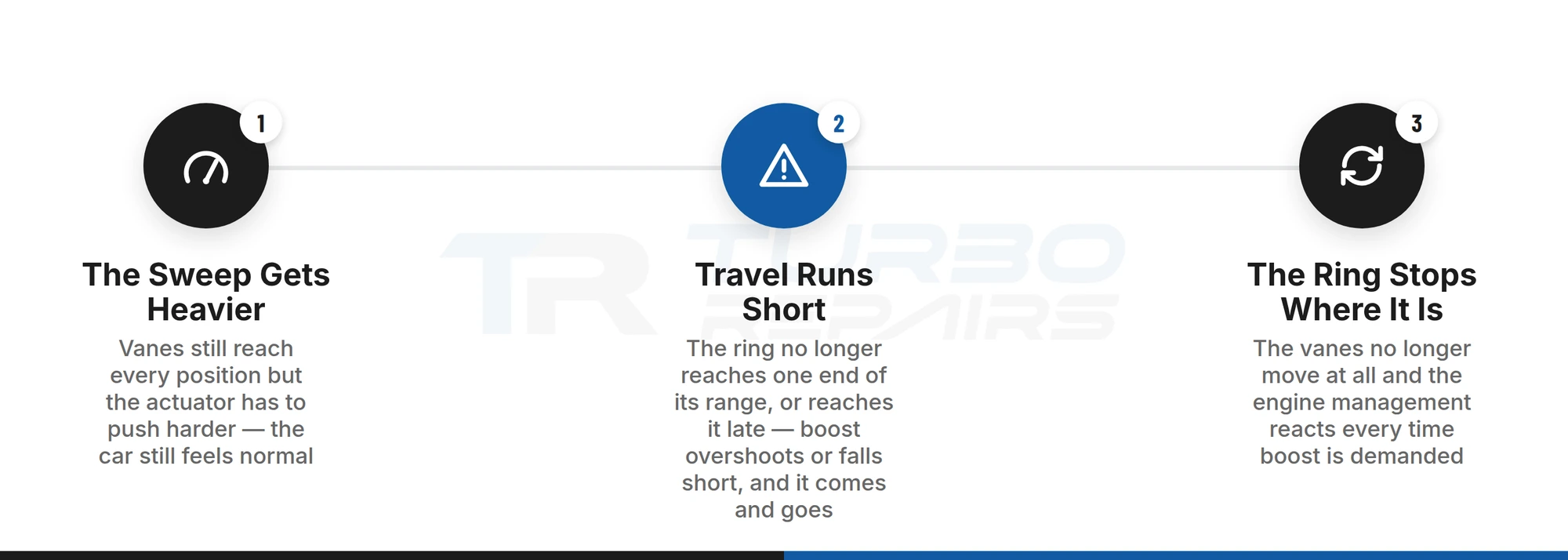
The mechanism rarely seizes all at once. It gets worse in stages:
- The sweep gets heavier. The vanes still reach every position, but the actuator has to push harder to get them there. The car feels normal.
- Travel runs short. The ring no longer reaches one end of its range, or reaches it late. Boost overshoots or falls short at particular speeds, and the fault comes and goes.
- The ring stops where it is. The vanes no longer move at all, and the engine management reacts every time boost is demanded.
Where the ring stops decides what the driver feels. Stuck closed, the turbocharger makes too much boost too soon. Overboost is a real risk to the turbo’s internal components, and the engine usually drops into limp mode to protect itself. Stuck open, boost never builds properly, and the engine may produce black smoke under acceleration because it is fuelled for air that is not arriving. Our guide to overboost and underboost codes explains which code each position sets.
Underneath the carbon there can be wear. The vanes turn on pivots, and a pivot that has worn oval will bind however clean it is. Carbon adds load while it is there, so wear and deposit tend to arrive together. That is why this page does not treat “sticking vanes” as another name for “dirty vanes”.
Driving Patterns That Coke Up the Vanes
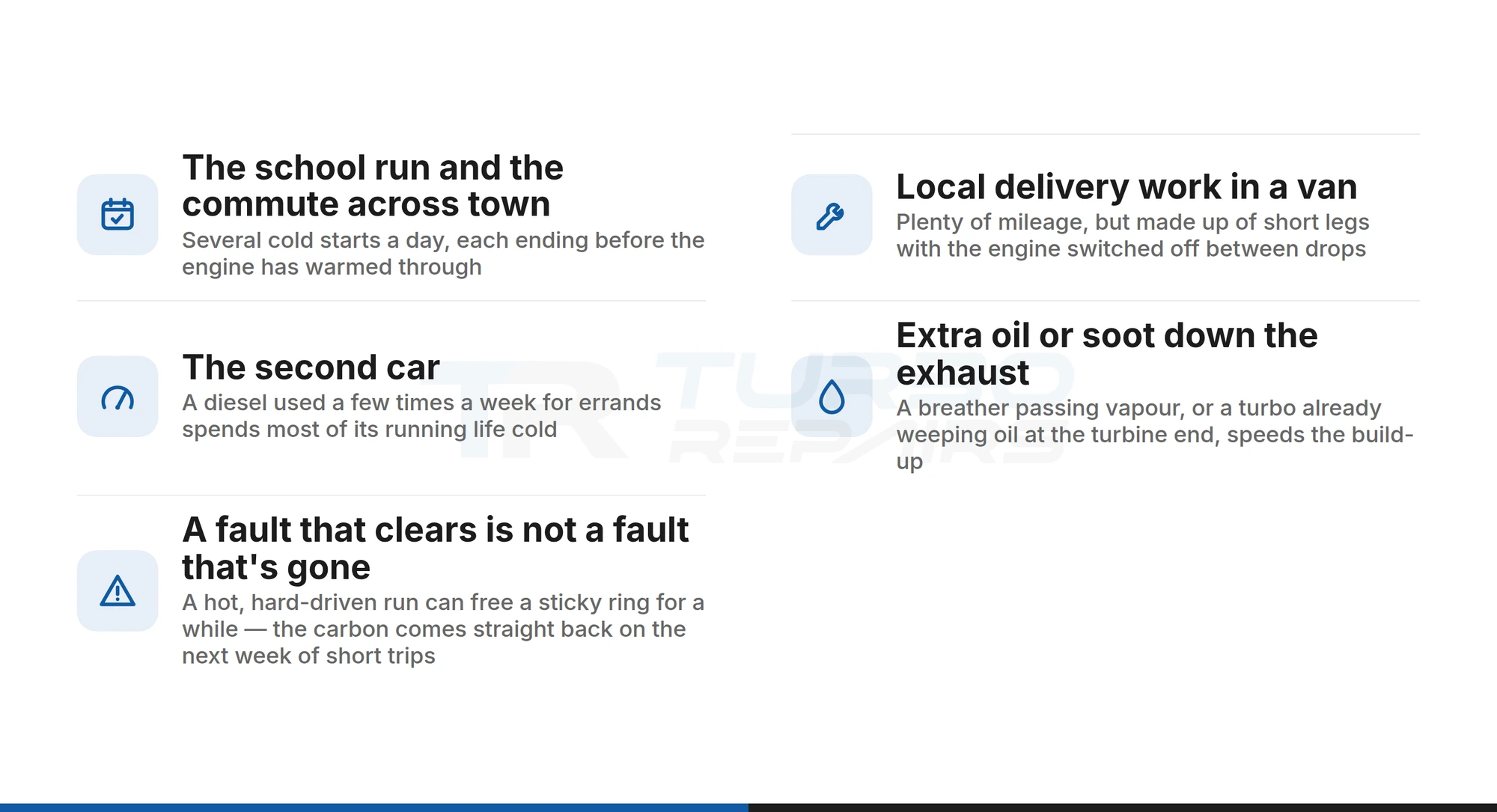
Turbo specialists single out one pattern above the rest: carbon can build up on the vane mechanism quite quickly on a car used mainly for short journeys. On a short trip the engine never reaches full operating temperature and the turbine housing never gets properly hot. Typical patterns:
- The school run and the commute across town. Several cold starts a day, each ending before the engine has warmed through.
- Local delivery work in a van. Plenty of mileage, but made up of short legs with the engine switched off between drops.
- The second car. A diesel used a few times a week for errands spends most of its running life cold.
Anything that sends more oil or soot down the exhaust speeds this up: a breather system passing extra vapour, or a turbo already weeping oil at the turbine end. Those are faults in their own right, and fixing them is part of fixing the vanes.
Why a fault that clears has not gone away
The most misleading thing about sticking vanes is that the fault often clears. A hot, hard-driven engine can free a mechanism that was sticky when cold, and cycling the ignition can reset limp mode. Either way the car feels right again, until the problem comes back.
A sticking vane ring that frees itself has not been repaired. The carbon that stiffens it collects on the journeys that never bring the turbine housing up to heat. A long run can loosen it for a while, and the next week of short trips puts it straight back. So a fault that keeps clearing is one to act on, not one to wait out.
Because of this, we do not recommend a deliberate hard run as a cure. If the ring is sticking towards closed, that run is exactly when overboost happens, and overboost can damage the parts that decide how big the repair is. We also make no claim for fuel additives or cleaning sprays. Whatever they do to deposits, no liquid can put metal back on a worn pivot.
Instead, write down what the car was doing when the fault appeared. Was the engine cold or hot? Was it after a run of short trips or a long drive? Did it clear on a restart? That record is worth more to whoever repairs the turbo than any temporary relief.
Sticking Vanes or a Failed Actuator? Telling Them Apart
From the driver’s seat, a stiff vane ring and a failing actuator look the same: loss of power, limp mode, a warning light and a boost fault code. The code records that the boost the engine management asked for did not arrive. It does not say which part stopped it. Three clues point one way or the other before anything is unbolted, and one test settles it.
Three clues that point one way
- When the fault appears. Carbon-stiffened vanes are often at their worst cold and ease as the turbo heats up. An electronic actuator on its way out tends to do the opposite. A tiring motor, a worn sensor track or a cracked solder joint usually shows up once everything is thoroughly hot and has gone by the next morning. This is a clue, not a verdict.
- How the car is used. A diesel that does almost nothing but short journeys and has started losing power makes the vanes the first suspect. A car that does long, hot runs makes the actuator’s electronics a stronger candidate.
- Which code is stored. A position code such as P2563 says the actuator’s reported position is not being accepted, and carbon holding the vanes can set it as readily as a failing sensor. Our turbo actuator fault codes guide explains what each code does and does not prove.
The test that settles it
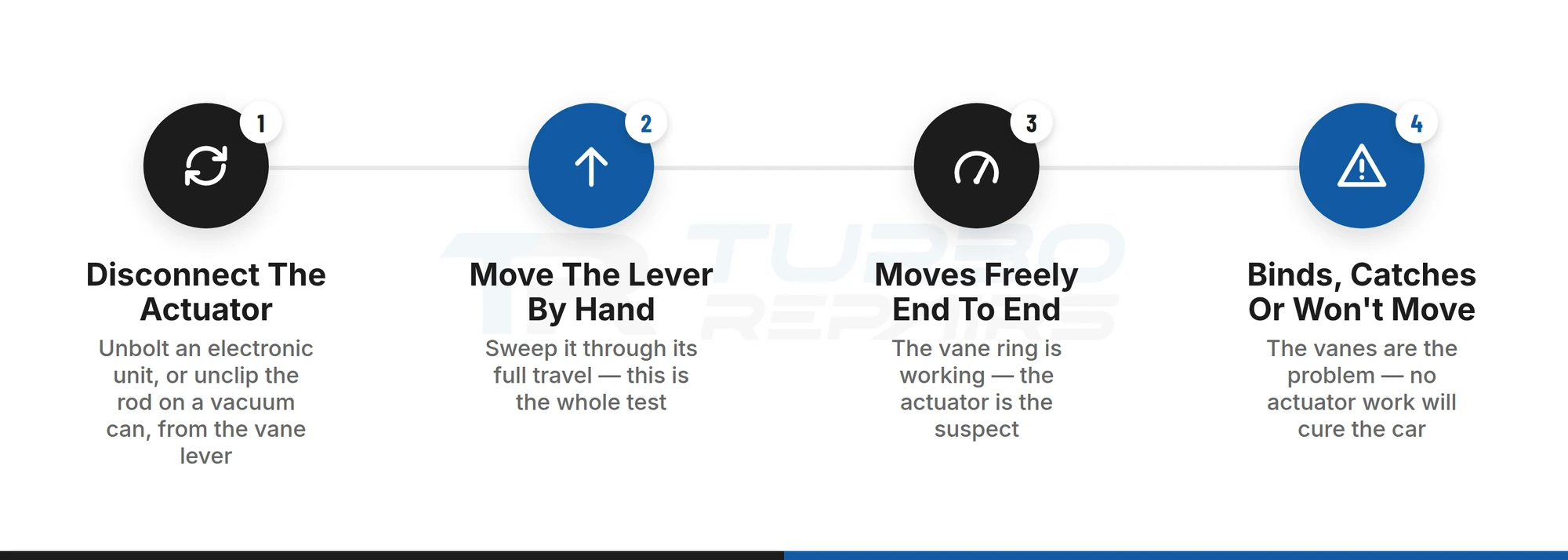
With the engine cold, disconnect the actuator from the vane lever. On an electronic unit that usually means unbolting it; on a vacuum can it means unclipping the rod. Then move the lever through its full travel by hand. If it moves freely from one end to the other, the vane ring is working and the actuator is the suspect. If it binds, catches part way or will not move, the vanes are the problem, and no work on the actuator will cure the car.
The awkward result is a lever that moves but feels notchy. The actuator can probably still drive it, so the car may run, but the drag that wears actuators out is still there. Count that as a vane fault. On a vacuum-operated turbo there is one more check: with the engine running, watch the rod. If it travels smoothly to its stops, the supply is working. If it travels short or jerkily, check the vacuum pipe and control solenoid before blaming either part on the turbocharger.
Sometimes the answer is both. An electronic actuator that has spent months forcing a stiff ring can strip its gears or burn out its motor. Our Jeep Grand Cherokee page covers the case in detail, including when seized vanes take out the actuator. If that is what happened, the actuator needs rebuilding and the vane ring needs freeing, and only doing the first means the new actuator is pulling against the same resistance from day one. Do not drive with the actuator disconnected to see what happens. The vanes are then left wherever they last stopped, with nothing controlling them.
Turbo Repairs · Epsom workshop
Swept the lever and still unsure what you felt?
Tell us how the lever moved by hand, whether the fault comes on cold or hot, and what kind of journeys the car does. We will tell you whether that points at the vane ring, the actuator or both before anything is taken off the engine.
Lifetime, unlimited-mileage warranty · Mail-in from the UK and internationally · Bench-tested and calibrated before it ships
Clean, Rebuild or Replace the Nozzle Ring
The vane mechanism sits inside the turbine housing, between the housing and the centre section. It cannot be properly freed, or even properly inspected, with the turbocharger on the engine. On most cars, a stuck vane ring means the turbo comes off. After that there are three routes, and they are not equal.
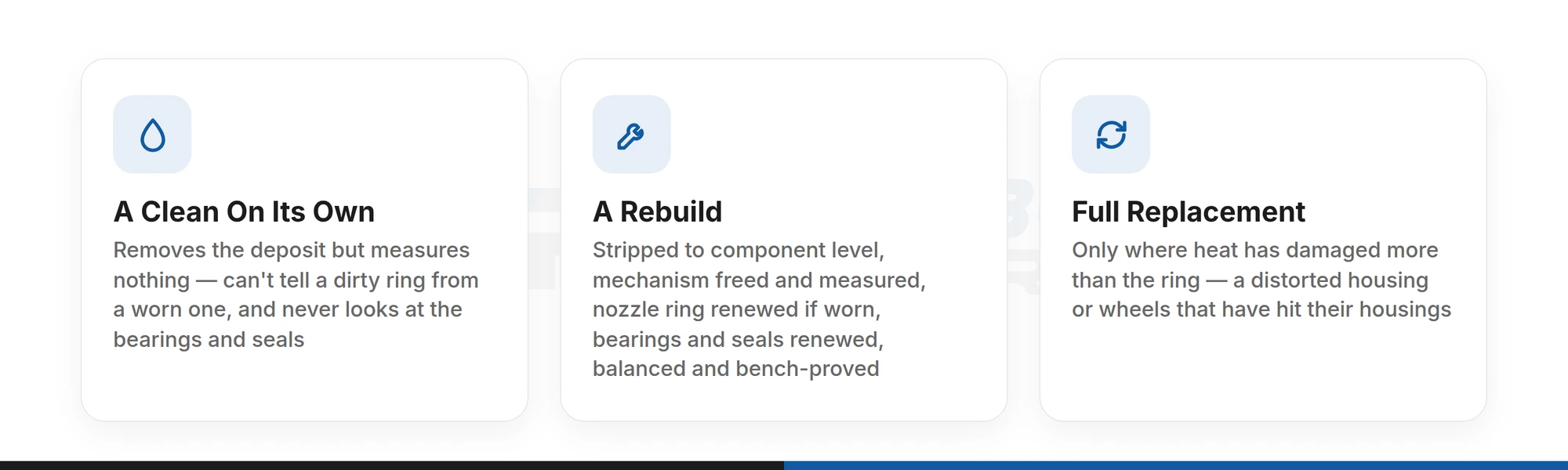
A clean on its own
Cleaning removes the deposit, which is necessary but not enough. A clean on its own does not measure anything, so it cannot tell a ring that was only dirty from one whose pivots have worn. A worn pivot binds again however clean it is. The bearings and seals have also been working throughout the time the ring was sticking, and a clean does not look at them. That is why we do not offer a clean as a repair. Deposit removal is one step inside a rebuild.
A rebuild
This is the repair we do for carboned or sticking vanes. The turbocharger is stripped to component level, the vane mechanism is freed off, and the pivots and nozzle ring are measured. The nozzle ring is renewed if it is worn. The rest of the unit is then rebuilt on what the measurements call for: bearings, seals and thrust parts renewed with genuine OE, OEM-grade or uprated components. The rotating assembly is balanced, and the finished turbocharger is run on the bench with the vanes proved through their full sweep before it is boxed.
Your own turbocharger comes back, not an exchange unit. A turbo rebuild starts from £185 + VAT and typically takes one to three working days on the bench. If the turbo carries an electronic actuator that has also failed, we rebuild that at component level too, from £100 + VAT, and it goes back on with no programming. Every repair carries a lifetime, unlimited-mileage warranty.
Replacing the nozzle ring, or the whole turbocharger
Renewing a worn nozzle ring is part of a rebuild, not a reason to buy a complete turbocharger. A whole replacement makes sense when heat has damaged more than the ring, for example a distorted turbine housing, or when the wheels have hit their housings. If your unit is in that state, we will tell you before any work goes ahead. A brand-new turbocharger goes into the same exhaust as the old one, behind the same engine, on the same journeys. Unless the breather, the oil supply or the driving pattern that coked the first one has been dealt with, the new one starts the same process from day one.
VNT Turbo FAQ
What does VNT stand for on a turbo?
Variable nozzle turbine. It is Garrett’s name for a turbocharger with a ring of moving vanes around the turbine wheel, and a trailing V in a Garrett designation such as GT2052V marks it. The plate on the compressor housing, not the designation, identifies your unit.
Is a VNT turbo the same as a variable geometry turbo?
Yes, for practical purposes. VNT is Garrett’s term, VTG is BorgWarner’s, and VGT is Holset’s and the trade’s general term. Garrett itself uses “variable geometry” and “VNT” for the same product. They all describe moving vanes that control the exhaust flow onto the turbine, and they stick for the same reasons.
What causes turbo vanes to stick?
Soot and oil residue, from exhaust gas recirculation and crankcase breather vapour, baked onto the vane pivots, the unison ring and the nozzle ring faces. It builds fastest on cars used mainly for short journeys that never get the engine up to full temperature. Wear at the vane pivots can make a mechanism bind even once it is clean.
Can sticking turbo vanes be cleaned?
The deposit can be removed, but cleaning alone is not a repair. It cannot find or cure a worn pivot, and it does not check the bearings and seals. We strip the turbocharger, free off the mechanism, measure it, and renew the nozzle ring if it is worn, as part of a full rebuild.
Can I keep driving with sticking turbo vanes?
Limp mode is the engine protecting itself, and it is best respected rather than driven round. Vanes stuck towards closed can overboost the turbo and damage its internal parts, so a deliberate hard run to “clear” the fault is the wrong move. Get the lever checked by hand and the cause found before the repair gets bigger.
Does a VNT turbo have a wastegate?
Usually not. The vanes control how much energy reaches the turbine, which is the wastegate’s job on a fixed-geometry turbo, so most variable-vane units have no conventional wastegate. The actuator bolted to a VNT turbo turns the vane ring, even when a listing calls it a wastegate actuator.
Final Thoughts
A VNT turbo is not more fragile than a fixed-geometry turbo. It has more moving parts in the exhaust stream. Those parts need freedom to move, and short, cool journeys slowly take that freedom away. Whether the housing says VNT, VGT or VTG, the fault is the same and so is the fix.
Do not be reassured when the fault clears. Sweep the lever by hand before buying an actuator, and when the ring does need freeing, have it measured rather than just cleaned, so that anything worn underneath the carbon gets renewed instead of going back in.
Turbo Repairs · Epsom workshop
Have the vane ring freed, measured and proved on the bench
Post your turbocharger in and we will strip it, free off the vane mechanism and renew the nozzle ring if its pivots have worn, rebuilding the rest of the unit on what the measurements show. It comes back balanced, with its vanes swept end to end on the bench, ready to refit.
Lifetime, unlimited-mileage warranty · Mail-in from the UK and internationally · Bench-tested and calibrated before it ships