

Summary We rebuild the Hella electronic turbo actuator fitted to the W211 E-Class CDI diesels, saloon and estate alike, from £100 + VAT. Turnaround is typically one to two working days, the unit comes back needing no programming, and every rebuild carries a lifetime, unlimited-mileage warranty. The one thing to settle before you order, buy or post anything is the engine size, and on this car the boot lid is the wrong place to look for it.
An E200 CDI is a 2.2, an E280 CDI is a 3.0, and an E320 CDI can be either a 3.2 or a 3.0 — and those last two do not share an actuator.
A W211 E-Class CDI that loses power, drops into limp mode, then drives normally again after it has been switched off and left to cool is showing the pattern most often traced to a failing electronic turbo actuator. The actuator is a small unit bolted to the side of the turbocharger, and it can be rebuilt on its own. What makes the E-Class awkward is not the fault but the purchase: the model number on the car does not reliably tell you which engine, turbocharger or actuator sits underneath it.
- Vehicle: Mercedes-Benz E-Class W211 saloon and S211 estate, CDI diesels, listed 2002–2009
- Badges the actuator listings name: E200 CDI and E220 CDI (2.2) · E270 CDI (2.7) · E280 CDI (3.0) · E320 CDI (listed as both 3.2 and 3.0)
- The part: a Hella electronic actuator on a Garrett turbocharger, commanded by the engine control unit
- First thing to check: the cylinder capacity on your V5C, not the badge on the boot lid
- Typical code: 2510 – Boost Pressure Control on Mercedes equipment; P0299 or P0234 on a generic reader
- Our service: component-level rebuild of your own unit from £100 + VAT, typically 1–2 working days, no programming on refit, lifetime unlimited-mileage warranty
Which E-Class Diesel Is Yours? The Number on the Boot Is Not the Engine Size
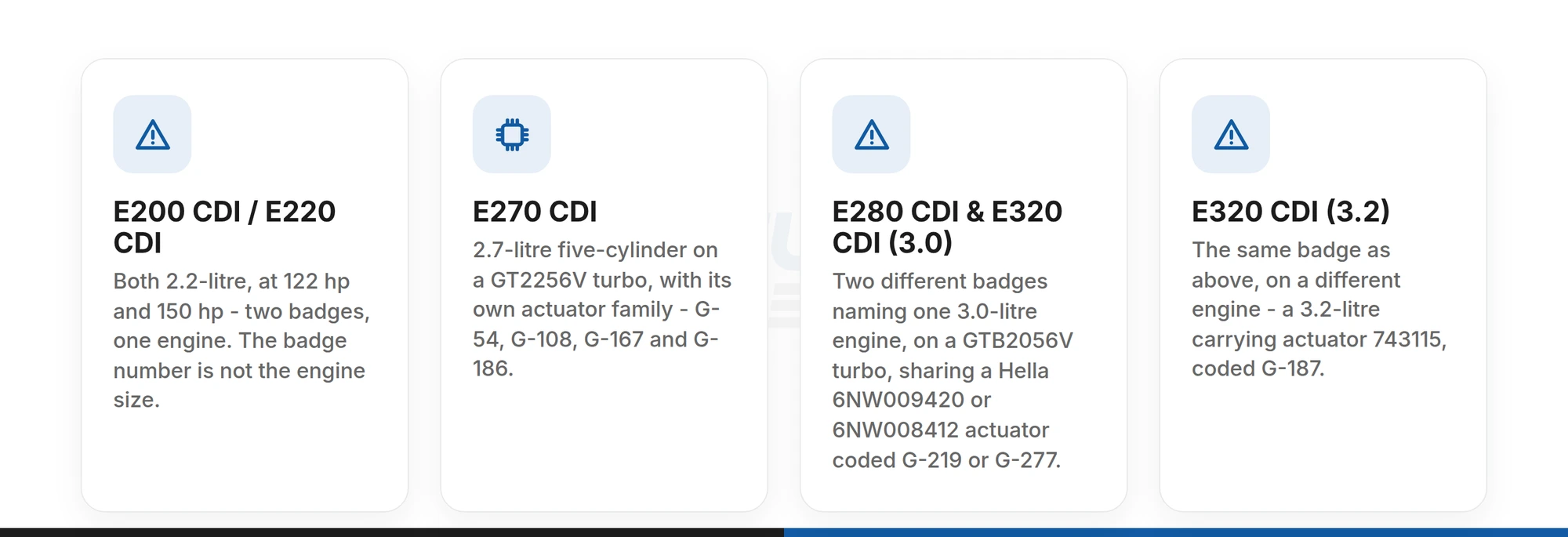
On many cars a badge reading 220 or 320 is a fair guide to the engine size. On the W211 E-Class it is not a reliable one. The actuator listings for this car record four engine sizes behind five CDI badges, and the badge number and the litres agree only part of the time.
The table below sets out what specialist actuator listings record against each badge. It is a record of those listings rather than a promise about any individual car, which is exactly why the check in the next subsection matters.
| Badge | Engine size and output as listed | Garrett turbocharger references listed | Actuator references listed |
|---|---|---|---|
| E200 CDI | 2.2-litre, 122 hp | 742693; 727461 also appears on an E200 listing | G-107 (742693-0001); G-185, which is listed for both the E200 and E220 CDI |
| E220 CDI | 2.2-litre, 150 hp | 727461; Mercedes turbo numbers A6460960499, A6460960099 and A6460900080 are listed against the 2.2 cars | G-53 (727461-0002), G-107 (727461-0004), G-185, G-271 (727461-0006) |
| E270 CDI | 2.7-litre, 177 hp | GT2256V; 727463 (727463-5004S, -5006S, -9006S) | G-54, G-108 (727463-0001, -0002, -0003), G-167, G-186; Mercedes reference A6470900180 listed alongside |
| E280 CDI | 3.0-litre | GTB2056V; 757608 and 765155 | Hella 6NW009420 or 6NW008412 on base number 712120, coded G-219 or G-277; G-001 also listed |
| E320 CDI (3.0) | 3.0-litre | GTB2056V; 757608 and 765155 | The same family as the E280 CDI: 6NW009420 or 6NW008412, 712120, G-219 or G-277 |
| E320 CDI (3.2) | 3.2-litre | Not stated in the listing | 743115 with 712120, coded G-187 |
A further 3.0-litre family is listed for the W211 without a specific badge: Hella 6NW009660 with 781751, coded G-004.
Read the table in both directions, because the badge fails in both. The same badge can sit on two different engines: the E320 CDI is listed as a 3.2 carrying a 743115 unit coded G-187, and separately as a 3.0 carrying the 6NW009420 or 6NW008412 family. Different badges can sit on the same engine: the E200 CDI and E220 CDI are both listed as 2.2-litre cars, at 122 hp and 150 hp, while the E280 CDI and the 3.0-litre E320 CDI share one turbocharger family and one set of actuator references.
So a part matched on the badge goes wrong both ways. Search for an “E320 CDI actuator” and you can be offered a unit from the engine you do not have. Search for an “E280 CDI actuator” with a 3.0-litre E320 on the drive and you may scroll straight past the unit that matches yours.
Check the V5C before you check the badge
The quickest way through is already in a drawer at home. The V5C registration certificate records the car’s cylinder capacity in cc, and that one figure separates a 2.2, a 2.7, a 3.0 and a 3.2 without the bonnet being opened. Put it alongside the badge and the table narrows to a single row, or, for a 2.2 or a 3.0, to a pair of rows that share an engine size.
Include the capacity when you complete the repair form. It is the figure we check the references on your casing against when the unit arrives.
One listing that fits none of the rows
One reference does not sit comfortably anywhere. A unit coded G-109, numbered 743436-0001, is listed for the E320 CDI and S320 CDI and described as a “2.7, 204 hp”, a displacement no other listing gives the E320 badge. It is left out of the table for that reason. If G-109 or 743436 is what your casing reads, photograph the label and send it with your registration, and the unit is identified on the bench rather than from the listing.
A later E-Class
The listings that name a chassis name the W211 saloon and the S211 estate. If your E-Class belongs to a later generation, do not assume it carries the same part. Look at the unit on the turbocharger first: an electronic actuator has an electrical plug and a wiring loom to it, whereas a vacuum-operated actuator is worked through a rubber hose and has no wiring at all. Only the first is the part this page is about.
Reading the Actuator References Off Your Own Unit
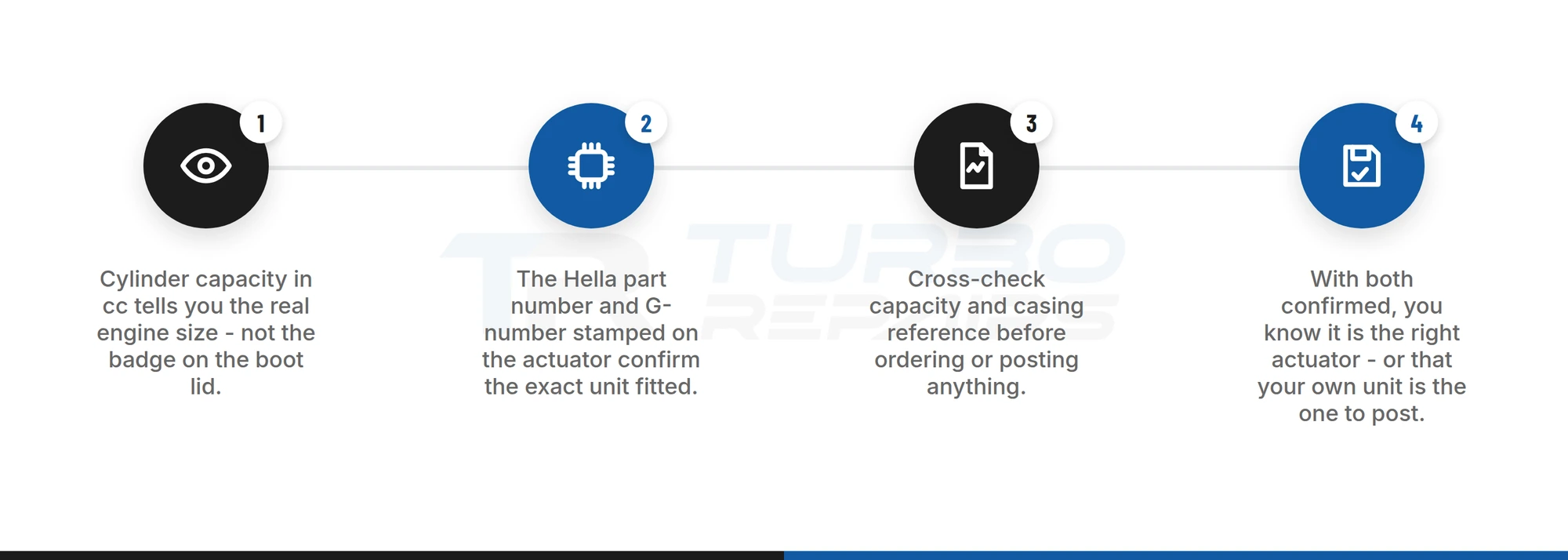
Once the V5C has narrowed the field, the casing finishes the job. The label on the actuator housing usually carries three kinds of identifier, and on a heat-aged unit it can take a wipe and a torch to read them.
- The Hella part number, beginning 6NW. On the E-Class listings that means 6NW009420, 6NW008412, 6NW009228 or 6NW009660. It names a family of actuators, not a single fitment.
- A base or turbocharger-related number, such as 712120, 730314, 743115, 727461, 727463 or 781751.
- The G-number — G-53, G-107, G-108, G-187, G-219, G-277 and so on. This is the reference suppliers and rebuilders catalogue units by.
Several of those numbers are shared well beyond the E-Class. Why a base number such as 712120 identifies almost nothing on its own is set out on our Mercedes CLS 320 and 350 CDI actuator page, so it is not repeated here. What is particular to the E-Class is the cross-check: the G-number on your casing should fall in the same row of the table as the capacity on your V5C.
When the casing and the V5C disagree
If they do not match — a G-187 on a car whose V5C records a 3.0, for example — stop before ordering anything. Possible explanations include a reference misread from a worn label, or an actuator that is not the one the car was built with. Either way, send a photograph of the label with your registration and we will tell you which it is before the unit is posted.
References listed for the W211 without an engine size
Some listings name the W211 E220, E270 and E320 together without saying which engine each reference belongs to: 6NW009228 with 730314, 6NW009420 with 712120 and G-277, and 6NW008412 with 712120 and G-129. Elsewhere, 6NW009228 with 730314 is catalogued as G-88 against the 320 CDI across the C, E, S and M-Class, again with no capacity given. If your casing carries one of these, the V5C figure is what narrows it and the bench confirms it.
What a Failing E-Class Actuator Does
The E-Class fault has a recognisable shape, and it is documented against this car specifically. It starts intermittently: the engine loses power, and the fault normally clears if the engine is switched off and restarted after it has cooled down. If the ignition is not cycled, the car will often drop into limp-home mode and stay there. Over time the intermittent fault becomes a permanent one that seriously limits what the car can do.
Behind that pattern is an actuator that can no longer hold the position the engine control unit commands. Inside the housing are a small electric motor, a gear train, a position sensor and a circuit board, all living beside the exhaust side of the engine. When any of them becomes marginal, the vanes end up somewhere other than where they were sent, boost falls out of step with fuelling, and the control unit protects the engine by cutting power.
Alongside the power loss, owners may notice:
- the engine management light, with a boost-related fault stored behind it;
- clicking or buzzing from the actuator itself as a worn motor or gear train struggles;
- an operating arm that no longer moves when the engine is revved;
- heavier fuel use, as the driver presses harder for the same progress.
None of those symptoms tells you the engine size, and none of them differs between an E220 CDI and an E320 CDI. They narrow the fault to the boost control system; they never narrow the part. The fuller picture, and what each symptom rules in or out, is in our guide to the symptoms of a failing turbo actuator.
The Fault Codes an E-Class Stores, and What a Generic Reader Shows
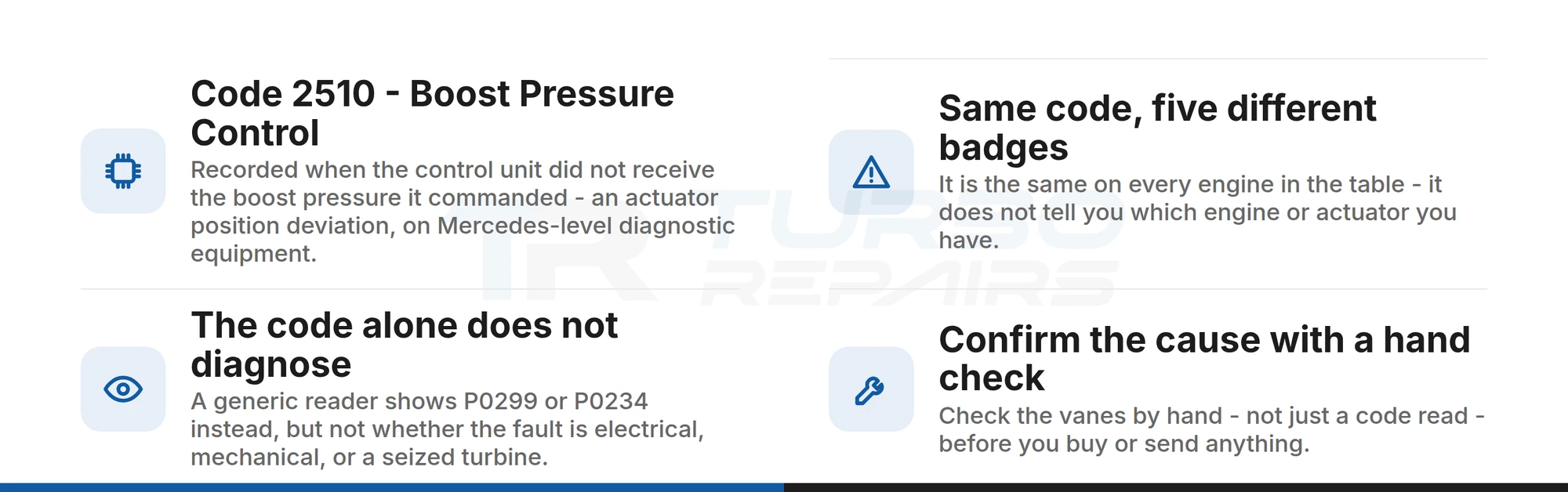
The code most often recorded against a failing W211 actuator is 2510 – Boost Pressure Control, read on Mercedes-level diagnostic equipment. It means the control unit did not receive the boost pressure it commanded. That is a statement about the whole control loop, so the same code appears whether the actuator has failed, the vane mechanism has stiffened, boost is escaping from the intake side or the pressure sensor is misreporting.
A generic OBD-II reader frequently cannot see the Mercedes code and reports a standard equivalent instead, most often P0299 for underboost or P0234 for overboost. Neither is more specific than 2510. They say that boost was too low or too high, not why.
On an E-Class the code has one further limit worth stating plainly: it is the same on every engine in the table above. A 2510 from a 2.2 reads exactly like a 2510 from a 3.2, so the code contributes nothing to identifying the actuator. That is why the V5C and the casing come first here and the code comes third.
What the code record can tell us is how the fault behaves. Before anything is cleared or unplugged, note three things:
- whether the fault is present now or only stored from an earlier episode;
- whether switching off and restarting clears it, and roughly how long it takes to return;
- whether it appeared from cold, or only once the engine had been worked hard and was fully hot.
Those answers go on the repair form and are read against what the bench test finds.
Actuator or Turbocharger? The Vane Check Before You Send Anything
A stored 2510 and a flat E-Class can come from a failed actuator or from the turbocharger mechanism it drives, and posting the wrong part costs you the postage and the days. The E270 CDI and the 3.0-litre cars are listed on Garrett turbochargers with a V in the designation — GT2256V and GTB2056V — which marks a variable-nozzle design: the actuator turns a ring of vanes inside the turbine housing rather than opening a wastegate. Carbon on those vanes makes them stiff, and a stiff vane ring produces the same symptoms as a failing actuator.
The check that separates the two is straightforward, and any competent mechanic can carry it out, because the actuator unbolts from the outside of the turbocharger.
- Rule out the wiring first. Look at the actuator’s connector for corrosion, a split seal or a latch that is not fully home, and check supply and earth at the plug. A poor connection can store the same code as a dead motor.
- Watch the arm with the engine running. As the engine is revved, the operating arm should move. If it does not, the fault is either the actuator or what it drives, so you have narrowed it rather than solved it.
- Sweep the vane lever by hand with the actuator off. Once the unit is unbolted, move the turbocharger’s vane lever through its full travel by hand. If it moves freely end to end, the vane ring is free and the actuator is the suspect. If it binds, catches part way or will not move, the vanes are stiff or seized, and no work on the actuator will cure the car.
If the vanes are seized, the work moves to the turbocharger itself, which our turbocharger rebuild service covers. Do not fit a rebuilt actuator to a vane ring that will not move: it will strain against the stiffness exactly as the old one did.
If the vanes are free, the actuator is the only part to send. The turbocharger stays on the engine.
Turbo Repairs · Epsom workshop
Vanes free? Send the E-Class actuator, not the turbocharger
Tell us the badge, the cylinder capacity from your V5C and the references on the casing, then post the unit in. We check those three against each other before the actuator is opened, so you know what we are rebuilding before any work begins.
Lifetime, unlimited-mileage warranty · Mail-in from the UK and internationally · Bench-tested and calibrated before it ships
Our Mercedes E-Class Electronic Turbo Actuator Rebuild
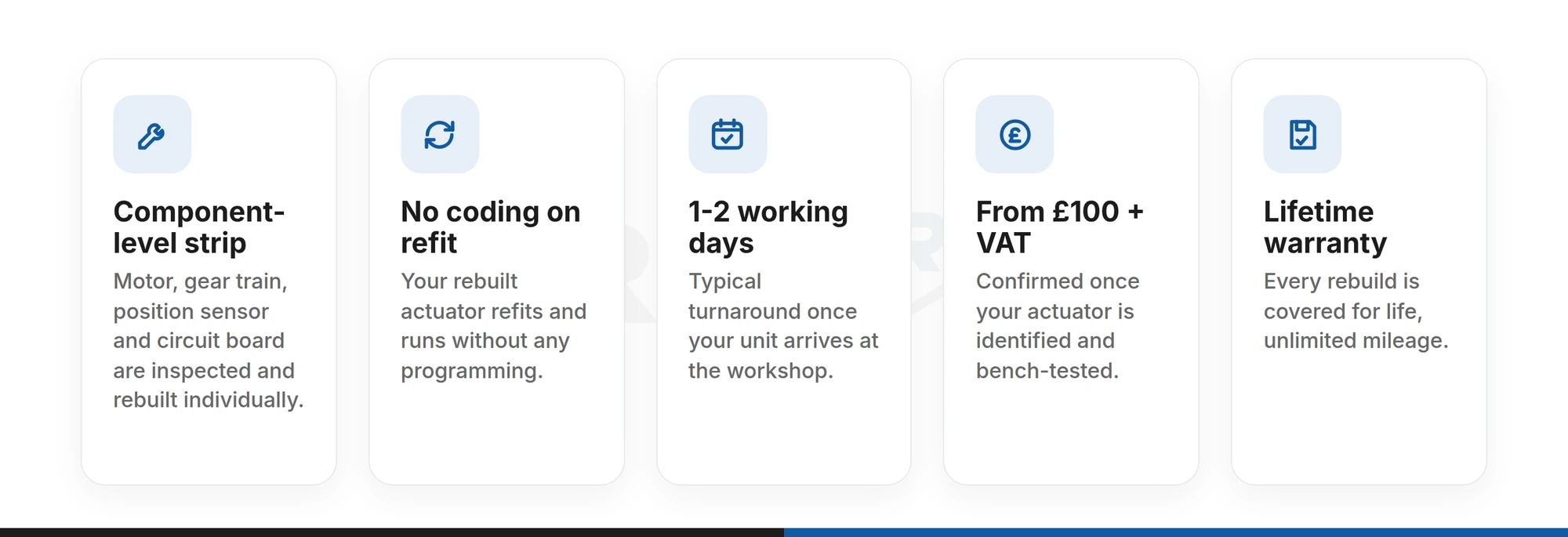
The E-Class electronic actuator is not sold separately from the turbocharger, so the dealer route to a new one is a complete turbocharger: a serviceable turbo replaced to reach a failed unit bolted to its side. A component-level rebuild of the actuator you already own is the alternative. Because the part going back on is the part that came off, it also removes the identification problem the rest of this page has been about.
The work is carried out in our own workshop at Unit 102 Reaver House, 12 East Street, Epsom, Surrey, KT17 1HX, United Kingdom, by a team of turbo specialists and electronic engineers. It is a mail-in service, so the car stays with you, and independent garages and main dealers use the same route for their customers’ cars.
- Complete the repair form. Registration, badge, the cylinder capacity from the V5C, every reference legible on the casing, the stored codes and how the fault behaves. On an E-Class the capacity is the line that saves the most time.
- Remove the actuator and post it. It unbolts from the turbocharger, which stays on the engine. Pack it in bubble wrap or foam inside a rigid box; there is more on packing and postage on our FAQs page.
- We identify it against your car. The references on the casing are checked against the badge and capacity you gave us. If they point to different engines, we tell you before any work is done.
- We test it as received, then strip it. The unit is bench-tested before it is opened, so what we report is what actually failed. It is then stripped to component level.
- We rebuild it. Motor, gear train, position sensor and seals are renewed as required, the circuit board is reworked, and components with a known weakness in the original design are replaced with uprated parts, so the unit meets or exceeds original specification.
- We calibrate and prove it. The rebuilt unit is set up and checked on dealer-level diagnostic and calibration tooling and our own test platforms, then returned ready to refit with no programming or coding needed.
Repairs start from £100 + VAT, with the exact price confirmed once the unit has been identified and tested, so it is known before work goes ahead. Turnaround is typically one to two working days from arrival, plus postage each way, and every rebuild carries a lifetime, unlimited-mileage warranty.
Two related Mercedes pages go further on points kept deliberately short here. Why the rebuild leaves the turbocharger, its oil lines and its gaskets undisturbed is covered under our Mercedes C-Class actuator repair, and why a cleaned actuator tends to fail again is covered under our Mercedes CLK actuator repair. The full range sits under our electronic turbo actuator repairs.
Mercedes E-Class Turbo Actuator Repair FAQ
Which turbo actuator does a Mercedes E-Class have?
A Hella electronic actuator on a Garrett turbocharger, but which one depends on the engine rather than the badge. The listings put the 2.2-litre E200 and E220 CDI on Garrett 742693 or 727461 turbochargers, the 2.7-litre E270 CDI on a GT2256V (727463), the 3.0-litre E280 CDI and 3.0-litre E320 CDI on a GTB2056V (757608, 765155), and the 3.2-litre E320 CDI with actuator 743115, coded G-187. Check the cylinder capacity on your V5C, then read the references off your own casing.
My car is an E320 CDI. Which actuator is it?
Check the V5C first. The E320 CDI badge is listed on two engines: a 3.2, with 743115 coded G-187, and a 3.0, with Hella 6NW009420 or 6NW008412 on 712120, coded G-219 or G-277 — the same family as the E280 CDI. The capacity tells you which, and the casing confirms it. If you are sending us your own unit to rebuild, you do not need to choose at all.
Do the E200 CDI and E220 CDI use the same actuator?
Not necessarily. Both are listed as 2.2-litre cars, at 122 hp and 150 hp, and some G-numbers, such as G-107 and G-185, appear against both. But the listings overlap without matching: E200 listings carry both the 742693 and 727461 turbocharger numbers, the E220 listings carry 727461, and the G-53 and G-271 units appear only against the E220. Do not assume a unit from one suits the other — match on the references on the casing, not on the badge.
Can I buy just the actuator for an E-Class?
Not as a new part on its own: the E-Class electronic actuator is not available separately from the turbocharger, which is why a dealer quote is normally for a complete turbo. Rebuilding the actuator you already have avoids replacing a turbocharger that may be perfectly serviceable.
Will a rebuilt E-Class actuator need coding?
No. You get your own unit back, calibrated and tested, and it refits without programming. Clearing the stored fault codes with a diagnostic tool once it is back on is sensible.
Does this apply to the E-Class estate?
Yes. The listings name the S211 estate together with the W211 saloon, so the same badges, engines and actuator references apply. The V5C check works the same way on either body.
How much does an E-Class actuator repair cost, and how long does it take?
Repairs start from £100 + VAT, with the exact figure confirmed once the unit has been identified and bench-tested. Turnaround is typically one to two working days from arrival at the workshop, plus postage each way, and every rebuild carries a lifetime, unlimited-mileage warranty.
Final Thoughts
An E-Class actuator fault is easy to recognise and awkward to buy for. The symptoms are consistent, the 2510 code is clear about what it measures, and the vane check settles the actuator-or-turbocharger question in minutes. What goes wrong is the purchase, because the number on the boot lid describes the engine only some of the time: one E320 CDI badge sits on two engines, and two different badges share one.
So work from the paperwork inward. The V5C gives you the engine size, the casing gives you the actuator, and the hand check tells you whether the actuator is the part to send. With those three settled, what remains is a padded box and a couple of working days.
Turbo Repairs · Epsom workshop
Rebuild the E-Class actuator you already own
Your own unit is already matched to your turbocharger, whichever engine sits behind the badge. Send it in with the V5C capacity and the casing references, and it comes back rebuilt at component level, calibrated and covered for life.
Lifetime, unlimited-mileage warranty · Mail-in from the UK and internationally · Bench-tested and calibrated before it ships