

Summary We rebuild the electronic turbo actuator from the VW Touareg 3.0 V6 TDI and 5.0 V10 TDI, from £100 + VAT. You post your own actuator in, and it comes back rebuilt at component level, bench-tested and ready to refit without coding, typically after one to two working days in the workshop. Every rebuild carries a lifetime, unlimited-mileage warranty.
Before you buy or send anything, identify the engine under the Touareg badge. It decides which actuator your turbocharger carries, and whether the part on it is one we rebuild at all.
The Touareg badge covers three diesels with three different boost-control set-ups: the 3.0 V6 TDI is listed with an electronic Hella actuator, the 5.0 V10 TDI with electronic units under several G-codes, one of them sold as the left-hand side, and the 2.5 R5 with an actuator sold as a wastegate part to be set up on a boost gauge.
A Touareg that loses power or starts to judder under acceleration halfway up a long climb with a trailer behind it, then drives normally again once it has been switched off and left to cool, is showing the pattern specialists associate with the electronic turbo actuator on the TDI engines. The actuator is catalogued and rebuilt as a part in its own right, so the fault does not have to end in a new turbocharger. This page sorts out which engine and actuator you have, why towing draws the fault out, and how to rule the turbocharger in or out before anything comes off.
- Vehicles covered: VW Touareg 3.0 V6 TDI and 5.0 V10 TDI fitted with an electronic actuator. First-generation cars are listed from 2002 to 2010 (body codes 7LA, 7L6 and 7L7), and Hella actuator repair is also catalogued for the second generation
- 3.0 V6 TDI, as listed: Hella 6NW009550, G-020 / G-20, on a Garrett GTB2260VK (776470), with the Phaeton and Audi A6 and Q7 named on the same listings. A second family, G-82 (799672, 804986) on a GTB2056VZK, is listed with the Audi A4 to A8
- 5.0 V10 TDI, as listed: Hella 6NW009228 (base 730314) as G-22 and as G-124, and 6NW008412 as G-145, sold as the left-hand unit
- 2.5 R5 TDI: listed with a wastegate-type actuator set up on a boost gauge. Check for an electrical connector before assuming it is covered here
- Codes linked to the fault: P1952 and P1953, alongside the boost codes P0299 and P0234
- Our service: your own actuator rebuilt from £100 + VAT, typically 1–2 working days, no coding on refit, lifetime unlimited-mileage warranty
Which Touareg Engine Do You Have?
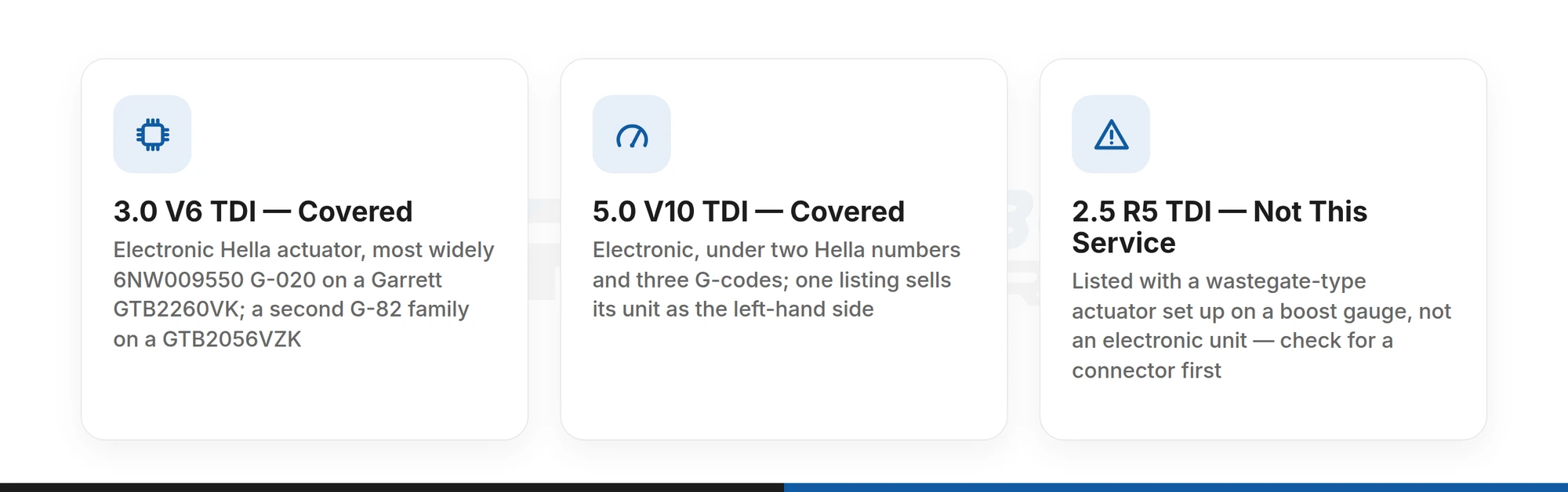
Three diesel engines carry the Touareg TDI badge in the listings we reviewed: the 3.0 V6, the 5.0 V10 and the 2.5 five-cylinder R5. They do not share a boost-control set-up, and the catalogues describe their actuators quite differently. The badge and the service record will usually tell you which engine you have, and a VW parts desk can confirm it from the VIN.
| Engine as listed | What the listings say about the actuator | What to do |
|---|---|---|
| 3.0 V6 TDI | Electronic Hella actuator. Most widely listed as 6NW009550, G-020, on a Garrett GTB2260VK for the Touareg 3.0 TDI at 240 hp. A second family, G-82 on a GTB2056VZK, is listed for the Touareg 3.0 TDI alongside Audi’s A4 to A8. | Covered. Match on the G-code on your own casing. |
| 5.0 V10 TDI (4,921 cc, listed 2002–2010) | Electronic. Listed under two Hella numbers and three G-codes, with one listing selling its unit as the left-hand side. | Covered. Note which side of the engine the unit came off. |
| 2.5 R5 TDI | Listed with a GTB1752V turbocharger (760700, VW 070145701Q) and a wastegate actuator to be set up with a boost gauge. No listing we found describes it as electronic. | Look for a connector before going further. A vacuum can is not covered by this service. |
The V6 is the Touareg most owners mean, and its actuator appears in the same listings as the Phaeton and Audi’s large saloons and SUVs on the same engine. That does not change the job. Whichever car the unit came off, the references on the casing decide which set-up it is.
The R5 is the one to check before anything else. The only actuator listing we found for it describes a part set up with a boost gauge, which reads as a mechanical rod adjustment rather than an electronic unit. An electronic actuator is a moulded housing with an electrical connector plugged into it; a pneumatic actuator is a sealed can with a rod and a small vacuum pipe. If your R5 has a vacuum can, the part more likely to need the work is the turbocharger. The catalogues place it under more than one Garrett designation, so start with our page on the 2.5 R5 turbocharger and the plate on its compressor housing.
What Towing and Off-Road Duty Does to the Actuator
The actuator on a Touareg’s turbocharger positions the ring of variable vanes that decides how hard the exhaust gas drives the turbine. It does not switch on to accelerate and off again. It holds a commanded position against the exhaust for as long as the engine runs, as our guide to what a turbo actuator does explains. What changes from one journey to the next is how hard and how hot that holding work is, and towing sits at the far end of the scale.
Towing: the most boost, for the longest time
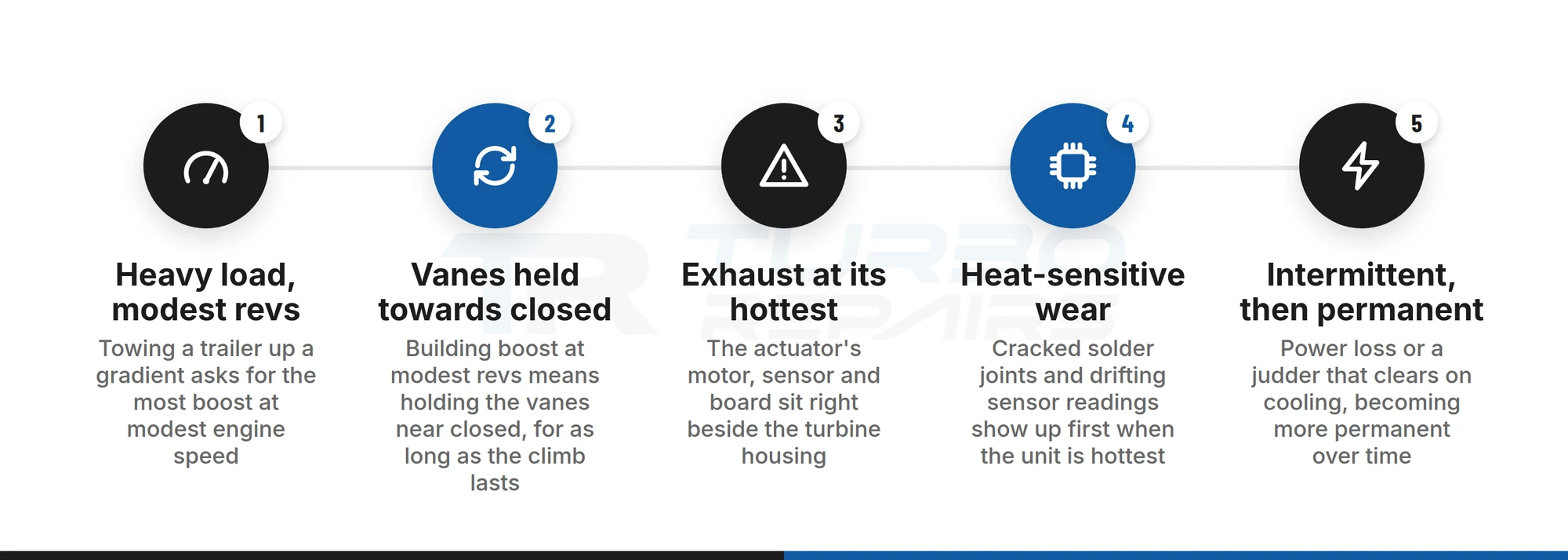
Pulling a caravan, horsebox or trailer up a long gradient asks the engine for heavy load at modest engine speed, which is where the engine management wants the most boost. On a variable-geometry turbocharger, building boost at modest revs means holding the vanes towards closed, and keeping them there for as long as the climb lasts. The exhaust is at its hottest while that happens, and the actuator is bolted to the turbocharger right beside it.
Heat is what the actuator’s electronics tolerate least. Its motor, position sensor and circuit board share one housing, and heat-related wear such as cracked solder joints and drifting sensor readings shows up first when the unit is hottest and working hardest. That is why a Touareg turbo actuator fault is so often a towing fault. Specialists describe it as a loss of power or a judder under acceleration that clears once the ignition has been off and the engine has cooled, and that becomes more permanent over time.
One habit is worth changing. Switching off straight after a hard climb leaves the actuator beside a turbine housing at full temperature with the car standing still. Letting the engine idle briefly before you switch off, as with any turbocharged engine after a hard run, costs nothing.
Off-road: slow, heavy and wet
Slow, heavy work off the road asks the same of the actuator at walking pace, with little air moving past the engine to carry heat away. Water is the other hazard. Wading, mud and a pressure washer afterwards all put water where the connector’s seal has to keep it out, and moisture or corrosion behind that seal produces the same faults as an actuator that has failed inside, so the connector is the first thing to inspect.
Short runs during the week count too
Short, cold, low-speed journeys let soot and oil mist build up on the vane pivots, because the turbocharger rarely gets properly hot. A Touareg that does local trips all week and tows at the weekend gets both: vanes that have stiffened, followed by the hardest possible work holding them against the exhaust. An actuator straining against stiff vanes wears its gears and motor faster, which is why the vane check further down this page comes before any actuator is replaced.
If the fault comes on while you are towing, note it at the time: the load behind you, the gradient, the outside temperature, how long the climb had lasted, and whether switching off and waiting cleared it. On the repair form, that tells the bench test which conditions to reproduce.
Symptoms, and What Each One Narrows Down
No single symptom names the actuator. What each one does is shorten the list of suspects.
| What you notice | What it narrows down |
|---|---|
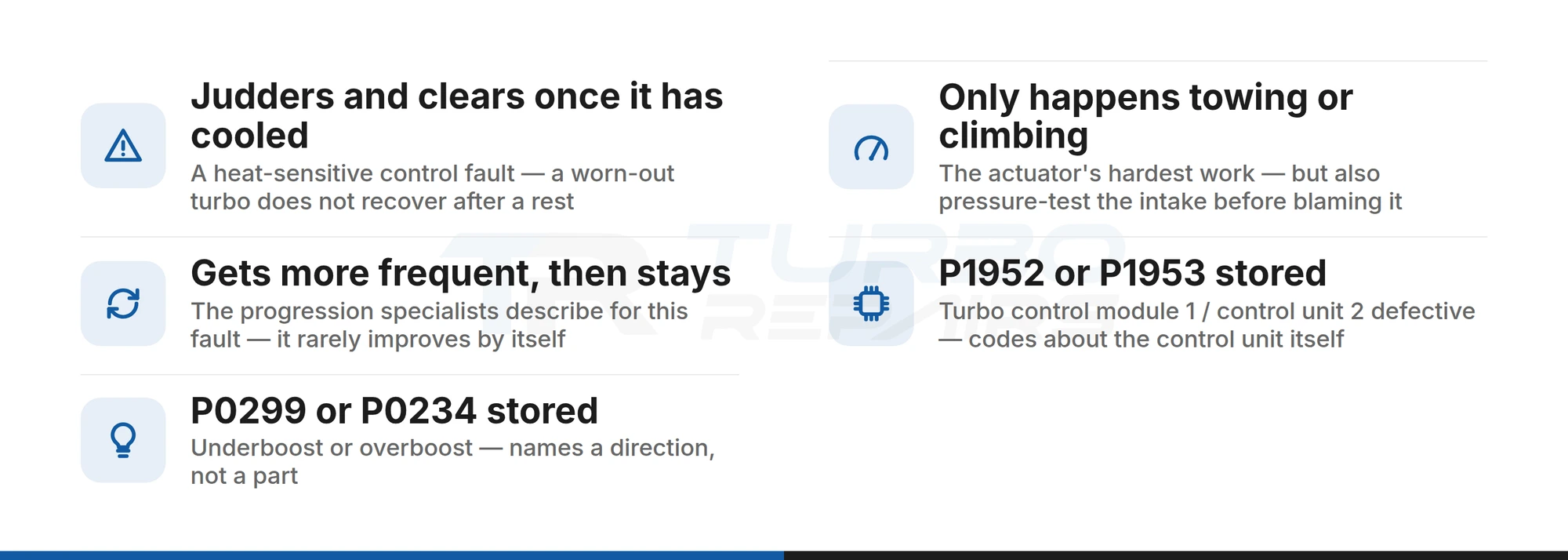
| Power falls away or the car judders under acceleration, and switching off and letting it cool brings it back | A heat-sensitive control fault, with the actuator’s electronics as the first suspect. A turbocharger that has worn out does not recover after a rest. |
| It only happens when towing or climbing | The actuator is being asked for its hardest work, so a marginal unit shows itself here first. A boost hose or intercooler joint that holds at a cruise can also open up at the highest boost, so pressure-test the intake before blaming the actuator. |
| It happens more often until it no longer clears | The progression specialists describe for this fault on the Touareg TDI: intermittent at first, then more permanent. It rarely improves by itself. |
| Flat everywhere, but no warning light and no code | Look at the intake first. A split hose or a slipped clamp loses boost and feels much the same. |
| P1952 or P1953 stored | Listed for this fault as turbo control module 1 and turbo control unit 2 defective: codes about the control unit rather than the boost it produces. Note which number is stored, particularly on a V10. |
| P0299 or P0234 stored | Underboost or overboost. These codes name a direction, not a part: a leak, stuck vanes and a failed actuator can all set P0299. |
Read the freeze-frame data stored with any code, showing engine speed, load and temperature at the moment it set, before anything is cleared. It is worth more than the code itself. Our guides to turbo actuator symptoms and overboost and underboost codes go further into what each one can and cannot tell you.
Reading the References Off Your Own Actuator
The numbers are printed or moulded on the actuator housing. Wipe it clean and photograph everything on it: a Hella number beginning 6NW, often a six-digit base number, and a G-code. On a Touareg the G-code is the reference that separates one set-up from another, and the listings show why.
Touareg 3.0 TDI turbo actuator references
The most widely listed V6 unit is Hella 6NW009550, G-020 (also written G-20), catalogued for the Touareg and Phaeton 3.0 TDI at 240 hp on a Garrett GTB2260VK turbocharger, 776470. The same Hella number is fitted to BMW six-cylinder diesels under a different G-code, as our BMW 5 Series actuator page shows, so the Hella number on its own does not identify your unit.
A second family is listed for the Touareg 3.0 TDI alongside the Audi A4 to A8: G-82, with manufacturer numbers 799672 and 804986, on a GTB2056VZK turbocharger, cross-referenced to VAG 059145874D and 059145874J. If your casing reads G-82 rather than G-20, you have the other family, and that is what we test it against.
5.0 V10 TDI references
The V10 is where the listings disagree. One catalogue sells Hella 6NW009228, base 730314, as G-22 for the Touareg 5.0 TDI; another lists the same Hella number and base as G-124. A third sells a unit numbered 6NW008412, G-145, as the left-hand actuator for the 5.0 V10 TDI built from 2002 to 2010, cross-referenced to Garrett 742810-5007S and VW 07Z145702J and 07Z145702P.
None of those listings sets out both sides together. So before the unit comes off, note which side of the engine it is on and send that with your photographs. Side, Hella number and G-code together are what we check against your car.
If you are sending us your own unit
Most of the identification problem disappears when the part you post is the one off your own turbocharger, because it is already the right family and set up for that turbocharger. The references still matter. They confirm the unit is electronic, tell us which set-up to test it against, and on a V10 tell us which side it belongs to.
Actuator or Turbocharger? The Vane Check
Most codes cannot tell a failed actuator from vanes that no longer move freely. A few minutes with the actuator’s linkage undone can, and on a Touareg that tows or spends its week on short runs, this is the check that decides where your money goes. Let the engine cool completely first, because the turbine housing gets hot enough to burn.
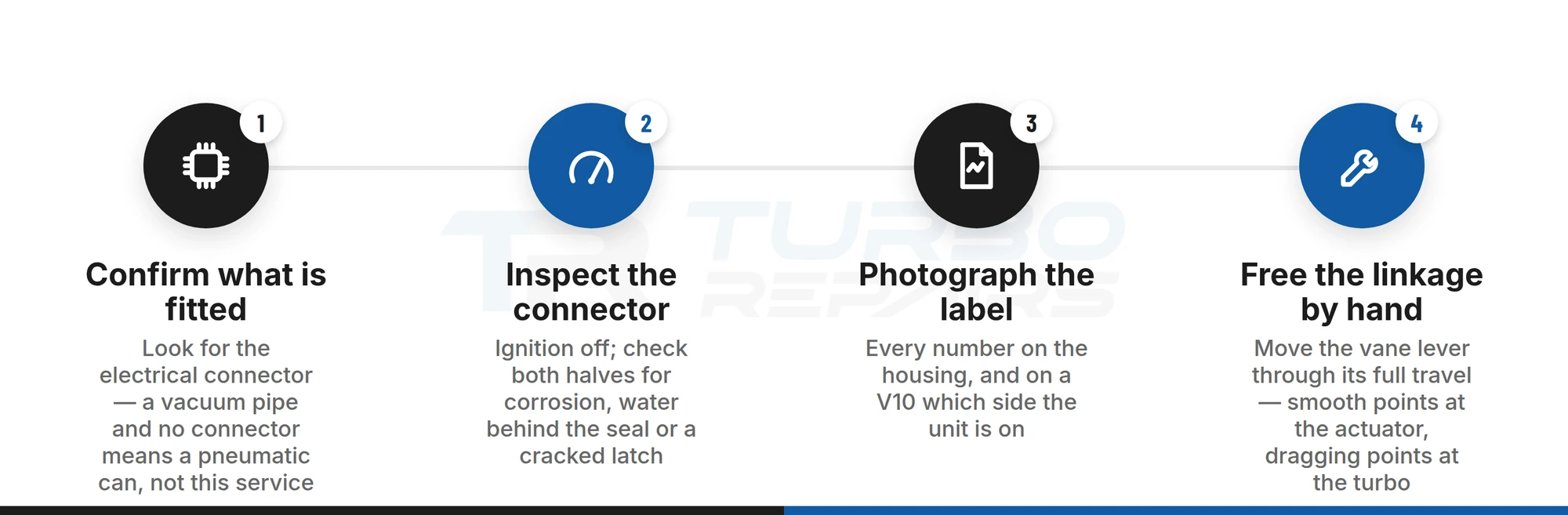
- Confirm what is fitted. Find the actuator on the turbocharger and look for the electrical connector. A vacuum pipe and no connector means a pneumatic can, and this service is not the right one.
- Inspect the connector. With the ignition off, unlatch it and look at both halves for green corrosion, water behind the seal, a pushed-back pin or a cracked latch, especially if the car has been wading or pressure-washed. Refit it until it clicks fully home.
- Photograph the label. Capture every number on the housing, and on a V10 write down which side the unit is on.
- Free the linkage and move the vanes by hand. Disconnect the actuator’s link from the turbocharger’s vane lever and move the lever gently through its full travel. If it moves smoothly from end to end, the vanes are free and the actuator is the suspect. If it drags, catches or stops short, the problem is inside the turbocharger.
A lever that moves freely on a cold engine is good evidence but not proof, because vane mechanisms can tighten when hot, and the Touareg fault is so often a hot one. If yours only appears on a long tow, say so on the repair form.
If the vanes are stiff or seized, a rebuilt actuator would be fighting the same resistance from its first climb, and the turbocharger is the part that needs the work. Whatever you find, do not drive the car with the actuator unplugged to see what happens, because the engine management can no longer position the vanes at all.
Turbo Repairs · Epsom workshop
Vanes free, connector clean, fault still there? Send us the actuator
Post the actuator in with your registration, engine, label photographs, stored codes and a note of what the car was doing when it faulted, towing included. We check its references against your Touareg and test it as received, before it is opened.
Lifetime, unlimited-mileage warranty · Mail-in from the UK and internationally · Bench-tested and calibrated before it ships
Our VW Touareg Actuator Rebuild
You or your garage remove the actuator and post it to our workshop at Unit 102 Reaver House, 12 East Street, Epsom, Surrey, KT17 1HX, United Kingdom. It is rebuilt there by our team of turbo specialists and electronic engineers, in a fixed order.
- Complete the repair form. Give us the registration, the engine (V6, V10 or R5), the side for a V10, photographs of every reference on the label, the stored codes and freeze-frame notes, whether cooling down clears the fault, what the car was doing when it appeared, and what you found when you moved the vane lever by hand.
- Pack it. Wrap the actuator in foam or bubble wrap inside a rigid box, with your repair reference on a note inside. Our FAQs page covers packing and postage in more detail.
- We identify it against your Touareg. The references are checked against your registration and engine. If the unit turns out to be a pneumatic can, or an actuator we cannot rebuild, we tell you before any work is done.
- We bench-test it as received. Testing before the unit is opened means what we report is what actually failed, not what we assumed.
- We rebuild it at component level. The motor, gear train, position sensor and seals are renewed as needed, and the circuit board is reworked. Components with a known weakness in the original design are replaced with uprated parts, so the unit meets or exceeds original specification.
- We calibrate it and prove it. The rebuilt actuator is checked across its full travel on dealer-level diagnostic and calibration tooling, then posted back ready to refit. It needs no coding. Once it is fitted, clear the stored codes with a diagnostic tool.
Repairs start from £100 + VAT, and the exact price is confirmed once the unit has been identified and tested, so you know it before any work goes ahead. Turnaround is typically one to two working days from the actuator reaching us, plus postage each way. Every rebuild carries a lifetime, unlimited-mileage warranty, with no mileage cap and no time limit. Units reach us from across the UK and from overseas, and the other vehicles we cover are on our electronic turbo actuator repairs hub.
VW Touareg Turbo Actuator Repair FAQ
Is the Touareg V6 turbo actuator the same as the V10’s?
No. The 3.0 V6 is listed as Hella 6NW009550, G-020, or under the separate G-82 family. The 5.0 V10 is listed under 6NW009228 as G-22 or G-124, and under 6NW008412 as G-145. Match the references on your own casing and, on a V10, the side it came from.
Does the 2.5 R5 Touareg have an electronic turbo actuator?
The one listing we found for it sells a wastegate actuator to be set up with a boost gauge, which does not describe an electronic unit. Look at the part itself. A connector means electronic, which we rebuild; a vacuum pipe means a pneumatic can, which this service does not cover. For the R5’s turbocharger, see our Garrett GT2052V page.
Why does my Touareg only lose power when it is towing?
Towing up a gradient is when the engine asks the turbocharger for the most boost at modest revs, so the actuator holds the vanes hardest, for longest, with the exhaust at its hottest. A unit with heat-sensitive faults shows them there first. Check the intake for leaks as well, because high boost also opens up weak joints.
Can I fit a new actuator instead of rebuilding mine?
New units are sold, but one has to match the G-code on yours, and on a V10 the side as well, and the listings do not always agree on those. Rebuilding your own unit removes the matching question, because it goes back on the turbocharger it came off.
Will a rebuilt actuator need coding once it is back on the car?
No. You get your own unit back, calibrated and tested on our bench, and it refits without programming. Clear the stored fault codes once it is fitted.
How much does a Touareg actuator repair cost, and how long does it take?
Repairs start from £100 + VAT, with the exact price confirmed once the unit has been identified and tested. Turnaround is typically one to two working days from arrival, plus postage each way, and every rebuild carries a lifetime, unlimited-mileage warranty.
Final Thoughts
On a Touareg the actuator fault is usually a working fault. It shows itself on the long climb with a trailer behind, because that is when the actuator holds the vanes hardest in the most heat, and it goes quiet again once the engine has cooled. That makes it easy to live with for a while, and easy to mistake for something else.
Start with the engine, because the V6, the V10 and the R5 do not share a boost-control set-up. Then check the connector, photograph the references, note the side on a V10 and move the vane lever by hand. If all of that points at the actuator, the part to rebuild is the one already set up for your turbocharger.
Turbo Repairs · Epsom workshop
Get your Touareg’s actuator rebuilt before the next long tow
Whether it is a V6 unit or one side of a V10, send it with the label photographs, the stored codes and a note of what the car was pulling when it faulted. We renew the motor, gears, position sensor and board, set it up on the bench and return it ready to bolt back on, with no coding needed.
Lifetime, unlimited-mileage warranty · Mail-in from the UK and internationally · Bench-tested and calibrated before it ships