

Summary A turbo actuator controls how much exhaust energy reaches the turbine wheel, by moving either a wastegate or the ring of variable vanes inside the turbine housing. It is not a valve that pops open at a set pressure — it is a positioner, holding whatever position the engine management commands, for as long as the engine is running.
It moves to whatever position the engine management demands, for as long as the engine runs, so a worn one is rebuilt at component level rather than swapped.
- What the part is: a positioner, not a pressure valve. It holds whatever position the engine management commands, for every second the engine runs — not a spring holding a valve shut until boost pushes it open.
- What it physically moves: either a wastegate, letting exhaust gas bypass the turbine wheel, or the ring of small vanes surrounding the turbine on a variable-geometry turbocharger, all of which pivot together when the unison ring behind them is rotated.
- Two families, diagnosed differently: a vacuum or pressure actuator is a sealed can holding a diaphragm and a spring, with a pipe and no wiring, and nothing measures where the rod ended up. An electronic actuator holds a motor, a reduction gear train, a position sensor and a control board — it is commanded to a position and reports the one it reached.
- Why the fault reads as a boost fault: two comparisons run at once. The outer loop checks the boost target against measured manifold pressure; the inner loop checks commanded position against actual shaft position. The driver only notices the outer one, even when the failure is a set of gear teeth in the inner.
- Why calibration belongs to your turbocharger: the position sensor reports a raw electrical signal, not millimetres of travel. It means nothing until the unit knows which reading is the mechanism fully closed and which fully open, on the turbocharger it is bolted to — which is why a unit taken off another car arrives carrying another turbocharger’s numbers.
- What sets its life: continuous holding duty, not mileage and not age. Holding a fine position against exhaust gas that is pushing back is work even at a steady cruise, and after a hard run the hottest moment for its electronics can arrive once the engine has been switched off.
- Why a rebuild is usually the answer: wear lands in identifiable parts — the motor, the reduction gears, the position sensor, the seals and the connections on the board — and each is renewable, so the unit returns recalibrated and plug-and-play, typically within one to two working days, under a lifetime, unlimited-mileage warranty. One condition applies: if the vane mechanism itself has seized, freeing that comes first, or the next actuator strains against the same resistance.
Most explanations of this part describe a spring holding a valve shut until boost pushes it open. That describes one design accurately and every other one badly. On a modern variable-geometry turbocharger the actuator is a positioning device under continuous command, and reading it that way is what tells you why it wears out and whether it can be repaired.
Why a Turbocharger Needs Anything Controlling It
A turbocharger is a self-reinforcing loop. Exhaust gas leaving the engine spins the turbine wheel; the compressor on the other end of the same shaft pushes more air in; more air allows more fuel; more fuel means more exhaust energy, which spins the turbine harder still. Nothing in that loop limits itself, and left alone it climbs until the rotating assembly turns faster than its bearings allow, or cylinder pressures exceed what the engine was built to contain.
So every turbocharged engine needs a device that can take energy back out of the loop on demand. The opposite problem sits at the other end of the rev range: pulling away from low engine speed there is very little exhaust energy available, and the same device is what makes the most of what there is. It restrains the turbocharger at the top of the range, helps it at the bottom, and moves between those two jobs continuously as you drive.
What the Actuator Physically Moves
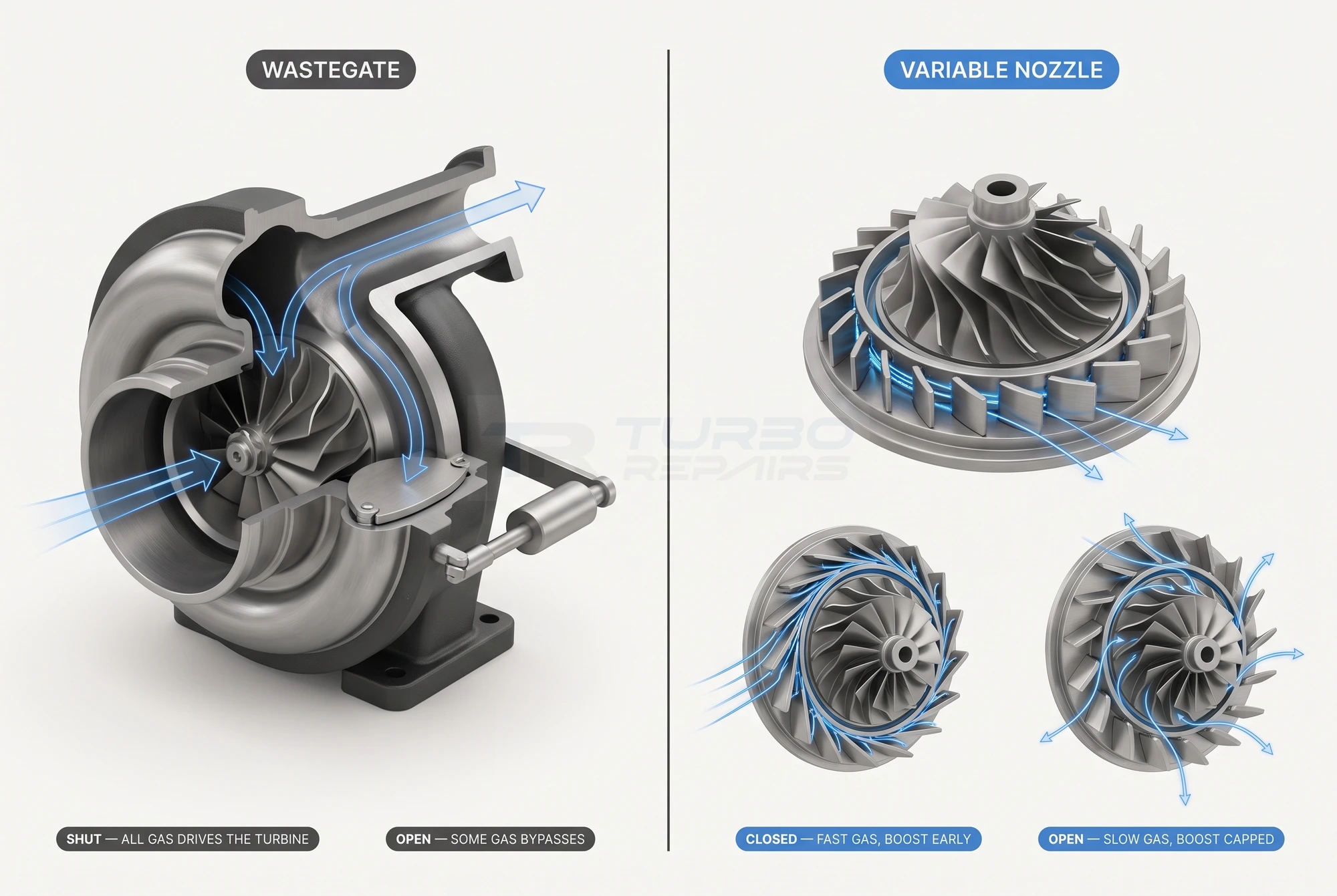
The actuator does the same job in two quite different designs.
A wastegate. A valve in the turbine housing that lets exhaust gas bypass the turbine wheel and go straight down the exhaust. Shut, everything goes through the turbine; open, some of it goes round. The actuator moves the arm that opens it, and how far it opens decides how much drive the turbine receives.
A variable-nozzle mechanism. On a variable-geometry turbocharger there is no bypass. A ring of small vanes surrounds the turbine wheel, and all of them pivot together when a unison ring behind them is rotated. The actuator rotates that ring.
Closing the vanes narrows the gaps between them, so the same mass of gas is forced through a smaller area, accelerates, and meets the turbine blades at a sharper angle — which is how a modestly sized turbocharger produces usable boost before engine speed has risen. Opening them widens the passages, the gas slows, and boost is capped at the top end. The V in a designation such as the Garrett GT2052V is what marks that variable nozzle turbine out from a fixed one.
Wastegate or vanes, the job is identical: decide, moment by moment, how much of the exhaust stream does useful work on the turbine wheel.
Commanded Position and Achieved Position
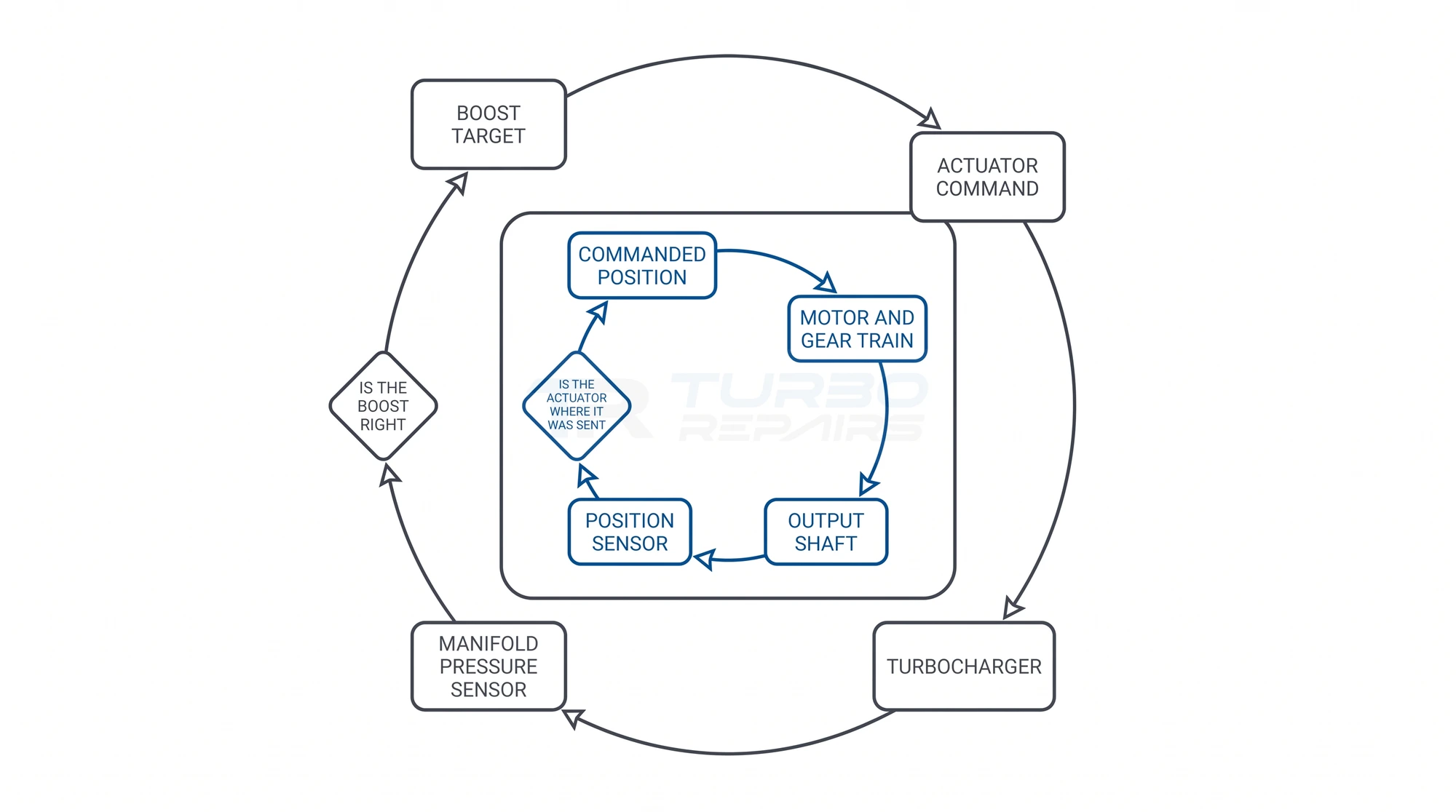
The engine management does not switch the actuator on and off. It runs a target, and it checks the result.
For the engine speed, load, temperature and ambient air pressure of the moment, the control unit holds a boost target — the manifold pressure it wants to see — and reads the actual manifold pressure from a sensor. The difference between those two numbers is what drives the actuator: too little boost, and the vanes are commanded further closed or the wastegate held further shut; too much, and the correction runs the other way.
On an electronic actuator there is a second loop inside that one. A position sensor on the output shaft reports where the shaft actually is, and the unit’s electronics compare that against the position it was told to reach, correcting until the two agree. Two comparisons therefore run continuously while you drive: is the boost right, and is the actuator where it was sent.
That arrangement explains two things people find odd. Actuator faults present as boost faults rather than as noises, because the complaint the driver notices belongs to the outer loop — the engine did not get the air it asked for — even when the failure is a set of gear teeth in the inner one. And a diagnostic session shows commanded position beside actual position because those two figures are the inner loop made visible; a wide, persistent gap says the actuator was sent somewhere and did not arrive.
It also explains why those figures belong to one unit on one turbocharger. A position sensor reports a raw electrical signal, not millimetres of travel, and that signal means nothing until the unit knows which reading is the mechanism fully closed and which is fully open, on the turbocharger it is bolted to. Establishing that reference range is what calibration is — which is why a rebuilt actuator is recalibrated on a bench rather than simply reassembled, and why a unit taken off another car arrives carrying another turbocharger’s numbers.
Vacuum Actuator or Electronic Actuator
Both are turbo actuators. Only one of them knows where it is.
A vacuum or pressure actuator is a sealed can holding a diaphragm and a spring, with a rod out of one side, a pipe into the other and no wiring at all. The engine management varies the signal reaching it through a control solenoid, and the diaphragm settles the rod wherever that signal and the spring balance. Position is a consequence of the pressure applied: nothing measures it, and nothing reports it back.
An electronic actuator is a moulded body bolted to the turbocharger with an electrical connector on it, holding a motor, a reduction gear train, a position sensor and a small control board. It is commanded to a position, and it reports the position it reached.
That is the substantive difference, and it is why the two are diagnosed by completely different methods. The same model can be built with either type across a production run — the Ford Mondeo 2.0 TDCi is the clearest example on this site — so establishing which part is on your turbocharger comes before anything else. Identifying yours, and reading what each type’s symptoms point at, is covered in full in our guide to turbo actuator symptoms.
What the Actuator Is Doing While You Drive
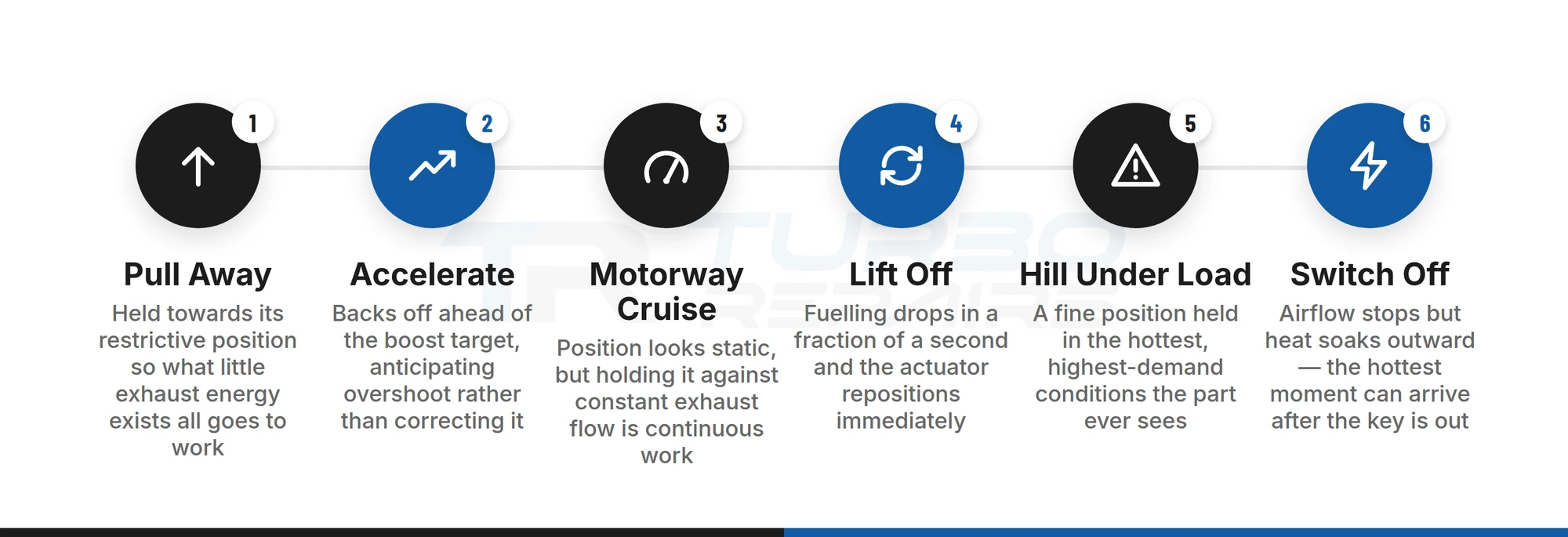
Pulling away from rest there is very little exhaust energy to work with, so the mechanism is held towards its restrictive position and all of what there is goes to work on the turbine. As the engine picks up and boost rises towards the target, the actuator starts backing off — easing the vanes open, or cracking the wastegate — before the target is reached rather than after it. Overshoot is anticipated, not corrected, and this is the phase in which the actuator moves most.
At a steady motorway cruise the position looks static, and this is where the part’s duty is most often misread. Exhaust gas is flowing hard and pushing constantly on the mechanism the actuator is holding. Holding a position against that is work: the motor and the gear train are loaded even though, from outside, nothing appears to be happening.
Lift off and fuelling drops away in a fraction of a second; exhaust energy falls with it while the turbine is still spinning at speed, and the actuator repositions immediately. Climbing a long hill under load is the hardest case of all — sustained high demand, sustained high exhaust temperature, and a fine position held in the hottest conditions the part ever sees.
Then the engine is switched off. Airflow stops, coolant stops circulating, and heat soaks outwards from the turbine housing into everything bolted to it. After a hard run that ends in a car park, the hottest moment of the day for the actuator’s electronics can arrive after the key has been turned.
Across the whole of that cycle there is no phase in which the part is idle.
Why Turbo Actuators Wear Out
Three loads do the damage, and none of them is age.
The mechanism it drives gets harder to move. Soot and oil residue — from exhaust gas recirculation, from crankcase breather vapour, from short journeys that never bring the turbine housing properly up to temperature — bake onto the vane pivots and the unison ring, and the sweep stiffens. The actuator is still commanded to the same positions, so it applies more force to reach them: more current through the motor, more torque through the gear teeth, more heat in both. Eventually the motor burns or a gear strips, and the actuator has failed as a consequence of a mechanism it could not move. The Jeep Grand Cherokee 3.0 CRD page follows that failure through.
Heat cycles the electronics. Every journey takes the board and its connections through a full expansion and contraction, and joints flexed enough times eventually crack.
Vibration and water work on the rest. The unit is bolted to a turbocharger on a running engine, so gear teeth, mountings and internal joints are shaken constantly; and a perished seal or a cracked connector housing lets water reach electronics that then corrode and report positions that are not real.
This is why two identical cars do not wear their actuators at the same rate. A turbo actuator is not an occasional-use part: it holds a commanded position against exhaust-gas load for as long as the engine is running, and that continuous holding duty — not mileage, not age — is what sets its life. It is also why the things that fail are the motor, the gear train, the position sensor and the connections on the board: parts that wear, and parts a component-level rebuild renews.
What that wear looks like from the driver’s seat, and how to tell it apart from a failing turbocharger, is a separate question with a longer answer — set out in our guide to turbo actuator symptoms.
Turbo Repairs · Epsom workshop
Not sure which actuator your turbo has?
Send us the reference stamped on the casing and your vehicle details, and our engineers will tell you what type it is and what can be done with it before you buy anything.
Mail-in from anywhere in the UK · Returned plug-and-play · Lifetime, unlimited-mileage warranty
Rebuilt or Replaced? It Depends How It Failed
A part destroyed in a single event is a replacement. A part worn out by duty is usually a rebuild, because the wear lands in identifiable components — the motor, the reduction gears, the position sensor, the seals, the connections on the board — and those are renewable individually.
That distinction is rarely made in writing about this part, for a straightforward reason: an explanation written by a business whose answer to a failed actuator is a replacement unit has little reason to tell you which parts inside it are renewable.
A rebuild here means the unit is tested as received before it is opened, then stripped to component level, with worn parts renewed and uprated where the original design is the weak point — the sequence set out on the BMW 3 Series page — then recalibrated to the travel and feedback range its own reference demands and proved against live boost targets on the bench, the way every Ford Transit actuator is signed off. It is a mail-in repair: the actuator comes off and the turbocharger stays on the engine, so the oil feed and return lines, the manifold studs and the gaskets are never disturbed. The unit returns plug-and-play with no programming on refit, typically within one to two working days of reaching the workshop, and every repair carries a lifetime, unlimited-mileage warranty.
Our electronic turbo actuator repair service covers units fitted across a wide range of makes, and it is the reference on your casing rather than the badge on the car that decides whether yours is one of them.
One condition applies to all of it. If the vane mechanism itself has seized, a rebuilt or brand-new actuator bolted to it will strain against the same resistance and fail again. Freeing the mechanism comes first, and on most engines that means the turbocharger comes off for a turbocharger rebuild in its own right.
Turbo Actuator FAQ
Questions about how the part works are below; postage, turnaround and warranty are answered in our full FAQs.
Does every turbocharger have an actuator?
Almost every turbocharger fitted to a road vehicle has one, because a turbocharger with no way of limiting the energy reaching its turbine cannot protect itself or the engine from overboost. What differs is the form: a wastegate and its actuator on a fixed-geometry turbocharger, or a vane mechanism and its actuator on a variable-geometry one.
What is the difference between a wastegate and a wastegate actuator?
The wastegate is the valve — the passage in the turbine housing that lets exhaust gas bypass the turbine wheel. The actuator is the device that moves it. They are usually spoken of as one thing, but they fail separately, and a seized wastegate flap needs entirely different work from a failed actuator.
Is the turbo actuator the same as the boost control solenoid?
No. On a vacuum-operated system the solenoid is a small electrically switched valve that varies the signal being sent to the actuator; the actuator is the part on the turbocharger that physically moves. Both can produce the same boost complaint, so which one is at fault needs establishing before either is bought.
Why does a turbo actuator need calibrating?
Because its position sensor reports a raw electrical signal rather than a measurement of travel. The unit has to be told which reading corresponds to the mechanism fully closed and which to fully open, on the specific turbocharger it is fitted to. That reference range is what calibration establishes, and it is why an electronic actuator taken off another car is not simply a swap.
Does a turbo actuator do the same job on a petrol engine?
The principle is identical — it sets how much exhaust energy reaches the turbine wheel — though the usual arrangement on a petrol turbocharger is a wastegate rather than a variable-nozzle mechanism. Variable-geometry designs are far more common on turbocharged diesels.
Final Thoughts
Ask what a turbo actuator does and the short answer — it controls boost — is true and almost useless. What it actually does is hold a mechanism at a commanded position, against gas that is pushing back, for every second the engine runs, adjusting continuously as speed and load change.
Read it that way and the rest follows: why these are wear failures rather than breakages, why the parts that go are the motor, the gears, the sensor and the board connections, and why the calibration belongs to your turbocharger rather than to the part. It also explains the step most often skipped — that freeing whatever the actuator has been straining against matters more than which replacement you choose.
Turbo Repairs · Epsom workshop
Have the actuator rebuilt rather than guessed at
Post the unit in with the reference from its casing and a note of how the fault behaves. It is tested as received, stripped to component level, recalibrated and bench-proven under live boost targets before it comes back.
Mail-in from anywhere in the UK · Typically one to two working days · Lifetime, unlimited-mileage warranty