

Summary The 1.3 CDTi in a Vauxhall Corsa is Fiat’s small 1.3 diesel, the same engine sold as the 1.3 Multijet in the Fiat Panda and 500, and its turbocharger can be rebuilt rather than replaced. You or your garage take it off and post it to us. It is stripped to component level, measured, rebuilt on genuine OE or OEM-grade parts, balanced and bench-tested, typically within one to three working days of arrival. Rebuilds start from £185 + VAT and carry a lifetime, unlimited-mileage warranty.
The engine was built at two broad power levels, and they do not carry the same kind of turbocharger. Which level your car sits at decides which of the many other badges’ turbo advice is really about your engine.
Trade listings sell turbochargers for this one engine under nine makers’ badges and six engine names: CDTi, Multijet, JTD, DDiS, TDCi and HDi.
This page is for owners of a Vauxhall Corsa, Meriva, Combo or Astra with the 1.3 CDTi, and of the Fiat, Suzuki, Ford and other small cars that share the engine, when the turbocharger is the suspect: power has gone, the car has dropped into limp mode, there is smoke from the exhaust or a new whistle under boost. The 1.6, 1.7 and 1.9 CDTi are different engines with different turbochargers, covered on our page for the 1.6, 1.7 and 1.9 CDTi. The Corsa’s petrol turbo is covered on our Vauxhall 1.4 Turbo petrol page.
- The engine: a 1248 cc four-cylinder diesel, sold as the 1.3 CDTi, Multijet, JTD, DDiS, TDCi or HDi depending on the badge
- Vauxhalls in our fitment data: Corsa, Meriva, Combo and Astra
- Turbochargers in our fitment data: BorgWarner KP35, KP31 and BV35; Garrett GT1238SZ and GTD1036VZ
- Two power levels: 68 to 75 bhp and 89 to 94 bhp, each with its own turbochargers
- Price: rebuilding your own turbocharger from £185 + VAT; a replacement turbocharger from £450 + VAT
- Turnaround: typically one to three working days on the bench, plus postage each way
- Warranty: lifetime and unlimited mileage
- Getting started: the online Repair Form
One Fiat-Built 1.3 Diesel, Several Badges
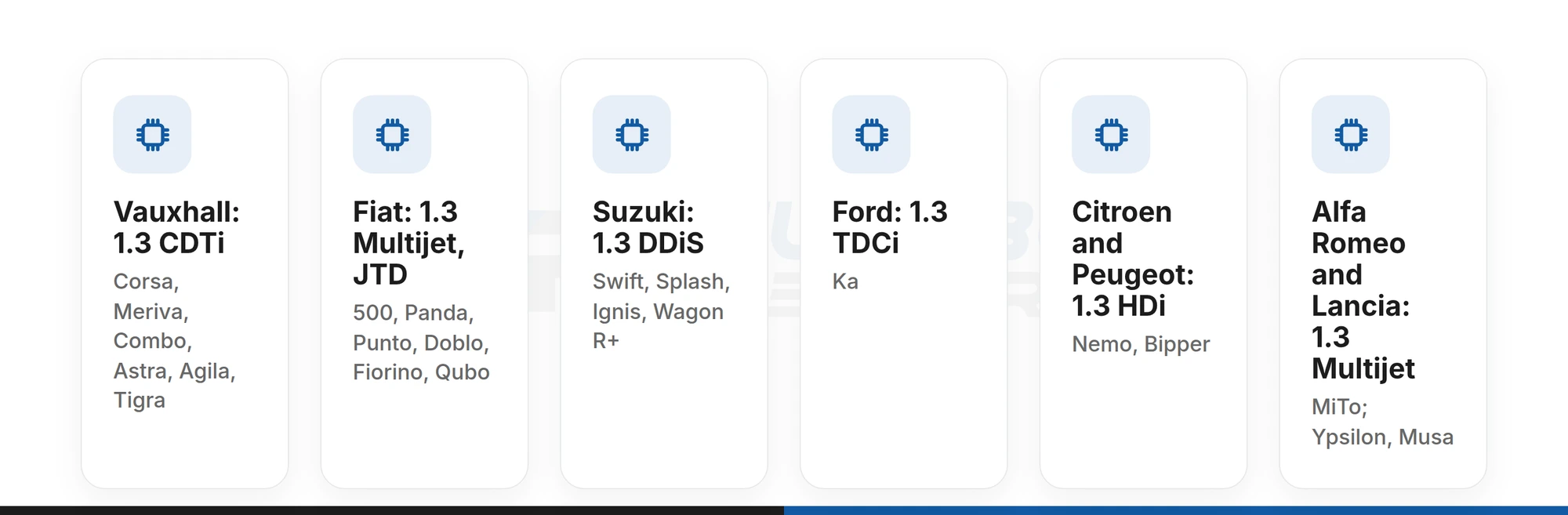
Most engines on this site belong to one manufacturer and turn up under a few of its model names. The 1.3 diesel went much further. Trade listings for its turbochargers name cars from nine makers, from city cars such as the Panda and the Ka to small vans such as the Combo, Doblo and Nemo, and each maker gave the engine its own name.
| Maker | Name on the engine | Models named in trade turbo listings |
|---|---|---|
| Vauxhall / Opel | 1.3 CDTi | Corsa, Meriva, Combo, Astra, Agila, Tigra |
| Fiat | 1.3 Multijet, JTD | 500, Panda, Punto, Grande Punto, Punto Evo, Doblo, Fiorino, Qubo |
| Alfa Romeo | 1.3 Multijet | MiTo |
| Lancia | 1.3 Multijet | Ypsilon, Musa |
| Suzuki | 1.3 DDiS | Swift, Splash, Ignis, Wagon R+ |
| Ford | 1.3 TDCi | Ka |
| Citroen and Peugeot | 1.3 HDi | Nemo, Bipper |
| Chevrolet | not stated in the listings | Aveo |
The table is a map of where the engine turns up, not a fitment guide. Our own fitment data catalogues it under Vauxhall’s badges only, on the Corsa, Meriva, Combo and Astra, and even there the Fiat origin shows: some rows give Vauxhall engine codes such as Z13DTJ and A13DTC, and others name the engine with Fiat’s labels, SJTD and SDE.
What a shared engine means for your car
It means the pool of information about your turbocharger is much larger than a search for “Corsa 1.3 CDTi turbo” suggests. A fault report or a listing written for a Panda or 500 Multijet may be describing exactly the engine and turbo in your Corsa, and the reverse is true for a Fiat owner reading about a Vauxhall.
It does not mean every 1.3 turbo fits every 1.3 car. Some listings print a single power range, as wide as 69 to 95 hp, against one turbocharger reference. In our fitment data that span crosses both kinds of turbocharger the engine carries, so a range that wide is a reason to read the label on your own unit, not evidence that a part fits. The next section shows where the line falls.
Fixed-Geometry or Variable-Vane: Which Turbo Is on Yours
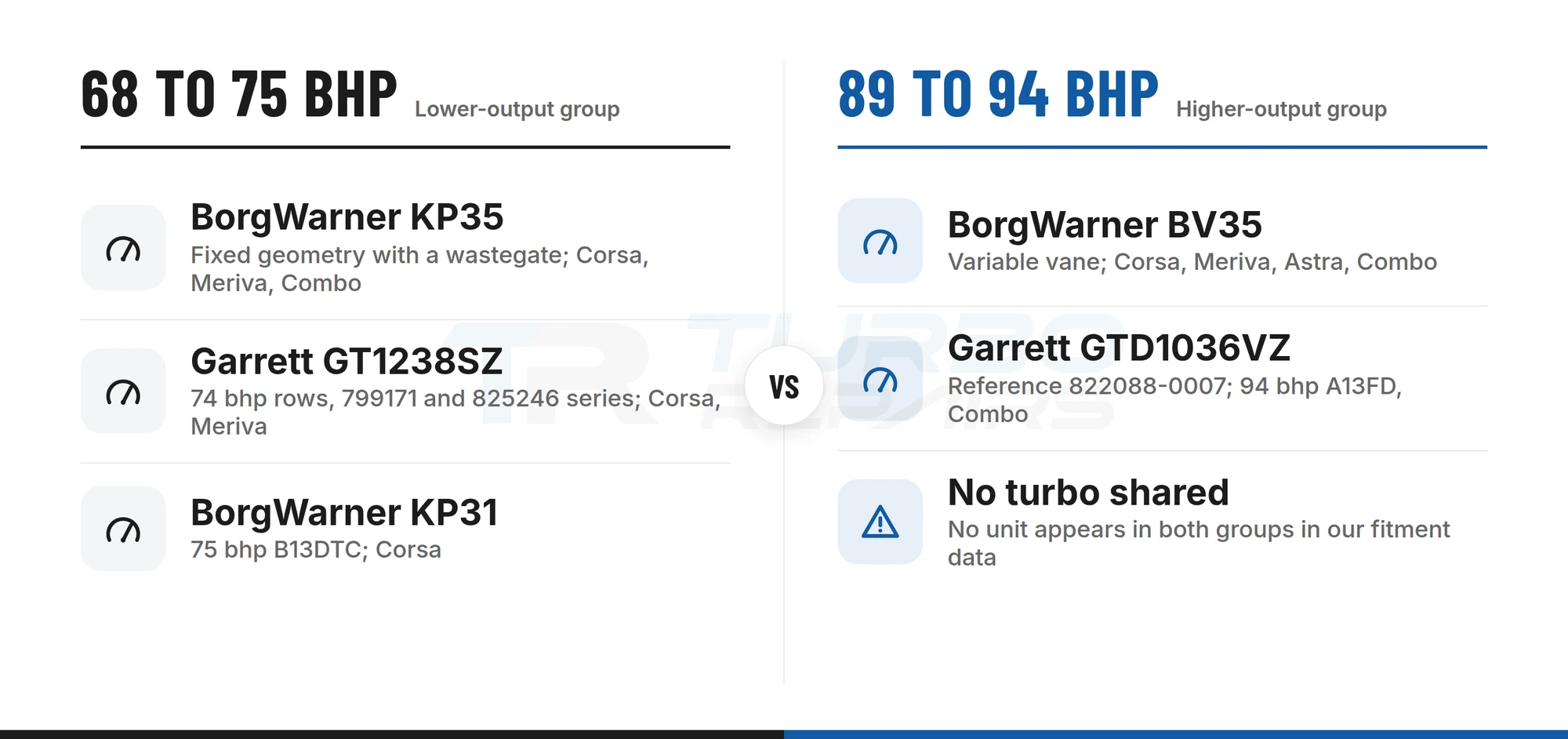
Across every Vauxhall row in our fitment data, the 1.3 falls into two groups by power output. Every row from 68 to 75 bhp carries one set of turbochargers, and every row from 89 to 94 bhp carries another, with no turbocharger shared between the two groups.
| Output | Engine codes in our data | Turbocharger | Vauxhalls listed |
|---|---|---|---|
| 68 to 75 bhp | Y13DT, Z13DT, Z13DTJ, A13DTC; also filed as SJTD | BorgWarner KP35, fixed geometry with a wastegate | Corsa, Meriva, Combo |
| 74 bhp | A13DTC; also filed as SDE | Garrett GT1238SZ, references in the 799171 and 825246 series | Corsa, Meriva |
| 75 bhp | B13DTC | BorgWarner KP31 | Corsa |
| 89 to 90 bhp | Z13DTH; also filed as SJTD | BorgWarner BV35, variable vane | Corsa, Astra |
| 94 bhp (89 on some Combo rows) | Z13DTE, A13DTE, A13DTR, A13FD | BorgWarner BV35, variable vane | Corsa, Meriva, Astra, Combo |
| 94 bhp | A13FD | Garrett GTD1036VZ, reference 822088-0007 | Combo |
Finding your row
Start with the power output. Your V5C logbook gives it in kilowatts at section P.2, and one kilowatt is about 1.34 bhp, so a car registered at 55 kW sits in the lower group and one at 66 or 70 kW in the upper group. The later Corsa, for example, was sold with the 1.3 CDTi at both 55 kW and 70 kW.
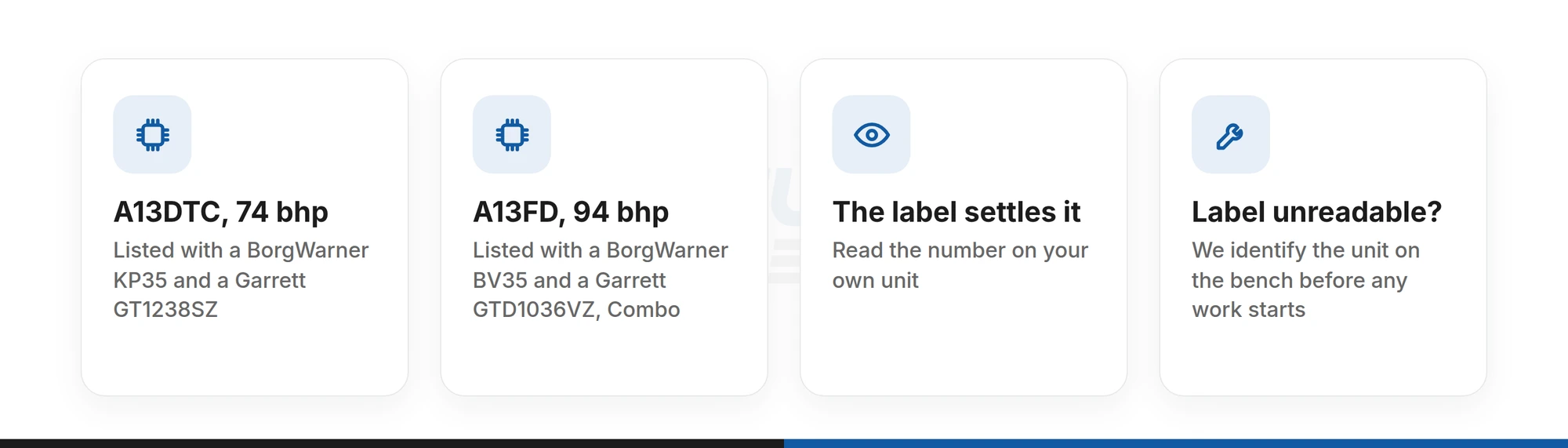
The engine code narrows it further, but not always to one unit. A13DTC appears on KP35 rows and on Garrett GT1238SZ rows at the same 74 bhp, and the Combo’s A13FD appears with both the BV35 and the Garrett GTD1036VZ. Where two makers share a row, the label on the turbocharger settles it. If the label is unreadable, the unit is identified on the bench before any work starts, so you do not need to settle it before posting.
The years attached to each reference in the catalogue are the years it is listed from, not the build dates of the car, so a registration year is a weaker guide than the output. The one broad pattern the dates do show is that the Garrett GT1238SZ, the KP31 and the GTD1036VZ are all listed from later dates than the first KP35s.
Why the group matters
The BorgWarner KP35 controls boost with a wastegate, a flap that lets exhaust bypass the turbine once pressure is high enough. The BV35 has no need of one: a ring of movable vanes around the turbine changes how hard the exhaust drives it. The two wear in different places, so a boost fault is read differently on each. Our wastegate actuator repair page and our guide to variable-vane turbos explain each mechanism.
For the KP31, the GT1238SZ and the GTD1036VZ our fitment data names the unit but does not record how it controls boost, so we do not state it here. It is confirmed on the bench from the unit itself, before any part of the boost control is diagnosed or renewed.
What Fails on a 1.3 CDTi Turbo
Whichever unit your engine carries, the core is the same. A turbine wheel in the exhaust and a compressor wheel in the intake share one shaft, which spins in oil-fed bearings inside a centre housing, with a seal at each end. That shared layout is why the failures on a 1.3 read much like those on larger diesels.
- Bearing wear and shaft play. Oil that arrives late, thin or dirty wears the bearings first. The shaft then moves further than it should, and a wheel that brushes its housing loses the tips of its blades.
- Failed seals. Once the shaft has room to move, the seals stop keeping oil inside the centre housing. It leaves as blue or grey smoke, or pools in the intercooler pipes.
- Compressor damage. Grit or a fragment that gets past a split intake hose or a badly seated air filter strikes the compressor blades at full speed.
- Wastegate wear on the lower-output engines. On a KP35 the wastegate spindle and its bush wear with heat, and a flap that sticks or leaks lets boost wander.
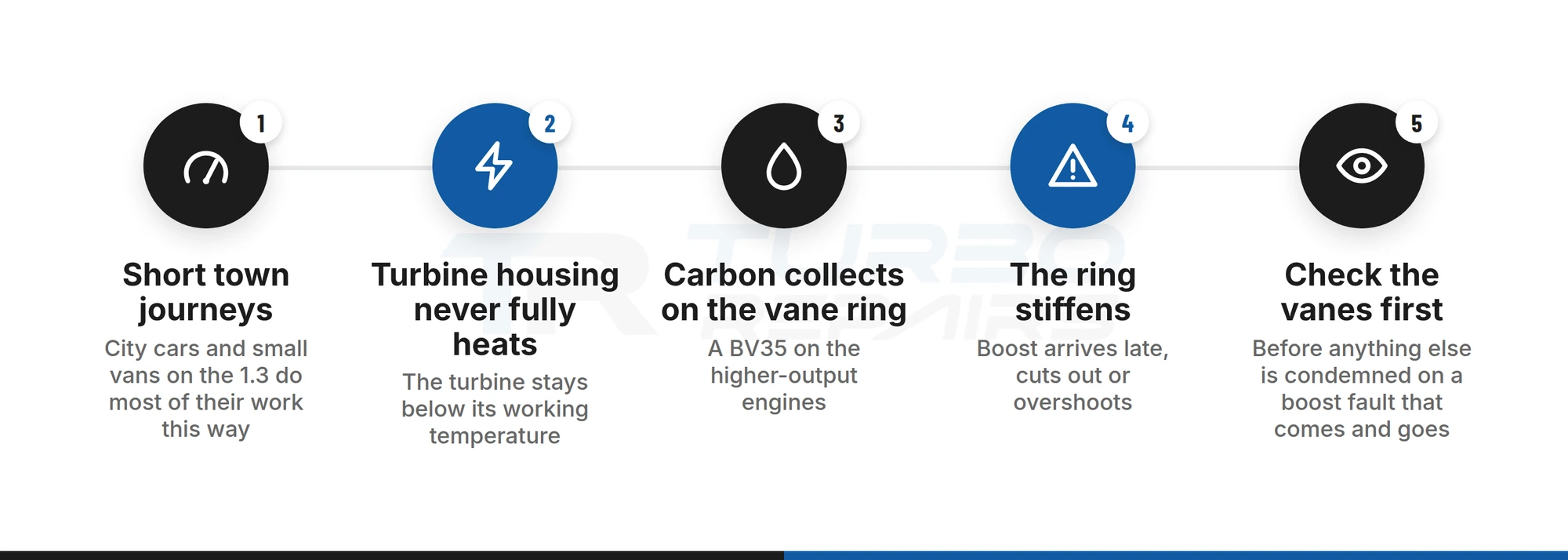
- Vane stiffening on the higher-output engines. On a BV35 the vane ring collects carbon and stiffens, so boost arrives late, cuts out or overshoots.
The last point is worth weighing on a car like this. Many 1.3 diesels are in city cars and small vans, and short journeys that never bring the turbine housing fully up to heat are exactly the conditions in which a vane ring collects carbon. If your car is a higher-output 1.3 that mostly does town work, a boost fault that comes and goes deserves a look at the vanes before anything else is condemned.
Nearly all of these faults begin outside the turbocharger. A carboned oil feed pipe, a slow-draining return line, stretched oil-change intervals or an intake leak will wear a rebuilt or new unit exactly as they wore the old one, so the cause has to be found and put right on the car before the turbocharger goes back on.
Symptoms and the Checks That Come First
A failing turbo on a 1.3 announces itself in familiar ways: a flat spot or no pull above low revs, limp mode with the engine warning light on, smoke under acceleration, oil in the intake pipework, or a whistle or siren that rises with boost. None of those, on its own, proves the turbocharger has failed. Several cheaper faults produce the same signs, and they are worth ruling out in this order before anything is unbolted.
- Read the stored codes. A P0299 (underboost) or P0234 (overboost) says which way boost went wrong, not which part caused it. Our guide to overboost and underboost codes explains what each one can and cannot rule out.
- Check the pressurised pipework. A split boost hose, a loose clip or a cracked intercooler joint loses boost and whistles in a way that mimics a worn turbo closely. It is the cheapest fault on this list to put right.
- Check the air filter and intake. A collapsed or badly fitted filter starves the compressor, and it is also the route by which debris reaches the compressor wheel.
- Check the oil. Low, old or diluted oil is the usual cause of the bearing wear above, and it has to be put right whatever happens to the turbo.
- Look at the compressor end. With the intake pipe off, check the compressor wheel for chipped blades and the housing for a wet film of oil, and feel for play in the shaft. Our guide to turbo failure symptoms explains what each finding means and which cheaper faults imitate it.
- Check the boost control moves. On a KP35 that is the wastegate arm and its actuator; on a BV35, the vane mechanism and the actuator that drives it. A mechanism that is stiff or seized often points to carbon rather than a worn rotating assembly.
If the pipework, filter and oil are sound and the compressor end shows play, damage or oil, the turbocharger itself is the problem, and the next question is whether to rebuild it or replace it.
What a Corsa 1.3 CDTi Turbo Costs to Put Right
For the turbocharger itself, the starting prices are the same whichever badge the engine wears and whichever of its turbochargers you have.
| Route | Price with us | What it covers |
|---|---|---|
| Rebuild of your own turbocharger | From £185 + VAT | The unit that came off your car, stripped, measured, rebuilt, balanced and bench-tested |
| Replacement turbocharger | From £450 + VAT | A reconditioned or new exchange unit supplied in place of yours, where yours is too far gone to rebuild |
| Removal and refitting | Not included | Charged by whoever does the work on the car, and the same job whichever route you choose |
Our guide to turbo repair and replacement prices sets rebuild prices by vehicle class, and puts small cars such as the Fiesta and Polo at £185 to £285, excluding VAT. A Corsa sits in that group. For the Astra, Combo and Meriva 1.3 CDTi, a rebuild listing shows the price for your year and power output before you order: see our Astra 1.3 CDTi, Combo 1.3 CDTi and Meriva 1.3 CDTi listings. There is no separate listing for the Corsa 1.3, so Corsa owners, and owners of any other badge in the table above, start with the Repair Form instead.
What moves a rebuild up its range
Bearings, thrust parts and seals are renewed on every rebuild, and those are what the starting price covers. A compressor wheel chipped by debris, a shaft scored by a failing bearing, a worn wastegate spindle or a vane ring too far gone to free adds to the work. The price is confirmed once the unit has been stripped and measured, before anything further is done, and if so little survives that a rebuild stops making sense, we tell you, and a replacement becomes the better buy.
Rebuild or replace on a 1.3
The labour to take the turbo off and put it back is identical whichever unit goes on, so the choice turns on the unit itself. A rebuild returns the turbocharger that was already matched to your engine, which on this engine is worth more than it looks: with two power levels, two makers and several engine codes in play, it takes the question of whether a bought-in unit matches your car off the table. A replacement is the answer when the wheels, shaft and housings have all failed along with the bearings.
Turbo Repairs · Epsom workshop
Corsa, Panda or Swift, the 1.3’s turbo comes back as yours
Post the turbocharger that came off your car, whatever badge it wears, and it is identified, stripped and measured before any price above the starting figure is confirmed. You hear whether it is worth rebuilding before any work is done.
Lifetime, unlimited-mileage warranty · Mail-in from the UK and internationally · Bench-tested and calibrated before it ships
Our 1.3 CDTi and Multijet Turbo Rebuild
You, or the garage that looks after the car, remove the turbocharger and post it to us at Unit 102 Reaver House, 12 East Street, Epsom, Surrey, KT17 1HX, United Kingdom. Independent garages and dealers send units in for their customers’ cars the same way. From there, our turbocharger rebuild service runs in this order.
- Repair Form or listing. Astra, Combo and Meriva owners can order from their model’s listing. Everyone else, Corsa, Fiat, Suzuki, Ford and the rest, completes the online Repair Form with the registration, the make and model, the power output from the V5C, the mileage, the symptoms, any stored fault codes and every number on the turbocharger’s label.
- Pack and post. Send the turbo complete, as it came off the engine, with its actuator attached and every port plugged or taped. Write your repair reference inside and outside the box. Our FAQs page covers packing and postage.
- Identified before it is opened. The unit is matched to its reference from the label, or on the bench where the label has gone, so a 74 bhp unit that could be a BorgWarner or a Garrett is settled on the unit itself.
- Stripped and measured. Turbo specialists strip it to component level and measure the shaft, wheels, bearing bores and housings against original specification.
- Rebuilt. Bearings, thrust parts and seals are renewed with genuine OE or OEM-grade components that meet or exceed the original, and a part with a known design weakness is uprated rather than put back. On a wastegated unit the flap, spindle and bush are renewed where worn; on a variable-vane unit the vane ring is cleaned and freed where it is sound and renewed where it is not.
- Balanced and bench-tested. The rotating assembly is balanced, and the unit is run on the bench before it is boxed and returned, ready to refit.
Bench time is typically one to three working days from arrival, with postage each way on top, and every rebuild carries a lifetime, unlimited-mileage warranty. When it goes back on, renew the oil feed and return lines rather than reusing them, and prime the oil supply before the engine runs. Our guide to refitting and priming a turbocharger sets out both.
Vauxhall Corsa 1.3 CDTi Turbo FAQ
Is the Vauxhall 1.3 CDTi the same engine as the Fiat 1.3 Multijet?
Yes. It is Fiat’s 1.3 diesel under Vauxhall’s name, and trade listings sell turbochargers for it under the Fiat, Alfa Romeo, Lancia, Suzuki, Ford, Citroen, Peugeot and Chevrolet badges as well. Some of the Vauxhall rows in our own fitment data even name it with Fiat’s labels, SJTD and SDE. Whether two cars share a turbocharger still depends on the power output and the reference on the unit.
Which turbo does my Corsa 1.3 CDTi have?
Start with the power output on your V5C. At 68 to 75 bhp our fitment data lists a BorgWarner KP35, a Garrett GT1238SZ or, on the 75 bhp B13DTC, a BorgWarner KP31. At 89 to 94 bhp it lists a variable-vane BorgWarner BV35. The label on the unit settles which one you have, and if it is unreadable we identify the turbo on the bench.
Can I fit a turbo listed for a Fiat Panda to my Corsa?
Only if its reference matches the one on your own unit. The engine is shared, but it carries different turbochargers at different outputs, and some listings cover a power range wide enough to include both kinds. A rebuild avoids the question, because the unit that goes back on is the one that came off.
Do you rebuild the 1.3 turbo from a Fiat, Suzuki or Ford?
Yes. The turbocharger is rebuilt the same way whichever badge the car wears. Complete the Repair Form with the make, model, power output and every number on the label, post the unit in, and it is identified on the bench before any work starts. Alfa Romeo’s larger JTD diesels are covered on our Alfa Romeo turbo repair page.
Is the Astra 1.3 CDTi turbo the same as the Corsa’s?
At 94 bhp our fitment data lists the same BorgWarner BV35, under the same Vauxhall part number, 55225439, on the Corsa, Meriva, Astra and Combo. At 89 to 90 bhp the Corsa and Astra are both listed with a BV35, mostly under different Vauxhall numbers. The Astra is not listed with any of the lower-output turbos. Our Astra 1.3 CDTi listing takes your year and output.
Does the Corsa 1.4 Turbo use the same turbo?
No. The 1.4 Turbo is a petrol engine with a turbocharger of its own, covered on our Vauxhall 1.4 Turbo petrol page.
How much does it cost, and how long does it take?
Rebuilding your own turbocharger starts from £185 + VAT and a replacement turbocharger from £450 + VAT, with removal and refitting charged separately and your exact price confirmed after inspection. Bench time is typically one to three working days from arrival, plus postage each way, and every rebuild carries a lifetime, unlimited-mileage warranty.
Final Thoughts
Few engines have been sold under as many names as this one. A Corsa CDTi, a Panda Multijet, a Swift DDiS and a Ka TDCi can all be running the same 1.3 diesel, which makes the knowledge available about its turbocharger far wider than any one badge suggests, provided you read it at the right power output.
That output is the line that matters. Below it sit the KP35, KP31 and Garrett GT1238SZ; above it, the variable-vane BV35 and, on the later Combo, the Garrett GTD1036VZ. Know which side your car is on, rule out the cheap faults that imitate a failed turbo, and put right whatever wore the old one out. Rebuilding the unit that came off your engine then leaves nothing to match.
Turbo Repairs · Epsom workshop
One engine, many badges, your own turbo rebuilt
Complete the Repair Form with your vehicle, its power output and the numbers from the label, then send the turbocharger in complete. It is identified, rebuilt, balanced and bench-tested, and returned ready to refit.
Lifetime, unlimited-mileage warranty · Mail-in from the UK and internationally · Bench-tested and calibrated before it ships