

Summary In the UK a turbo replacement costs from £185 + VAT when we rebuild the turbocharger already fitted to your car, and from £450 + VAT for a reconditioned exchange unit. A new turbo is priced by whoever sells it, so we do not quote one. If the electronic actuator is the only thing that has failed, its repair starts from £100 + VAT. Every one of these is a price for the unit alone; the labour to change it is a separate line.
Below: what each route includes, a rebuild price table taken from our own vehicle listings, what pushes a price up, and how to choose between rebuilding, exchanging and buying new.
All eleven vehicles in our price table rebuild for between £195 and £215 + VAT, and the three vans sit in exactly the same band as the cars.
The three prices buy three different things. A rebuild buys work on the one turbocharger already proven on your engine. An exchange unit buys time, because it is ready before yours could be, and a new turbo buys a unit in which nothing has turned before.
Which of those you actually need moves the bill far more than the badge on the car does. This guide puts a figure on each route where we can publish one, and explains the rest.
How Much Does a Turbo Cost to Replace in the UK?
Here are the four routes side by side. Every price is for the turbocharger or actuator itself, excluding VAT.
| Route | What you get | Price | Typical timing |
|---|---|---|---|
| Rebuild your own turbo | The turbocharger off your car, stripped, rebuilt, balanced, bench-tested and returned to you | From £185 + VAT | 1–3 working days in our workshop, plus transit |
| Reconditioned exchange turbo | A ready-rebuilt unit supplied in place of yours, from a selection of commonly failing turbos | From £450 + VAT | Usually dispatched the same day when the unit is in stock |
| New turbocharger | An unused unit | Set by the seller and the unit, so we do not quote one | Depends on the seller |
| Electronic actuator only | Your actuator repaired at component level and calibrated | From £100 + VAT | 1–2 working days in our workshop, plus transit |
Read each “from” figure as the floor for that route rather than a quote. Where your own turbo lands above it comes down to the vehicle, the engine variant and, on a rebuild, what turns up once the unit is open.
Search for a turbo replacement price and the figures that come back are usually whole-job totals. A garage adds the unit, the hours to swap it and the consumables around it into one number. That is fine for setting a budget, but it blurs the one thing you are actually choosing: of all those lines, the unit is the only one that moves when you switch route.
Rebuilds, exchange units and actuator repairs from us share one warranty: lifetime, with unlimited mileage.
Rebuilding Your Own Turbo: What It Costs and What Is Included
A rebuild starts from £185 + VAT and works on the turbocharger that came off your car. Nothing is swapped for a different unit, so the question of whether the replacement matches your engine never comes up.
What happens to the unit
We take the turbo apart completely. Three groups of parts are discarded on every job without being judged at all: the bearings, the seals and the thrust parts. They exist to wear, so a rebuild that kept them would not be a rebuild.
Everything else is checked for size and condition against the manufacturer’s figures: both housings, the compressor wheel, and the turbine wheel with its shaft. Parts within limits are refitted. Parts outside them are swapped for genuine OE or OEM-grade replacements, and where a model has a known weak component we fit an uprated version in its place.
The rotating assembly is then balanced, because a rebuild means undoing the parts that were balanced at the factory — our page on turbocharger balancing explains why that step is not optional. Finally the unit is bench-tested before it is packed and returned.
What the price covers, and what moves it
£185 + VAT is the figure for a turbo whose housings, wheels and shaft are all still within limits, so the only new parts are the wear items. A turbo that comes off soon after it starts misbehaving is usually in that position.
From there, the price rises in steps, one for each structural part the strip-down condemns. Compressor wheels are never repaired: a chipped or bent one is simply renewed. The turbine wheel and the shaft come as a single part, so harm to either means fitting a new pair. Housings are replaceable too, which is why a crack or a gouge does not by itself rule out a rebuild. The figure is fixed once the strip-down has shown which of these, if any, your turbo needs.
What it asks of you
A rebuild costs you time with the car off the road: the days in our workshop plus the journey each way. It also needs the turbo removing and refitting, which is the same job on every route and is covered further down.
It helps to send the number from the label on the turbo itself along with the repair form, so the unit is identified before it arrives. Our guide to finding your turbo part number shows where to look and how to tell whose number you are reading.
Reconditioned Exchange Turbo: From £450 + VAT and How the Price Works
An exchange turbo is a unit that has already been rebuilt, held ready and supplied in place of yours. We hold a selection of exchange units for some of the most commonly failing turbos, not one for every vehicle.
How the price works
- From £450 + VAT for the exchange unit.
- A surcharge may apply when you order. It is refunded when your old turbo comes back to us, so keep the old unit rather than scrapping it.
- The same lifetime, unlimited-mileage warranty as a rebuild of your own turbo.
- Same-day dispatch is typical when the unit is in stock, but it is not guaranteed, and the time in transit comes on top. A unit we do not hold cannot be supplied as an exchange at all.
Why it costs more than a rebuild
With an exchange you are paying for a complete unit that was rebuilt before your turbo failed, and for it being ready to go. That is worth paying for when the vehicle cannot sit waiting — a van that earns its keep, or a car someone depends on every day.
It is also the sensible route when your own turbo has gone past the point where rebuilding it is good value. Only the strip-down can show that, so it is not a call anyone can make while the turbo is still on the car.
What it asks of you
Because an exchange unit is a different turbocharger, it has to be the right one. Match it on the number printed on your turbo’s label; two cars wearing the same model name can carry different turbos, so the badge is no guide. Our reconditioned exchange turbochargers page covers how the exchange works from order to return. If we do not hold a unit for your turbo, the alternative is a rebuild of your own.
A New Turbo: What the Price Pays For
We do not quote new turbochargers. Each seller sets its own price for each unit, and we have no published figure we can stand behind, so this section explains what the money buys rather than how much it is.
Every part is new. Housings, wheels, shaft and bearing housing all arrive unused, along with the actuator where the turbo is sold with one attached. Compare that with a rebuild, which renews the wear items and only those structural parts the strip-down rejects. On most failed turbos the housings, wheels and shaft pass, so with a new unit you are paying for fresh versions of parts yours could have kept.
New does not mean improved. A factory-pattern turbo follows the design of the one that failed, weaknesses and all. If a model is known for a fragile component, a rebuild is where that component gets upgraded; a brand-new pattern unit arrives with the same component it always had.
It still has to match. Like an exchange unit, a new turbo is a different turbocharger from the one on your car, so the part number on your existing unit has to be read and matched first.
There are times when new is the right answer. If your turbo is too badly damaged to rebuild and no exchange unit is held for it, a new turbo may be the remaining route. The point is to arrive there knowing the other two were ruled out, not to start there.
What Changes the Price: Engine, Twin Turbos, Parts Renewed, Refit Labour
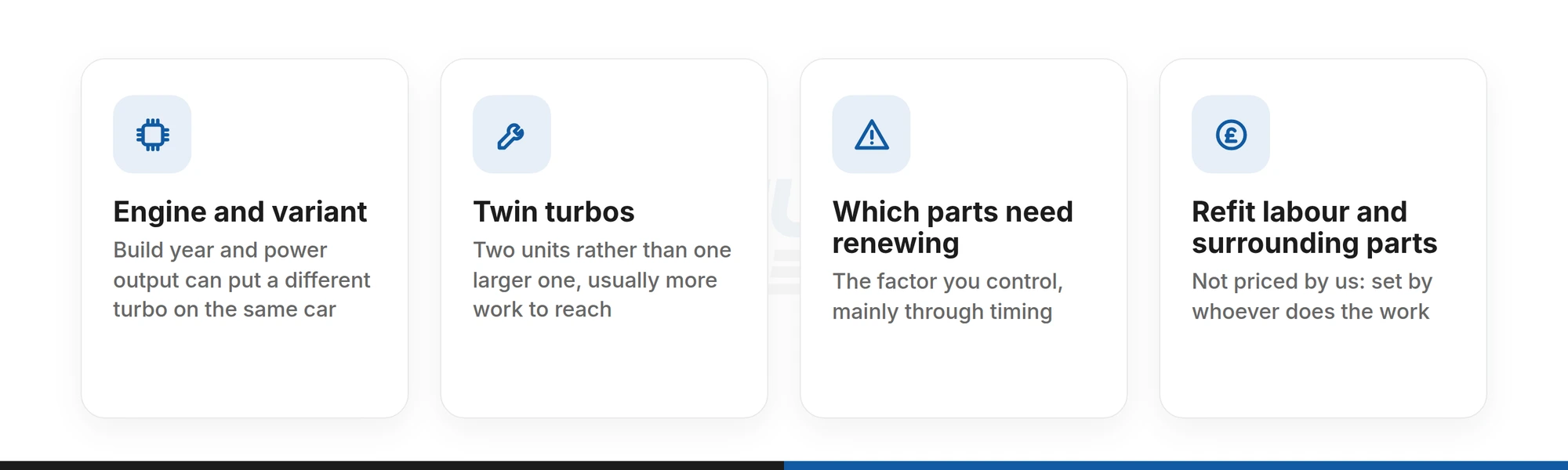
Four things move the total. Two of them change the price of the turbo itself; the other two change the cost of the job around it.
The engine and its variant
Turbo size tends to follow engine size, so a bigger engine usually means a bigger unit. The model name alone does not settle it, though: build year and power output can put a different turbo on the same car, which is why one vehicle can carry more than one rebuild price. Our Audi A4 2.0 TDI listing, for example, runs from £195 to £215 + VAT depending on the variant.
Twin turbos
Some engines carry two turbochargers, and that is two units rather than one larger one. A failure on one does not automatically condemn the other. But both are fed from the same oil system, so if the cause of the failure was oil-related, it applies to the second unit too, and the finding on the first is worth acting on.
Twin installations usually cost more to work on as well, because reaching one unit of a pair on a V6 diesel is a longer job than reaching the single turbo on a typical four-cylinder engine.
Which parts need renewing
Of everything on this list, this is the factor you control, and you control it mainly through timing. A turbo that is still being driven after its bearings have worn does not stay put. Loose bearings let the rotating assembly wobble; a wobbling wheel catches its housing; a wheel that has caught can lose fragments; and a shaft run long enough without proper support can bend or snap.
Each of those steps adds a structural part to the rebuild. Stop early and the job is wear items only; stop late and the wheels, the shaft or a housing join the list. Our guide to common turbocharger problems sets out which symptoms mean stopping.
Refit labour and the parts around the turbo
We do not put figures on these, because they are set by whoever does the work. They are real costs all the same, and they belong in your budget.
- Taking the turbo off and putting it back. Your garage bills this as labour; do it yourself and the cost is your own time. Reach is what decides how long it takes. A turbo with clear access is a short job, while one half of a twin set-up, or a unit hidden behind other components, takes considerably longer, and studs that have seized or fixings that have corroded slow it further.
- Parts fitted at the same time. The job normally calls for fresh gaskets and an oil feed pipe, plus an oil and filter change; most fitters renew the air filter while they are there.
- Tracking down why it failed. Every recognised cause of turbo failure begins somewhere other than the turbo itself, so the culprit is still on the car when the old unit comes off. Leave it there and the replacement inherits it, whichever route that replacement came from.
Because the fitting work does not change with the unit, it never tips the choice between a rebuild, an exchange or a new turbo. Our guide to replacing a turbocharger covers what to check while the unit is off and how to prime the new one with oil before the first start.
Cost by Vehicle: Rebuild Prices From Our Own Listings
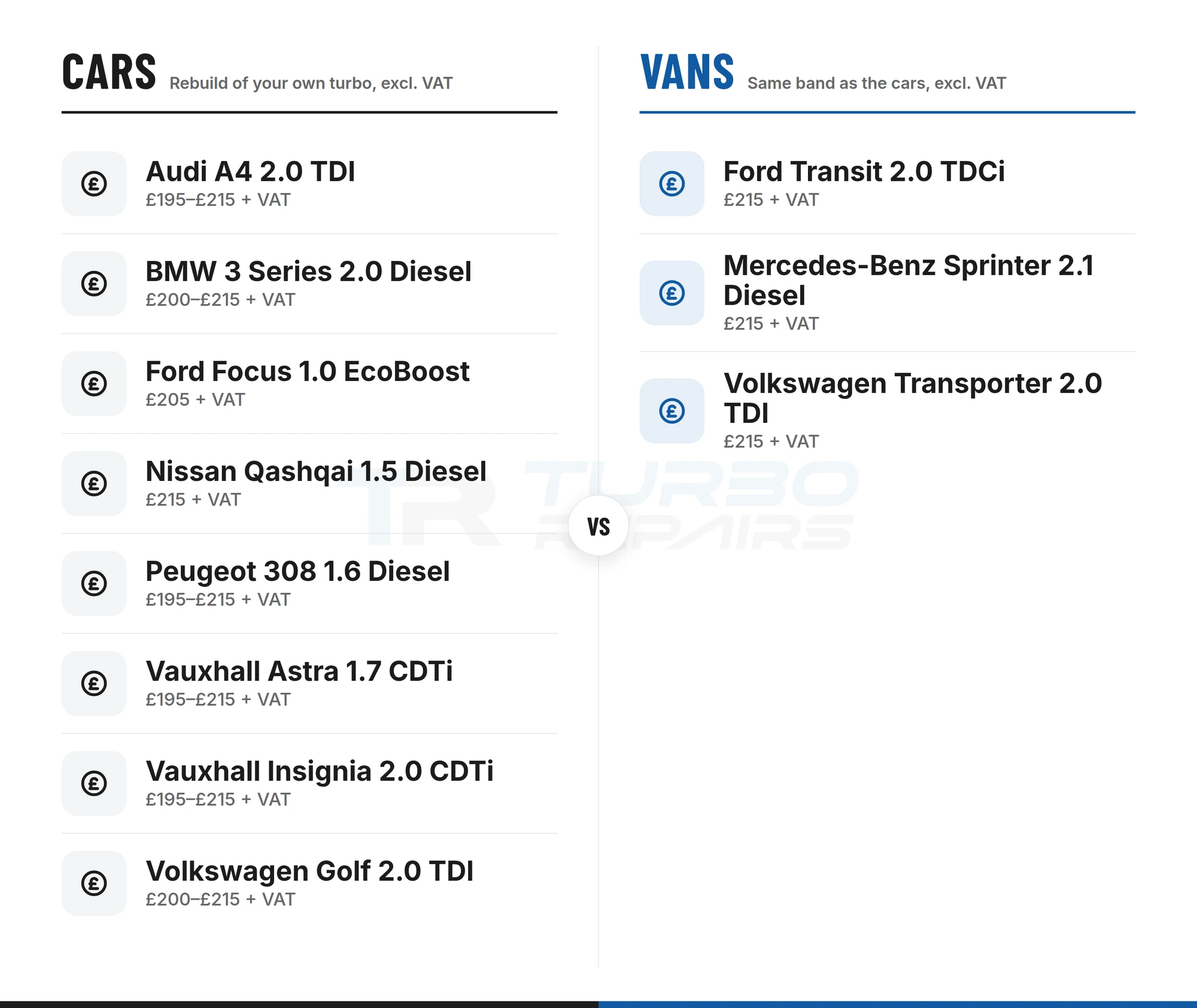
These are the rebuild prices on our own vehicle listings, for rebuilding the turbo that comes off your car. Where a model shows a range, the price differs between variants by build year and power output, and the listing shows which variant carries which figure. All prices exclude VAT.
| Vehicle | Rebuild of your own turbo (excl. VAT) |
|---|---|
| Audi A4 2.0 TDI (2000–2019) | £195–£215 + VAT |
| BMW 3 Series 2.0 Diesel (2005–2013) | £200–£215 + VAT |
| Ford Focus 1.0 EcoBoost (2012–2018) | £205 + VAT |
| Ford Transit 2.0 TDCi (2000–2018) | £215 + VAT |
| Mercedes-Benz Sprinter 2.1 Diesel (2006–2016) | £215 + VAT |
| Nissan Qashqai 1.5 Diesel (2005–2018) | £215 + VAT |
| Peugeot 308 1.6 Diesel (2003–2015) | £195–£215 + VAT |
| Vauxhall Astra 1.7 CDTi (1995–2013) | £195–£215 + VAT |
| Vauxhall Insignia 2.0 CDTi (2008–2017) | £195–£215 + VAT |
| Volkswagen Golf 2.0 TDI (2003–2020) | £200–£215 + VAT |
| Volkswagen Transporter 2.0 TDI (2009–2017) | £215 + VAT |
Rebuilds as a whole start from £185 + VAT, so every row above sits a little above that floor. Two things stand out. The vans — Transit, Sprinter and Transporter — are priced in the same band as the cars. And where one model shows a range, it follows the variant of the engine, not the size of the vehicle.
If your vehicle is not in the table, that does not mean we cannot rebuild its turbo. Complete the repair form with the make, model, engine and the number on the turbo’s label, so the unit is identified before it reaches us.
Turbo Repairs · Epsom workshop
Your own turbo back, rebuilt, from £185 + VAT
Fill in the repair form with your vehicle and the number on the turbo’s label, then post the unit to our workshop. We strip it, price it on what it actually needs, and return the same turbocharger rebuilt and tested.
Lifetime, unlimited-mileage warranty · Mail-in from the UK and internationally · Bench-tested and calibrated before it ships
Rebuild or Replace? How to Decide
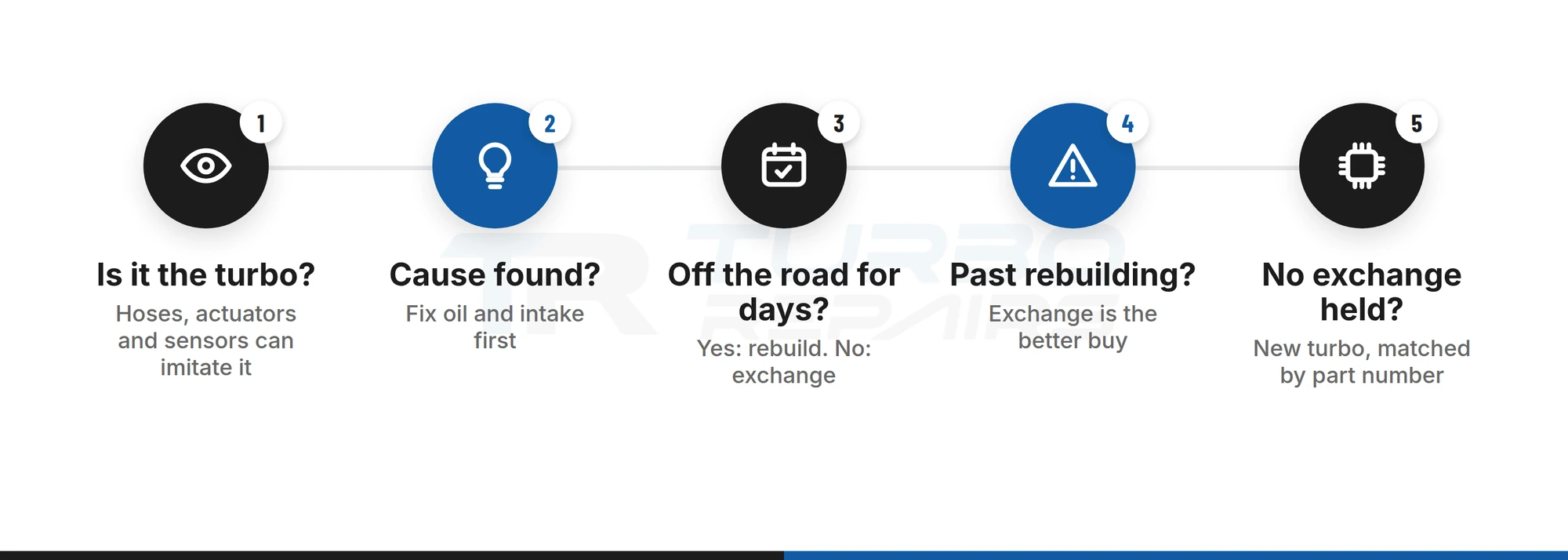
Work through these in order. Each one either settles the route or passes you to the next question.
- Is it definitely the turbocharger? A split boost hose, a failed electronic actuator or a faulty sensor can all imitate a failing turbo. If the turbo itself shows no oil leaks, smoke or bearing noise and the fault is a boost-control code, read the actuator section below before buying anything.
- Has the cause been found? Oil that arrives late, dirty or not at all, or grit getting past the air intake, will destroy a fresh unit as surely as it destroyed the old one. Get to the bottom of it before paying for any turbo, by any route.
- Can the vehicle be off the road for a few days? If yes, a rebuild of your own turbo costs less than an exchange unit and needs no matching. If no, check whether an exchange unit is held for your turbo’s part number.
- Is your turbo past rebuilding? One condemned wheel or housing is still a rebuild with an extra part in it. The balance tips when the strip-down rejects most of the structural parts at once, or when contaminated oil has damaged the bearing housing and not just the bearings it carries. At that stage an exchange unit is the better buy, and that is what we will recommend.
- Is no exchange unit available? Then a new turbocharger is the remaining route, matched by part number.
| Your situation | Usual best route |
|---|---|
| Turbo failed early, vehicle can wait a few days | Rebuild your own, from £185 + VAT |
| Vehicle cannot be off the road, exchange unit held | Exchange unit, from £450 + VAT |
| Turbo badly damaged after being driven on | Inspection first; exchange if the core is not worth keeping |
| Boost-control fault, turbo otherwise healthy | Electronic actuator repair, from £100 + VAT |
| Past rebuilding and no exchange unit held | New turbo, matched by part number |
When Only the Actuator Is Faulty: From £100 + VAT
On many diesel turbos an electronic actuator moves the boost-control mechanism to the position the engine management asks for. It has its own motor, gears, position sensor and circuit board, and it can fail while the turbocharger it drives is perfectly healthy.
In that case the turbo can stay as it is and only the actuator comes to us, from £100 + VAT. On most cars the actuator can be unbolted without lifting the turbo off the engine, so the oil lines and gaskets stay untouched. Actuator repairs are typically completed in 1–2 working days and calibrated on our bench, and a repaired unit goes back on with no programming needed.
The check that matters first is whether the vanes the actuator drives still move freely. If they are seized, any actuator — new, rebuilt or used — will strain against them and fail again, and the turbocharger needs attention as well. Our guide to turbo actuator replacement cost compares the actuator routes in detail, and the electronic turbo actuator repairs hub lists the units we rebuild by vehicle.
Not every turbo has an electronic unit. Plenty of petrol engines, and diesels from earlier generations, control boost through a pneumatic wastegate actuator with no motor or circuit board inside. Repairing one of those is partly a matter of adjustment, since the length its operating rod is set to counts for as much as the state of the actuator; our wastegate actuator repair page explains how that is done.
Turbo Cost FAQ
How much is a turbo?
It depends on the route. Rebuilding the turbo already on your car starts from £185 + VAT, and on our vehicle listings rebuilds run from £195 to £215 + VAT depending on the model and variant. A reconditioned exchange unit starts from £450 + VAT. A new turbocharger is priced by whoever sells it, so we do not quote one. Fitting is extra on every route.
How much does a turbo cost to fix in the UK?
Fixing your own turbo with us starts from £185 + VAT for the rebuild. Where it ends up depends on the strip-down: a turbo that needs only its wear items stays close to that figure, and each wheel, shaft or housing that has to be renewed takes it higher. If the electronic actuator is the only failed part, its repair starts from £100 + VAT. Whoever removes and refits the turbo charges separately for that work and for the parts fitted alongside it.
How much is a new turbo?
We do not quote a new-turbo price: each seller sets its own, and it varies from unit to unit. What the money buys is a turbo with every part unused, including the parts that seldom wear out, built to the original design with any weaknesses that design has.
Is an exchange turbo cheaper than a rebuild?
No. Exchange units start from £450 + VAT, against £185 + VAT for a rebuild of your own turbo. You pay the difference for a unit that is ready now, which makes sense when the vehicle cannot wait or your own turbo is past rebuilding.
Is fitting included in these prices?
No — every figure on this page is for the unit alone. You or your garage take the old one off and put the replacement on, and that job takes the same time whether a rebuilt turbo, an exchange unit or a new one goes back in.
What warranty comes with each route?
One warranty covers all three of our routes — turbo rebuilds, exchange units and electronic actuator repairs: lifetime and unlimited-mileage, so it runs out neither after a set number of miles nor after a set period.
Final Thoughts
A turbo replacement price is really three prices, and each pays for something different: work on the unit you already have, a unit that is ready today, or a unit with every part new. Start with the route that buys only what you need, which for most failed turbos is a rebuild of the one already proven to fit.
Move up to an exchange unit when time matters more than the difference, or when the inspection shows yours is not worth keeping, and treat a new turbo as the route left when the other two are closed. Whichever you choose, put the cause of the failure at the top of the list: a replacement fitted to an engine with the same fault is only borrowing time.
Turbo Repairs · Epsom workshop
Find out which of the three routes your turbo needs
Tell us the vehicle and the number on the turbo’s label, and we will say whether a rebuild or an exchange unit makes sense. Rebuilds start from £185 + VAT, and exchange units from £450 + VAT where we hold one.
Lifetime, unlimited-mileage warranty · Mail-in from the UK and internationally · Bench-tested and calibrated before it ships