

Summary We rebuild Renault turbochargers from the 1.5 dCi diesel in the Clio, Megane, Scenic, Captur, Kadjar, Kangoo and Laguna, and from the Trafic and Master vans. Find your engine in the table below, read the page that covers it, then post your own turbo in: rebuilds start from £185 + VAT, replacement units from £450 + VAT, and every repair carries a lifetime, unlimited-mileage warranty.
On the 1.5 dCi, the model tells you how much the turbo’s label matters. A Twingo, Symbol, Laguna or Kadjar is catalogued with one turbo type; a Kangoo is catalogued with five.
Twelve Renault models, one 1.5 dCi engine, five main turbo types between them.
- Diesels covered: the 1.5 dCi (K9K) across twelve Renault models, the Trafic’s 1.6, 1.9 and 2.0 dCi, and the Master’s 2.3 dCi
- Before you post: note the engine size and output from the logbook and photograph the turbo’s label
- Prices: your own turbo rebuilt from £185 + VAT; a replacement turbocharger from £450 + VAT; electronic actuator repairs from £100 + VAT
- Bench time: typically one to three working days for a turbo, plus postage each way
- Start here: the online Repair Form
Find Your Renault Engine
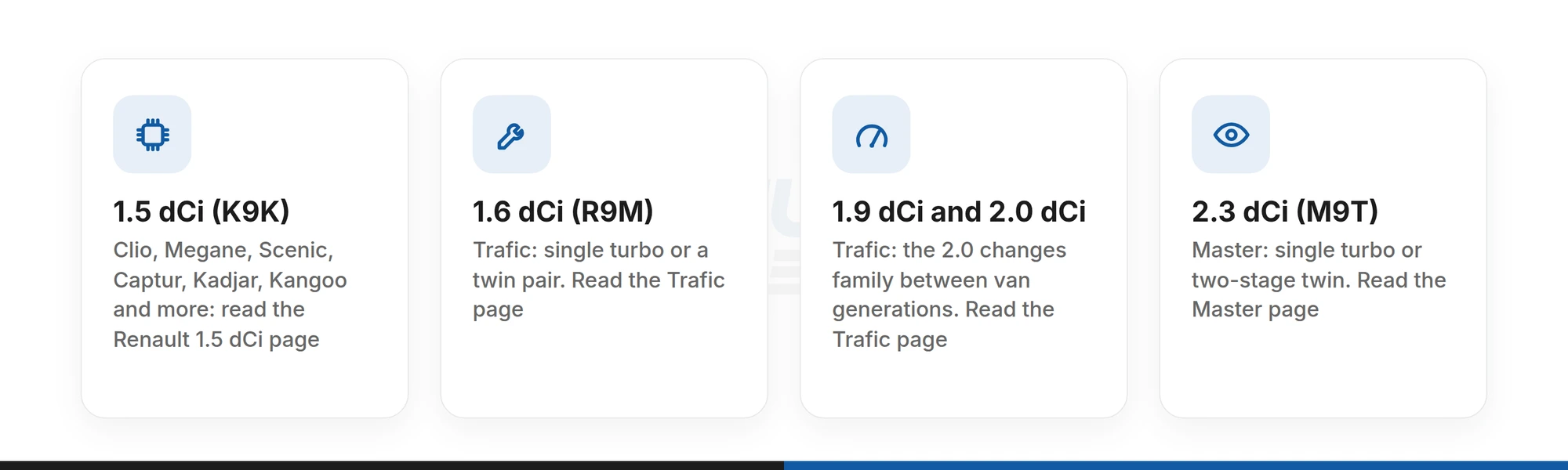
Read the engine size from your V5C, then find it below. The last column links the page that covers that turbocharger in depth.
| Engine size | Renaults that carry it | Turbo set-up, as catalogued | Read first |
|---|---|---|---|
| 1.5 dCi (K9K) | Clio, Megane, Scenic, Grand Scenic, Captur, Kadjar, Kangoo, Laguna, Fluence, Modus, Twingo, Symbol | Fixed-geometry KP35 or variable-vane BV39; later BV38, B01V or Garrett GT1241 | Renault 1.5 dCi turbo repair |
| 1.6 dCi (R9M) | Trafic | Single turbo, or a twin pair of two different units | Trafic turbo repair |
| 1.9 dCi (F9Q), 2.0 dCi (M9R) | Trafic | Single turbo; the 2.0 changes family between van generations | Trafic turbo repair |
| 2.3 dCi (M9T) | Master | Single turbo or two-stage twin | Master turbo repair |
| 2.2, 2.5, 2.8 diesel | Earlier Master | Each with its own turbochargers | Repair Form |
| Petrol TCe, or a car diesel other than the 1.5 | For example a TCe Clio, Captur or Megane | Not covered by our Renault pages | Repair Form |
Nissan fitted the same K9K to the Qashqai, and our Nissan Qashqai 1.5 dCi turbo repair page reads that car’s catalogue year by year.
Renault Clio Turbo
Our Renault Clio 1.5 Diesel (2000–2021) Turbocharger listing covers four turbo types: the fixed-geometry KP35, the variable-vane BV39, and on later cars a Garrett GT1241 and a BorgWarner B01V.
Power output narrows it. KP35 references sit mostly against outputs up to about 90 bhp, BV39 references against versions of around 100 to 110 bhp, and on later 74 and 89 bhp Clios the Garrett has taken the KP35’s place. One early reference for 100 to 106 bhp Clios is a KP39 that shares the BV39’s label prefix, so on those cars the label leaves two candidates rather than one.
A search for a Clio turbo also turns up petrol units: trade listings include turbochargers for the 0.9 and 1.2 TCe and the Clio Renault Sport 1.6. Our Clio listing is the 1.5 dCi only. For a petrol Clio, describe the car on the Repair Form and we will confirm whether its unit can be rebuilt.
Renault Megane, Scenic and Captur Turbo
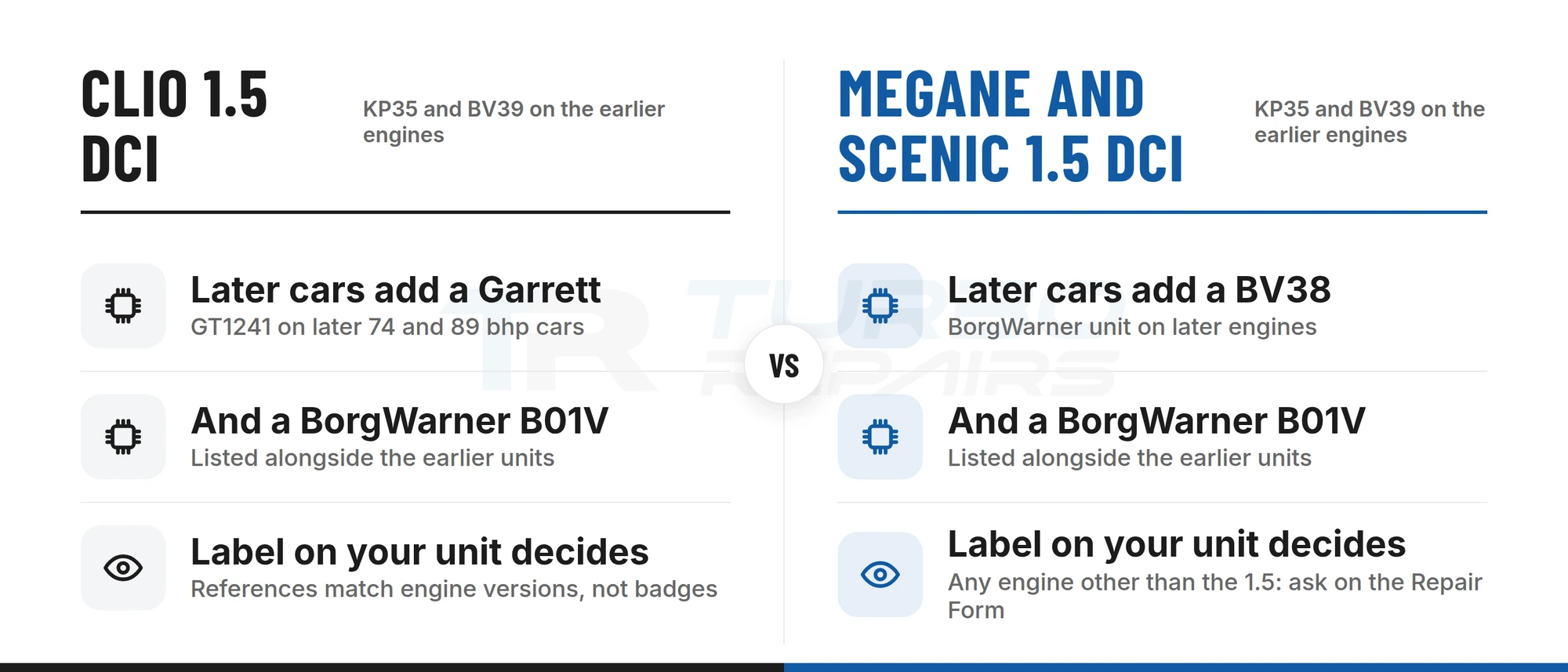
The Megane, Scenic and Grand Scenic 1.5 dCi share one catalogue pattern: KP35 and BV39 on the earlier engines, BorgWarner BV38 and B01V units on later ones. The Captur’s catalogue is the later one, a Garrett GT1241 or a B01V.
If the logbook of your Megane or Scenic shows an engine other than the 1.5, none of our Renault pages covers it. Give the engine size and output on the Repair Form, with a photograph of the label if it is readable, and we will confirm whether the unit can be rebuilt before you send it.
Renault Kadjar, Kangoo and Laguna Turbo
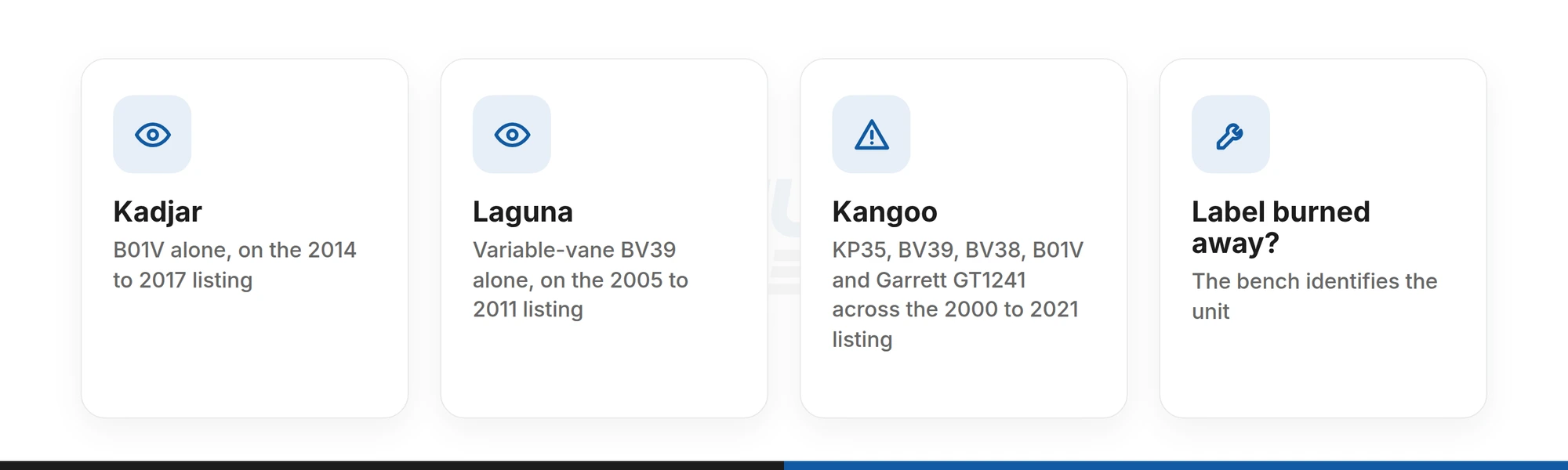
These three sit at the two ends of the 1.5 dCi catalogue. The Kadjar and the Laguna are each listed with one turbo type, as are the Twingo and Symbol. The Kangoo is listed with all five of the engine’s main types.
- Kadjar: the B01V alone, on our 2014 to 2017 listing.
- Laguna: the variable-vane BV39 alone, on our 2005 to 2011 listing.
- Kangoo: KP35, BV39, BV38, B01V and the Garrett GT1241, across a 2000 to 2021 listing. Here the label decides which of the five you have, and where it has burned away, the bench identifies the unit.
Renault Trafic and Master Vans
The Trafic is the same van as the Vauxhall Vivaro, built with the 1.9, 2.0 and 1.6 dCi. On a 1.6, count the turbochargers on the engine before anything is ordered. Power output is a clue rather than a rule: 136 bhp is listed with a single turbo and 138 bhp with a twin pair of two different Garrett units, so counting is the reliable check. The Trafic and Vivaro turbo repair page sorts all three engines.
The Master III shares its 2.3 dCi with the Vauxhall Movano, as a single turbo or a two-stage pair. On the twin, trade accounts name the large low-pressure unit as the stage most at risk and describe an electric actuator on the later pair’s large turbo. If the bench finds the fault in that actuator, we tell you before any work starts; electronic turbo actuator repairs start from £100 + VAT. The Master and Movano turbo repair page has the detail, and our van turbo repair page routes every van we rebuild for.
Fixed-Geometry or Variable-Vane: Which Turbo Is on Yours
Every Renault listing we carry is a 1.5 dCi, and the engine’s two original turbo types hold boost down in different ways. That decides which faults your unit can have.
- Fixed-geometry KP35. A wastegate valve opens to let part of the exhaust bypass the turbine. Heat cycling wears the flap’s spindle and bush until it rattles, leaks or sticks. There are no vanes, so a sticking-vane diagnosis on a KP35 is describing a different turbocharger.
- Variable-vane BV39. A ring of pivoting vanes around the turbine does the controlling, with no wastegate. Carbon builds up on the vanes and pivots, most on cars that mostly do short journeys. A ring stuck towards closed can push boost past its limit and trip reduced power; stuck towards open, it leaves the engine flat low down.
Both share a shaft running in bearings fed by engine oil, with a seal at each end, and short, overdue or dirty oil wears those first. The first four digits of the label reference tell the two types apart, and our 1.5 dCi turbo types guide explains what each prefix means. For what to rule out on the car, see what causes turbo failure and blown turbo symptoms.
Turbo Repairs · Epsom workshop
Wastegate or vane ring, we set up the one you send
Post the turbo in with its actuator attached and, if it is readable, a photograph of the label. It is identified and measured before anything is priced, and its boost control is rebuilt to suit the unit that came off your Renault.
Lifetime, unlimited-mileage warranty · Mail-in from the UK and internationally · Bench-tested and calibrated before it ships
How to Send Your Renault Turbo In
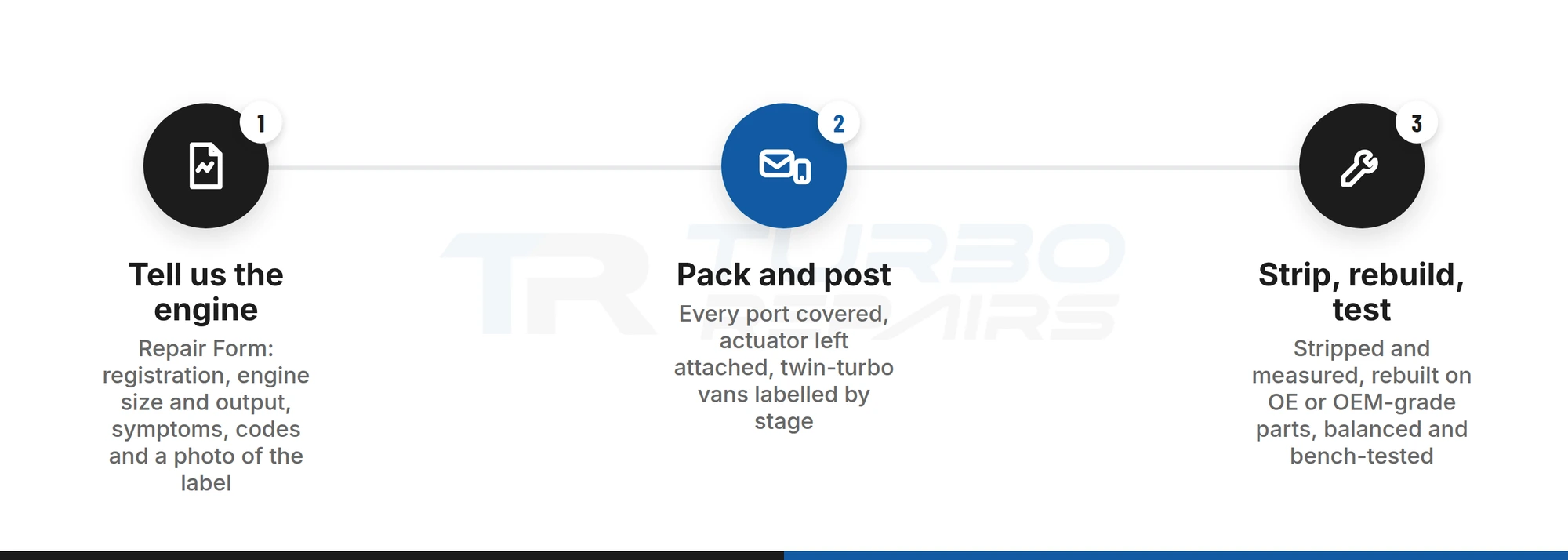
You, or your garage, take the unit off and send it to us. Independent garages, workshops and main dealers send units in for their customers in exactly the same way. Our turbo rebuild then runs in three stages.
- Tell us the engine. Complete the online Repair Form with the registration, the engine size and power output from the logbook, the symptoms, any stored codes and a photograph of the turbo’s label.
- Pack and post. Cover every port, leave the actuator attached, and send the unit to Unit 102 Reaver House, 12 East Street, Epsom, Surrey, KT17 1HX, United Kingdom. On a twin-turbo van, label which stage you are sending.
- Strip, rebuild, test. The unit is identified, stripped to component level and measured, then rebuilt on genuine OE or OEM-grade parts, uprated where a design weakness is known. A KP35’s wastegate flap, spindle and bush are checked and renewed where worn, a BV39’s vane ring is cleaned of carbon, freed or renewed, and the assembly is balanced and bench-tested.
On refit, fit new oil feed and return lines and prime the feed before the first start. If the car cannot wait for its own unit, a reconditioned exchange turbocharger from £450 + VAT is the alternative where we hold one.
Renault Turbo Repair FAQ
How much does a Renault turbo repair cost?
Rebuilding your own turbo starts from £185 + VAT, a replacement turbocharger from £450 + VAT and an electronic actuator repair from £100 + VAT. Removal and refitting are extra, and your price is confirmed once the unit has been inspected.
Is the Clio turbo the same as the Megane turbo?
On the 1.5 dCi both draw on the KP35 and BV39, but the later units differ: the Clio adds a Garrett and a B01V, the Megane a BV38 and a B01V. Each reference matches an engine version rather than a badge, so the label on your own unit decides.
Can my turbo still be rebuilt if the label has burned off?
Yes. Send it as it is, with the engine size and output on the Repair Form, and the unit is identified on the bench before any work starts.
Renault Turbo Listings by Engine
Every Renault rebuild listing we carry is a 1.5 dCi. Choose your year on the listing to book the rebuild; the bench confirms the unit when it arrives.
Final Thoughts
Twelve Renault models in our range share one small diesel, and between them it was catalogued with five main turbo types. Some models narrow that to a single type; others leave the label to decide.
If the turbo itself has gone, the unit already on the engine is the one that fits beyond question. Rebuilding it keeps its type, its reference and its boost-control setting as they were.
Turbo Repairs · Epsom workshop
Send the Renault turbo you already have
Give us the engine size and output on the Repair Form, then post the unit in as it came off the car or van. It comes back rebuilt, balanced and bench-tested, with nothing left to match against a catalogue.
Lifetime, unlimited-mileage warranty · Mail-in from the UK and internationally · Bench-tested and calibrated before it ships