

Summary We rebuild turbochargers and electronic turbo actuators from UK vans and pickups: the Ford Transit and Transit Custom, Mercedes Sprinter and Vito, VW Transporter and Crafter, Renault Trafic and Vauxhall Vivaro, Renault Master and Vauxhall Movano, Peugeot Boxer, Citroën Relay and Fiat Ducato, and the Ranger, Navara, L200, D-Max and Hilux. The table below sends you to the page for your van, where its engines, turbochargers and actuator references are set out. Turbo rebuilds start from £185 + VAT and actuator repairs from £100 + VAT, and every repair carries a lifetime, unlimited-mileage warranty.
Several of these vans are one vehicle sold under more than one badge, and some share an engine with another maker’s van. So start from the van underneath the badge, then let the fault decide whether the turbocharger or only its actuator needs to come to us.
The Renault Trafic is also catalogued as the Vauxhall Vivaro, Nissan Primastar, Nissan NV300 and Fiat Talento, so five badges on the road lead to a single row in the table below.
This page is for owner-drivers, fleet managers and the garages that keep vans working. It finds your van’s own page, separates a turbocharger fault from an actuator fault, and explains how to get the unit rebuilt with the van off the road for as short a time as possible.
- Vans covered: Transit and Transit Custom, Sprinter and Vito, Transporter and Crafter, Trafic and Vivaro, Master and Movano, Boxer, Relay and Ducato
- Pickups covered: Ford Ranger, Nissan Navara D40, Mitsubishi L200, Isuzu D-Max, Toyota Hilux and Land Cruiser
- Turbo rebuild: your own unit from £185 + VAT, typically one to three working days on the bench
- Actuator repair: electronic actuators from £100 + VAT, typically one to two working days, refitted without programming
- Reconditioned exchange: from £450 + VAT, on a selection of common units
- Warranty: lifetime and unlimited mileage on every repair
- Getting started: the online Repair Form
Find Your Van: Engine, Turbo Maker and Actuator by Model
Each row below is a page of its own. The engines, turbo makers and actuators are as each page records them from trade listings; where a page does not state a detail, the cell says so rather than guessing. Read the table to find your page, then let the label on your own unit settle the part.
| Van | Engine(s) | Turbo maker | Actuator | Page |
|---|---|---|---|---|
| Ford Transit and Transit Custom | Transit: 2.0, 2.2, 2.4 and 3.2 diesels, 2.0 EcoBlue. Transit Custom: Euro 5 2.2 TDCi, 2.0 EcoBlue | Garrett (GT2049, GTA1749MV or GTA1756MV, and a GT2052V core on one 2.4); Mitsubishi TD04 on the 2004–2006 2.4 | Electronic on the 2.2 TDCi and 2.0 EcoBlue | Turbo rebuild |
| Ford Transit electronic actuator | MK7 2.2 TDCi; Euro 5 2.2 TDCi in the Transit, Custom and Tourneo; 2.0 EcoBlue in the MK8 and later Custom | Garrett GTB1749VK on the Euro 5 2.2; Garrett variable-geometry unit on the 2.0 EcoBlue | Hella 6NW009206 (MK7); Hella 6NW009550, G-59 (Euro 5 2.2); 6NW010430-22 on some 2.2 vans; no EcoBlue reference in our sources | Actuator repair |
| Mercedes Sprinter and Vito | Four-cylinder CDI: OM611, OM646 and OM651 (the 3.0 V6 is not covered) | Garrett, IHI and BorgWarner; a BorgWarner KP39 and K04 two-stage pair on the OM651 and on OM646 engine code 646986 | See page | Turbo rebuild |
| Mercedes Sprinter and Vito electronic actuator | Sprinter 2.2 (OM646 DE22LA), 2.1 (OM651) and 3.0 V6 (OM642); Vito 3.0 V6 | Garrett GT1749V (2.2), GT2056V (Sprinter V6), GTB2056V (Vito V6); KP39 on the 2.1 | G-049 (2.2); Hella 6NW009660, G-001 (Sprinter V6); Hella 6NW009420, G-219 or G-277 (Vito V6); the 2.1 unit is not described as electronic | Actuator repair |
| VW Transporter T5/T6 | T5 1.9 TDI; 2.0 TDI in the T5 and T6; 2.0 BiTDI in both generations; Caravelle, Multivan and California included | BorgWarner KP39 (T5 1.9); Garrett variable-nozzle units (single-turbo 2.0); two-stage assembly on the BiTDI | Electronic, with position sensor, on the T5 2.0 | Turbo rebuild |
| VW Transporter and Crafter electronic actuator | Transporter T5 and T6 2.0 TDI; Crafter 2.0 TDI | Garrett (830323, 830324 and related numbers in the later family) | 775517 or VW 03L253016T (T5 2.0, earlier Crafter); 04L253 references (T6, Crafter DAUA and DAUB) | Actuator repair |
| Renault Trafic and Vauxhall Vivaro | 1.9 dCi (F9Q), 2.0 dCi (M9R), 1.6 dCi (R9M) single and twin turbo; also sold as the Primastar, NV300 and Talento | Garrett (GT1549S, GT1546JS, GT1546LJS; GT1236Z HP with GT1549S LP on the twin 1.6); a single BV38 and a K03 also listed | See page | Turbo rebuild |
| Renault Master and Vauxhall Movano | 2.3 dCi / 2.3 CDTi (M9T), single turbo and two-stage twin; also catalogued as the NV400 and Interstar | Garrett singles (786997, 795637, 790179); twin pairs from 846016 with 846015 onwards | Electric actuator on the large stage of the second-generation twin, per trade accounts | Turbo rebuild |
| Peugeot Boxer, Citroën Relay and Fiat Ducato | 2006 on: 2.2 HDi / Multijet, later 2.0 and 2.2 (DW10, DW12), 2.3 Multijet, 3.0; vans, buses and motorhome bases | Mitsubishi (MHI) on the 49131-prefixed 2.2 references; see page for the rest | See page | Turbo rebuild |
| Ford Ranger | 3.2 TDCi five-cylinder, 2.2 TDCi, 2.0 EcoBlue single and bi-turbo | Garrett (GTB2256VK on the PX1 3.2, GTD2056V on the PX2 and PX3); BorgWarner two-stage on the 2.0 bi-turbo | Electronic on the later 3.2 variable-geometry unit; PX1 type not stated | Turbo and actuator |
| Nissan Navara | D40 and Pathfinder 2.5 dCi (YD25DDTi), listed at 128 kW and 140 kW | Maker not named; listed as GT2056V (128 kW) and BV45 (140 kW) | Electronic 6NW010099-01 on the BV45; 128 kW type not stated | Actuator and turbo |
| Mitsubishi L200 | 2.5 (4D56) and 2.4 DI-D (4N15); the Fiat Fullback shares the 2.4 listing | Mitsubishi (49-prefixed references); VT10 and VT16/VT17 units on the 2.5 | Electronic or vacuum: check for a plug | Turbo rebuild |
| Isuzu D-Max | 2.5 twin-turbo (163 hp), 1.9 (RZ4E), 3.0 | IHI references on the 2.5 pair (VIHM high-pressure, VIHN low-pressure); see page for the 1.9 and 3.0 | Electronic or vacuum: check for a plug | Turbo and actuator |
| Toyota Hilux and Land Cruiser | 2.5 D-4D (2KD-FTV), 3.0 D-4D (1KD-FTV) at 163 and 171 hp, 2.4 (2GD-FTV) | IHI VB31 on the 2.5, as sold; Toyota 17201 references | Electric vane motor on the 3.0, which stays on the turbo | Turbo rebuild |
Three things the table cannot show. A Transit Connect or Transit Courier runs on the smaller diesels Ford also fits to its cars, so the Transit page does not apply to it. A Transporter on the five-cylinder 2.5 TDI carries a different Garrett family, covered on our Garrett GT2052V page. And a Relay or Boxer built before 2006 belongs with the older Relay and Jumper engines.
If your van is not in the table, or sits between two rows, put the registration and a photograph of the turbocharger’s label on the Repair Form. We identify the unit with you before anything is posted.
Turbo or Actuator? Splitting the Fault Before Anything Comes Off
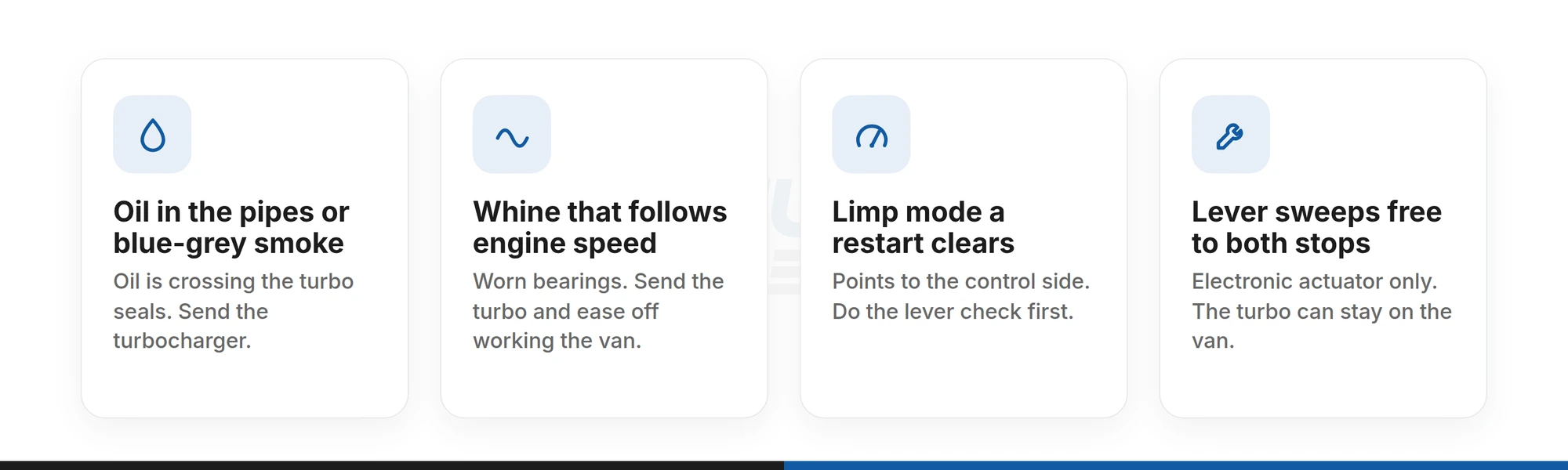
On many of these vans the boost-control vanes are moved by an actuator bolted to the outside of the turbocharger. When the actuator alone has failed, it unbolts and comes to us on its own while the turbo stays on the van. When the fault is inside the turbocharger, no actuator will cure it. The two are different repairs at different prices, so settle which you have first.
| What you find | Where it points | What to send |
|---|---|---|
| Oil in the boost pipes or intercooler, or blue-grey smoke | Oil crossing the turbocharger’s seals; an actuator cannot put oil anywhere | The turbocharger |
| A metallic whine or siren that follows engine speed, or shaft play you can feel | Worn bearings in the rotating assembly | The turbocharger, and stop working the van hard |
| Limp mode that a restart clears, with no oil, smoke or noise | The control side: actuator, connector or wiring. A worn turbo does not recover on a restart | Do the lever check below first |
| Vane lever stiff, tight at either end, or seized with the actuator disconnected | Carbon binding the vane mechanism inside the turbine housing | The turbocharger; a seized ring defeats any actuator |
| Lever sweeps freely to both stops, and the actuator has a wiring plug | The electronic actuator | The actuator on its own |
| A vacuum hose to the actuator and no plug | A pneumatic actuator, which is not an electronic actuator repair | The turbocharger, with the actuator attached, if the turbo is at fault |
The lever check, in order
- Clear the cheap causes. Check the boost hoses, intercooler pipes and clamps for splits and oil. A hose that opens only under boost loses power exactly like a failing turbo.
- Inspect the connector. With the ignition off, unplug the actuator and look for corrosion, water and pushed-back pins, then refit it until it clicks home.
- Let the engine go cold. The turbine housing stays hot enough to burn long after a drive.
- Disconnect the actuator and sweep the vane lever by hand to one stop and then the other. Vanes that are starting to stick usually tighten at the ends of their travel first, so a lever that is free only through the middle has not passed.
Do not drive the van with the actuator unplugged to see what happens, because nothing is then controlling the vanes. A boost code such as P0299 or P0234 will not settle the question either: it records which way the boost missed its target, not which part caused it. Our guides to turbo actuator symptoms and overboost and underboost codes go through both in more depth, and each van page above carries the check for its own engine.
Why Van Turbos Fail: Duty Cycle, Idling and the Oil Supply
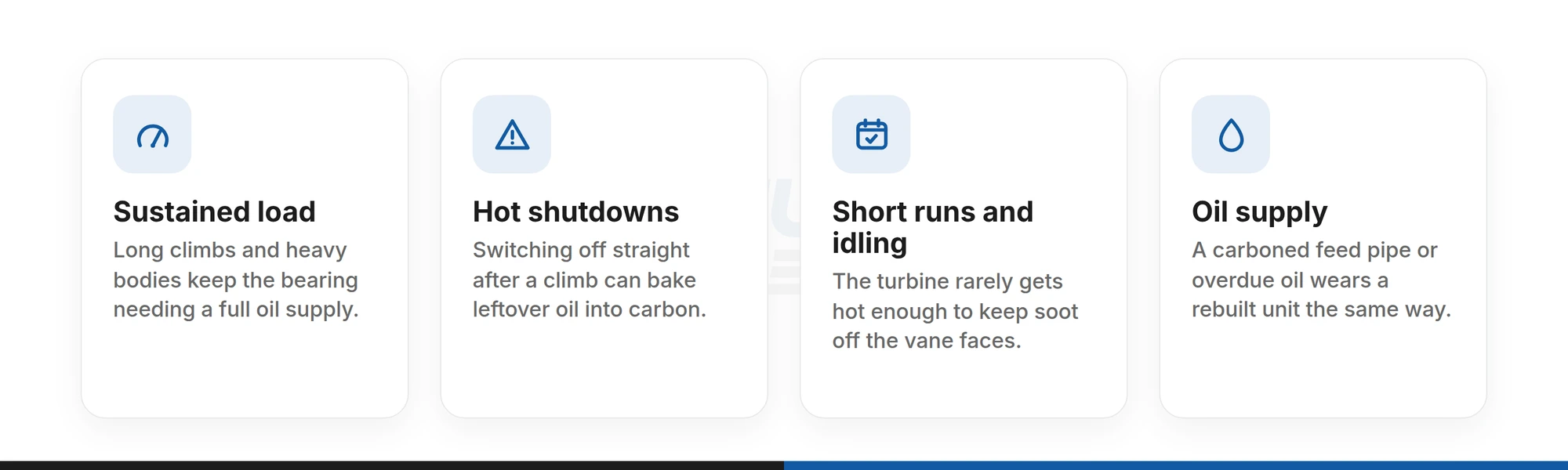
A van’s working day is hard on a turbocharger in two opposite ways. Some of it is sustained load: a full body on a long climb, a trailer behind, a motorway run at weight. The rest is often the reverse, with short hops between drops, long spells at idle and frequent stops. Each wears the turbo by a different route.
Sustained load and hot shutdowns
Under load the exhaust runs hot for long stretches, and the shaft bearing needs its full supply of oil for as long as the work lasts. That is when a part-blocked feed pipe matters most, because demand is highest exactly where supply is weakest. Switching off straight after a climb then stops the oil flow while the bearing housing is at its hottest, and oil left inside can bake into carbon. A minute or two at idle before switching off lets the oil carry that heat away.
The same load is why a van shows a failing turbo when it is working rather than when it is parked. A van that drives normally empty has not passed a test; drive it loaded before deciding a fault has cleared.
Short runs and idling
Short journeys and long idling rarely bring the turbine housing up to full heat. On a turbocharger with variable vanes, that lets soot and oil residue build on the vane faces and pivots until the ring drags. A long run can free it for a while without curing it, which is why a fault that keeps clearing is one to act on. Our guide to why variable-vane turbos stick covers the mechanism.
The oil supply decides most of it
The shaft runs on a film of engine oil, and overdue changes, the wrong grade or a carboned feed pipe all wear the bearings first. Nearly every cause starts outside the turbocharger, so a rebuilt unit fitted to the same oil supply wears the same way. When any turbo goes back on, renew the oil feed and return lines, change the oil and filter, and prime the feed before the first start, as our guide to refitting a turbocharger sets out.
Some van engines carry more specific instructions than this, and those stay on their own pages. The Transit page, for example, sets out the fitting instruction reported to UK workshops for its 2.2, 2.4 and 2.5 diesels. The wider factors behind turbo life are in our guide to how long turbos last.
Rebuild the Van’s Own Turbo or Fit an Exchange Unit?
The work on the van is the same either way: the turbocharger comes off, the oil supply is put right, and a unit goes back on and is primed. What differs is which unit that is, and the choice can wait until the old one is off and in your hands.
| Route | Price | What goes back on the van | What it depends on |
|---|---|---|---|
| Rebuild of your own turbo | From £185 + VAT | The unit that came off, rebuilt at component level | The core surviving inspection; typically one to three working days on the bench |
| Reconditioned exchange unit | From £450 + VAT | A ready-rebuilt unit in place of yours, from a selection of common units | Your reference being one we hold; same-day dispatch is typical when it is in stock |
| Actuator repair only | From £100 + VAT | Your own electronic actuator, on the turbo that never left the van | The vane lever passing the check above; typically one to two working days |
On vans the matching problem is sharper than on most cars. Several engines in the table are catalogued with more than one turbocharger, some with a two-stage pair whose stages carry separate references, and one van can reach a seller under several badges. An exchange unit has to match the reference and, on a twin, the stage. A rebuild returns the unit that came off, so there is nothing to match.
An exchange unit earns its price when the van cannot wait and your reference is in stock, or when the strip shows your own turbo is not worth rebuilding. A surcharge may apply when you order one, refunded when your old turbo comes back to us, and it carries the same lifetime warranty as a rebuild. Our reconditioned exchange turbochargers page explains how the exchange works.
Where a wheel, the shaft and a housing have all failed inspection, little of the original is left, and we say so rather than rebuild a unit that should be replaced. Every price is confirmed after inspection and before any work goes ahead, and none of the figures includes removing and refitting the unit.
Turbo Repairs · Epsom workshop
Lever free at both ends? The actuator can come off on its own
Send the actuator with photographs of its label and the codes the van stored, and the turbocharger stays where it is. If the lever dragged, send the turbo instead and we report on what we find before any work starts.
Lifetime, unlimited-mileage warranty · Mail-in from the UK and internationally · Bench-tested and calibrated before it ships
Pickups and 4×4 Workhorses: Ranger, Navara, L200, D-Max and Hilux
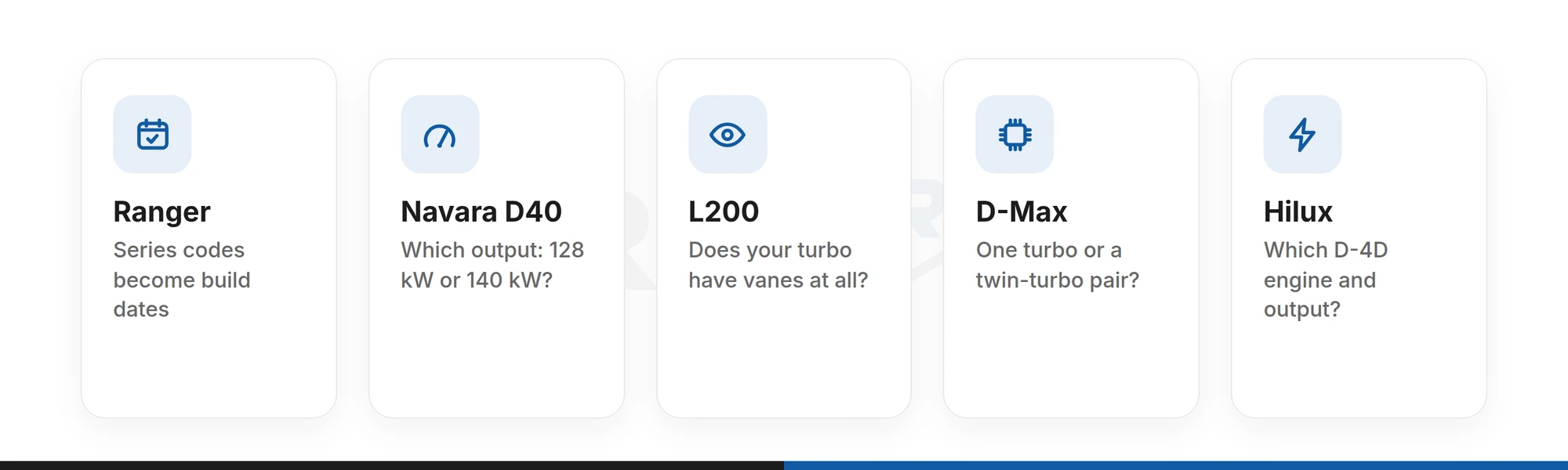
A pickup does van work with extra demands: towing at weight, low-range crawling, wading and site dust. Each of the five has its own page, and each starts from a different identification question.
- Ford Ranger. Listings sort the truck by PX1, PX2 and PX3 series codes that a UK V5C does not show, so the page turns them into dates. Turbo and actuator are both covered.
- Nissan Navara D40. Two turbochargers are listed for the 2.5 dCi by output, and only the 140 kW unit is listed with an electronic actuator. Keep the old actuator whole until you have read the page.
- Mitsubishi L200. Several turbos are listed for the 2.5, and not all of them are described as variable geometry, so find out whether yours has vanes before blaming sticky ones.
- Isuzu D-Max. The 2.5 twin-turbo runs two separate turbochargers, each priced and rebuilt on its own, while the 1.9 is listed with one.
- Toyota Hilux and Land Cruiser. The 2.5 and each output of the 3.0 D-4D are listed with their own turbo, and the 3.0 comes to us with its vane motor still attached.
Two habits matter more on a working pickup than on a van. After wading or a jet-wash underneath, check the actuator’s connector before the actuator itself, because water in a plug produces the same fault as a failed motor. And after a long tow, give the engine that minute at idle before it is switched off. The Land Rover Defender has a page of its own too.
Off the Road for Less Time: How the Mail-In Van Rebuild Works
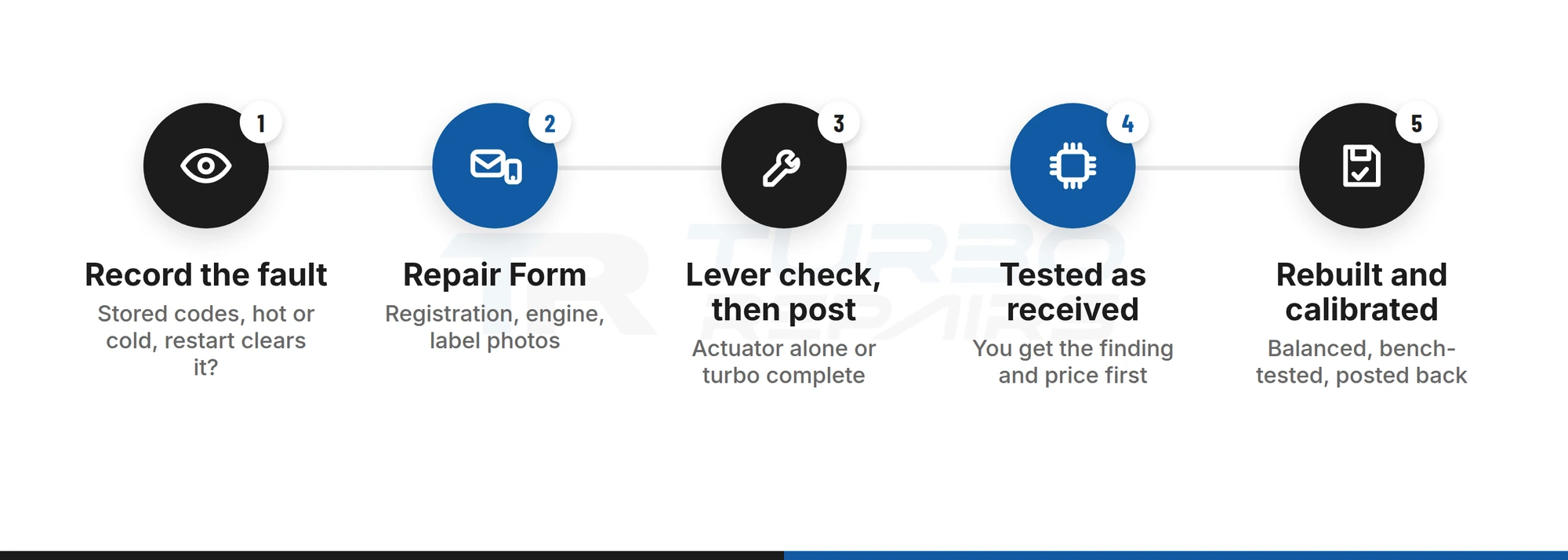
On a working van, most of the days lost to a turbo fault are spent away from the bench: waiting for a diagnosis, waiting for a part, or refitting something that was not the fault. The bench time is short. What shortens the rest is an order of work in which the van comes off the road once.
- Record the fault while it is live. Read the stored codes and note whether the fault appears hot or cold and whether a restart clears it. On a shared van, ask every driver who has had it.
- Complete the online Repair Form with the registration, engine, power output from the V5C, mileage, codes and photographs of every label. Say what the van’s day usually involves, and on a twin-turbo engine which unit you are sending.
- Remove the right part. Do the lever check as the unit comes off, so you send either the actuator alone or the turbocharger complete with its actuator attached.
- Pack and post it with every port sealed, in a rigid box, to Unit 102 Reaver House, 12 East Street, Epsom, Surrey, KT17 1HX, United Kingdom. Packing and postage are covered on our FAQs page.
- We test it as received. The unit is identified against your van and checked before it is opened, so the fault we report is the one we found. You hear what failed and the price before any work goes ahead.
- We rebuild it at component level. Worn parts are renewed with genuine OE or OEM-grade components, and a part with a known design weakness is uprated rather than reinstated.
- We balance, calibrate and bench-test it, then post it back ready to refit. A rebuilt actuator goes back on without programming.
Bench time is typically one to three working days for a turbocharger and one to two for an actuator, plus postage each way. You get your own unit back, with a lifetime, unlimited-mileage warranty that has no time limit and no mileage cap.
Fleet operators, independent garages and main dealers send van units in the same way owners do. Each job gets its own reference on the Repair Form, so units from different vans in one fleet are never confused.
Van Turbo Repair FAQ
How much does a van turbo repair cost?
Rebuilding your van’s own turbocharger starts from £185 + VAT, and a reconditioned exchange unit from us starts from £450 + VAT. If only the electronic actuator has failed, its repair starts from £100 + VAT. Removal and refitting are not included, and the price is confirmed once the unit has been inspected.
Can you repair just the actuator and leave the turbo on the van?
Yes, if the actuator is electronic and the vane lever sweeps freely to both stops with it disconnected. It unbolts, comes to us on its own and goes back on without programming. If the lever drags or will not move, the turbocharger needs the work instead.
My van is sold under another badge. Which page do I use?
The page for the van underneath. A Vivaro, Primastar, NV300 or Talento uses the Trafic page, a Movano or NV400 the Master page, and a Relay or Ducato the Boxer page. On every one, match the reference on your own turbo rather than the badge a part is sold under.
My van has two turbos. Do I need to send both?
Not usually. On the two-stage engines each stage is a turbocharger in its own right, and the failed one can be rebuilt on its own. If you cannot tell which has failed, send both as they came off, and each is measured and reported on separately before any work goes ahead.
Do you rebuild turbos from motorhomes built on a van?
Yes. The turbocharger belongs to the base vehicle, so a motorhome on a Boxer, Relay or Ducato is rebuilt exactly as the van would be. Tell us the base vehicle, its engine and the converter on the Repair Form.
How long will my van be off the road?
Bench time is typically one to three working days for a turbocharger and one to two for an actuator, from the day it arrives. Add postage each way and the time your garage needs to remove and refit it.
Final Thoughts
Most of the confusion around a van turbo comes before the turbo itself. The same van wears several badges, one engine can carry several turbochargers, and a dealer quote is often for a whole turbo when only the actuator has failed. None of that changes what is bolted to your engine, which carries its own reference on its own label.
So work in order. Find the van underneath the badge in the table, sweep the vane lever cold to both stops, and put the oil supply right before anything goes back on. Done that way, the van comes off the road once and the unit that returns is the one it was built with.
Turbo Repairs · Epsom workshop
Get the van back to work on its own rebuilt unit
Complete the Repair Form with the van’s registration, engine and label photographs, then post in the turbocharger or the actuator, whichever the lever check pointed at. It is tested as received, rebuilt at component level and returned ready to refit.
Lifetime, unlimited-mileage warranty · Mail-in from the UK and internationally · Bench-tested and calibrated before it ships