

Summary Most turbochargers are not worn out by anything inside them. Garrett, which designs and builds them, attributes fewer than one failure in a hundred to manufacturing defects and more than nine in ten to the oil: either the turbo was starved of it or the oil it got was contaminated. Most of what is left comes from heat, from foreign objects getting in at either end, and from overspeed when boost control or the charge-air system goes wrong.
Each of those causes damages a turbo in its own way and leaves its own marks on the parts: heat colour on the bearings, scoring and polishing on the shaft, carbon packed into the centre housing, a damaged wheel. Read the damage and it names the cause, which is the first step to stopping the next turbo going the same way. Below, each cause is set out with the signature it leaves inside the turbo and where it usually starts.
A strike on the turbine wheel means the debris came out of the engine; a strike on the compressor wheel means it came in with the air.
The Short Answer: Most Turbos Are Killed by Something Else
Every cause of turbo failure leaves its own signature inside the unit. Starvation typically leaves heat colour on the shaft and bearings, dirty oil scores and polishes them, debris chips the blades at one end only, and overspeed damages the compressor wheel with no sign of a strike. Read the damage and it names the cause. That works because a turbocharger sits where three engine systems meet: its shaft spins on a film of engine oil, with a turbine wheel at one end in exhaust gas and a compressor wheel at the other drawing in fresh air. Our guide to how a turbo works covers the layout.
Turbo manufacturers and rebuilders give much the same list of causes: oil starvation, oil contamination, excessive heat, foreign object damage and overspeed. Each one describes what happened to the turbo, not what went wrong on the car. “Oil starvation” tells you the bearings ran short of oil. It does not tell you whether the feed pipe coked up, the level ran low, or a new unit was started without being primed.
That second answer decides whether the next turbo survives, and the marks on the parts are the way in to it. The table pairs each cause with its signature and with where it usually starts.
| Cause | What it leaves on the turbo | Where it usually starts on the car |
|---|---|---|
| Oil starvation | Heat-discoloured shaft and bearings; damage that happened fast, with little sign of gradual wear | A low oil level, a blocked or kinked feed pipe, a coked strainer, or a unit started without being primed |
| Contaminated oil | Scored and polished bearing surfaces, opened-up clearances, oil holes partly closed | Overdue oil changes, combustion carbon in the oil, metal left over from earlier engine damage |
| Heat and coking | Hard carbon in the centre housing behind the turbine, coked oil passages, and in severe cases a distorted or cracked housing | Switching off straight after hard running, a fault or tune that raises exhaust temperature, a coolant circuit left disconnected |
| Foreign objects | Bent, chipped or missing blade edges, at one end of the turbo only | Compressor end: the air filter or intake. Turbine end: fragments from inside the engine |
| Overspeed | Damage to the compressor wheel and fast bearing wear, with no sign of a debris strike | A boost leak after the compressor, sticking vanes or wastegate, boost raised above standard, the wrong turbo for the engine |
| Blocked DPF | Heat marking spreading from the turbine side; carbon in the turbine-end seal groove | Short journeys, or a fault upstream of the filter such as the EGR valve or injectors |
The two right-hand columns rarely match up exactly on a real turbo. Causes overlap, and one often leads to another. Heat soak cokes the oil feed, and the coked feed then starves the bearing. Still, the pattern of damage almost always points one way more than the others, and reading that pattern is the starting point for every rebuild.
Oil Starvation and Contaminated Oil
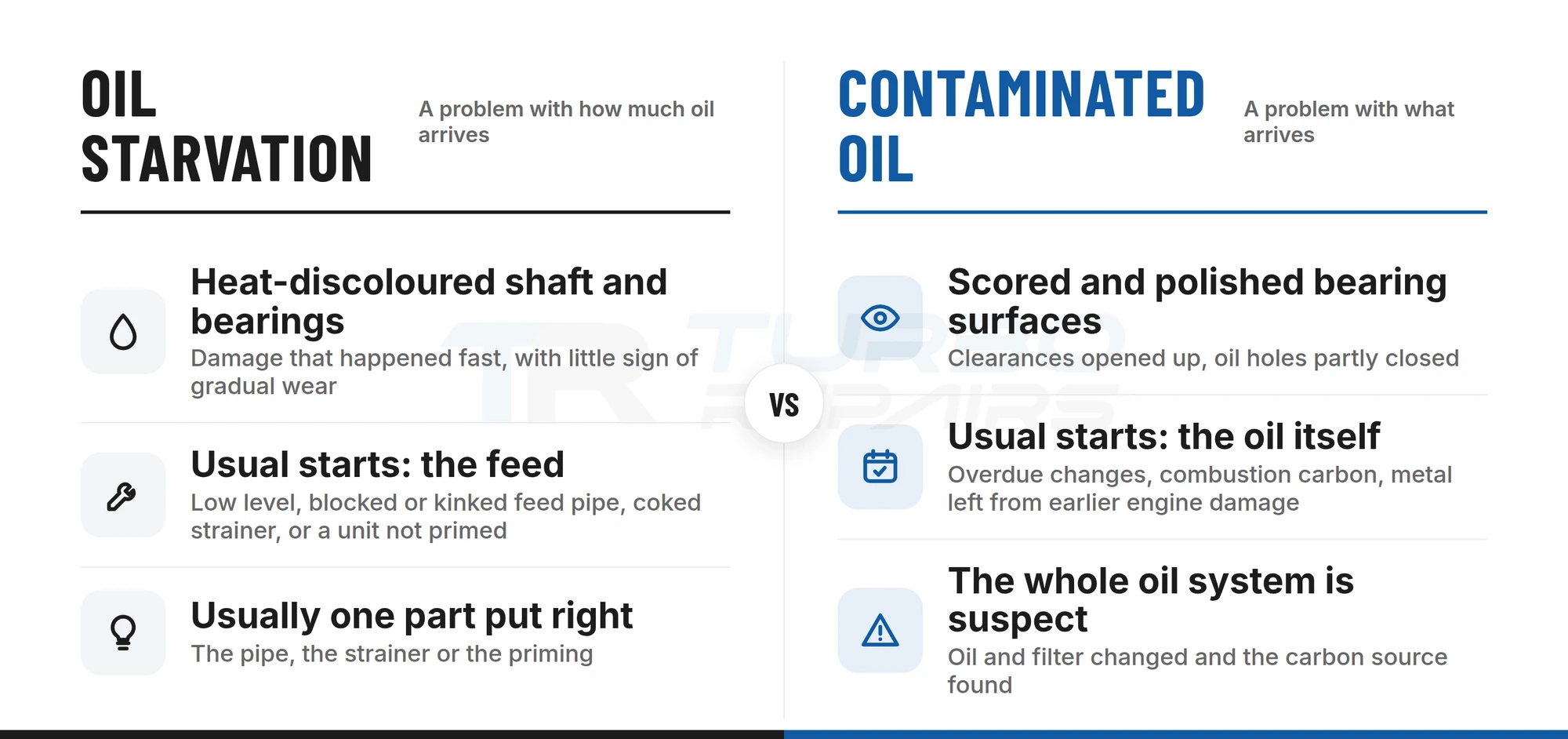
Garrett puts more than 90% of turbo failures down to the oil, and this one heading covers two quite different faults. Starvation is a problem with how much oil arrives. Contamination is a problem with what arrives. They leave different marks and they start in different places.
Oil starvation
A turbo shaft turns far faster than anything else under the bonnet. One UK remanufacturer quotes 80,000 to 200,000 rpm in normal use, and says that at those speeds a fraction of a second without oil is enough to do serious damage. There is no margin for a slow supply. If the oil film is not there when the shaft is spinning, the bearing is damaged straight away.
Garrett names the usual culprits as blocked or leaking pipes, or a turbo that was not primed when it was fitted. On the car, that means checking:
- The oil level and pressure. A sump running low, or an engine with worn oil pressure, feeds the turbo last and least.
- The feed pipe. Feed pipes kink, get crushed, or coke up inside when they run close to hot parts. A pipe can look perfect on the outside and be half-closed inside, which is why it gets renewed whenever the turbo comes off.
- Any strainer or inline filter in the supply. Some engines have a gauze strainer in the feed. When it clogs with carbon it starves a turbo that otherwise had nothing wrong with it.
- The last fitting job. Liquid sealant on an oil gasket can be squeezed into the passage it was meant to seal. A turbo started dry can be damaged before oil reaches the bearings at all. Our guide to refitting and priming a turbocharger covers the priming sequence.
Contaminated oil
Contamination is slower. Garrett’s description of it is the clearest in the trade. Fine particles in the oil, usually carbon from combustion, build up until the oil acts as an abrasive. Gradually it erodes and polishes the bearing and shaft surfaces, opening up the clearances and closing the oil feed holes, until the oil can no longer control the shaft.
The carbon has to come from somewhere. Most often it is oil left in too long, so the particles have had time to build up. Turbochargers also add carbon of their own: exhaust gas getting past the seals into the oil leaves soot behind. Some diesels add more from a leaking injector seal, which blows combustion gas into the engine. Metal from an earlier engine failure is a different contaminant, and a harder one to deal with. One UK remanufacturer names it as a common cause, because particles from a failure that nobody connected to the turbo stay in the oil system after the engine has been repaired.
The difference matters for the repair. Starvation is usually cured by putting one part right, such as the pipe, the strainer or the priming. Contamination means the oil system as a whole is suspect, so the oil and filter are changed, the source of the carbon is found, and after any engine failure the oil system is cleaned before a turbo goes back on.
Heat, Heat Soak and Coking
The turbine end of a turbocharger runs at exhaust temperature. While the engine is running, oil flowing through the centre housing carries that heat away from the bearings, and on water-cooled units coolant helps. Melett, a turbo component manufacturer, defines overheating failure as parts exposed to abnormally high exhaust temperatures or to insufficient cooling. So heat failures come from two directions: too much heat going in, or too little being taken away.
Heat soak at shutdown. When the engine stops, the oil stops moving, but the turbine housing that has just been working keeps giving off its heat. Oil left sitting in a hot bearing housing gets baked rather than carried away. Garrett lists hot shutdown as a cause of carbon build-up in the turbo leading to bearing failure. This is where heat turns into an oil problem. The carbon lines the oil passages, the passages narrow, and the turbo is starved by its own oil. Our page on how long turbos last covers the switch-off habits that prevent it.
Exhaust temperatures pushed up by something else. Exhaust gas runs hotter when an engine is over-fuelling, when a tune asks for more than the standard calibration, and when a loaded particulate filter holds heat behind the turbine. The housings have limits. One UK remanufacturer puts the point where diesel turbine housings can begin to crack or distort at around 650°C, with petrol housings rated higher depending on the material. A cracked turbine housing is one of the few kinds of damage that can rule out a rebuild.
Cooling that is not doing its job. A turbo designed to be water-cooled cannot shed its heat properly without coolant flowing through it, so a coolant circuit left disconnected after a repair is a heat failure waiting to happen. A blocked oil feed takes away the oil’s cooling job as well as its lubricating one, which is another way the causes in this list overlap.
The cold end of the scale matters too. Garrett warns that hard acceleration from cold does not give the oil time to circulate, so the bearings are starved at the moment the turbo is asked to work hardest. That is an oil failure triggered by temperature, and on the bench it looks like one.
Foreign Object Damage: Debris From Either Side
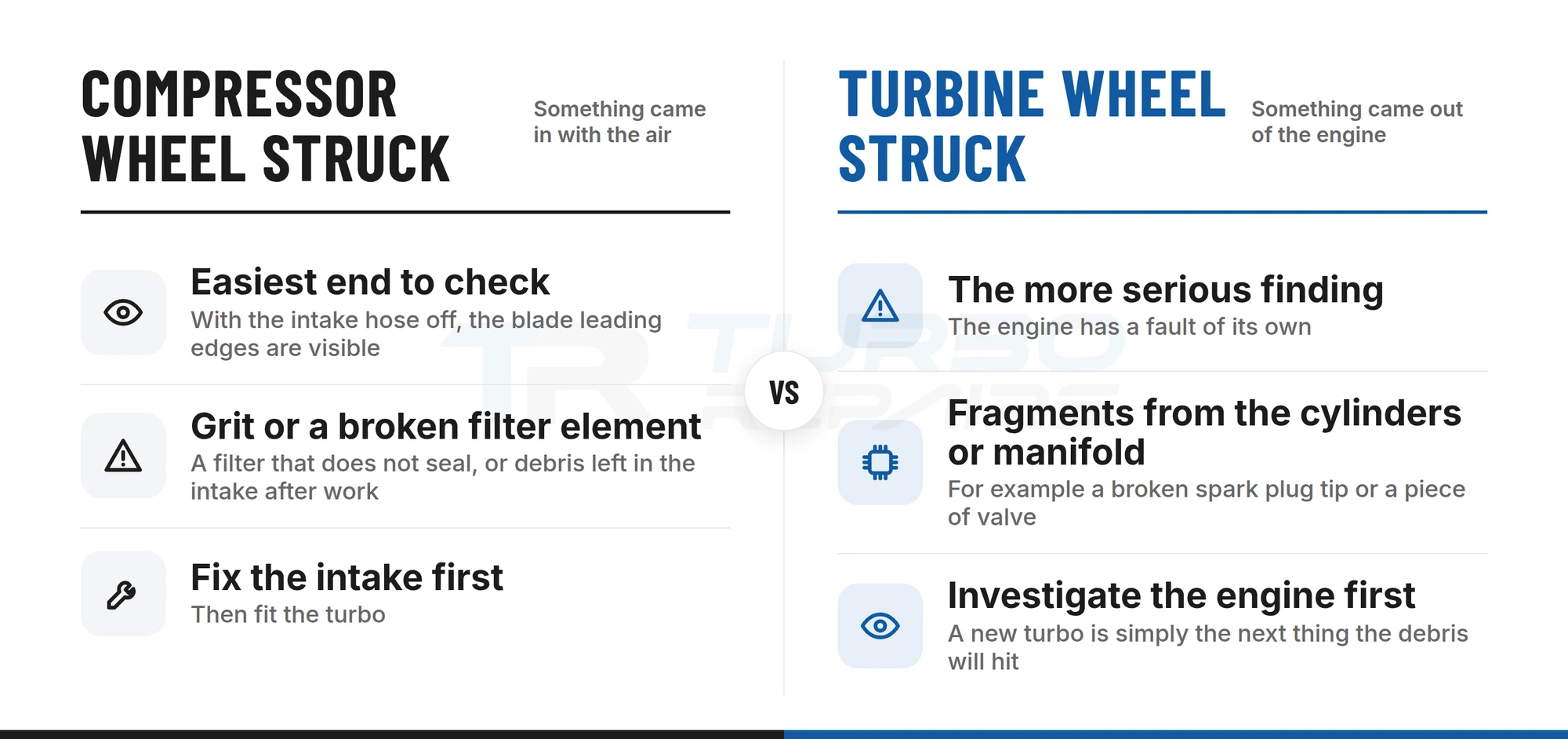
A foreign object is anything that gets into the turbo through the air inlet or the exhaust inlet. The two ends point to completely different faults, so the first question about foreign object damage is always which wheel took the hit.
Compressor end: the problem is in the intake. Damage to the compressor wheel means something came in with the air. That might be grit past an air filter that does not seal properly, a filter element that has broken up, or debris left in the intake after work on the car. A loose nut, a washer or a fragment of hose clip can all end up there. At the speeds a turbo runs, even a small particle hits hard. This end is also the easiest to check, because with the intake hose off you can see the leading edges of the compressor blades.
Turbine end: the problem is in the engine. Anything that strikes the turbine wheel has come out of the cylinders or the exhaust manifold. One UK remanufacturer gives the example of a broken spark plug tip. Fragments of a valve or other combustion-chamber parts do the same. This is the more serious finding, because it means the engine has a fault of its own, and the turbine is hard to inspect while the turbo is still on the car.
A single strike is rarely the end of it. Bent or chipped blades throw the rotating assembly out of balance, and the vibration that follows wears the bearings and gets worse over time. Debris damage can therefore turn up on the bench as a bearing failure with chipped blades as its cause. When we rebuild a unit, we balance the rotor as an assembly, not as separate parts. Our turbocharger balancing page explains why that matters.
The source has to be found before refitting. A turbine strike means the engine needs investigating first, because a new turbo is simply the next thing the debris will hit.
Overspeed: Boost-Control Faults and Leaks
Melett describes overspeeding as a turbo running well above its normal operating limits. Compressor and turbine wheels are designed for a speed range. Push past it and the wheels and bearings carry loads they were never matched for. The turbo itself has no say in this. It runs as fast as the gas driving it and the boost control allow, so overspeed always starts somewhere else.
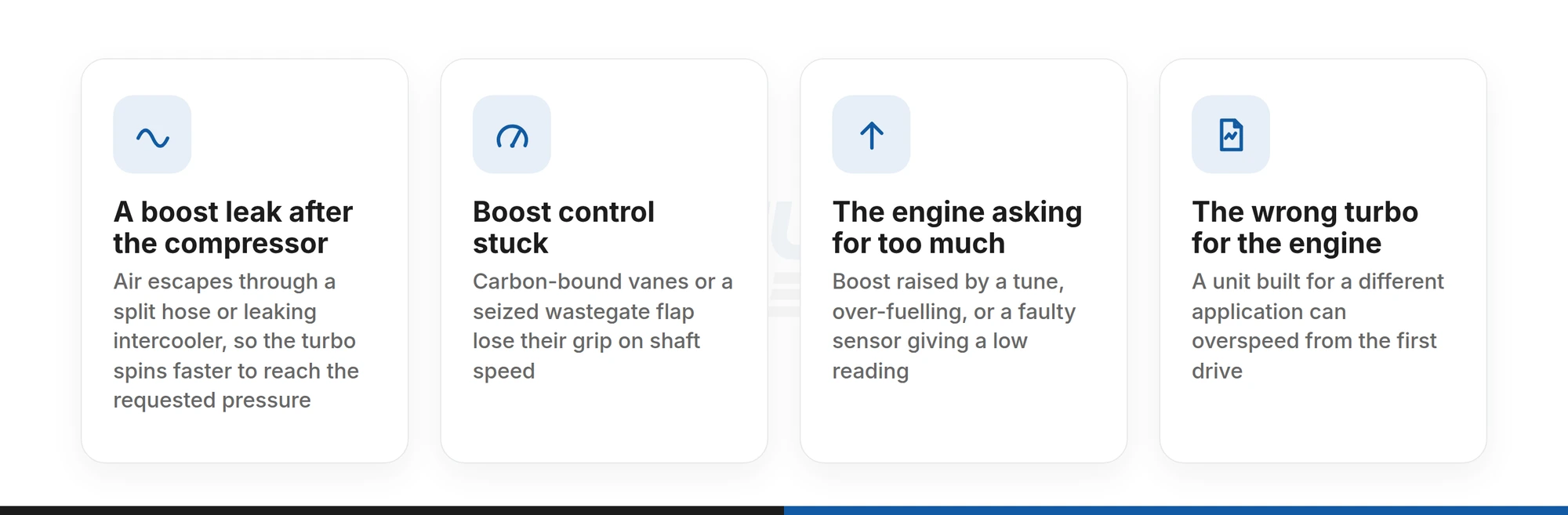
A boost leak after the compressor. This is the one most often missed. The engine management asks for a certain boost pressure. If air is escaping through a split charge hose, a loose clamp or a leaking intercooler, the turbo has to spin faster to reach that pressure. The car may feel only slightly down on power while the turbo runs close to its limit on every journey.
Boost control stuck in the wrong place. On a variable-vane turbo, carbon can bind the vanes so they stay towards the closed, high-boost position. On a wastegated turbo, a seized flap or a wrongly set actuator rod stops excess exhaust gas from bypassing the turbine. Either way the boost control loses its grip on shaft speed. Our guides to VNT turbos and overboost and underboost go through how that shows up. An electronic actuator that no longer moves the mechanism where it is told can cause the same thing, which is where electronic turbo actuator repairs come in.
The engine asking for too much. Boost raised above standard by a tune, over-fuelling, or a faulty sensor feeding the engine management a low reading all ask the turbo to spin faster than the engine maker intended. Garrett adds over-revving, particularly on commercial vehicles.
The wrong turbo for the engine. A unit that looks the same but was built for a different application can overspeed from the first drive. Our guide to finding your turbo part number shows how to confirm you have the right one.
A restricted air filter belongs here too. It makes the compressor work harder for the same boost, and like a boost leak it costs very little to rule out compared with the turbo it protects.
Blocked DPF and Back-Pressure
On a diesel with a particulate filter, the filter sits downstream of the turbine. When it loads up, the pressure and heat behind the turbine rise, exhaust gas is forced past the turbine-end seal into the centre housing, and repeated regenerations thin the oil the bearings run on. It is usually one cause among several rather than the whole story. A filter that has blocked also has a reason of its own, further up the engine. Our guide to whether a blocked DPF can cause turbo failure covers the mechanism, how to tell which failed first, and the order the fix has to follow.
Why a Replacement Turbo Fails Again if the Cause Stays
Garrett’s own troubleshooting advice is to stop before you replace, because turbo damage is often a symptom of an underlying problem rather than the cause. A replacement that fails again almost always does so for one of three reasons.
- The cause was never traced. The coked feed pipe, the overdue oil, the split hose and the engine shedding debris are all still on the car when the new unit goes on. A new turbo is bolted into the same conditions and wears out the same way.
- A new cause was added during fitting. Blanking plugs left in, sealant on the oil gasket, no priming, oil left in the intercooler from the old unit, or debris dropped into the open intake. These are the fitting mistakes that ruin new turbos, and our refitting and priming a turbocharger works through each of them.
- The unit was wrong for the car. A turbo matched to a different application can overspeed or fall short on boost from the start, and on the bench the result looks like the original fault happening again.
All three have the same remedy: find out what killed the first turbo before fitting the second. The cheapest way to do that is to read the first one.
Turbo Repairs · Epsom workshop
Have the failed unit stripped before the next one goes on
Send us the failed turbo and it is stripped to component level, with every worn part renewed on genuine OE, OEM-grade or uprated components. Known design weaknesses are put right, and the unit is balanced and bench-tested before it comes back.
Lifetime, unlimited-mileage warranty · Mail-in from the UK and internationally · Bench-tested and calibrated before it ships
How We Find the Cause on the Bench
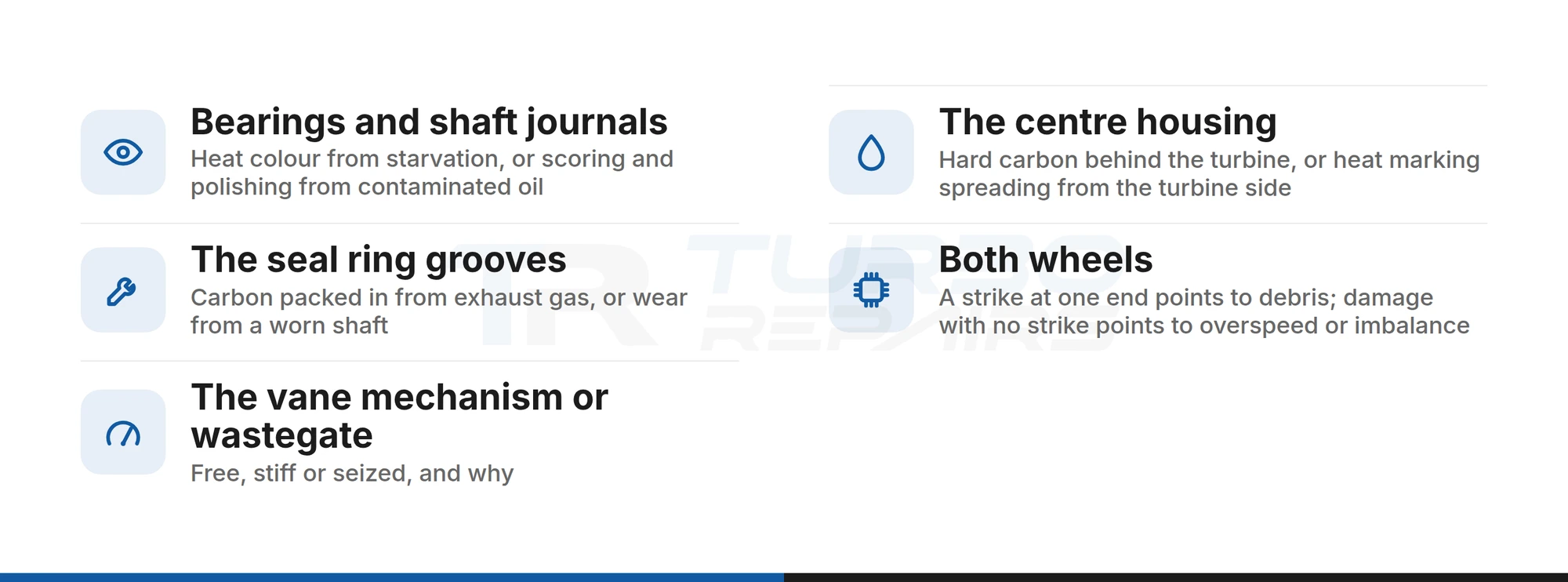
Every turbocharger that comes into our workshop is stripped to component level before anything is renewed. The strip is the diagnosis as well as the start of the repair, because the parts record what the unit was living with. Here is what we read on the bench:
- The bearings and shaft journals: heat colour from starvation, or scoring and polishing from contaminated oil.
- The centre housing: hard carbon behind the turbine from heat soak, or heat marking spreading from the turbine side.
- The seal ring grooves: carbon packed in from exhaust gas forced through, or wear from a worn shaft.
- Both wheels: strike damage at one end only, which points to debris, or damage without a strike, which points to overspeed or imbalance.
- The vane mechanism or wastegate: free, stiff or seized, and why.
That reading is part of the rebuild, because it decides which parts are renewed and which design weaknesses need putting right. The strip reads the mechanism, but it cannot see the car. A turbo that was starved shows that its oil supply failed, not which pipe or strainer is to blame. So the more you tell us when you send it in, the more the strip can be read against: what the car was doing when it failed, the oil-change history, and any recent work, especially if this is not the first turbo.
The rebuild then renews what failed on genuine OE, OEM-grade or uprated components that meet or exceed the original specification. Known design weaknesses, such as wastegate pivots, bearings, seals or actuators with a history of failing, are put right rather than refitted as they were. The rotating assembly is balanced, and the finished unit is tested on our dealer-level diagnostic and calibration equipment and in-house test rigs before it is boxed. A turbo rebuild is typically one to three working days on the bench.
Turbo Failure Causes FAQ
What is the most common cause of turbo failure?
Oil. Garrett puts more than 90% of turbo failures down to oil starvation or contaminated oil. The most common sources on the car are a blocked or leaking oil feed, a unit not primed when it was fitted, and oil left in too long so that carbon has built up in it.
Can a turbo simply wear out with age?
A turbo wears like any part that spins, but wear on its own is not what ends most of them. A turbo kept on clean oil of the right grade, allowed to shed heat before switching off and run within its boost limits wears slowly. When one fails early, the strip almost always shows a cause. Manufacturing defects account for fewer than 1% of failures, according to Garrett.
Can switching off straight away damage a turbo?
After hard running, yes. The oil stops moving when the engine stops, but the turbine housing keeps radiating heat into the centre housing, and oil sitting there can coke. Garrett lists hot shutdown as a cause of carbon build-up leading to bearing failure. After a gentle drive there is very little heat to shed.
Can a faulty actuator cause turbo failure?
It can, if it leaves the vanes or wastegate in a position that lets the turbo overspeed. More often it works the other way round: carbon stiffens the vane mechanism, and the actuator wears out fighting it. Our guide to what a turbo actuator does explains the relationship.
Can I find the cause without taking the turbo off?
Partly. With the intake hose off you can check the compressor blades for strikes and the intake for oil. You can also check the oil level and condition, the air filter seal and the boost hoses and intercooler for leaks. The bearings, the centre housing and the turbine wheel can only be properly read once the unit is off and stripped.
Is a failed turbo usually worth rebuilding?
Usually, yes. Bearings, seals, the shaft and wheel assembly and a carboned vane mechanism can all be renewed or restored. What usually rules a turbo out is a cracked housing, or wheel damage severe enough that the housing itself is damaged. If yours is beyond a rebuild, reconditioned exchange turbochargers are the alternative. Either way, the cause still has to be found on the car.
Final Thoughts
The usual answer to what causes turbo failure is a list of five words: oil, contamination, heat, debris, overspeed. That list is accurate, but a failed turbo can tell you more than which word applies. Each cause leaves its own signature on the parts, in the colour of a bearing, the scoring on a journal, the carbon in the centre housing or the end of the turbo a blade was struck at.
So read the damage before the unit is thrown away. It names the cause, and naming the cause correctly is what gives the next turbo a much better chance of lasting.
Turbo Repairs · Epsom workshop
Rebuild it on the right parts
Post your failed turbo in with your registration, the references from its plate and a note of what happened. We strip it, read the cause, rebuild it on genuine OE or OEM-grade parts, balance it and bench-test it, then send it back ready to refit.
Lifetime, unlimited-mileage warranty · Mail-in from the UK and internationally · Bench-tested and calibrated before it ships