

Summary This page covers the turbocharger and the electric wastegate actuator on Volkswagen, Skoda and SEAT TSI petrol engines: the EA211 1.0, 1.4 and 1.5 TSI and the third-generation EA888 1.8 and 2.0 TSI. We rebuild the turbocharger from £185 + VAT, typically in one to three working days on the bench, and repair the electric wastegate actuator at component level from £100 + VAT once the unit is confirmed on the bench, typically in one to two. Both carry a lifetime, unlimited-mileage warranty.
On these engines the actuator, the linkage it drives and the turbocharger’s wastegate work as one mechanism, so the sections below identify your engine first and then take the three in turn.
On the electric-wastegate 1.4 TSI, the engine management stores the actuator’s lower and upper stops as learnt values, so the setting a vacuum can keeps in its rod length lives in the engine’s software instead.
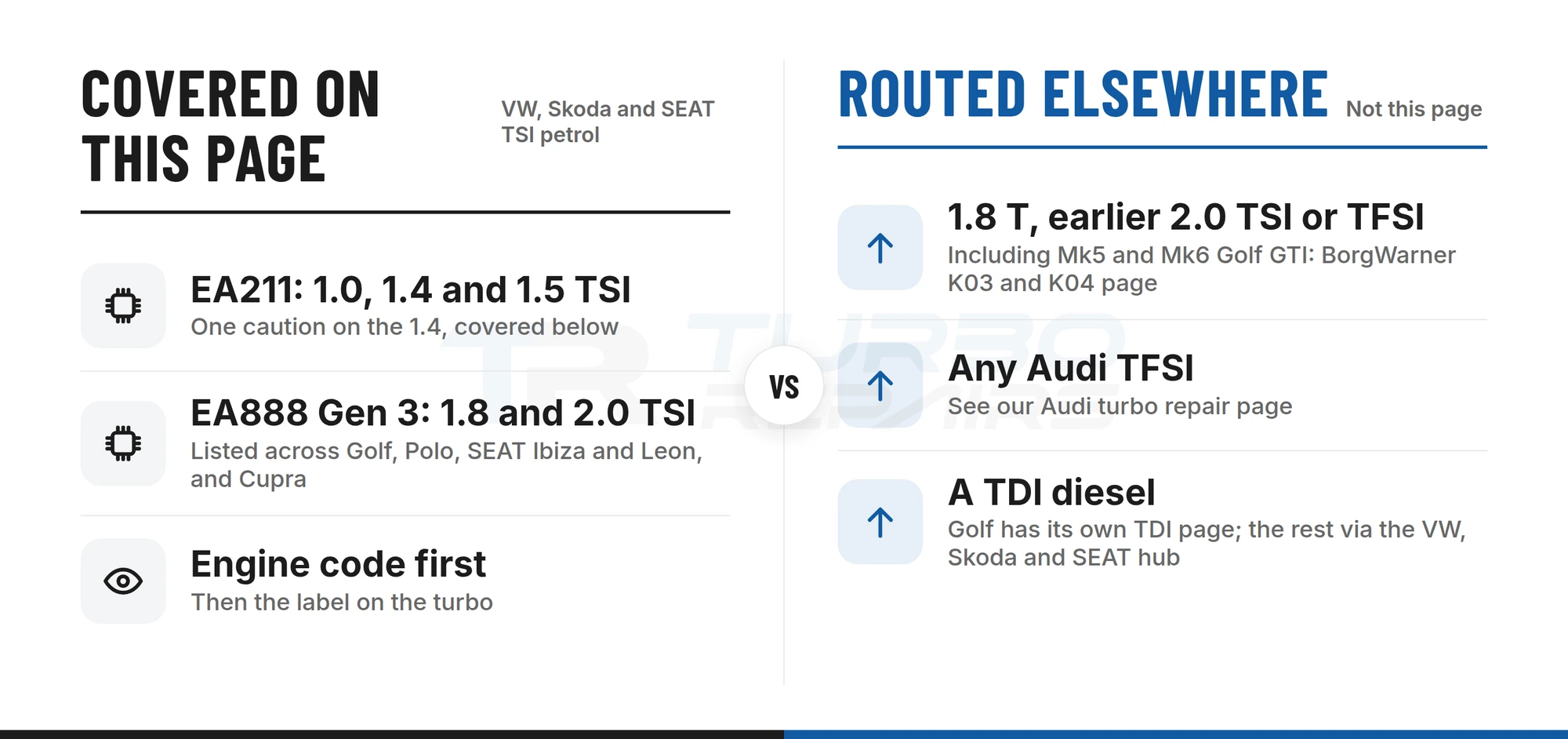
- Covered here: the EA211 1.0, 1.4 and 1.5 TSI and the EA888 Gen 3 1.8 and 2.0 TSI, under the VW, Skoda and SEAT badges
- Not covered here: the 1.8 T and earlier 2.0 TSI and TFSI, Audi’s TFSI engines and the TDI diesels, each routed below
- Turbo rebuild: from £185 + VAT, typically one to three working days
- Electric wastegate actuator repair: from £100 + VAT once confirmed on the bench, typically one to two working days, nothing to program
- Exchange turbocharger: from £450 + VAT
- What identifies yours: the engine code first, then the label on the turbo
- Warranty: lifetime and unlimited mileage, turbos and actuators alike
Which TSI Engine Do You Have? EA211 vs EA888 Gen 3, by Engine Code
TSI is a badge, not an engine. Volkswagen, Skoda and SEAT have put it on petrol engines from one litre to two across more than one engine family, and the turbocharger follows the family rather than the badge. Start with the cylinder capacity on your V5C, then find the engine code.
- 1.0, 1.4 or 1.5 TSI: the EA211 family, covered here, with one caution on the 1.4 below.
- 1.8 or 2.0 TSI, third-generation EA888: covered here. Parts sellers list the Gen 3 across the Golf, the Polo, the SEAT Ibiza and Leon, and the Cupra models.
- 1.8 T, or a first- or second-generation 2.0 TSI or TFSI, including the Mk5 and Mk6 Golf GTI: see our BorgWarner K03 and K04 turbo repair page.
- Any Audi TFSI: see our Audi turbo repair page.
- A TDI diesel: a Golf has its own VW Golf TDI turbo repair page, and the rest are routed from our VW, Skoda and SEAT turbo repair hub.
If you are not sure which generation your 1.8 or 2.0 TSI is, a dealer or parts supplier can read the engine code from your registration or VIN; if it is not to hand, the unit is identified on the bench before any work is quoted.
Not every 1.4 TSI is the same engine
Parts listings catalogue 1.4 TSI turbo parts under engine codes BMY and CAVC from 2006 and CAVD from 2008, and sell an aftermarket actuator for the twincharged CAV and CTH engines as a replacement for their diaphragm can. A diaphragm can is worked by pressure through a pipe. It is not the electric wastegate actuator this page repairs.
The electric version is documented on a 2014 to 2015 Mk7 Golf whose 103 kW 1.4 TSI carries engine code CHPA: the owner’s scan shows an electronic servo actuator on the wastegate, its end stops held by the engine management. If your 1.4 TSI carries an earlier code, we still rebuild its turbocharger through the Repair Form, but the actuator section below does not describe it.
The TSI Turbocharger: a Wastegated Petrol Unit
Exhaust gas spins the turbine wheel, a shaft turns the compressor wheel, and the compressor packs air into the engine; our guide to how a turbo works covers the principle. Left alone, a turbo makes more boost the harder the engine works, so something has to limit it. On a wastegated unit that is a hinged flap in the turbine housing which opens to let exhaust gas bypass the turbine, on a shaft passing out to an external arm that the actuator moves.
We are careful not to stretch this further than the evidence goes. The scan data and service notes we hold describe an electrically actuated wastegate on the 1.4 TSI and the Gen 3. For the 1.0 and 1.5 TSI we confirm the boost-control mechanism from the unit itself rather than assume it from a sibling engine, so tell us what is bolted to the side of yours: a moulded module with a plug, or a can with a pipe.
Wherever the wastegate is internal, its flap and shaft work in exhaust heat, soot and condensation for the life of the car. The bush can wear and carbon can pack the clearance, which is a turbocharger fault even when it first shows up as an actuator complaint.
The Electric Wastegate Actuator: Rattle, Fault Codes and What We Repair
The electric wastegate actuator is a moulded module bolted to the turbocharger, with a multi-pin plug and no vacuum pipe. Inside are a motor, a gear train, a position sensor and a circuit board. The motor drives the rod and arm that open the wastegate, and the sensor tells the engine management where the flap actually is.
What owners report
We list these as reports rather than diagnoses, because each has more than one possible cause:
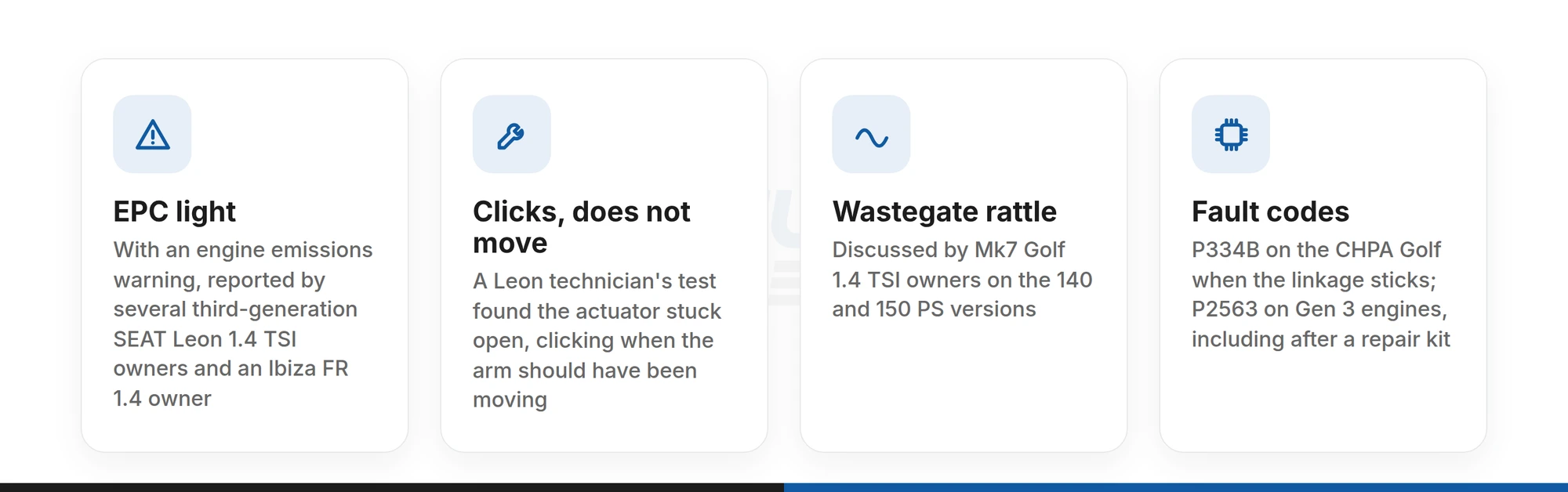
- An EPC light with an engine emissions warning, reported by several owners of the third-generation SEAT Leon 1.4 TSI and by an Ibiza FR 1.4 owner.
- An actuator that clicks but does not move. One Leon owner watched a manufacturer’s technician test it and heard it stuck open, clicking when the arm should have been moving.
- A wastegate rattle, discussed by Mk7 Golf 1.4 TSI owners on the 140 and 150 PS versions.
- Fault code P334B, which the CHPA Golf owner records when the linkage sticks badly, and which the owner’s scan tool names charge pressure control actuator.
A wastegate stuck open is the milder failure: boost will not build and the car feels flat. One that will not open is the serious case, because boost climbs past what the engine and turbocharger were designed for. If your car is surging, overboosting or repeatedly going into limp mode, drive it no further than you have to.
On the Gen 3 the code to know is P2563. Ross-Tech’s notes, summarised in our guide to turbo actuator fault codes, describe it on third-generation EA888 engines with a fully electric wastegate, including after a wastegate repair kit has been fitted, so a P2563 after a repair can be a set-up question rather than a failed part. Our guide to turbo actuator symptoms sets out what to record before any code is cleared.
Where the setting lives
A vacuum can is set with a spanner: its rod length decides how firmly the flap is held shut, which is why our wastegate actuator repair page gives rod length a section of its own. The electric actuator moves that setting into the engine management. The CHPA owner’s scan shows the engine storing the actuator’s lower and upper stops as learnt values, and lists basic settings that include a first adaptation of the charge pressure actuator.
The same owner found no adjustment on the rod at all. When the actuator was refitted the rod had retracted slightly; with the plug reconnected and the ignition on, the servo drove it out to the length it needed, and the owner found no routine that had to be run afterwards.
A repaired actuator needs no programming or coding. An adaptation is something different: a basic-settings routine run on a diagnostic tool, and only where the procedure for your engine calls for one. Ross-Tech’s Gen 3 notes do: where a P2563 follows wastegate work, they check the actual position against the adapted lower stop and run the initial adaptation.
What we repair
We repair the electric wastegate actuator at component level. It is tested as it arrives, before it is opened; whatever has failed among the motor, gears, position sensor and board is renewed, and the unit is recalibrated on the bench. If it is still on the turbocharger, send them together: an actuator can only be judged fully against the linkage and wastegate it drives.
Turbo Repairs · Epsom workshop
A seized pivot and a tired servo look the same from the driver’s seat
Send the turbocharger with its actuator still bolted on, plus the engine code and any stored codes exactly as your tool showed them. We check the linkage and wastegate by hand and test the actuator as received, so the price you get is for the part that has actually failed.
Lifetime, unlimited-mileage warranty · Mail-in from the UK and internationally · Bench-tested and calibrated before it ships
What Fails: Wastegate, Bearings and Oil Supply
The linkage pivot
One Mk7 Golf owner’s how-to names the main cause of servo motor failure on the 1.4 TSI as the pivot pin in the linkage between the servo arm and the turbo’s wastegate arm, which seizes. The CHPA owner found the same joint too tight.
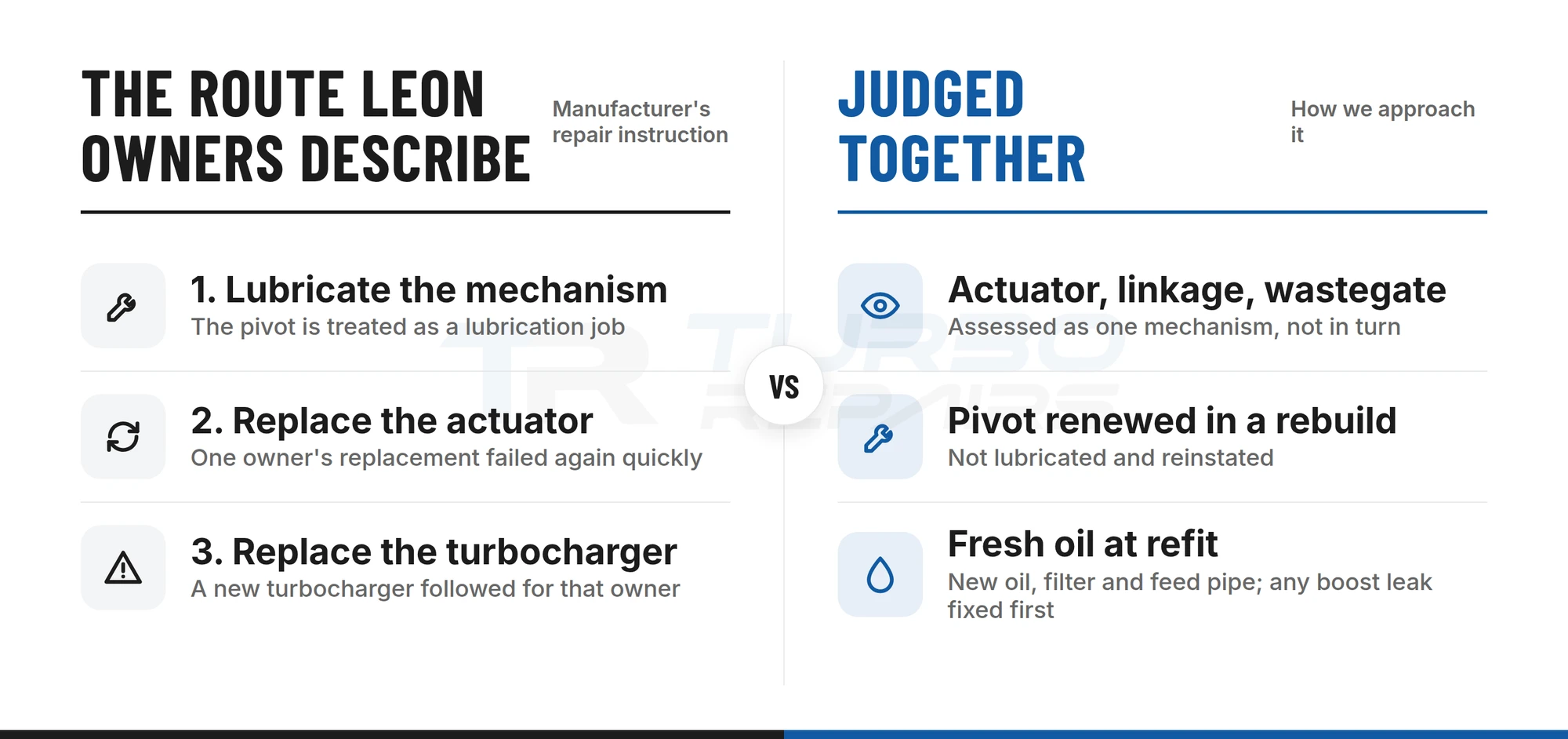
Leon owners describe the manufacturer’s repair instruction as three stages: lubricate the mechanism; if that fails, replace the actuator; if that fails, replace the turbocharger. One owner’s replacement actuator failed again quickly, and a new turbocharger followed.
The owners’ reports link these failures to the pivot, so we judge the actuator, linkage and wastegate together, and in a rebuild the wastegate pivot is renewed rather than lubricated and reinstated.
Bearings and oil supply
Nothing in our sources singles out a bearing or oil-supply weakness on these engines, so we treat them as we would any turbocharger rather than invent one. Bearings, seals and thrust parts are renewed in every rebuild, and what wears them out starts outside the turbo: interrupted lubrication, contaminated oil, debris and overspeed.
That matters at refit. A turbo that has worn its bearings has put metal into the oil, so fresh oil, a new filter and a new oil feed pipe go on with the rebuilt unit, and any boost leak is fixed first, because a leak makes the turbo spin harder for the same pressure. Our guides to what causes turbo failure and blown turbo symptoms cover reading the damage and when to stop driving.
What a TSI Turbo Repair Costs
Three published floors apply. None includes taking the unit off the car or putting it back.
- Rebuild of your own TSI turbocharger: from £185 + VAT.
- Electric wastegate actuator repair: from £100 + VAT, once the unit is confirmed on the bench.
- Exchange turbocharger: from £450 + VAT, where we have one for your engine; see our reconditioned exchange turbochargers.
Where a rebuild lands above its floor depends on what survived inside. Bearings, seals and a renewed wastegate pivot sit near the bottom; every wheel, shaft or housing that fails inspection moves it up. When a unit is not worth rebuilding we say so, and your price is confirmed with you before work goes ahead.
If the turbocharger is sound and the fault is inside the actuator, the actuator repair is the smaller job and the turbo can stay on the car.
How to Send Your TSI Turbo In
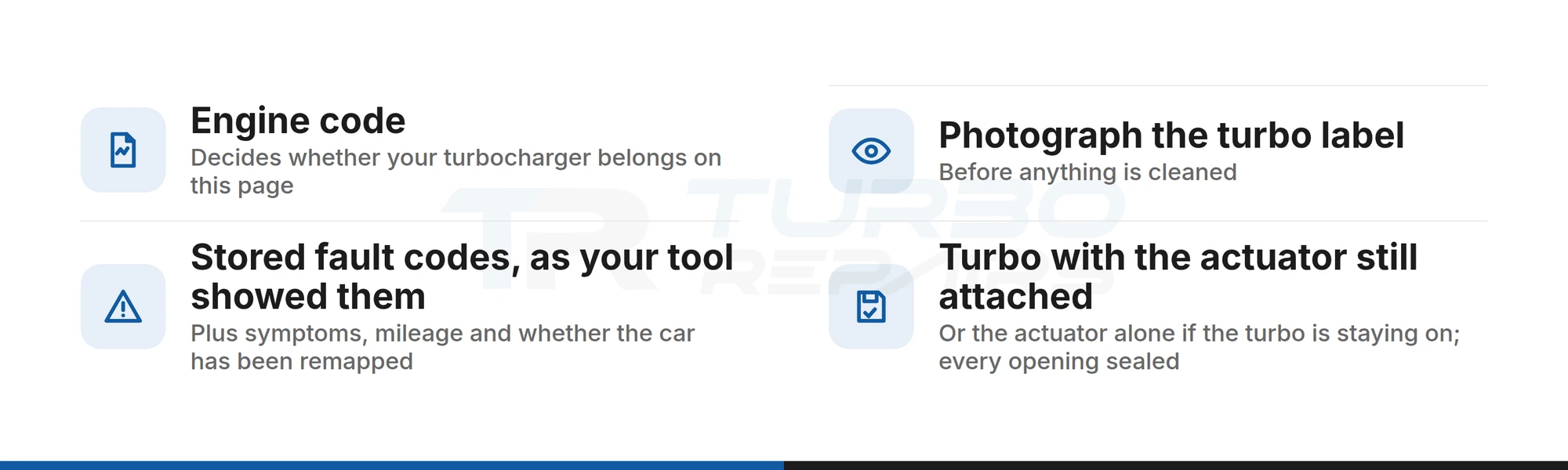
- Complete the online Repair Form with the registration, engine code, mileage, symptoms, any stored fault codes and whether the car has been remapped.
- Remove the unit: the turbocharger with its actuator still attached, or the actuator alone if the turbo is staying on. Photograph the turbo’s label before anything is cleaned.
- Pack and post it with every opening sealed, to Unit 102 Reaver House, 12 East Street, Epsom, Surrey, KT17 1HX, United Kingdom.
- Identified, stripped and rebuilt. The engine code and label are checked against each other and the actuator is tested as received. The turbo is stripped to component level, measured against original specification, rebuilt on genuine OE or OEM-grade parts, balanced and bench-tested, then posted back ready to refit.
It is the same turbo rebuild sequence we run on every turbocharger. What is particular to the TSI is that the actuator and the linkage are judged with it.
TSI Turbo FAQ
Which page covers a Golf GTI turbo?
It depends on the engine generation. A Mk5 or Mk6 GTI runs an earlier 2.0 TSI, which has its own page. A GTI with the third-generation EA888 is covered here, and the engine code confirms which you have.
The dealer wants to replace the actuator, then possibly the turbo. Is there another route?
Yes. Send the turbocharger with the actuator attached and we judge the actuator, the linkage pivot and the wastegate together, then repair whichever has actually failed. If only the actuator needs work, it is repaired on its own.
Do I need to reset anything after fitting?
Nothing needs programming or coding. Some engines have an adaptation, a basic-settings routine run on a diagnostic tool, for use after wastegate work; run it only where the procedure for your engine calls for it, as Ross-Tech’s Gen 3 notes do after a P2563.
Do you rebuild the 1.0 and 1.5 TSI turbos?
Yes, through the Repair Form. Give us the engine code and photographs of the label and of whatever is bolted to the side of the turbo, and the unit and its boost-control mechanism are confirmed on the bench before anything is priced.
Final Thoughts
A TSI badge tells you the fuel and roughly the size, and little else. The engine code decides whether your turbocharger belongs on this page, and on the 1.4 it separates the twincharged engines, sold with a pressure can, from the CHPA with its electric servo.
Where it is the electric servo, owners report trouble at the joint between the actuator and the wastegate, and the setting a can kept on its rod is held by the engine management. Have the actuator, linkage and wastegate judged together, and fix any leak or oil fault before the unit goes back on.
Turbo Repairs · Epsom workshop
Your TSI turbo and its electric actuator, judged as one mechanism
Complete the Repair Form with the engine code and any stored fault codes, then post the turbocharger in with its actuator attached, or the actuator on its own if the turbo is staying on. Each is tested, rebuilt at component level and posted back ready to refit.
Lifetime, unlimited-mileage warranty · Mail-in from the UK and internationally · Bench-tested and calibrated before it ships