

Summary A turbocharger is an air pump driven by exhaust gas. Gas leaving the engine spins a turbine wheel, a shaft carries that rotation through an oil-fed bearing housing to a compressor wheel on the intake side, and the compressor pushes air into the cylinders at above atmospheric pressure — so the engine can burn more fuel on every stroke and make more power from the same size of engine.
Below is how that happens part by part: the turbine, the shaft and its bearings, the seals, the compressor and the boost control that stops the whole thing running away with itself. Because we rebuild turbochargers, each part also comes with what wears on it.
The turbine and compressor wheels are fixed to one shaft and always turn at exactly the same speed, so the compressor can never deliver more than the exhaust has given the turbine.
Most explanations of a turbocharger stop at “exhaust spins a turbine, turbine spins a compressor”. That is true, and it is enough to know what a turbo is. It is not enough to understand why one fails, why a rebuilt one can fail again, or what is actually happening when the engine management reports a boost fault.
This guide follows the energy through the unit in the order it travels, then goes back over each part from the point of view of the bench it ends up on when it wears out.
What a Turbo Does, in One Paragraph
An engine’s power is limited by how much air it can get into its cylinders, because fuel needs oxygen to burn and there is only so much oxygen in a cylinder full of air at atmospheric pressure — about 1 bar, or 14.7 psi, at sea level. A turbocharger raises the pressure in the inlet above that, so each cylinder is filled with a denser charge of air; the engine management adds fuel to match, and more air and fuel burned per stroke means more power and torque. The energy to do it comes from exhaust gas the engine has already finished with, which is why manufacturers use turbochargers to get the output of a larger engine from a smaller one.
That extra pressure is what “boost” means: pressure in the inlet above atmospheric. How much boost an engine runs is set by its maker for that engine, so any single boost figure you read describes one engine rather than turbochargers in general.
What makes a turbo a turbo, rather than any other kind of forced induction, is the drive: exhaust gas instead of a belt from the crankshaft. That difference, and where it puts each device on the engine, is the subject of our guide to turbocharger vs supercharger. This page stays inside the turbocharger.
The Parts of a Turbocharger, Labelled
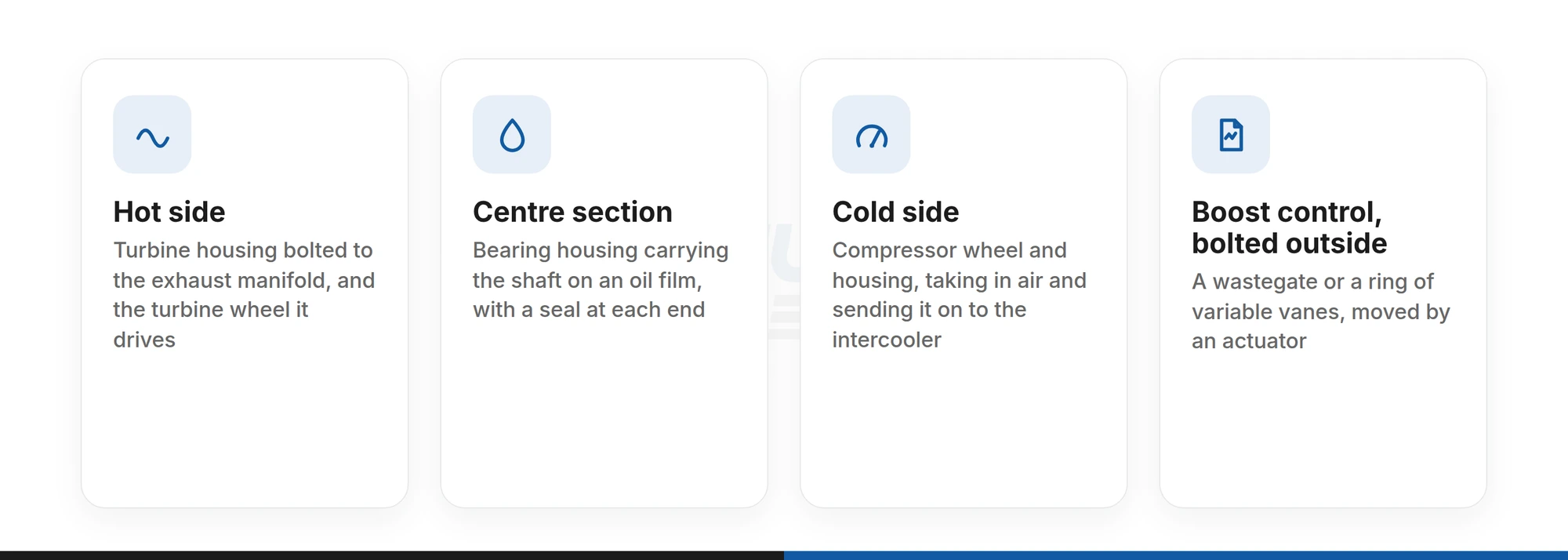
Take a turbocharger off an engine and it divides into a hot side, a cold side and the centre section that joins them, with the boost-control hardware bolted to the outside. Working from the exhaust end to the intake end:
- Turbine housing (the hot side). A snail-shaped casting bolted to the exhaust manifold. Its spiral passage narrows as it wraps around the wheel, speeding the gas up and aiming it at the blade tips. The outlet in its centre feeds the downpipe.
- Turbine wheel. Sits inside the turbine housing on one end of the shaft. Its blades turn the flow of exhaust gas into rotation.
- Shaft. Joins the two wheels. On a typical automotive unit the turbine wheel is permanently joined to the shaft and the compressor wheel is held on the other end by a nut, so the two can never turn at different speeds.
- Centre housing, also called the bearing housing. Carries the shaft between the hot and cold sides. It has an oil feed in at the top and a larger drain out of the bottom, and some designs also carry engine coolant.
- Bearings. Journal bearings (plain bushes riding on pressurised oil) or a ball-bearing cartridge carry the shaft’s radial load, and a thrust bearing stops it moving end to end.
- Shaft seals. A ring seal at each end of the shaft, where it passes out of the centre housing into the turbine and compressor sides.
- Compressor wheel. On the intake end of the shaft. A lighter wheel with finely profiled blades that draws air in at its centre and throws it outwards.
- Compressor housing (the cold side). Takes air from the air filter through its central inlet, collects the compressed air in its own spiral passage and sends it on towards the intercooler.
- Boost control. Either a wastegate — a valve that lets some exhaust gas bypass the turbine — or a ring of moveable vanes inside the turbine housing, and in both cases an actuator that moves it.
Parts listings have their own names for some of this. The shaft, both wheels, the bearings and seals in their centre housing are sold together as a CHRA (centre housing rotating assembly), also called a core or a cartridge: the whole turbocharger minus its two outer housings and the boost-control hardware.
From Exhaust Gas to Boost: One Revolution of the Shaft
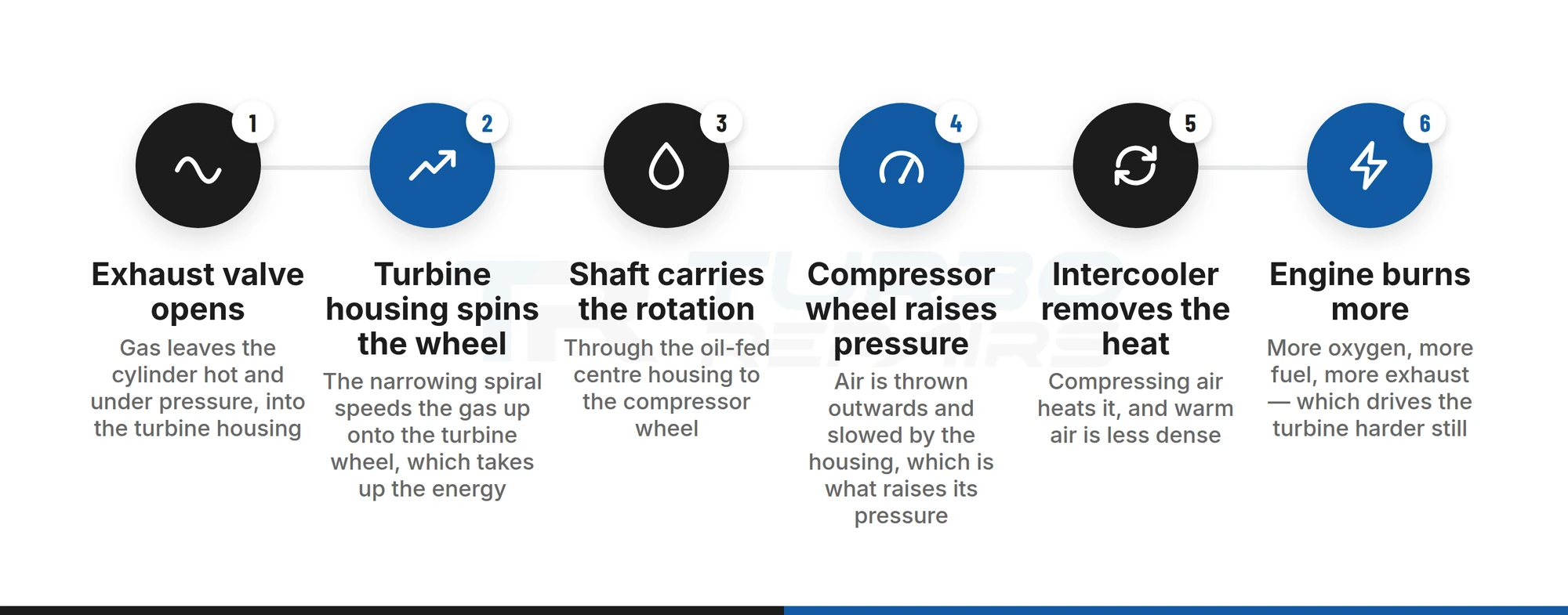
Follow one pulse of exhaust through the unit and the whole mechanism falls into place.
- The exhaust valve opens. Gas leaves the cylinder hot and still under pressure, and the manifold delivers it into the turbine housing.
- The turbine housing accelerates it. The narrowing spiral speeds the gas up and directs it onto the outer edge of the turbine wheel.
- The turbine wheel takes the energy. The gas works its way inwards through the blades, giving up pressure, heat and speed as it goes, and leaves through the centre of the wheel into the downpipe and on to the rest of the exhaust.
- The shaft carries the rotation through the centre housing, running on its oil film, to the compressor wheel.
- The compressor wheel throws air outwards. Air enters at the centre of the wheel and the blades fling it to the rim at high speed.
- The compressor housing turns speed into pressure. Around the wheel the air is slowed down, and slowing it is what raises its pressure; the spiral passage collects it and sends it towards the engine.
- The intercooler takes the heat out. Compressing air heats it, and warm air is less dense, so on most turbocharged engines the air passes through an intercooler (charge-air cooler) before the inlet manifold.
- The engine burns more. A denser charge means more oxygen, the engine management adds fuel to match, and the bigger combustion produces more exhaust — which drives the turbine harder still.
That last step is the important one. A turbocharger feeds itself: more boost makes more exhaust, and more exhaust makes more boost. Left alone, that loop keeps climbing, which is why every road-car turbo has something controlling it.
The speeds involved are extreme. Garrett, the turbocharger manufacturer, quotes turbine wheel speeds of up to 350,000 rpm and exhaust gas at the turbine of up to 1,900°F, about 1,040°C. Those are ceilings across its whole range rather than the figures for every unit, but they give the scale: nothing else in the engine turns anywhere near as fast, and very little runs as hot.
Some engines split the exhaust into two streams before it reaches the turbine. A twin-scroll turbine housing keeps the pulses from pairs of cylinders apart so they do not interfere with one another on the way to the wheel; the principle is the same, with the gas delivered more cleanly.
Turbo lag and boost threshold are not the same thing
Both describe a wait for boost, and they have different causes. The boost threshold is an engine speed: below it there simply is not enough exhaust flow to spin the turbine fast enough to make meaningful pressure, however long you wait. Turbo lag is a delay: the engine is above the threshold, you open the throttle, and it takes a moment for the extra exhaust to accelerate the rotating assembly up to speed.
That is also why a turbocharger is never really “off”. The shaft turns whenever the engine runs; at idle and on light throttle it just is not turning fast enough to build much pressure.
Two things the usual explanations get wrong
The exhaust energy is recovered, not free. It is often said that a turbo costs the engine nothing because it runs on waste gas. The energy is waste, but the turbine is still something the engine has to push its exhaust through, and that restriction raises the pressure the engine exhausts against. On a well-matched engine the gain far outweighs that cost; it is not zero, and it is one reason a turbocharger has to be matched to its engine rather than simply made bigger.
The “chuff” when you lift off is not the wastegate. On many petrol turbo engines, closing the throttle traps pressurised air between the compressor and the throttle. A blow-off or diverter valve on the intake side releases or recirculates it, protecting the compressor from that air trying to surge back through it. The wastegate sits on the exhaust side and does a different job, covered below. If you are trying to work out a noise, our guide to turbo whistle sorts it by what the sound follows.
The Bearing Housing: Oil, Heat and Speed
The centre housing is the part nobody sees and the part that decides most of a turbocharger’s life. It has three jobs: hold the shaft true at those speeds, keep oil in, and stop exhaust heat reaching the parts that cannot take it.
Oil in, oil out. Oil arrives under pressure from the engine’s own lubrication system through a feed pipe on top of the housing. It lubricates the bearings, carries heat away with it, and leaves through a larger drain at the bottom that returns it to the sump by gravity rather than under pressure. That detail matters: anything that restricts the drain — a kinked pipe, a coked outlet, high pressure in the crankcase it drains into — backs oil up inside the housing.
The bearings. In a journal-bearing turbocharger, which describes most of the diesel units we see, the shaft does not touch its bearings when it is running properly: it rides on a pressurised film of oil, and the unit is built with a small amount of radial play so it has room to do so. A ball-bearing cartridge carries the shaft on the bearing itself, with the oil lubricating and damping it, and behaves differently — our Garrett GT28R page covers the one we document. Either way, a thrust bearing takes the end load that pushes the shaft one way or the other as pressures on the two wheels change.
The seals. The seals at each end of the shaft are not rubber lip seals. They are metal rings, closer to a piston ring than a gasket, and they work by keeping the pressure either side of them in balance. That is why a turbo can leak oil with seals in perfectly good condition: back the oil up behind them, or pressurise the crankcase, and the balance goes.
Heat. Heat soaks from the turbine side into the centre housing all the time the engine runs; the oil flowing through carries it away, and on water-cooled designs the coolant helps. Switch off straight after a hard run and the oil stops flowing while the housing is still at its hottest. What that does to the unit over time is covered in our guide to how long turbos last.
Speed. At the shaft speeds a turbocharger reaches, the oil film is the only thing between a spinning shaft and a stationary bearing. Interrupt it for a fraction of a second and the damage is done in that fraction of a second, which is why oil-starvation damage on the bench looks like an event rather than slow wear.
How Boost Is Controlled: Wastegate or Variable Vanes
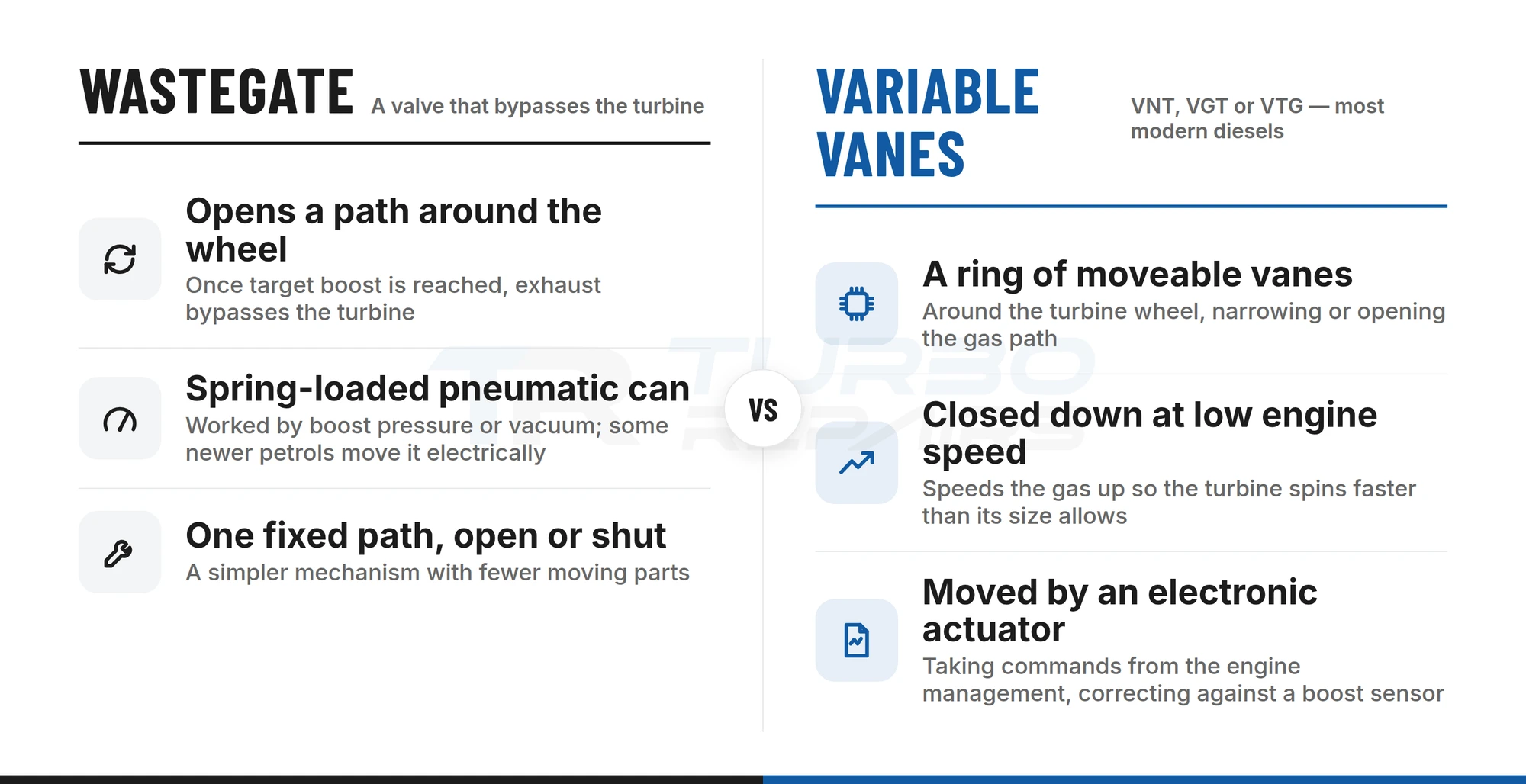
Because a turbocharger feeds itself, it needs a way to limit how hard the exhaust drives the turbine. A turbo sized to make boost at low engine speed would make far too much at high speed without it. There are two ways of doing it, and each has its own guide on this site.
A wastegate is a valve in the turbine housing that opens a path around the turbine wheel, so once the target boost is reached, some of the exhaust bypasses it. It is usually opened by a spring-loaded pneumatic can worked by boost pressure or vacuum; some newer petrol engines move it electrically. How the setting on that can decides the boost is covered on our wastegate actuator repair page.
Variable vanes, fitted to most modern diesels and called VNT, VGT or VTG depending on the maker, are a ring of moveable vanes around the turbine wheel. Closed down at low engine speed, they narrow the gas path and speed the gas up so the turbine spins faster than its size would allow; opened out as flow rises, they let it pass. Why that ring sticks, and what to do about it, is in our VNT turbo guide.
Either way, something has to move the mechanism, and on most modern diesels that is an electronic actuator taking commands from the engine management, which compares the boost it asked for with the boost a sensor reports and corrects the difference. That part has its own guide: what the turbo actuator does.
What Wears on Each Part
Every part that makes a turbocharger work is also a part that wears, and knowing the mechanism is what makes the wear make sense. This is how each part looks from the bench, which is a different view from the driver’s seat: if you are starting from what the car is doing, our guide to turbo failure symptoms works from the symptom back to the part.
| Part | Its job | What wears it | What a rebuild does about it |
|---|---|---|---|
| Compressor wheel | Pressurises the intake air | Debris that gets past the air filter chips or bends the blade edges; a wheel that starts touching its housing once bearing clearance has grown | Inspected and replaced if damaged; how the debris got in still has to be found on the car |
| Turbine wheel and shaft | Turns exhaust flow into rotation | Heat, fragments arriving from the engine side, and scoring on the shaft’s bearing surfaces from dirty or starved oil | Measured against specification; replaced if out of it |
| Journal and thrust bearings | Carry the shaft on oil | Oil starvation, oil contaminated with carbon or metal, oil left in too long | Renewed with genuine OE or OEM-grade parts |
| Shaft seals | Keep oil inside the centre housing | Bearing clearance growing, a restricted oil drain, high crankcase pressure | Renewed; a restricted drain or breather has to be put right on the car as well |
| Turbine housing | Directs exhaust onto the wheel | Repeated heating and cooling, which can crack it | Inspected; a cracked housing can rule a unit out of rebuilding |
| Variable vane ring | Varies the gas path to the turbine | Soot and oil residue baking around the vanes and pivots until the ring stiffens | Cleaned or renewed, freed and set to sweep its full travel |
| Wastegate | Bypasses exhaust around the turbine | Carbon and wear in the pivot; an actuator rod set to the wrong length | Pivot wear addressed rather than reinstalled; rod set to the turbocharger’s specification |
| Electronic actuator | Moves the vanes or wastegate | Motor, gear train and position sensor wearing under constant holding load | Rebuilt at component level and calibrated as a separate repair |
Two things stand out from that table. First, most of the wear starts outside the turbocharger — in the oil it is given, the air it is fed and the exhaust it receives — which is why a rebuilt or new unit fitted to an uncorrected fault goes the same way as the first. Our guide to replacing a turbocharger covers finding the cause while the unit is off.
Second, almost all of it is invisible from outside. Bearing clearance, shaft condition, seal wear and a stiffening vane ring can only be judged once the unit is apart. So a turbo rebuild starts with a strip to component level and measurement against original specification; worn parts are replaced with genuine OE, OEM-grade or uprated components, the rotating assembly is balanced, and the unit is run up on the bench before it goes back. Electronic actuators are rebuilt under electronic turbo actuator repairs.
Turbo Repairs · Epsom workshop
Every part in that table, measured on one bench
Post your turbocharger to our Epsom workshop and it is stripped to the shaft, each part checked against the specification it was built to, and rebuilt, balanced and run up before it comes back. We tell you what the wear says about the car, not just which parts were changed.
Lifetime, unlimited-mileage warranty · Mail-in from the UK and internationally · Bench-tested and calibrated before it ships
How Does a Turbo Work? FAQ
What does a turbo do?
It pushes more air into the engine than the engine could draw in on its own. With more air in each cylinder, the engine management can add more fuel, and burning more fuel per stroke gives more power and torque from the same size of engine. The turbocharger does it using energy from exhaust gas that would otherwise leave through the tailpipe.
What is a turbo, and is it the same as a turbocharger?
Yes. “Turbo” is the everyday short form of turbocharger: an exhaust-driven air pump made of a turbine wheel and a compressor wheel on one shaft, running in an oil-fed bearing housing between two outer housings.
Does a turbo work all the time?
It turns whenever the engine is running, but it only makes meaningful boost once there is enough exhaust flow to spin it fast enough. At idle and on a light throttle it is turning without building much pressure; as the load and engine speed rise, boost builds, up to the limit the boost control allows.
How fast does a turbo spin?
Far faster than anything else in the engine. Garrett quotes turbine wheel speeds of up to 350,000 rpm across its range. That is a ceiling rather than the speed of every unit, but it explains why a turbocharger depends entirely on a clean, uninterrupted oil supply: at those speeds there is no margin for the oil film to break down.
Why do diesel engines almost always have a turbo?
Modern diesels are turbocharged as a matter of course, because a turbocharger lets a diesel of practical size produce the power and torque drivers expect while recovering energy from its own exhaust. Most pair it with variable vanes, which help it make boost at the low engine speeds diesels spend much of their time at. That vane mechanism is also one of the parts that most often needs attention; see our VNT turbo guide.
Can a worn turbocharger be rebuilt, or does it have to be replaced?
Most can be rebuilt. The parts that wear — bearings, seals, the vane mechanism or wastegate hardware — are renewable, and the shaft and wheels are measured and replaced where needed. What can rule a unit out is damage to the parts that are not normally renewed, such as a cracked turbine housing. Our guide to turbo repair costs sets out what a rebuild costs.
Final Thoughts
How a turbo works fits in a sentence: exhaust spins a turbine, a shaft spins a compressor, and the compressor packs more air into the engine. What that sentence leaves out is how much the turbocharger depends on the engine it is bolted to.
A turbocharger supplies none of its own inputs. Its energy is exhaust the engine has finished with, its lubrication and cooling come from the engine’s oil, and its instructions come from the engine’s management — so it can only ever work as well as the three things it borrows. Understand those three and you understand both how a turbo makes boost and why one stops making it.
When one does stop, the same parts list in the same order is how it gets put right: stripped, measured, renewed where worn, balanced and tested.
Turbo Repairs · Epsom workshop
Turbine to compressor, rebuilt in the order it works
Tell us the vehicle and what it is doing, then post the turbocharger in. It comes back with its bearings, seals and boost-control hardware renewed or set to specification, its rotating assembly balanced, and a note of what we found inside it.
Lifetime, unlimited-mileage warranty · Mail-in from the UK and internationally · Bench-tested and calibrated before it ships