

Summary We rebuild the turbochargers from the Iveco Daily’s 2.3 and 3.0 diesels, on panel vans, minibuses and chassis cabs alike. Find your engine and the makers the parts listings name for it, then post the turbo in: it is stripped, rebuilt, balanced and bench-tested, and comes back ready to refit. Rebuilds start from £185 plus VAT, with a lifetime, unlimited-mileage warranty.
In the listings we have read, the Daily 2.3 shares its Mitsubishi turbochargers with the Fiat Ducato, yet none of the Daily 3.0 units we found is listed for the Ducato at all.
- Vehicles covered: the Iveco Daily as a van, bus, platform cab or chassis cab, listed by the trade as Daily III, IV, V and VI
- Engines: the 2.3 (F1A family) and the 3.0 (F1C)
- Makers in the listings: Mitsubishi on the 2.3 and 3.0, Garrett on the 3.0; other Daily units are listed without a maker
- How to identify it: the label on the turbo; the model code on the cab and the power on the V5C narrow the field
- Price: rebuilds from £185 plus VAT, confirmed once the unit has been stripped and measured
- Bench time: between one and three working days is typical, with postage on top
- Warranty: lifetime, with no mileage limit
Which Iveco Daily Engine Do You Have? 2.3 or 3.0
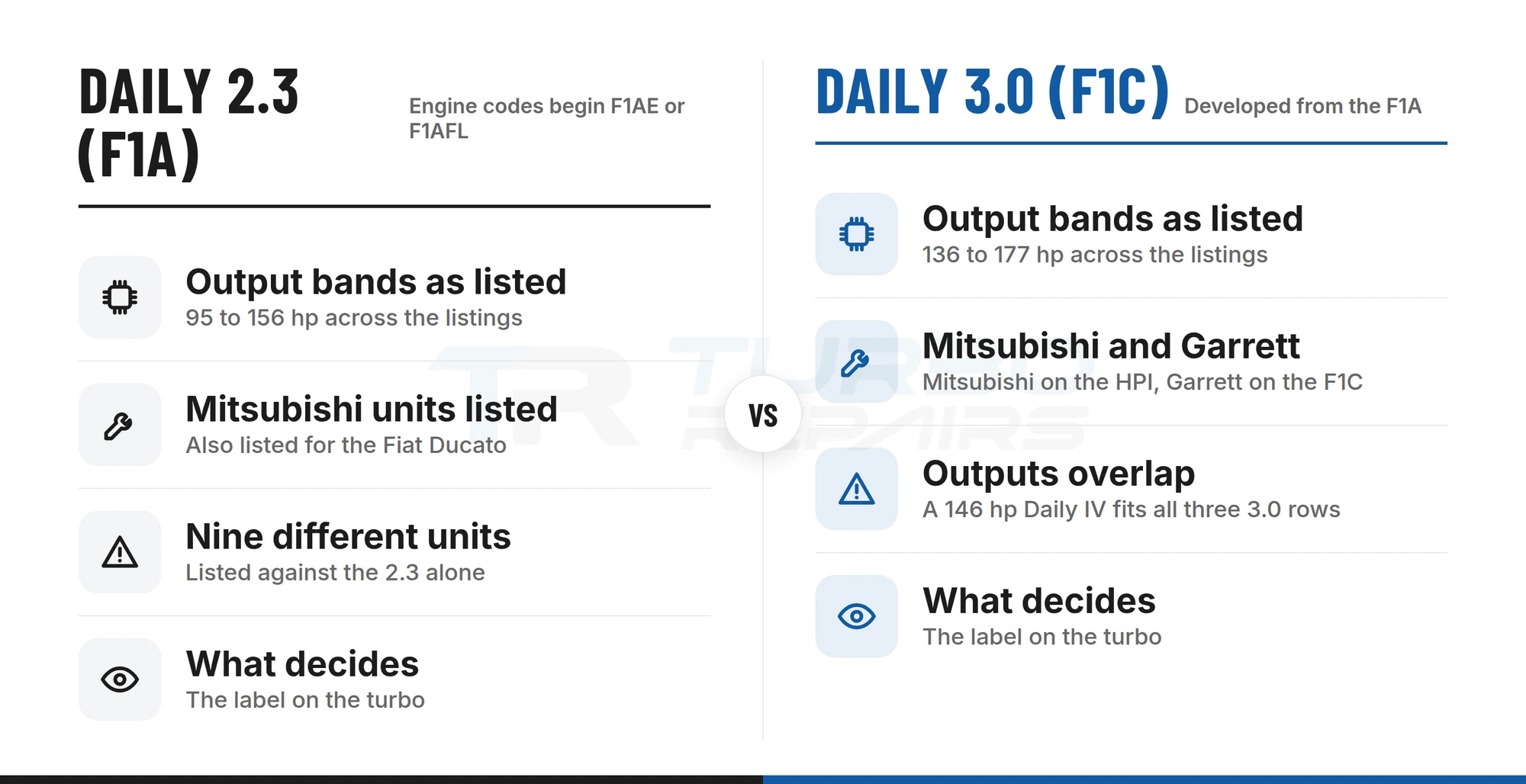
The turbo listings put two diesel families under the Daily. The 2.3 is Iveco’s F1A, with engine codes beginning F1AE or F1AFL. The 3.0 is the F1C, a larger engine developed from the F1A.
Three labels can describe one Daily: the trade’s generation numbers, Daily III to VI; output names such as HPI and HPT; and the model code on the cab, such as 35S14. One 2.3 listing dates the Daily III to 2005–2006 and the Daily IV to 2006–2011, and another covers Daily V and VI from 2011 to 2016.
The model code earns a second look. In the listings we have read, the 29L14, 35C14 and 35S14 all sit at 136 hp and the 33S16 to 50C16 at 156 hp. Take the cylinder capacity and power from the V5C, note the model code, and leave the final word to the label on the turbo. If your Daily has another engine, tell us what is on the label when you fill in the Repair Form.
The Turbochargers Listed for the Daily 2.3 and 3.0
This is what the three parts listings we have read put against the Iveco Daily. A maker is shown only where a listing names it, or where the listed reference begins 49.
| Engine and output, as listed | Maker families listed | What decides |
|---|---|---|
| 2.3, Daily III and IV, 110 hp (Euro 3) and 136 hp | No maker named | One engine code here is also listed on a Mitsubishi unit; the label decides |
| 2.3, Daily IV and V, 106 to 136 hp | Mitsubishi, also listed for the Ducato | More than one unit per engine code and output; the label decides |
| 2.3, Daily V and VI, 116 to 131 hp, from 2011 | Mitsubishi, also listed for the Ducato | Two units share an engine code; the label decides |
| 2.3, 95 to 154 hp, F1AE and F1AFL series | No maker named | An output band this wide settles nothing; the label decides |
| 2.3, Daily VI, 156 hp | No maker named | Output and model code point to one listed unit; the label confirms |
| 3.0 HPI, Daily III to VI, 136 to 146 hp | Mitsubishi | A 146 hp Daily IV fits all three 3.0 rows; the label decides |
| 3.0 F1C, Daily IV to VI, 146 to 177 hp | No maker named; also listed for the Mitsubishi Canter | As above |
| 3.0 F1C, from 2005; and 176 bhp Euro 4, 2006 to 2010 | Garrett | As above |
Where the listings overlap they do not agree, and we have not chosen between them, because the label on your unit already has. A label reference beginning 49 marks a Mitsubishi (MHI) turbocharger, as our Mitsubishi MHI turbo repair page explains. Photograph the label while the turbo is still dirty and enter everything on it in the Repair Form. If the label has burned off or cannot be read, send the turbo anyway: it is identified on the bench before any work starts.
Shared Engines: the Fiat Ducato 2.3 and 3.0
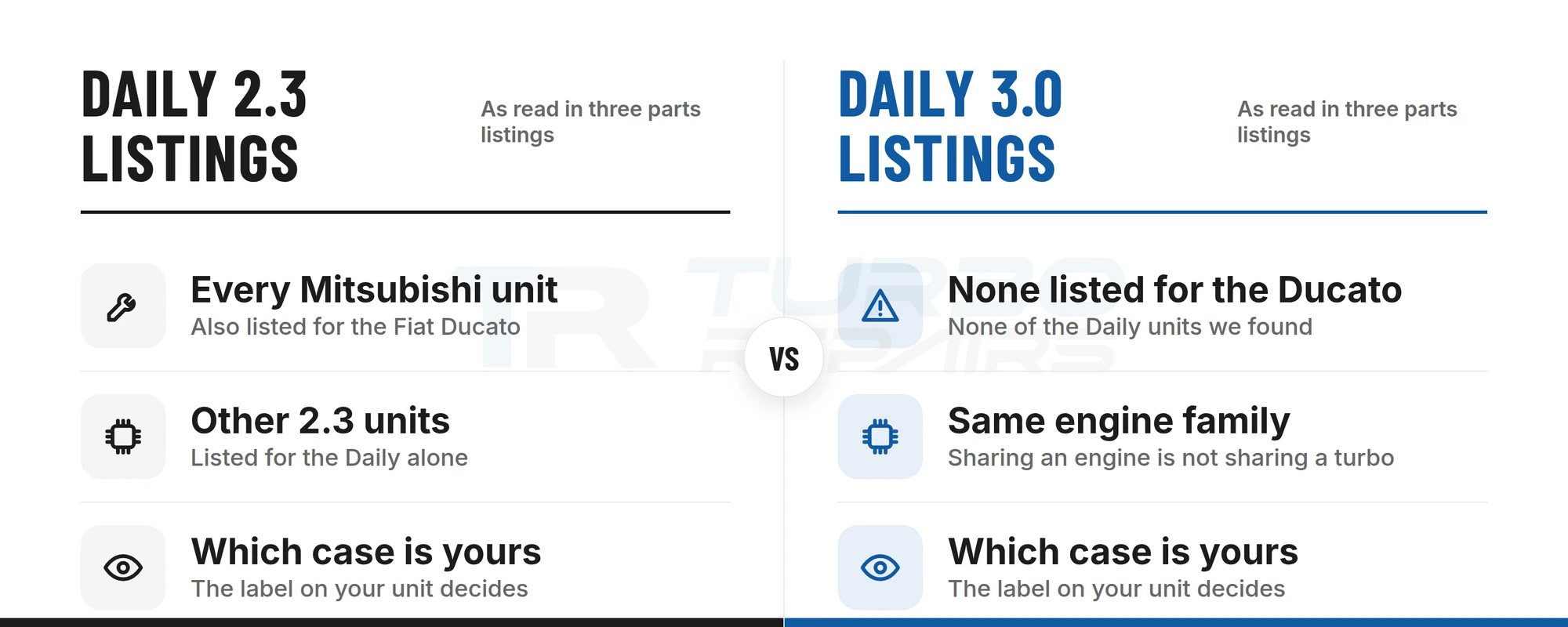
The Daily shares its 2.3 and 3.0 engine families with the Fiat Ducato, but the Ducato is a unibody van while the Daily sits on a separate ladder frame of the kind heavier commercial vehicles use. Sharing an engine has not meant sharing every turbocharger.
On the 2.3, every Mitsubishi unit in the table is listed for the Ducato as well, and the others for the Daily alone. On the 3.0, none of the Daily units we found is listed for the Ducato. If your engine is in a Ducato, or a motorhome built on one, our Fiat Ducato turbo repair page covers it; for other vans, start from our van turbo repair page.
What Fails on a Daily Turbo: Duty Cycle and the Oil Supply
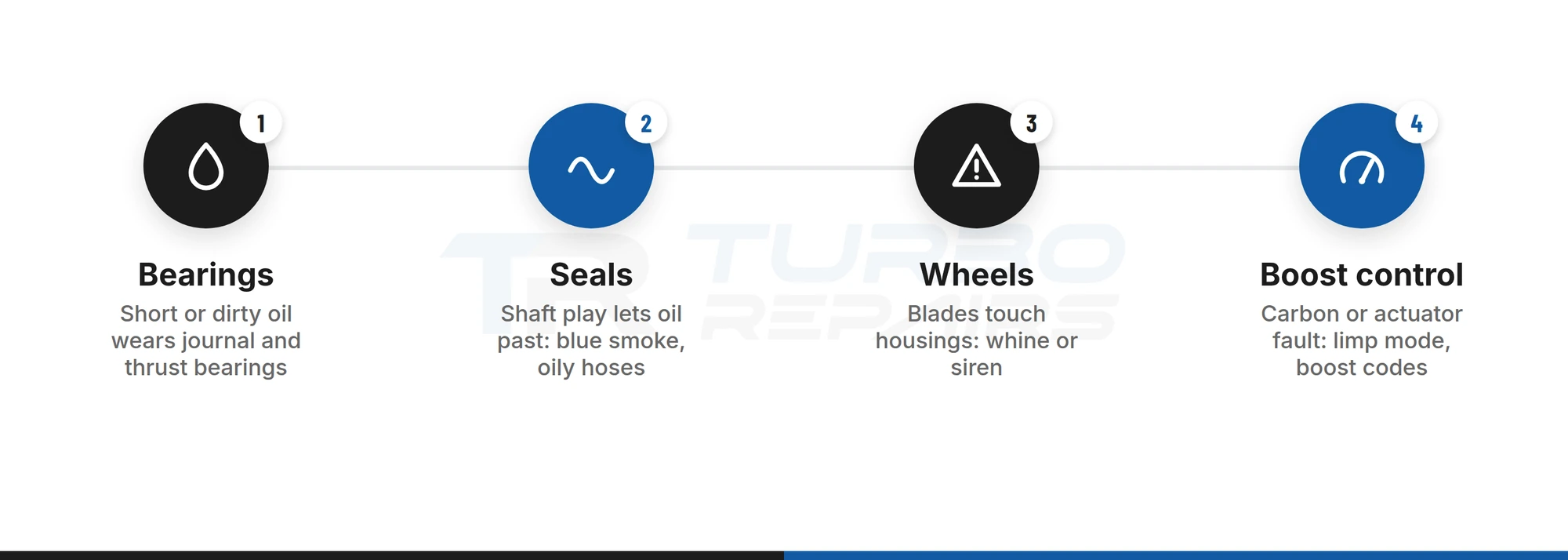
The turbo is a shaft with a wheel at each end, spinning on a film of engine oil, and its faults build on one another:
- Bearings. Oil that runs short or carries dirt wears the journal and thrust bearings, and the shaft starts to move.
- Seals. A shaft with play lets oil past its seals: oily intercooler hoses, blue smoke, oil that disappears between services.
- Wheels. With more play the blades touch their housings, bringing a whine or siren, and broken tips can be carried downstream or into the intercooler.
- Boost control. Carbon on the vanes or wastegate, or an actuator fault, shows up as a loss of power, limp mode, and over-boost or under-boost codes.
How a Daily is worked decides which of those it meets first. A hard climb at full weight keeps the exhaust at its hottest, so let the engine tick over for a minute or so before the key comes out.
Our guide to what causes turbo failure shows how each cause marks the parts it damages, and blown turbo symptoms covers the warning signs. Before a rebuilt unit goes back on, replace the oil feed pipe or flush it through, check the drain, clear oil and debris from the boost pipework and intercooler, fit new gaskets, give the engine fresh oil and a new filter, and pre-oil the turbo before its first start.
Turbo or Actuator? Which Repair You Need
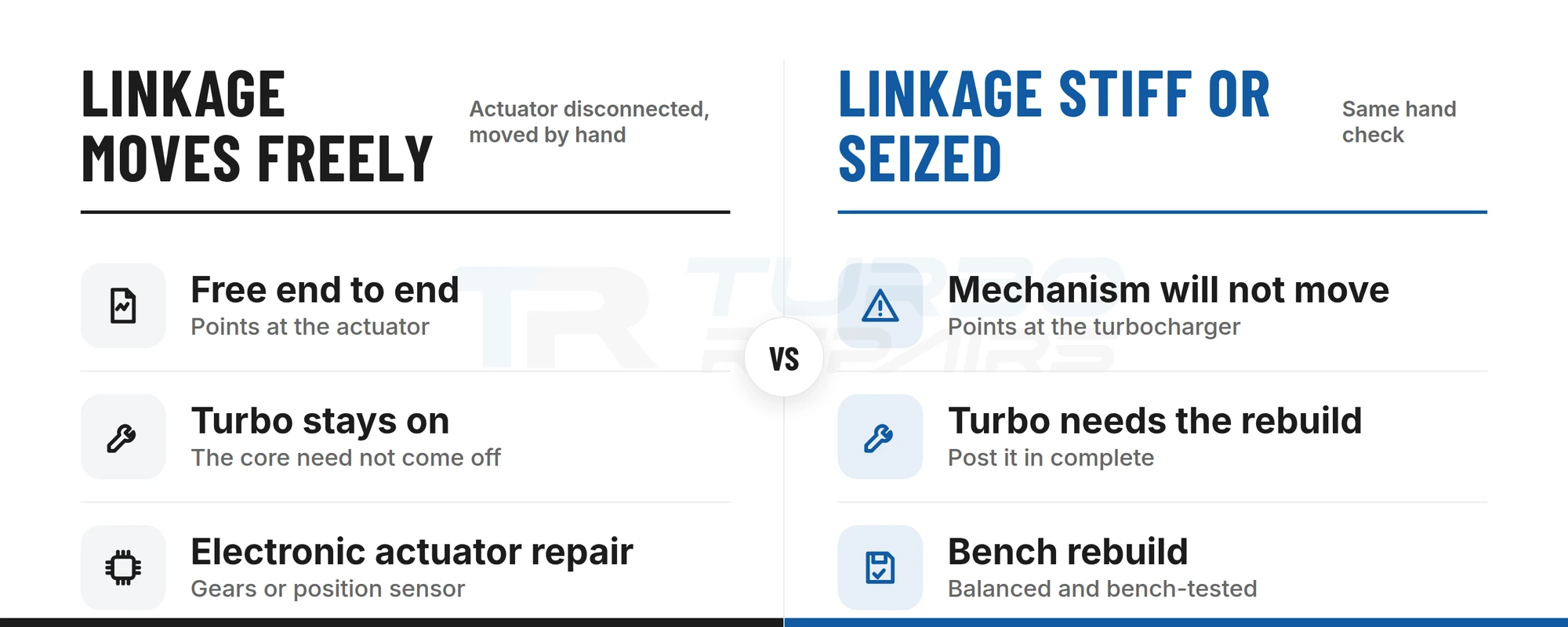
A boost code or a drop into limp mode does not prove the turbocharger has failed. On a variable-geometry turbo an electronic actuator positions the vanes, and when its gears wear or its position sensor fails, the vanes stop short of where the engine asks while the core stays healthy. One listing describes a Daily 2.3 unit as variable geometry; the listings do not say which Daily turbos carry an electronic actuator.
If yours does, disconnect it from the vane linkage and move the mechanism by hand. Free from one end of its travel to the other points at the actuator, and the turbocharger need not come off; our electronic turbo actuator repairs cover that job. A stiff or seized linkage means the turbocharger needs the rebuild.
What an Iveco Daily Turbo Rebuild Costs
Rebuilding the turbocharger from your Daily starts from £185 plus VAT. Where it lands above that depends on what the strip-down finds: a core needing only the standard wear parts stays close to the starting figure, and each wheel, shaft or housing measured outside tolerance adds to it. We confirm the figure once the unit has been stripped and measured, before the rebuild goes on.
That price is for work on your unit, not for a listing, which matters on a Daily: the 2.3 alone is listed with nine different units. A garage’s figure for replacing the turbo also covers removal, refit, gaskets, oil and a filter. If a casting cannot be saved, a reconditioned exchange turbocharger is the alternative; everything in our turbo rebuild is set out on the hub.
Turbo Repairs · Epsom workshop
Nine listed units for one engine. Yours is already on the van.
Send in the turbocharger from your Daily and the bench works on the unit your engine was built with, whichever listing it matches. You have the price once it has been stripped and measured.
Lifetime, unlimited-mileage warranty · Mail-in from the UK and internationally · Bench-tested and calibrated before it ships
How to Send Your Daily Turbo In
- Fill in the online Repair Form with the engine size, power, model code, mileage and any fault codes, plus everything on the turbo’s label.
- Have the turbo removed complete, with its actuator still fitted. Your own garage can take it off and refit it.
- Pack and post it. Seal every port, wrap the turbo and box it rigidly with padding round both wheel ends, then send it to Unit 102 Reaver House, 12 East Street, Epsom, Surrey, KT17 1HX, United Kingdom.
- On the bench. The unit is identified, stripped and measured against specification. Bearings, thrust parts and seals are renewed as standard, anything outside tolerance is replaced with genuine OE or OEM-grade parts, and the rotating assembly is balanced, then boost control is set and the unit is run.
- Back to you. Between one and three working days on the bench is typical, plus postage. Your own turbocharger comes back ready to refit, with a lifetime warranty and no limit on mileage.
Iveco Daily Turbo FAQ
Is the Iveco Daily 2.3 turbo the same as the Fiat Ducato 2.3 turbo?
Sometimes. Every Mitsubishi 2.3 unit we found for the Daily is also listed for the Ducato, but other 2.3 units are listed for the Daily alone. The label on your unit decides which case you are in.
Who makes the Iveco Daily 3.0 turbo?
The listings carry a Mitsubishi unit for the 3.0 HPI, Garrett units for the F1C, and a further F1C unit with no maker named. Their outputs overlap, so the label settles it.
How much does an Iveco Daily turbo rebuild cost?
From £185 plus VAT, with the final figure confirmed after the strip-down. Removal and refitting are billed separately by the garage that does them.
Can you rebuild the turbo from a Daily minibus or camper?
Yes. The body built on the chassis makes no difference: the turbo is part of the base vehicle’s engine. Give us the model code and, for a camper, the converter’s name on the Repair Form.
Final Thoughts
The Daily’s turbo question is narrower than the listings make it look. Two engines, a handful of output names and four generations add up to more than a dozen listed units, and they overlap exactly where an owner needs them to agree. The label on your own unit is the one thing that overlaps with nothing.
So the useful work sits at either end of the job: note the model code and the label before the unit goes in the box, and put the oil supply right before it goes back on. Everything between is the bench’s job.
Turbo Repairs · Epsom workshop
Send in the turbo from your Daily 2.3 or 3.0
Fill in the Repair Form with the model code, engine and everything on the label, then post the turbocharger in with its actuator attached. It is identified, rebuilt, balanced and run on the bench, and returned ready to refit.
Lifetime, unlimited-mileage warranty · Mail-in from the UK and internationally · Bench-tested and calibrated before it ships