

Summary P0045, P0047 and P003A on a Ford S-Max 2.2 TDCi name the boost-control circuit, not the component that failed. That circuit starts at a driver stage inside the engine control unit, runs through the loom and a connector, passes through the actuator’s motor, gear train and position sensor, and ends at the vane mechanism the arm has to move — and most of it can be eliminated in an hour without spending anything. We rebuild your own actuator at component level from £100, typically in one to two working days, returned needing no coding and covered by a lifetime, unlimited-mileage warranty — and we tell you when the evidence says the actuator is not what failed.
Most of that boost-control circuit can be eliminated in an hour without spending anything, which is worth doing before any part is bought.
This repair goes wrong so often because the code sounds like a diagnosis. Read literally, P0045 says that boost control circuit “A” is open. It does not say the actuator has failed. It says a loop is broken somewhere along its length — a length running from the control unit, through a loom, through a connector sitting in heat, vibration and road salt, and only then into the small motor the code is habitually blamed on.
Which end of the loop gave way decides what you buy. Get it wrong and you have fitted a part you cannot return, to a car still in limp mode.
- Vehicle: Ford S-Max 2.2 TDCi — catalogued at 175–200HP against DW12B (EU4) variants, turbocharger listings spanning 2008–2015
- The part: an electronic actuator bolted to the outside of a variable-nozzle turbocharger — a motor, a reduction gear train and a position sensor, commanded by the control unit and reporting back where the arm actually reached
- References catalogued against the 2.2 TDCi: Continental A2C53367100 / OEM 01920060, for 2010–2015 cars; and Hella 6NW009483 under G-code G-50, against turbocharger 753544
- Codes: P0045, P0046, P0047, P003A, P0238, often with a “Charge Air Pressure Control” message; P2263, P0234 and P0299 on a generic reader
- Symptoms: power loss under acceleration, permanent or intermittent; limp mode; smoke on acceleration; a flashing glow-plug light; an arm that will not move
- Our service: component-level rebuild of your own unit — from £100, typically 1–2 working days, no coding on refit, lifetime unlimited-mileage warranty
What P0045, P0047 and P003A Actually Assert
A diagnostic tool reports what the engine control unit observed. It cannot report what broke. The boost-control codes fall into three groups, and the difference between them is the most useful thing to learn before spending anything. Electrical codes describe the state of a wire loop. Positional codes describe a disagreement between where the actuator was told to go and where it reported arriving. Outcome codes describe boost that missed target, which anything in the air path can cause.
| Code | What the control unit observed | Candidates producing the identical observation |
|---|---|---|
| P0045 | Boost control “A” circuit — open. Current that should have flowed did not. | A broken or chafed wire; a corroded, spread or unlatched pin; a failed earth; an open motor winding; or the driver stage in the control unit. Five candidates, one code. |
| P0047 | Boost control “A” circuit — low. Voltage below what was expected. | The same loop, dragged down rather than broken. A wire rubbed through onto a bracket does this as readily as a shorted winding. |
| P0046 | Boost control circuit — range or performance. It responds, but not as expected. | Leans towards the component more than the loom does, without proving it. A high-resistance joint looks like a tiring motor. |
| P003A | Boost control “A” — position exceeded learning limit. In adaptation, reported position fell outside the accepted range. | A worn position sensor reporting where it is not; a gear train slipping so the motor turns and the arm does not; a replacement whose travel does not suit this turbocharger; or a healthy actuator held short of its stop by a stiffened vane mechanism. |
| P0238 | Boost sensor “A” circuit — high input. | A measurement fault, not a control fault. It belongs to the sensor the control unit checks the result with, and lands in the same scan looking like part of the same problem. |
| P2263 / P0234 / P0299 | Boost system performance; overboost; underboost. | Outcome codes, confirming the engine did not get the boost it asked for and saying nothing about why. A basic reader often returns these instead of the specific codes. |
P003A is the row worth reading twice. It is routinely sold as proof of a failed actuator, and it is the one code a mechanically perfect actuator will set when the ring of vanes it swivels has stiffened with carbon — the actuator reporting the problem rather than having it.
One caution while researching: listings for this part commonly print a single generic fault-code block covering every vehicle the seller handles, so codes belonging to other manufacturers appear on pages about a Ford.
The Boost-Control Circuit: Seven Places One Code Can Come From
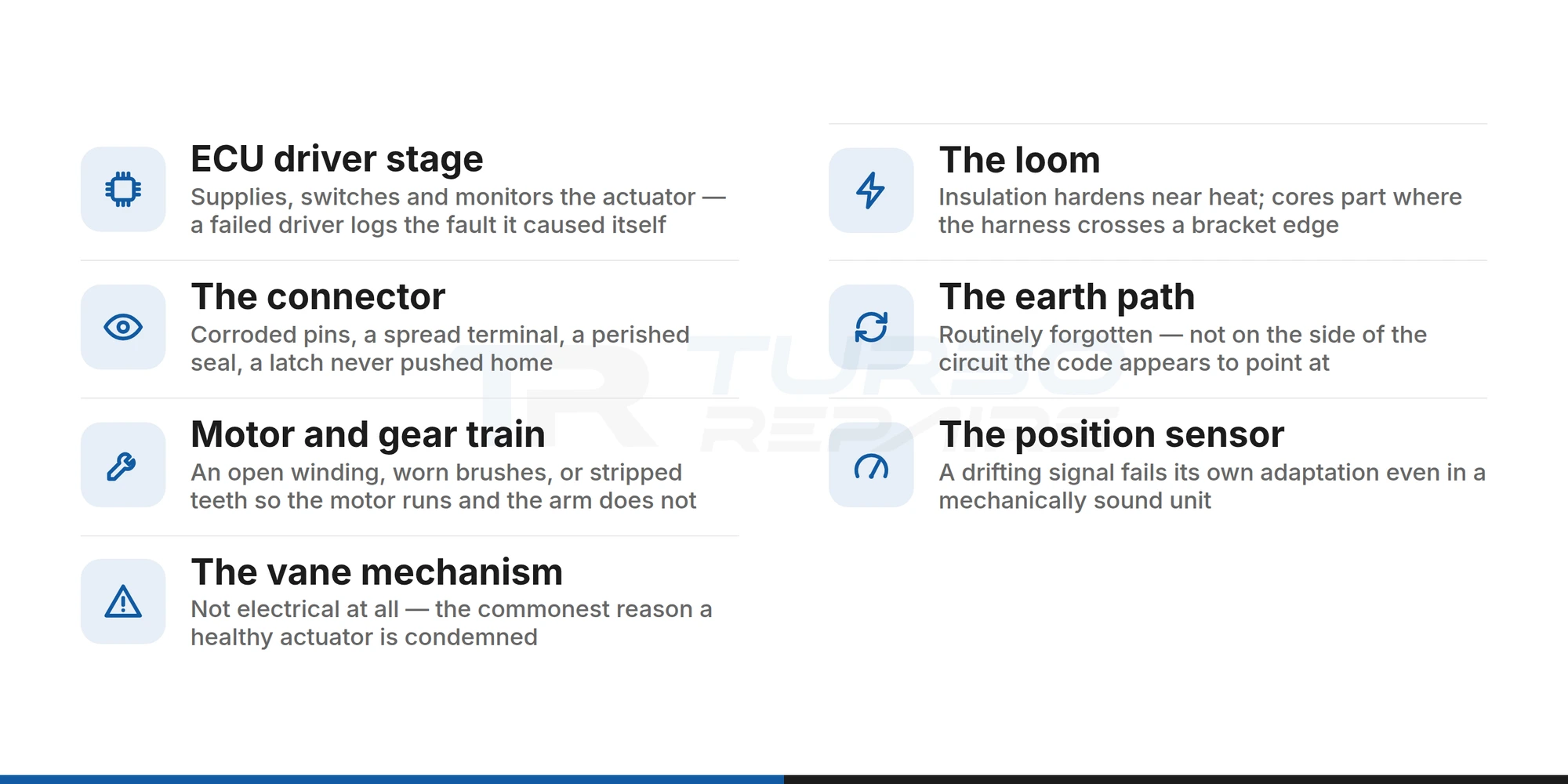
Here is the whole loop, in the order the current travels it. Every item can set a boost-control code, and only two sit inside the part that usually gets replaced.
- The driver stage in the engine control unit — the output that supplies, switches and monitors the actuator. When a driver fails, the unit records the circuit fault it caused itself.
- The loom between control unit and turbocharger. Insulation hardens near hot components; cores part where the harness crosses a bracket edge or has been pulled during other work.
- The connector — pins, seal and latch. Corrosion on a pin face, a terminal spread by careless probing, a hardened seal that has let water in, a latch never pushed home after a previous job.
- The earth path — routinely forgotten, because it is not on the side of the circuit the code appears to point at.
- The motor and gear train inside the actuator: an open winding, worn brushes, or stripped teeth so the motor runs and the arm does not.
- The position sensor inside the actuator. A drifting or worn signal makes a mechanically sound unit fail its own adaptation.
- The vane mechanism inside the turbine housing — the mechanical load. Not electrical at all, and the commonest reason a healthy actuator is condemned.
Worth naming separately: the boost-pressure sensor, the control unit’s only measure of whether any of this worked. When it reads wrongly, corrections are commanded that were never needed and the disagreement is logged — which is where P0238 and the outcome codes come from.
Two candidates out of seven are inside the actuator. A third sits behind it and is cured by an entirely different job. Any process running straight from a code to a part has skipped five of the seven.
Reading the Pattern Before You Spend
The symptom list identifies the system. The pattern starts to identify the component, and observing it costs nothing.
Does it clear on an ignition cycle, and how long does it stay clear? A code returning the instant the ignition is switched on is behaving electrically. One that needs the engine to run and warm through is behaving like something marginal — a joint opening as everything expands, a motor coping until it is hot, a mechanism stiffening.
Did it arrive overnight or over months? A sudden total loss suits something that broke. A gradual decline, with the good spells shortening, is the signature of something wearing — and what usually wears here is the resistance the actuator has to overcome.
The Checks That Cost Nothing, in the Order That Eliminates Most
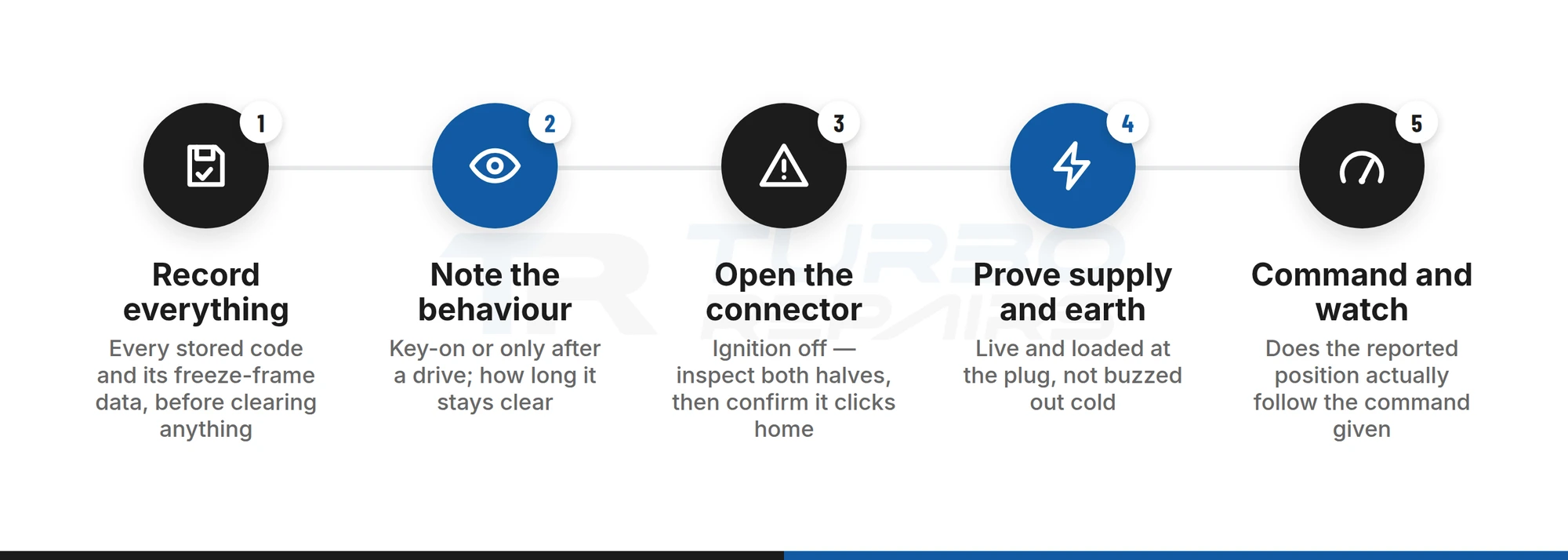
None of this needs more than an hour, a torch and a multimeter, and the order is what prevents the expensive mistake.
- Record everything before clearing anything. All stored codes, not just the boost one, plus the freeze-frame data stored with them. An EGR or particulate-filter code alongside a boost code changes the picture, because those systems share exhaust conditions with the turbocharger.
- Note the behaviour. Whether it returns at key-on or only after a drive, whether it needs the engine hot, how long it stays clear. Write it down — it is worth more than the code number, and it is the first thing we ask about.
- Open the connector and look at it properly. Ignition off, unlatch it, inspect both halves for corrosion, a pin pushed back or spread, a perished seal, a cracked latch — then confirm it clicks fully home. Cheapest finding on the list, in the wettest, hottest corner of the bay.
- Prove supply and earth actually reach the plug. Detailed in the next section. If nothing arrives at the connector, the actuator is not your fault.
- Command the actuator and watch the reported position follow. A tool that can drive the unit and display its feedback separates what a static test cannot: whether it responds at all, and whether the position it reports matches the one it was given. Commanded moving while actual stays put is the split between a unit that will not drive and an arm being held.
Then separate the actuator from what it drives
With the actuator unbolted, sweep the operating arm through its complete travel by hand. Free movement end to end means the vane mechanism is moving and the actuator is your suspect. Binding, notchiness or refusal to move means the nozzle ring inside the turbine housing has stiffened, and no work on the actuator will cure the car — a rebuilt unit bolted onto a stiff mechanism carries the same overload from its first mile.
That failure route, and the method for testing it properly, is set out in full on our Jeep Grand Cherokee actuator page. Different vehicle, same variable-nozzle arrangement and the same sequence of events — worth reading before you order anything.
One warning to go with the sweep: do not drive the car with the actuator unplugged or removed to see what happens. The control unit can no longer position the vanes at all, and boost is no longer being controlled to any target.
Turbo Repairs · Epsom workshop
Not certain the actuator is your fault?
Tell us what the S-Max is doing, which codes it stored, whether they return at key-on or only when warm, and whether any supply reaches the actuator plug. Our engineers will tell you what that rules in and out before you post anything.
Lifetime, unlimited-mileage warranty · Mail-in from the UK and internationally · Bench-tested and calibrated before it ships
When the Fault Is the Loom, the Connector or an Earth
An open winding inside the actuator and a broken wire two feet away from it produce exactly the same P0045, because the control unit is watching a loop and cannot see inside it. The only way to tell them apart is to test the two halves separately: the car’s half at the connector, and the unit’s half on a bench.
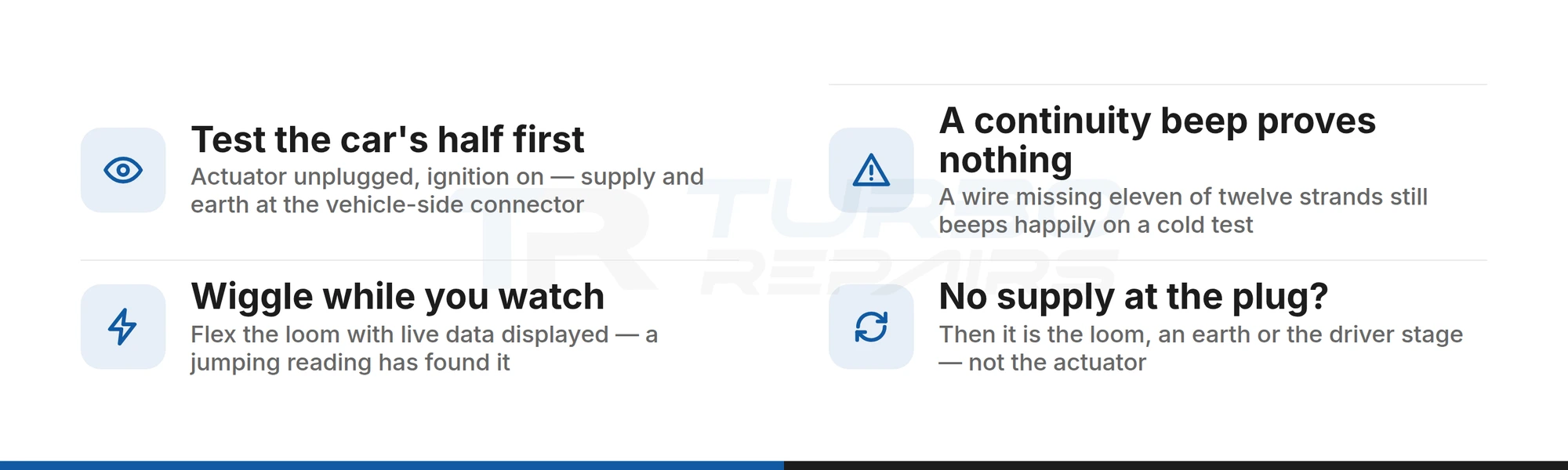
Test the car’s half first, because it is the half you still have. With the actuator unplugged and the ignition on, check that the expected supply is present at the vehicle-side connector and that the earth path is sound back to its chassis point — against the wiring data for your own vehicle, not a wire colour quoted somewhere for a different engine.
A continuity beep is not the same test. This is the commonest false clearance on this fault. A wire with one strand left out of a dozen beeps happily on a continuity range and still collapses under the current a motor draws. What matters is whether the circuit holds its voltage while working — measured live and loaded, not buzzed out cold.
Wiggle while you watch. With live data displayed, move the loom section by section and flex the connector at its body. If the reading jumps or the code sets while you hold a particular stretch, you have found it, and it is not the actuator. Concentrate on where looms actually fail: close to hot components, across bracket and clip edges, and anywhere previous work disturbed the routing.
If no supply arrives at the actuator connector, the actuator is not your fault. It is the loom, an earth or the driver stage, and a new actuator on that car will behave exactly as the old one did.
You have already fitted a solenoid and an actuator, and nothing changed
Then the code was never pointing at either, and a third part on the same end of the circuit will not change the outcome. Work up the loop rather than across it: supply and earth at the connector, then the loom back to the control unit, then the control unit’s own output. Unglamorous, but every step is testable and costs nothing but time.
Which Actuator Is Actually Fitted to Your S-Max
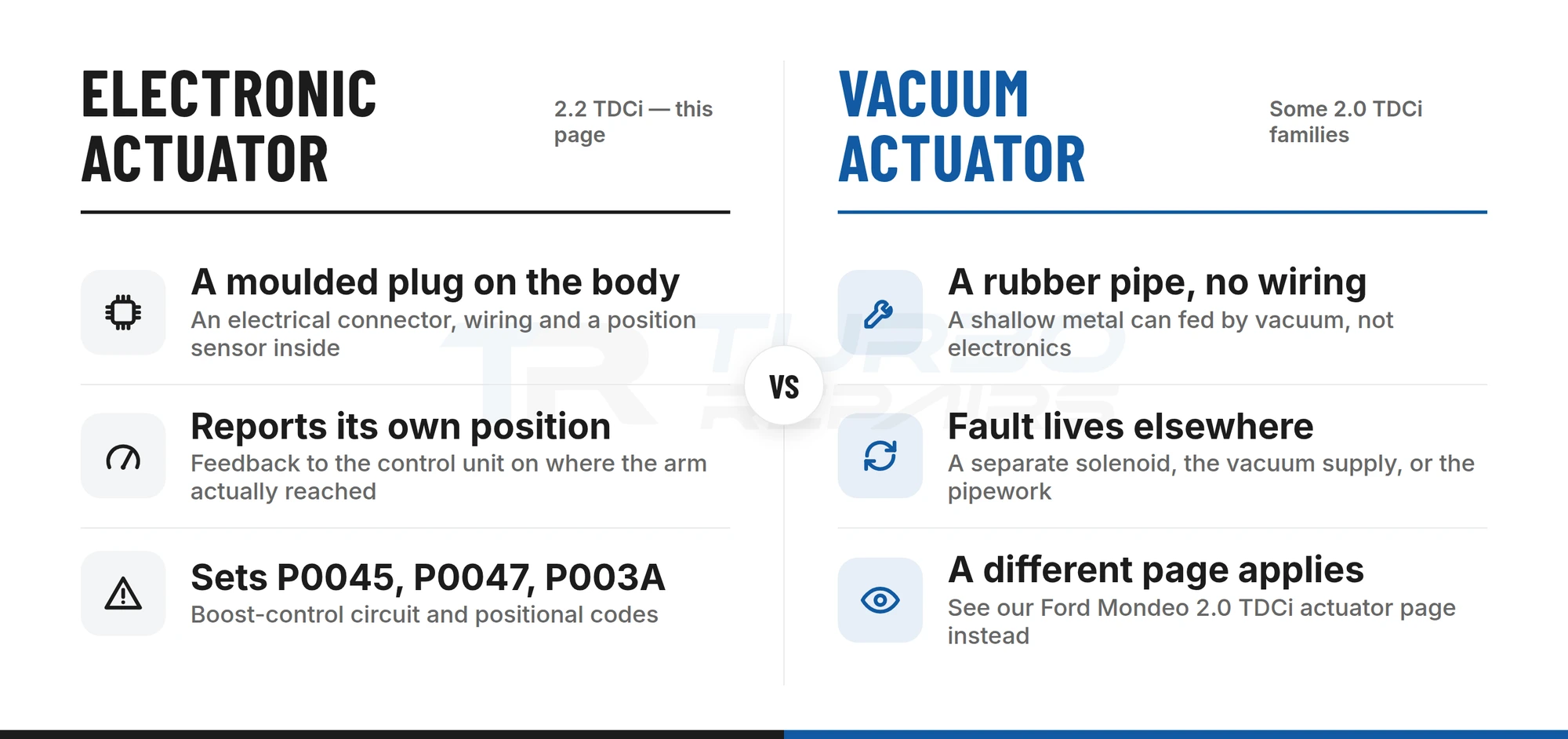
This page is written around the 2.2 TDCi, and the scope is deliberate. Not every S-Max diesel carries an electronic actuator: suppliers catalogue a vacuum-operated actuator against some 2.0 TDCi turbocharger families, and on those cars the fault lives in a separate solenoid, a vacuum supply and a length of small-bore pipe. An electronic actuator is a moulded body with an electrical connector on one face; a vacuum actuator is a shallow metal can with a rubber pipe into it and no wiring at all. If yours has a pipe rather than a plug, nothing here about motors and position feedback describes your car — and on the 2.0 TDCi, our Ford Mondeo 2.0 TDCi actuator page covers the closest equivalent, since the two share a platform and a turbocharger list.
Within the 2.2 TDCi there is a second thing almost nobody says: more than one manufacturer’s actuator is catalogued against this engine. Specialist catalogues record a Continental unit, A2C53367100 with OEM number 01920060, for 2010–2015 cars. A separate listing records a Hella unit, 6NW009483 under G-code G-50, against turbocharger 753544 for Galaxy, Mondeo and S-Max 2.2 TDCi — and a UK repair specialist advertises the S-Max job specifically as a Hella actuator on a Garrett turbocharger. Two turbocharger references, 753544-0020 and 49477-01103, are both catalogued for the 2.2 TDCi at 175–200HP.
None of those entries is wrong. They describe different turbochargers fitted to the same engine across its production run, so a listing quoting only the vehicle has identified nothing. What identifies yours is what is moulded or printed on it: the manufacturer’s reference, any shorter base number beside it, and on Hella units the G-code. Wipe the housing, take a torch to it, photograph everything legible — including markings you do not recognise. The other Ford electronic actuator we rebuild most often is on the Ford Transit, and it wears out in much the same sequence.
What Wears Out Inside the Actuator, and Which Code It Sets
The unit is a small direct-current motor driving a reduction gear train, a position sensor reporting where the output shaft reached, and a circuit board doing the commanding — all bolted to the outside of the hottest component on the engine and repositioning the vane ring on every gearchange, hill and lift of the throttle.
The motor goes marginal long before it goes dead, which is why the fault first appears when everything is thoroughly hot and has gone by morning. The gear train carries the full reaction of whatever resistance the vane ring offers, so teeth round off or strip; the motor then runs perfectly while the arm moves loosely or not at all, which reads as an electrical fault and is not one. The position sensor wears a band at the part of the travel the engine uses most and reports a position the arm is not in — the classic route to P003A, and the most misleading of the four, because everything still looks alive. The circuit board develops hairline fractures at joints that have spent years expanding and contracting, opening under vibration and closing as the engine warms: the intermittent P0045 no static test will catch.
Underneath all four sits the load. Fit a flawless actuator to a stiff nozzle ring and it begins its life carrying the overload that killed the last one.
Our Ford S-Max Actuator Rebuild, and What to Send With It
It is a mail-in service carried out in our own workshop at Unit 102 Reaver House, 12 East Street, Epsom, Surrey, KT17 1HX, United Kingdom, by turbo specialists and electronic engineers who work on these units daily. The actuator unbolts from the outside of the turbocharger, so the car stays where it is.
Your unit is identified from the references on its own casing, cross-checked against the engine it came off, then tested on the bench as received — so what we report is what genuinely failed, which occasionally means telling you the unit is healthy and the fault is on the car. It is then stripped to component level: motor and brushes, reduction gears, position sensor and seals renewed as required, the board reworked rather than wiped over, and components with a known weakness in the original design uprated rather than refitted, so the rebuilt unit meets or exceeds original specification. It is finally calibrated across its full travel and held against commanded positions until the readings repeat properly with the unit warm.
It comes back ready to bolt straight on: no coding and no programming, because it is your own unit, still calibrated to the travel of the turbocharger it belongs to. You will simply want a diagnostic tool to clear the stored codes and let the control unit run its adaptation.
Send these four things with it:
- Your registration and which engine the car has.
- Every code stored, whether each returns at key-on or only when hot, and how long the car runs before it comes back.
- Whether any supply reaches the actuator connector, and what you found on the pins.
- What the arm felt like when you swept it by hand with the unit off.
Rebuilds start from £100, with the exact figure confirmed once your unit has been identified and bench-tested, so it is known before any work goes ahead. Turnaround is typically one to two working days from the unit reaching the workshop, plus postage each way, and every rebuild carries a lifetime, unlimited-mileage warranty — no mileage cap, no expiry date. Units are accepted from anywhere in the UK and internationally; if you are posting from overseas, get in touch first. The full range we rebuild sits on our electronic turbo actuator repair service.
When a Rebuild Is Not the Answer
A specialist who only ever confirms the fault you arrived with is not much use. Four results send an S-Max owner somewhere other than an actuator rebuild.
The unit tests healthy. Then the fault is on the car: the loom, the connector, an earth, the driver stage, or the mechanism the actuator drives. That is more useful than a part, because it is what stops you buying the next one.
The vanes are seized. If the by-hand sweep found the arm binding or immovable, the nozzle ring is the job, the turbocharger has to come off for it, and it sits under our turbocharger repair and rebuild service.
The core is worn. Play in the shaft, oil in the intake pipework, blue smoke or a whine that keeps getting louder belong to the turbocharger itself, not to the part bolted to its outside.
The boost never leaves the pipework. A split intercooler hose, a slipped clamp or a failed joint under-delivers boost and stores the same outcome codes — and there is nothing to send anybody. It is the cheapest thing this can turn out to be.
Ford S-Max Turbo Actuator Repair FAQ
Does P0045 mean the turbo actuator on my S-Max has failed?
No. P0045 says boost control circuit “A” is open — a break somewhere in a loop, not a failed component. That loop includes the driver stage in the control unit, the loom, the connector, the earth path and the motor winding. What separates the actuator from the other four candidates is whether supply and earth actually arrive at the connector.
I have already fitted a solenoid and an actuator and the fault is still there. What have I missed?
Almost certainly the car’s half of the circuit. Both parts sit at the same end of the loop, so if the break is in the loom, an earth or the control unit’s output, replacing them changes nothing. Check for supply at the vehicle-side connector, confirm the earth, and flex the loom while watching live data. A continuity beep proves a wire is joined, not that it can carry current.
What is the difference between P0045 and P003A?
P0045 is electrical: current that should have flowed did not. P003A is positional: the actuator was told to reach a position and reported that it could not, during adaptation. That matters, because P003A is the one code a mechanically perfect actuator will set when the vane ring it drives has stiffened with carbon.
Can I keep driving an S-Max with a boost-control fault?
It will usually still drive, which is not the same as it being sensible. With the circuit faulty the control unit can no longer position the vanes to target, so it limits fuelling to protect the engine — that is limp mode. If it is smoking on acceleration, surplus fuel is going into the particulate filter. Never drive it with the actuator unplugged or removed.
Is the actuator the same on every S-Max diesel?
No, and that is where owners lose money. Suppliers catalogue a vacuum-operated actuator against some 2.0 TDCi turbocharger families, where the fault sits in a solenoid, the vacuum supply or the pipework. Even within the 2.2 TDCi, catalogues record a Continental unit (A2C53367100 / 01920060, 2010–2015) and, separately, a Hella unit (6NW009483 under G-50, against turbocharger 753544).
Will a rebuilt S-Max actuator need coding or programming?
No. You get your own unit back, still calibrated to the travel of the turbocharger it came off, so it refits plug-and-play. You will want a diagnostic tool to clear the stored codes afterwards and let the control unit run its adaptation. Bought replacements are only pre-coded where the part number matches your original exactly, and used units generally need coding.
What happens if you test my actuator and find nothing wrong with it?
We tell you, and it goes back. That result is worth having: it means the fault is in the loom, the connector, an earth, the driver stage or the vane mechanism, and it stops you buying a second part on the same end of the circuit. We will also say which of those we would test next, based on how the fault behaved.
What does the repair cost, how long does it take, and what is the warranty?
Rebuilds start from £100, with the exact figure confirmed once the unit has been identified and bench-tested rather than quoted blind. Turnaround is typically one to two working days from the unit reaching the workshop, plus postage each way. Every rebuild carries a lifetime, unlimited-mileage warranty — no mileage cap, no expiry date.
Final Thoughts
The mechanics of this repair are not the difficult part. The difficult part is that the S-Max hands you a code that sounds specific, points at a component that genuinely is a likely culprit, and is sold everywhere as a number you can order in ninety seconds — and none of that amounts to a diagnosis. An open-circuit code is a statement about a loop. Only testing tells you which end of it gave way.
So do the free work first. Read the codes before clearing anything, open the connector and look at it, prove that voltage and earth arrive at the plug, and sweep the arm by hand once the unit is off. That is an hour of your time, and it either condemns the actuator properly or saves you from replacing a part that was never broken.
If it does condemn the actuator, the unit already bolted to your turbocharger is the one that fits, the one already calibrated to it, and the one nobody has to identify from a photograph.
Turbo Repairs · Epsom workshop
Post your S-Max actuator in and find out what actually failed
Send the unit with your registration, the codes it stored, how the fault behaved, and photographs of the references on the housing. We identify it, bench-test it before it is opened, rebuild it at component level and calibrate it before it goes back in the box — and if the test says it is healthy, we tell you that instead of rebuilding it anyway.
Lifetime, unlimited-mileage warranty · Mail-in from the UK and internationally · Bench-tested and calibrated before it ships