

Summary We rebuild Ford Transit and Transit Custom turbochargers at component level. Your own unit is stripped, measured, rebuilt on genuine OE or OEM-grade parts, balanced and bench-tested at our Epsom workshop, then posted back ready to refit. Rebuilds for diesel vans are priced from £250 to £450 excl. VAT depending on what has survived inside, bench time is typically one to three working days, and every rebuild carries a lifetime, unlimited-mileage warranty.
What makes a Transit its own job is what happens around the turbocharger rather than inside it. On these vans the oil supply decides how long a turbo lasts, and the repair is not finished on the day the unit goes back on.
For the Transit 2.2, 2.4 and 2.5 diesels, the turbo fitting instruction reported to UK workshops ends 100 miles after the refit, with a second oil and filter change.
This page is about the turbocharger itself on the Ford Transit and Transit Custom: the shaft, bearings, seals and wheels, and the oil supply they live on. If your van has a boost fault and you are weighing a rebuild against a replacement or an actuator repair, it takes you through that decision in the order it should be made.
- Vans covered: the Ford Transit on its 2.0, 2.2, 2.4 and 3.2 diesels and the 2.0 EcoBlue, and the Transit Custom on the Euro 5 2.2 TDCi and the 2.0 EcoBlue
- Documented cause on the 2.2 and 2.4: abrasives in the oil system or a restricted oil feed to the turbo
- Turbo, not actuator, when: there is oil in the boost pipes, blue smoke, a metallic whine or play in the shaft
- Price: diesel van rebuilds £250 to £450 excl. VAT, confirmed once the unit has been inspected
- Turnaround: typically one to three working days on the bench
- Warranty: lifetime and unlimited mileage, with no time limit
- How it works: mail-in from anywhere in the UK or internationally, via the online Repair Form
Is It the Turbo or the Actuator on Your Transit?
Settle this before anything is ordered, because the two are different repairs at very different prices. On the 2.2 TDCi and 2.0 EcoBlue Transits the turbocharger carries an electronic actuator that sets its boost-control vanes, and when that actuator alone has failed the turbo can stay on the van: that repair has its own page, Ford Transit turbo actuator repair. Everything below is about the turbocharger.
The dividing line is physical. An actuator fault shows itself as a boost-control problem and little else. A failing turbocharger usually leaves evidence: oil where it should not be, a noise from the shaft, or movement you can feel with your fingers.
| What you find | Where it points | What to do next |
|---|---|---|
| Oil in the intercooler or the boost pipes | Oil crossing the turbocharger’s seals: worn bearings, a restricted oil return or high crankcase pressure | Turbo off for inspection; the return line and breather are checked before any unit goes back on |
| Blue or grey smoke, worst under load or after a long idle | The same seal leak, or an engine burning oil past its own rings | Rule out the engine’s own oil consumption, then inspect the turbo |
| A metallic whine or siren that follows engine speed | The rotating assembly: bearings worn far enough for a wheel to touch its housing | Stop working the van hard; the turbo has to come off |
| Play in the shaft you can feel by hand | Bearings well past their limit | Rebuild; if the compressor wheel has touched, check the intake for fragments |
| Vane arm stiff or seized with the actuator unbolted | Carbon binding the vane mechanism inside the turbine housing | Turbo rebuild; no actuator, new or rebuilt, can move a seized ring |
| Boost code and lost power, but no oil, smoke or noise, and the vane arm sweeps freely | Boost pipework, a sensor or the actuator | Check hoses and clips first, then look at the actuator |
Several cheaper faults imitate a failing turbo convincingly, split boost hoses above all. Our guide to turbo failure symptoms sorts each symptom by where in the unit it starts and lists the imitators worth ruling out first.
What Fails Inside a Transit Turbocharger (Bearings, Seals, Wheels, Oil Supply)
A turbocharger is two wheels on one shaft. Exhaust gas drives the turbine wheel, the shaft carries that turn across to the compressor wheel, and the compressor pushes air into the engine. Between them sits the centre bearing housing, where the shaft runs on a film of pressurised engine oil and is sealed at each end.
That oil film is the whole of the bearing. The fitting instruction written for the Transit 2.2, 2.4 and 2.5 diesels describes the turbo on those engines as a robust unit which, like every turbocharger, relies on a constant supply of oil — and warns that if the supply fails, the bearings quickly suffer irreparable damage.
From there, failures run in a fairly fixed order:
- Bearings. The first parts to wear, and the first to suffer when oil is short or dirty. Once worn, they let the shaft move further than it was built to.
- Seals. A shaft that no longer runs true stops the seals at each end holding oil in the bearing housing. Oil reaches the intake on one side and the exhaust on the other.
- Wheels. Enough movement lets the compressor or turbine wheel touch its housing, and a wheel that has touched can shed material into the intake or the exhaust.
- Shaft. Left running on failed bearings, the shaft can bend or break. The turbine wheel and shaft are one assembly, so damage to either replaces both.
- Boost-control mechanism. On the variable-geometry units, carbon builds around the vane pivots until the ring no longer moves freely. That is a turbocharger fault, even when the actuator is the part reporting it.
In practice, the day the unit comes off decides much of the bill. A Transit turbo removed when the whine first starts is usually a bearings-and-seals job. The same turbo driven on until it is blowing oil may need a wheel, a shaft or a housing as well.
Where the oil comes from matters as much as what it does once it arrives. The same instruction puts most failures of this turbocharger down to abrasives in the oil system or a restricted oil feed, and names the Transit units among those particularly prone to blockages in the turbo oil feed pipe. Across all turbochargers, it adds, an estimated 95% of failures come back to oil: starvation, contamination or the wrong grade.
Transit Custom and Transit: Identify the Turbo From Its Own Plate
The Transit name has run across several generations of van, and each has been catalogued with more than one turbocharger. Trade catalogues list units against the early 2.0 Duratorq, the 2.2 and 2.4 TDCi, the 3.2 TDCi and the 2.0 EcoBlue, and against the Transit Custom on the Euro 5 2.2 TDCi and the 2.0 EcoBlue. Within a single engine the unit changes again with power output and year.
A few examples from the published listings show how far that goes:
- The 2.2 TDCi of 2006 to 2014, the MK7 era, is listed with at least three reference families — 49131-05310, 767933 and 753519 — depending on output and year.
- The 2.4 TDCi is listed with 49131-05400 on 100–120 hp vans, with 752610 on 140 hp rear-wheel-drive and 4×4 vans, and with a Mitsubishi TD04 (49377-00510) on the earlier 2004–2006 H9FA engine. A 103 kW 2.4 TDCi application is also catalogued as a Garrett GT2052V core, and our Garrett GT2052V page covers that unit and its vane mechanism.
- The Euro 5 2.2 TDCi is listed with 786880 references in both the Transit and the Transit Custom.
- The 2.0 EcoBlue is listed with 838417, 838452 and 850840 references, and its highest-output version with 850841.
The earliest generation shows the same pattern inside one engine family. The 2.0 Duratorq Transits built from 2000 to 2006 are catalogued with two different Garrett turbocharger frames and five reference families:
| Engine codes | Garrett turbocharger | Reference families |
|---|---|---|
| ABFA, ABFB, F3FA | GT2049 | 714716, 726194, 802419 |
| D3FA | GT2049 | 709035, 802419 |
| FIFA | GTA1749MV or GTA1756MV | 714467 |
None of that has to be solved from a catalogue. The turbocharger carries its own identification: a label or plate on the housing giving the manufacturer’s reference in a form such as 786880-0006, usually with Ford’s own number alongside. On every Transit listing in our sources, Ford’s number contains the group 6K682 — BK2Q6K682GA is one example.
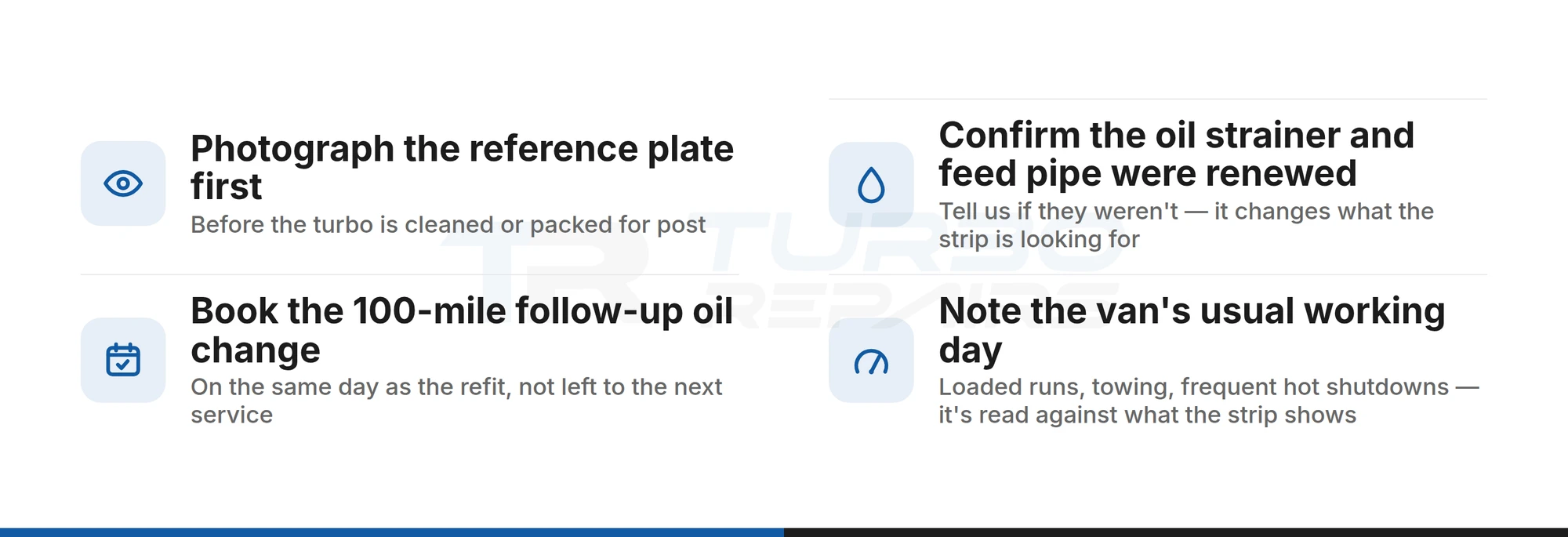
Photograph the label before the unit is cleaned or packed, and put the reference on the Repair Form. If it has burned off or is unreadable, send the turbo anyway: it is identified on the bench before any work starts.
One more check before you go further. A Transit Connect or Transit Courier is a smaller vehicle on the 1.5, 1.6 and 1.8 diesels Ford also fits to its cars, and none of the references above applies to it.
What Kills Transit Turbos: Van Duty Cycles and the Oil Supply
Transits are workhorses, often pushed hard day after day. That is how the trade press introduced the fitting instruction for their turbochargers, and it is the context for everything in it. A van’s working day asks for sustained load, and sustained load means sustained exhaust heat and a bearing that needs its full supply of oil for as long as the work lasts.
Two patterns in that day are worth thinking about on your own van:
- Heavy, sustained work. A loaded van on a long climb, or one towing, runs its turbo hot for long stretches. That is when a partly restricted feed pipe matters most, because the bearing’s demand is highest exactly where the supply is weakest.
- Frequent hot shutdowns. Switching off straight from load, many times a day, leaves heat soaking into a bearing housing whose oil flow has just stopped. Residual oil in a heat-soaked housing can bake onto the surfaces it was meant to protect, and that carbon stays in the engine.
Neither is a fault in itself, and neither belongs to one generation of Transit. They are the conditions the oil supply has to cope with, which is why the instruction for the 2.2, 2.4 and 2.5 engines deals almost entirely with the oil rather than with the turbocharger.
What the Transit fitting instruction asks for
As reported in the UK trade titles Autotechnician and CVW in 2017, best practice when the turbo is replaced on these engines is:
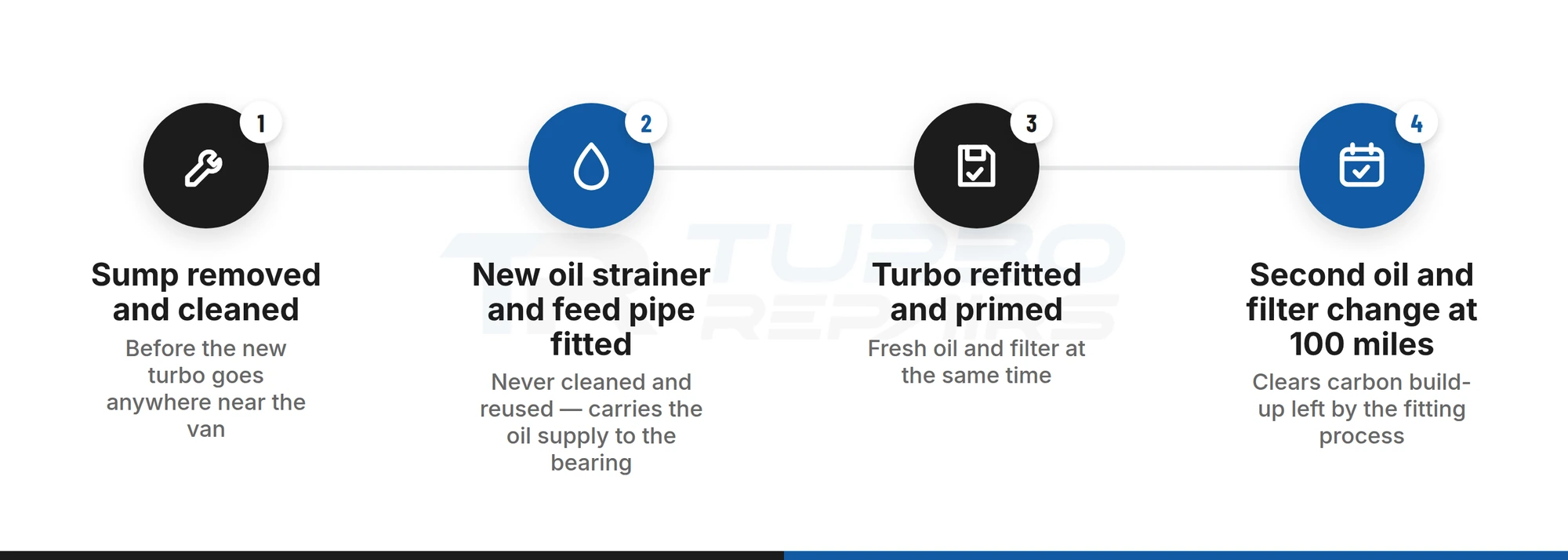
- Remove the sump and clean it.
- Fit a new oil strainer and a new oil feed pipe to the turbo.
- After 100 miles, change the engine oil and filter again, to deal with any carbon build-up in the lubrication system.
The first two steps are about the path the oil takes to the bearing. The third is the one that sets this instruction apart, because it treats the fill put in at the refit as a cleaning fill, taken out early rather than left in for a full service interval.
On a Transit, then, the turbo job does not end when the turbocharger goes back on. It ends a hundred miles later, with a second oil and filter change — so the first hundred miles belong to the repair, not to the van’s normal service schedule. Book that change on the same day you book the refit.
Scope matters here. The instruction names the Transit 2.2, 2.4 and 2.5 diesels without dividing them by generation or body, and none of our sources carries an equivalent Transit instruction for the 2.0 EcoBlue. On an EcoBlue van the general practice still applies: fresh oil and filter at the refit, the feed and return lines inspected or renewed, and the oil feed primed before the first start. Our guide to refitting and priming a turbocharger sets out that sequence step by step.
Rebuild Your Own Turbo or Fit a Replacement?
Whichever route you take, the work on the van is identical: the turbocharger comes off, the oil supply is put right, and a unit goes back on and is primed. The only choice is which unit that is, and it can wait until the old one is off and in your hands.
| Route | What goes back on the van | Identification | What decides it |
|---|---|---|---|
| Rebuild of your own turbo | The unit that came off, rebuilt at component level | Nothing to match: the references are the van’s own | Whether the core survives inspection |
| Reconditioned or exchange unit | A different turbocharger, rebuilt from another core | The reference must match yours, not just the model name | The condition and history of that other core |
| New unit | A new turbocharger built to the original design | The reference must match yours, not just the model name | Price, and whether you want the original design’s weak points reinstalled |
A rebuild is the sensible default wherever the housings, shaft and wheels can be re-used, because the consumables are the parts that wore out and the rest were built to last the life of the turbo. Where a unit has lost a wheel, the shaft and a housing at once, very little of the original is left and a replacement can be the better value. The inspection decides, and we say so plainly when it does.
With as many references as the catalogues carry against each Transit engine, the identification column is not a formality. A replacement ordered on the model name alone may not be the unit your engine was built with. A rebuild never has to answer that question.
Turbo Repairs · Epsom workshop
Have your Transit’s turbo stripped before you buy another
Post the turbocharger in and we will strip it, measure every part against specification and tell you whether it is a consumables rebuild, a rebuild with parts added, or a unit better replaced. You decide once you know what is actually inside it.
Lifetime, unlimited-mileage warranty · Mail-in from the UK and internationally · Bench-tested and calibrated before it ships
What a Ford Transit Turbo Replacement Costs
Our published price guide puts diesel vans and commercial vehicles in a single row, and the Transit and Transit Custom sit in it:
- Rebuild of your own turbocharger: £250 to £450, excluding VAT.
- New turbocharger, typical market price for the unit: £1,500 to £2,000.
- Electronic actuator alone, where that is the only fault: from £100 plus VAT.
Where your rebuild falls in that range is set by what survived inside. A bearings-and-seals job sits near the bottom, and each wheel, shaft or housing that fails inspection moves it up. The full breakdown, with the other vehicle classes beside it, is in our guide to turbo repair and replacement prices.
None of those figures covers removing and refitting the turbocharger, or the oil-system work described above. That labour is charged by whoever does it, and it is the same job on either route. The exact price for your own unit is confirmed once it has been inspected, before the rebuild goes ahead.
Our Ford Transit Turbo Rebuild
Your turbocharger comes to our workshop at Unit 102 Reaver House, 12 East Street, Epsom, Surrey, KT17 1HX, United Kingdom. There it is identified from its own plate and stripped to component level by specialists who rebuild turbochargers and turbo actuators as their core work.
- Measured, not guessed. The shaft, wheels, bearing surfaces, seals and housings are cleaned and measured against original specification.
- Consumables renewed every time. Bearings, seals and thrust components are replaced with genuine OE or OEM-grade parts that meet or exceed the original specification, and a component with a known design weakness is uprated rather than reinstated.
- Damaged parts replaced as sections. A wheel, the shaft and turbine assembly, or a housing that fails inspection is replaced, so the turbo can still be rebuilt rather than written off.
- The vane mechanism freed or renewed. On a variable-geometry unit the ring is cleaned and freed where its parts are sound and renewed where they are worn, so the actuator has a mechanism it can actually move.
- Balanced and bench-tested. The rotating assembly is balanced, the unit is set up, and it is run on the bench before it is boxed.
Bench time is typically one to three working days from arrival, with postage on top in each direction. You get your own turbocharger back rather than an exchange unit, with a lifetime, unlimited-mileage warranty that has no time limit and no mileage cap.
The service is mail-in from anywhere in the UK and internationally, and independent garages, workshops and main dealers send units in the same way owners do. Send the turbo complete, with its actuator or boost-control hardware attached exactly as it came off and every port covered. Packing and postage are covered on our FAQs page.
On the online Repair Form, give us the registration, engine and mileage and any fault codes, plus two things specific to a working van: what its day usually involves, and whether the oil feed pipe was renewed the last time a turbo was fitted. A bearing that wore out on clean oil looks different from one that ran short of it, and those answers are read against what the strip shows.
Ford Transit Turbo FAQ
How much does a Ford Transit turbo replacement cost?
A new turbocharger for a diesel van typically costs £1,500 to £2,000 for the unit alone. Rebuilding your own Transit turbo with us costs £250 to £450 excl. VAT, depending on what has survived inside, and the price is confirmed once the unit has been inspected. Neither figure includes removing and refitting it.
Can a Transit turbo be rebuilt instead of replaced?
Usually. Bearings, seals, thrust parts and the vane mechanism are all serviceable, and a damaged wheel, shaft or housing can be replaced as a section. A core is ruled out only when so much has failed at once that little of the original remains, and that is decided after the strip, not before it.
Which turbo does my Transit Custom have?
It depends on the engine. Catalogues list 786880 references against the Euro 5 2.2 TDCi Transit Custom and 838417 references against the 2.0 EcoBlue, with further variation by output and year. The label on the turbocharger’s housing settles it; if it is unreadable, send the unit and it is identified on the bench.
Is the MK7 Transit turbo the same as the Transit Custom’s?
Not as a rule. The 2006–2014 MK7 2.2 TDCi is listed with 49131-05310, 767933 and 753519 references, while the Euro 5 2.2 TDCi is listed with 786880 references in both the Transit and the Transit Custom. Go by the reference on the unit rather than by the body style.
Do I need a new oil feed pipe when the turbo is refitted?
For the Transit 2.2, 2.4 and 2.5 diesels, the fitting instruction reported to UK workshops says yes: the sump removed and cleaned, a new oil strainer and feed pipe, and the oil and filter changed again after 100 miles. On any engine, a rebuilt turbo fed through a restricted pipe is starved in the same way the first one was.
My garage says the actuator has failed. Do you need the whole turbo?
No. If the vane arm sweeps freely with the actuator unbolted, the actuator can be repaired on its own, from £100 plus VAT, and the turbo stays on the van — see our Ford Transit turbo actuator repair page. If the arm is stiff or seized, the turbocharger needs rebuilding as well.
How long does a rebuild take, and what is the warranty?
Bench time is typically one to three working days from arrival, plus postage each way. Every rebuild carries a lifetime, unlimited-mileage warranty with no time limit.
Final Thoughts
Most of what is published about Transit turbos is a catalogue: units for sale set against a list of engines. The list is real and it is long, but your van only ever needed the one reference printed on its own turbocharger, and a rebuild is the route that never has to look it up.
Whether that turbo then lasts is decided mostly outside it. Tell the turbo from the actuator before anything is ordered, put the oil supply right while the unit is off, and treat the first hundred miles as part of the job rather than the start of normal running. Done in that order, the rebuild is the smallest part of the repair and the least likely to need doing twice.
Turbo Repairs · Epsom workshop
Rebuild the Transit’s turbo, then give it a clean start
Complete the Repair Form with your van’s details and the reference from the plate, and post the turbocharger in complete. We strip, measure, rebuild, balance and bench-test it, and send it back ready to refit on a clean oil supply.
Lifetime, unlimited-mileage warranty · Mail-in from the UK and internationally · Bench-tested and calibrated before it ships