

Summary We rebuild the turbochargers from Peugeot’s petrol and diesel engines: the 1.2 PureTech three-cylinder, the 1.5 and 1.6 BlueHDi, the earlier 1.6 HDi, the 1.6 turbo petrol and the 2.0 diesels in the 3008 and Expert. You or your garage take the turbo off and send it to our Epsom workshop, where it is stripped, measured, rebuilt on genuine OE or OEM-grade parts, balanced and bench-tested, then returned ready to refit. Rebuilds start from £185 + VAT, and every one carries a lifetime, unlimited-mileage warranty.
On a Peugeot, the quickest way to the right turbocharger is the engine code rather than the model name. The table below starts from the first letters of that code, and the sections after it cover the places where the last letters matter too. The 1.6 HDi section sets out why that engine’s turbos fail and what must be fixed first.
On the 1.6 BlueHDi, a DV6FC engine in our fitment data carries a Garrett turbocharger and a DV6FD a Mitsubishi one: the same size of engine under the same badge, with a different company’s turbo bolted to it.
Peugeot names its engines in a code that tells you more than the badge on the tailgate. Find that code and the table below takes you to your turbocharger in one step; on the BlueHDi diesels, the letters at the very end of it decide which company built the turbo.
- Petrol engines covered: the 1.2 PureTech three-cylinder (codes beginning EB2) and the 1.6 turbo petrol (codes beginning EP6)
- Diesel engines covered: the 1.5 BlueHDi (DV5), the 1.6 BlueHDi (DV6F), the earlier 1.6 HDi (DV6) and the 2.0 HDi and BlueHDi (DW10)
- Models in our fitment data: 207, 208, 308, 3008, 5008, RCZ, Partner and Expert
- Turbo makers in our data: Garrett, Mitsubishi (MHI) and BorgWarner, depending on the engine
- What identifies your turbo: the engine code first, then the reference on the turbocharger’s own label
- Prices: your own turbo rebuilt from £185 + VAT; a replacement turbocharger from £450 + VAT
- Bench time: typically one to three working days from the day the unit arrives
- Warranty: lifetime, unlimited mileage, on every repair
Which Peugeot Engine Do You Have?
Peugeot fits a small number of engines across its whole range, and each has a code whose first characters name the family. The code is stamped on the engine and usually appears on service invoices, and a parts supplier can look it up from your registration.
Once you have it, read across. The last column tells you where to go next on this site.
| Engine | Code begins | Peugeot models in our data | Turbochargers in our data | Go to |
|---|---|---|---|---|
| 1.2 PureTech (petrol, three-cylinder) | EB2 | 208, 308, 3008, 5008, Partner | Garrett NGT1341 or MGT1241; one B01G | PureTech section, then the Repair Form |
| 1.6 turbo petrol | EP6 | 208, 308, 3008, RCZ | BorgWarner K03 | BorgWarner K03 and K04, then the Repair Form |
| 1.5 BlueHDi (diesel) | DV5 | 208, 308, 3008, 5008 | Garrett GTD1244VZ or Mitsubishi TD02L11 | BlueHDi section, then the Repair Form |
| 1.6 BlueHDi (diesel) | DV6F | 208, 308, 3008, 5008, Partner, Expert | Garrett GTD1244VZ or Mitsubishi TD02L11 | BlueHDi section, then your model’s listing |
| 1.6 HDi (diesel, earlier) | DV6, with no F after it | 207, 208, 308, 3008, 5008, Partner, Expert | Mitsubishi TD025 or TD02; Garrett GT1544V | 1.6 HDi section, then your model’s listing |
| 2.0 HDi and BlueHDi (diesel) | DW10 | 3008, Expert | Garrett GTB1449 or GT1546S; BorgWarner BV43 or K03 | Vans section or the Repair Form |
Every 1.6 diesel Peugeot we list has its own rebuild listing, where you choose the year and power output and the price follows. The number in brackets is how many turbocharger part numbers that listing carries, a fair guide to how much the label will matter:
- Peugeot 207 1.6 (30)
- Peugeot 208 1.6 (6)
- Peugeot 308 1.6 (24)
- Peugeot 3008 1.6 (9)
- Peugeot 5008 1.6 (9)
- Peugeot Partner 1.6 (22)
- Peugeot Expert 1.6 (14)
Every other engine in the table goes through the Repair Form. Give us the engine code and a photograph of the turbo’s label, and we can confirm the unit before you post anything.
1.2 PureTech: Three Turbo Generations Under One Name
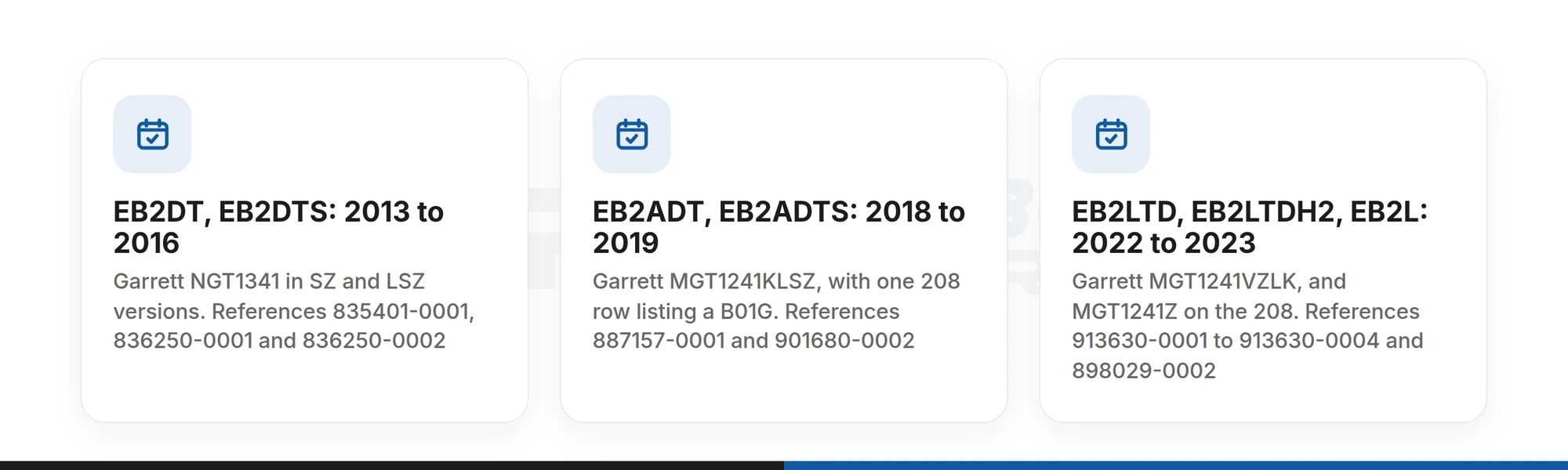
The 1.2 PureTech is a three-cylinder turbo petrol, catalogued in our fitment data for the 208, 308, 3008, 5008 and Partner. Its engine code always begins EB2, and the letters after that mark the generation. That matters because the turbocharger changed with it.
| Engine codes | Years in our data | Turbocharger | References listed |
|---|---|---|---|
| EB2DT, EB2DTS | 2013 to 2016 | Garrett NGT1341, in SZ and LSZ versions | 835401-0001, 836250-0001, 836250-0002; 829754-0001 on one 308 row |
| EB2ADT, EB2ADTS | 2018 to 2019 | Garrett MGT1241KLSZ; one 208 row lists a B01G | 887157-0001, 901680-0002; 1633-970-0041 |
| EB2LTD, EB2LTDH2 (3008, 5008); EB2L (208) | 2022 to 2023 | Garrett MGT1241VZLK; MGT1241Z on the 208 | 913630-0001 to 913630-0004; 898029-0002 |
The years are the catalogue’s, not a promise about your car. Several 2018 rows carry no engine code at all, and the same reference can sit against more than one code, so the label on the unit has the final word.
Peugeot’s newer Turbo 100 badge is another 1,199 cc three-cylinder, going by Peugeot’s own published figures, and our fitment data lists no turbocharger under that name. If your car wears that badge, send us the reference from the label through the Repair Form before you post anything, and we will tell you what we can do with it.
Before a rebuilt turbo goes back on a PureTech
Two of the four recognised causes of turbocharger failure run through the oil: a supply that was interrupted, and oil that was contaminated. Both start outside the turbocharger, which is why our guide to refitting and priming a turbocharger treats the removal as the moment to find the cause.
So before a rebuilt unit goes back on, ask your garage to establish why the old one failed: the condition of the oil, the oil pressure, and the state of the feed and return lines. That diagnosis is engine work and belongs to the garage. What we add is a report of what we found inside the unit, which can help point at where the problem started.
If you are still at the symptom stage, our guide to turbo failure symptoms sorts them by where on the shaft they begin, and lists the cheaper faults that imitate a failing turbo.
1.5 and 1.6 BlueHDi: One Engine Size, Two Turbo Makers
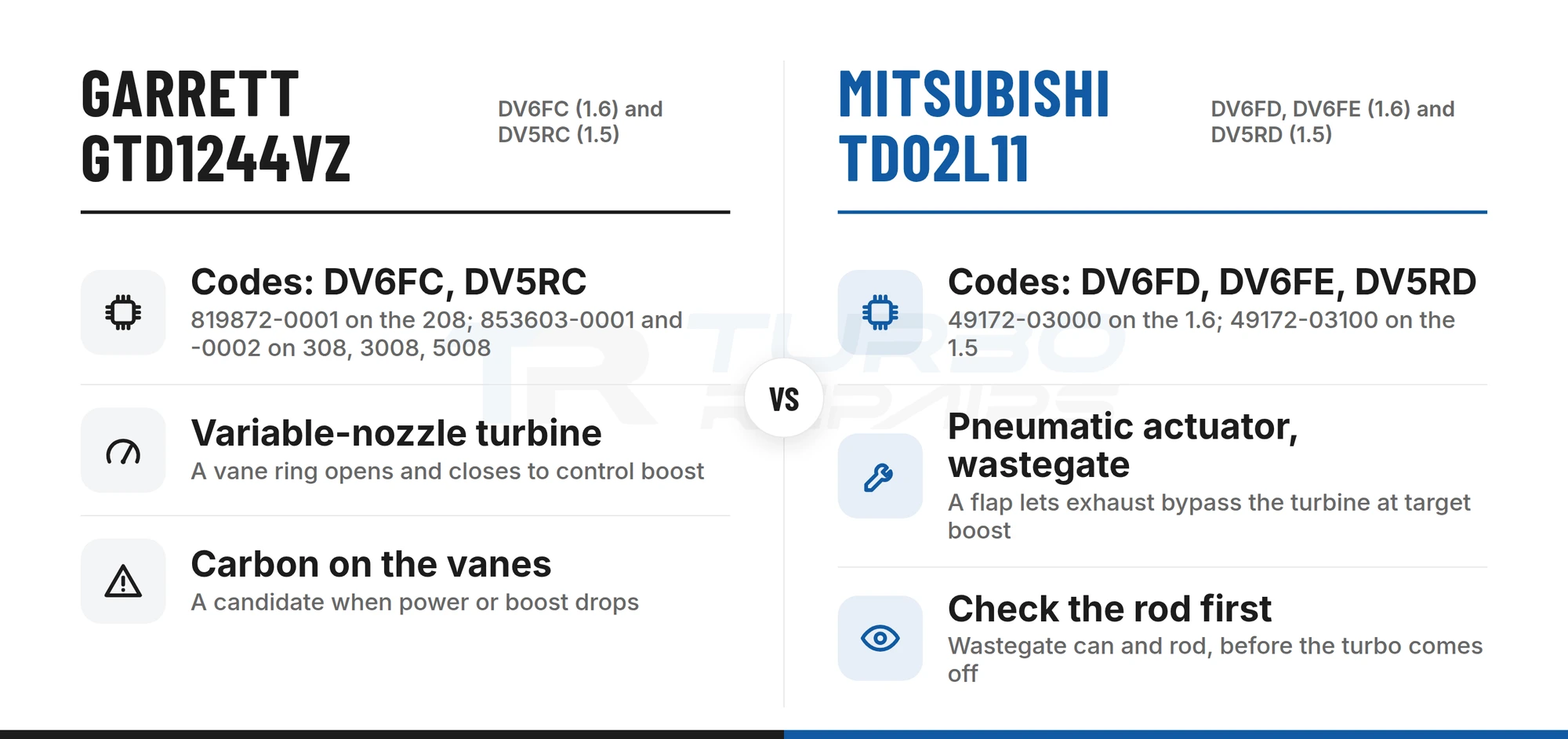
The BlueHDi diesels are where the end of the engine code earns its place. Under one engine size and one badge, our fitment data gives each of these engines two different turbochargers from two different companies, and the suffix is what separates them.
| Engine | Code | Turbocharger | Reference | Models in our data |
|---|---|---|---|---|
| 1.6 BlueHDi | DV6FC | Garrett GTD1244VZ | 819872-0001 | 208 |
| 1.6 BlueHDi | DV6FD, DV6FE (DV6FDU in the Expert) | Mitsubishi TD02L11 | 49172-03000 | 208, 308, Partner, Expert |
| 1.5 BlueHDi | DV5RC | Garrett GTD1244VZ | 853603-0001, 853603-0002 | 308, 3008, 5008 |
| 1.5 BlueHDi | DV5RD | Mitsubishi TD02L11 | 49172-03100 | 208, 308 |
On the 1.6, the suffix also follows the power output: the DV6FC rows sit at the top of the range in our data, with the DV6FD and DV6FE rows below them. On the 1.5, the DV5RD rows carry no power figure at all, so on that engine the code is the only handle the catalogue gives you.
Why the maker changes more than the part number
The two designs hold boost in different ways. The V in Garrett’s GTD1244VZ follows Garrett’s convention for a variable-nozzle turbine: a ring of vanes around the turbine wheel opens and closes to control boost across the rev range. The Mitsubishi TD02L11 is catalogued with a pneumatic actuator and a wastegate instead, a flap that lets exhaust gas bypass the turbine once boost reaches its target, as our Mitsubishi MHI turbo page sets out.
That means the same complaint, whether a loss of power, a boost fault or limp mode, points to different places depending on which unit you have. On the Garrett, carbon on the vanes is a candidate, and our guide to variable-nozzle turbos explains how the vane ring sticks. On the Mitsubishi, the wastegate can and its rod are worth checking before the turbo comes off, and our wastegate actuator page explains why the setting of that rod matters as much as the part.
It changes the replacement question too. In our data a Mitsubishi reference begins 49 and a Garrett one is a six-digit number with a four-digit suffix, so a quote in one maker’s numbering is not a quote for your car if your label is in the other’s. A rebuild removes that match from the job, because the unit we work on is the one that came off your engine.
The 1.6 BlueHDi turbos in the 208, 308, 3008, 5008, Partner and Expert are covered by the model listings linked above. Choose by year and power output, and let the label confirm it. The 1.5 has no model listing, so send its details through the Repair Form.
1.6 HDi (DV6): Why the Turbo Fails and What Must Be Put Right First
If your engine code begins DV6 with no F after it, such as DV6ATED4, DV6TED4, DV6UTED4, DV6C or DV6DTED, you have the earlier 1.6 HDi, the same engine used in Citroën and Ford models, and in our data it carries Mitsubishi TD025 and TD02 units or a Garrett GT1544V. A code with the F in it, DV6FC, DV6FD or DV6FE, is the later 1.6 BlueHDi in the section above; everything below is written for the earlier engine.
On this engine a worn turbocharger is usually the end of an oil problem rather than the start of one, so a rebuild lasts only if that problem is fixed first.
The shaft runs on oil, not metal
The turbo’s shaft never touches its bearings. It floats on a film of oil delivered under pressure, and it spins at more than 100,000 rpm on that film alone.
The film lasts only while oil keeps arriving. Cut the supply briefly, or repeatedly, and it collapses: the bearing wears, the shaft develops play, and the compressor and turbine wheels end up touching their housings.
Where the DV6 starves its own turbo
Oil reaches the turbo through a small-bore feed pipe, with a fine gauze strainer in the feed circuit to keep debris out of the bearing. Carbon, soot and oxidised oil build up on that gauze, the openings close, and the flow drops below what the bearing needs.
No warning light comes on. The oil-pressure switch reads the main oil gallery, not the turbo feed, so the dashboard cannot see the restriction.
How driving and servicing wear the oil down
Three things contribute:
- Short trips. The oil never gets hot enough to drive off the moisture and fuel in it.
- DPF regeneration. The engine adds a late injection of fuel, and some of it gets past the piston rings into the sump, diluting the oil.
- Long service intervals. Degraded oil stays in the engine for longer.
Blue smoke from a blocked drain
Oil drains out of the bearing housing by gravity. If carbon narrows the return pipe, the oil backs up, pressure in the centre housing rises, and oil is forced past the seals as blue smoke. New seals do not cure it while the drain is still restricted.
Why a second turbo meets the same end
Swapping the turbo leaves the feed pipe and its strainer untouched. If a restriction there killed the first unit, it starves the replacement from the very first start, and a warranty that covers only the turbo will not cover that cause.
What the garage must do before the rebuilt turbo goes on
On the 1.6 HDi, every step below is required, not optional.
- New oil feed pipe, strainer included. Do not clean the old gauze: a partly cleared strainer cannot be checked, and it starves the bearing just as a blocked one does.
- New oil return pipe.
- Sump off and cleaned, and a new oil pick-up. The pick-up has its own mesh screen, which blocks the same way and cuts oil pressure to the whole engine.
- Crankcase breather system cleaned and breather filters renewed. A blocked breather raises crankcase pressure and pushes oil past the turbo’s seals.
- Oil filter housing cleaned and a new oil filter fitted.
- Intercooler and boost pipework flushed of debris and oil from the failed unit.
- Oil to the handbook specification, and low-SAPS oil on a car with a DPF.
- Turbo primed with clean oil before the first start, then left to idle without revving so the bearing has its oil film before it takes load.
After the refit, book oil changes more often than before: this engine family benefits from a shorter interval than the one it has been on.
Find your engine: the Peugeot 1.6 diesel listings
Each listing covers that model’s 1.6 diesels. Choose the year and power output there, and the label on your turbo confirms it.
The same 1.6 diesel in a Volvo
On a Volvo, as on a Peugeot, the engine code decides which section of this page applies, not the badge. The Volvo S40 and V50 listings carry DV6 engine codes, so check the code on your car before you read on.
The Volvo listings are the Volvo S40 1.6 diesel turbocharger, the V50 1.6 diesel, the C30 1.6 diesel and the V40 1.6 diesel.
Turbo Repairs · Epsom workshop
Know your engine code? Send the turbo that came off it
Order on your model’s listing, or give us the code and a photograph of the label through the Repair Form. We check the unit against your engine before any work starts, then strip, measure, rebuild and bench-test it.
Lifetime, unlimited-mileage warranty · Mail-in from the UK and internationally · Bench-tested and calibrated before it ships
Peugeot Partner and Expert Vans
The Partner and Expert share their engines with the cars, so the sections above apply to them. What differs is how far back each van’s history runs, and which of its engines our listings cover.
Partner
Our data lists three engine families in the Partner. The 1.2 PureTech petrol appears on 2016 rows with the Garrett NGT1341. The 1.6 HDi appears under more engine codes than in any other Peugeot we list, among them DV6ATED4, DV6BTED4 and DV6UTED4, with Mitsubishi TD025 and TD02 units. The 1.6 BlueHDi DV6FD and DV6FE carry the Mitsubishi 49172-03000.
Our Peugeot Partner 1.6 listing covers the diesels. The petrol Partner is not on it, so send its details through the Repair Form.
So a diesel Peugeot Partner turbo is one of two different designs, and “1.6 HDi turbo” in a listing title does not say which: parts sellers use the phrase for the earlier DV6 units and the BlueHDi’s TD02L11 alike. Go by the engine code and the label. If the code begins DV6 with no F, do the oil-supply work in the 1.6 HDi section first, especially on a van kept on short local runs.
Expert
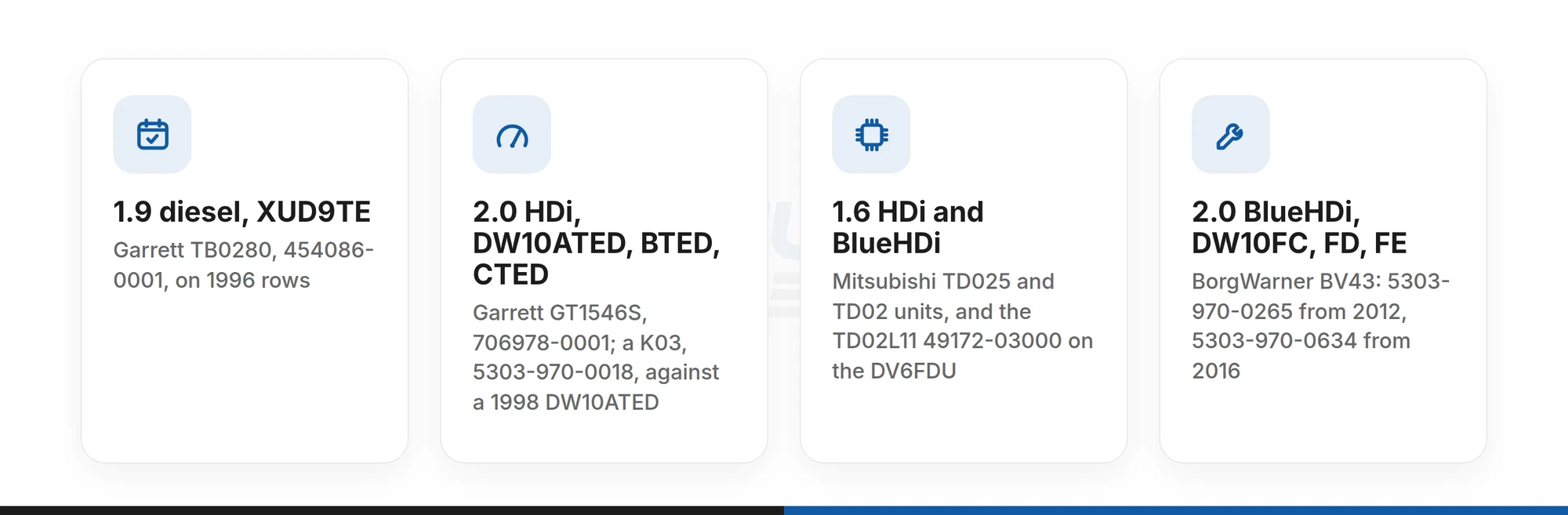
The Expert runs from the 1.9 diesel to the 2.0 BlueHDi in our data, and its turbochargers change with each engine:
- 1.9 diesel (XUD9TE): a Garrett TB0280, 454086-0001, on 1996 rows
- 2.0 HDi (DW10ATED, DW10BTED, DW10CTED): a Garrett GT1546S, 706978-0001, with a K03, 5303-970-0018, listed against a 1998 DW10ATED
- 1.6 HDi and 1.6 BlueHDi: Mitsubishi TD025 and TD02 units, and the TD02L11 49172-03000 on the DV6FDU
- 2.0 BlueHDi (DW10FC, DW10FD, DW10FE): a BorgWarner BV43, 5303-970-0265 from 2012 and 5303-970-0634 from 2016
Our Peugeot Expert 1.6 listing covers the 1.6 diesels. The 1.9 and 2.0 go through the Repair Form with the reference from the label.
A Peugeot Expert turbo can therefore be a Garrett, a Mitsubishi or a BorgWarner unit. On the 1.6, a DV6 code with no F means the earlier HDi and the oil-supply work above; the DV6FDU is a BlueHDi, covered in the BlueHDi section.
Keeping a working van off the road for as little time as possible
For a van that earns its keep, the number that matters is days off the road. Bench time is typically one to three working days from the day the unit arrives; add postage each way and the time taken to remove and refit it. Book the refit for when the rebuilt unit is back in hand, not for the day it leaves, and have the oil and the feed and return lines ready at the same time.
Independent garages use the same service for their customers’ vans. The Boxer uses larger diesels than the Partner and Expert and has its own page: Boxer, Citroën Relay and Fiat Ducato turbo repair.
Our Peugeot Turbo Rebuild, Step by Step
The route is the same for every engine on this page, whichever company built the turbocharger.
- Tell us about the car. On a 1.6 diesel, order on your model’s listing. For anything else, complete the online Repair Form with the registration, the engine code, any fault codes you have read and a photograph of the turbo’s label.
- Send it complete. Leave the actuator, wastegate can and linkage attached. They are part of how the unit holds boost, and they are checked as part of the rebuild.
- Pack it well. Seal every oil and air opening, pack the unit in a rigid box so it cannot move, and put a note inside with your name, the car and the symptom. Our FAQs cover packing and postage.
- Post it to the workshop at Unit 102 Reaver House, 12 East Street, Epsom, Surrey, KT17 1HX, United Kingdom.
- We check, strip and measure. The unit is matched to your engine code and label on arrival, and if they do not agree, we contact you before any work starts. It is then stripped to component level, measured, rebuilt on genuine OE or OEM-grade or uprated components, balanced and bench-tested, typically within one to three working days.
- Refit it with the cause put right. Fresh oil and filter, renewed oil feed and return lines, clean charge pipework, and a primed oil feed before the engine first fires. Our refit and priming guide takes you through it.
Every rebuild carries a lifetime, unlimited-mileage warranty, with no mileage cap and no time limit. For what each route costs and why, see our guide to turbo repair and replacement prices.
Peugeot Turbo FAQ
How much does a Peugeot turbo repair cost?
Rebuilding your own Peugeot turbocharger starts from £185 + VAT, and a replacement turbocharger from us starts from £450 + VAT. Removal and refitting are extra. On the 1.6 diesels, your model’s listing gives the price for your year and power output; for other engines, the price is confirmed once the unit has been stripped and measured.
Is my 1.6 BlueHDi turbo a Garrett or a Mitsubishi?
In our data it depends on the engine code. A DV6FC carries a Garrett GTD1244VZ, and a DV6FD or DV6FE a Mitsubishi TD02L11. The label settles it: a Mitsubishi reference begins 49, a Garrett one is a six-digit number with a four-digit suffix. On the 1.5 the same split runs between the DV5RC (Garrett) and the DV5RD (Mitsubishi).
Can you rebuild a 1.2 PureTech turbo?
Yes. The PureTech’s turbochargers are Garrett units in our data, with one B01G listed on a 2019 208. There is no model listing for them, so complete the Repair Form with the engine code and the reference from the label, and we will confirm before you post it.
Should the engine be checked before a rebuilt turbo goes on?
Yes, on any Peugeot. Interrupted lubrication and contaminated oil are two of the recognised causes of turbo failure, and both start on the engine, so a rebuilt unit fitted to the same oil supply can fail the same way. Your garage diagnoses the engine; we report what we found inside the turbo.
Does the Partner listing cover the petrol Partner?
No. The Partner 1.6 listing covers the diesel vans only. For a 1.2 PureTech Partner, send its details through the Repair Form.
How long will my Peugeot be off the road?
Bench time is typically one to three working days from the day the turbocharger arrives. Add postage each way and the time taken to remove and refit it.
Final Thoughts
A Peugeot turbo search is shorter than the range suggests, because a handful of engine codes stand behind every model on this page. The first letters of your code take you to the right section; on the BlueHDi diesels the last letters decide whether a Garrett or a Mitsubishi is bolted to the engine, which changes what a symptom means and what a replacement has to match.
After that, the order of work matters more than the choice of part. Have the cause found and put right on the engine, then send us the turbocharger that came off it, complete and with its label photographed.
Turbo Repairs · Epsom workshop
PureTech, BlueHDi or HDi, have your Peugeot’s own turbo rebuilt
Order on your model’s listing or complete the Repair Form with your engine code, then post the unit to Epsom with a photograph of its label. It comes back stripped, measured, rebuilt, balanced and bench-tested, ready to refit.
Lifetime, unlimited-mileage warranty · Mail-in from the UK and internationally · Bench-tested and calibrated before it ships