

Summary Our Land Rover turbo pages are divided by diesel engine, and this page sends you to the one for yours. Find your model and engine size in the table below, follow the row to the turbocharger or electronic actuator page written for that engine, and that page covers the faults, the references and the repair. A rebuild of your own turbocharger starts from £185 + VAT, an electronic actuator repair from £100 + VAT, and every repair carries a lifetime, unlimited-mileage warranty.
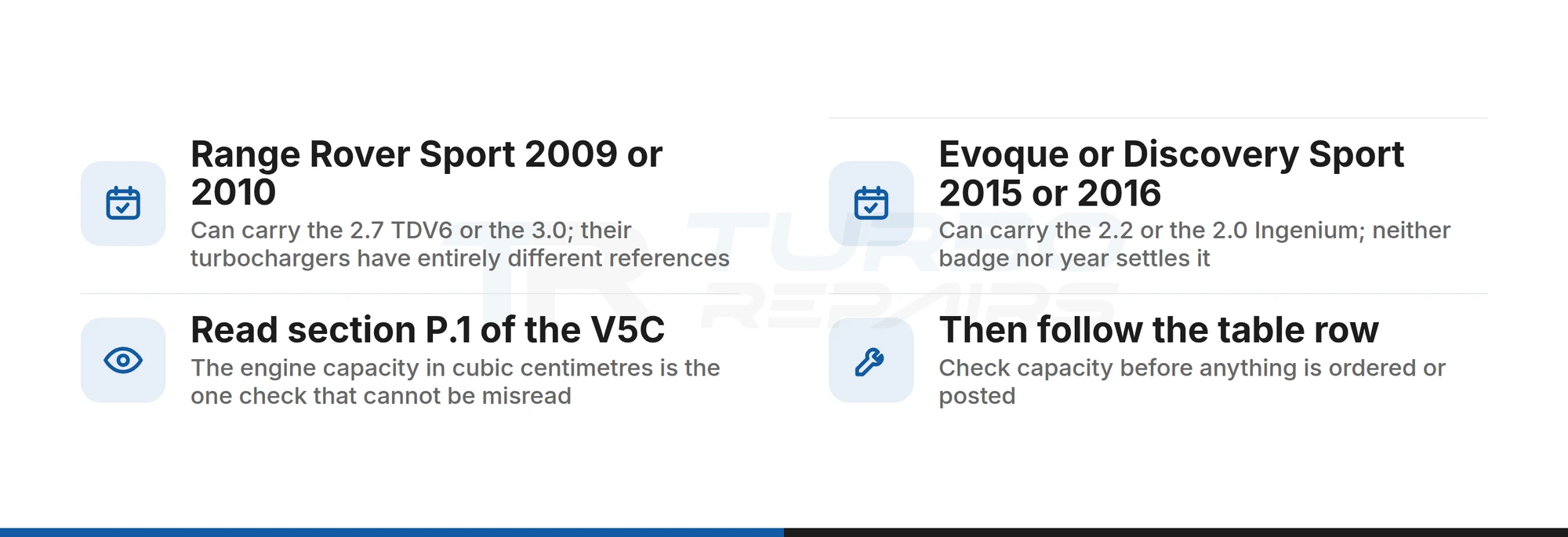
The model years that cause the most confusion are the changeovers. A Range Rover Sport built in 2009 or 2010, or a Discovery Sport or Evoque built in 2015 or 2016, can carry either of two engines. Land Rover changed engine size at both changeovers, so the capacity printed on your V5C settles the page where the badge and the year cannot.
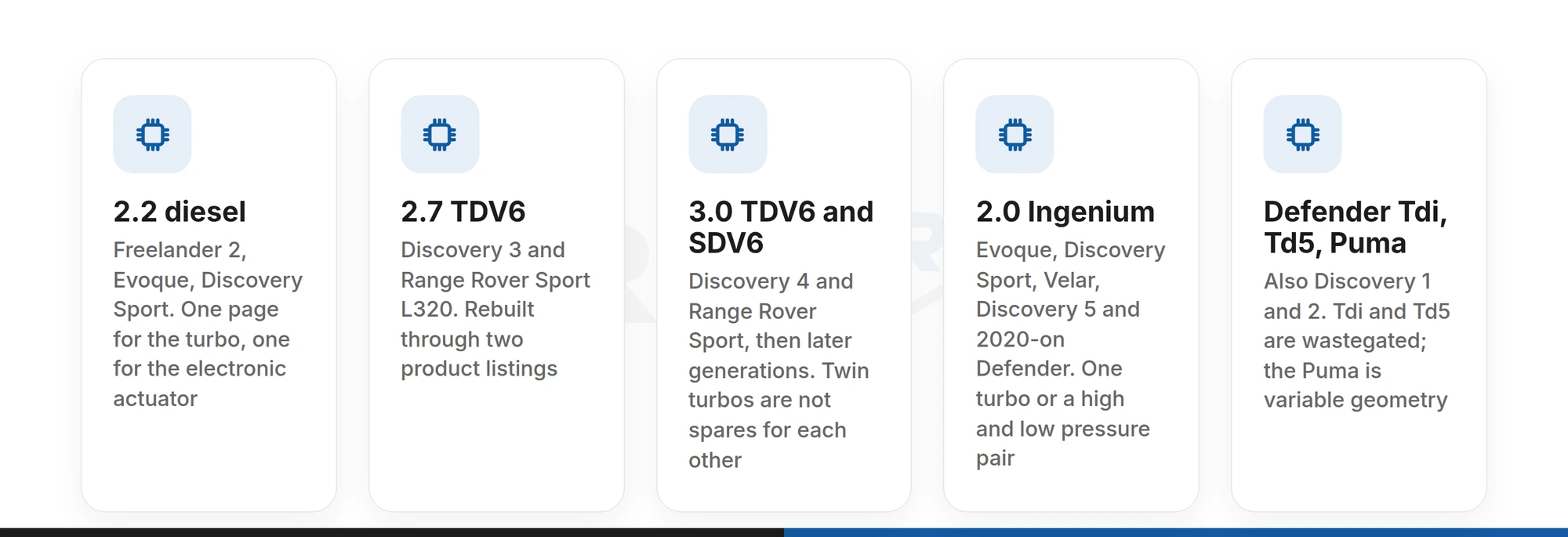
On our Land Rover pages one engine size, the 2.2, leads to two different turbo pages: one for the engine shared by the Freelander 2, Evoque and Discovery Sport, and one for the Defender’s Puma, which takes a different turbocharger.
Land Rover kept its model names in production while the diesels underneath them changed, so our Land Rover pages are divided by engine rather than by model. Two lines from your logbook and the label on the unit are all it takes to reach the right one.
- Turbo pages by engine: the 2.2 diesel (Freelander 2, Evoque, Discovery Sport), the 2.7 TDV6, the 3.0 TDV6 and SDV6, the 2.0 Ingenium, and the Defender’s Tdi, Td5 and Puma engines
- Actuator pages: the Freelander 2 2.2, whose later unit is also listed for the 2.2 Evoque and Discovery Sport, and the TDV6 in the Discovery and Range Rover Sport
- What finds your page: the engine capacity on your V5C, then the model
- What confirms it: the reference on the turbocharger’s or actuator’s label, or the unit itself on our bench
- Prices: your own turbo rebuilt from £185 + VAT; a replacement turbo from £450 + VAT; electronic actuator repairs from £100 + VAT
- Bench time: typically one to three working days for a turbo, one to two for an actuator
- Warranty: lifetime, unlimited mileage, on every repair
Which Land Rover Engine Do You Have?
Three facts take you to the right page, and the first two are on your V5C.
- The engine capacity. Section P.1 gives it in cubic centimetres. It narrows the table below to one or two rows before the model is even considered, and at the two changeovers above it is the one quick check that cannot be misread.
- The model. Where two engines share a size, the model separates them. A 2.2 Defender has Ford’s Puma engine, while a 2.2 Freelander 2, Evoque or Discovery Sport has the engine those three cars share, and the two take different turbochargers.
- The label on the unit. Once the turbocharger or actuator is off, the reference on its housing confirms what it is. Photograph it before anything is cleaned or packed. If it is missing or burnt off, send the unit anyway: we identify it on the bench before any work starts.
| Model | Diesel engine | Years as listed | Turbocharger page | Electronic actuator |
|---|---|---|---|---|
| Freelander 2 (L359) | 2.2, badged TD4 or SD4 | 2006 to 2015 | 2.2 diesel turbo | Freelander 2 actuator |
| Range Rover Evoque, first generation (L538) | 2.2, badged TD4 or SD4 | 2011 to 2015 | 2.2 diesel turbo | Freelander 2 actuator (later unit) |
| Discovery Sport (L550) | 2.2, badged TD4 or SD4 | 2015 to 2016 | 2.2 diesel turbo | Freelander 2 actuator (later unit) |
| Evoque (both generations), Discovery Sport | 2.0 Ingenium | 2015 onwards | Ingenium 2.0 diesel turbo | Repair Form |
| Velar, Discovery 5 | 2.0 Ingenium | 2017 onwards | Ingenium 2.0 diesel turbo | Repair Form |
| Defender (L663) | 2.0 Ingenium | 2020 onwards | Ingenium 2.0 diesel turbo | Repair Form |
| Discovery 3 (L319) | 2.7 TDV6 | 2004 to 2010 | Discovery 3 2.7 TDV6 rebuild | TDV6 actuator |
| Range Rover Sport (L320) | 2.7 TDV6 | 2005 to 2010 | Range Rover Sport 2.7 TDV6 rebuild | TDV6 actuator |
| Discovery 4, Range Rover Sport (L320) | 3.0 TDV6 and SDV6 | 2009 onwards | 3.0 TDV6 turbo | TDV6 actuator |
| Range Rover (L405), Range Rover Sport (L494), Discovery 5 | 3.0 TDV6 and SDV6 | Later generations | 3.0 TDV6 turbo | Repair Form |
| Defender 90, 110 and 130 | 2.5 Diesel Turbo, 200Tdi, 300Tdi, Td5, 2.4 and 2.2 Puma | Built 1983 to 2016 | Defender turbo | On the Defender page |
| Discovery 1 and 2 | 200Tdi, 300Tdi, Td5 | Engines shared with the Defender | Defender turbo | On the Defender page |
The years are those given in the parts listings each page is built from. Where a model appears in two rows with overlapping years, the capacity on the V5C decides the row.
Land Rover diesels without a page of their own
Some Land Rover diesels are not covered by any of the pages above: the 3.6 TDV8 and 4.4 SDV8 V8s in the Range Rover and Range Rover Sport, which run pairs of turbochargers, the BMW-based 3.0 diesel in the earlier Range Rover L322, and the original Freelander’s 2.0. The same applies to petrol Land Rovers. Complete the online Repair Form with the reference from the turbo’s label and your registration, and we can tell you what the unit is and whether it is a candidate for a rebuild before you post anything.
The 2.2 Diesel: Freelander 2, Evoque and Discovery Sport
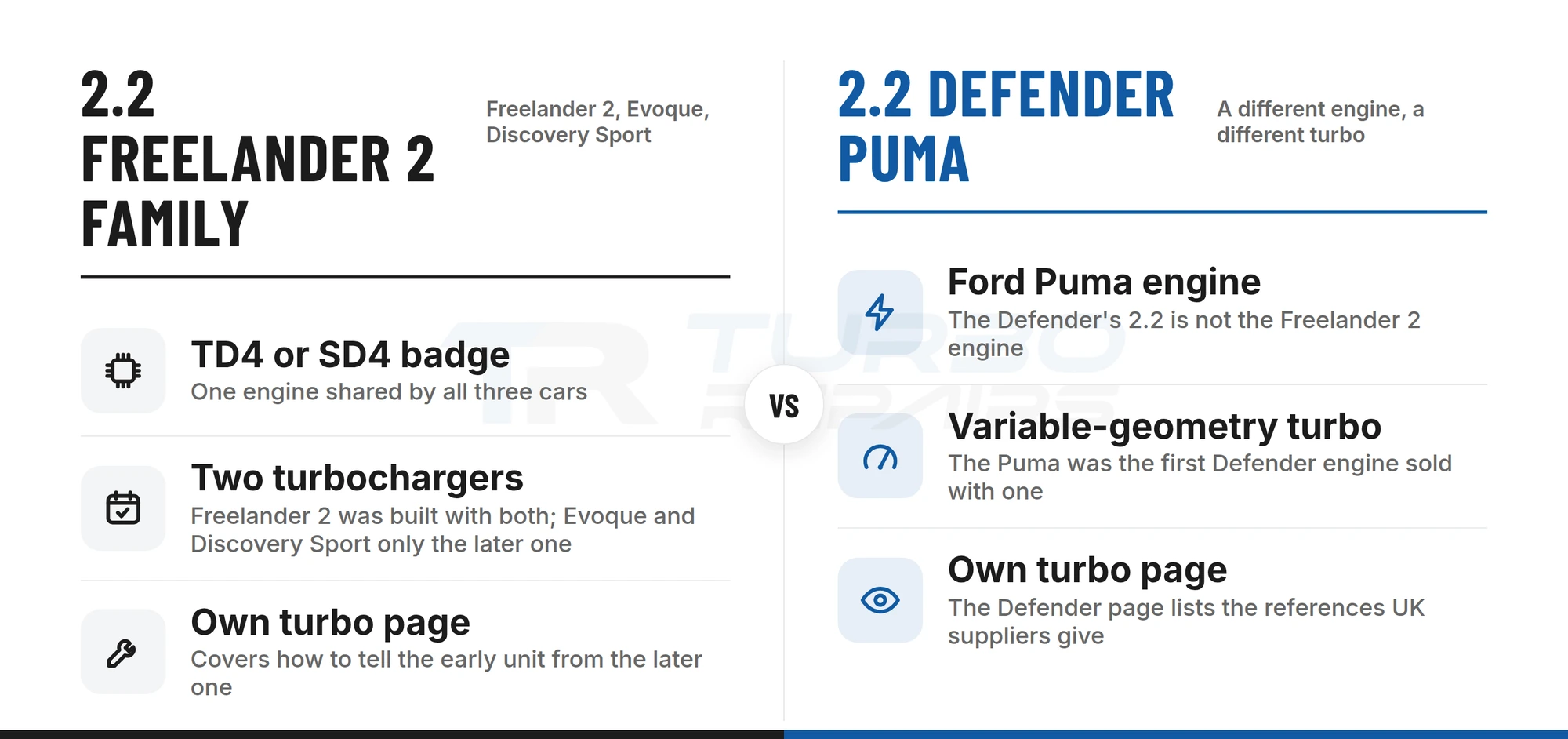
One 2.2 diesel, badged TD4 or SD4, sits in the Freelander 2, the first-generation Range Rover Evoque and the Discovery Sport. The Evoque and Discovery Sport were only ever listed with the later of its two turbochargers. The Freelander 2 was built with both, and the years around 2010 do not separate them cleanly.
Our Freelander 2, Evoque and Discovery Sport turbo repair page covers the turbocharger on all three cars, including how to tell the early unit from the later one. If the fault is in the electronic actuator on the side of the turbo, the Freelander 2 turbo actuator repair page covers both actuator types.
A Discovery Sport or Evoque from 2015 or 2016 may have the 2.0 Ingenium instead, which neither of those pages covers. A 2.2 on the V5C keeps you on them; a 2.0 sends you to the Ingenium section below.
The TDV6 2.7 and 3.0: Discovery and Range Rover Sport
Land Rover sold two TDV6 diesel V6s, and the Discovery and the Range Rover Sport each carried both in turn. Their turbochargers are catalogued under entirely different references, so the capacity comes first here too.
- 2.7 TDV6: listed in the Discovery 3 from 2004 to 2010 and the Range Rover Sport L320 from 2005 to 2010. We rebuild its turbocharger through two listings, one for the Discovery 3 2.7 TDV6 and one for the Range Rover Sport 2.7 TDV6.
- 3.0 TDV6 and SDV6: catalogued for the Discovery 4 and Range Rover Sport from 2009, then for the Range Rover L405 and Range Rover Sport L494. The twin-turbo versions carry two turbochargers that are not spares for each other, and our Range Rover and Discovery 4 3.0 TDV6 turbo repair page explains how they are catalogued and how to tell which one has failed.
The electronic actuators from the Discovery 3, Discovery 4 and Range Rover Sport are covered on our Discovery and Range Rover Sport TDV6 actuator repair page, which also shows how to confirm at the car whether your actuator is electronic at all.
The 2.0 Ingenium Diesel
The 2.0 Ingenium four-cylinder diesel took over from the 2.2 in the Evoque and Discovery Sport from 2015, and runs through most of the later range: the Velar, the Discovery 5 and the 2020-on Defender, as well as several Jaguars. Depending on its output, it carries either one turbocharger or a high-pressure and low-pressure pair.
Our Ingenium 2.0 diesel turbo repair page covers both layouts. Read it before the turbo comes off, because on this engine the checks your garage makes on the engine decide whether a rebuilt turbo is worth fitting.
The Defender: Tdi, Td5 and Puma Engines
The Defender built until 2016 carried several diesels under a body that barely changed: the 2.5 Diesel Turbo, the 200Tdi and 300Tdi, the five-cylinder Td5, and from 2007 Ford’s 2.4 and then 2.2 Puma engines. The Tdi and Td5 turbochargers are wastegated, and the Puma was the first Defender engine sold with a variable-geometry turbo. Our Land Rover Defender turbo repair page tells the engines apart by cylinder count and bonnet shape, and lists the references UK suppliers give for each.
The Discovery 1 and 2 used the Tdi and Td5 engines, so the Defender page is the place to start for those too. It carries one caution worth knowing in advance: a shared engine was not always installed the same way, so the label on your own unit decides. The 2020-on Defender is a different vehicle, and its 2.0 diesel is covered in the Ingenium section above.
Electronic Turbo Actuators on Land Rover Diesels
On a variable-geometry turbocharger, boost is set by a ring of vanes inside the turbine housing, moved by an actuator bolted to the outside. Where that actuator is electronic, with a motor, a gear train and a position sensor in a sealed housing, it is a separate part we rebuild on its own, from £100 + VAT and typically in one to two working days. It goes back on without programming.
- Freelander 2, Evoque and Discovery Sport 2.2: two different electronic actuators, one on early Freelander 2 cars and one on later cars, covered on the Freelander 2 actuator page.
- Discovery 3, Discovery 4 and Range Rover Sport TDV6: covered on the TDV6 actuator page, which explains how to tell an electronic unit from a vacuum-worked can with the engine cold.
- 2.0 Ingenium: actuator wear is reported on this engine, but it has no actuator page of its own. Send the reference from the label through the Repair Form.
- Tdi and Td5: not electronic. These turbos are wastegated, with an actuator can on the side of the unit, and our wastegate actuator repair page explains why the setting of its rod matters as much as the can itself.
- 2.4 and 2.2 Puma: send the turbocharger with its boost-control hardware attached, exactly as it came off, as the Defender page sets out.
Every electronic actuator we rebuild, across every make, is listed on our electronic turbo actuator repairs page.
Turbo Repairs · Epsom workshop
Turbo or actuator? Send only the part that failed
Put your engine capacity and any stored fault codes on the Repair Form, and we can advise which part to send before anything is posted. An electronic actuator is rebuilt on its own; a turbocharger comes in complete, with its actuator still attached.
Lifetime, unlimited-mileage warranty · Mail-in from the UK and internationally · Bench-tested and calibrated before it ships
Turbo or Actuator? Which Page You Need
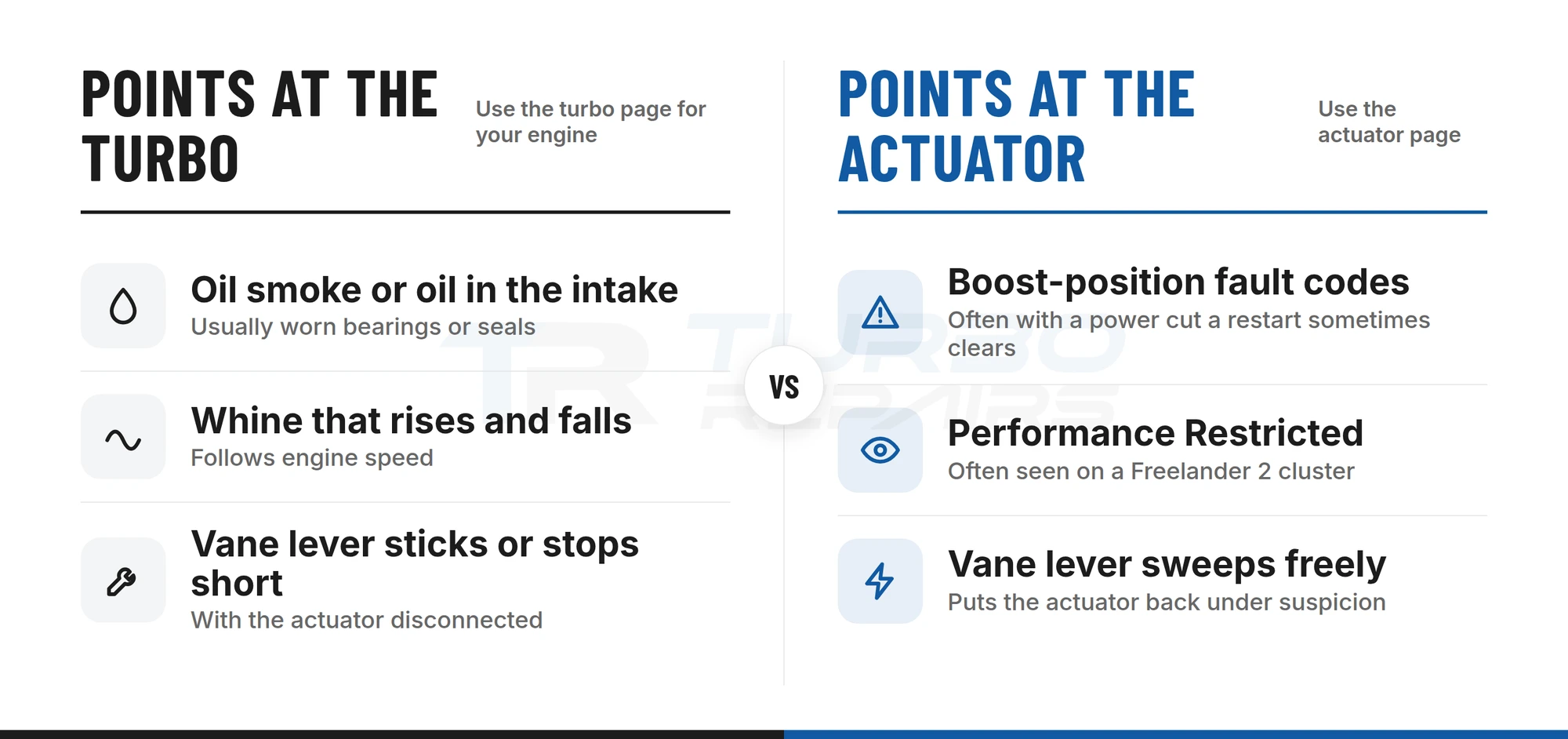
On a variable-geometry Land Rover the two parts share several symptoms, so the turbo often gets blamed for an actuator fault and the other way round. Three observations usually decide which page to read.
- Oil smoke, oil in the intake pipework, or a whine that rises and falls with engine speed points at the turbocharger itself, usually worn bearings or seals. Use the turbo page for your engine.
- Actuator or boost-position fault codes, with a power cut that a restart sometimes clears, point at the actuator. On a Freelander 2 this often appears as “Performance Restricted” in the instrument cluster. Use the actuator page.
- A flat engine with no code stored points at neither until the intake pipework has been checked, because a split hose or a slipped clamp loses boost in exactly the same way.
Where the vane lever can be reached, one hand check separates the two parts. With the actuator disconnected, a lever that sticks, catches or stops short means the fault is inside the turbocharger, and a lever that sweeps freely puts the actuator back under suspicion. The actuator pages explain how to make that check on each engine. For the full symptom maps, see our guides to turbo failure symptoms and turbo actuator symptoms.
Sending your unit in
- Tell us about the vehicle. Complete the online Repair Form with the registration, the engine capacity, any fault codes and a photograph of the unit’s label.
- Send the turbo complete. Leave its actuator or wastegate can attached. If only an electronic actuator is being repaired, the actuator alone comes to us.
- Pack and post it. Seal every oil and air opening, pack the unit in a rigid box, and post it to Unit 102 Reaver House, 12 East Street, Epsom, Surrey, KT17 1HX, United Kingdom. Our FAQs cover packing and postage.
- We identify, strip and report. The unit is matched to your engine, stripped and measured, and we tell you what we found before the rebuild goes ahead.
Independent garages and main dealers send units in the same way owners do.
Land Rover Turbo Repair FAQ
How much does a Land Rover turbo repair cost?
Rebuilding your own turbocharger starts from £185 + VAT, and a replacement turbocharger from us starts from £450 + VAT. An electronic actuator repair starts from £100 + VAT. The rebuild price is confirmed once the unit has been stripped and measured, and on a twin-turbo engine each turbocharger is priced on its own. Removal and refitting are charged by whoever does that work. Our guide to turbo repair prices explains what moves the figure.
Which page do I need for a 2015 or 2016 Discovery Sport or Evoque?
Check the engine capacity on the V5C. A 2.2 belongs on the 2.2 diesel pages; a 2.0 is an Ingenium and belongs on the Ingenium page. The listings for both engines overlap in those years, so neither the badge nor the registration year settles it.
Is every Range Rover Sport TDV6 turbo the same?
No. The first Range Rover Sport was sold with the 2.7 TDV6 and then the 3.0, and turbochargers for the 3.0 are catalogued from 2009 while the 2.7 is listed to 2010. The two engines’ turbochargers carry entirely different references, so a 2009 or 2010 car needs its capacity checked before anything is ordered or posted.
Do I need to send the whole turbo if only the actuator has failed?
Not where the actuator is electronic, as on the Freelander 2, Evoque and Discovery Sport 2.2: the actuator is rebuilt on its own from £100 + VAT, typically in one to two working days. On a Tdi or Td5, the wastegate can stays on the turbo and the two come in together.
I searched for a “Rover turbo”. Is this the right page?
If your vehicle is a Land Rover or a Range Rover, yes, and the table above takes you to its engine. Rover cars are a separate make and are not covered on these pages; send the reference from the turbo’s label through the Repair Form and we can advise.
How long will my Land Rover be off the road?
Bench time is typically one to three working days for a turbocharger and one to two for an electronic actuator, counted from the day the unit arrives. Add postage each way and the time taken to remove and refit it.
Final Thoughts
A Land Rover turbo search covers a long run of diesel engines under a handful of model names that outlived several of them. The capacity on your V5C and the model narrow that to one page, the changeover years included, and the label on the unit confirms it.
The decision after that is turbocharger or actuator, and it is worth settling before anything is unbolted. Oil and noise point at the turbo; stored codes and a fault that clears on a restart point at the actuator. Either way, the page for your engine takes it from there.
Turbo Repairs · Epsom workshop
Have the turbo or actuator off your Land Rover rebuilt
Complete the Repair Form with your registration, engine capacity and the reference from the label, then send the unit in complete. It is identified against your engine, stripped, measured and rebuilt, then bench-tested and returned ready to refit.
Lifetime, unlimited-mileage warranty · Mail-in from the UK and internationally · Bench-tested and calibrated before it ships