

Summary A wastegate actuator is the plain metal can bolted to the turbocharger — a spring and a diaphragm inside, a steel rod to the wastegate arm, a small pressure or vacuum pipe, no wiring and nothing to program. We bench-test the can as it arrives, service the rod, guide, rod end and linkage, deal with corrosion and seizure, assess the wastegate flap where the turbocharger is sent in with it, and set the rod preload to your turbocharger’s own specification so the flap seals shut and opens where it should. If your actuator has an electrical connector it is an electronic module and a different repair.
There is nothing to program on a wastegate can: the repair is mechanical, and the rod preload is set to your own turbocharger’s specification.
- Which type this page covers: the pneumatic can, vacuum- or pressure-operated, on turbochargers of all makes and models. A unit with an electrical connector is an electronic turbo actuator — a different repair.
- What fails: a split or hardened diaphragm, a tired spring, a corroded or bent rod, a worn rod end and missing clip, perished control pipework, and a rusted crimp on a two-piece can.
- What you notice: flat performance and underboost, overboost and limp mode, a rattle at idle or light throttle, hesitation that changes as the engine warms.
- Check this before buying anything: with the engine off and cold, record the rod’s setting, disconnect the rod end and move the wastegate arm by hand. Stiff, notchy or with side-to-side play means a seized flap, and no actuator will fix it.
- The setting almost nobody checks: rod length. A can that passes a bench test still delivers the wrong boost if the preload is set wrong.
- What we do: bench-test the can, service the rod and linkage, then set the preload and travel to your turbocharger’s specification and lock it — returned ready to refit, with nothing to code. Every repair we carry out carries a lifetime, unlimited-mileage warranty. Start with the online Repair Form.
1. Vacuum Can or Electronic Module? Settle This First
The word “actuator” covers two different parts, and only one of them is the subject of this page.
A pneumatic wastegate actuator is a sealed metal can with a steel rod running to an arm on the turbine housing and a small pipe running to the can. No electrical connector. Inside: a rubber diaphragm and a coil spring.
An electronic turbo actuator is a moulded module with a multi-pin plug, containing a motor, gear train, position sensor and circuit board. Those are rebuilt at component level and recalibrated — a different discipline, covered across our electronic turbo actuator repair pages for the Ford Transit, BMW 3 Series and others.
Do not assume from the model: the same car in the same year can carry either type, and the Ford Mondeo 2.0 TDCi is the clearest example on our own site. On a variable-geometry turbocharger the same style of can may move the vane mechanism rather than a wastegate — the same device doing a different job, which our Garrett GT2052V page covers.
2. What a Wastegate Actuator Actually Does
A turbocharger has no natural upper limit: the harder the engine works, the faster the shaft spins and the more boost it makes. The wastegate is the limit — on almost every factory turbo a hinged flap in the turbine housing, on a shaft passing through to an external arm, which opens to let exhaust gas take a short cut past the turbine wheel. Our explainer on what a turbo actuator does covers both families; this page is the vacuum and pressure half.
The actuator opens it. The spring in the can holds the flap shut; apply pressure or vacuum to the diaphragm and it works against that spring, rotating the shaft and lifting the flap. On petrol engines the signal is often boost pressure itself; on most European diesels the can is vacuum-operated through a solenoid the engine management modulates. Either way, a pressure difference against a spring — and very little in it to go wrong, which is why so many are condemned when the fault is elsewhere.
3. What Actually Fails on a Wastegate Actuator
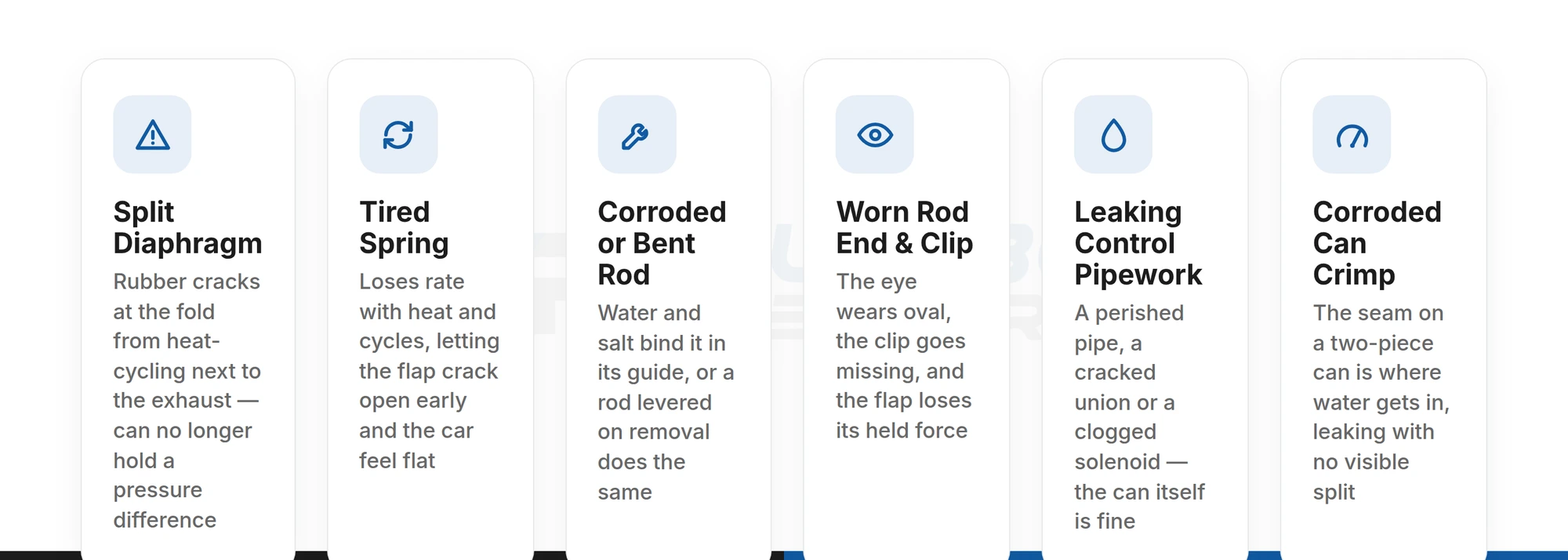
A split or hardened diaphragm. The rubber heat-cycles next to an exhaust housing until it cracks at the fold where it flexes, and can no longer hold a pressure difference. Fail with the wastegate shut and boost climbs past target — the overboost case, and the one that damages engines.
A tired spring. Springs lose rate with heat and cycles, letting the flap crack open early. The car feels flat, an underboost fault is logged, and every part on the turbo looks intact.
A corroded, bent or seized rod. Water and salt collect where the rod enters the can, binding it in its guide so travel is short or sticky. A rod levered on during a previous removal does the same.
A worn rod end and clip. The eye connecting the rod to the arm wears oval and the clip goes missing. The free play rattles at idle or light throttle — one of the most misdiagnosed noises on a turbo diesel — and the flap is no longer held shut with the force it was set to.
Leaks in the control pipework. The pipe perishes, a union cracks, the solenoid clogs. The actuator is fine; it is simply not receiving its signal. Check this before a turbocharger comes off a vehicle.
Corrosion of the can. Where the can is a two-piece crimped assembly, the crimp is the seam water finds, and a rusted crimp leaks with no visible split.
4. The Seized Wastegate Flap — the Fault the Actuator Gets Blamed For
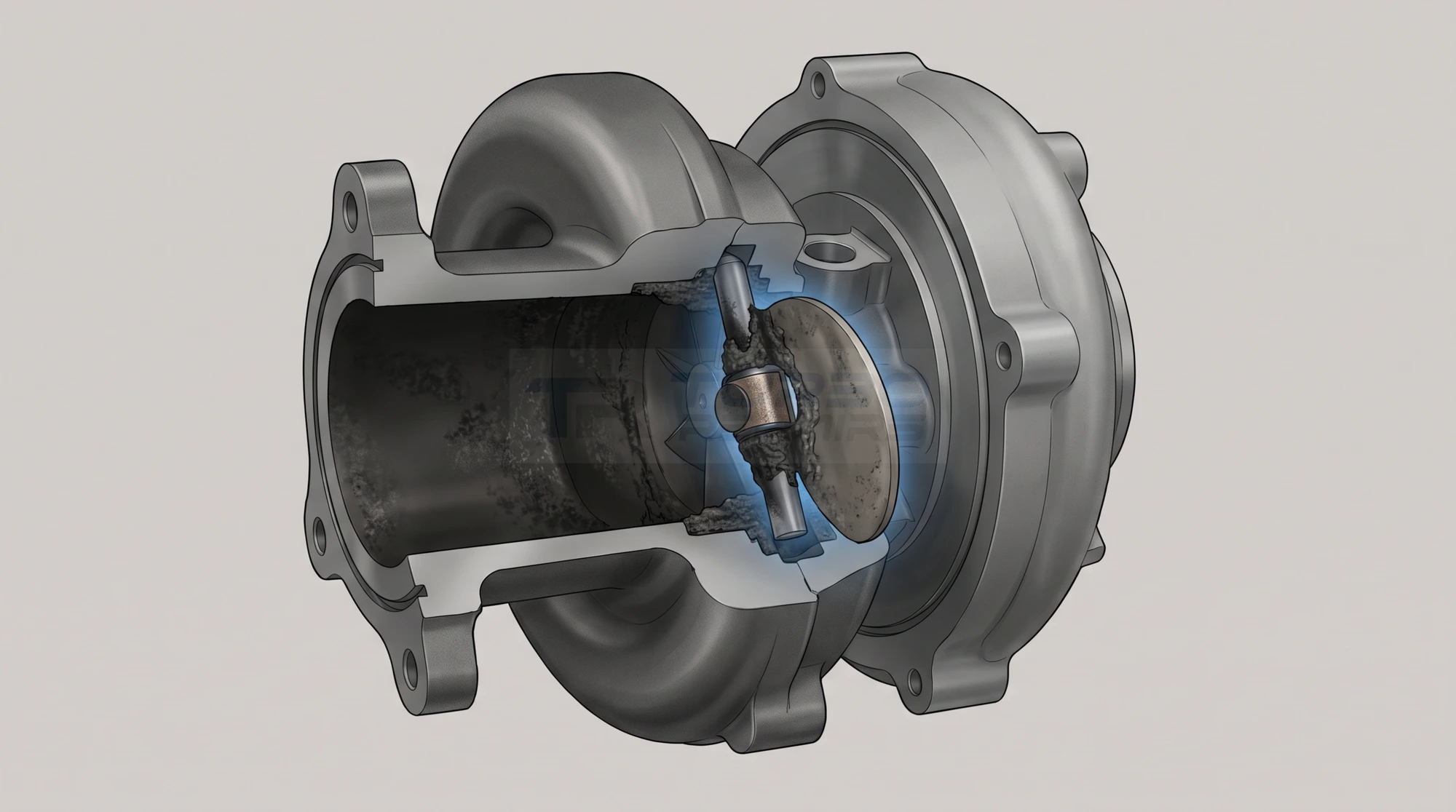
More wastegate actuators are replaced for a seized wastegate than for anything genuinely wrong with the actuator.
The flap sits in the exhaust stream on a shaft running in a bush, inside a component repeatedly heated, cooled and coated in soot. The bush wears oval, carbon packs the clearance, and the shaft binds. From the driver’s seat that is indistinguishable from a failed actuator: boost overshoots and is pulled back, or will not build, with a boost-control code logged.
Check it before you order anything. With the engine off and completely cold, and having first recorded the rod’s setting, disconnect the rod end and move the arm through its travel by hand. It should move freely, stop cleanly at each end and return positively. Stiff, notchy, or with side-to-side play in the shaft, and the fault is in the turbine housing rather than the can.
That decides the whole job. Fitting a new actuator to a binding wastegate loads the new one until it fails too, which is where “I already changed the actuator and it did not fix it” comes from. A worn wastegate shaft and bush is turbocharger work and sits with our turbocharger rebuild service; the BorgWarner K03 and K04 family is the internal-wastegate turbo we see it on most.
5. Preload and Rod Length — Why a Good Actuator Still Gives the Wrong Boost
This is the part of the job nobody explains, and the part that decides whether the repair holds. Preload is how far the spring is compressed when the rod is connected and the flap is shut, and it is set by the effective length of the rod. Wind the rod end on and the rod is shorter: the spring is compressed more, the flap is pulled harder onto its seat, and more pressure is needed before it lifts. Wind it out and the flap is held less firmly and opens sooner.
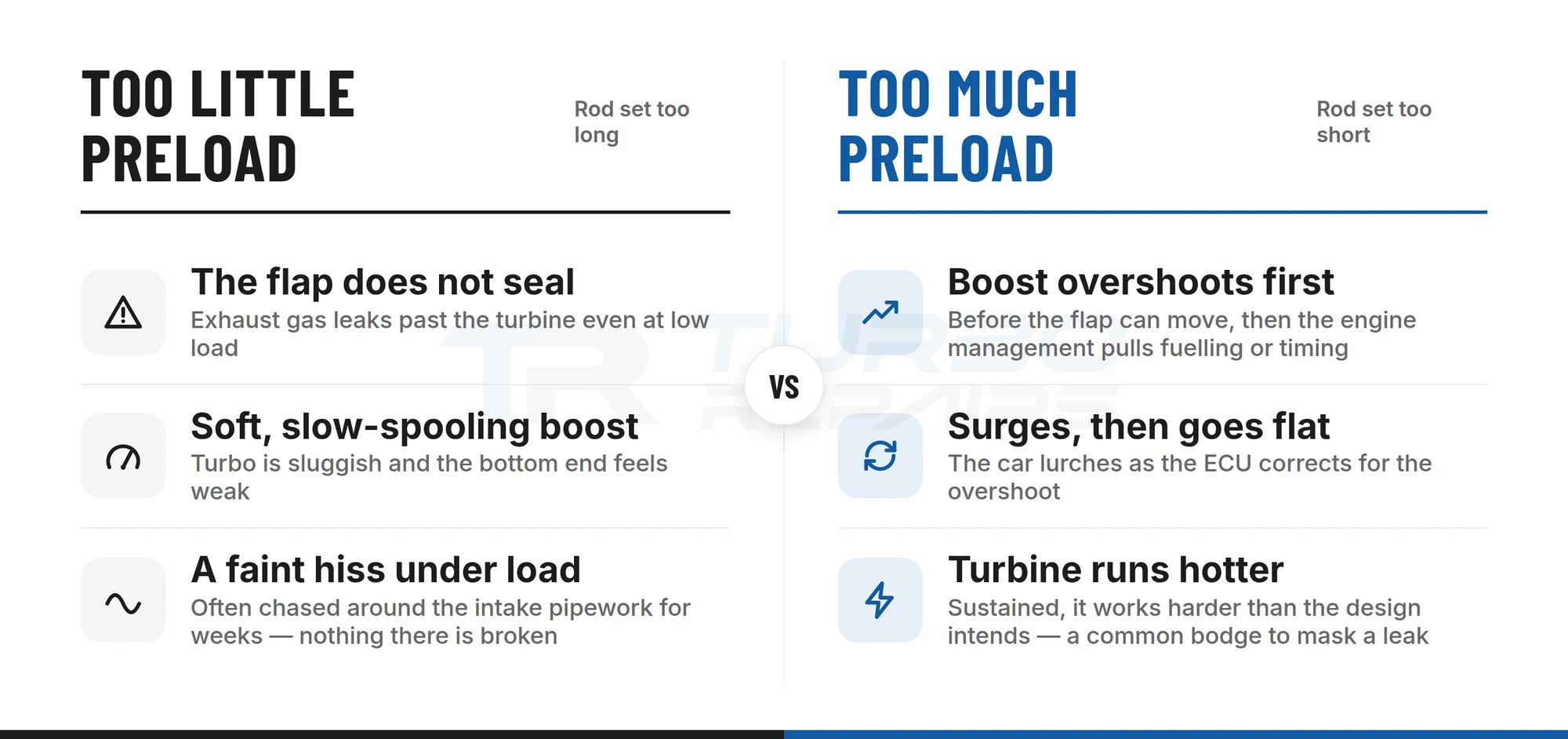
Too little preload and the flap does not seal. A wastegate not held firmly shut leaks exhaust gas past the turbine at low load. The turbo is slow to spool, boost is soft at the bottom end, and there is often a faint hiss under load that gets chased around the intake pipework for weeks. Nothing is broken. The rod is long.
Too much preload and the wastegate opens late. Boost overshoots before the flap moves, the engine management pulls fuelling or timing, and the car surges then goes flat. Sustained, the turbine works harder and runs hotter than the design intends. Winding preload in to “get a bit of boost back” is one of the most damaging things that can be done to a healthy engine, and a common bodge to mask a leak elsewhere.
It is also where straight replacement goes wrong: a correct replacement actuator arrives with the rod at whatever length it was assembled at, not set up for your turbocharger. The manufacturer specifies, for that unit, the pressure or vacuum at which the rod should begin to move and how far it should travel. Setting it means putting the actuator on a bench with a regulated supply and a gauge on the rod, applying the specified signal, and adjusting the rod end until movement begins and ends where it should — then locking it. We publish no figure here because there is no general one, and a number borrowed from a different unit is worse than no adjustment at all.
Not every actuator is adjustable. Plenty of factory cans are crimped or staked at the rod end and are not meant to be reset in service; there, correct part selection is the whole answer. On a fixed-rod unit the honest position is that we can test it and tell you whether it meets specification — we cannot adjust it into specification.
Turbo Repairs · Epsom workshop
Have it tested before you buy the part
A bench test tells you whether the diaphragm, the spring, the rod or the wastegate itself is at fault, so nothing is bought on a guess and no new can gets bolted onto a binding flap. Post the actuator in on its own, or send the turbocharger with it if the turbo is already off the vehicle and we will set the rod against your own wastegate.
Lifetime, unlimited-mileage warranty · Mail-in from the UK and internationally · Bench-tested and calibrated before it ships
6. What Our Service Does — and What It Does Not
We are not going to tell you that a sealed can gets the same component-level rebuild as an electronic module, because on most of them it does not. A can with a spring and a diaphragm is simpler than a module with a motor, a gear train and a circuit board, and being straight about that is worth more than a bigger claim.
What we do:
- Bench-test it as it arrives: apply a regulated pressure or vacuum, confirm the diaphragm holds, and measure where the rod starts to move and how far it travels.
- Assess the rod, guide, rod end and retaining hardware; free, clean or renew what is serviceable; address corrosion and find a leaking crimp.
- Inspect the wastegate arm, shaft and flap where the turbocharger comes in with the actuator.
- Set the preload and rod travel to the specification for your turbocharger, and lock the setting.
What we do not do:
- We do not open a factory-crimped can and claim to have renewed the diaphragm inside it. Where the diaphragm or spring inside a sealed assembly has failed, the correct outcome is a properly specified replacement set up on the bench for your turbocharger — and we will say so rather than carry out a repair that cannot last.
- We do not raise preload to make an engine feel better. If boost is low, the reason gets found first.
- We do not quietly return an actuator to a turbocharger whose wastegate shaft is worn or seized.
The work is done in our own UK workshop in Epsom by turbo specialists who rebuild turbochargers and actuators as their only trade. You post the part in from anywhere in the UK and it comes back tested, set and ready to refit — with nothing electronic inside, there is nothing to code or program. Every repair we carry out carries a lifetime, unlimited-mileage warranty, with no mileage cap and no time limit. Complete the online Repair Form to start.
7. What to Send Us, and What to Tell Us
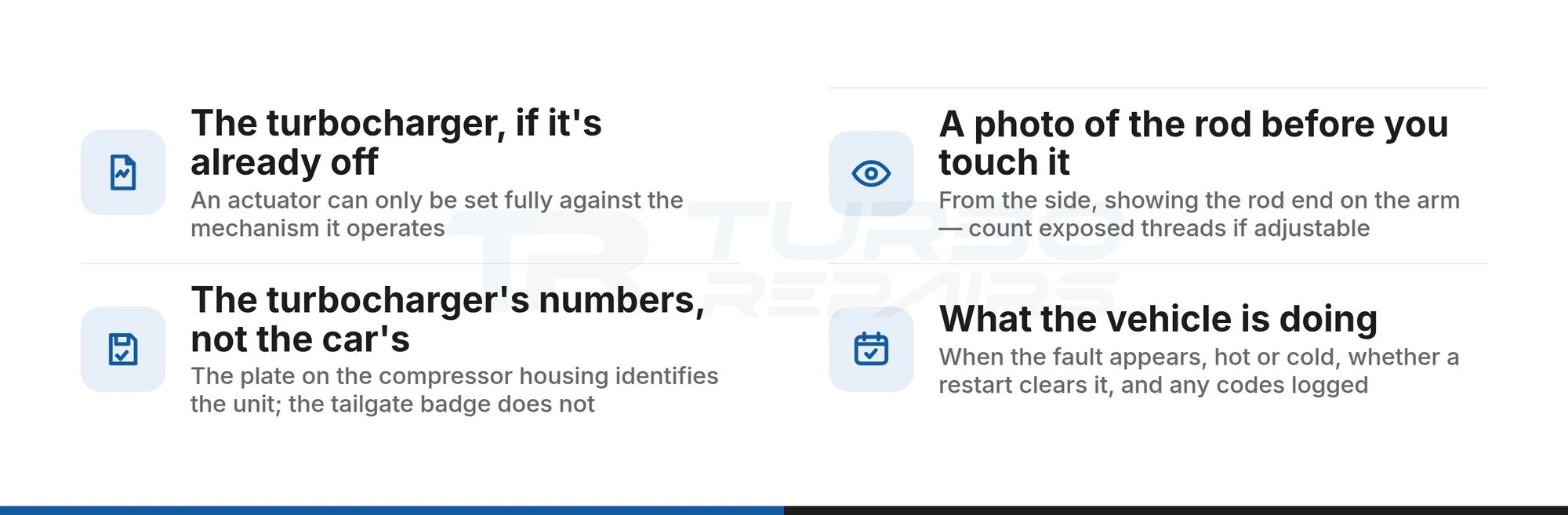
Send the turbocharger with it if the turbo is already off. An actuator can only be set fully against the mechanism it operates, so sending both lets us check the flap and shaft and set the rod against your own wastegate. If the turbo is staying on the vehicle, send the actuator alone.
Photograph the rod before you touch it, from the side, showing the rod end on the arm — and if the end is adjustable, count and record the exposed threads. Thirty seconds preserves the only record of how your engine was running.
Give us the turbocharger’s numbers, not the car’s. The plate on the compressor housing identifies the unit; the badge on the tailgate does not, and neither does engine size alone.
Tell us what the vehicle is doing and what has already been changed — when the fault appears, hot or cold, whether a restart clears it, what the codes are. Our guide to turbo actuator symptoms sets out how to separate an actuator fault from a turbocharger fault. If you are unsure, send us your fault codes and vehicle details and we will tell you what can be established first.
8. Wastegate Actuator Repair FAQ
How do I know whether I have a wastegate actuator or an electronic one?
Look for a connector. A pneumatic wastegate actuator is a plain metal can with a rod and a small pipe and no wiring; an electronic actuator is a moulded module with a multi-pin plug. If you cannot see it clearly, photograph the side of the turbocharger and send it with the turbo’s reference numbers.
Can a wastegate actuator be repaired, or does it have to be replaced?
It depends what has failed. Corrosion, a seized or bent rod, a worn rod end, a damaged clip, a perished pipe and an incorrect setting are all repairable, and account for a large share of what we see. A diaphragm or spring that has failed inside a factory-crimped can is not repairable in a way that lasts, and the right answer there is a correctly specified replacement, set up on the bench.
Can I adjust the rod myself to bring the boost back?
Please do not use it as a fix. Adjusting preload changes when the wastegate opens, so it hides the symptom of a leak, a sticking flap or a failing diaphragm while the real fault carries on. Winding preload in to recover lost boost makes the turbine work harder and run hotter, and on an engine already overboosting that is genuinely dangerous.
What happens if I keep driving with a faulty wastegate actuator?
It depends which way it failed. A wastegate stuck open gives underboost: the car is flat and will usually be derated, which is unpleasant rather than immediately destructive. One that will not open is the serious case, because boost climbs past the level the engine and turbocharger were designed for. If the car is overboosting, surging hard or repeatedly entering limp mode, it should not be driven further than it has to be.
Does a repaired or replacement wastegate actuator need programming?
No. There is nothing electronic inside a pneumatic actuator, so there is nothing to code, adapt or program — it refits mechanically. What matters is that the rod goes back at the length it was set to and the clip or locknut is properly secured.
9. Final Thoughts
The wastegate actuator is the simplest part in the boost control system and the one most often replaced for nothing. A can, a spring, a diaphragm and a rod — cheap to buy, easy to unbolt, and therefore the part that absorbs the blame for seized flaps, perished pipes, sticking solenoids and boost leaks that were never its fault.
Two things separate a repair that holds from one that comes back. First, check before anything is bought that the wastegate arm moves freely by hand, because if it does not, no actuator will fix the car. Second, the rod: a correct part fitted at the wrong length is still the wrong boost, and that setting is the difference between an engine that pulls as it should and one that surges, hisses, or quietly cooks its own turbine.
When you are ready, complete the online Repair Form, or look through the rest of our turbo actuator repair work. Our FAQs cover the practical side of sending a unit in.
Turbo Repairs · Epsom workshop
The rod comes back at the length it should be
We test the can, free or renew the rod, guide, rod end and retaining hardware, then set the preload and travel to the specification for your turbocharger and lock the setting. It refits mechanically — with nothing electronic inside, there is nothing to code, adapt or program.
Lifetime, unlimited-mileage warranty · Mail-in from the UK and internationally · Bench-tested and calibrated before it ships