

Summary We rebuild the turbocharger from the Nissan Qashqai 1.5 dCi, the K9K diesel fitted to the first and second-generation cars. You or your garage take the turbo off and post it to us; it is stripped to component level, measured, rebuilt on genuine OE or OEM-grade parts, balanced and bench-tested, then posted back ready to refit. Rebuilds start from £185, bench time is typically one to three working days, and every rebuild carries a lifetime, unlimited-mileage warranty.
Across its life the diesel Qashqai was catalogued with three different turbocharger families. That matters the moment anything is priced: a replacement has to match the family and reference on your own unit, while a rebuild starts from the unit itself.
From 2011 the trade catalogue lists both a BV39 and a BV38 against the 1.5 dCi Qashqai, so the car’s year alone cannot tell you which turbo is fitted.
This page is for owners and garages dealing with a failed or failing turbocharger on a diesel Qashqai with the 1.5 dCi engine. It sets out which turbo the car was built with, what wears out inside it, how to read the symptoms, and what a rebuild or a replacement costs.
- Covered here: the Nissan Qashqai 1.5 dCi (K9K engine family), first and second generation
- Not covered here: the 1.6 dCi (R9M), the 1.7 and 2.0 dCi, and the DIG-T petrols, which all carry different turbochargers
- Turbo families catalogued: BV39, BV38 and B01V, depending on engine version and year
- Price: rebuilds from £185; replacement units from £450; your price is confirmed once the unit has been inspected
- Order by year and power: our Qashqai 1.5 diesel turbo rebuild listing
- Turnaround: typically one to three working days on the bench, plus postage each way
- Warranty: lifetime and unlimited mileage, with no time limit
- How it works: you remove the turbo, post it to us, and we post it back; start with the online Repair Form
Which Qashqai Is This Page For? 1.5 dCi Only
Search for a Qashqai turbo and you will find units for most of the engines the car has carried. Listings under that one model name run from the 1.2 and 1.3 DIG-T petrols to the 1.6 DIG-T, and from the 1.5 dCi through the 1.6 and 1.7 diesels to the 2.0 dCi. Each of those engines has its own turbochargers.
This page covers one of them: the 1.5 dCi, a 1461 cc four-cylinder diesel that the parts trade catalogues under Renault’s K9K engine family. It was offered in both the first and the second-generation Qashqai, and this page covers the 1.5 dCi in either.
If your Qashqai is a 1.6 dCi (catalogued as R9M), a 1.7 or 2.0 dCi, or any of the petrols, its turbocharger is a different unit from the ones below. It comes to us through the same mail-in service, but nothing on this page describes it, and none of the references here should be used to order a part for it.
The Turbochargers Fitted to the 1.5 dCi, by Engine Variant
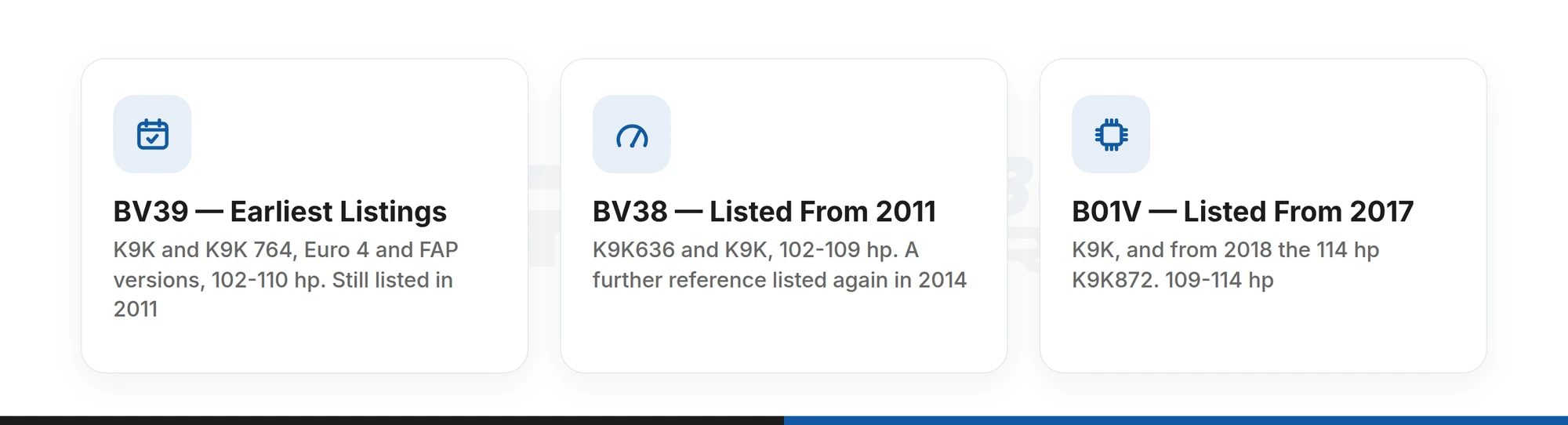
Trade catalogue data lists every 1.5 dCi Qashqai application with a turbocharger from one of three families: BV39, BV38 or B01V. Within each family the reference changes again with power output, emissions equipment and year. The full list, reference by reference, is under Affected Part Numbers on our Nissan Qashqai 1.5 diesel turbocharger listing. What this page adds is when each family appears in the catalogue:
| Turbo family | Engine versions catalogued | Power | When it is listed |
|---|---|---|---|
| BV39 | K9K, K9K 764, Euro 4 and particulate-filter (listed as FAP) versions | 102–110 hp | The earliest listings, and still listed in 2011 |
| BV38 | K9K636 and K9K | 102–109 hp | Listed from 2011, with a further reference listed in 2014 |
| B01V | K9K and, from 2018, the 114 hp K9K872 | 109–114 hp | Listed from 2017 |
Notice what the catalogue does not do. It splits these units by year and engine version, and nowhere by the car’s generation, so the generation a seller quotes is not a reliable guide to the turbo. The family changed across the engine’s own versions and years, and that is the axis a match has to follow.
That has two practical consequences:
- A car from 2011 onwards has both BV39 and BV38 references catalogued against that year, so the year alone does not settle which one is fitted.
- A later car can carry either a BV38 or a B01V, depending on its year and which version of the engine it has: the BV38 is listed again in 2014, the B01V from 2017.
The unit itself settles it. The label on the turbo housing carries the manufacturer’s reference in a form such as 5439-970-0070 or 1635-970-0057, and catalogues cross-reference each one to vehicle-maker numbers — the 8200-series on the earlier units and the 1441-series on the later ones. Photograph the label before the turbo is cleaned or packed. If it has burned off or is unreadable, send the unit anyway: it is identified on the bench before any work starts.
The same engine family, and the same turbo families, are fitted far beyond the Qashqai.
The Renault and Dacia cars have their own page: Renault and Dacia 1.5 dCi turbo rebuilds. The examples below come from published listings for references in each family:
| Turbo family | Other vehicles listed against references in the family (examples) |
|---|---|
| BV39 | Nissan Juke, Note, NV200; Renault Clio, Megane, Scenic, Laguna, Modus |
| BV38 | Nissan Juke, Note, NV200; Renault Megane, Scenic, Kangoo; Dacia Duster; Mercedes-Benz A-Class, B-Class, Citan |
| B01V | Renault Captur, Clio, Kangoo, Kadjar, Megane; Dacia Duster, Sandero; Mercedes-Benz A-Class, B-Class, Citan |
That is why so many listings for a Qashqai turbo also name a Clio or an A-Class. It is a sign of how widely the engine was used, and it changes nothing about which unit is on your car.
What Fails on a Qashqai 1.5 dCi Turbo
A turbocharger is a turbine wheel and a compressor wheel on a single shaft. Exhaust gas spins the turbine, the shaft carries that turn to the compressor, and the compressor pushes air into the engine. The shaft runs in a centre bearing housing on a film of pressurised engine oil, with a seal at each end. Boost-control hardware on the unit, worked by an actuator, regulates how hard the exhaust drives the turbine, and so how much boost the turbo makes across the rev range.
Nissan’s own UK owner’s manual for the Qashqai puts the turbo’s dependence plainly. Engine oil lubricates and cools the rotating parts, the turbine turns at extremely high speed and reaches extremely high temperature, and a sudden interruption to the oil supply may cause the turbocharger to malfunction. The edition quoted is the 2024 manual, but the mechanics it describes apply to every turbo in this family.
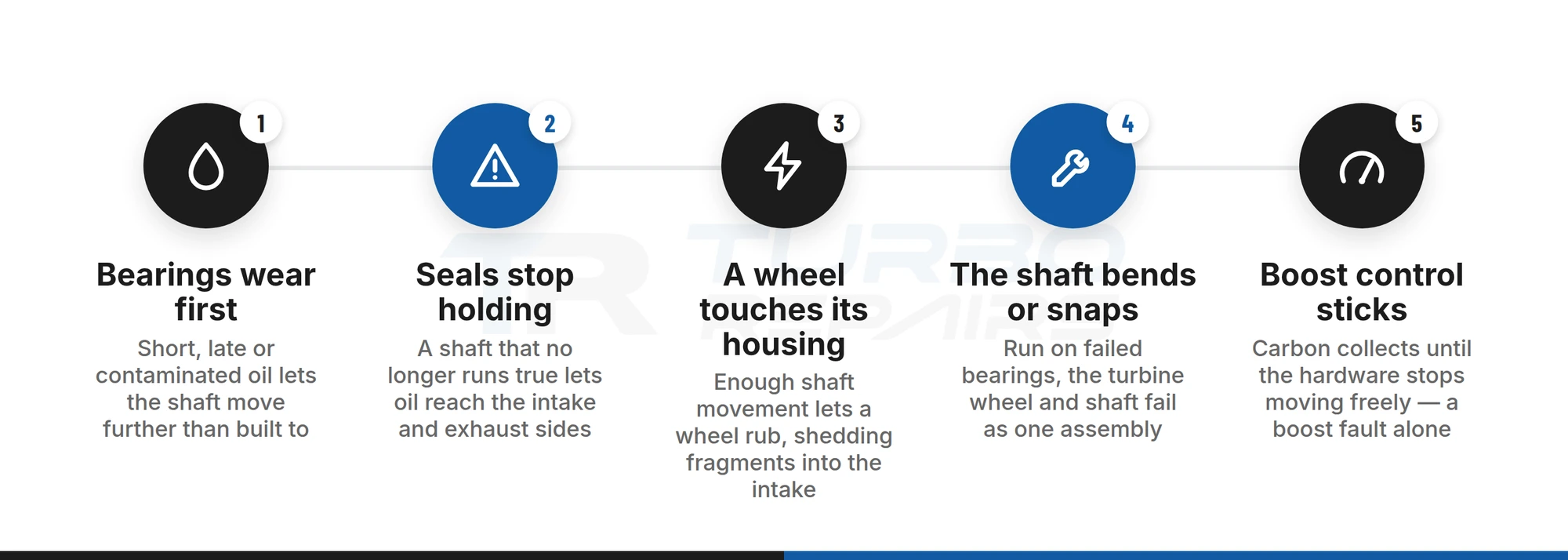
When a 1.5 dCi turbo fails, the damage usually builds in a recognisable order:
- Bearings. The first parts to wear, and the first to suffer when the oil is short, late for a change or contaminated. Worn bearings let the shaft move further than it was built to.
- Seals. A shaft that no longer runs true stops the seals holding oil inside the bearing housing, so oil reaches the intake on one side and the exhaust on the other.
- Wheels. With enough movement, a wheel touches its housing. A compressor wheel that has rubbed can shed fragments into the intake.
- Shaft. Left running on failed bearings, the shaft can bend or snap. The turbine wheel and shaft are one assembly, so damage to either replaces both.
- Boost control. Carbon collects on the boost-control hardware until it stops moving freely. That shows up as a boost fault, even though nothing in the rotating assembly has worn.
The handbook also sets out three habits that protect the oil film: change the oil as the service schedule prescribes, using only the recommended grade; let the engine idle for a few minutes before switching off after it has run at high revs for a long spell; and do not rev the engine hard straight after starting it. Each one covers a moment when the bearing is least well served — before oil pressure has built, or as a hot housing loses its flow.
What decides the size of the repair is mostly how long the turbo ran after the first symptom. Taken off when a whine first appears, a 1.5 dCi unit is usually a bearings-and-seals job. Driven on until it is blowing oil, it may need a wheel, the shaft or a housing as well.
Symptoms, and What Each One Narrows Down
No single symptom proves the turbo has failed, and several cheaper faults imitate one convincingly. Treat each of these as a pointer to where to look next:
- Lost power, often with the engine management light and a reduced-power mode. This narrows the fault to boost, not to the turbo. A split intercooler hose, a loose clip, a sensor or sticking boost-control hardware can all produce it, and the pipework is the cheapest thing to check first.
- A whistle that rises to a siren with engine speed. A boost leak tends to hiss under load; a worn rotating assembly tends to whine. A metallic note that follows the revs points inside the turbo.
- Blue or grey smoke, and oil use between services. Oil is crossing the turbo’s seals — or the engine is burning oil through its own wear, which a rebuilt turbo will not cure. Both are worth ruling in or out before anything is ordered.
- Oil pooled in the intake pipework after the turbo. A strong pointer to worn bearings and seals on the compressor side.
- Movement you can feel at the compressor nut, or marks where a wheel has touched its housing. Visible with the intake pipe off, and a sign the turbo has to come off.
- A stored underboost or overboost code. Useful, but it records a pressure disagreement rather than naming a part; our guide to turbo overboost and underboost explains what those codes can and cannot tell you.
Our guide to turbo failure symptoms sorts each symptom by where in the unit it starts, and lists the imitators worth ruling out before a turbo comes off. If you hear a metallic whine or see oil smoke, stop working the car hard: a bearing failure that is driven on becomes a wheel, shaft or housing failure.
Rebuild Your Own Turbo or Fit a Replacement?
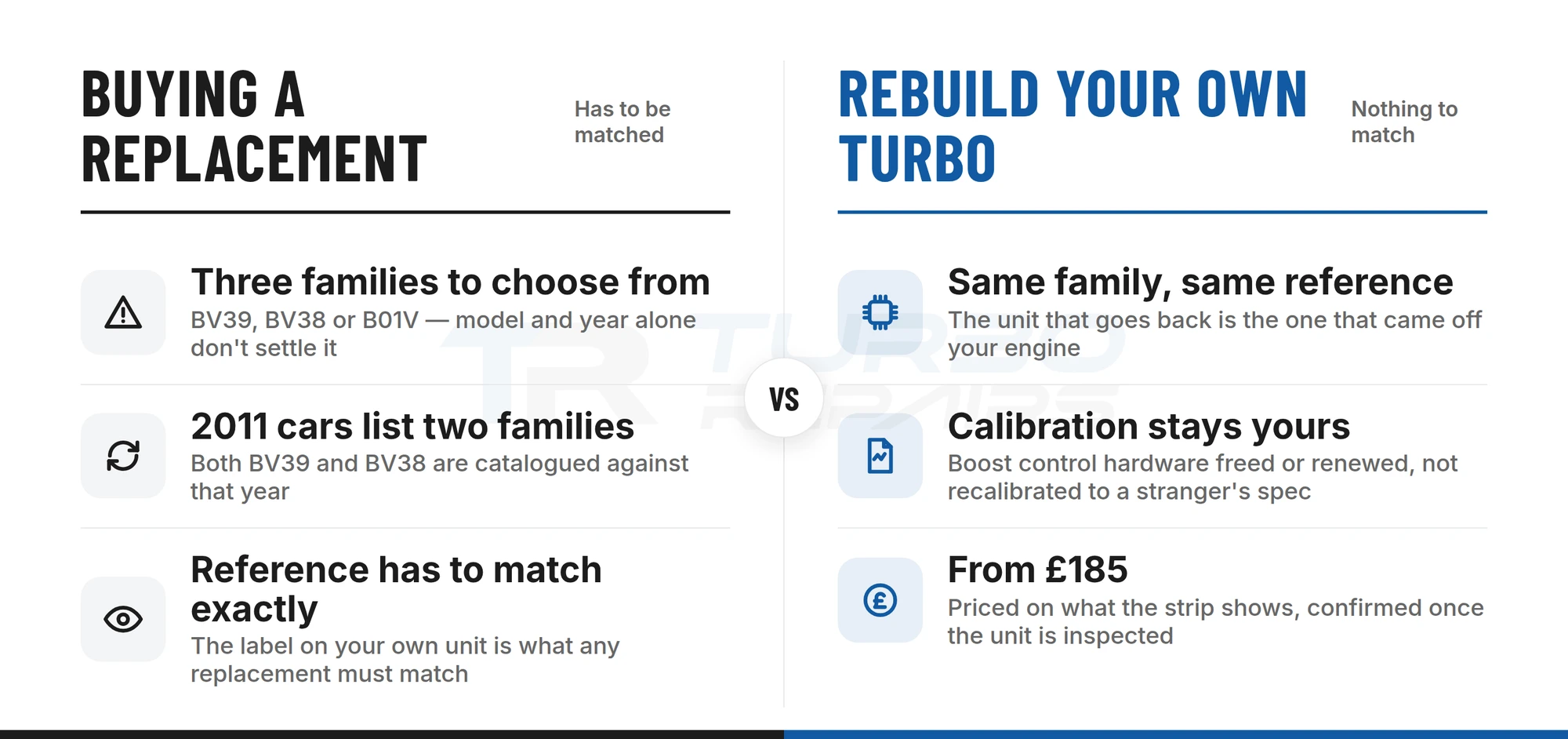
The work on the car is the same either way. The turbo comes off, a unit goes back on, and the oil feed is primed before the first start. The only choice is which unit goes back, and it can wait until the old one is off and in your hands.
A replacement has to be matched. Ordered as a “Qashqai 1.5 dCi turbo”, or even with a year attached, it could be any of several references across more than one family. The family table above is the reason the model name is not enough: the reference on your own unit is what a replacement must match.
A rebuild has nothing to match. The turbo that goes back is the one that came off, so the family, the reference and the calibration are already your car’s own. That is the sensible default wherever the housings, shaft and wheels survive inspection, because the parts that wore out are consumables and the rest were built to last the life of the turbo.
Replacement is the better value when too much has gone at once — a wheel, the shaft and a housing on top of the consumables leaves very little of the original. The inspection decides that, and when a unit is not worth rebuilding we say so and recommend replacement instead.
Turbo Repairs · Epsom workshop
Find out what your Qashqai’s turbo actually needs
Post the turbocharger to us and it is stripped, measured part by part and priced on what it needs, not on an average for the model. If a rebuild is the right route, the unit that comes back is your own, with its reference and calibration unchanged.
Lifetime, unlimited-mileage warranty · Mail-in from the UK and internationally · Bench-tested and calibrated before it ships
What a Qashqai Turbo Replacement Costs
Our published prices start from three floors:
- Rebuild of your own turbocharger: from £185.
- Replacement turbocharger from us, reconditioned or new exchange: from £450.
- Labour to remove and refit: not included in either, and charged by whoever does the work.
Our price guide sets rebuilds by vehicle class, and the nearest row to a Qashqai 1.5 dCi is mid-size cars, at £185 to £350 excluding VAT. Where a rebuild falls in that range depends on what survived inside. A bearings-and-seals job sits near the bottom; each wheel, shaft or housing that fails inspection moves it up. The full breakdown, with every vehicle class beside it, is in our guide to turbo repair and replacement prices.
If you already know your car’s year and power output, the Qashqai 1.5 diesel turbo rebuild listing lets you order the rebuild directly, with the price set for your car and the unit still identified on the bench before any work starts.
Because the 1.5 dCi turbo is a small unit fitted to a great many cars, new and remanufactured replacements for it are widely listed and competitively priced. So on this car the choice is rarely settled by price alone. It turns on whether the unit you buy matches the one on your engine, and on whether you would rather refit a turbo that has been measured than one that has been described.
Our Nissan Qashqai Turbo Rebuild
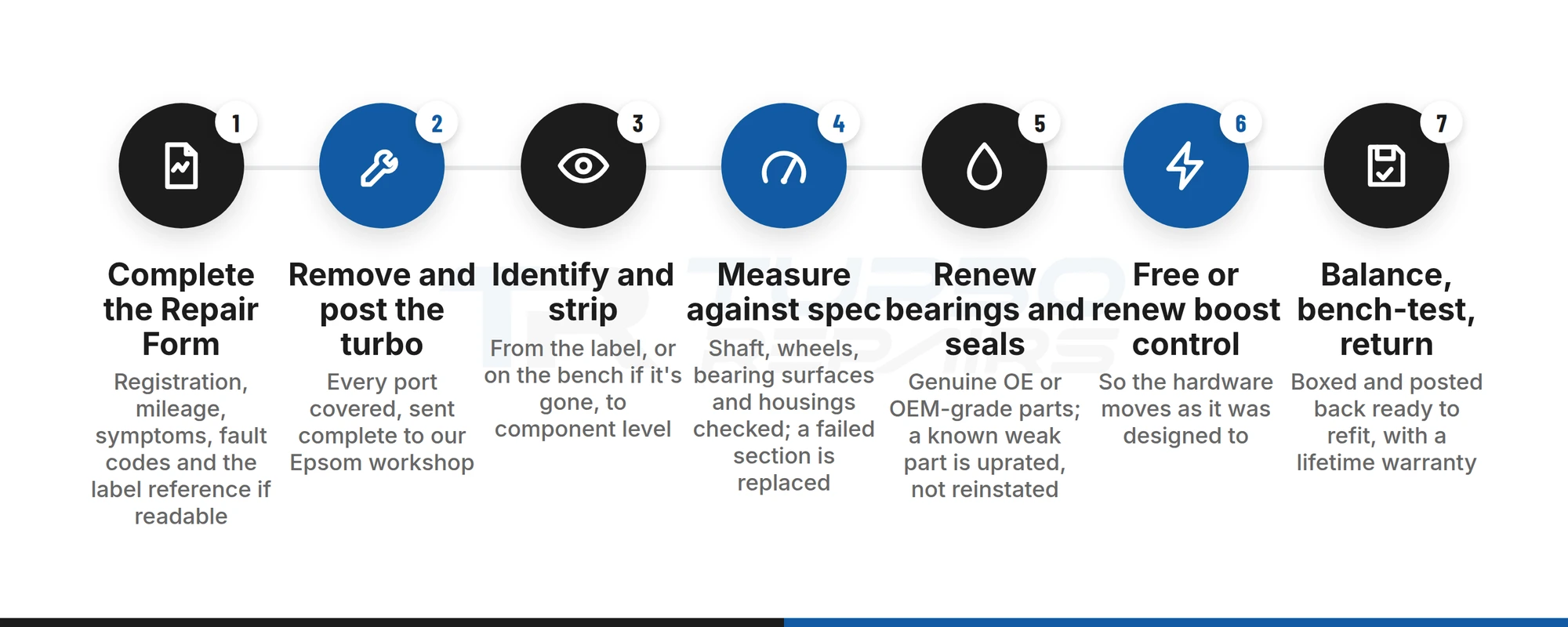
You, or the garage working on the car, remove the turbocharger and post it to us; we rebuild it and post it back. The process runs like this:
- Complete the online Repair Form with the registration, mileage, symptoms, any fault codes, and the reference from the turbo’s label if you can read it.
- Remove the turbo. Our guide to refitting and priming a turbocharger covers removal, refit and the first start.
- Pack and post it complete, with every port covered, to Unit 102 Reaver House, 12 East Street, Epsom, Surrey, KT17 1HX, United Kingdom. Packing and postage are covered on our FAQs page.
- Identification and strip. The unit is identified from its label, or on the bench if the label is gone, then stripped to component level by specialists who rebuild turbochargers and turbo actuators as their core work.
- Measurement and rebuild. The shaft, wheels, bearing surfaces and housings are cleaned and measured against original specification. Bearings, seals and thrust parts are renewed with genuine OE or OEM-grade components that meet or exceed the original, and a part with a known design weakness is uprated rather than reinstated. A wheel, shaft or housing that fails inspection is replaced as a section.
- The boost-control hardware freed or renewed. Cleaned and freed where its parts are sound, renewed where they are worn, so boost control moves as it was designed to.
- Balanced, bench-tested and returned. The rotating assembly is balanced, the unit is set up and run on the bench, then boxed and posted back to you ready to refit.
Bench time is typically one to three working days from arrival, with postage on top in each direction. The rebuild carries a lifetime, unlimited-mileage warranty, with no time limit and no mileage cap. Independent garages, workshops and main dealers send units in exactly as owners do.
One more detail helps: tell us on the form whether the failure followed an oil warning light, a missed service or a recent engine repair. A bearing that wore out on clean oil looks different from one that ran short of it, and the answer is read against what the strip shows.
Nissan Qashqai Turbo FAQ
How much does a Nissan Qashqai 1.5 dCi turbo replacement cost?
Rebuilding your own turbo with us starts from £185, and our price guide puts mid-size cars at £185 to £350 excluding VAT, depending on what has survived inside. A replacement unit from us starts from £450. Neither figure includes removing and refitting the turbo, and your exact price is confirmed after inspection.
Which turbo does my Qashqai 1.5 dCi have?
A BV39, BV38 or B01V, depending on the engine version and the car’s year. The BV39 covers the earliest listings, the BV38 is listed from 2011, and the B01V from 2017. The reference on the turbo’s own label settles it; if the label is unreadable, send the unit and it is identified on the bench.
Is the turbo the same on the first and second-generation Qashqai?
Not reliably, and the generation is not how the catalogue divides it. The turbo is listed by year and engine version: BV39 first, then BV38 from 2011, then B01V from 2017, with both a BV39 and a BV38 listed for 2011. Go by the reference on the unit, not by the car’s generation.
Can you rebuild the turbo from a Qashqai 1.6 dCi or a petrol Qashqai?
Those engines carry different turbochargers from the 1.5 dCi, so nothing on this page applies to them. Send the details through the Repair Form and we will tell you what the unit is and whether it is a candidate for a rebuild.
Can I keep driving with a failing turbo?
Not hard, and not for long. A turbo with a metallic whine, oil smoke or a rubbed wheel is getting worse each mile, and worn bearings driven on can take a wheel, the shaft or a housing with them. Taken off early, far more of the unit survives to be rebuilt.
Do I need to send the whole turbo?
Yes. Send the complete turbocharger as it came off, with its boost-control hardware attached and every port covered. It is the whole unit that is measured, balanced and bench-tested.
How long does a rebuild take, and what is the warranty?
Bench time is typically one to three working days from arrival, plus postage each way. Every rebuild carries a lifetime, unlimited-mileage warranty with no time limit.
Final Thoughts
The Qashqai’s generations are how most people think about the car, and they are the wrong frame for its turbo. The catalogue lists the 1.5 dCi’s turbocharger by year and engine version — BV39, then BV38 from 2011, then B01V from 2017 — and never by generation. A year and a model name narrow the search; they do not finish it.
A rebuild sidesteps that question, because the unit being rebuilt is the one your engine was already running. Rule out the cheaper imitators first, take the turbo off before a bearing failure spreads, and the rebuild is usually the smaller job it deserves to be.
Turbo Repairs · Epsom workshop
Rebuild the turbo your 1.5 dCi was built to run
Complete the Repair Form with your Qashqai’s details and the reference from the label, then post the turbocharger in complete. We identify it, strip, measure, rebuild, balance and bench-test it, and post it back ready to refit.
Lifetime, unlimited-mileage warranty · Mail-in from the UK and internationally · Bench-tested and calibrated before it ships