

Summary A turbocharger rebuild at our workshop starts from £185, a replacement turbocharger from £450, and an electronic turbo actuator repair from £100, all plus VAT. Where your own job lands depends on the make and model, and above all on how much of the turbo is still fit to re-use once it has been stripped — which is why the price is confirmed after inspection.
Below: what each figure covers, a price guide by vehicle type, what moves a rebuild up from its starting price, how rebuilt, reconditioned and new units differ, and the costs that sit outside the turbo altogether.
In every vehicle class on our price guide, the dearest rebuild still costs less than the cheapest new turbocharger.
Most turbo prices published online are for one route: a whole new unit, fitted. The figure that usually applies to your car is lower, and it is set by something no quote given in advance can see — how much of your existing turbocharger survived.
A rebuild keeps the parts that are still sound and replaces only the ones that are not, so two turbos off identical cars can come in at different prices. This guide sets out what each of our prices includes, what pushes a job towards the top of its range, and which parts of the bill have nothing to do with the turbocharger at all.
How Much Does a Turbo Repair or Replacement Cost?
Our prices start from three figures, one for each kind of job:
- Turbocharger repair or rebuild — from £185. Your own turbo, stripped to component level, rebuilt on new wear parts and bench-tested before it comes back to you.
- Replacement turbocharger — from £450. A reconditioned or new exchange unit supplied in place of yours, for when the original is not worth rebuilding.
- Electronic turbo actuator repair — from £100. The electronic module that positions the turbo’s boost-control mechanism, repaired on its own when it is the part that failed.
Each is where a price starts, not what every job costs. Prices vary with the make, the model and the extent of the damage, and yours is confirmed once the unit has been inspected. If your vehicle has a listing in our turbo shop, that listing gives the fixed rebuild price for that model.
None of these figures covers taking the turbocharger off the car or refitting it. That labour is charged by whoever does it, and it is the same job whichever route you choose — more on that further down.
Turbo Repair and New Turbo Prices by Vehicle Type
The guide below sets our rebuild prices beside the typical market price of a new turbocharger for the same class of vehicle. Use it to place your car, not to fix the price of your job. Our prices are shown excluding VAT.
| Vehicle type | Rebuild of your own turbo (our price, excl. VAT) | New turbocharger (typical market price for the unit) |
|---|---|---|
| Small cars (e.g. Ford Fiesta, VW Polo) | £185 – £285 | £700 – £1,000 |
| Mid-size cars (e.g. BMW 3 Series, Audi A3) | £185 – £350 | £900 – £1,300 |
| Large cars and SUVs (e.g. Range Rover, Mercedes E-Class) | £210 – £450 | £1,200 – £1,800 |
| Diesel vans and commercial vehicles | £250 – £450 | £1,500 – £2,000 |
Two patterns run through it. Both columns climb as vehicles get larger, because bigger engines generally carry bigger turbochargers, and some carry two. And in every row the most expensive rebuild sits below the cheapest new unit — which is the reason to find out whether yours can be rebuilt before buying anything.
What the table cannot tell you is where in its row your own turbo falls. That comes down to what is inside it.
Why the Price Depends on What Survived Inside the Turbo
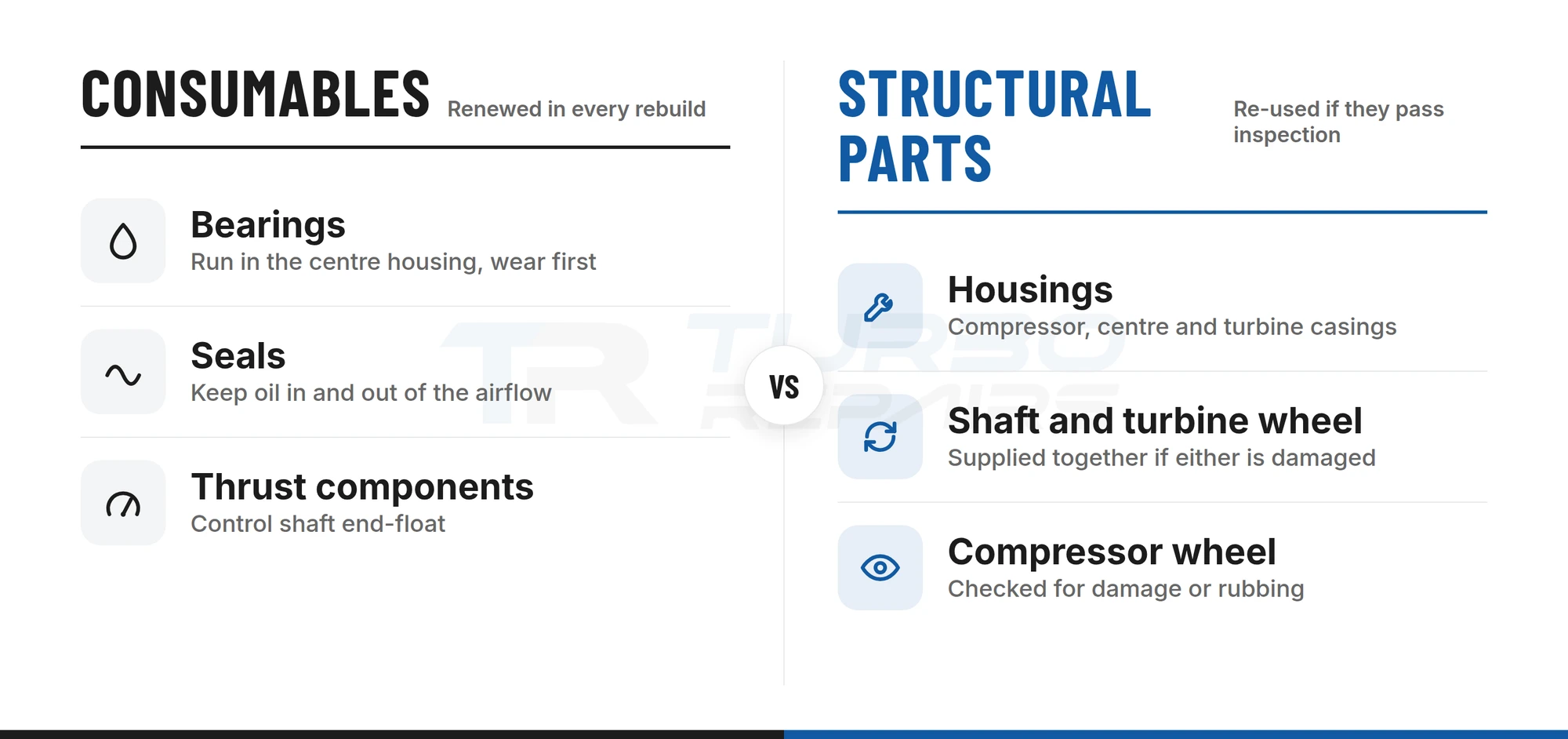
A turbocharger is two housings with a rotating assembly between them. Exhaust gas drives the turbine wheel in one housing; the turbine turns a shaft; the shaft turns the compressor wheel in the other housing, which pushes air into the engine. The shaft runs in bearings inside a centre bearing housing, fed with engine oil and sealed at each end.
Those parts do not wear at the same rate. The bearings, the seals and the thrust components are consumables — designed to wear, and renewed in every rebuild as a matter of course. The housings, the wheels and the shaft are meant to last the life of the turbo, and in most failed units they still can, which is why most turbos can be rebuilt rather than replaced.
That split is the whole of the pricing logic. A rebuild starts from £185 because at its simplest it re-uses the housings, wheels and shaft and replaces only the consumables. Every part that fails inspection moves from the list of things we re-use to the list of things we replace, and that, more than the badge on the car, is what moves the price up its range.
It also explains why a rebuild costs so much less than a new unit. A new turbocharger replaces every part, including the ones in your old turbo that had plenty of life left in them.
What Moves a Rebuild Above the Starting Price
Working up from the simplest job, these are the findings that add to it.
Only the wear parts have gone. Worn bearings, tired seals, a worn thrust bearing: the typical high-mileage failure, and the one closest to the starting price. The consumables are renewed, the rotating assembly is balanced, and the unit is bench-tested.
The compressor wheel is damaged. Debris drawn into the intake strikes the blades, or worn bearings let the wheel touch its housing. A damaged compressor wheel is replaced rather than repaired, and the rotating assembly is rebalanced around the new one.
The shaft is bent or snapped, or the turbine wheel is damaged. The turbine wheel and shaft are supplied together as one assembly, so damage to either replaces both. It is a bigger step up than a compressor wheel, and it usually follows a bearing failure that was left to run on.
A housing is cracked or distorted. The turbine housing lives at exhaust temperature and can crack, and a wheel that has rubbed can gouge the housing around it. In most cases a damaged housing can be replaced and the turbo still rebuilt, rather than the whole unit written off.
The boost-control mechanism is seized or worn. On a variable-geometry turbo, carbon builds up around the vane pivots until the ring can no longer move freely. Where the parts are sound they are cleaned and freed; where they are worn or distorted they are renewed, which adds to the job. Our Garrett GT2052V page explains that mechanism on one widely fitted unit, and the fault codes a stuck one stores are covered in our guide to turbo overboost and underboost.
The actuator has failed as well. An electronic actuator is its own repair, from £100, and can be repaired alone when it is the only thing wrong — see our electronic turbo actuator repairs. A pneumatic wastegate actuator is a simpler part whose rod setting matters as much as its condition; our wastegate actuator repair page covers it.
The list runs in roughly the order a neglected failure progresses. Bearings wear first; the extra movement they allow lets the wheels touch their housings; a wheel that has touched can shed material, and a shaft left running on failed bearings can bend or break. A turbo taken off at the first stage is usually a consumables rebuild. The same turbo driven on until the later stages may not be. Which warning signs mean you should stop driving is covered in our guide to common turbocharger problems.
Why the Exact Price Comes After Inspection
Most of what sets the price is inside the bearing housing, and none of it can be judged with the turbo on the car. Shaft play can be felt by hand, and a rubbed compressor wheel can sometimes be seen with the intake pipe off. Bearing surfaces, shaft straightness, seal condition and the state of a vane mechanism only show once the unit is apart.
So every turbo that reaches us is stripped to component level and each part measured against original specification before a route is recommended. Where the core is good, it is rebuilt. Where it is not, we say so and recommend replacement instead. Diagnosing first means the price reflects your unit rather than an average.
An online average, however carefully compiled, is a figure drawn from many cars. It cannot tell you which list your own compressor wheel belongs on.
You can narrow things down before sending anything. When you complete the repair form, include the make, model and engine, any fault codes the car has stored, what happened when it failed and, if you can read it, the part number on the plate fixed to the turbo itself. That does not replace the inspection, but it means the unit is identified before it arrives.
Turbo Repairs · Epsom workshop
Find out how much of your turbo is worth keeping
Post your turbocharger to our workshop and it is stripped, measured and priced on what it actually needs. Rebuilds start from £185, and the unit that comes back is your own, rebuilt and bench-tested.
Lifetime, unlimited-mileage warranty · Mail-in from the UK and internationally · Bench-tested and calibrated before it ships
Rebuilt, Reconditioned or New: What Each Price Buys
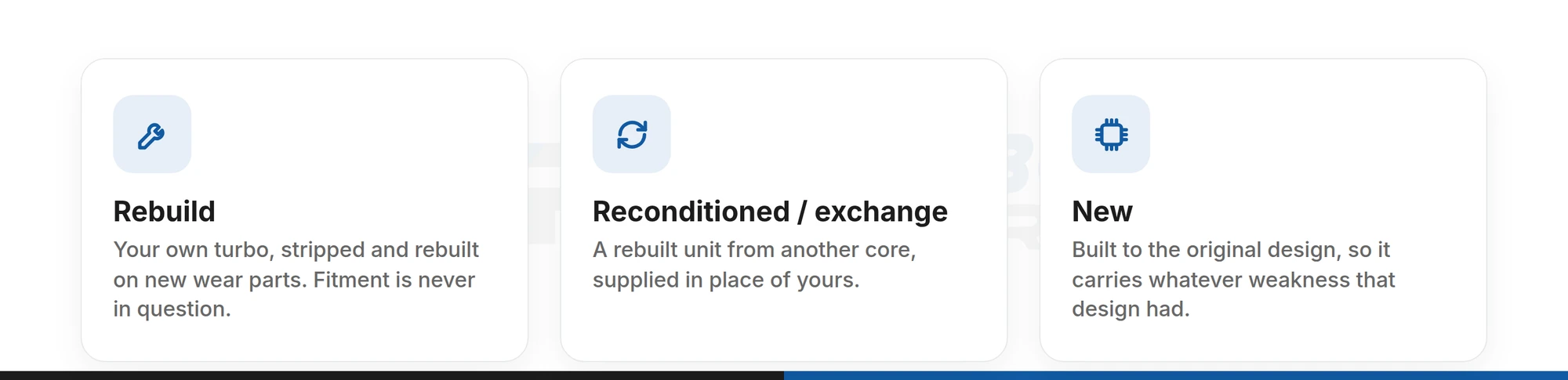
The three words get used loosely, so it is worth being exact about what each one means here.
A rebuild is your own turbocharger, repaired. It is stripped to component level, the consumables are renewed, and any part that fails inspection is replaced with genuine OE or OEM-grade components — or an uprated part where the original design has a known weakness. The rotating assembly is balanced and the unit bench-tested before it is returned. Because the turbo that goes back on is the one that came off, fitment is never in question. From £185.
A reconditioned or exchange unit is a turbocharger rebuilt from another core and supplied in place of yours. It suits the job where your own turbo is too far gone to rebuild sensibly. From £450 with us. Because it is a different unit, the identification has to be right: the part number and specification must match your engine, not just the model name on the boot.
A new turbocharger is exactly that, and the typical market prices in the guide above reflect it. It is the most expensive route, and a new unit built to the original design carries whatever weakness that design had. Where a rebuild can correct a known weak point, a new unit simply reinstalls it.
Every repair we carry out — turbocharger rebuilds and electronic actuator repairs alike — carries a lifetime, unlimited-mileage warranty.
When Replacement Is the Better Value
A rebuild is usually possible. Even a cracked housing or a damaged turbine can be replaced as a section and the turbo still rebuilt. The question is whether it is still the better value, and that turns on how many sections have gone at once.
One damaged part is a rebuild with a part added. A turbo that needs new wheels, a new shaft and a new housing on top of its consumables has very little of the original left, and at that point a replacement unit from £450 can be the more sensible buy. The same applies where oil contamination has worn the bearing housing itself rather than only the bearings inside it.
We would rather tell you that plainly than rebuild what has become a set of new parts in an old casing. The recommendation follows the inspection, and it is the most cost-effective route that will last — not the most expensive one.
Whichever you choose, whatever destroyed the first turbo is still on the car. An oil supply fault, a restricted feed pipe or debris in the intake all start outside the turbocharger, and a rebuilt or new unit fitted without them being found fails the same way. Our guide to replacing a turbocharger sets out what to check while the unit is off.
The Rest of the Bill: Costs Outside the Turbo

The unit is usually the largest line on the invoice but rarely the only one. We have not put figures against the items below because they are set by whoever does the work, not by us — but you should expect to see them.
- Removal and refitting. Labour charged by your garage, or your own time if you do the work yourself. It varies with access: a turbo within easy reach on a four-cylinder engine is a different job from one tucked into the vee of a V6, or one of a twin-turbo pair. It is the same job whether a rebuilt or a new unit goes back on.
- Parts fitted with it. New gaskets, a new oil feed pipe, fresh oil and a new oil filter, and usually a new air filter. The feed pipe is the part people are tempted to re-use, and it is the one that cannot be judged from the outside.
- Diagnosis and the cause. Reading fault codes, pressure-testing the charge-air system and checking oil pressure at the turbo — then whatever that turns up, whether a split hose, a blocked feed or an oil supply problem. This is the line that decides whether the next turbo lasts.
- Getting the unit to us. A mail-in rebuild means posting the turbo in and having it returned; postage and packing are covered in our FAQs.
Put together, the honest answer to “how much does a turbo cost?” is three numbers: the unit, the labour to fit it, and the cost of fixing whatever killed the last one. Only the first changes depending on whether you rebuild or replace.
Turbo Repair Cost FAQ
How much does it cost to rebuild a turbo?
Our turbocharger rebuilds start from £185. That covers a rebuild where the housings, wheels and shaft can be re-used and only the wear parts need renewing; a damaged wheel, a bent shaft or a cracked housing adds to it. Your price is confirmed after the unit has been inspected.
How much is a new turbo?
It depends on the vehicle. The typical market price of a new unit runs from £700–£1,000 for a small car up to £1,500–£2,000 for a diesel van or commercial vehicle. A replacement turbocharger from us, reconditioned or new exchange, starts from £450.
Is it cheaper to repair or replace a turbo?
Usually cheaper to repair. In every vehicle class in our price guide, the dearest rebuild costs less than the cheapest new unit. Replacement becomes the better value only when so many major parts are damaged that little of the original turbo would be re-used.
Does the price include fitting?
No. Our prices are for the turbocharger or actuator itself. Removing and refitting it is done by your garage or by you, and that labour is the same whichever route you choose.
How much does an electronic turbo actuator repair cost?
From £100. If the actuator is the only fault, it is repaired on its own without the turbo being rebuilt, and a repaired actuator refits without programming.
Why can you not give an exact price before seeing the turbo?
Because most of what sets the price is inside the bearing housing. Until the unit is stripped, nobody can see whether the shaft is straight, the bearing surfaces are sound or the vane mechanism is free — and those findings are the difference between the bottom and the top of the range.
What warranty comes with a turbo rebuild?
A lifetime, unlimited-mileage warranty: no mileage cap and no time limit. It applies to turbocharger rebuilds and electronic actuator repairs alike.
Final Thoughts
Asking what a turbo costs is a fair question with an unhelpful answer, because the range is wide and most published figures describe a single route: a new unit, fitted. The more useful question is what is still usable inside yours. The bearings and seals rarely are, and they are the inexpensive part. The housings, wheels and shaft often are, and they are the expensive part.
That is the whole reason a rebuild starts from £185 while a new turbocharger costs so much more: one re-uses what survived, the other replaces all of it. Take the unit off early, before worn bearings have had the chance to damage the parts around them, and far more of it survives.
Then budget for the part of the job no turbo price includes — finding and fixing whatever caused the failure. It is rarely the largest line on the bill, and skipping it is how people end up paying for two turbochargers.
Turbo Repairs · Epsom workshop
Get a price for your own turbocharger, not an average
Complete the repair form and post your turbo in. We strip it, measure every part against original specification and recommend the route that makes sense — a rebuild from £185, or a replacement from £450 where the core is beyond saving.
Lifetime, unlimited-mileage warranty · Mail-in from the UK and internationally · Bench-tested and calibrated before it ships