

Summary We rebuild the electronic turbo actuator from the VW Transporter 2.0 TDI, T5 and T6, and the Crafter 2.0 TDI, from £100 + VAT. You remove the actuator and post it to us, and it comes back rebuilt at component level, bench-tested and ready to refit without coding, typically after one to two working days in the workshop. Every rebuild carries a lifetime, unlimited-mileage warranty.
Before you buy or send anything, identify the engine. Not every Transporter carries an electronic actuator, and the one on yours is decided by the engine generation, not by whether the badge says Transporter or Crafter.
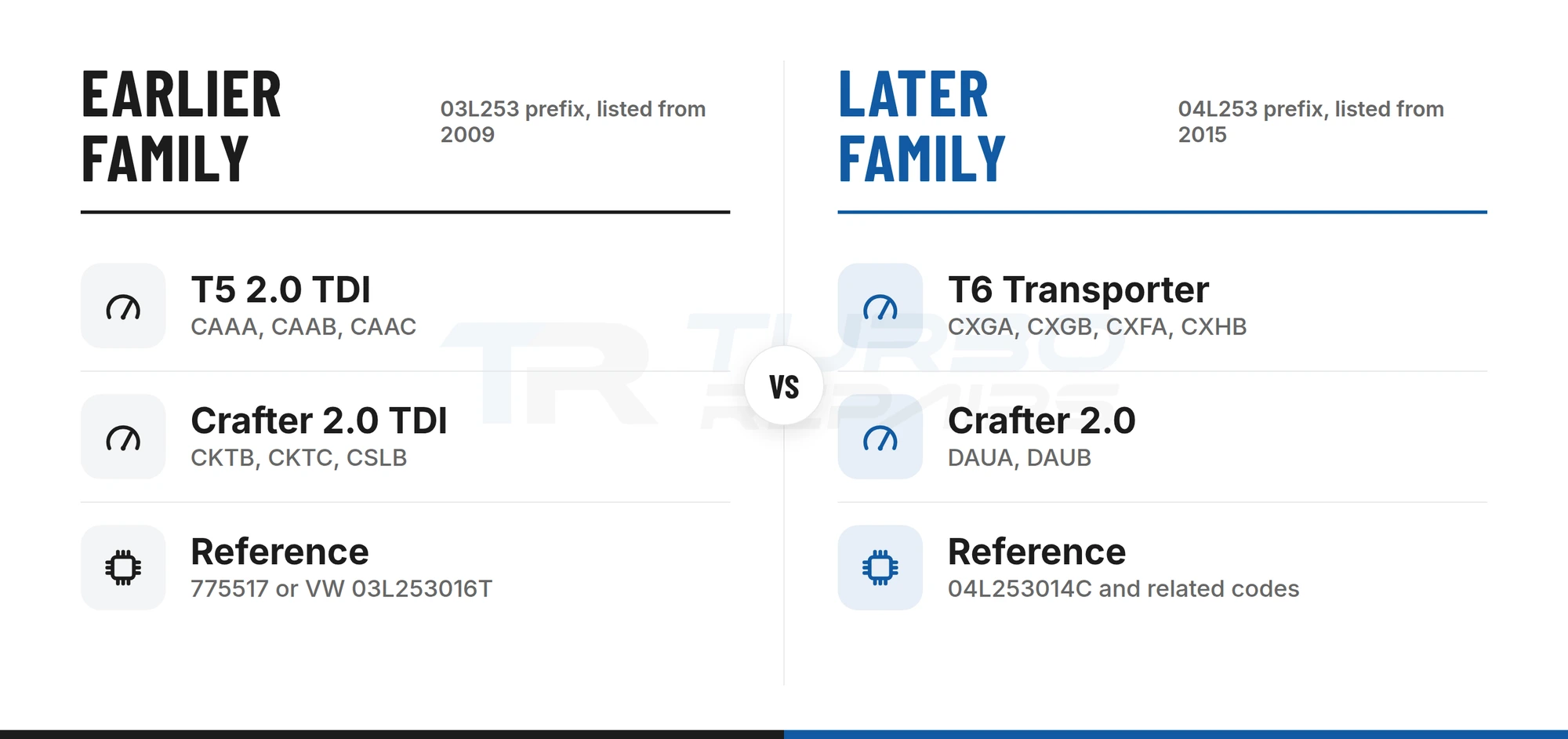
In the parts catalogues a T6 Transporter’s turbo actuator sits with the 2.0 Crafter’s rather than the T5’s: one 04L253-referenced unit is listed for both vans from 2015, while the T5 2.0 TDI is listed with the earlier Crafter 2.0.
A Transporter or Crafter that loses its pull under load, drops into limp mode and then drives normally again after a restart is showing a boost-control fault, and on the 2.0 TDI vans the electronic actuator on the turbocharger is one of the first parts to suspect. Specialists catalogue and sell that actuator as a separate part, so a fault inside it does not have to mean a new turbocharger. This page shows you which actuator your van carries, how to tell it apart from a turbocharger fault, and how our rebuild works.
- Vans covered: VW Transporter T5 and T6 2.0 TDI and VW Crafter 2.0 TDI fitted with an electronic actuator. The T6 listings also name the Caravelle, Multivan and California
- Later actuator (listed from 2015): Transporter T6 2.0 with engine codes CXGA, CXGB, CXFA and CXHB, and Crafter 2.0 with DAUA and DAUB. VW references 04L253014C, 04L253014F, 04L253014H, 04L253014L, 04L253014M, 04L253016S and 04L253056R
- Earlier actuator: Transporter T5 2.0 TDI with CAAA, CAAB and CAAC (listed from 2009) and Crafter 2.0 TDI with CKTB, CKTC and CSLB (listed from 2010). Catalogued as an electronic actuator with position sensor, 775517 or VW 03L253016T
- Check before assuming: the T5 1.9 TDI, the T5 2.5 TDI and the twin-turbo 2.0 BiTDI. The listings for these do not describe an electronic unit, so look at what is fitted to the turbocharger
- Codes that point at boost control: P0299, P0234, P2562, P2563, P0045
- Our service: your own actuator rebuilt from £100 + VAT, typically 1–2 working days, no coding on refit, lifetime unlimited-mileage warranty.
Which Transporter or Crafter Engine Do You Have?
The name Transporter covers several diesel engines, and they do not all control their turbochargers the same way. Some are catalogued with an electronic actuator. For others the specialist listings describe only an actuator, with no type given. Knowing the engine code narrows the field before anything is unbolted, and a VW dealer or parts supplier can look it up from your registration or VIN.
| Engine as listed | Engine codes as listed | What the listings say about the actuator |
|---|---|---|
| T5 1.9 TDI | AXB, AXC, BRR, BRS | Sold as a wastegate actuator. No listing we reviewed describes it as electronic. Check what is fitted before assuming it is covered here. |
| T5 2.5 TDI, five-cylinder | AXD and AXE (Garrett 720931); BNZ and BPC (Garrett GTB1749V, 760698) | The type is not stated. The Garrett GT2052V family behind the AXD and AXE is catalogued with more than one style of vane control, so the part on the turbocharger decides it. |
| T5 2.0 TDI | CAAA (84 hp), CAAB (102 hp), CAAC (140 hp), listed from 2009 | Catalogued as an electronic actuator with position sensor, 775517 or VW 03L253016T, on the same listing as the earlier Crafter 2.0 TDI. |
| 2.0 BiTDI, twin turbocharger | CFCA (listed 2009–2011) and CXEB (listed 2015–2016) | Two turbochargers in one system. Neither actuator listing we reviewed covers their turbocharger references, so identify each unit from its own label. |
| T6 2.0 TDI | CXGA, CXGB, CXFA, CXHB, listed from 2015 | One actuator listing covers the T6 and the later Crafter 2.0 together, under 04L253-prefixed VW references. |
| Crafter 2.0 TDI | CKTB, CKTC, CSLB (listed from 2010); DAUA, DAUB (listed from 2015) | Split between the two families above: the CKT and CSLB codes with the T5, the DAUA and DAUB codes with the T6. |
If your engine is one of the first two rows, the next step is not a code reader, it is a torch. An electronic actuator is a moulded unit with an electrical connector plugged into it. A pneumatic actuator is a sealed can with a rod and a small vacuum pipe. We rebuild electronic actuators. A vacuum can is a different part and a different job, and this service does not cover it. For the 2.5 TDI turbocharger itself, including the vane mechanism it drives, our page on the Garrett GT2052V on the 2.5 TDI covers identification from the compressor plate.
One Actuator Reference Across Two Vans
Owners tend to assume a T5 and a T6 are close relatives and a Transporter and a Crafter are not. For the turbo actuator the catalogues say the opposite. The split runs between two generations of the 2.0 TDI, and each generation shares its actuator across both vans.
The later family: T6 Transporter and 2.0 Crafter from 2015
One specialist sells a single actuator for the T6 Transporter and the Crafter 2.0 together. The Transporter T6 is listed at 83 and 148 hp with engine codes CXGA, CXGB, CXFA and CXHB. The Crafter is listed at 101 and 138 hp with DAUA and DAUB. The same listing names the California and Multivan on the T6 engines, and the MAN TGE on DAUA, DAUB and DAWA from 2016. A second specialist sells its own single actuator under the title Transporter T6, Crafter and Multivan 2.0 TDI.
That listing is matched to turbochargers rather than to vans. It names Garrett turbocharger numbers 830323, 830324, 845888, 873732, 873767 and 873970, and VW references 04L253014C, 04L253014F, 04L253014H, 04L253014L, 04L253014M, 04L253016S and 04L253056R. Three of those turbocharger numbers appear on our own VW Transporter 2.0 TDI turbocharger rebuild listing. It gives 830324 for 2015 vans on CXGA and CXGB, 830323 for 2015–2016 vans on CXFA, CXHA and CXHB, and 873732 at 101 bhp. Two independent catalogues put the same turbochargers on the same engines, which is good evidence that the pairing is real.
The earlier family: T5 2.0 TDI and the first 2.0 Crafter
The earlier 2.0 TDI works the same way under different numbers. One specialist lists an electronic actuator with position sensor, 775517 or VW 03L253016T, for the T5 Transporter 2.0 TDI with CAAA, CAAB and CAAC from 2009, and for the Crafter 2.0 TDI with CKTB, CKTC and CSLB from 2010. The same listing also names the Golf, Passat, Polo, Octavia and A3 1.6 TDI on engine code CAYC. On that listing a family hatchback and a large panel van share one actuator, so the badge tells you very little.
What that means when you are choosing a part
- A T5 actuator and a T6 actuator are different parts. Both vans are Transporters, but they are listed in different families under different VW prefixes: 03L253 on the earlier unit and 04L253 on the later one.
- A Crafter actuator from the same era may be the same part. A unit listed for a DAUA Crafter can be the right family for a CXGB T6, and a CKTC Crafter unit can match a CAAC T5.
- “May be” is as far as a listing goes. Each family covers several turbocharger numbers and VW suffixes, and the specialist that lists the later unit tells buyers to check the part and OEM numbers on the turbocharger before ordering. The references on your own unit settle it.
If you are sending us your own actuator, most of that problem goes away. The unit coming off your van is already the right generation and the right variant for the turbocharger it came from. The identification still matters, because it tells you whether the part is one we rebuild and whether the fault is in the actuator at all.
Symptoms on a Working Van, and What Each One Narrows Down
A van shows the fault most readily when it is working hardest: loaded, towing, climbing or pulling out to overtake. That is when the engine management asks the turbocharger for the most boost and checks most closely that it got it. No single symptom names the part. The table shows what each one leaves on the list.
| What you notice | What it narrows down |
|---|---|
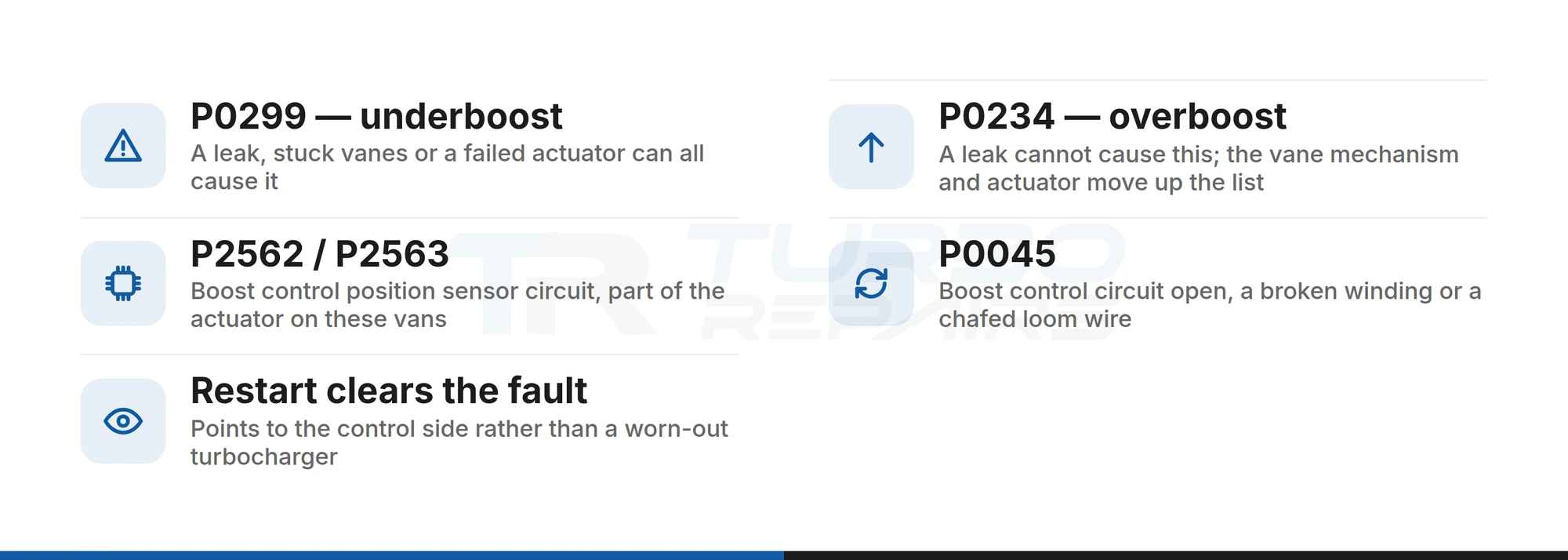
| Power cuts out under load, and a restart brings it back | The engine management has stepped in because boost or vane position left its expected range. This is an intermittent fault. It points to the control side (actuator electronics, connector or loom) more than to a turbocharger that has worn out, because a worn turbocharger does not recover on a restart. |
| It only happens once the engine is fully warm | Heat makes marginal electronics and a tight vane mechanism both worse. Write down when it happens, because that tells the bench test what to look for. |
| Flat everywhere, but no warning light and no code | Look at the intake before the actuator. A split intercooler hose or a slipped clamp loses boost and feels much the same. |
| P0299 stored | Underboost: the engine asked for more pressure than it got. This names a direction, not a part. A leak, stuck vanes and a failed actuator can all cause it. |
| P0234 stored | Overboost: more pressure than requested. A leak cannot cause this, so the suspects shrink to the vane mechanism, the actuator, the control side and the sensor. |
| P2562 or P2563 stored | The boost control position sensor circuit. On the electronic actuators catalogued for these vans the position sensor is part of the actuator, so the unit and its wiring move up the list. |
| P0045 stored | The boost control circuit is open somewhere along its length. A broken winding inside the actuator and a chafed wire in the loom set the same code. |
Two cautions before anything is bought. Turbocharger circuits share supply and earth paths with other sensors, so a fault reported against the turbocharger can belong to something else on the same circuit. And the freeze-frame data stored with a code, showing speed, load and temperature at the moment it set, is worth more than the code itself. Do not clear anything until it has been read and noted.
For how to read the pattern around a symptom, see our guide to turbo actuator symptoms. For what P0299 and P0234 can and cannot tell you, see overboost and underboost codes.
Actuator or Turbocharger? The Check Before It Comes Off
Most stored codes cannot tell a failed actuator from vanes that no longer move. A few minutes under the bonnet can, and the check is worth doing before you order a part or post one. Let the engine cool completely first, because the turbine housing gets hot enough to burn.
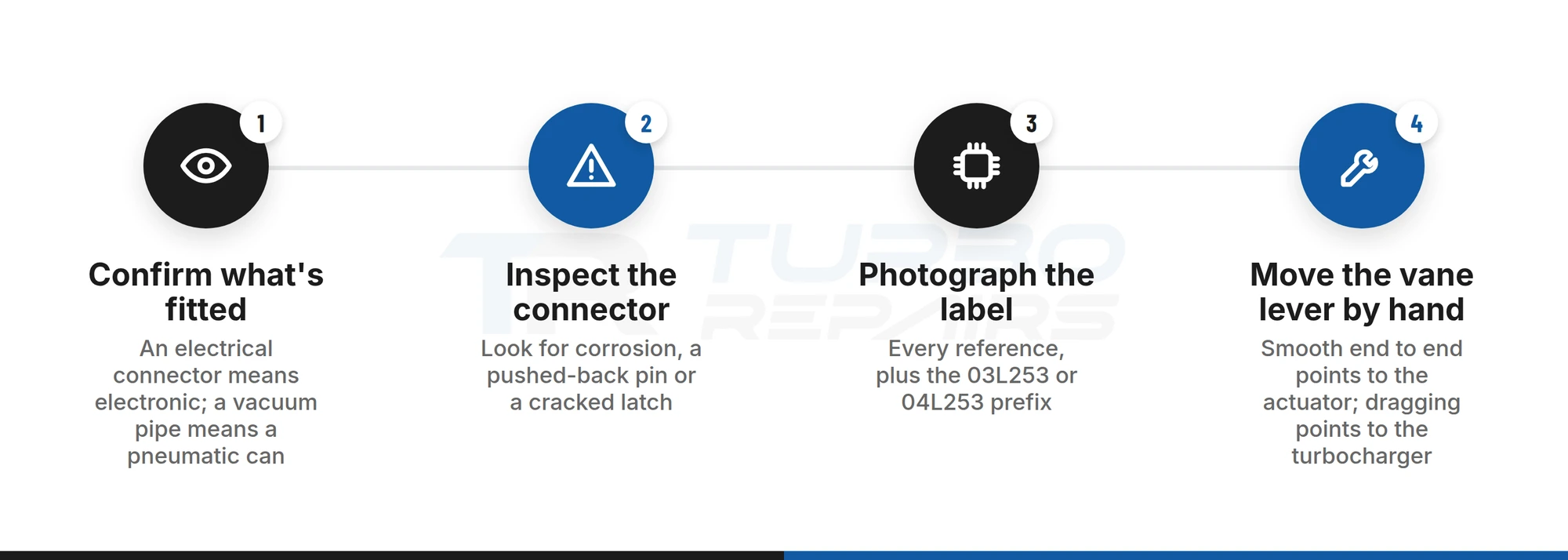
- Confirm what is fitted. Find the actuator on the turbocharger and look for the electrical connector. If there is a vacuum pipe and no connector, you have a pneumatic can, and this service is not the right one.
- Inspect the connector. With the ignition off, unlatch it and look at both halves for green corrosion, a pin pushed back, moisture under the seal or a cracked latch. Refit it until it clicks fully home. A poor connection behaves exactly like a failing actuator.
- Photograph the label. Wipe the actuator body and photograph every number on it, VW and supplier references alike. On these vans the prefix (03L253 or 04L253) is the quickest guide to which family you have.
- Free the linkage and move the vanes by hand. Disconnect the actuator’s link from the turbocharger’s vane lever and move the lever gently through its full travel. If it moves smoothly from end to end, the vanes are free and the actuator is the suspect. If it drags, catches or stops short, the problem is inside the turbocharger.
A free lever on a cold engine is good evidence but not proof, because vane mechanisms can tighten when hot. If your van only faults once it is fully warm, say so on the repair form.
If the vanes are stiff or seized, a rebuilt actuator will fight the same resistance from its first mile, and the turbocharger is the part that needs the work. For the 2.0 TDI, the turbocharger itself goes through our Transporter 2.0 TDI turbocharger rebuild, which you choose by year and power output. Whatever you find, do not drive the van with the actuator unplugged to see what happens. The engine management can no longer position the vanes at all.
Turbo Repairs · Epsom workshop
Lever moves freely and there is a connector? Send us the actuator
Post the actuator to us with your registration, engine code, label photographs and stored codes. We check its references against your van and test it as received, before it is opened.
Lifetime, unlimited-mileage warranty · Mail-in from the UK and internationally · Bench-tested and calibrated before it ships
Our Transporter and Crafter Actuator Rebuild
This is a mail-in service. You or your garage remove the actuator and post it to our workshop at Unit 102 Reaver House, 12 East Street, Epsom, Surrey, KT17 1HX, United Kingdom. The van stays with you, and we do not work on vehicles. The actuator is rebuilt there by our team of turbo specialists and electronic engineers.
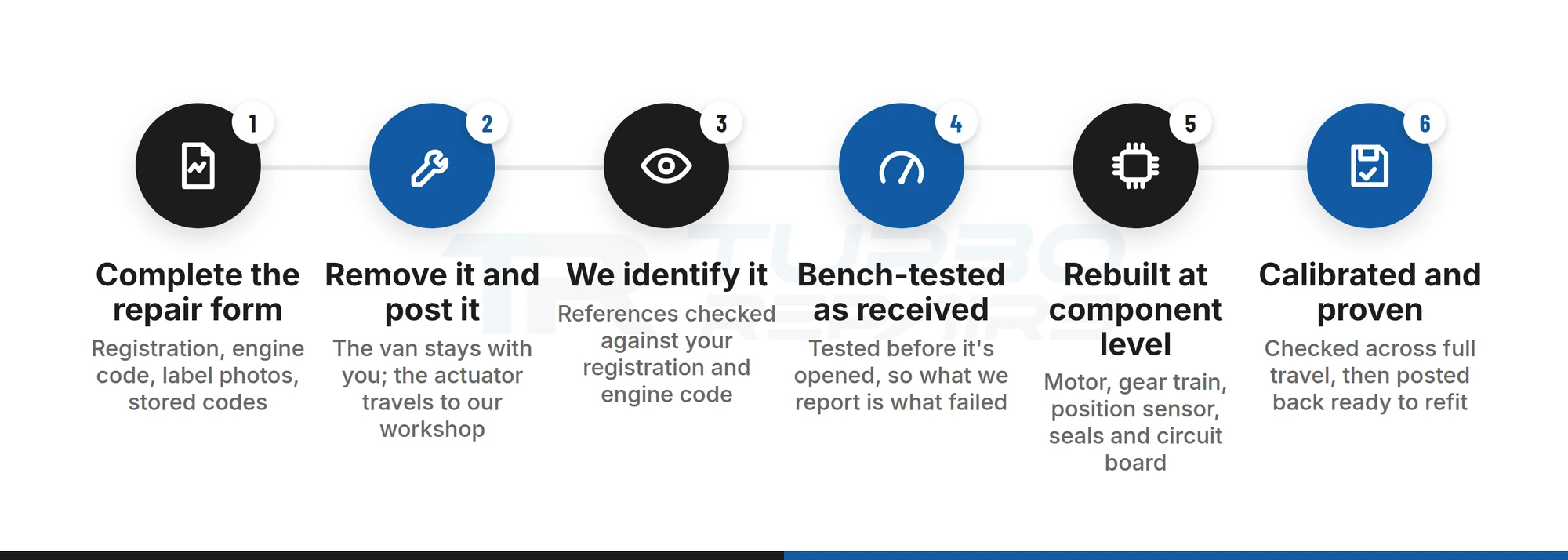
- Complete the repair form. Give us the registration, the engine code if you have it, photographs of every reference on the label, the stored codes and freeze-frame notes, whether a restart clears the fault, and what you found when you moved the vane lever by hand.
- Remove the actuator and pack it. Wrap it in foam or bubble wrap inside a rigid box, with your repair reference on a note inside. Our FAQs page covers packing and postage in more detail.
- We identify it against your van. The references are checked against your registration and engine code. If the unit turns out to be a pneumatic can, or an actuator we cannot rebuild, we tell you before any work is done.
- We bench-test it as received. Testing before the unit is opened means what we report is what actually failed, not what we assumed.
- We rebuild it at component level. The motor, gear train, position sensor and seals are renewed as needed, and the circuit board is reworked. Components with a known weakness in the original design are replaced with uprated parts, so the unit meets or exceeds original specification.
- We calibrate it and prove it. The rebuilt actuator is checked across its full travel on dealer-level diagnostic and calibration tooling, then posted back ready to refit. It needs no coding. Once it is fitted, clear the stored codes with a diagnostic tool.
Repairs start from £100 + VAT. The exact price is confirmed once the unit has been identified and tested, so you know it before any work goes ahead. Turnaround is typically one to two working days from the actuator reaching us, plus postage each way. Every rebuild carries a lifetime, unlimited-mileage warranty, with no mileage cap and no time limit. We accept units posted from anywhere in the UK and from overseas. The other vehicles we cover are on our electronic turbo actuator repairs hub.
VW Transporter Turbo Actuator Repair FAQ
Is a T6 turbo actuator the same as a T5 one?
No. They are listed in different families. The T6 2.0 TDI, from 2015 on CXGA, CXGB, CXFA and CXHB, is listed under 04L253-prefixed VW references. The T5 2.0 TDI on CAAA, CAAB and CAAC is listed as 775517 or VW 03L253016T. Match on the references on your own unit, not on the Transporter name.
Does the VW Crafter use the same turbo actuator as the Transporter?
It depends on the engine generation. The Crafter 2.0 with DAUA or DAUB is listed with the T6 actuator. The Crafter 2.0 TDI with CKTB, CKTC or CSLB is listed with the T5 2.0 TDI actuator. A listing gets you to the right family, and the label on the part settles the exact variant.
Is every Transporter turbo actuator electronic?
No. The listings we reviewed describe the T5 2.0 TDI unit as electronic, but give no type for the T5 1.9 TDI or 2.5 TDI actuators. A connector on the actuator body means electronic, which is what we rebuild. A vacuum pipe means a pneumatic can, which this service does not cover.
What if the vanes are seized rather than the actuator failing?
Then the turbocharger is the part to send, because a rebuilt actuator cannot move a seized vane ring. For the Transporter 2.0 TDI, choose your year and power output on our Transporter 2.0 TDI turbocharger rebuild listing and post the turbocharger in.
Will a rebuilt actuator need coding or calibrating on the van?
No. You get your own unit back, calibrated and tested on our bench, and it refits without programming. Clear the stored fault codes once it is back on.
How much does a Transporter actuator repair cost, and how long does it take?
Repairs start from £100 + VAT, with the exact price confirmed once the unit has been identified and tested. Turnaround is typically one to two working days from arrival, plus postage each way, and every rebuild carries a lifetime, unlimited-mileage warranty.
Final Thoughts
On these vans the badge is a poor guide to the turbo actuator. A Transporter can carry an electronic unit or not, depending on the engine, and the electronic units follow the 2.0 TDI’s generation rather than the model name. The T5 is listed with the earlier Crafter, and the T6 with the later one. That is why a part ordered as a Transporter part can be the wrong one, while a unit listed for a Crafter can be the right one.
So identify the part from the van itself: the engine code, the connector, the prefix on the label and a hand check of the vane lever. Once those point at the actuator, the right part is the one already fitted to your turbocharger, and that is the one we rebuild.
Turbo Repairs · Epsom workshop
Rebuild the actuator already matched to your Transporter or Crafter
T5 or T6, 03L253 or 04L253, post us the unit off your van with its label photographs and stored codes. It is identified, tested before it is opened, rebuilt at component level and calibrated, then posted back ready to refit without coding.
Lifetime, unlimited-mileage warranty · Mail-in from the UK and internationally · Bench-tested and calibrated before it ships