

Summary Turbo balancing is the step that lets a rebuilt core run quietly and keeps its bearings alive. A turbocharger’s wheels are balanced on their own when they are made, but once the shaft, thrust collar, compressor wheel and nut are stacked together, the small errors left in each of them add up, so the assembled core has to be balanced as one rotor.
We do that in-house on a VSR (vibration sorting rig) as part of every turbo rebuild. Rebuilds start from £185 + VAT, typically take one to three working days on the bench, and carry a lifetime, unlimited-mileage warranty.
Undoing the compressor nut to renew the bearings is enough on its own to disturb a core’s balance, so a rebuilt turbo is balanced again even when every rotating part goes back in.
- What is balanced: the assembled rotating core (CHRA), not only its individual wheels
- Why it matters: imbalance becomes force at speed, which breaks down the bearings’ oil film, wears them unevenly, makes noise and can make the seals weep
- How: two stages, with the shaft-and-wheel assembly balanced on its own, then the assembled core spun on a VSR and trimmed
- Where: in-house, at our Epsom workshop
- When: on every rebuild, because taking the compressor wheel off disturbs the balance
- Price: rebuilds from £185 + VAT; your price is confirmed once the unit has been inspected
- Turnaround: typically one to three working days on the bench, plus postage each way
- Warranty: lifetime and unlimited mileage
What an Out-of-Balance Core Does to a Turbo
A turbocharger’s shaft carries the turbine wheel at one end and the compressor wheel at the other, and it runs on a film of pressurised engine oil rather than on anything solid. Our guide to how a turbo works goes through the parts one at a time. What matters here is that the rotor is light and turns far faster than anything else on the engine.
Every rotor carries some imbalance: slightly more mass on one side of its axis than the other. Engineers measure it as mass multiplied by the radius it sits at, so a speck of metal at the tip of a wheel counts for far more than the same speck near the centre. The imbalance does not grow as the shaft speeds up. The force it produces does, and steeply.
That is why a fractionally out-of-balance core can spin sweetly by hand and pass a casual check. At working speed the same small error is pushing the shaft against its bearings on every revolution.
The bearings take it first
Most car and van turbos run on oil-fed journal bearings. The BorgWarner K03 and K04 and the Garrett GT2052V both do. They depend on the oil film to hold the shaft off metal, and a rotor that keeps pushing through that film breaks it down.
The bearings then wear unevenly, the shaft gains play, the seals at each end stop sealing and, in time, a wheel touches its housing. Turbo component maker Melett notes that balance failure leaves a recognisable taper worn into the journal bearings, and that an unbalanced core can wear out its bearings with no sign of oil starvation or contamination at all. A failure like that is easy to blame on the oil and hard to blame on the build.
The rest of the car hears it
Vibration does not stay in the bearing housing. It passes into the turbine housing, the manifold and the pipework, which is why an out-of-balance turbo is often heard before it fails, as a howl or a scream from the turbo. Not every turbo noise is imbalance, though, and our guide to turbo whistle sorts the common ones by what they follow.
Balancing the Parts vs Balancing the Assembly
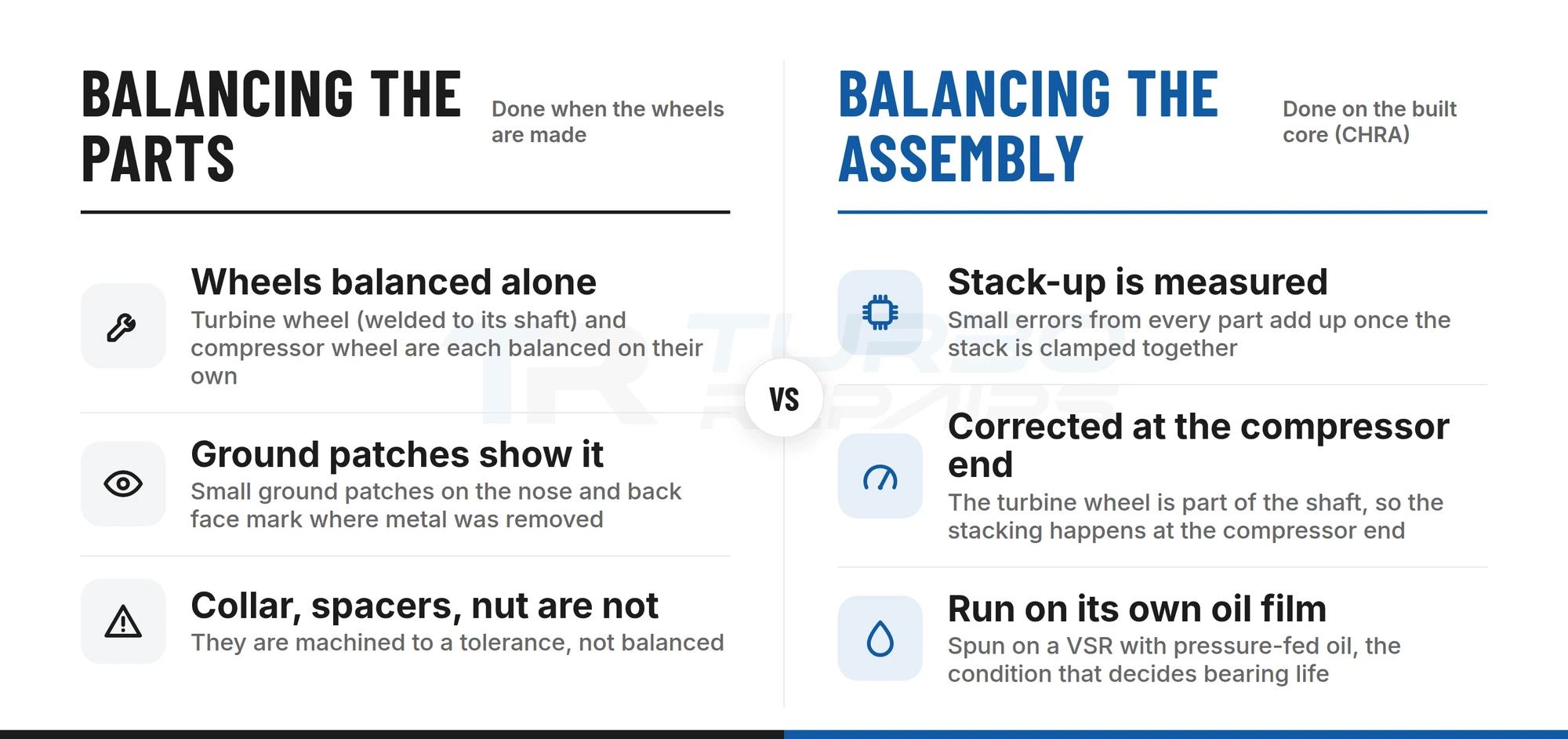
A turbocharger is balanced at two levels, and most of the confusion about turbo balancing comes from treating them as one.
Component balancing
When the wheels are made, the turbine wheel (welded to its shaft) and the compressor wheel are each balanced on their own, normally in two planes on a low-speed balancing machine. The evidence is visible on most wheels: small ground patches on the nose and the back face, where metal was taken off to bring each one into line. A new replacement wheel or shaft-and-wheel arrives balanced in the same way.
Assembly balancing
A turbo’s rotor is not one part but a stack: the shaft and turbine wheel, the thrust collar, any spacers, the compressor wheel and the nut that clamps them all. The collar, spacers and nut are not balanced at all. They are machined to a tolerance, every tolerance leaves a little error, and when the parts are clamped together those errors add up. The trade calls this stack-up imbalance.
Where it adds up matters. Because the turbine wheel is part of the shaft, assembling the core does not disturb the balance at that end. All of the stacking happens at the compressor end, so that is the end a core is corrected at.
Why small turbos cannot skip the second step
On a large commercial turbo, stack-up is rarely a problem: the wheels are balanced closely enough that the assembled error stays harmless. Small turbos are different. Their rotors are lighter and run faster, and Melett puts the dividing line at a turbine wheel of roughly 50 mm. Below that, the core passes through a resonance within its normal operating speed, which as a guide covers the turbochargers on diesel engines up to about four litres.
For those, balanced wheels on their own are not enough. That is what our turbocharger rebuild service means when it says that balancing the wheels before assembly is not the same as VSR-balancing the assembled core: only the second catches the stack-up of every component together.
What VSR Balancing Is
VSR stands for vibration sorting rig. It balances the assembled core, the centre housing rotating assembly or CHRA, by running it rather than by weighing its parts.
How the rig runs a core
The core is clamped into an adapter that stands in for its turbine housing, and the adapter sits on a flexible mounting. Compressed air is directed into the turbine to drive the shaft while oil is fed to the bearings under pressure, as the engine would feed them, and a guard covers the compressor wheel. An accelerometer reads the vibration of the mounting and a sensor reads the shaft’s speed.
The core is then run up through its speed range, to operating speed on our rig, which is the same principle used in original turbo manufacture. As it runs, the rig plots vibration against speed. A small core typically shows peaks where it passes through its resonances, and alongside each reading the rig shows the angle at which the heavy spot sits, which tells the operator where to correct.
How the correction is made
The usual correction is to remove a small amount of metal from the compressor nose or the nut, then run the core again. The cycle repeats until the vibration across the speed range sits inside the limit for that core. The correction is made at the compressor end, in one plane, because that is where the stack-up lives; the two-plane work was done when the wheels themselves were balanced.
Why it is more than a correction
- It measures the real assembly. Stack-up, the clamping of the nut and the fit of every part are all in the reading.
- It measures it running. The core spins on its own pressure-fed oil film, which is the condition that decides whether the bearings survive.
- It is a test as well as a fix. A core that will not come into balance, or makes an odd noise as it runs up, is pointing at a part out of tolerance or an assembly error before the unit is ever boxed.
Cores can also be balanced at low speed, on a conventional two-plane machine with the shaft pre-lubricated rather than pressure-fed, and that corrects stack-up too. What it cannot show is how the core behaves as it passes through the resonances inside its working range, which is why high-speed balancing became the standard for small turbos.
When a Rebuild Needs a Fresh Balance
Every time. Melett’s guidance is that a core must be balanced again even when every original component goes back in, because loosening and retightening the compressor nut on its own changes the balance of the rotor. A rebuild cannot avoid that step: the compressor wheel has to come off the shaft before the bearings, thrust parts and seals can be renewed.
Some situations make it more pressing still:
- A new wheel or shaft. A replacement compressor wheel or shaft-and-wheel is balanced as a part, but the stack it joins is not the stack it was balanced in.
- A damaged wheel. A wheel with bent, chipped or eroded blades has lost mass unevenly. That is not something to balance around; a wheel that fails inspection is replaced, and the new stack is balanced.
- Lower-grade parts. Parts made to looser tolerances add more stack-up, and Melett notes that they make a core harder to balance to the right level. That is one reason our rebuilds use genuine OE or OEM-grade components.
The reverse is also true. A rebuild that skips the balance can look perfect on the bench and still wear its new bearings out early, which is why balancing belongs to the rebuild itself and is not an optional extra.
Turbo Repairs · Epsom workshop
Have your turbo rebuilt and balanced as one rotor
Post your turbocharger in and it is stripped, measured and rebuilt, then its assembled core is spun on our VSR and trimmed before the unit is bench-tested. You get your own turbo back with a core balanced as it will actually run.
Lifetime, unlimited-mileage warranty · Mail-in from the UK and internationally · Bench-tested and calibrated before it ships
Where Balancing Sits in Our Rebuild
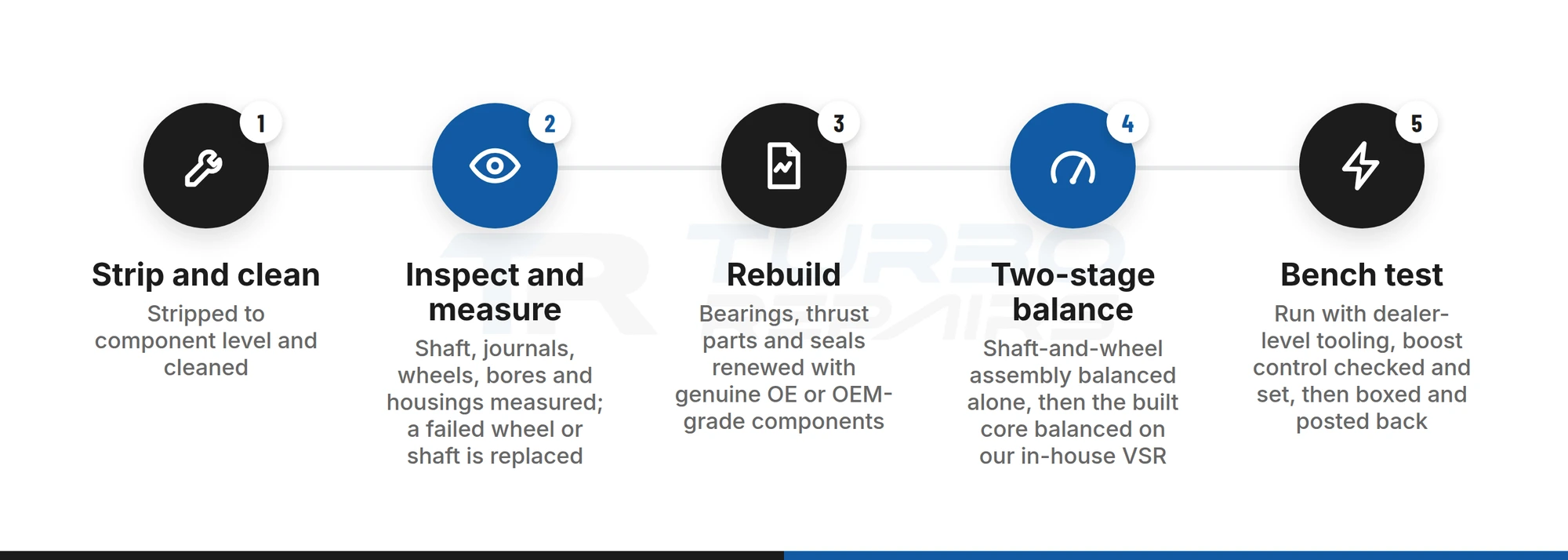
Balancing is one step in the order every turbo goes through on our bench, and it comes after the steps that decide whether the rotor is worth balancing at all. You, or the garage working on the car, remove the turbocharger and post it to us, and the online Repair Form tells us the vehicle and its symptoms before it arrives.
- Strip and clean. The unit is stripped to component level and cleaned.
- Inspect and measure. The shaft, journals, wheels, bearing bores and housings are measured against the original specification. A wheel or shaft that fails is replaced rather than balanced around.
- Rebuild. Bearings, thrust parts and seals are renewed with genuine OE or OEM-grade components, uprated where the original has a known weakness.
- Two-stage balance. The shaft-and-wheel assembly is balanced on its own, then the fully assembled core is spun to operating speed on our in-house VSR and trimmed until residual vibration is inside limits.
- Bench test. The finished unit is set up and run on the bench with dealer-level diagnostic and calibration tooling, and its boost control is checked and set before it is boxed and posted back, ready to refit.
Bench time is typically one to three working days from arrival, plus postage each way, and every rebuild carries a lifetime, unlimited-mileage warranty. Our about page explains who does the work, and independent garages send units in for their customers in exactly the same way owners do.
What You Can and Cannot Check Yourself
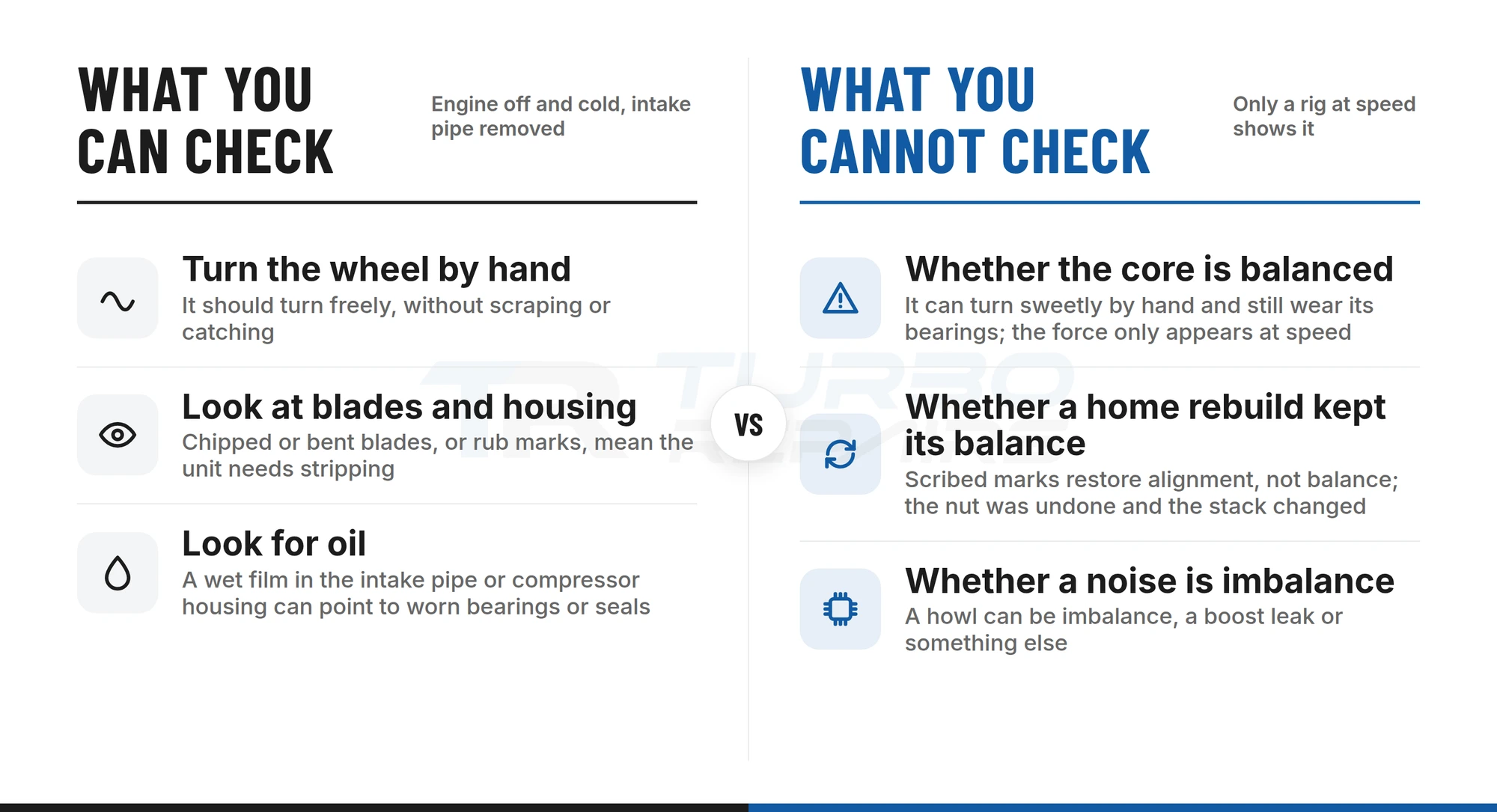
Balance is the one property of a turbocharger an owner cannot measure. What you can check are the things imbalance, or its consequences, leave behind.
What you can check
With the engine off and cold and the intake pipe removed from the compressor inlet:
- Turn the compressor wheel gently by hand. It should turn freely, without scraping or catching.
- Look at the blades and the housing. Chipped or bent blades, or rub marks on the housing wall, mean the wheel has touched or been hit, and the unit needs stripping.
- Look for oil. A wet film in the intake pipe or the compressor housing can point to worn bearings or tired seals.
- Feel the shaft play. Some play is normal on a journal-bearing turbo and the standard is different on a ball-bearing one. Our guide to common turbocharger problems explains how to read it.
What you cannot check
- Whether the core is balanced. A core can turn sweetly by hand and still be out by enough to wear its bearings, because the force only appears at speed.
- Whether a noise is imbalance. A howl from the turbo area can be imbalance, a boost leak or something else entirely, and only stripping and running the core separates them.
- Whether a home rebuild kept its balance. Some home rebuilders scribe a line down the shaft tip, the nut and the compressor wheel before stripping, so the parts go back in the same position. That restores the alignment of the parts, not the balance: the nut has been undone, and new bearings and a new thrust collar change the stack. As our K03 and K04 page puts it, a kit cannot balance a reassembled rotating assembly.
- Whether a second machine agrees. Melett notes that two VSRs rarely draw the same graph for one core, because the adapter and the clamping force differ from machine to machine and operator to operator. A different reading on another rig is not, on its own, evidence that a core is out.
Turbo Balancing FAQ
Does a turbo need balancing after it has been rebuilt?
Yes. The compressor wheel has to come off the shaft to renew the bearings and seals, and undoing and retightening its nut changes the balance even when every original part goes back in. On a small turbo the assembled core then has to be balanced as one rotor.
If the new wheels are already balanced, why balance the core?
Because balanced parts do not make a balanced assembly. The thrust collar, spacers and nut are machined rather than balanced, and their small errors add up at the compressor end when the stack is clamped together. Only balancing the assembled core corrects that stack-up.
Can I keep the balance by marking the parts before I strip the turbo?
Marking puts the parts back in the same positions, which is better than nothing, but it does not restore the balance. The nut has been undone and the new bearings and thrust collar change the stack, so the core still needs balancing as an assembly.
Is turbo balancing like balancing a car wheel?
In principle, yes: a wheel needs balancing after a new tyre goes on, and a core needs balancing after it has been dismantled and rebuilt. The difference is speed. A small turbo core passes through resonances inside its own working range, so it has to be checked while running through them.
Will my core show the same balance graph on another workshop’s machine?
Rarely. The adapter, the clamping force and the machine itself all affect the reading, so two VSRs seldom draw the same graph for one core. Readings are compared on the same rig, against the limit for that core.
Is every rebuild balanced, and what does a rebuild cost?
Every turbo we rebuild is VSR-balanced in-house before its bench test. Rebuilds start from £185 + VAT, with your price confirmed once the unit has been inspected, and every rebuild carries a lifetime, unlimited-mileage warranty.
Final Thoughts
Balance belongs to the assembled rotor, not to its parts. Two wheels that were each balanced when they were made can still form an out-of-balance core once the collar, nut and shaft are stacked together, and the error only shows itself at the speeds where it does its damage.
A rebuild cannot leave that stack alone, because renewing the bearings means taking the compressor wheel off. So the honest test of any turbo rebuild is simple to ask about: was the assembled core balanced afterwards, running, on its own oil? On every rebuild we carry out, it is.
Turbo Repairs · Epsom workshop
Send in the turbo, get back a balanced core
Complete the Repair Form with your vehicle and its symptoms, then post the turbocharger to us complete. It is rebuilt on genuine OE or OEM-grade parts, balanced as an assembly on our VSR and bench-tested before it comes back ready to refit.
Lifetime, unlimited-mileage warranty · Mail-in from the UK and internationally · Bench-tested and calibrated before it ships