

Summary We rebuild the turbocharger from a Mitsubishi L200 with the 2.5 or 2.4 DI-D diesel from £185 + VAT, and send your own unit back bench-tested and ready to refit. Start with the engine table below: the trade lists several different turbos for these engines, and only a turbo with variable vanes can develop the sticky-vane fault so many L200 owners search for.
On a 2.5 L200 the engine code narrows almost nothing. The listings file every 2.5 diesel they give a code for, from a 1996 turbo-diesel to a 2015 DI-D, as a 4D56 and hang three different turbochargers on it, so the year, the power output and the label on the turbo do the identifying.
One 2.4 DI-D turbocharger, 49335-01700, is listed for both the L200 and the Fiat Fullback, and one seller titles it a 2.5 while another calls it a 2.4.
This page is about the turbocharger on the diesel Mitsubishi L200 pick-up: which engine and turbo your truck carries, whether that turbo controls boost with vanes or a wastegate, what the common symptoms point to, and how we rebuild it. The Mitsubishi turbocharger families themselves, and the 49-number format on their labels, are covered on our Mitsubishi MHI turbo repair page.
- Vehicle: the diesel Mitsubishi L200, which the listings pair with the Triton; the Fiat Fullback is listed with the same 2.4 turbo
- Engines: the 2.5 turbo-diesel and DI-D (4D56), listed up to 2015, and the 2.4 DI-D (4N15), listed from 2014
- Turbos listed on the 2.5: 49135-02110, 49135-02650, 49135-02652, VT10 and VT16/VT17
- Turbos listed on the 2.4: the 49335-01700 group, 49335-01410 and 49335-02100
- Boost control: varies by unit, so check whether yours has vanes before blaming sticky ones
- What we do: rebuild your own turbocharger, sent to us complete with its actuator attached
- Prices: a rebuild of your own turbo from £185 + VAT; a replacement turbo from £450 + VAT; an electronic actuator repaired on its own from £100 + VAT
- Bench time: typically one to three working days
- Warranty: lifetime, unlimited mileage
Which L200 Engine and Turbo Do You Have?
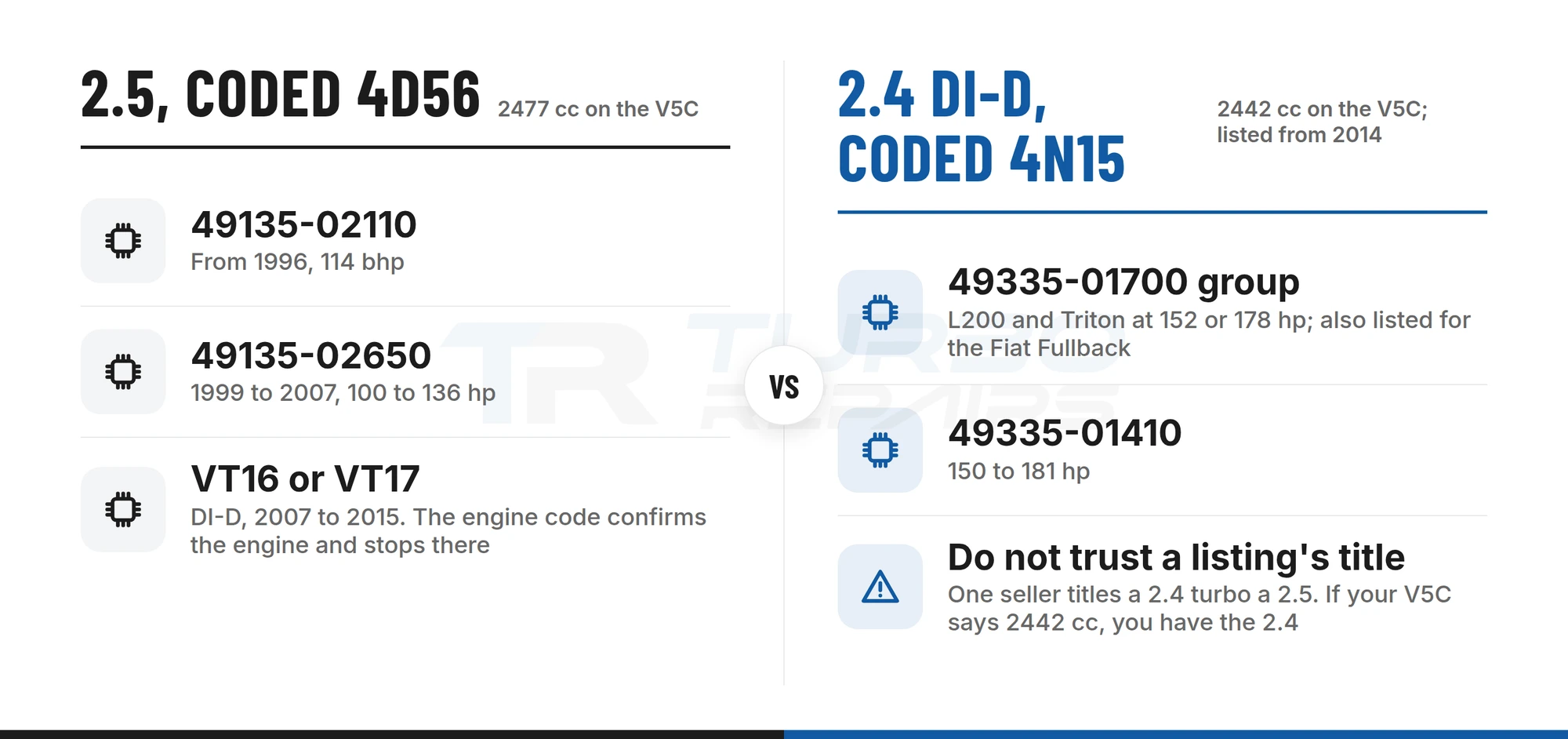
A diesel L200 carries one of two engine families. The 2.5, coded 4D56, runs from the turbo-diesel trucks of the 1990s to the DI-D listed up to 2015. The 2.4 DI-D, coded 4N15, is listed from 2014. The cylinder capacity in section P.1 of your V5C separates them: 2477 cc for the 2.5 and 2442 cc for the 2.4.
Use the capacity rather than the heading of a parts listing. Some sellers file the 2.4’s turbo under a 2.5 title, so the number in a listing name is not a reliable guide to the engine.
| Engine as listed | Years and outputs as listed | Turbo reference | Vanes stated? |
|---|---|---|---|
| 2.5 turbo-diesel, 4D56 | From 1996, 114 bhp; the same listing covers the Shogun | 49135-02110 (Mitsubishi number MR212759) | Not stated |
| 2.5 turbo-diesel, 4D56 | 1999 to 2007, 100 to 136 hp; also listed for the Pajero and L300 | 49135-02650 | Not stated |
| 2.5 (listed as TDI) | L200 and Pajero III; no years or engine code given | 49135-02652 (MR968080, MR968081) | Variable geometry |
| 2.5 DI-D | 100 to 136 hp, in a listing that spans 2000 to 2016 across the L200, Triton, Pajero, Pajero Sport II and L300/L400 | VT10 (VA420088) | Not stated |
| 2.5 DI-D, 4D56 | 2007 to 2015, at 89, 126 or 165 hp; also listed for the Pajero and Triton | VT16 / VT17 | Not stated |
| 2.4 DI-D, 4N15 | L200 and Triton from 2014, Fiat Fullback from 2016, at 152 or 178 hp | 49335-01700 to 49335-01703 (also listed as 1515A322) | Not stated |
| 2.4 diesel, 4N15 | From 2015, 150 to 181 hp; also listed for the Pajero Sport and Fullback | 49335-01410 | Not stated |
| 2.2 and 2.4 diesel | From 2014, 154 and 182 hp versions | 49335-02100 (listed against 1515A381) | Not stated |
Treat the table as a map of what has been sold for the L200, not as a parts choice. Where listings overlap, the label on your own turbo decides.
The 2.5: one engine code, several turbos
The three listings that give an engine code for the 2.5 all say 4D56, yet they describe three different turbochargers: 49135-02110 on a 114 bhp truck from 1996, 49135-02650 on 100 to 136 hp versions between 1999 and 2007, and a VT16 or VT17 on the DI-D between 2007 and 2015. Two more 2.5 listings, 49135-02652 and the VT10, cover the same years without giving a code at all.
So on a 2.5 the engine code confirms the engine and stops there. The year narrows the field, the power output narrows it further, and the label finishes the job. Your V5C gives power in kilowatts in section P.2; the VT16/VT17 listing quotes 66 to 123 kW across its three outputs, which makes a useful cross-check against the horsepower figures sellers use.
The 2.4 DI-D and the Fiat Fullback
The 2.4 is a tidier picture. Its listings centre on references beginning 49335: the 49335-01700 group for the L200 and Triton at 152 or 178 hp, and 49335-01410 for 150 to 181 hp. A third reference, 49335-02100, is listed across 2.2 and 2.4 versions. Mitsubishi’s own part numbers, such as 1515A322 and 1515A381, appear on the same listings.
The Fiat Fullback shares the 49335-01700 listing with the L200, so a Fullback owner reading this page is reading about the right turbo. The trap runs the other way: because one seller titles that unit a 2.5, a search for a 2.5 L200 turbo turns up 2.4 parts. If your V5C says 2442 cc, you have the 2.4, whatever a listing calls it.
Reading the label
The reference is on a label or plate on the turbo’s housing. A number made of 49, three digits, a dash and five digits is a Mitsubishi turbocharger reference, and the MHI page linked above explains how those numbers are built. A VT reference, such as VT10 or VT16, is a different format. Photograph the whole label rather than copying one number from it, because the vehicle maker’s own part number often sits beside the turbo reference. Our guide to finding the number on your turbo covers the other label formats.
If the label has burnt or peeled off, send the turbo anyway. It is identified on the bench before any work starts, and the registration on the Repair Form lets us check it against the truck it came from.
Newer L200s and anything not in the table
Mitsubishi Motors UK lists the all-new L200 Series 7 with a 2.4 bi-turbo diesel. None of the listings this page is built on covers that truck. If yours is one, or if your L200 is not in the table, put the registration and a photograph of the label on the Repair Form and we will confirm the unit with you before you post anything.
We also cover other working pick-ups and 4x4s, such as the Isuzu D-Max, the Toyota Hilux, the Ford Ranger, the Nissan Navara D40 and the Land Rover Defender, with the rest of the range on our Land Rover page. Each of those pages is about its own vehicle, and none of them suggests a part that fits an L200.
Fixed-Geometry or Variable-Vane: Why It Changes the Fault
Every turbocharger needs a way to stop making boost once the engine has enough, and there are two. A fixed-geometry turbo lets surplus exhaust bypass the turbine wheel through a wastegate, a small flap worked by an actuator. A variable-geometry turbo has a ring of movable vanes around the turbine wheel instead, which close to raise boost at low engine speed and open as speed rises.
The rotating parts, meaning the shaft, bearings, seals and wheels, wear the same way in both. What differs is the boost-control mechanism, and with it the list of faults that are even possible. A wastegate turbo cannot have sticky vanes, and a vane turbo has no wastegate flap to seize.
What the listings say about the L200
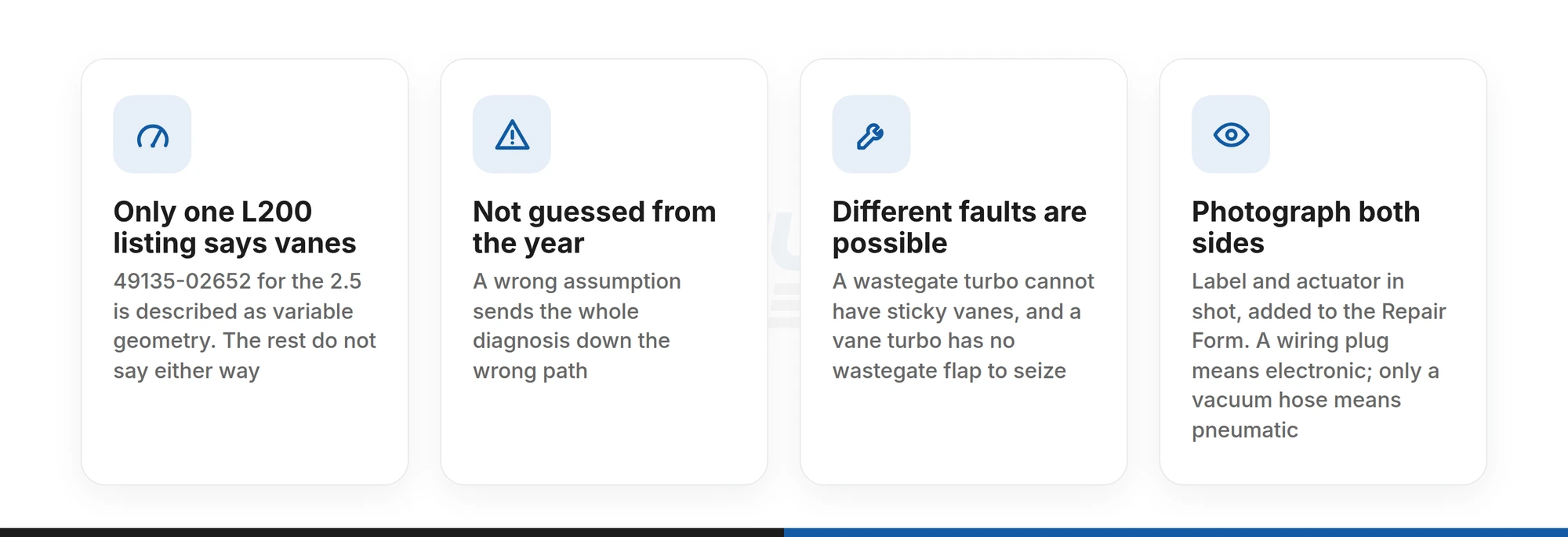
Of the L200 listings we have read, only one, 49135-02652 for the 2.5, is described as variable geometry. The rest do not say either way. We do not assign a type to the others from the year alone, because a wrong assumption sends the whole diagnosis down the wrong path.
How to check yours
Both designs have an actuator rod working a lever on the turbine housing, so the rod on its own does not settle it. The label does, checked against the turbo maker’s data, and so does the unit on our bench. Photograph the turbo from both sides with the label and the actuator in shot, add the photographs to the Repair Form, and we will tell you what we can from them before anything comes off the truck.
The same photographs show what drives the mechanism. An actuator with a wiring plug is electronic; one with only a vacuum hose is pneumatic. That tells you the actuator type rather than the turbo type, because either kind can work vanes or a wastegate, and we have no source that settles which kind your L200 carries, so check yours. An electronic actuator can be repaired on its own from £100 + VAT through our electronic turbo actuator repairs. We do not repair pneumatic actuators: one stays attached to the turbo, is checked as part of the rebuild, and if the can itself has failed we tell you before the work goes ahead.
Sticky Vanes on the VGT Engines
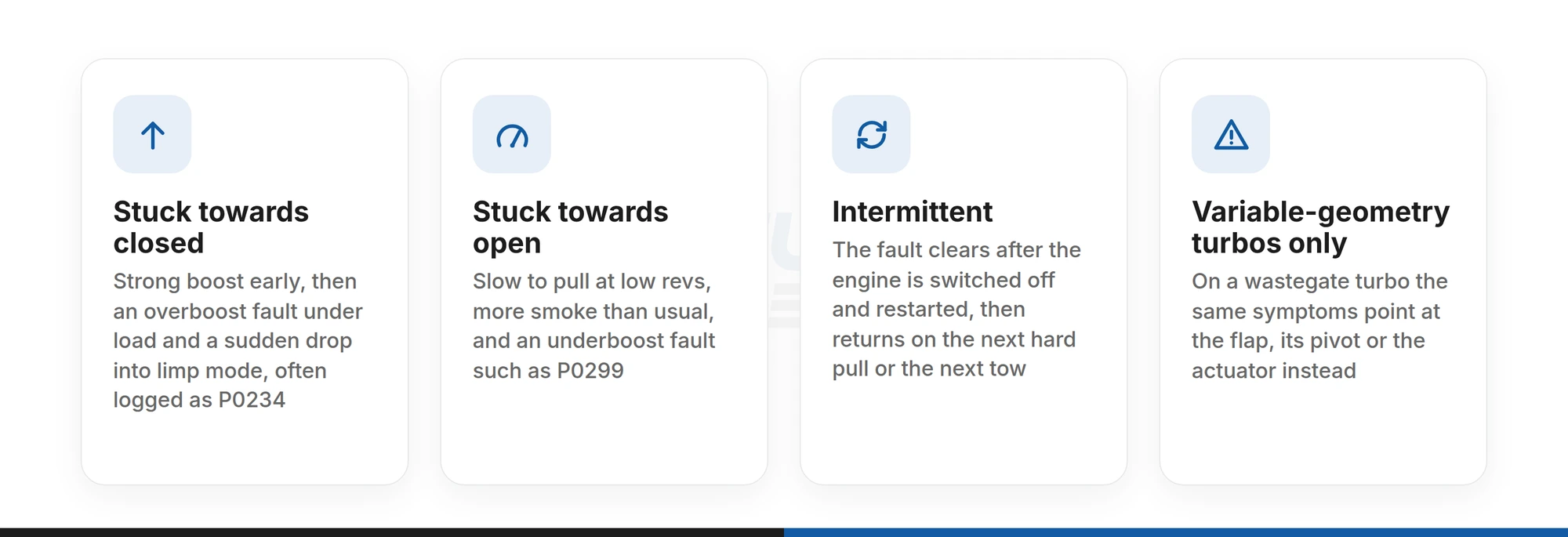
Sticky vanes are a fault of variable-geometry turbos only. If your L200’s turbo has vanes, they are the first boost fault to rule out. If it has a wastegate, the same symptoms point at the flap, its pivot or the actuator instead, and the symptom table in the next section covers both.
Why the vanes stick
The vanes pivot in a ring that sits in the exhaust flow with small running clearances. Soot and oil residue build up on the vane faces and around their pivots, and they build fastest when the turbine housing never gets hot enough to burn them off: short journeys, long idling and slow work around a site or a farm.
A pick-up that spends its week at low load and its weekend towing gives the deposits time to form, then asks the mechanism for its full travel. Wear adds to it, because the pivots and the ring that moves them wear with use, and a worn mechanism catches where a clean one would slide.
What sticky vanes feel like
- Stuck towards closed: strong boost early, then an overboost fault under load and a sudden drop into limp mode, often logged as P0234.
- Stuck towards open: slow to pull at low revs, more smoke than usual, and an underboost fault such as P0299.
- Intermittent: the fault clears after the engine is switched off and restarted, then returns on the next hard pull or the next tow.
Neither code names a part. Each says only that boost came out higher or lower than the engine management wanted, and a split hose or a faulty pressure sensor can set them just as easily as a stuck vane ring. Our guide to overboost and underboost faults takes the possible causes one at a time.
Freeing the vanes or rebuilding them
A stuck mechanism can sometimes be freed with the turbo on the truck, and a long hard run can loosen it for a while. Neither removes the deposits from the vane faces and pivots, and neither touches the wear, so the fault tends to return. Our guide to how variable-vane turbos work and why they stick explains why a fault that clears itself is still a fault.
In a rebuild the vane assembly comes out of the turbine housing. The vanes, their pivots and the ring that moves them are cleaned, inspected and measured, worn parts are renewed, and the mechanism is reassembled and checked to sweep its full travel without binding.
What Fails, and What Each Symptom Points To
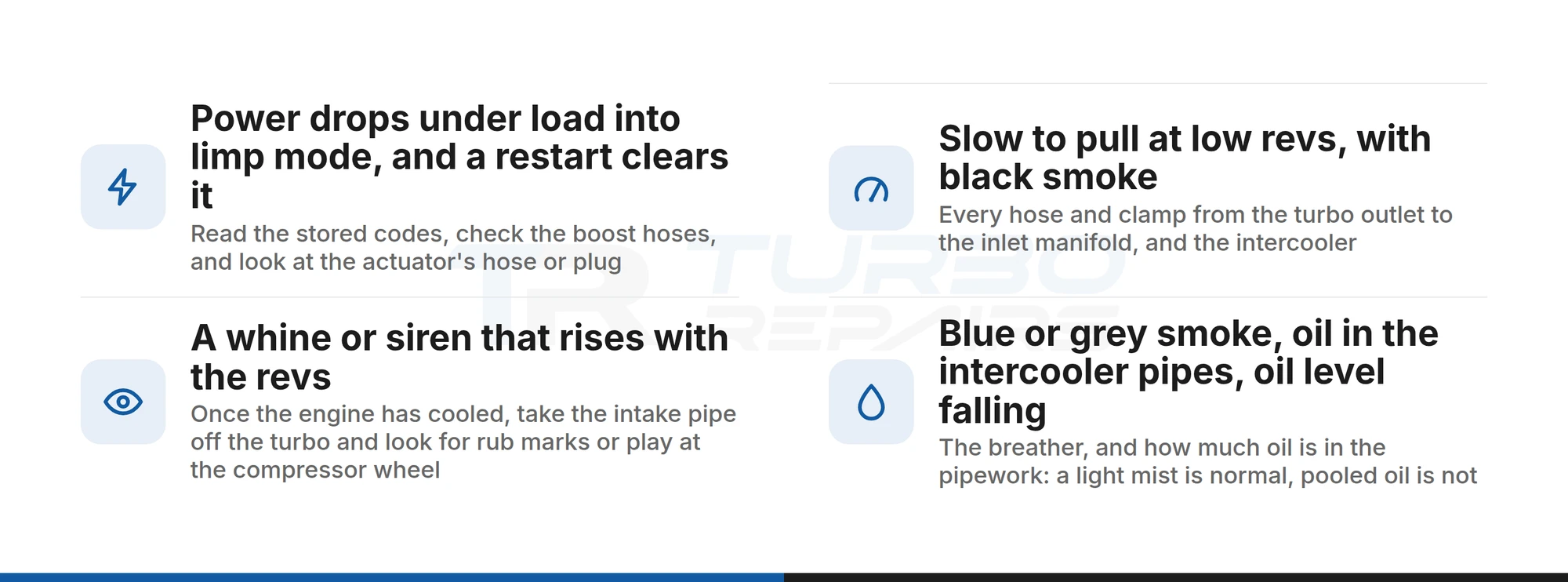
Most L200 turbo faults fall into two groups: the rotating assembly wearing out, and boost control misbehaving. They feel different from the driver’s seat, and they call for different checks before anything is unbolted.
| What you notice | What it usually points to | Check first |
|---|---|---|
| Power drops under load into limp mode, and a restart clears it | Boost control: sticking vanes, a sticking wastegate, or the actuator | Read the stored codes, check the boost hoses, and look at the actuator’s hose or plug |
| Slow to pull at low revs, with black smoke | A boost leak, vanes stuck open, or a wastegate stuck open | Every hose and clamp from the turbo outlet to the inlet manifold, and the intercooler |
| A whine or siren that rises with the revs | Wear in the bearings, or a boost leak whistling | Once the engine has cooled, take the intake pipe off the turbo and look for rub marks or play at the compressor wheel |
| Blue or grey smoke, oil in the intercooler pipes, oil level falling | Worn seals and bearings, or crankcase pressure pushed through the breather | The breather, and how much oil is in the pipework: a light mist is normal, pooled oil is not |
| Grinding or scraping, then a sudden loss of all boost | A wheel touching its housing or breaking up | Stop driving; the turbo has to come off |
The causes stay on the truck
A turbo rarely fails on its own account. Its shaft spins on a film of engine oil, so a restricted oil feed, oil run past its change interval or debris carried in the oil wears the bearings. Anything drawn into the intake damages the compressor wheel, and a boost leak makes the turbo spin harder to reach the pressure the engine management asks for.
Working pick-ups add heat. Switching off straight after towing or a long climb stops the oil flow while the bearing housing is at its hottest, and the oil left inside it cooks. Letting the engine idle for a minute or two before switching off lets the oil carry that heat away.
Whatever caused the failure has to be put right before a rebuilt or new turbo goes on, or the replacement starts the same clock. Our guide to replacing a turbocharger covers the causes to check while the unit is off, and our guide to common turbocharger problems sorts symptoms by the part of the turbo they start in.
If the evidence points at the turbo, keep the truck to gentle, essential journeys and leave the trailer behind. A worn turbo can pass oil into the intake and the exhaust, and a failing wheel can shed pieces downstream into the intercooler or the engine itself.
Turbo Repairs · Epsom workshop
Not sure whether yours has vanes? Let us look before it comes off
Add the registration, the symptoms, any fault codes and photographs of the turbo and its label to the Repair Form. We tell you what the evidence points to, and which unit you are likely to have, before you take anything off the truck.
Lifetime, unlimited-mileage warranty · Mail-in from the UK and internationally · Bench-tested and calibrated before it ships
Our L200 Turbo Rebuild
You get your own turbocharger back, not an exchange unit from a shelf. On an L200 that matters more than usual: with several turbos listed for the 2.5, the unit that goes back on your engine is the one that came off it, so the identification question answers itself.
What happens on the bench
- Checked on arrival. Before it is opened, the turbo is examined as it came off your truck, which keeps the repair aimed at the fault it really has.
- Stripped and measured. It is stripped to component level, and the shaft, wheels, bearing surfaces and housings are cleaned and measured against original tolerances.
- Renewed where worn. Bearings, seals and thrust parts are renewed with genuine OE or OEM-grade components that meet or exceed the original, a part with a known design weakness is uprated rather than reinstated, and a damaged wheel, shaft or housing is replaced.
- Boost control put right. On a vane turbo the vane assembly is cleaned or renewed until it sweeps its full travel; on a wastegate turbo the flap and its pivot are checked for wear and the actuator is set to the turbo’s specification.
- Balanced and run. The rotating assembly is balanced, the turbo is rebuilt and it is run on the bench before it is boxed.
Expect the turbo to spend one to three working days with us once it has arrived, plus the post in each direction. Every rebuild is covered by a lifetime warranty with unlimited mileage.
Rebuild, replacement or a used turbo?
Three routes put a working turbo back on an L200: your own unit rebuilt, from £185 + VAT; a replacement turbo from us, from £450 + VAT; or a used turbo from a breaker. The work on the truck, meaning removal, refit, gaskets, oil and filter, is the same whichever you choose, so the choice only moves the price of the turbo itself.
A replacement has to match your engine’s reference, and on the 2.5 that means picking the right one of several. A used turbo carries wear that nobody has measured. A rebuild measures your own unit and renews what has worn, so you know what was replaced and why.
Sometimes replacement is the right answer. If a turbo has broken up badly enough to damage its housings, we tell you once it has been measured, and we recommend replacement rather than a rebuild that would not be good value. Our turbo repair price guide explains what moves the figure.
Sending your turbo in
- Fill in the details. Complete the online Repair Form with the registration, the cylinder capacity and power output from the V5C, the mileage, the symptoms, any fault codes and photographs of the label and the actuator.
- Remove the turbo complete. Leave the actuator attached.
- Pack and post it. Cap or tape over every oil and air port, box the turbo so it cannot move in transit and post it to Unit 102 Reaver House, 12 East Street, Epsom, Surrey, KT17 1HX, United Kingdom. Our FAQs cover packing and postage.
- Findings before work. Once the turbo is stripped we report what we found and wait for your go-ahead; the rebuilt unit then comes back bench-tested and ready to refit.
Before the rebuilt turbo goes back on, renew the oil and filter and put right whatever caused the failure. On refit, prime the oil feed first: crank the engine for 10 to 15 seconds without letting it fire, as our refitting guide describes. Garages and dealers send L200 turbos to us in exactly the same way owners do.
Mitsubishi L200 Turbo Repair FAQ
How much does an L200 turbo rebuild cost?
Rebuilding your own turbocharger starts from £185 + VAT, and a replacement turbo from us starts from £450 + VAT. Taking the turbo off and refitting it is priced separately by your garage, as are the gaskets, oil and filter. Your exact price is confirmed once the unit has been inspected.
Does my L200 have sticky vanes or a wastegate?
It depends on the turbo, not the badge. Only one L200 listing we have read, 49135-02652 on the 2.5, is described as variable geometry, and the rest do not say. Send photographs of the label and both sides of the turbo through the Repair Form and we will tell you what we can before it comes off; the bench settles it for certain.
Is my L200’s turbo a Mitsubishi turbo?
Not always. A reference beginning 49 is a Mitsubishi turbocharger reference, and our MHI turbo page explains how to read one. Some 2.5 DI-D units are listed under VT references instead, which use a different format. Either way, we rebuild the unit you send.
Is the Fiat Fullback turbo the same as the L200’s?
On the 2.4 DI-D the listings put the same reference, 49335-01700, on both trucks, and 49335-01410 is listed for the Fullback as well. The label on your own turbo is the one to go by, and we rebuild Fullback turbos in exactly the same way.
Do you repair the L200’s turbo actuator?
If it has a wiring plug, it is electronic, and we repair it on its own from £100 + VAT. If it has only a vacuum hose, it is pneumatic, and we do not repair those; it stays on the turbo, is checked during the rebuild, and if it has failed we tell you before the work goes ahead.
How long will my L200 be off the road?
The turbo is typically on our bench for one to three working days. Allow for the post both ways, plus however long your garage takes to remove it and put it back.
Final Thoughts
An L200 turbo is identified in three steps. The capacity on the V5C tells you whether the truck has the 2.5 or the 2.4, the year and power output narrow the 2.5’s several turbos, and the label settles it. On a 2.5, the engine code alone settles nothing.
Find out whether your turbo has vanes before going looking for sticky ones, because a wastegate turbo shows the same symptoms for different reasons. When the evidence does point at the turbo, take it off while the wear is still in the bearings and seals rather than the wheels, and fix what caused it before the rebuilt unit goes back on.
Turbo Repairs · Epsom workshop
Send your L200’s own turbo in for a rebuild
Complete the Repair Form with the registration, the engine capacity and a photograph of the label, then post the turbo in with its actuator attached. It is checked on arrival, rebuilt to original specification, run on the bench and sent back ready to refit.
Lifetime, unlimited-mileage warranty · Mail-in from the UK and internationally · Bench-tested and calibrated before it ships