

Summary We rebuild turbochargers from the Renault Trafic and the Vauxhall Vivaro, one van sold under two badges, on its 1.9 dCi, 2.0 dCi and 1.6 dCi diesels. You or your garage take the turbo off and post it to our Epsom workshop, where it is stripped to component level, measured, rebuilt on genuine OE or OEM-grade parts, balanced and bench-tested, then posted back ready to refit. Rebuilds start from £185, bench time is typically one to three working days, and every rebuild carries a lifetime, unlimited-mileage warranty.
The badge on the tailgate tells you very little about the turbo. The engine does, and on the later 1.6 dCi the first question is not which turbocharger is fitted but how many.
The twin-turbo 1.6 dCi does not carry two copies of one turbocharger: the catalogue lists a Garrett GT1236Z as its HP turbo and a GT1549S as its LP turbo, each under its own reference.
If a Trafic or Vivaro has lost its boost, started smoking or begun to whistle, this page takes you from the badge to the engine, from the engine to the turbocharger, and from there to a decision: rebuild the unit you have, or buy another. It is written for owners, fleet operators and the garages that look after their vans.
- Vans covered: the Renault Trafic and Vauxhall Vivaro diesels, and the same van sold as the Nissan Primastar, Nissan NV300 and Fiat Talento
- Engines: 1.9 dCi (F9Q), 2.0 dCi (M9R) and 1.6 dCi (R9M), the last in single-turbo and twin-turbo form
- First check on a 1.6: count the turbochargers on the engine before anything is ordered
- Price: rebuilds from £185; replacement units from £450; your price is confirmed once the unit has been inspected
- Order a Vivaro rebuild by year and power: 1.6 CDTi, 1.9 CDTi and 2.0 CDTi listings; for a Trafic, start with the online Repair Form
- Turnaround: typically one to three working days on the bench, plus postage each way
- Warranty: lifetime and unlimited mileage, with no time limit
One Van, Several Badges: Which Engine Is in Yours?
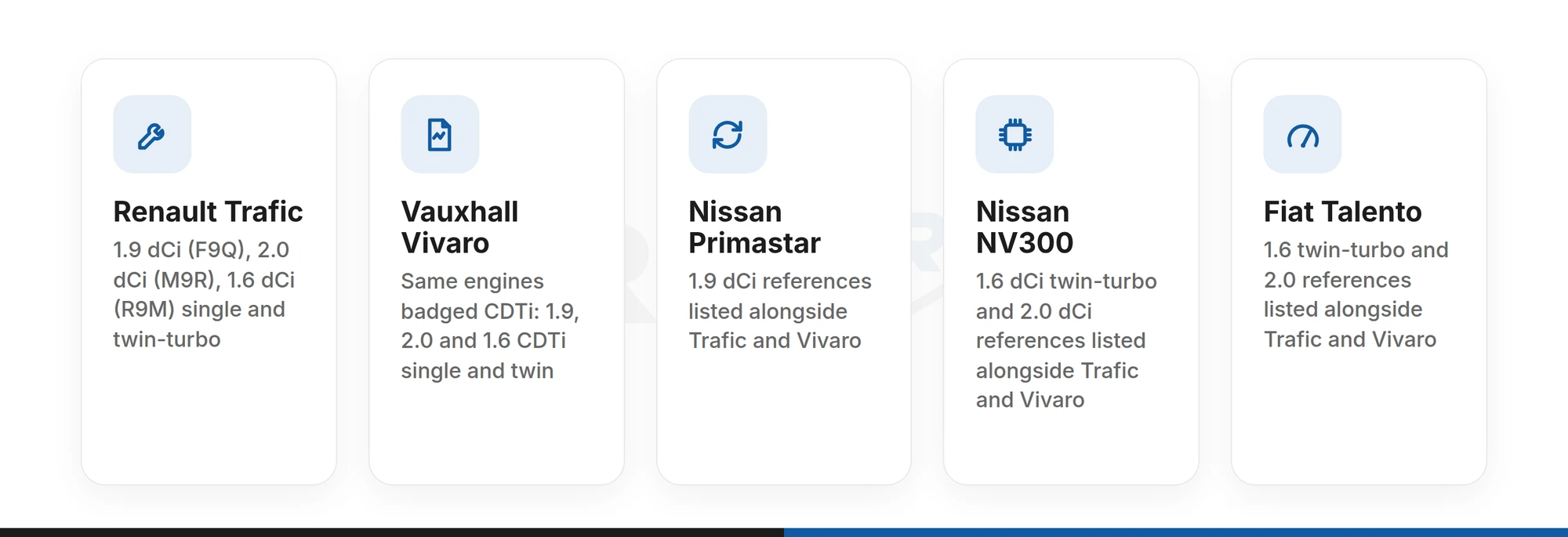
The Trafic and the Vivaro are the same van with different badges, and the turbocharger trade treats them that way. A reference catalogued for one is almost always catalogued for the other, often alongside a Nissan and, on the later vans, a Fiat. The table shows how the names line up against the engines that concern this page.
| Badge | Earlier van (Trafic II, Vivaro A) | Later van (Trafic III, Vivaro B) |
|---|---|---|
| Renault Trafic | 1.9 dCi (F9Q), 2.0 dCi (M9R) | 1.6 dCi (R9M), single and twin turbo; 2.0 dCi |
| Vauxhall Vivaro | 1.9 CDTi (F9Q), 2.0 CDTi (M9R) | 1.6 CDTi (R9M), single and twin turbo; 2.0 CDTi |
| Nissan Primastar | 1.9 dCi references listed alongside Trafic and Vivaro | — |
| Nissan NV300 | — | 1.6 dCi twin-turbo and 2.0 dCi references listed alongside Trafic and Vivaro |
| Fiat Talento | — | 1.6 twin-turbo and 2.0 references listed alongside Trafic and Vivaro |
Two practical points follow. First, a part advertised for a Primastar, NV300 or Talento is not automatically wrong for your Trafic, and one advertised for a Trafic is not automatically right: the reference decides, not the badge. Second, several of these turbochargers also turn up under the larger Renault Master, Vauxhall Movano and Nissan Interstar or NV400, and under Renault, Volvo and Mitsubishi cars. A listing naming a Movano beside your Vivaro is a sign of how widely the engine was used, nothing more.
So start with the engine. The engine size is on the logbook, and Vauxhall badges the same engines CDTi where Renault uses dCi. The turbo’s own reference is on the label on its housing, and that is the number any replacement has to match. Photograph it before the unit is cleaned or packed.
The 1.6 dCi Twin-Turbo, the 2.0 and the 1.9: Different Jobs
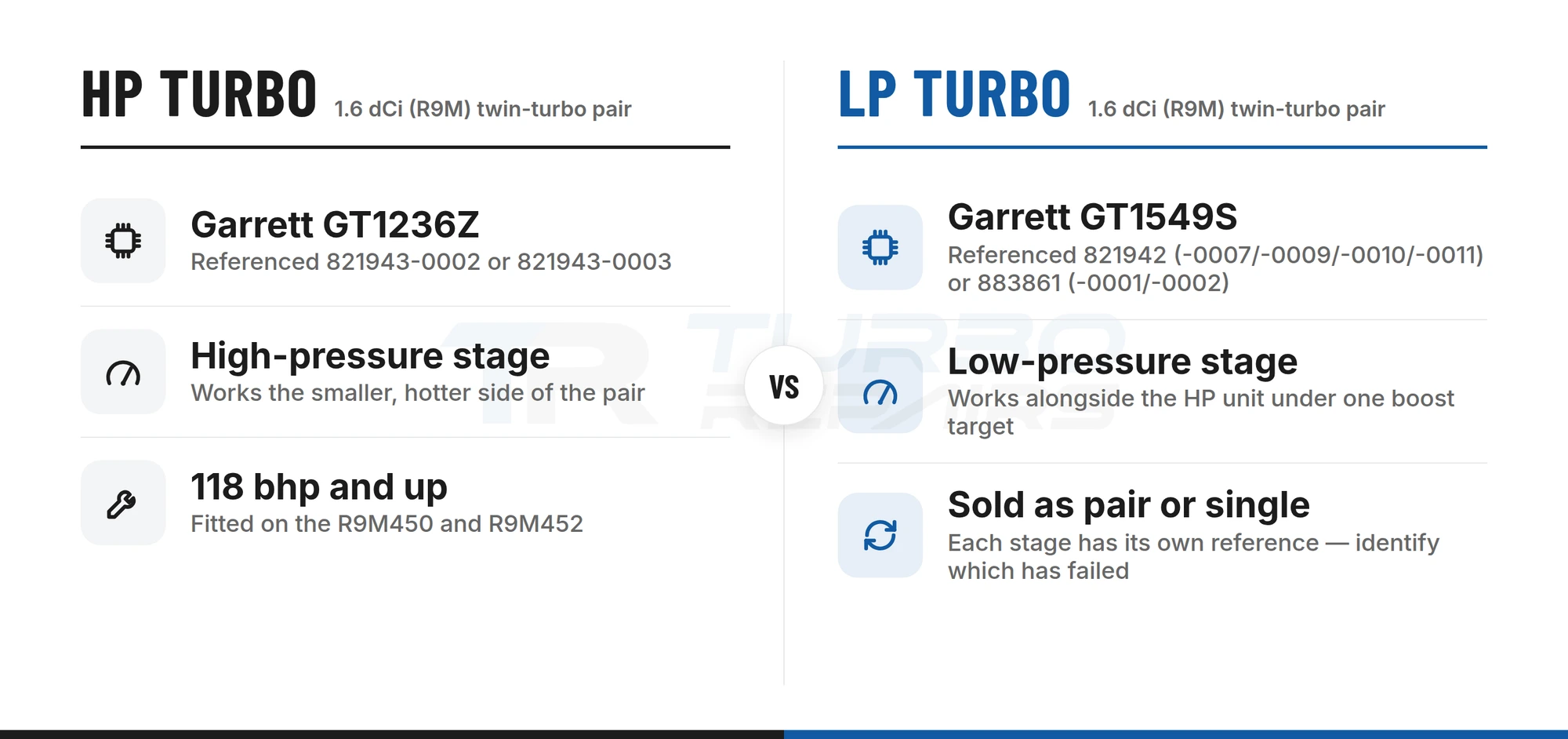
Each engine brings a different turbocharger job to the bench, and the differences matter more than the shared body shell. The references below come from trade catalogue data for the Vivaro and from published listings for the Trafic.
1.6 dCi (R9M): one turbo or two
The 1.6 dCi was catalogued in two layouts. The lower-output versions, listed at 89, 94 and 114 bhp on the R9M408 and R9M413 engines, carry a single BV38 turbocharger, referenced 5438-970-0005. A 136 bhp version is listed with a single BV38 as well, under 5438-970-0019.
The higher outputs, from 118 bhp upwards and mostly on the R9M450 and R9M452, are catalogued with a twin-turbo pair. The two are not the same unit. The catalogue lists one as the HP turbo, a Garrett GT1236Z referenced 821943-0002 or 821943-0003, and the other as the LP turbo, a Garrett GT1549S referenced 821942 (dash 0007, 0009, 0010 or 0011) or 883861 (dash 0001 or 0002). The replacement trade sells the pair both as a set and as single units.
That makes power output a clue rather than a rule: 136 bhp is listed with a single turbo while 138 bhp is listed with the pair. Counting is quicker and certain. Look at the engine: one turbocharger or two. On a twin, note which unit has failed and keep the two references separate, because each stage has its own.
Our Vauxhall Vivaro 1.6 CDTi turbo rebuild listing covers both layouts and carries the full reference table under Affected Part Numbers. The same references are listed for the 1.6 dCi Trafic.
2.0 dCi (M9R): two generations of turbo
On the earlier vans the 2.0 dCi is catalogued with three Garrett turbochargers: a GT1549S referenced 762785-0004 on the M9R780 to M9R788 engines, a GT1546JS referenced 795637-0001, and a GT1546LJS referenced 786997-0001 on the M9R630 and M9R692. The 786997-0001 is also listed for the Master, Movano and NV400 on the M9R, and on the 2.3 M9T.
The later Trafic, Vivaro, NV300 and Talento 2.0 dCi are listed with a different family of references altogether, 49131-07400, 49131-07430 and 49131-07500, across engine versions including the M9R650, M9R710 and M9R717. A reference from one generation is no guide to the other. Our Vauxhall Vivaro 2.0 CDTi turbo rebuild listing covers the earlier vans; a later 2.0 comes to us through the Repair Form and is identified on the bench.
1.9 dCi (F9Q): the oldest vans
The 1.9 dCi on the F9Q760 and F9Q762 is catalogued with six references across its years: five Garrett GT1549S units (751768-0004 and -0005, 703245-0002, 717345-0002 and 738123-0004) and one K03, 5303-970-0048. The same F9Q turbochargers are listed for the Primastar, the Movano and Interstar, and for Renault, Volvo and Mitsubishi cars of the period.
These are the oldest vans in the range, and a label that is scorched or missing is no reason to hold the unit back. Send it as it is and it is identified on the bench. Our Vauxhall Vivaro 1.9 CDTi turbo rebuild listing covers these references.
What Fails on Trafic and Vivaro Turbochargers
Whichever engine it sits on, a turbocharger is a turbine wheel and a compressor wheel joined by one shaft. Exhaust gas drives the turbine, and the compressor feeds pressurised air to the engine. The shaft turns in a centre bearing housing on a film of engine oil, with a seal at each end, and boost-control hardware on the unit, vanes or a wastegate depending on the design, sets how hard the exhaust drives the turbine.
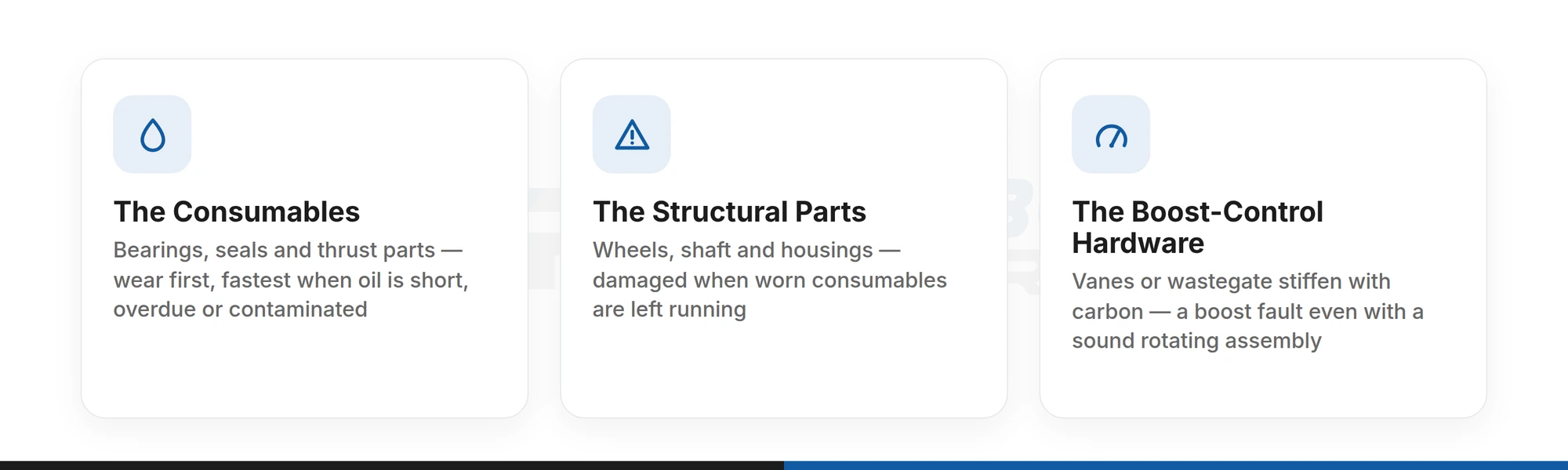
What wears out falls into three groups, and the split is what decides the size of the repair.
- The consumables. Bearings, seals and thrust parts. They wear first, and fastest when the oil is short, overdue or contaminated. Once the bearings have worn, the shaft moves further than it should and the seals stop holding oil inside the housing.
- The structural parts. The wheels, the shaft and the housings. Built to last the life of the turbo, they are damaged when worn consumables are left running: a wheel touches its housing, a compressor wheel sheds fragments, or the shaft bends. The turbine wheel and shaft are one assembly, so damage to either means both.
- The boost-control hardware. Carbon builds up until vanes or a wastegate no longer move freely. That produces a boost fault even when nothing in the rotating assembly has worn.
A rebuild that only needs consumables sits at the bottom of the price range. Every structural part that fails inspection moves it up. That is why the moment a van is taken off the road matters as much as the fault itself.
On the twin-turbo 1.6, the same list applies to each stage, and the two can be at different points on it. The unit that has failed is the one to identify first; tell us on the form which stage it is, and we report on what the strip finds.
Symptoms on a Working Van
A van has a reason to keep going that a car often does not: it is earning. That is exactly how a bearings-and-seals rebuild becomes a wheel and shaft rebuild. The symptoms below are the usual signs of a failing turbo on these engines, and each one also has a cheaper imitator worth ruling out.
- Loss of power or limp mode, often with an underboost (P0299) or overboost (P0234) code. The code records a pressure disagreement, not a failed part; a split intercooler hose or loose clip can raise it as easily as a worn turbo. Our guide to turbo overboost and underboost codes explains what each can and cannot tell you.
- Boost that comes in late, drops out or spikes. Typical of boost-control hardware that is sticking rather than a worn rotating assembly.
- A whistle or siren that rises as the turbo spools. A metallic note that follows the revs points inside the turbo; a hiss under load points at the pipework.
- Blue or grey smoke from the exhaust. Oil crossing the turbo’s seals, or an engine burning oil through its own wear, which no turbo rebuild will cure.
- Oil in the intercooler pipes, or leaking from the turbo. A strong pointer to worn bearings and seals.
- Shaft play or blade damage on the compressor wheel, seen or felt with the intake pipe off. The turbo has to come off.
Our guide to turbo failure symptoms sorts these by where in the unit they start and lists the imitators in full. If you hear a metallic whine or see oil smoke, stop working the van hard. A few more days of deliveries on a failing bearing can cost you the wheels and shaft as well.
Rebuild or Replace on a High-Mileage Van?
If your van has a big mileage behind it, it is tempting to read the odometer as a verdict on the turbo. It is not. The parts that wear with mileage are the consumables, and those are what a rebuild renews. The housings, wheels and shaft either survive inspection or they do not, and the mileage cannot tell you which.
The work on the van is the same either way: the turbo comes off, a unit goes back on, and the oil feed is primed before the first start. What differs is how the unit that goes back is chosen.
- A replacement has to be matched. On these vans that means the right engine, the right generation on a 2.0, and on a 1.6 the right layout and the right stage. A “Trafic 1.6 turbo” could be a single BV38, the HP unit of a pair or the LP unit of a pair.
- A rebuild has nothing to match. The turbo that goes back is the one that came off, so the reference, the stage and the calibration are already the van’s own.
High mileage does make one check worth doing before anything is sent. If the engine is using oil through its own wear, a rebuilt turbo will be sitting in the same smoke. Rule that out first.
Replacement is the better value when too much has gone at once. A wheel, the shaft and a housing on top of the consumables leaves little of the original, and when a unit is not worth rebuilding we say so and recommend replacement instead.
Turbo Repairs · Epsom workshop
Get the van’s own turbo measured, not guessed at
Post the turbocharger in and it is stripped, measured part by part and priced on what it actually needs. If a rebuild is the right route, the unit that goes back on the van is the one that came off, reference and stage unchanged.
Lifetime, unlimited-mileage warranty · Mail-in from the UK and internationally · Bench-tested and calibrated before it ships
What a Trafic or Vivaro Turbo Replacement Costs
Our published prices start from three points:
- Rebuild of your own turbocharger: from £185.
- Replacement turbocharger from us, reconditioned or new exchange: from £450.
- Labour to remove and refit: not included in either, and charged by whoever does the work.
Where a rebuild lands above the floor depends on what survived inside. A bearings-and-seals job sits near the bottom; each wheel, shaft or housing that fails inspection moves it up. If you already know your Vivaro’s engine, year and power output, the 1.6, 1.9 and 2.0 CDTi listings set the rebuild price for that van. For a Trafic, the Repair Form is the starting point. Either way, the unit is identified on the bench before any work starts.
Replacement prices published in the trade for these vans run from around £250 to beyond £1,300, depending on the engine and on whether the unit is reconditioned or new. On the twin-turbo 1.6, a pair bought as a set costs roughly twice a single stage, which is worth knowing before both units are replaced because one has failed.
The full breakdown, including what moves a rebuild up its range and when replacement is the better buy, is in our guide to van turbo repair prices.
Our Trafic and Vivaro Turbo Rebuild
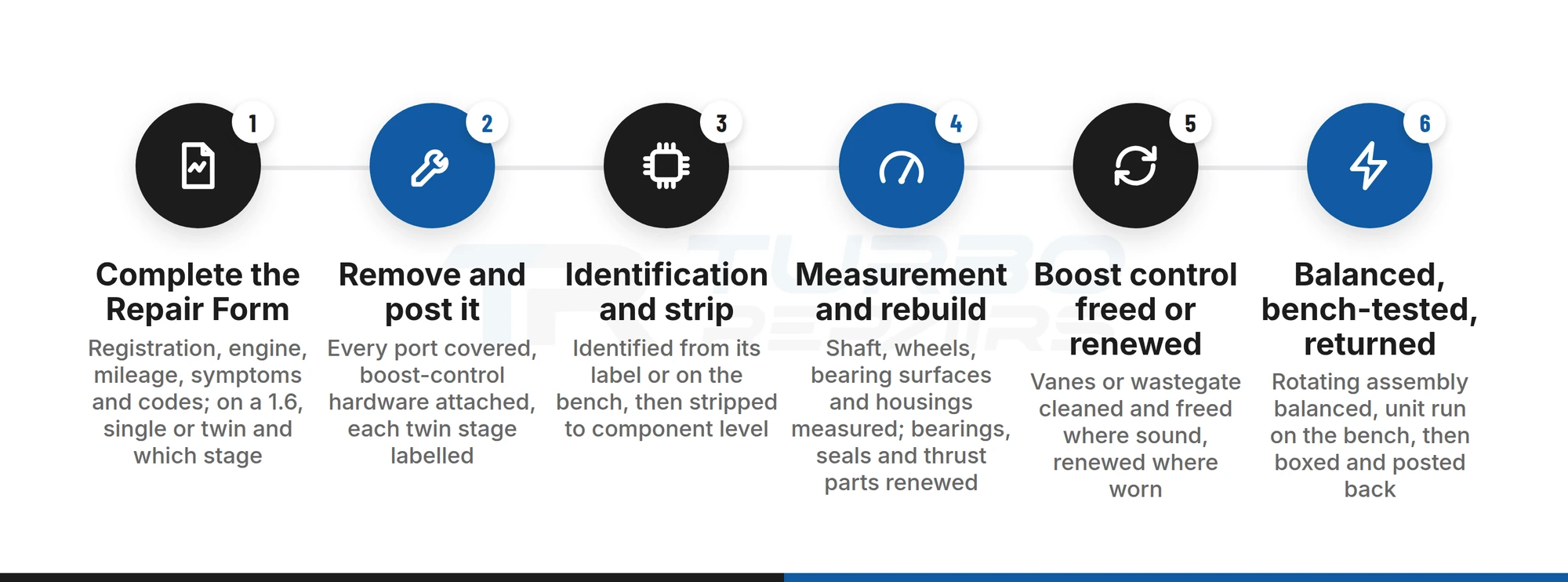
You, or the garage working on the van, remove the turbocharger and post it to us; we rebuild it and post it back. Independent garages, workshops and main dealers send units in exactly as owners do. The job runs in this order:
- Complete the online Repair Form with the registration, engine, mileage, symptoms and any fault codes. On a 1.6, say whether the engine is single or twin-turbo and which stage you are sending.
- Remove the turbo. Our guide to removing, refitting and priming a turbocharger covers the job, including the first start.
- Pack and post it complete, with every port covered and the boost-control hardware still attached, to Unit 102 Reaver House, 12 East Street, Epsom, Surrey, KT17 1HX, United Kingdom. If you are sending both stages of a twin, label each. Packing and postage are covered on our FAQs page.
- Identification and strip. The unit is identified from its label, or on the bench if the label is gone, then stripped to component level by specialists who rebuild turbochargers and turbo actuators as their core work.
- Measurement and rebuild. Shaft, wheels, bearing surfaces and housings are cleaned and measured against original specification. Bearings, seals and thrust parts are renewed with genuine OE or OEM-grade components that meet or exceed the original, and a part with a known design weakness is uprated rather than reinstated. A wheel, shaft or housing that fails inspection is replaced as a section.
- Boost control freed or renewed. Vanes or wastegate are cleaned and freed where sound and renewed where worn, so boost control moves as it was designed to.
- Balanced, bench-tested and returned. The rotating assembly is balanced and the unit set up and run on the bench before it is boxed and posted back, ready to refit.
Bench time is typically one to three working days from arrival, with postage on top each way, which matters when the van is off the road. The rebuild carries a lifetime, unlimited-mileage warranty, with no time limit and no mileage cap.
Renault Trafic and Vauxhall Vivaro Turbo FAQ
How much does a Renault Trafic or Vauxhall Vivaro turbo replacement cost?
Rebuilding your own turbo with us starts from £185, and a replacement unit from us starts from £450. For a Vivaro, the rebuild listing for your engine sets the price by year and power output. Neither figure includes removing and refitting the turbo, and the price is confirmed once the unit has been inspected.
Is the Vivaro turbo the same as the Trafic turbo?
Engine for engine, yes. The two are the same van under different badges, and trade catalogues list the same turbocharger references against both. What changes the turbo is the engine, its output and its generation, not whether the badge says Renault or Vauxhall.
How do I know if my 1.6 dCi has one turbo or two?
Look at the engine. The lower-output versions are catalogued with a single BV38 turbocharger; the versions from 118 bhp upwards are catalogued with a twin-turbo pair, one unit listed as HP and one as LP. Power output is a useful clue, but 136 bhp is listed with a single turbo and 138 bhp with the pair, so counting is the reliable check.
Only one of my twin turbos has failed. Do I have to replace both?
No. Each stage is a turbocharger in its own right, with its own reference, and replacements are sold singly as well as in sets. The failed unit can be rebuilt on its own. Tell us on the Repair Form which stage you are sending.
Do Nissan Primastar, NV300 and Fiat Talento turbos fit the Trafic and Vivaro?
Many of the same references are listed across all of them: the Primastar on the 1.9, the NV300 and Talento on the later 1.6 and 2.0. Match the reference on your own turbo rather than the badge a part is sold under.
Can I keep driving the van with a failing turbo?
Not hard, and not for long. A metallic whine, oil smoke or a rubbed compressor wheel all get worse with every mile, and worn bearings driven on can take a wheel, the shaft or a housing with them. Taken off early, far more of the unit survives to be rebuilt.
How long does a rebuild take, and what is the warranty?
Bench time is typically one to three working days from arrival, plus postage each way. Every rebuild carries a lifetime, unlimited-mileage warranty with no time limit.
Final Thoughts
Most of what is sold for these vans is sorted by badge, and the badge is the one fact that does not matter. The engine decides the turbo, the generation decides it again on a 2.0, and on a 1.6 the question comes before any reference at all: one turbocharger, or a pair of two different ones.
Once that is settled, the choice is simpler than the catalogue makes it look. Rule out the cheaper imitators, take the unit off before a worn bearing spreads its damage, and the turbo that goes back can be the one your van was already running.
Turbo Repairs · Epsom workshop
Rebuild the stage that failed, on the van it came from
Complete the Repair Form with the van’s engine and, on a 1.6, whether it is single or twin-turbo. Post the unit in complete and it comes back rebuilt, balanced and bench-tested, ready to refit.
Lifetime, unlimited-mileage warranty · Mail-in from the UK and internationally · Bench-tested and calibrated before it ships