

Summary This page is about the Ford 1.0 EcoBoost, the three-cylinder turbocharged petrol engine catalogued in the Fiesta from 2012 to 2020 and shared with the Focus, the C-Max and five other Fords. We rebuild its turbocharger to original specification. The unit that comes off your car is stripped to component level, measured, renewed where it has worn, balanced and bench-tested, then returned ready to refit. Rebuilds start from £185, bench time is typically one to three working days, and the rebuild carries a lifetime warranty with no mileage cap.
A search for a Fiesta turbo turns up diesel units and Fiesta ST upgrades at least as often as the 1.0 petrol. The first section below sorts out which Fiesta you have. The rest covers the 1.0 EcoBoost turbo itself: how to identify it, what wears inside it, what kills it from outside, and how the rebuild runs.
Turbo reference 1761178 is catalogued on the 100, 125 and 140 PS versions of the 1.0 EcoBoost Fiesta alike, so on this engine the power output does not pick the turbocharger.
This page is for owners and garages dealing with a failing turbocharger on a 1.0 EcoBoost Fiesta, Focus or C-Max. It shows how to confirm the engine, which turbocharger references the catalogue lists for it and why the power output will not narrow them down, what wears inside the unit, which faults on the engine need fixing before any turbo goes back on, and what a rebuild or a replacement costs.
- Covered here: the 1.0 EcoBoost three-cylinder petrol in the Fiesta, Focus and C-Max, and in the B-Max, EcoSport, Grand C-Max, Mondeo and Puma that share it
- Not covered here: the diesel Fiestas and the 1.6 EcoBoost Fiesta ST, which all carry different turbochargers
- Fiesta outputs catalogued: 94, 99, 123, 138 and 153 bhp; the 99, 123 and 138 bhp cars are the 100, 125 and 140 PS versions
- Turbo references catalogued for the Fiesta 1.0: thirteen, including 1761178, 1761181, 1799836 and B100101-0001 on earlier cars and 2220961 on 2019 and 2020 cars; our Fiesta 1.0 EcoBoost rebuild listing sets out the priced ones year by year
- What identifies yours: the reference on the turbo’s own label, not the output and not the model name
- Price: rebuilds from £185; replacement units from £450; your price is confirmed once the unit has been inspected
- Turnaround: typically one to three working days on the bench, plus postage each way
- Warranty: lifetime and unlimited mileage, with no time limit
- How it works: the turbo is removed, packed and posted to us, and posted back rebuilt; start with the online Repair Form
Petrol or Diesel? Which Fiesta This Page Is For
“Ford Fiesta turbo” covers several engines that have nothing in common under the bonnet. One specialist’s Fiesta category lists fourteen turbochargers, and only one of them is for the 1.0 EcoBoost. Most of the rest are diesel units, alongside a 1.6 EcoBoost turbo for the Fiesta ST.
This page covers the 1.0 EcoBoost petrol and nothing else. Your V5C settles it before anything is unbolted: the fuel type and the cylinder capacity are both printed on it, and a 1.0 EcoBoost reads as a petrol engine of roughly one litre.
If your Fiesta is the 1.6 TDCi diesel, it shares its engine with the Focus 1.6 TDCi, and our page on the 1.6 TDCi diesel is the one to read.
The 1.4 and 1.5 TDCi diesel Fiestas, and the 1.6 EcoBoost fitted to the Fiesta ST between 2013 and 2019, carry different turbochargers from the 1.0. Nothing below applies to them. They are all part of our turbocharger rebuild service, and the Repair Form is the place to start with any of them.
The Turbocharger on the 1.0 EcoBoost
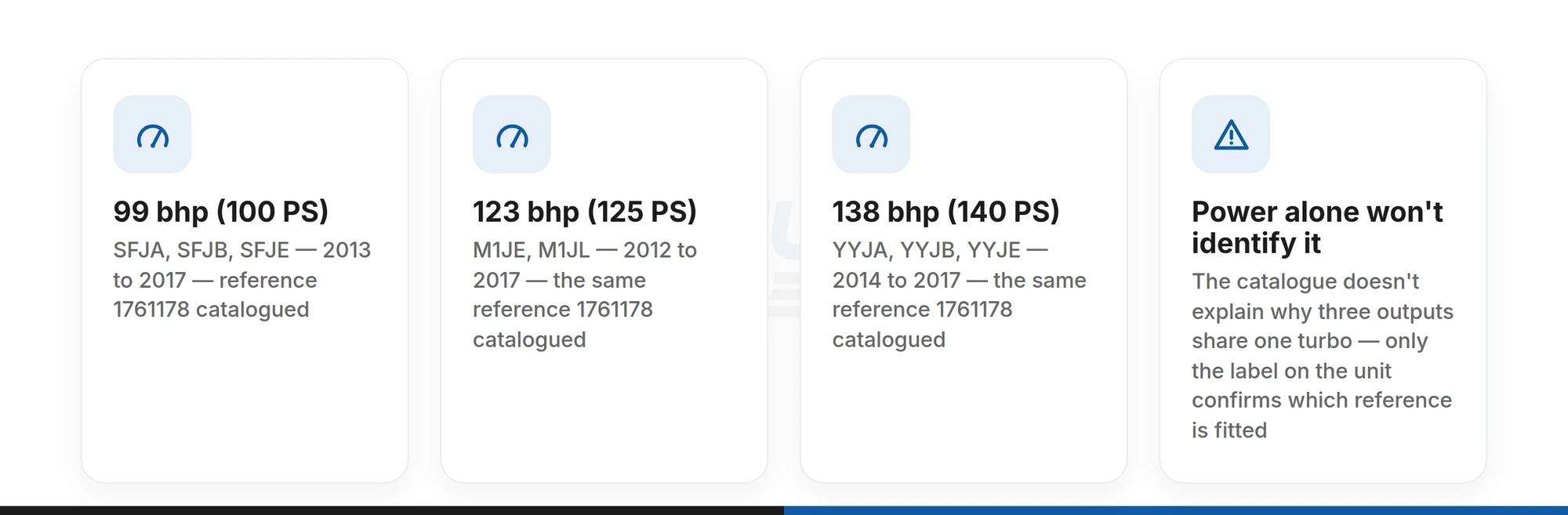
Trade catalogue data lists thirteen turbocharger references against the Fiesta 1.0 EcoBoost. Six of them carry the designation GTDI12V; the others have no designation listed. They are not thirteen sizes of turbo for thirteen versions of the car. Most of them are listed across the same years and the same outputs, which is why neither fact identifies the unit on your engine.
Grouped by what the catalogue records against them, the Fiesta rows look like this:
| Output listed | Engine codes listed | Years on the rows | Turbo references catalogued |
|---|---|---|---|
| 99 bhp (the 100 PS car) | SFJA, SFJB, SFJE | 2013 to 2017 | 1761178, 1761181, 1799836, 1808411, 2008152, 2082181 |
| 123 bhp (the 125 PS car) | M1JE, M1JL; M1DA on one row | 2012 to 2017 | 1761178, 1761181, 1799836, 1799852, 1808366, 1808411, 2008150, 2008152, 2082181, B100101-0001 |
| 138 bhp (the 140 PS car) | YYJA, YYJB, YYJE | 2014 to 2017 | 1761178, 1799852, 1808366, 2008150, 2082254, B100101-0001 |
| No output listed | SFJA, SFJB, SFJC, SFJD | 2013 | 2254345 |
| 94, 123 and 153 bhp | M0JA, B7JA, B7JB, B7JC, BZJA | 2019 to 2020 | 2220961 |
Three outputs, one reference
On some engines the power output is the quickest way to narrow the turbo down. BMW’s N47 diesel is one: our N47 turbo page shows its catalogue falling into clean bands by output. The early 1.0 EcoBoost does not work that way.
Reference 1761178 is catalogued on the 99, 123 and 138 bhp Fiesta alike, and B100101-0001 on both the 123 and the 138. The catalogue records which references fit which cars; it does not explain why the 100, 125 and 140 PS versions can share one, and this page does not guess. What it does tell you is practical: knowing your car’s output rules almost nothing out.
The change around 2018
The catalogue does divide, but by date rather than by output. The Fiesta rows run from 2012 to 2017 on the earlier references, then pick up in 2019 on a single one: 2220961, listed at 94, 123 and 153 bhp against engine codes M0JA, B7JA, B7JB, B7JC and BZJA. There are no Fiesta rows dated 2018 at all.
Ford’s own numbers follow the same split. For the earlier units they take the form CM5G-6K682 followed by two letters, such as CM5G-6K682-GB or CM5G-6K682-HD. The later unit is listed under H6BG-6K682-AC. The same later reference appears on Focus and C-Max rows dated 2018, so a Fiesta built around the changeover could carry either family, and only the label settles which.
One turbo, several Fords
None of these is really a Fiesta part. Reference 1761178 is also catalogued for the Focus, C-Max, Grand C-Max and EcoSport 1.0, other references from the same early group appear on the B-Max and the Mondeo, and 2220961 is listed for the Puma as well as the later Focus and C-Max. If you own one of those, our rebuild listings for the Focus, C-Max, Grand C-Max, B-Max, EcoSport, Mondeo and Puma 1.0 EcoBoost set out the references model by model, year by year.
How to find which one is on your car
- The V5C first. Confirm petrol and roughly one litre, and note the power at section P.2. It is given in kilowatts; multiply by about 1.34 for brake horsepower. On this engine that narrows the date band more than the turbo.
- The registration. Put it on the Repair Form, so the car can be identified alongside the unit.
- The label on the turbo. Once the unit is off, the label on its housing carries the reference that decides the question. Photograph it before the turbo is cleaned or packed. If it has burned off or cannot be read, the unit is identified on the bench before any work starts.
One boundary: this page is about rebuilding the turbocharger your engine was built with, to its original specification. Two of the leading results for this search sell hybrid upgrade turbochargers, one for the 1.0 and one for the Fiesta ST. Those are a different job, and nothing here covers them.
What Fails on a Small Petrol Turbo
Whatever the reference, the unit is a turbine wheel and a compressor wheel on a single shaft. Exhaust gas spins the turbine, the shaft turns the compressor, and the compressor packs air into a one-litre, three-cylinder engine. The shaft turns inside a centre bearing housing on a film of pressurised engine oil, with a seal at each end holding that oil in.
An upgrade turbocharger sold for this engine lists what it changes against the standard unit: larger journal bearings and bearing spacer, a larger shaft, and a 360-degree thrust bearing. Read the other way round, that is a description of the original: a shaft running in oil-fed journal bearings, with a thrust bearing taking the end load. Those are the parts built to wear.
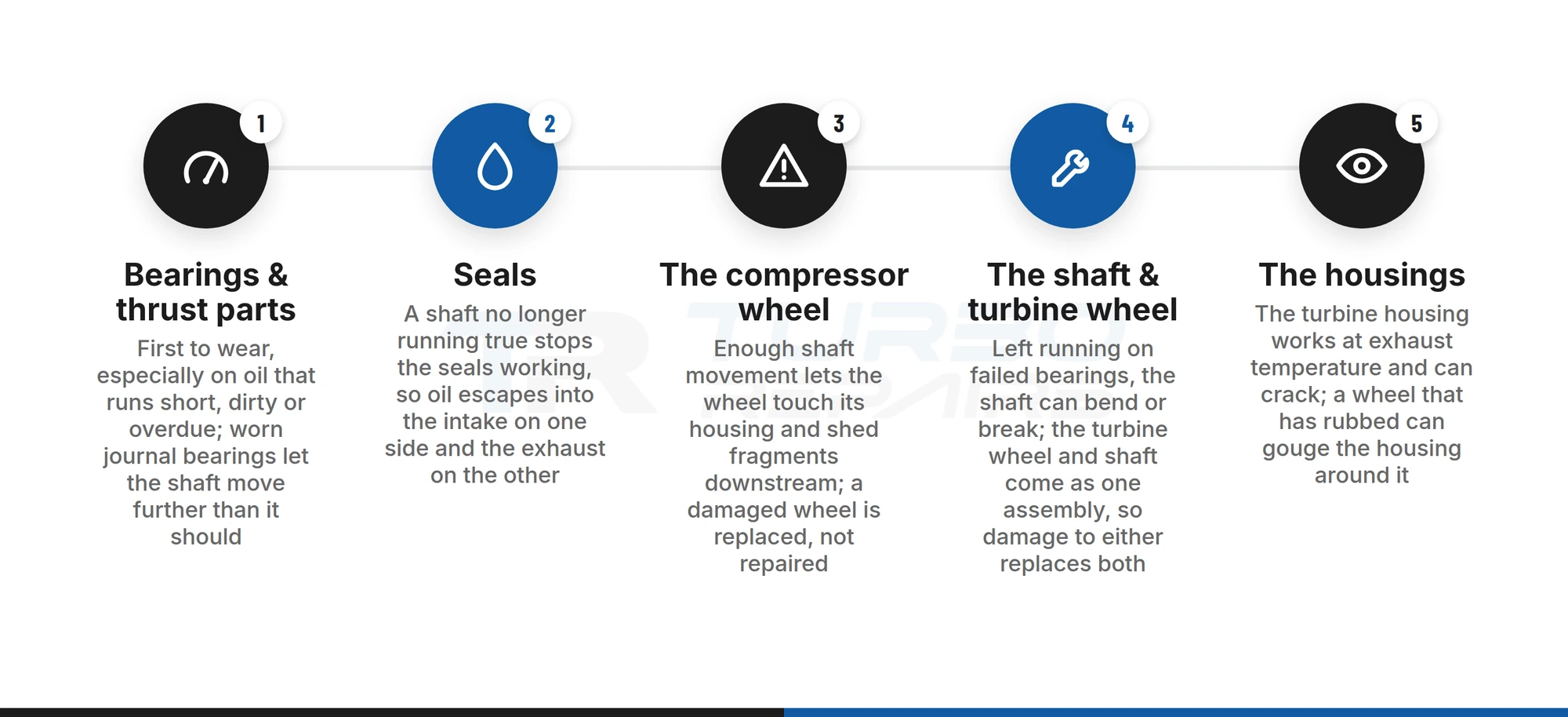
The bearings, seals and thrust parts are consumables, renewed in every rebuild as a matter of course. The housings, wheels and shaft are meant to last the life of the turbo, and in most failed units they still can. When a 1.0 EcoBoost turbo does fail, the damage tends to spread in this order:
- Bearings and thrust parts. First to wear, and first to suffer when the oil is short, dirty or overdue. Worn journal bearings let the shaft move further than it was built to.
- Seals. A shaft that no longer runs true stops the seals doing their job, so oil escapes into the intake on one side and the exhaust on the other.
- The compressor wheel. With enough movement, the wheel touches its housing and can shed fragments downstream. A damaged compressor wheel is replaced, not repaired.
- The shaft and turbine wheel. Left running on failed bearings, the shaft can bend or break. The turbine wheel and shaft come as one assembly, so damage to either replaces both.
- The housings. The turbine housing works at exhaust temperature and can crack, and a wheel that has rubbed can gouge the housing around it.
The housings deserve a closer look on this engine. One performance supplier for the 1.0 EcoBoost notes that older units can carry small cracks in their housings that are not visible, enough to make a unit unusable. A crack nobody can see is found on the bench, once the housing has been stripped and cleaned. In most cases a cracked housing can be replaced as a section and the turbo still rebuilt, rather than the whole unit written off.
How far the damage gets depends mostly on how long the turbo kept running after the first sign of trouble. Taken off when it first starts to whine, it is usually a bearings-and-seals rebuild. Driven on until it smokes, it may need a wheel, the shaft or a housing as well.
Faults on the Engine That Kill the Turbo
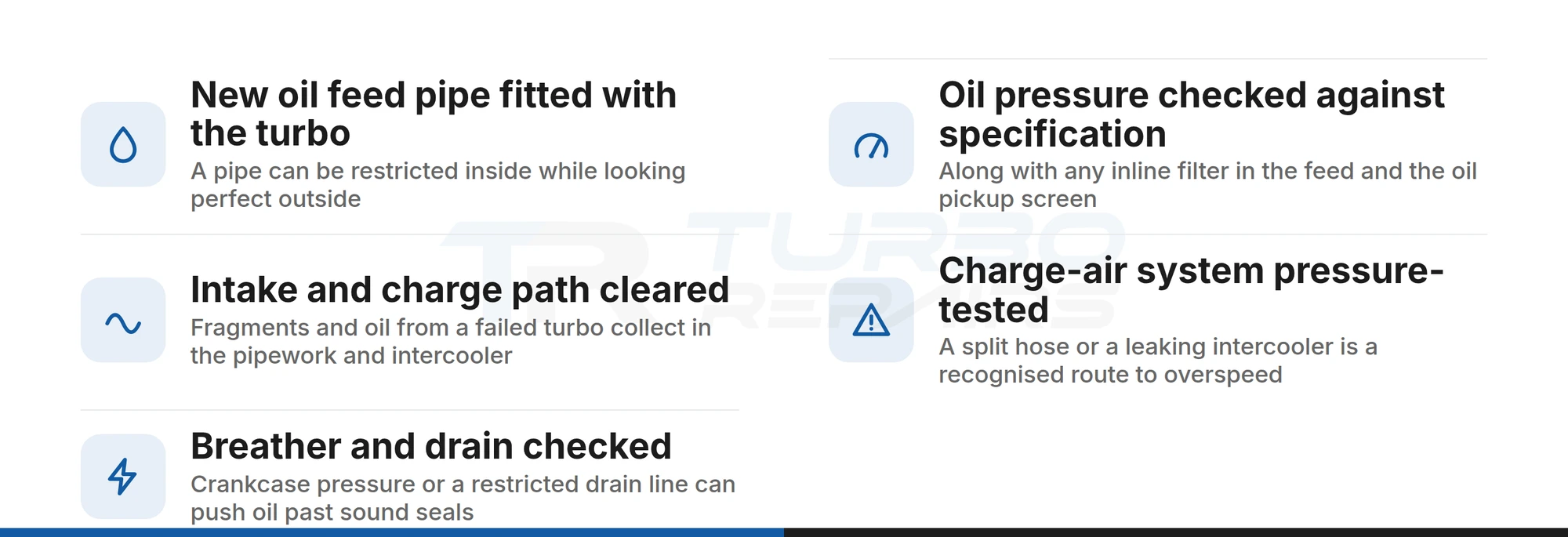
The trade recognises four causes of turbocharger failure: interrupted lubrication, oil contamination, foreign-object damage and overspeed. All four start on the engine, and a rebuilt turbo refitted into the same conditions meets the same end. Our guide to removing and refitting a turbocharger works through them in detail. On a 1.0 EcoBoost, these are the checks that decide whether the rebuild lasts:
- The oil supply. Fit a new oil feed pipe with the turbo rather than reusing the old one, because a pipe can be restricted inside while looking perfect outside. Oil pressure at the turbo is worth checking against specification, along with any inline filter in the feed and the oil pickup screen.
- The oil itself. A turbo that has worn out its bearings has put that metal into the engine oil. Fresh oil and a new filter go in with the rebuilt unit, and if the failure followed an overdue service or an oil warning, that belongs on the Repair Form.
- The intake and charge path. Fragments from a rubbed compressor wheel, and oil from failed seals, collect in the charge pipework and the intercooler. Both have to be cleared before the engine is cranked again: oil drawn into a cylinder does not compress, and an engine that tries to compress it damages itself.
- Leaks and overspeed. A split hose or a leaking intercooler is more than lost boost; it is a recognised route to overspeed, with the shaft driven beyond its safe speed. Pressure-test the charge-air system before the new unit goes on.
- The breather and the drain. Crankcase pressure that cannot escape through the breather pushes oil past the turbo’s seals, and a partly restricted drain line does the same. Either can make a sound turbo smoke.
If the car has been remapped or fitted with a freer-flowing exhaust, say so on the form. Engine management faults and reduced exhaust back-pressure both appear on the trade’s list of overspeed routes, and the answer changes how the strip findings are read.
Which of these ended a particular turbo is decided on that car, not from a list. The strip helps: a bearing that wore out on clean oil looks different from one that ran short of it, and what the unit shows is read against what you tell us.
Symptoms, and What Each One Narrows Down
Each of the complaints below points somewhere specific, and each has a cheaper imitator worth ruling out before the turbo comes off.
- A whine or siren that rises with revs and boost. Points at bearing wear in the centre housing. A boost leak can whistle too; our guide to turbo whistle sorts a noise by what it follows.
- Blue or grey smoke, and oil use between services. Points at the seals, usually because bearing wear has let the shaft move. A blocked breather or a restricted drain can push oil past seals that are perfectly sound, so check both first.
- Oil pooled in the pipework after the turbo. Points at the compressor-end seal, with the same two imitators. Whatever the cause, it has to be cleared out before a rebuilt unit is fitted.
- Loss of power or limp mode, with an underboost or overboost code. Narrows it less than it seems. The code records that measured pressure disagreed with the request, not which part caused it, and a split hose can store the same code as a worn turbo. Our guide to turbo overboost and underboost works through the suspects.
- Play or rub marks at the compressor wheel. The one symptom you can check directly: with the intake pipe off, the compressor end is visible. Some movement is normal on a journal-bearing turbo; a wheel that has touched its housing is not.
Our guide to turbo failure symptoms sorts each one by where in the unit it starts, lists the other faults that imitate a failed turbocharger, and covers when to stop driving.
Turbo Repairs · Epsom workshop
Thirteen references, and the one that fits is already on your car
Post your 1.0 EcoBoost turbocharger in and it is identified from its label, stripped, measured part by part and priced on what it actually needs. If a rebuild is the right route, the unit that goes back on is your own, so there is no reference to match and nothing to order.
Lifetime, unlimited-mileage warranty · Mail-in from the UK and internationally · Bench-tested and calibrated before it ships
Our Ford 1.0 EcoBoost Turbo Rebuild
The turbocharger comes off the car, is posted to our workshop, and is posted back rebuilt. This is how the job runs:
- Complete the online Repair Form with the registration, the power figure from the V5C, the mileage, the symptoms, any fault codes, whether the car has been modified, and the reference from the turbo’s label if you can read it.
- Remove the turbo. Our guide to removing and refitting a turbocharger covers the job, including priming the oil feed before the first start.
- Pack and post it, every port covered, to Unit 102 Reaver House, 12 East Street, Epsom, Surrey, KT17 1HX, United Kingdom. Packing and postage are covered on our FAQs page.
- Identification and strip. The unit is identified from its label, or on the bench if the label is gone, then stripped to component level by specialists whose core work is rebuilding turbochargers and turbo actuators.
- Measurement. The shaft, wheels, bearing surfaces and housings are cleaned and measured against original specification, and the housings are inspected for the cracking described above.
- Rebuild. Journal bearings, seals and thrust parts are renewed with genuine OE or OEM-grade components that meet or exceed the original. A part with a known design weakness is uprated rather than reinstated, and a wheel, shaft or housing that fails inspection is replaced as a section. The boost-control mechanism is checked for free movement.
- Balanced, bench-tested and returned. The rotating assembly is balanced, the unit is set up and run on the bench, then boxed and posted back ready to refit.
Bench time is typically one to three working days from arrival, with postage on top each way. The rebuild carries a lifetime, unlimited-mileage warranty, with no time limit and no mileage cap.
What a Ford Fiesta turbo replacement costs
Our published prices start from three floors: a rebuild of your own turbocharger from £185, a replacement turbocharger from us, reconditioned or new exchange, from £450, and an electronic actuator repair on its own from £100.
Our price guide names the Ford Fiesta in its small-car row, where rebuilds of your own turbo run from £185 to £285 excluding VAT, against a typical market price of £700 to £1,000 for a new turbocharger. Where your rebuild lands in that range depends on what survived inside: a bearings-and-seals job sits near the bottom, and every wheel, shaft or housing that fails inspection moves it up. The Focus, C-Max and the other 1.0 EcoBoost models draw their turbochargers from the same reference list, so the condition of the unit moves the price rather than the body it came from. The full breakdown is in our guide to turbo repair prices.
Three things sit outside those figures: the labour to remove and refit the turbo, charged by whoever does it; the parts fitted with it, such as gaskets, an oil feed pipe, fresh oil and a filter; and whatever caused the first failure, which still has to be found and fixed on the car.
Rebuild or replacement?
The labour on the car is the same either way, so the choice is only about which unit goes back, and it can wait until the old one is off. A replacement has to be matched first, and on this engine that means picking one reference out of thirteen for the Fiesta alone, with the output and the model name of little help. A rebuild has nothing to match, because the unit that goes back is the one that came off.
Replacement becomes the better value when too much has gone at once: a turbo needing new wheels, a new shaft and a new housing on top of its wear parts has little of the original left. The strip decides that, and when a unit is not worth rebuilding we say so and recommend replacement instead.
Ford 1.0 EcoBoost Turbo FAQ
How much does a Ford Fiesta turbo replacement cost?
Rebuilding your own turbo with us starts from £185, and our price guide puts the Fiesta in its small-car row at £185 to £285 excluding VAT, depending on what has survived inside. A replacement unit from us starts from £450, against a typical market price of £700 to £1,000 for a new one. None of those figures includes removing and refitting the turbo, and your exact price is confirmed after inspection.
Which turbo does my Fiesta 1.0 EcoBoost have?
The catalogue lists thirteen references against it. Cars from 2012 to 2017 are listed with references from the earlier group, such as 1761178, 1761181, 1799836 or B100101-0001, and 2019 and 2020 cars with 2220961. The reference on the turbo’s own label settles it; if the label cannot be read, the unit is identified on the bench.
Does the 125 or 140 PS Fiesta have a bigger turbo than the 100 PS?
Not according to the catalogue for the earlier cars. Reference 1761178 is listed for all three outputs, and B100101-0001 for both the 125 and the 140 PS, so the output on its own tells you very little about which unit is fitted.
My Fiesta was built in 2018. Which turbo is it?
The catalogue has no Fiesta 1.0 rows dated 2018. It lists the earlier references up to 2017 and 2220961 from 2019, and the same later reference already appears on 2018 Focus and C-Max rows. A car from around the changeover could carry either, so read the label before ordering anything.
Is the Focus or C-Max 1.0 EcoBoost turbo the same as the Fiesta’s?
Often, yes. Reference 1761178 is catalogued for the Fiesta, Focus, C-Max, Grand C-Max and EcoSport 1.0, and 2220961 for the later Fiesta, Focus, C-Max and the Puma. The label on your own unit is still what confirms it.
Do you rebuild the Fiesta ST turbo?
The 1.6 EcoBoost in the Fiesta ST carries a different turbocharger from the 1.0, so nothing on this page applies to it. Send the car’s details and the reference from the turbo’s label through the Repair Form.
How long does a rebuild take, and what is the warranty?
Bench time is typically one to three working days from arrival, plus postage each way. Every rebuild carries a lifetime, unlimited-mileage warranty with no time limit.
Final Thoughts
On most cars, the quickest way to a turbo is through the engine and its output. The 1.0 EcoBoost undoes that shortcut. The Fiesta alone is catalogued with thirteen references, the 100, 125 and 140 PS cars share them, the same units turn up in seven other Fords, and the one clean dividing line in the catalogue is a date, with 2018 left blank in between.
A rebuild is the one route where none of that has to be solved in advance, because the unit that goes back is the one your engine was already running. Confirm it is the petrol, rule out the leaks and breather faults that imitate a failing turbo, and take the unit off before worn bearings have time to take the wheels and shaft with them.
Turbo Repairs · Epsom workshop
Have your own 1.0 EcoBoost turbo rebuilt, not replaced
Complete the Repair Form with the registration, the power figure and the reference from the label, then post the turbocharger in. We identify it, strip, measure, rebuild, balance and bench-test it, and post it back ready to refit.
Lifetime, unlimited-mileage warranty · Mail-in from the UK and internationally · Bench-tested and calibrated before it ships