

Summary We rebuild the turbochargers from the Renault Master and Vauxhall Movano 2.3 dCi, one van under two badges that is also catalogued as the Nissan NV400, in both its single-turbo and its two-stage twin-turbo form. Send the unit in and it is stripped to component level, measured, rebuilt on genuine OE or OEM-grade parts, balanced and bench-tested, then posted back ready to refit. Rebuilds start from £185, bench time is typically one to three working days, and every rebuild carries a lifetime, unlimited-mileage warranty.
On the twin-turbo engine the two units are not equal partners. The large one does the hotter, heavier work, it is the one most likely to fail, and it is the one a replacement has to match most exactly.
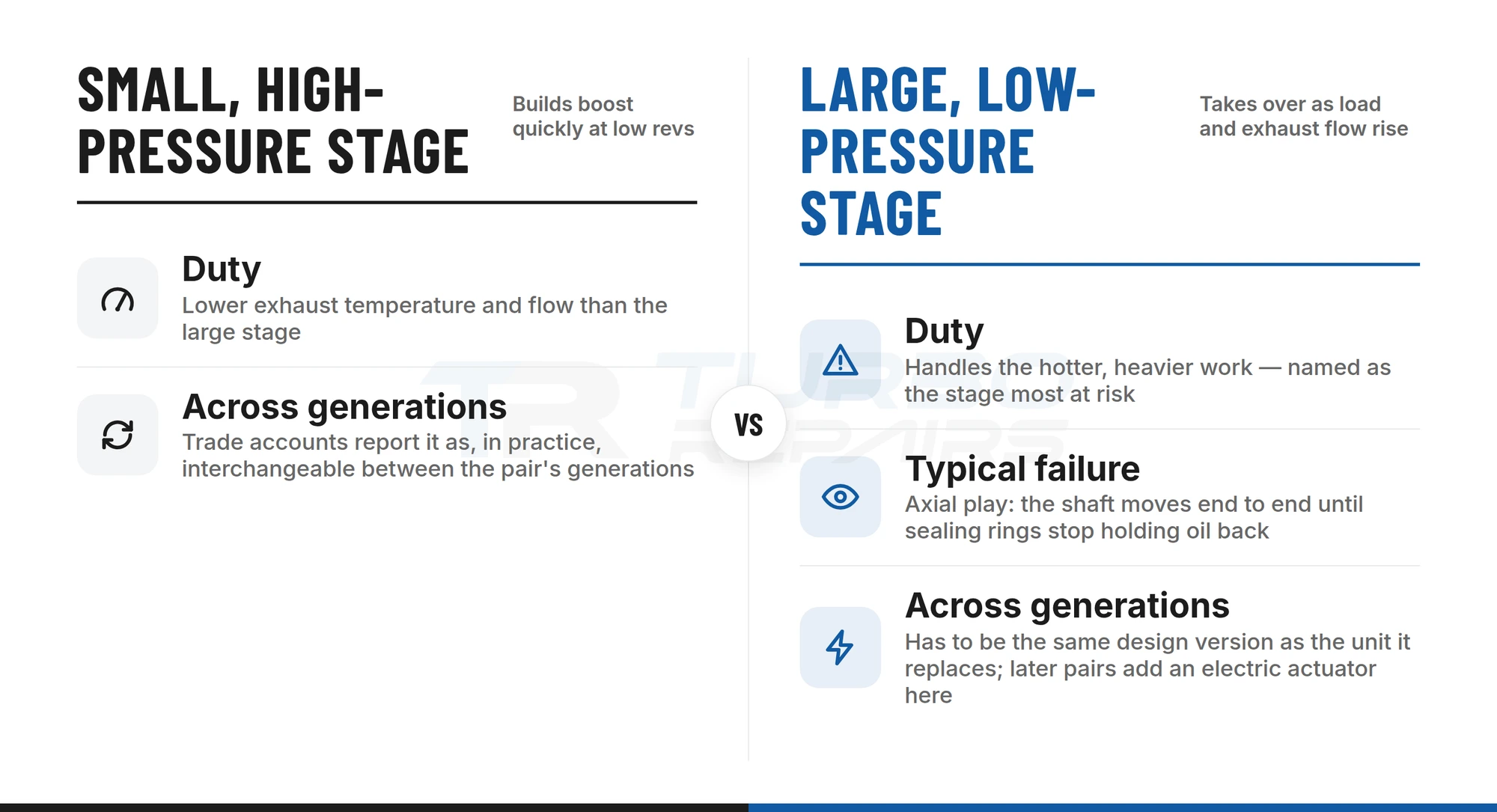
Trade accounts of the two-stage 2.3 report that the small turbocharger is, in practice, interchangeable between generations of the pair, while the large one has to be the same design version as the unit it replaces.
This page is for owners, fleet managers and garages with a 2.3 dCi Master or Movano that has lost boost, started smoking or begun to whistle. It sets out which version of the engine you have, what wears out on each, and when rebuilding the unit already on the van is the better route than buying another.
- Vans covered: the Renault Master III and Vauxhall Movano B with the 2.3 dCi or 2.3 CDTi (engine code M9T), also catalogued for the Nissan NV400 and Interstar
- Two layouts: a single turbocharger, or a two-stage pair made up of a small high-pressure unit and a large low-pressure unit
- The unit most at risk on a twin: the large, low-pressure stage
- Price: rebuilds from £185; replacement units from £450; your price is confirmed once the unit has been inspected
- Movano built 2014 to 2019: order by year and power on our Vauxhall Movano 2.3 CDTi turbo rebuild listing; for any other Master or Movano, start with the online Repair Form
- Turnaround: typically one to three working days on the bench, plus postage each way
- Warranty: lifetime and unlimited mileage, with no time limit
Single Turbo or Twin? Which 2.3 dCi Is in Your Van
The Master III and the Movano B are the same large van with different badges, and the turbocharger trade lists them side by side, usually with the Nissan NV400 or Interstar alongside. Vauxhall calls the engine the 2.3 CDTi where Renault and Nissan say 2.3 dCi, but it is one engine, coded M9T. What changes the turbocharger is which version of that engine is fitted, not whose name is on the grille.
Earlier vans are a separate job. The Master II and Movano A were catalogued with 2.2, 2.5 and 2.8 litre diesels, each carrying its own turbochargers, and those units come in through the same Repair Form; the detail below is for the 2.3 only. The smaller Trafic and Vivaro have their own engines and their own page, Renault Trafic and Vauxhall Vivaro turbo repair.
The single-turbo 2.3
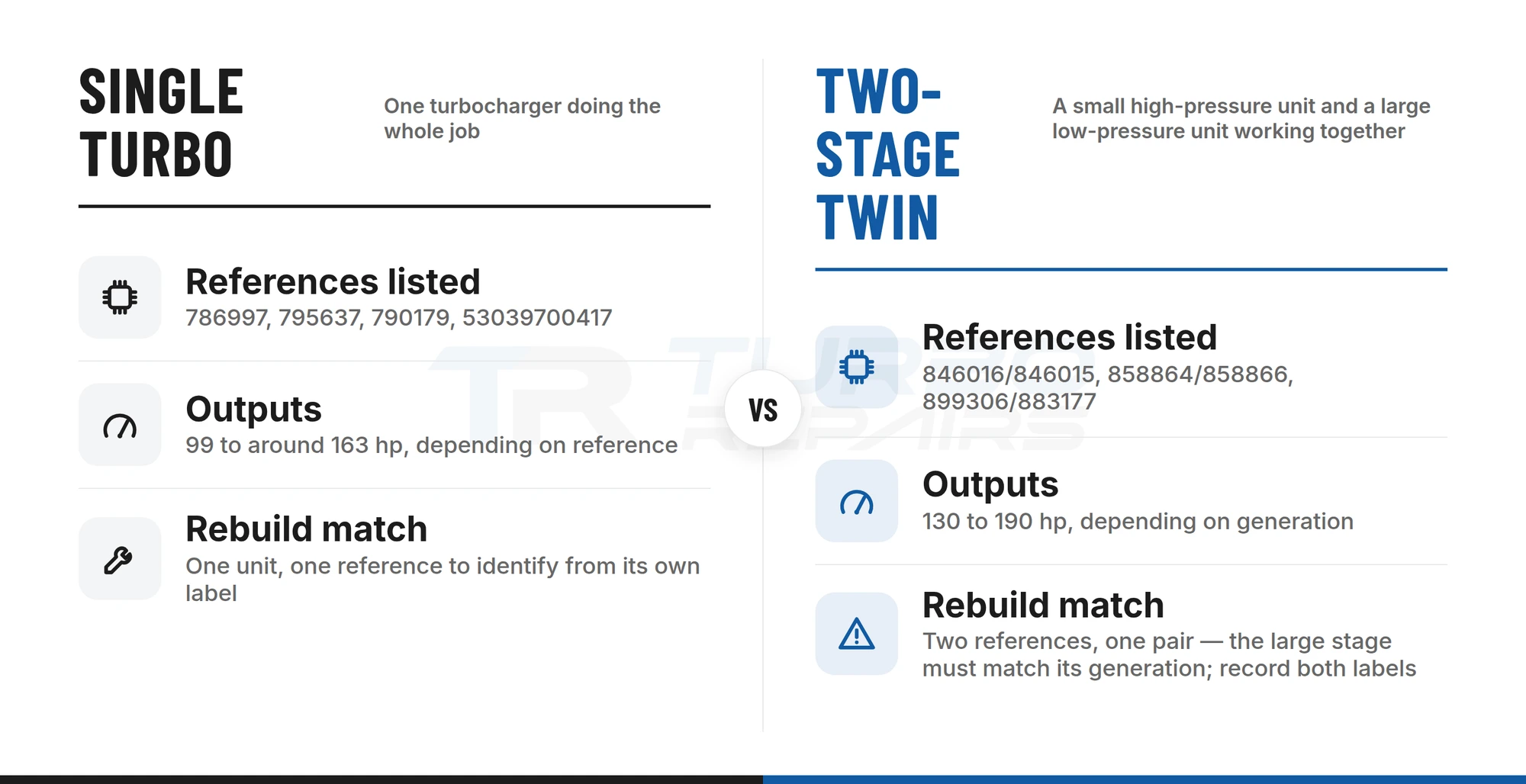
Several single turbochargers are catalogued for the 2.3 in the Master III and Movano B. Garrett units are listed under 786997 at 99 bhp, 795637 at 113 bhp on the M9T670 and M9T676, and 790179 at around 150 bhp. A further unit, referenced 53039700417, is listed for the Master III, Movano B and NV400 across 110 to 163 hp from 2013.
The 786997 is also catalogued for the 2.0 dCi, which is why a Master part number can appear on a Trafic or Vivaro listing. It is shared hardware, not a sign that the vans are interchangeable.
The two-stage twin-turbo 2.3
The twin-turbo 2.3 works in two stages. A small high-pressure turbocharger builds boost quickly at low revs, and a larger low-pressure turbocharger takes over as load and exhaust flow rise. Versions of this engine are listed at outputs from 136 to 190 hp.
The pair has been revised more than once. The earlier pair is listed as 846016 for the high-pressure stage and 846015 for the low-pressure stage, from 2010. A later pair, 858864 with 858866, is the one catalogued for the 2014 to 2019 Movano at 136, 150 and 179 bhp on the M9T702 and M9T716, where the two units are listed as a DSGT22 and a GT1238Z. A third pair, 899306 with 883177, is described as a further revision of the large unit.
| Layout | References listed | Outputs listed | Notes |
|---|---|---|---|
| Single turbo | 786997 | 99 bhp | Also catalogued for the 2.0 dCi |
| Single turbo | 795637 | 113 bhp | M9T670, M9T676 |
| Single turbo | 790179 | around 150 | Master III, Movano B |
| Single turbo | 53039700417 | 110 to 163 hp | Master III, Movano B, NV400, from 2013 |
| Twin, earlier pair | 846016 high-pressure, 846015 low-pressure | 130 to 170 hp | From 2010 |
| Twin, later pair | 858864 with 858866 | 136, 150, 179 bhp on the 2014 to 2019 Movano | Also listed for the 2.3 diesel Nissan Navara NP300, Renault Alaskan and Mercedes-Benz X-Class |
| Twin, further revision | 899306 with 883177 | — | Revised large unit |
The logbook will not settle which layout you have. Around 150 is listed both for a single turbocharger and for the pair, so the power figure points both ways. The engine bay settles it: a two-stage engine carries a second turbocharger, and each unit carries its own label. Photograph every label before anything is cleaned, and note which unit is coming off.
What Fails on the Master and Movano Turbochargers
At heart, every turbocharger on these engines is built the same way. A turbine wheel in the exhaust and a compressor wheel in the intake share one shaft, which turns on a film of oil inside the bearing housing with a seal at each end. Bearings, seals and thrust parts wear; the wheels, shaft and housings get damaged when that wear is left running. On the single-turbo 2.3, that is most of the story.
On the two-stage engine the two units do not share the work evenly. The large low-pressure turbocharger handles the greater exhaust flow at the higher temperature, and trade accounts of the engine name it as the stage most at risk. Its typical failure is axial play: the shaft starts to move end to end, the sealing rings stop holding oil back, and eventually the blades rub against their housings.
The large stage changed; the small one largely did not
The same accounts describe the second-generation pair as bringing a revised core for the large unit, more prone to axial play under heat and high back pressure, and an electric actuator on the large turbocharger in place of the earlier vacuum control. They also report that the small units are, in practice, interchangeable between generations, while the large unit has to be the same design version as the one it replaces.
Put those together and the unit most likely to fail is also the one with the least room for error in replacement. The small stage can be matched to the engine; the large stage has to be matched to its generation as well.
The electric actuator is a failure point of its own. If the bench finds the fault in the actuator rather than in the turbocharger, we tell you before any work is done; electronic actuators are a separate repair, and our electronic turbo actuator repairs section explains how those are handled.
Causes that stay on the van
Two causes described for this engine sit outside the turbocharger entirely. A loaded diesel particulate filter raises the pressure the turbine has to exhaust into, which drives exhaust temperature up and makes it harder for oil to drain out of the bearing housing. Injectors that are not atomising fuel properly let it burn in the exhaust manifold, spiking the temperature at the turbine and, on the twin, restricting or seizing the valve that manages boost between the two stages.
Either one will do to a rebuilt turbocharger exactly what it did to the original. If the strip shows heat damage or signs of back pressure, we say so in the report, and those checks belong on the van before the rebuilt unit goes back on.
Symptoms on a Large Van
A big van spends much of its day under load, and that changes how a failing turbocharger announces itself. A slow loss of boost can pass for the van simply being heavily loaded until a long gradient or a motorway slip road makes it impossible to ignore. These are the usual signs on the 2.3:
- Loss of power, underboost or limp mode, often with a P0299 (underboost) or P0234 (overboost) code. Those codes describe the boost system, not the turbocharger core; on the twin, a sticking valve between the stages can raise them with both units sound. Our guide to turbo overboost and underboost codes explains what each can and cannot tell you.
- A whistle that builds as the engine pulls. On this engine that is commonly developing axial play or bearing wear, though a leak on the hot side of the system makes a similar sound.
- Oil in the intake or intercooler pipework. Worn seals, stuck sealing rings, high exhaust back pressure or a restricted oil drain can each put it there.
- Smoke from the exhaust. Oil reaching the exhaust or the cylinders, or a fuel-atomisation fault that no turbocharger rebuild will cure.
- A warning light with boost pressure or temperature messages, usually alongside one of the above.
None of these tells you which stage of a twin has failed; that is found on the bench, with each unit measured separately. Our guide to turbo failure symptoms sorts them by where in the unit they start and lists the cheaper faults that imitate them. Once the note turns metallic or oil appears in the pipework, keep the van off heavy work until the turbocharger is off: a bearing driven on under load can take the wheels and shaft with it.
Rebuild or Replace on a High-Mileage Van?
Big mileages are normal for a 2.3 Master or Movano, and trade accounts put the engine’s durability beyond 500,000 km. A turbocharger failure on a high-mileage van is therefore rarely a verdict on the engine. Nor is the odometer a verdict on the turbo: it cannot tell you which of the wheels, shaft and housings are still inside specification.
The work on the van is the same either way. What differs is how the unit that goes back on is chosen.
- On a single-turbo van, a replacement has to match one of several references catalogued for the same engine. A rebuild returns the unit that came off, so the reference is already right.
- On a twin, only the failed stage needs to come to us. If that is the large unit, a rebuild keeps its own design version by definition, which removes the generation-matching problem altogether. Replacement pairs are sold as sets and as single units, so a failed large stage does not by itself mean buying both.
- Either way, the causes that stay on the van come first. A back-pressure or injector problem left in place will shorten the life of a new turbocharger just as it will a rebuilt one.
Replacement is the better buy when too much has gone at once. If a wheel, the shaft and a housing have all failed inspection on top of the consumables, little of the original is left, and we recommend replacement rather than rebuild.
Rebuilding your own turbocharger with us starts from £185, and a replacement unit from us starts from £450. Neither includes removing and refitting it, which is charged by whoever does that work. Where a rebuild lands above the floor depends on how much survived; the full breakdown is in our guide to van turbo repair prices.
Turbo Repairs · Epsom workshop
Keep the large stage your van was built with
Send the failed unit in and it is stripped, measured part by part and priced on what it actually needs. If a rebuild is the right call, the turbocharger that goes back is the same design version that came off, so there is no generation to match.
Lifetime, unlimited-mileage warranty · Mail-in from the UK and internationally · Bench-tested and calibrated before it ships
Our Master and Movano Turbo Rebuild
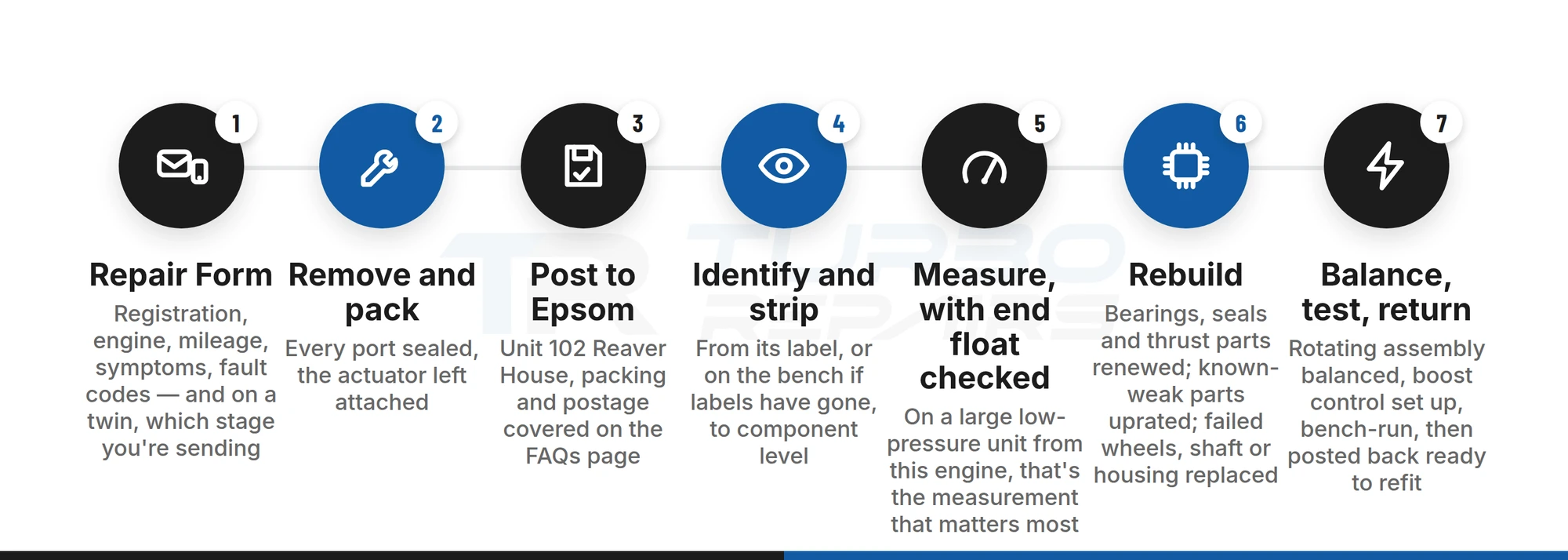
You, or the garage looking after the van, take the turbocharger off and send it in; we rebuild it and post it back. Fleet workshops and independent garages send units in the same way owners do. This is the order the job runs in:
- Fill in the online Repair Form with the registration, engine, mileage, symptoms and any fault codes. On a twin, tell us which stage you are sending, large or small, and include photographs of both labels if you can. A Movano built between 2014 and 2019 can also be ordered by year and power on its rebuild listing.
- Take the unit off. Our guide to removing, refitting and priming a turbocharger covers the job from start to first start.
- Pack it complete and post it with every port sealed and the actuator still attached, to Unit 102 Reaver House, 12 East Street, Epsom, Surrey, KT17 1HX, United Kingdom. Packing and postage are covered on our FAQs page.
- Identification and strip. The unit is identified from its label, or on the bench if the label has gone, then taken down to component level by specialists whose core work is turbochargers and turbo actuators.
- Measurement. Shaft, wheels, bearing surfaces and housings are cleaned and measured against original specification, with end float checked on the shaft: on a large low-pressure unit from this engine, that is the measurement that matters most.
- Rebuild. Bearings, seals and thrust parts are renewed with genuine OE or OEM-grade components that meet or exceed the original, and parts with a known design weakness are uprated rather than reinstated. A wheel, shaft or housing that fails inspection is replaced.
- Balance, test and return. The rotating assembly is balanced, the boost control is set up, and the unit is run on the bench before it is boxed and posted back ready to refit.
Bench time is typically one to three working days from arrival, with postage on top each way. Every rebuild carries a lifetime, unlimited-mileage warranty, with no time limit and no mileage cap.
Renault Master and Vauxhall Movano Turbo FAQ
How much does it cost to rebuild a Renault Master turbo?
Rebuilding your own turbocharger with us starts from £185, and a replacement unit from us starts from £450. Removal and refitting are not included. The price is confirmed once the unit has been inspected, because it depends on how many parts are still within specification.
Does my Master or Movano 2.3 have one turbo or two?
Both layouts were built. The single-turbo versions carry one turbocharger; the twin-turbo versions carry a small high-pressure unit and a large low-pressure unit. Power output overlaps between the two, so look at the engine: a twin has a second turbocharger with its own label.
Is the Movano turbo the same as the Master turbo?
Engine for engine, yes. The Movano B and Master III are the same van, and the turbocharger trade lists the same references against both, usually with the Nissan NV400 or Interstar. What changes the turbocharger is the engine version and, on a twin, the generation of the pair.
Only the large turbo on my twin-turbo 2.3 has failed. Do I need both?
Not necessarily. Each stage is a turbocharger in its own right, with its own reference, and the failed one can be rebuilt on its own. Rebuilding it also keeps its original design version, which matters more on the large unit than on the small one.
Will a turbo listed for a Navara, Alaskan or X-Class fit my Master?
The later twin-turbo pair, 858864 with 858866, is listed for the 2.3 diesel Nissan Navara NP300, Renault Alaskan and Mercedes-Benz X-Class as well as the Master and Movano. A listing under another vehicle name is not automatically wrong, but match the reference on your own unit, not the vehicle a part is sold under.
Why has my replacement turbo failed again?
Usually because the cause stayed on the van. On the 2.3, the causes described most often are exhaust back pressure from a loaded particulate filter and injectors that let fuel burn in the exhaust manifold. Both overheat the turbocharger whatever its origin, so they need to be checked before another unit goes on.
How long does a rebuild take, and what is the warranty?
Bench time is typically one to three working days from arrival, plus postage each way. Every rebuild carries a lifetime, unlimited-mileage warranty with no time limit.
Final Thoughts
On the single-turbo 2.3, a Master or Movano turbo repair is a familiar job: identify the reference, rebuild the worn parts, deal with anything on the van that shortened its life. The twin is less forgiving, and it is less forgiving in one place. The large stage takes the heat, wears first, and is the one unit on the engine where a replacement has to be the right generation as well as the right part.
That is the strongest argument for rebuilding it. The unit that goes back on is the design your engine was built with, measured and renewed where it wore, and the question of which generation to buy never has to be asked.
Turbo Repairs · Epsom workshop
Have your 2.3 dCi turbo rebuilt, not re-matched
Complete the Repair Form with your van’s details and, on a twin, which stage has failed. Send the unit in complete and it comes back rebuilt, balanced and bench-tested, ready to refit.
Lifetime, unlimited-mileage warranty · Mail-in from the UK and internationally · Bench-tested and calibrated before it ships