

Summary We rebuild the turbocharger from the VW Golf 1.6 TDI and 2.0 TDI, on the Pumpe-Düse and the common-rail engines alike. You or your garage take the unit off and send it to our Epsom workshop, where it is stripped to component level, measured, rebuilt on genuine OE or OEM-grade parts, balanced and bench-tested, then returned ready to refit. Rebuilds start from £185 + VAT, bench time is typically one to three working days, and every rebuild carries a lifetime, unlimited-mileage warranty.
The first thing to settle on a Golf TDI is which diesel it has. The 2.0 changed injection system under the same badge and at the same power output, and its turbocharger changed with it, so the model year and the figure on the logbook stop helping exactly where the two engines overlap. The engine code does not.
In the fitment listings, a 2008 Golf 2.0 TDI at 138 bhp can carry a Garrett GTB1646MV on the Pumpe-Düse BMM engine or a BorgWarner BV43 on the common-rail CBAB.
A turbo problem on a diesel Golf usually arrives as one of four things: limp mode with a boost code stored, a loss of pull under load, smoke, or a new noise from the engine bay. Before any of those becomes a parts order, two questions need answering: which of the Golf’s diesel engines you have, and whether the turbocharger is really the part that failed. This page takes them in that order.
- Cars covered: VW Golf 1.6 TDI and 2.0 TDI, Pumpe-Düse and common rail, including the 2.0 TDI GTD. Petrol Golfs are not covered on this page
- Turbochargers catalogued: Garrett variable-nozzle units across much of the range, BorgWarner BV-series units on many common-rail cars, and some later units listed with no maker named. No single maker covers every Golf TDI
- What decides it: the engine code first, then the label on the turbocharger. Year and power output overlap at the changeover between engines
- Codes that point at boost: P0299 (underboost) and P0234 (overboost). Neither names the failed part
- Prices: your own turbo rebuilt from £185 + VAT; replacement turbochargers from £450; electronic actuator repairs from £100 + VAT
- Our service: component-level rebuild of the unit off your car, typically one to three working days on the bench, lifetime and unlimited-mileage warranty
Which Golf TDI Do You Have? PD or Common Rail, 1.6 or 2.0
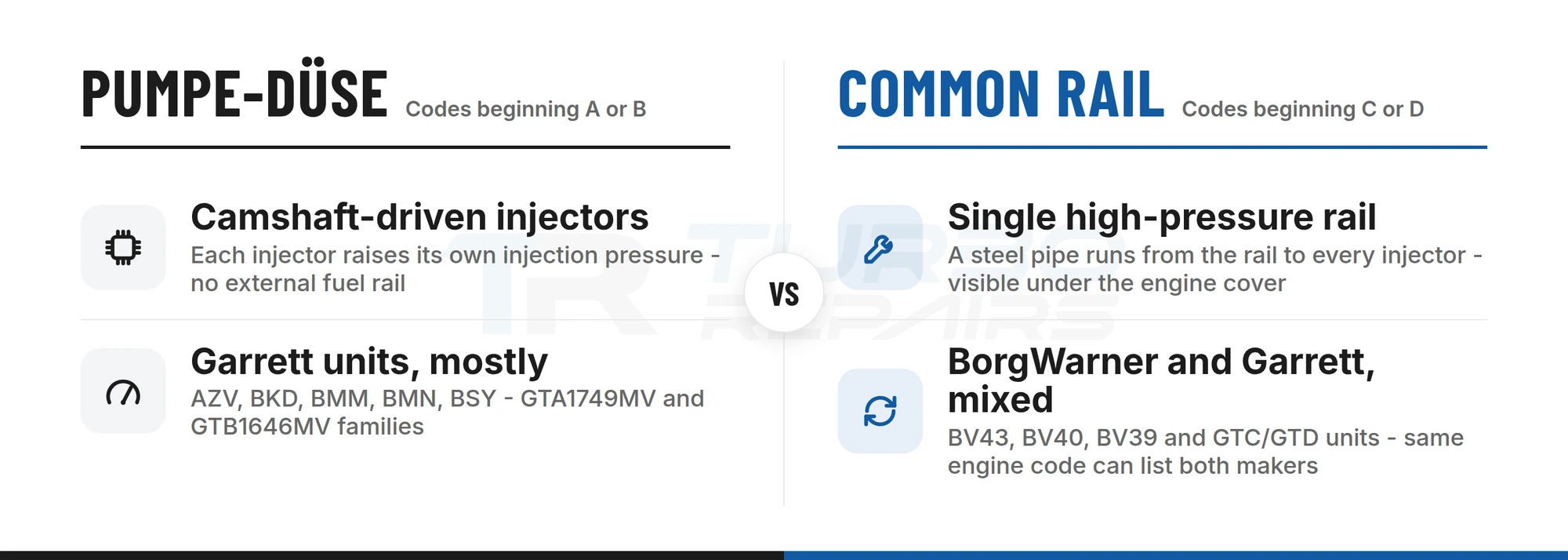
Every diesel Golf on this page is a TDI, but the badge has covered three generations of engine in two sizes. The 2.0 TDI started out as a Pumpe-Düse engine, in which each injector is driven by the camshaft and raises its own injection pressure. It then moved to common rail, where a single high-pressure rail feeds every injector. The 1.6 TDI in the Golf was common rail from the start, and later both sizes moved to a newer common-rail engine family again.
Each of those steps brought different turbochargers. So the question “which Golf turbo do I need?” is really “which of these engines is in my car?”, and the answer is not always obvious from the outside of the car.
Why the year and the power output are not enough
The changeover from Pumpe-Düse to common rail is where a search by year and power stops working. The fitment data lists 2.0 TDI Golfs at 138 to 140 bhp in 2007 and 2008 on both sides of it: the Pumpe-Düse BKD and BMM engines with Garrett units, and the common-rail CBAB, CFFB and CJAA engines with BorgWarner units. Same car name, same years, same power, and a turbocharger that will not swap between them.
Three checks separate them, and none needs a spanner:
- The engine code. A VW dealer or a parts supplier can look it up from your registration or VIN, and it is usually printed on the vehicle data sticker in the service book and in the spare-wheel well. The Pumpe-Düse codes in the Golf listings (AZV, BKD, BMM, BMN and BSY) all begin with A or B. The common-rail codes all begin with C or D.
- A look under the engine cover. A common-rail engine has a fuel rail with a steel pipe running to each injector. A Pumpe-Düse engine has no external high-pressure pipes to its injectors, because the fuel is fed through the cylinder head.
- The cylinder capacity at section P.1 of your V5C separates the 1.6 (1598 cc) from the 2.0 (1968 cc). It will not tell you which 2.0 you have.
A handful of catalogue rows list engine codes from both sides of the changeover together. Treat the engine code as the way in, and the label on the turbocharger as the confirmation.
The Turbochargers Fitted to Golf TDIs, by Engine Code
The table sets out what the fitment data we work from catalogues for the Golf’s diesel engines. Use it to narrow the field rather than as a final answer. References are superseded over time, and where two units are listed against one engine, the label on the unit decides.
| Engine as listed | Engine codes | Catalogued years and output | Turbocharger as catalogued | References as listed |
|---|---|---|---|---|
| 2.0 TDI Pumpe-Düse | AZV, BKD, BMM, BMN, BSY | 2003 to 2008; 129 to 140 bhp, 168 bhp on the BMN | Garrett GTA1749MV (AZV, BKD, BSY), GTB1646MV (BMM), GTB1749MV (BMN); one BorgWarner BV43 also listed against the BKD | 724930, 756062, 756867, 765261, 757042; BorgWarner 5303-970-7005; VW numbers beginning 03G253 |
| 1.6 TDI common rail, first generation | CAYA, CAYB, CAYC | 2008 to 2011; 89 to 105 bhp | BorgWarner BV39 (CAYA) and Garrett GTC1244MVZ | 5439-970-0086, -0094, -0098; 775517-0001, -0002; VW 03L253016 family |
| 2.0 TDI common rail, first generation | CBAA, CBAB, CBBB, CBDA, CBDB, CBDC, CFFA, CFFB, CFGB, CFHC, CJAA, CLCA | 2007 to 2015; 109 to 140 bhp, 167 to 170 bhp on CBBB, CFFA and CFGB | BorgWarner BV43 and BV40; Garrett GTC1549MVZ on CFFA, CFFB and CFGB | 5303-970-0130, -0139, -0169 and others; 5440-970-0002, -0036 and others; 785448-0005 |
| 1.6 TDI, later common rail | CLHA, CLHB, CRKA, CRKB, CXXA, CXXB, DBKA, DDYA | 2012 to 2016; 89 to 114 bhp | Garrett GTD1244MVZ | 813860-0001, -0003; 847671-0002, -0003, -0004; VW 04L253016H, 04L253020A |
| 2.0 TDI, later common rail | CKFC, CRBC, CRLB, CRMB, CRUA, CRVA, CRVC, CUUA, CUUB | 2012 to 2014; 108 to 150 bhp | Catalogued as BM70B, with no maker named in the fitment data | 030TC11002000, 030TC11003000, 030TM11004000; VW 04L253010B, 04L253019Q, 04L253019P |
| 2.0 TDI, higher output including GTD | CUNA, DGCA, CUWA, CUXA | 2013 to 2016; 181 to 184 bhp | Garrett GTD1449V and GTD1449VZ | 821866-0002, -0004, -0009; 819891-0005 |
| 2.0 TDI from 2019 | DSRB, DTSA, DTSB, DTTA, DTTC, DTUA | 2019 to 2021; 121 to 197 bhp | BM60 at 148 bhp, no maker named; Garrett GTD1446VZ at 121 bhp and GTD1752VMZL at 197 bhp | VW 05L253019F; 872869-0001; 878087-0004 |
More than one maker, sometimes on one engine code
The Golf 2.0 TDI is not a Garrett car or a BorgWarner car. The BKD is listed with Garrett GTA1749MV units and also with a BorgWarner BV43. The CFFA and CFFB are listed with BorgWarner BV43 and BV40 units and with a Garrett GTC1549MVZ. On the 1.6, the CAYA appears under both a BorgWarner BV39 and a Garrett GTC1244MVZ. Any listing that names one maker for “the Golf 2.0 TDI turbo” is describing some of these cars, not all of them.
Variable geometry across the range
Every Garrett designation in the Golf TDI rows carries a V, which marks a variable-nozzle turbocharger, and BorgWarner’s BV series are variable-geometry units too. A ring of vanes around the turbine wheel opens and closes to control boost across the rev range. That mechanism is the part of a diesel turbo most exposed to soot, and it features in the failures below. The fitment data does not describe the construction of the BM70B and BM60 units, so we make no claim about them until one is on the bench.
What Fails on a Golf TDI Turbo
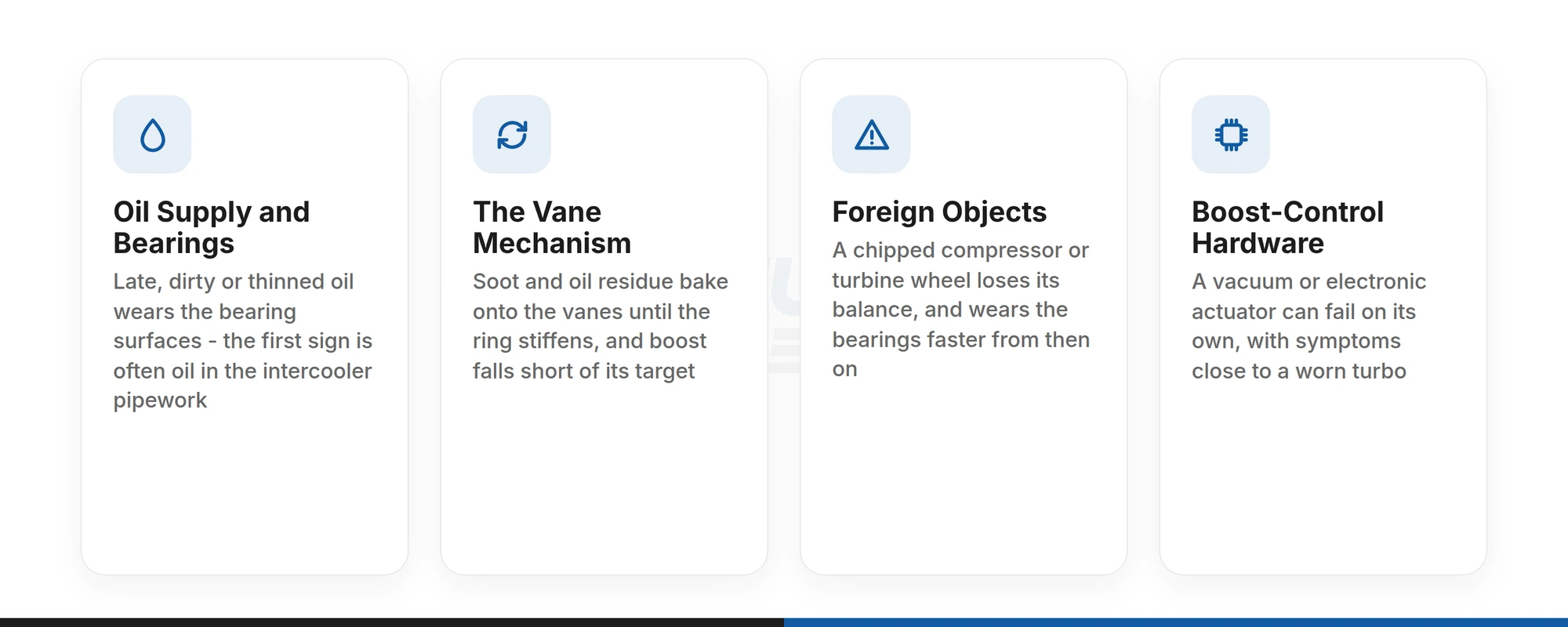
Whichever maker built it, a Golf TDI turbocharger wears out for reasons that nearly all begin outside it. That matters, because a rebuilt or new unit fitted to the same conditions meets the same fate. These are the four areas we assess on every unit that arrives.
Oil supply and the bearings. The shaft spins on a film of engine oil rather than on its housing. Oil that arrives late at start-up, carries dirt or has been thinned lets the bearing surfaces wear, the shaft gains play, and the seals at each end stop holding. The first outward sign is often oil in the intercooler pipework, well before any noise.
The vane mechanism. Soot and oil residue bake onto the vanes and their pivots until the ring stiffens. The engine management commands a position the vanes can no longer reach, boost falls away from its target, and the car drops into limp mode while the rotating assembly itself may still be in good order. Driving that rarely brings the exhaust up to full temperature leaves more of that residue behind.
Foreign objects. A compressor wheel chipped by something drawn through the intake, or a turbine wheel struck by debris from the engine, loses its balance. An unbalanced wheel then wears the bearings quickly, so a small impact becomes a larger failure if the car stays in use.
The boost-control hardware. Depending on the engine, the vanes are moved either by a vacuum actuator fed through a control solenoid or by an electronic actuator. Either can fail while the turbocharger is sound, and the symptoms are close to those of a worn turbo. A wiring plug on the actuator itself tells you it is electronic, and an electronic actuator can be repaired on its own through our electronic turbo actuator repairs.
On Golfs fitted with a particulate filter, the filter’s condition is part of the turbine’s working conditions as well. Our Audi A4 TDI page sets out what a DPF does to a 2.0 TDI turbo, in both directions.
Symptoms, and What Each One Narrows Down
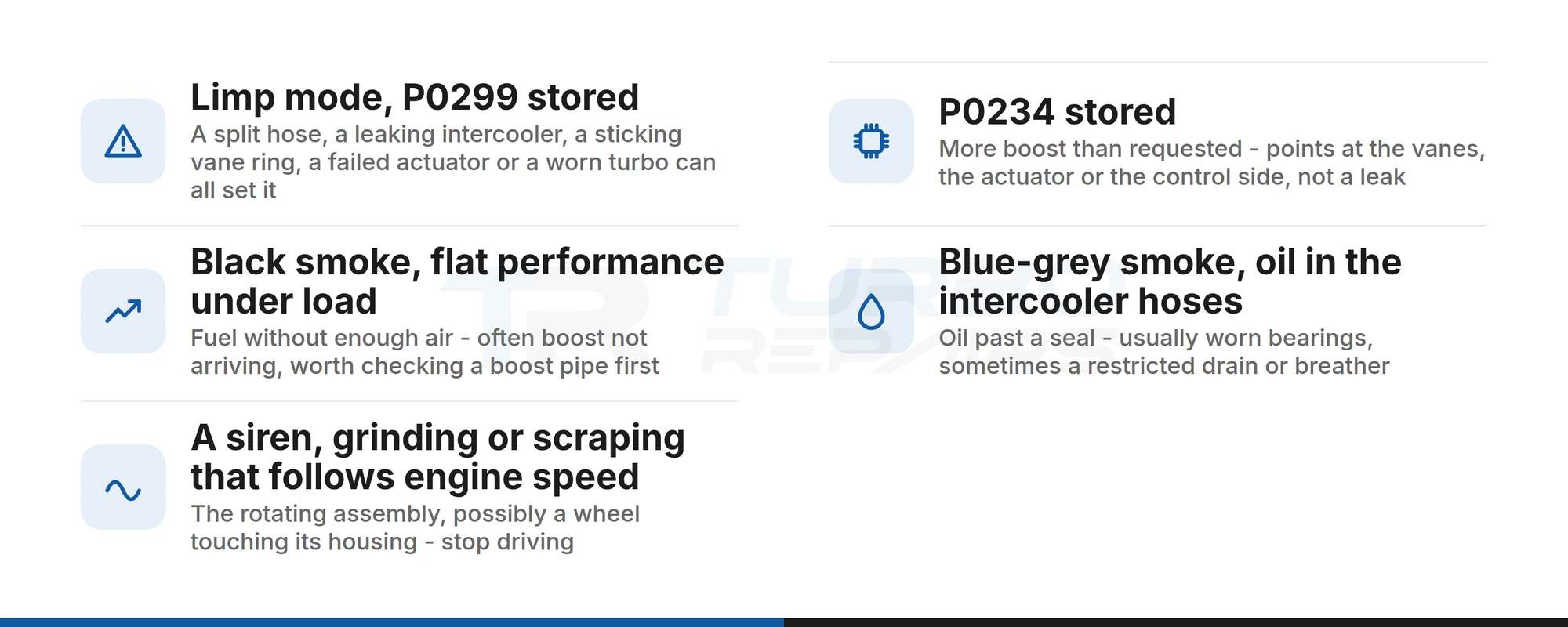
No symptom names the part on its own. What each one does is shorten the list of suspects, and several of those suspects cost far less than a turbocharger.
- Limp mode with P0299 stored. The engine asked for more boost than it measured. A split hose, a leaking intercooler, a sticking vane ring, a failed actuator or its vacuum supply, and a worn turbo can all set it. The code says which way the reading went, not why.
- P0234 stored. More boost than requested. A leak cannot raise the pressure, so this points at the vanes stuck towards closed, the actuator, or the control side. Our guide to overboost and underboost codes explains what each direction rules out.
- Black smoke with flat performance under load. Fuel without enough air to burn it. On a variable-nozzle Golf that usually means the boost is not arriving, and a boost pipe is worth checking before the turbocharger.
- Blue-grey smoke, or oil in the intercooler hoses. Oil is getting past a seal. Worn bearings are the usual reason, but a restricted oil drain from the turbo or a blocked crankcase breather can push oil through a healthy one.
- A whistle that rises with boost. More often air escaping from the pressurised side than a failing turbo. Our guide to diagnosing a turbo whistle sorts the noise by what it follows.
- A siren, grinding or scraping that follows engine speed. The rotating assembly, and possibly a wheel touching its housing. Stop driving the car, because fragments can travel into the intake or exhaust.
For the cheaper faults that imitate a turbo failure, see our guide to common turbocharger problems.
Checks to make before the turbo comes off
- Read every stored code and its freeze-frame data with a tool that talks to VW engine management. Write them down before anything is cleared.
- Go over the boost path by hand: every hose between the turbo, the intercooler and the inlet manifold, looking for splits, oil wetting and loose clips.
- Check the actuator’s supply. On a vacuum-operated unit, inspect the vacuum pipes and the control solenoid. On an electronic unit, check the plug and wiring for damage or corrosion.
- With the engine off and cold, move the vane lever through its travel. Disconnect the actuator link first where it can be done. A lever that drags or stops short puts the turbocharger ahead of the actuator.
- Compare requested and actual boost on a live-data road run. Where the two part company, and in which direction, narrows it further.
If everything passes and the fault remains, the turbocharger needs to come off and be opened. That is where measurement replaces guesswork.
Rebuild Your Own Turbo or Fit a Replacement?
Once the turbocharger is confirmed as the fault, there are three routes. You can buy a new unit, buy a reconditioned exchange unit, which is normally sold against your old one being returned, or have your own unit rebuilt.
On a Golf, the risk in the first two routes is the match. A replacement has to be the right reference for your engine code, and the changeover described above is exactly where a unit chosen by year and power lands on the wrong side. Your own turbocharger was built for your engine, so rebuilding it removes that question. What wears in a turbo is the rotating assembly, the seals and, on these units, the vane mechanism, and those are the parts a rebuild renews.
Replacement is the right call when the housing is cracked or the damage has gone beyond what the housings can support. We establish that when the unit is stripped and tell you before any work goes ahead. If the turbocharger turns out to be sound and the fault is in an electronic actuator, the actuator can be repaired on its own, from £100 + VAT.
Whichever route you take, deal with the cause on the car first. That usually means a new oil feed pipe, fresh oil and filter, and an intercooler and boost pipework cleared of oil or debris from the old unit. Our guide to removing, refitting and priming a turbocharger covers the refit itself.
What a Golf Turbo Replacement Costs
Rebuilding your own Golf TDI turbocharger starts from £185 + VAT. A replacement turbocharger from us starts from £450. Removal and refitting are not included in either figure, and the rebuild price is confirmed once your unit has been stripped and measured, because it depends on how many components are still within specification.
If you know your car’s year and power output, our VW Golf 2.0 TDI turbocharger rebuild listing and VW Golf 1.6 TDI turbocharger rebuild listing let you choose by those two details and show the price for your car. If you are unsure of either, the Repair Form route works just as well, and the unit is identified on the bench.
Replacement units, new or exchange, are priced by reference, and the Golf TDI spans a lot of references, so a quoted figure only means something once the reference is confirmed. Our guide to turbo repair prices sets out what drives the cost of each route.
Turbo Repairs · Epsom workshop
Not sure which side of the changeover your Golf is on?
Send us the turbocharger with your registration and engine code, and a photograph of its label if you can reach it. We match it to your engine before any work starts, then strip, measure and rebuild the unit that was built for your car.
Lifetime, unlimited-mileage warranty · Mail-in from the UK and internationally · Bench-tested and calibrated before it ships
Our VW Golf TDI Turbo Rebuild
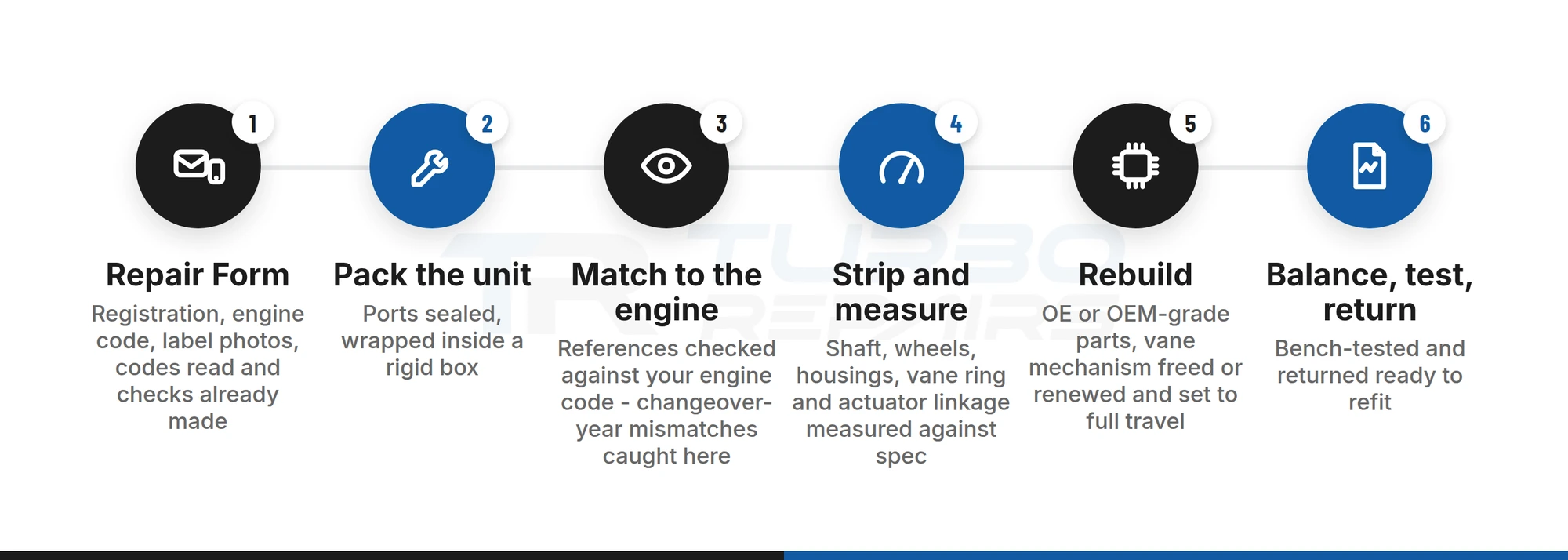
Our team of turbo specialists carries out every stage in-house, and the unit you send is the unit that comes back.
- Tell us about the car. Complete the online Repair Form with the registration, the engine code, photographs of the turbocharger’s label, the codes you read and the checks you have already made.
- Pack the unit. Seal the oil and air openings, wrap it well inside a rigid box, and put your repair reference on a note inside. Our FAQs page covers packing and postage.
- We match it to the engine. The references on the unit are checked against your engine code. On a car from the changeover years this is where a mismatch shows up, and if anything does not agree, we contact you before work starts.
- We strip and measure it. Shaft, bearing surfaces, seals, both wheels, the housings, the vane ring and its pivots, and the actuator linkage are cleaned, inspected and measured against specification.
- We rebuild it. Worn parts are renewed with genuine OE or OEM-grade components, or uprated ones where the original design has a known weakness. The vane mechanism is stripped, freed and renewed where worn, then set to sweep its full travel.
- We balance and bench-test it. The rotating assembly is balanced, the unit is run on the bench, and it goes back to you ready to refit.
Units come to us at Unit 102 Reaver House, 12 East Street, Epsom, Surrey, KT17 1HX, United Kingdom. Bench time is typically one to three working days from arrival, and independent garages and main dealers use the same service for their customers’ cars. Every rebuild carries a lifetime, unlimited-mileage warranty, with no mileage cap and no time limit. For the other engines on our bench, see our turbocharger rebuild service.
VW Golf TDI Turbo FAQ
Is my Golf 2.0 TDI turbo a Garrett or a BorgWarner?
It could be either, or neither. The Pumpe-Düse engines are listed mainly with Garrett units, the first common-rail engines mainly with BorgWarner BV43 and BV40 units, and some later engines with units the fitment data gives no maker for. Several engine codes are listed under both makers, so the label on your own turbocharger is what settles it.
Will a 140 bhp Pumpe-Düse turbo fit a 140 bhp common-rail Golf?
No. The two engines carry different turbochargers under different references, even where the power output and the year are the same. Match the unit to your engine code, not to the output on your V5C.
How much does a VW Golf turbo replacement cost?
Rebuilding your own turbocharger starts from £185 + VAT, and a replacement turbocharger from us starts from £450. Removal and refitting are extra. The rebuild price is confirmed once the unit has been stripped and measured, and if the fault turns out to be an electronic actuator on a sound turbo, that repair starts from £100 + VAT.
Do you rebuild the Golf GTD turbocharger?
Yes. The GTD is a 2.0 TDI, and the higher-output engines it uses are listed with Garrett GTD1449V units under references such as 821866. It is rebuilt the same way as any other Golf TDI turbo, vane mechanism included.
What about the 1.9 TDI and petrol Golf turbos?
This page covers the 1.6 and 2.0 TDI. For an older 1.9 TDI Golf, complete the Repair Form with the numbers from the label and we identify the unit when it arrives. The petrol 1.8 T’s turbocharger belongs to a different family, covered on our BorgWarner K03/K04 repair page.
How long will my Golf be off the road?
Bench time is typically one to three working days from the day the unit arrives, plus postage each way and the time taken to remove and refit it. The rebuilt unit comes back ready to fit, with a lifetime, unlimited-mileage warranty.
Final Thoughts
A Golf TDI turbo is only a simple purchase once you know which Golf TDI you have, and the car does not make that easy. The 2.0 kept its badge and its power output across a change of injection system, so the details most people search by run out exactly where the two engines meet. The engine code, and then the label on the unit, are what carry you across that line.
After that, the order of work matters more than the choice of part. Check the pipes, the actuator and the vane lever on the car, put right whatever starved or contaminated the old unit, and then decide how to replace what failed. If you send us the turbocharger itself, the matching question never reaches you: the unit built for your engine is the one we rebuild.
Turbo Repairs · Epsom workshop
Have your Golf’s own turbo rebuilt, not re-matched
1.6 or 2.0, Pumpe-Düse or common rail, send us the unit with your engine code and the label photographs. We strip it, measure it, rebuild it on OE or OEM-grade parts, balance it and bench-test it before it comes back to you.
Lifetime, unlimited-mileage warranty · Mail-in from the UK and internationally · Bench-tested and calibrated before it ships