

Summary We rebuild the turbocharger and the electronic turbo actuator from the Ford Ranger, starting with the 3.2 TDCi five-cylinder and covering the 2.2 TDCi and 2.0 EcoBlue as well. You send in the unit that is on your truck. We test it, rebuild it at component level and bench-test it, then send it back ready to refit with a lifetime, unlimited-mileage warranty. Turbo rebuilds start from £185 + VAT and actuator repairs from £100 + VAT.
Most Ranger turbo listings are sorted by the truck’s series code, not by year or registration. This page turns those codes into dates, lists the turbochargers the trade catalogues for each engine, and explains how to tell whether the actuator or the turbocharger has failed before anything is ordered.
Turbo listings sort the Ranger 3.2 by series codes that a UK V5C does not show, and the code marks the point where the turbo changes: a Garrett GTB2256VK on the PX1, a GTD2056V on the PX2 and PX3.
The Ranger generations covered here, built from 2011 to 2022, have three diesel engines, and each one carries a different turbocharger arrangement. The 3.2 has a single Garrett turbocharger. On the later trucks it is a variable-geometry unit, with an electronic actuator bolted on as a separate part. The 2.2 has a single turbo that changed several times over its run. The 2.0 EcoBlue is listed as either a single-turbo or a bi-turbo engine. Working out which of these you have comes before choosing a repair.
- Engines covered: the 3.2 TDCi five-cylinder, the 2.2 TDCi and the 2.0 EcoBlue in single-turbo and bi-turbo form
- 3.2 turbochargers listed: a Garrett GTB2256VK on the PX1 and a Garrett GTD2056V on the PX2 and PX3, both at 200 hp (147 kW) in the listings
- Series codes, by catalogue dates: PX1 2011 to 2015, PX2 2015 to 2018, PX3 2018 to 2022
- Shares the 3.2 with: the Ford Everest and the Mazda BT-50, and one 3.2 reference is catalogued for the Transit as well
- Not on this page: the 3.0 V6 in the Ranger from 2022
- Fault codes: covered in our turbo actuator fault code guide
- Our service: turbo rebuilds from £185 + VAT, typically 1–3 working days; actuator repairs from £100 + VAT, typically 1–2 working days, with no programming on refit; lifetime, unlimited-mileage warranty on both
Which Ranger Engine Do You Have?
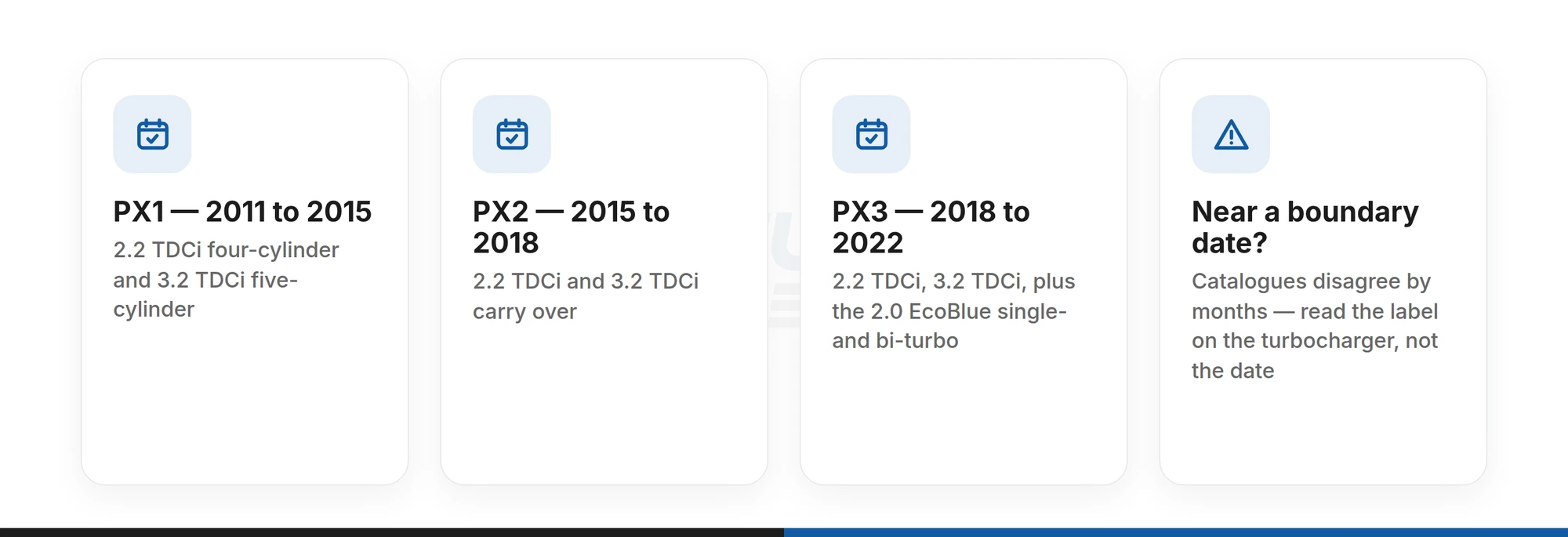
Most owners already know the engine size. What they usually don’t know is the series code, and turbo listings rely on it. Parts catalogues split the Ranger into PX1, PX2 and PX3, and one UK catalogue also uses TKE. None of these codes is printed on a UK V5C. The logbook gives the model name, the engine size, the first registration date and, in section P.2, the power output in kilowatts. Converting the series code into a date is how you match a listing to your truck.
These are the dates one turbo catalogue gives for each series:
| Series code | Catalogue dates | Diesel engines listed |
|---|---|---|
| PX1 | 2011 to 2015 | 2.2 TDCi four-cylinder, 3.2 TDCi five-cylinder |
| PX2 | 2015 to 2018 | 2.2 TDCi, 3.2 TDCi |
| PX3 | 2018 to 2022 | 2.2 TDCi, 3.2 TDCi, 2.0 EcoBlue (single-turbo and bi-turbo) |
| 2022 on | 2022 onwards | 2.0 bi-turbo and 3.0 V6 (the V6 is not covered on this page) |
The dates overlap at each changeover. Catalogues often disagree by a few months, and a truck first registered some time after it was built can sit on either side of the line. If your first-registration date falls near one of these boundaries, don’t choose between two listings based on the date. Read the label on the turbocharger.
Two quick checks settle most cases before you open a catalogue. On the 3.2, count the cylinders or check the V5C: it is the only five-cylinder Ranger. On the 2.0 EcoBlue, count the turbochargers. The bi-turbo engine has a two-turbo assembly, and the single-turbo engine has one turbo.
The 3.2 Five-Cylinder: Turbo and Actuator
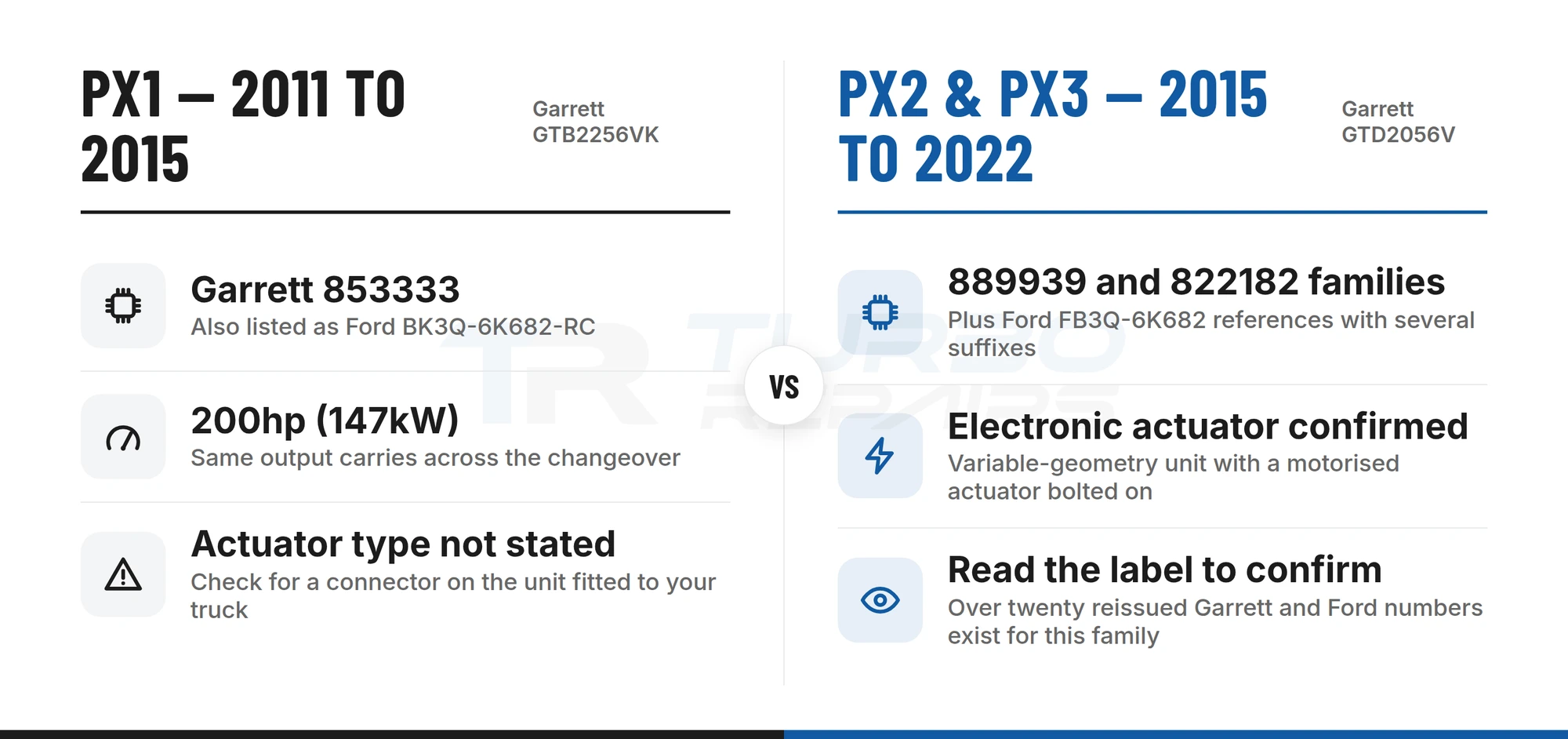
The 3.2 TDCi is the engine most Ranger owners mean when they search for a Ranger turbo, and it is the one the trade lists in the most detail. It is a 3,198 cc five-cylinder Duratorq, listed at 200 hp (147 kW). The same engine is fitted to the Ford Everest and the Mazda BT-50, and one UK catalogue puts one of its turbocharger references on the Transit 3.2 as well.
Two turbochargers, split by the series code
The listings give the 3.2 two Garrett turbocharger families. The engine and the power output stay the same across the change, so neither one tells you which turbo you have.
| Series | Turbocharger listed | References in the listings |
|---|---|---|
| PX1 (2011 to 2015) | Garrett GTB2256VK | Garrett 853333; Ford BK3Q-6K682-RC |
| PX2 and PX3 (2015 to 2022) | Garrett GTD2056V (listed as GTD2056VZK by one supplier) | Garrett 889939 and 822182 families; Ford FB3Q-6K682 references with PA, PC, PD, PE, DB and DE suffixes, among others |
| Catalogued against Ranger and Transit 3.2 | Not stated | 812971-0002, listed for 200 hp SAFA engines from 2011 |
A catalogue gives each family as a list of references because Garrett and Ford have both reissued the unit under new numbers. One supplier lists more than twenty Garrett and Ford numbers for the later 3.2 turbo alone. If your label shows one of them, the table tells you which family you have. If the label is missing, burnt or painted over, send the unit anyway. We identify it on the bench before any work starts.
The Mazda BT-50 is where the dates matter. One catalogue lists the earlier GTB2256VK against the PX1 Ranger and against the Mazda BT-50 3.2 from 2011 through to 2020. Taken at face value, that means a late BT-50 can share its turbo with an early Ranger rather than with a Ranger of the same year. We have not verified that listing against the vehicles themselves, so treat it as a reason to read the label rather than a fitment you can rely on.
The actuator is a separate part
The later 3.2 turbocharger is a variable-geometry unit. One supplier that builds uprated versions of it describes the VNT housing and lists a remanufactured Hella actuator among the parts it fits. On that design, boost is controlled by a ring of vanes in the turbine housing, and a motorised actuator bolted to the turbocharger moves the vanes whenever the engine management changes its boost target. The supplier’s parts list confirms that the actuator on this turbo is an electronic unit that can be removed and rebuilt on its own. For the PX1 turbo, the listings we reviewed do not say what type of actuator it uses. Look at the one fitted to your truck: if it is a moulded housing with an electrical connector plugged in, it is electronic.
This matters because the two parts fail differently. An electronic actuator wears in its motor, its drive gears and its position sensor, and the circuit board that runs them suffers from heat and vibration. The turbocharger wears in its bearings and seals, which depend on a clean, steady oil supply. On a diesel that does a lot of low-speed or short-trip work, carbon also builds up on the vane ring until it sticks. Only the actuator’s faults can be fixed by removing the actuator alone.
The 2.2 and 2.0 EcoBlue: Where the Transit Overlap Ends
These two engines are also used in Ford’s vans, which is why Ranger owners often end up on Transit pages. Our page on the Transit 2.2 and 2.0 EcoBlue actuator covers those engines’ actuators, codes and failure pattern. The shared hardware only goes so far, though, and the listings show where it stops.
2.2 TDCi
Of the Ranger 2.2 turbocharger references in the listings we reviewed, only one is catalogued against the van as well. Reference 787556-0017 is listed for the Transit, Transit Custom, Tourneo Custom and Ranger 2.2. The others are listed for the Ranger alone: Garrett 854800 on the PX1 and on Euro 6 PX2 trucks, Garrett 889938 and a Garrett GTD1449VKZ on the PX2 and PX3, and 49131-06300 and 831157-0005 in a UK catalogue covering outputs of roughly 125 to 160 hp. So a “2.2 TDCi” turbo listing, or an actuator listing written for the Transit, is not necessarily right for a Ranger. The label on the turbocharger decides it.
2.0 EcoBlue, single-turbo and bi-turbo
The 2.0 EcoBlue is listed from 2018 in two forms, and the listings use a different turbocharger maker for each. The single-turbo engine is listed with a Garrett GTE1446VKZ under 850229 references. The bi-turbo engine is listed with a two-stage BorgWarner assembly under 1000-970-0257. The listings we reviewed catalogue these references for the Ranger, and the single-turbo unit for the Everest too, but they do not name the Transit against either one.
The bi-turbo pair is sold both as one complete assembly and, by at least one seller, as a separate high-pressure stage. The simplest approach is to send the assembly as it came off the engine and let us identify both stages on the bench. Our Ford Ranger 2.0 TDCi turbocharger rebuild listing covers both engines, with the Garrett and BorgWarner units it applies to set out by year and power output.
Symptoms on a Working Pickup
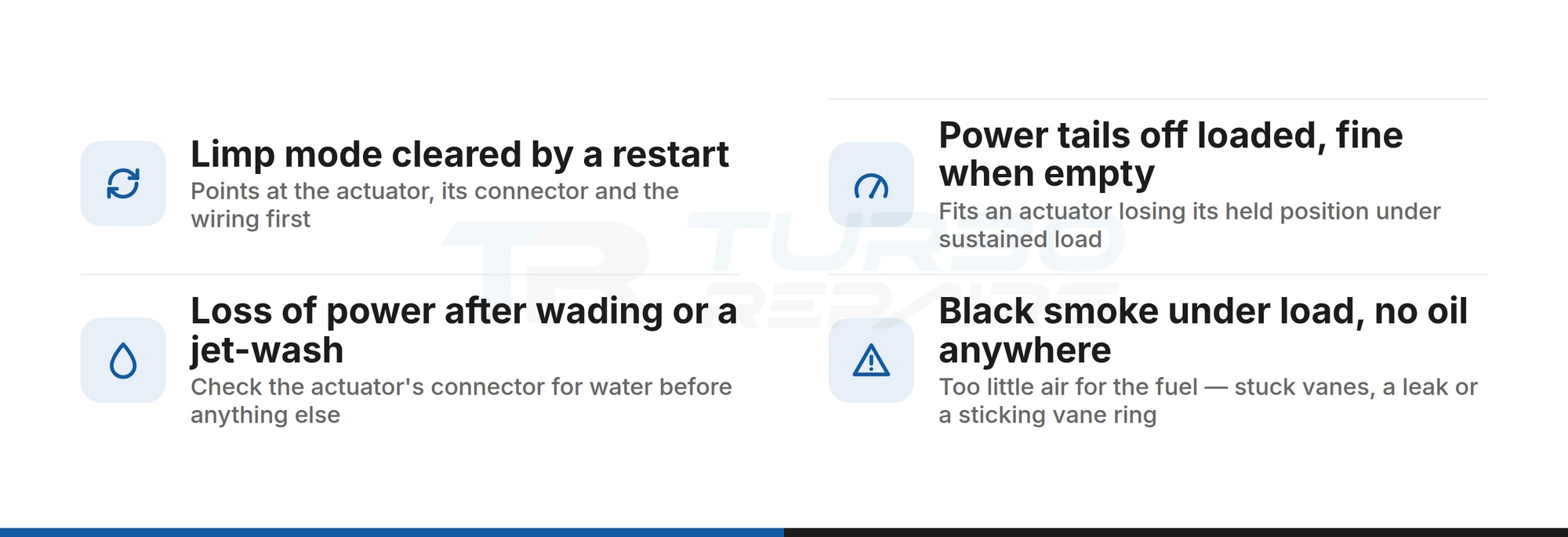
A Ranger usually shows a boost fault while it is working: loaded, towing or crawling in low range. Parked and empty in front of a diagnostic tool, it may show nothing. The symptom tells you which system to look at. The conditions it appeared in help narrow down the part.
- Limp mode with an engine warning light, cleared by a restart. A fault that comes and goes points at the control side first: the actuator, its connector and the wiring to it. A worn turbocharger gives steadier, more physical signs.
- Power that tails off on a long climb or with a full bed, but is fine when empty. This fits an actuator that can no longer hold the vane position it is asked for under a sustained load. It also fits a charge-air leak that only opens at full boost, so the pipework gets tested first.
- Loss of power after wading, jet-washing the underside or a winter of salted roads. Check the actuator’s connector before the actuator itself. Water in a connector produces the same fault as a failed motor.
- Blue smoke, oil in the intercooler pipes or a whine that rises with revs. These point at the turbocharger’s bearings and seals. An actuator cannot put oil anywhere.
- Black smoke under load with no oil anywhere. Too little air for the fuel. This can be vanes stuck open, a charge-air leak or a sticking vane ring, and the check in the next section separates them.
Before anything is cleared, write down what the truck was doing when the fault appeared: laden or empty, towing or not, high or low range, and whether the engine was hot. Read the stored codes and their freeze-frame data at the same time. Our guide to turbo actuator symptoms goes through each pattern in more depth.
Actuator or Turbocharger? What to Check on the Ranger First
A garage report that the actuator “isn’t responding” can mean two different faults. The actuator may have failed and be unable to move a healthy vane ring. Or the vane ring may have stiffened with carbon, so a working actuator cannot move it. The first needs an actuator repair. The second needs the turbocharger rebuilt, and any new or rebuilt actuator fitted to that turbo would fight the same resistance from the first drive.
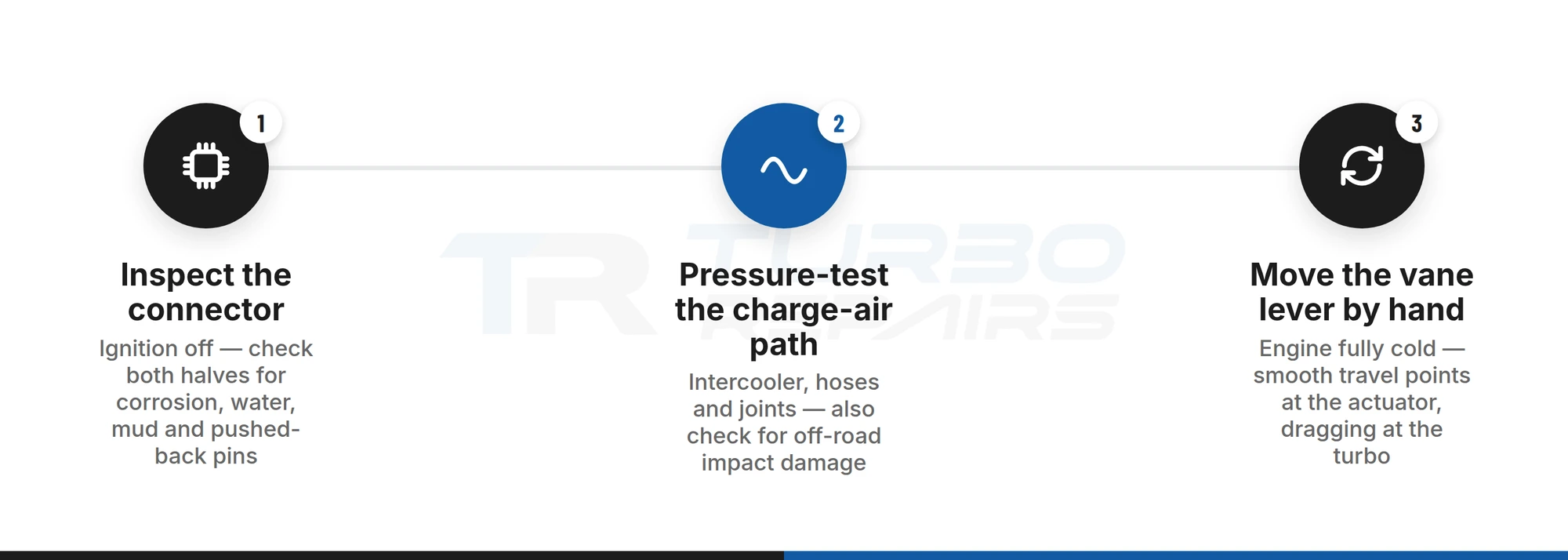
Work through these in order. The first two cost nothing and the third needs only a cold engine.
- The connector. With the ignition off, unplug the actuator and inspect both halves for green corrosion, water, mud and pins pushed back into the housing. On a truck that goes off-road, this check turns up more than it would on a car. Refit the plug until it clicks home.
- The charge-air path. Have the intercooler, its hoses and the joints pressure-tested. On a truck used off-road, look for impact damage as well as loose clips. A hose or core that only leaks under boost reads exactly like a boost-control fault.
- The vane mechanism, by hand. Let the engine cool completely, because the turbine housing gets hot enough to burn. Where the actuator drives the turbo through an external linkage, disconnect it and move the turbocharger’s vane lever gently through its full travel. Smooth, even movement from end to end points at the actuator. Dragging, catching or stopping short points at the turbocharger.
Don’t drive the truck with the actuator unplugged to see what happens. With the actuator disconnected, the engine management has no control over the vanes, and the three checks above tell you more without that risk.
If the lever is stiff, the turbocharger needs the work, and it comes off the engine as a unit. Our turbocharger rebuild service is where to start, with rebuilds from £185 + VAT. An actuator that has been pushing against a sticking vane ring has been working harder than it was designed to, so tell us on the form and we will test it at the same time.
Turbo Repairs · Epsom workshop
Vanes sweep freely? It is the Ranger’s actuator, and it can come off on its own
Photograph every marking on the actuator housing and the turbocharger label, note what the truck was doing when the fault appeared, then send us the actuator. We test it as received, before it is opened, so the fault we report is the one we measured.
Lifetime, unlimited-mileage warranty · Mail-in from the UK and internationally · Bench-tested and calibrated before it ships
Our Ford Ranger Turbo and Actuator Rebuild
You, or the garage that maintains the truck, remove the failed unit and send it to our workshop at Unit 102 Reaver House, 12 East Street, Epsom, Surrey, KT17 1HX, United Kingdom. It is rebuilt there by our team of turbo specialists and electronic engineers. Independent garages send Ranger units in for their customers’ trucks in the same way.
- Tell us what is coming. On the online Repair Form, give the registration, the engine, the first-registration date, the output from section P.2 of the V5C, the stored fault codes, the conditions the fault appeared in, and photographs of every label and marking.
- We confirm the unit. We check the references against your truck before you post anything. If the markings point to a different turbo family from the one the truck’s date suggests, we tell you then, not after the work.
- We test it as received. An actuator is run on the bench before it is opened. A turbocharger’s shaft play, wheel condition and vane-ring movement are measured and recorded before it is stripped.
- We rebuild it at component level. On an actuator, the motor, gear train, position sensor and seals are renewed as needed and the circuit board is reworked. On a turbocharger, the core is stripped, measured and rebuilt on genuine OE or OEM-grade parts, the vane ring is cleaned or renewed, and the rotating assembly is balanced. Any component with a known design weakness is replaced with an uprated part, not refitted as it was.
- We calibrate and bench-test it. An actuator’s travel and position feedback are checked across the full sweep on dealer-level diagnostic and calibration tooling, and it comes back ready to refit with no programming. A turbocharger is run up on the bench before it is boxed.
Actuator repairs start from £100 + VAT and typically take one to two working days from arrival. Turbo rebuilds start from £185 + VAT and typically take one to three. Postage each way is on top of both. The exact price is confirmed once the unit has been identified and tested, before any work goes ahead, and every rebuild carries a lifetime, unlimited-mileage warranty. Packing and postage are covered on our FAQs page.
When a rebuilt turbocharger goes back on, change the oil and filter and renew the oil feed and return lines rather than reusing them. Then prime the oil feed as set out in our guide to replacing a turbocharger, so the new bearings are not run dry on first start. The other vehicles whose actuators we rebuild are listed on our electronic turbo actuator repairs page.
Ford Ranger Turbo FAQ
Is the Ranger 3.2 turbo the same as the Transit 3.2 turbo?
Sometimes. One UK catalogue lists reference 812971-0002 against both the Ranger and the Transit 3.2 at 200 hp. The later Ranger 3.2 is listed under the GTD2056V families, 889939 and 822182, which are catalogued for the Ranger and the Everest. Go by the label on your own turbocharger, not the vehicle name on a listing. Our Ford Transit turbo repair page covers the van side.
Do the Ford Everest and Mazda BT-50 use the same turbo as the Ranger?
They use the same 3.2 five-cylinder engine, and the listings put the same turbocharger families on them. One catalogue lists the GTD2056V for the PX2 and PX3 Ranger and the Everest, and the same catalogue lists the earlier GTB2256VK for the PX1 Ranger and the BT-50 3.2 through to 2020. Because the dates don’t line up across the three badges, the label is the reliable check.
A listing says PX2. How do I know if that is my Ranger?
PX1, PX2 and PX3 are series codes that the parts trade uses and a UK V5C does not show. By one catalogue’s dates, PX1 runs from 2011 to 2015, PX2 from 2015 to 2018 and PX3 from 2018 to 2022. On the 3.2 the turbocharger changes between PX1 and PX2, so if your truck was first registered in 2015, read the label rather than relying on the year.
Can I send just the actuator from my Ranger 3.2?
Yes, if it is electronic and the turbocharger’s vanes move freely. The actuator is a separate unit on the turbo, and we rebuild it, calibrate it and return it ready to refit with no programming. If the vane lever drags or sticks when you move it by hand on a cold engine, the turbocharger needs the work instead.
Do you rebuild the Ranger 2.0 bi-turbo?
Yes. The bi-turbo 2.0 EcoBlue has a two-stage BorgWarner assembly. Send it as it came off the engine, tell us which engine it is on the Repair Form, and we identify both stages on the bench before any work is quoted.
Does this page cover the Ranger from 2022?
Not the 3.0 V6 from that generation. The 2.0 bi-turbo engine continued into it, but the listings we reviewed don’t show whether its turbo assembly carried over unchanged. Photograph the label and send it with the Repair Form, and we will confirm the unit before you post anything.
How much does a Ford Ranger turbo or actuator repair cost, and how long does it take?
Turbo rebuilds start from £185 + VAT and typically take one to three working days. Actuator repairs start from £100 + VAT and typically take one to two. Postage each way is on top. The exact price is confirmed once the unit has been identified and tested, and every rebuild carries a lifetime, unlimited-mileage warranty.
Final Thoughts
Ranger turbo listings are written around series codes, and the paperwork a UK owner holds does not include them. On the 3.2, the change from PX1 to PX2 is where the turbocharger itself changes, from a GTB2256VK to a GTD2056V, while the engine and the power output stay the same. On the 2.2, most of the references belong to the Ranger alone, whatever a Transit listing suggests. On the 2.0 EcoBlue, the number of turbochargers decides which maker’s assembly you have.
Two steps come before choosing a repair. Read the label on the turbocharger, and move the vane lever by hand with the engine cold. The label identifies the unit, and the lever check tells you whether the actuator or the turbocharger has failed. If you rebuild the unit already on your truck, you don’t have to match it to a listing at all.
Turbo Repairs · Epsom workshop
Your Ranger’s own turbo or actuator, rebuilt to go back on the same truck
Complete the Repair Form with your engine, codes and label photographs, and we confirm the unit before you post it. It is tested as received, rebuilt at component level, bench-tested and returned ready to refit.
Lifetime, unlimited-mileage warranty · Mail-in from the UK and internationally · Bench-tested and calibrated before it ships