

Summary A turbo leaking oil or blowing blue-grey smoke is losing oil past the seals at one or both ends of its shaft. The seal is rarely where the fault starts: it holds oil back by pressure, so a blocked air filter, an exhaust leak, a restricted oil drain or a pressurised crankcase can push oil past a turbo that is otherwise sound.
Oil out of the compressor end points first back up the intake, oil out of the turbine end points first down the exhaust, and oil out of both ends points first at the drain and crankcase between the turbo and the sump, or inside the turbo.
Turbo Leaking Oil: Where the Oil Comes From
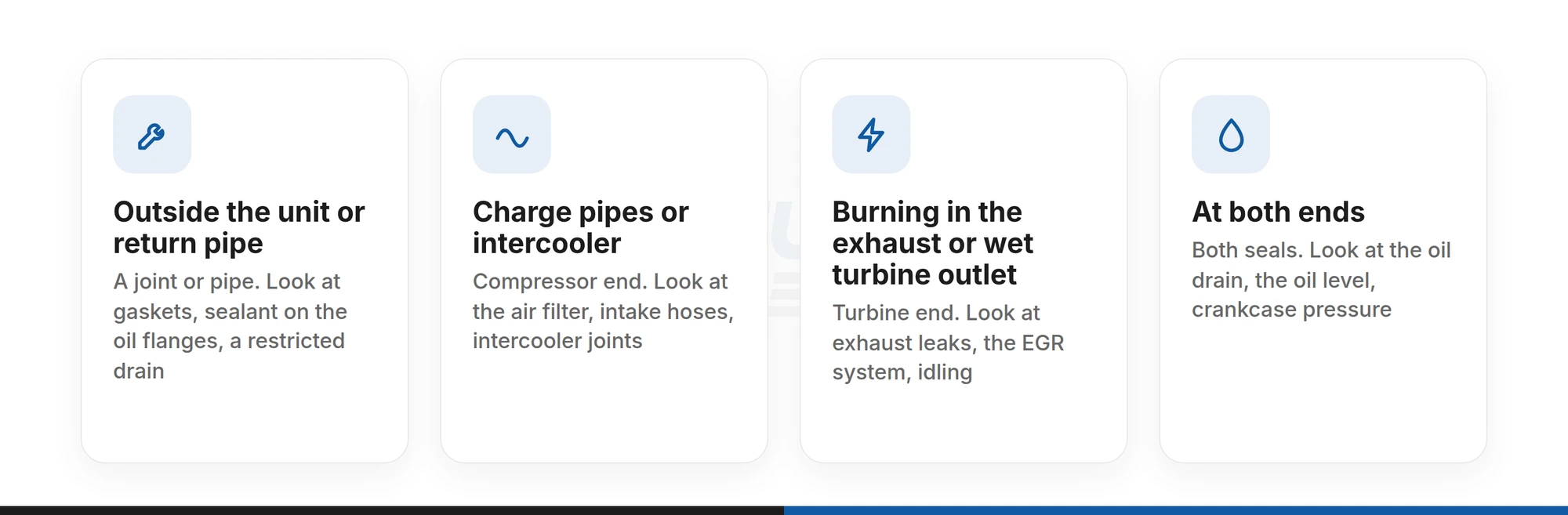
A correctly installed turbocharger should not leak oil. Garrett and Melett both make that point, and both then sort leaks by where they appear. Do the same before spending money, because each location points first at a different part of the car.
| Where the oil is | Where it came from | What to look at first |
|---|---|---|
| On the outside of the unit, the return pipe or its fittings | A joint or pipe | Gaskets, sealant on the oil flanges, a restricted drain |
| In the charge pipes or intercooler | Compressor end | The intake: air filter, intake hoses, intercooler joints |
| Burning in the exhaust, or wet in the turbine outlet | Turbine end | The exhaust: leaks, the EGR system, idling |
| At both ends | Both seals | The oil drain, the oil level, crankcase pressure |
Oil on the outside of the turbo
Oil on the outside of the unit is a joint or a pipe before it is a turbo. One turbo parts maker gives oil on the return line or its fittings as the visible sign of a poor drain, and Melett lists incorrect gaskets and silicone sealant among its causes.
Oil in the intake: the compressor end
Oil in the charge pipes or intercooler has come out of the compressor end. The causes the sources list include air-side faults: a clogged or undersized air filter, a blocked, split or badly fitted intake hose, and air leaks at the intake hoses or intercooler. A turbo supplier writing in a UK trade magazine adds a blocked exhaust, whose back pressure can push oil past the compressor-side seals too.
Oil in the exhaust: the turbine end
Oil reaching the turbine end leaves with the exhaust gas, as smoke or a wet, sticky turbine outlet. The listed causes include exhaust-side faults: leaks in the exhaust or EGR system, a cracked turbine housing or warped flange, and a turbine piston ring collapsed by excessive exhaust temperatures. Melett adds one cause involving no damage at all: running at idle.
Oil at both ends
The turbo drains its oil back to the sump by gravity. Anything that slows that return — a kinked or part-blocked drain pipe, an overfilled engine, or crankcase pressure from a blocked breather or blow-by past worn piston rings — backs oil up in the bearing housing until it leaves by both seals. Melett and one turbo specialist’s fact sheet add two causes inside the turbo: excessive bearing clearance, and carbon left in the centre housing by repeated hot shutdowns.
Blue, White and Black Smoke: What Each Points To
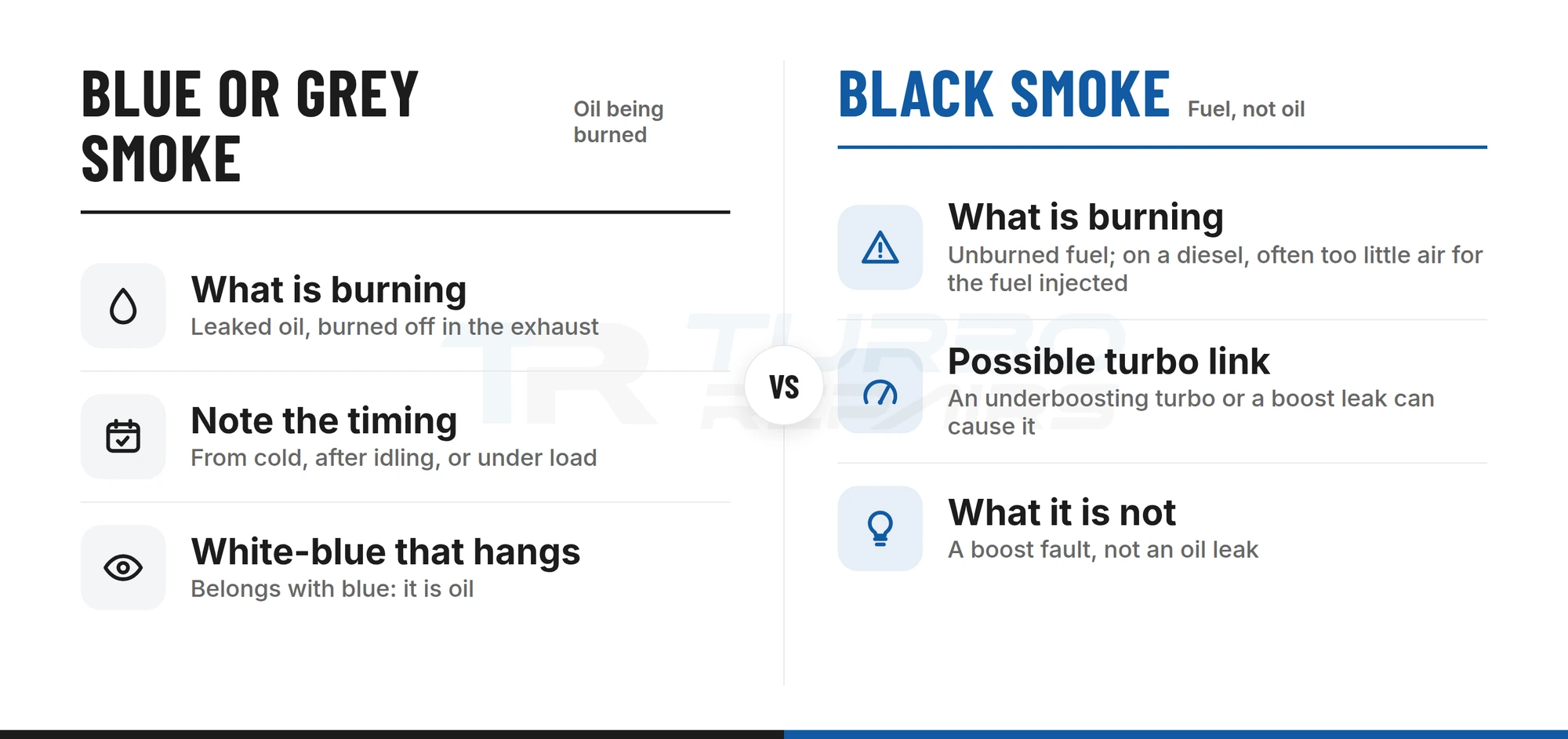
Smoke colour tells you what is burning, which is a different question from which part has failed. Note when it appears, too: from cold, after idling, or under load.
Blue or grey: oil. The trade-magazine supplier lists blue-grey exhaust smoke as the sign of leaked oil being burned off.
White: read it carefully. Thin white vapour from a cold diesel, which thins as the engine warms and smells of nothing, is not a turbo symptom. White-blue smoke that hangs in the air is oil, and belongs with blue. None of the turbo sources we draw on attributes persistent white smoke from a warm engine to the turbo, so we do not put a cause to it here: have it checked rather than guessed at.
Black: fuel, not oil. Black smoke is unburned fuel, on a diesel a common sign of too little air for the fuel injected. An underboosting turbo or a boost leak can cause it, but it is a boost fault, not an oil leak.
Timing matters as much as colour. Melett explains that at idle the pressure in the housings drops, which can create a vacuum that draws oil into the turbine housing; at normal engine speeds the pressure returns and the leak stops. The trade-magazine supplier turns that into a test after fitting a turbo: after a long idle, check the oil level and take the car for a run under load. If the smoke continues or gets heavier, it needs further investigation.
How Turbo Oil Seals Fail (and Why a Seal Is Rarely the Root Cause)
A turbo’s oil seals are not lip seals like those on a crankshaft. The trade-magazine supplier calls the arrangement a dynamic, differential pressure sealing system, and a turbo specialist’s fact sheet describes the seals as similar to piston rings, needing positive air pressure inside the compressor and turbine housings to keep oil in the bearing housing. Upset that pressure and oil moves past a seal in good condition.
Melett gives a neat demonstration. On a high-speed balancing machine, where the core spins with no housings fitted, oil can appear at both ends because the pressures that create the seal are absent. Melett says this is unlikely to happen once the turbo is on the engine.
So the seal is rarely the root cause. The trade-magazine supplier says most turbo oil leaks are a symptom of another problem. Our guide to what causes turbo failure covers the wider causes behind this kind of damage.
When the seal itself is worn
Seals do wear, and the sources name what wears them: high back pressure, for example from a blocked DPF; contaminants in the oil; heat soak from repeated hot shutdowns; and excessive exhaust temperatures, which can collapse the turbine piston ring. With the turbo stripped, the same supplier lists the evidence: worn shaft piston ring seals, clogged oil flinger grooves, a worn seal plate bore on the compressor side, and turbine blades coated in thick black oil.
Checks Before You Blame the Turbo: Breather, Intercooler Oil, DPF
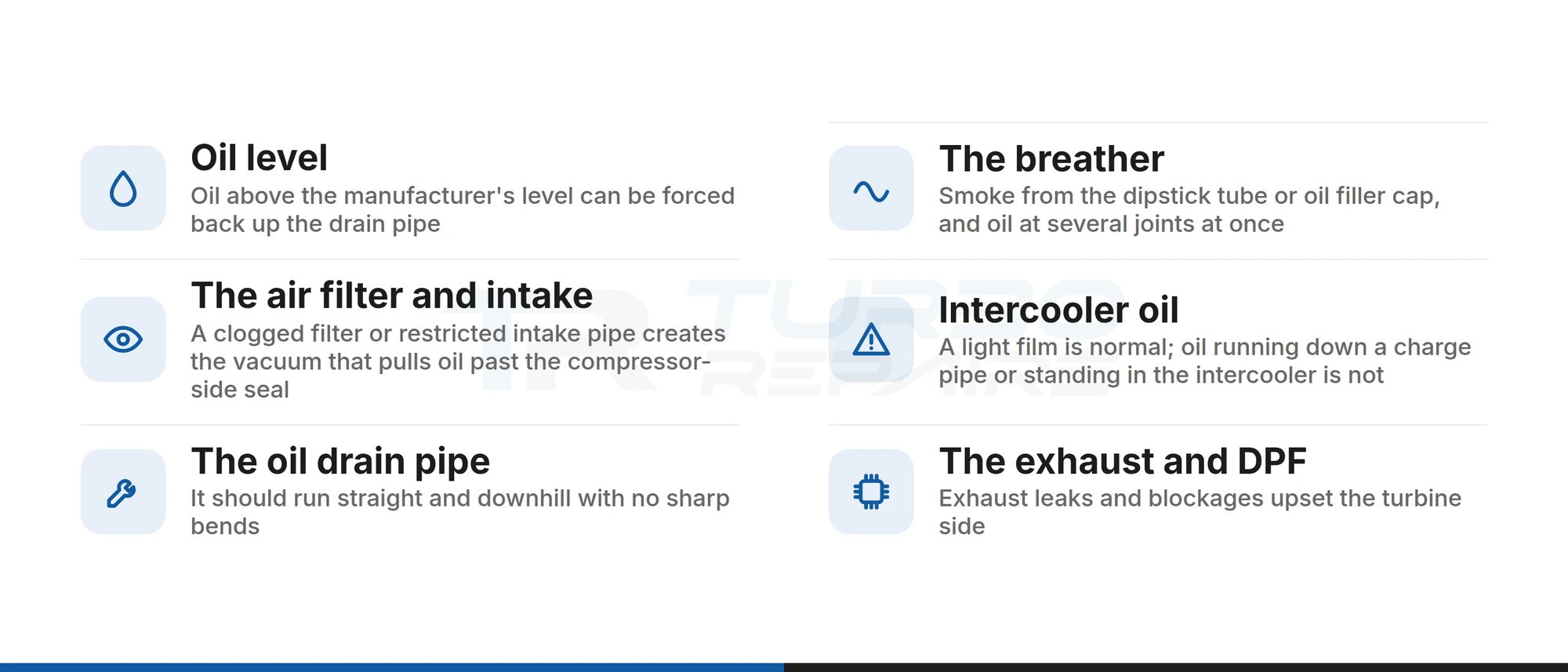
None of these needs the turbo off the car. Work through them in order.
- Oil level. Melett explains that oil above the engine manufacturer’s level can be forced back up the drain pipe by the motion of the crankshaft, restricting the flow and causing leaks at both ends.
- The breather. A blocked crankcase breather, or too much blow-by, builds crankcase pressure that backs up the turbo’s drain. A turbo parts maker gives the signs: smoke from the dipstick tube or oil filler cap, and oil at several joints at once. Check the breather hoses and valve; the trade-magazine supplier recommends a compression test to confirm excessive crankcase pressure.
- The air filter and intake. A clogged filter or restricted intake pipe creates the vacuum that pulls oil past the compressor-side seal.
- Intercooler oil. With the hose off the turbo outlet, a light oily film is normal on engines that route crankcase gases back into the intake. Oil running down a charge pipe or standing in the intercooler is not, and the intercooler and pipes then need cleaning or replacing.
- The oil drain pipe. A turbo parts maker says the drain should run straight and downhill with no sharp bends.
- The exhaust and DPF. Exhaust leaks and blockages upset the turbine side, and Melett includes a clear DPF and catalytic converter in its prevention advice. Our guide to whether a blocked DPF can cause turbo failure covers that link.
What Happens If You Keep Driving
Smoke that does not clear once the engine is working is not the idle leak described above. The risks, as the technical sources state them:
- The bearings. Melett states that oil leaks can cause catastrophic damage to the bearing systems, occurring within seconds of the turbocharger commencing operation.
- The oil level. The trade-magazine supplier lists the oil warning light among the signs of a leak.
- Oil in the charge-air cooler. The same supplier lists uncontrolled overspeeds when oil collected in the charge-air cooler is blown into the engine and combusted.
- The exhaust after-treatment. A turbo parts maker warns that oil leaking from the turbine end can damage the catalytic converter or diesel particulate filter.
Heavy smoke, or an oil level that falls between journeys, means the car should not be driven unless it is unavoidable. If a diesel ever revs on its own and does not respond when you lift off, treat it as an emergency; our guide to blown turbo symptoms covers what to do and when to have the car recovered.
Turbo Repairs · Epsom workshop
Oil past the seals? Have the cause read, not just the seals renewed
Post the turbo to our workshop and we establish what caused the leak before deciding what to renew. The rebuilt unit is checked for oil-tightness and comes back ready to refit.
Lifetime, unlimited-mileage warranty · Mail-in from the UK and internationally · Bench-tested and calibrated before it ships
What to Do Next
Write down three things before anything is unbolted: where the oil is, what colour the smoke is, and when it appears. Then run the checks above. If they find a cause, put it right first and watch whether the smoke stops.
If the turbo has to come off, the order of work matters. A turbo specialist’s fact sheet puts it plainly: before fitting a new turbocharger, find out what caused the original to fail, because not fixing the underlying problem will most likely lead to the failure of the replacement.
When a leaking turbo reaches our Epsom workshop, we establish what caused the failure before deciding what to renew. Bearings, piston-ring seals, O-rings and circlips are renewed as standard, never refitted, and the finished unit is run and checked for free rotation, oil-tightness and correct actuator travel before it is packed. A turbo rebuild typically takes one to three working days on the bench and carries a lifetime, unlimited-mileage warranty.
The trade-magazine supplier advises a new OE-quality oil return line routed downhill with no kinks, a clean intercooler and pipes, and no silicone on oil gaskets.
Turbo Oil and Smoke FAQ
Can I just replace the turbo’s oil seals?
Not with the turbo on the car: the seals are rings on the shaft inside the unit, so renewing them means stripping it. On our rebuilds, the piston-ring seals are renewed as standard.
What does it cost to fix a turbo that is leaking oil?
It depends on whether the cause is on the car or inside the turbo, which the checks above and a strip-down decide. Our turbo repair cost guide sets out the prices.
Final Thoughts
Oil from a turbo is a reading of pressure before it is a verdict on the turbo. Where it appears points first at the system that moved the pressure: the intake, the exhaust, or the drain and crankcase, and a fault inside the turbo can show there too.
Run the cheap checks in order and fix what they find. If the turbo does have to come off, have it read and rebuilt, and put the cause right on the car before it goes back on.
Turbo Repairs · Epsom workshop
A leaking turbo, rebuilt once the cause is known
Remove the turbo, complete the repair form and post it to our workshop. It is stripped, rebuilt with new seals and bearings, then run and checked for oil-tightness, typically within one to three working days of arriving.
Lifetime, unlimited-mileage warranty · Mail-in from the UK and internationally · Bench-tested and calibrated before it ships