

Summary We rebuild the electronic turbo actuator from the Audi 2.7 and 3.0 V6 TDI, as fitted to the A6 and to the A4, A5 and Q7 on the same engines, from £100 + VAT. Your own unit is tested as received, rebuilt at component level, calibrated and returned ready to refit without coding, typically after one to two working days on the bench, with a lifetime, unlimited-mileage warranty.
How much a parts listing can tell you depends on which V6 you have. The listings for the 240 hp 3.0 largely agree with one another; the listings for the 2.7 do not. This page sets out both before you buy, fit or send anything.
Audi’s own turbocharger numbers separate the two V6 TDIs by a single digit, 059145721F on the 2.7 and 059145722R or 059145722M on the 240 hp 3.0, and the listings put a different Hella actuator on each.
On the 2.7 and 3.0 V6 TDI, the electronic actuator is the motorised unit on the variable-geometry turbocharger that sets the position of the turbine vanes for the engine management. When it fails, the car typically loses power or drops into limp mode with a boost-control fault stored, while the turbocharger itself can be perfectly sound. The actuator is catalogued and rebuilt as a part in its own right, so the repair can stop at the part that actually failed.
- Engines covered: the Audi 2.7 TDI and 3.0 TDI V6 fitted with an electronic actuator, listed for the A6, A4, A5 and Q7
- 3.0 TDI at 240 hp, as listed: Hella 6NW009550, G-20, on a Garrett GTB2260VK (776470), Audi turbocharger numbers 059145722R and 059145722M, engine codes CDYA and CDYC on the A6 and CASA on the Q7
- 2.7 TDI, as listed: a Garrett GTB1756VK (765314 or 769701), Audi number 059145721F. The actuator listings for it disagree with each other, so identify from your own unit
- Not on this page: the four-cylinder 2.0 TDI, the 2.0 TFSI petrol engine and the older 2.5 V6 TDI
- Fault codes: covered in our turbo actuator fault code guide
- Our service: your own actuator rebuilt from £100 + VAT, typically 1–2 working days, no coding on refit, lifetime unlimited-mileage warranty
Which Audi V6 TDI Is Yours? 2.7 or 3.0, by Model and Output
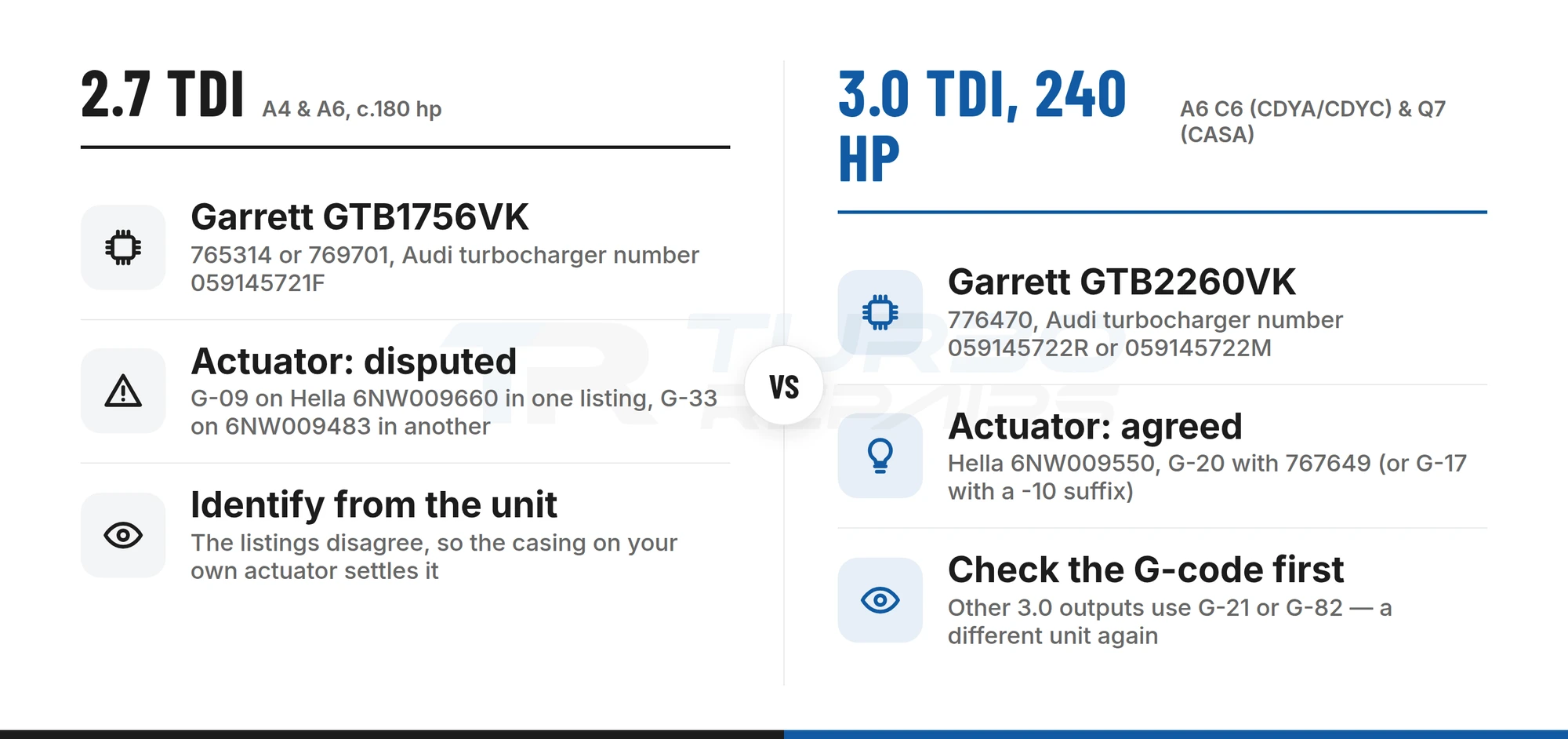
Two V6 diesels matter here. The listings we reviewed put the 2.7 TDI in the A4 and A6 at around 180 hp, and the 3.0 TDI in the A6, the Q7 and, under other references, the A4, A5 and larger Audis. Your V5C gives the cylinder capacity, which settles 2.7 or 3.0, and an Audi parts desk can confirm the engine code from the VIN.
Within the 3.0, the output and engine code matter as well, because the listings attach different actuator references to different versions. The table sets out what they say.
| Engine as listed | Vehicles named | Output and engine codes | Turbocharger | Actuator references listed |
|---|---|---|---|---|
| 3.0 TDI, 240 hp | A6 C6 3.0 TDI, 2008–2011; Q7 3.0 TDI, 2007–2010 | 176 kW; CDYA and CDYC (A6), CASA (Q7) | Garrett GTB2260VK, 776470 (769909 also listed); Audi 059145722R, 059145722M | Hella 6NW009550, G-20, with 767649. A second listing gives G-17 with 6NW009550-10 |
| 3.0 TDI, A4 and A5 quattro | A4 and A5 quattro 3.0 TDI | Not stated in the listing | Listed with 776470 references and 776469-5005S | G-21, with 777159 |
| 3.0 TDI, a further family | Audi A4 to A8, alongside the VW Touareg 3.0 TDI | Not stated in the listing | Garrett GTB2056VZK; Audi 059145874D, 059145874J | G-82, with 799672 and 804986 |
| 2.7 TDI | A4 and A6 2.7 TDI | 179–180 hp | Garrett GTB1756VK, 765314 and 769701; Audi 059145721F | Disputed: G-09 on Hella 6NW009660 in one listing, G-33 on 6NW009483 in another |
If your 3.0 is not a 240 hp car and its casing reads neither G-21 nor G-82, the listings we reviewed do not settle which unit it carries. That is no obstacle to a repair. It simply means the identification has to come from the unit rather than from a listing.
The 240 hp unit is also listed for the VW Phaeton and Touareg 3.0 TDI and for the Porsche Cayenne diesel. The Touareg’s side of that story, including why the fault tends to show up on a tow, is on our VW Touareg V6 TDI actuator page.
Where This Page Stops: 2.0 TDI, 2.0 TFSI and the Older 2.5 V6
Search results for an A6 turbo actuator mix several engines, and three of them sit outside this page.
- The 2.0 TDI. If your A6 is a 2.0 TDI, it shares engine codes such as BRE and CAGB with the four-cylinder A4, and its turbocharger is covered on our page on the four-cylinder A4 and A6 TDI turbo.
- The 2.0 TFSI petrol engine. The same searches return an electric wastegate actuator for the later 2.0 TFSI and a spring-and-diaphragm wastegate actuator for the BorgWarner turbocharger on earlier A4 and A6 2.0T cars. Both open and close a wastegate on a petrol engine rather than moving variable vanes on a diesel, so nothing on this page applies to them.
- The older 2.5 V6 TDI. This engine runs a different Garrett turbocharger, catalogued in more than one form. Start with our Garrett GT2052V page and the plate on the compressor housing.
Whatever the engine, look at the part before going further. An electronic actuator is a moulded housing with an electrical connector plugged into it. A sealed can with a rod and a small vacuum pipe is a pneumatic actuator, and it is not what this service rebuilds.
The 3.0 TDI: Where the Listings Agree
The 240 hp 3.0 is the best-documented Audi V6 actuator in the listings we reviewed, and three facts recur across them: the Hella number 6NW009550, the Garrett GTB2260VK turbocharger numbered 776470, and the Audi turbocharger numbers 059145722R and 059145722M. When separate suppliers repeat the same set, that set is worth trusting.
G-20, 767649, 6NW009550: the three references on the casing
One supplier’s listing for this unit asks buyers to match their original actuator on all three of its references, G-20, 767649 and 6NW009550, and tells them not to match by the turbocharger’s frame size, such as GTB22. That is sound advice. A frame size names a family of turbochargers, not the actuator bolted to the one on your engine.
The same supplier also lists a second unit for exactly the same vehicles, the A6, Q7, Touareg and Cayenne: G-17, with the Hella number carrying a -10 suffix, 6NW009550-10. So even on the best-documented Audi V6, the G-code and the suffix are the details to read off your own casing. Photograph every marking, exactly as printed.
Why the Hella number alone is not enough
6NW009550 is not unique to Audi. Our pages record the same Hella number on BMW six-cylinder diesels and on the Ford Transit 2.2 TDCi, each under its own G-code. Our Hella actuator index by part number shows every vehicle it appears against, and why a matching 6NW number on its own proves only that the unit is a Hella one.
The 2.7 TDI: Where the Listings Disagree
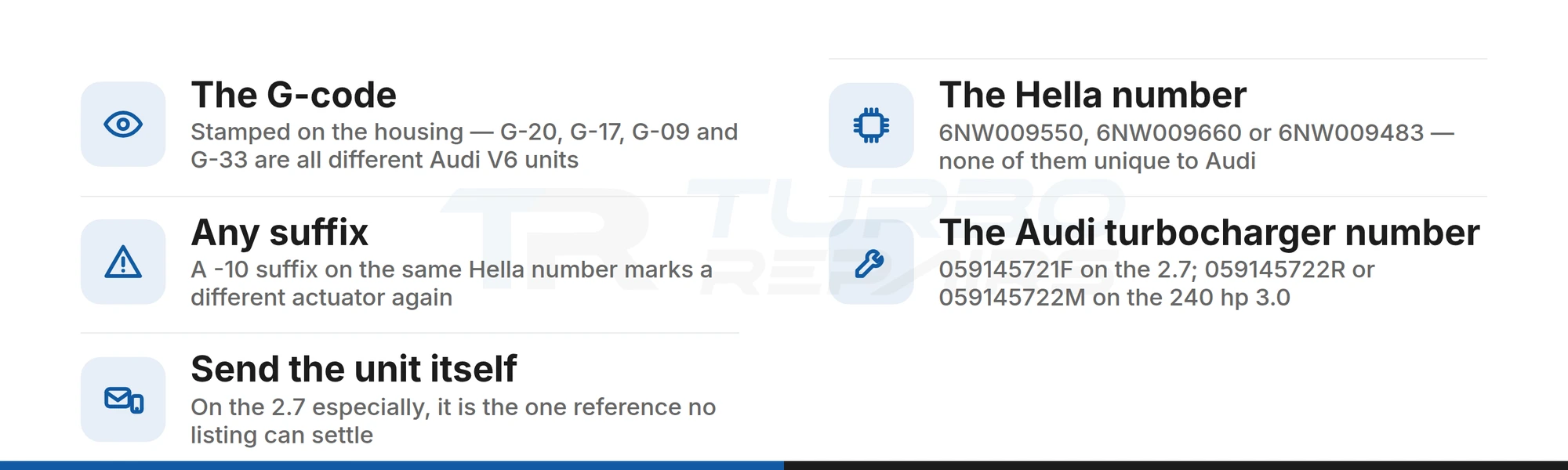
On the 2.7, the turbocharger side of the listings is consistent: a Garrett GTB1756VK, numbered 765314 or 769701, with the Audi number 059145721F, on A4 and A6 2.7 TDIs of around 180 hp. The actuator side is not.
One supplier lists the 2.7’s actuator as G-09, with the Hella number 6NW009660 and the base number 781751. The same supplier also sells an actuator for the A4 and A6 2.7 as G-33, on the Hella number 6NW009483, and the description under that listing gives turbocharger numbers for the Ford Transit 2.2 TDCi rather than for any Audi.
Both Hella numbers are recorded elsewhere on our site against other engines. 6NW009660 appears against the Mercedes-built 3.0 V6 diesel, under G-codes that include G-009, and 6NW009483 against the Ford 2.2 TDCi and the early Land Rover Freelander 2. We cannot tell from the listings which reference is right for a given 2.7, and neither can anyone ordering from them.
That makes the 2.7 the Audi V6 on which ordering a new actuator from a listing is most likely to go wrong. The one reference beyond argument is the unit already bolted to your turbocharger. Photograph its label before you order anything, and if you want it rebuilt, send that unit.
Is It the Actuator? Symptoms and Codes on the V6 TDI
A failing actuator on either V6 usually shows as a loss of power, limp mode or uneven boost, often intermittent at first, with a boost-control fault stored. None of that names the actuator on its own. A split intercooler hose, a failing connector or vanes stiffened by carbon can produce the same complaint, and our guide to turbo actuator symptoms sets out how to tell them apart.
The codes deserve the same care. Audi’s tooling reports position faults in its own wording, and the same code number can call for different tests on different engines. Our turbo actuator fault code guide goes through what each code watches and where to test first. Note the exact code, and read any freeze-frame data before anything is cleared.
Two checks cost nothing. With the ignition off, unlatch the actuator’s connector and look at both halves for corrosion, water or a pushed-back pin, then refit it until it clicks home. And pressure-test the intake before blaming anything bolted to the turbocharger.
Fitting a New Unit: What “Plug and Play” Assumes
New rotary actuators for the 3.0 are sold as plug and play. One supplier’s fitting description runs to three steps: unplug the power connector, remove the circlip from the actuator linkage, and undo the three mounting bolts, then fit the new unit in its place. It carries a footnote. The swap assumes the nozzle ring inside the turbocharger is free of damage, distortion, rust and carbon build-up.
That footnote applies to a rebuilt actuator exactly as it does to a new one. An actuator that has spent months forcing a stiffening vane ring wears its gears and motor faster, and whatever replaces it meets the same resistance from its first drive. So before either route, prove the vanes are free.
The vane check, on the V6 TDI
Let the engine cool completely, because the turbine housing gets hot enough to burn. With the circlip off and the link freed, move the turbocharger’s vane lever gently through its full travel by hand. Smooth movement from end to end points at the actuator; dragging, catching or stopping short points at the turbocharger, which then needs the work rather than the actuator. Never drive the car with the actuator unplugged to see what happens.
New unit or your own unit rebuilt
If the vanes are free, the choice is between buying a unit to match and having yours rebuilt. A new unit has to match every reference on your casing, and on the 3.0 that includes the G-code and suffix. On the 2.7, the listings do not even agree which references those should be. Rebuilding the unit you already have removes the matching question, because it goes back on the turbocharger it came off.
Turbo Repairs · Epsom workshop
Vanes move freely? Then the unit on your casing is the one to rebuild
Send the actuator with your registration, photographs of every reference on its label and the codes the car stored. We confirm it against your Audi’s engine and test it as received, before it is opened.
Lifetime, unlimited-mileage warranty · Mail-in from the UK and internationally · Bench-tested and calibrated before it ships
Our Audi V6 TDI Actuator Rebuild
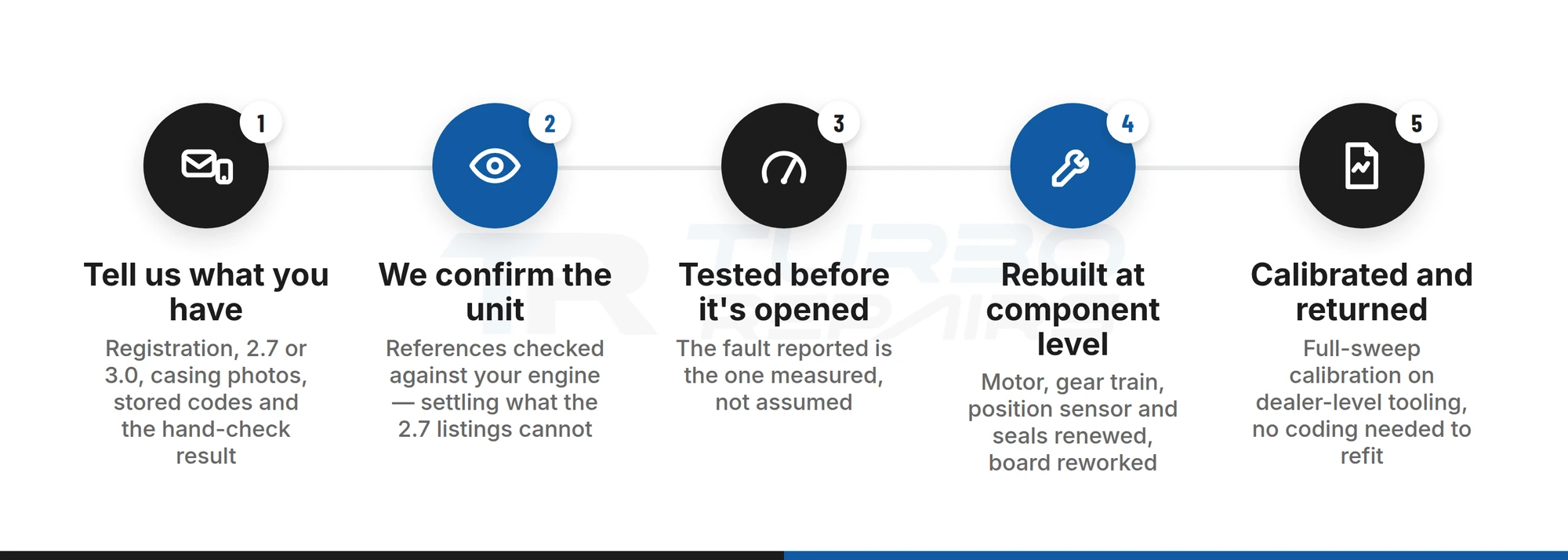
You or your garage remove the actuator and send it to our workshop at Unit 102 Reaver House, 12 East Street, Epsom, Surrey, KT17 1HX, United Kingdom, where it is rebuilt by our team of turbo specialists and electronic engineers. Independent garages and dealers send Audi units in for their customers in the same way.
- Tell us what you have. On the repair form, give the registration, whether the car is a 2.7 or a 3.0, the output if you know it, photographs of every reference on the casing, the stored codes, and what you found when you moved the vane lever by hand.
- We confirm the unit. The references are checked against your car’s engine. On a 2.7 that settles what the listings cannot. If the unit is a pneumatic can, or one we cannot rebuild, we say so before any work is done.
- We test it before it is opened. Running the unit as received means the fault we report is the one we measured.
- We rebuild it at component level. The motor, gear train, position sensor and seals are renewed as needed and the circuit board is reworked, with uprated parts in place of any component with a known weakness in the original design, so the unit meets or exceeds original specification.
- We calibrate it and return it. Its travel and position feedback are checked across the full sweep on dealer-level diagnostic and calibration tooling, and it comes back ready to refit with no coding. Clear the stored codes once it is on the car.
Repairs start from £100 + VAT, and the exact price is confirmed once the unit has been identified and tested, before any work goes ahead. Turnaround is typically one to two working days from arrival, plus postage each way, and every rebuild carries a lifetime, unlimited-mileage warranty. Our FAQs page covers packing and postage, and the other vehicles we cover are on our electronic turbo actuator repairs hub.
Audi A6, A4 and Q7 Turbo Actuator Repair FAQ
Is the A6 3.0 TDI turbo actuator the same as the Q7’s?
On the 240 hp cars, the listings put the A6 C6 3.0 TDI (engine codes CDYA and CDYC) and the Q7 3.0 TDI (CASA) on the same Hella 6NW009550 unit, on a Garrett 776470 turbocharger. Other 3.0s are listed under G-21 or G-82, so check the G-code on your own casing.
What do G20, 767649 and 6NW009550 mean on my actuator?
They are the three references one supplier lists for the 240 hp 3.0’s actuator: the G-code, a second reference number, and the Hella number. That supplier asks buyers to match all three. The Hella number alone is not enough, because 6NW009550 also appears on BMW and Ford Transit units under different G-codes.
Which actuator does the Audi 2.7 TDI use?
The listings disagree. One gives G-09 on Hella 6NW009660; another gives G-33 on 6NW009483, with a description naming Ford Transit turbocharger numbers. Read the references on your own unit, and if you are having it rebuilt, send that unit so the question never has to be settled from a listing.
Can I just fit a new plug-and-play actuator?
New units are sold that way, but they assume the vane mechanism inside the turbocharger is free of damage and carbon, and they have to match every reference on your casing. Check the vanes by hand first. If they are free, rebuilding your own unit removes the matching question altogether.
Will a rebuilt actuator need coding on my Audi?
No. Your own unit comes back calibrated and tested on our bench and refits without programming. Clear the stored fault codes with a diagnostic tool once it is fitted.
How much does an Audi V6 TDI actuator repair cost, and how long does it take?
Repairs start from £100 + VAT, with the exact price confirmed once the unit has been identified and tested. Turnaround is typically one to two working days from arrival, plus postage each way, and every rebuild carries a lifetime, unlimited-mileage warranty.
Final Thoughts
On an Audi V6 TDI, how far a parts listing can be trusted depends on the engine. The 240 hp 3.0 is documented consistently, down to the Audi turbocharger number, and the details left to check are the G-code and suffix. The 2.7 is sold under two different Hella numbers, both of which our own pages record against Mercedes and Ford engines, and no listing can say which is yours.
Whichever you have, the order of work is the same. Confirm the engine, check the connector and the intake, move the vane lever by hand, and photograph every reference on the casing. If that evidence points at the actuator, the unit already on your turbocharger is the one reference that needs no resolving, and it is the one to rebuild.
Turbo Repairs · Epsom workshop
Your 2.7 or 3.0 actuator, rebuilt for the turbo it came off
Post it in with the label photographs and your stored codes, and we identify it against your engine, test it before it is opened and rebuild the motor, gears, position sensor and board. It comes back calibrated, ready to bolt on, with no coding needed.
Lifetime, unlimited-mileage warranty · Mail-in from the UK and internationally · Bench-tested and calibrated before it ships