

Summary A turbocharger and a supercharger do the same job — both compress the air going into the engine so that more fuel can be burned with it — and they differ in one thing only: where the energy to drive that compressor comes from. A turbocharger takes it from exhaust gas the engine has already finished with. A supercharger takes it from the crankshaft, through a belt, chain or gear.
Everything else the two get argued about — throttle response, fuel efficiency, running temperature, what eventually wears — follows from that one difference, because the drive method decides where on the engine each device has to sit. Below is what each placement means for the part itself, how to tell which one is on your car, and what follows if it turns out to be the turbocharger.
If your car has forced induction and was built for the modern mass market, it is overwhelmingly likely to be a turbocharger rather than a supercharger.
A turbocharger and a supercharger solve the same problem in the same way. Both compress the air going into the engine so more fuel can be burned with it, and both use a spinning compressor wheel to do it.
What separates them is what turns that wheel. Because the two energy sources sit at opposite ends of the engine, the devices end up in completely different places, under conditions that have almost nothing in common. That is the difference worth understanding, and the one almost nobody writes about.
What Both Devices Are Actually Doing
Forced induction is the umbrella term for both. An engine drawing air on atmospheric pressure alone is naturally aspirated; put a compressor ahead of the inlet and you force a denser charge into the same cylinder volume, so more fuel can be burned in it.
That is how a manufacturer takes real power out of a small engine without making it bigger. Each of these devices is, at heart, an air pump driven by the engine it is bolted to.
How a Turbocharger Is Driven, and Where That Puts It
A turbocharger is driven by the exhaust. Gas leaving the cylinders is routed across a turbine wheel and spins it; on the far end of a single shaft sits a compressor wheel that pushes air into the inlet. The energy doing that work would otherwise have left through the tailpipe as heat and noise, which is the whole basis of the efficiency argument in the turbocharger’s favour: the compressor is not taking power from the engine in order to run.
But it comes with a location. To be driven by exhaust gas, a turbocharger has to sit in the exhaust stream, usually bolted straight onto the manifold, which is the hottest place on a running engine. And because its shaft spins in bearings rather than hanging off an external drive, it has to be plumbed into the engine’s own oil supply — a feed pipe in, a return pipe out. That oil is not only lubrication; it is also how heat is carried out of the bearing housing.
So a turbocharger lives at exhaust temperature and depends on a clean, uninterrupted oil supply to survive there. Both conditions are consequences of the drive method, not signs of a fragile design.
How a Supercharger Is Driven, and Where That Puts It
A supercharger takes its energy from the other end of the engine. It is driven mechanically from the crankshaft — by a belt, a chain or a gear train — so it sits on the intake side and turns whenever the engine turns, at a speed tied directly to engine speed.
Two things follow, and both mirror the turbocharger. Response comes first: the compressor is already spinning at whatever rate the engine is running, so boost is there from low engine speeds with nothing to wait for. The cost comes second: the power turning it is taken from the engine’s own output rather than from the exhaust, which makes it a less efficient way of producing the same boost. And it is not in the exhaust stream at all — it has no need to be, because the exhaust plays no part in driving it.
Why the Two Do Not Live the Same Life
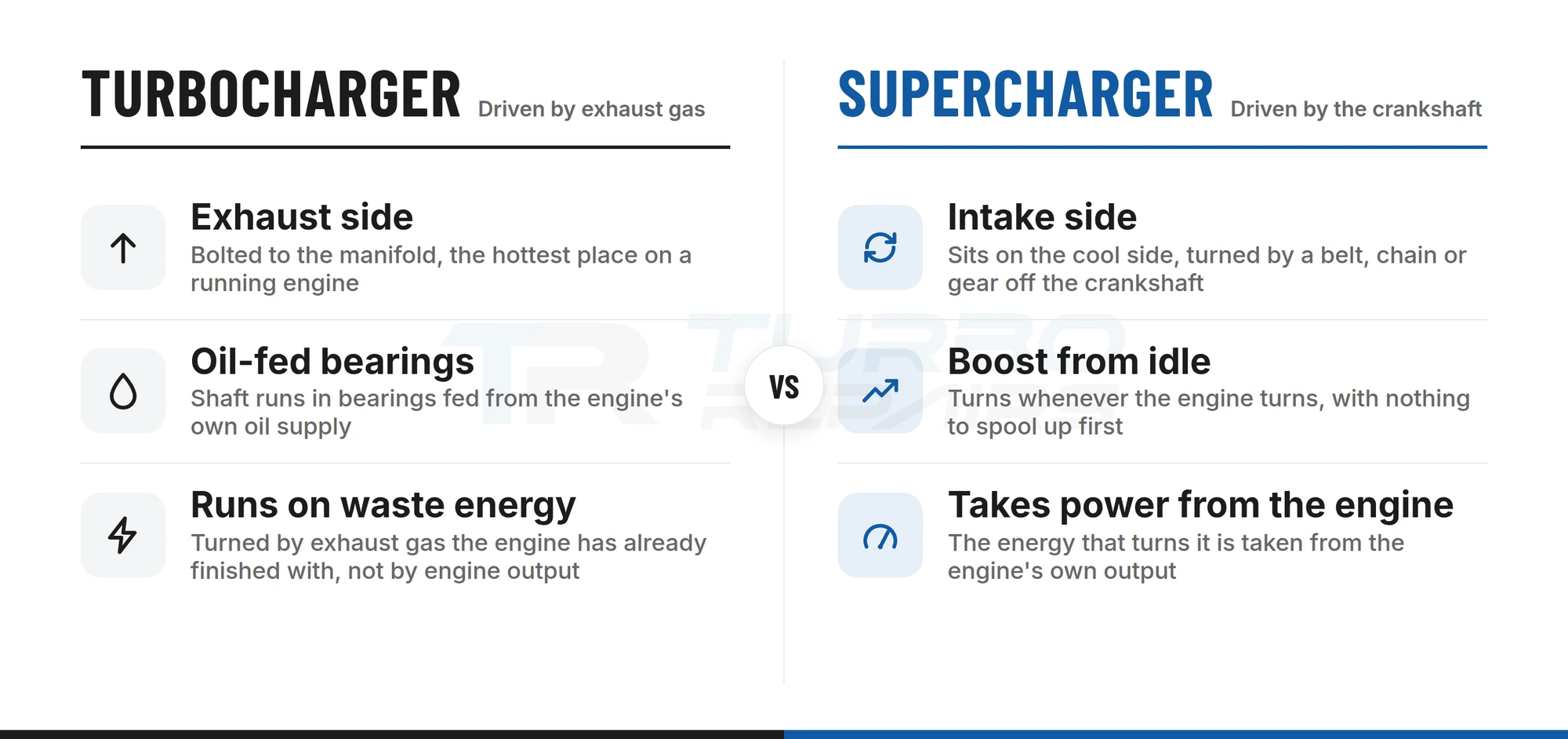
Set those two descriptions side by side and the point makes itself. These are not two grades of one component. They are two devices doing one job in different places: one bolted into the exhaust at exhaust temperature with its bearings fed from the engine’s oil, the other on the cool side turned by a drive belt. They are not being worn by the same forces.
That also decides what kind of object each one is. A turbocharger is a self-contained precision rotating assembly — two wheels on one shaft in a bearing housing, running to clearances measured in fractions of a millimetre. It comes off the car in one piece, and everything worn inside it can be measured against the specification it was built to, which is why it can be stripped and rebuilt rather than only replaced.
Our own scope follows from the same mechanism, so it belongs here rather than in a footnote. We rebuild turbochargers and electronic turbo actuators. We do not work on superchargers — a different device, in a different position, driven a different way — and nothing on this page should be read as guidance on diagnosing one.
Turbo Lag, and Why the Complaint Has Aged
Lag is the one part of this comparison everybody has already heard about, and it is a genuine consequence of the drive method. A turbocharger can only make boost once there is enough exhaust flow to spin the turbine, so between opening the throttle and the boost arriving there is a delay while the turbine comes up to speed. A crankshaft-driven supercharger has no equivalent, because it never waits for anything to spool up.
What has changed is how much of that delay a modern engine hands to the driver, and the reason is boost control. A wastegate lets exhaust gas past the turbine once the target pressure is reached, so the turbine no longer has to be sized purely for peak flow and can be chosen for response instead. The device that opens it is the subject of our wastegate actuator repair page.
Variable-geometry designs go further. A ring of moveable vanes narrows the gas path at low engine speed, so the turbine is driven harder than the size of its wheel alone would allow, then opens out again as flow rises. One such unit is set out on our Garrett GT2052V page.
Lag has been engineered down, then, rather than abolished — and the hardware that removed most of it is itself a moving mechanism in the exhaust stream, along with the actuator positioning it. Our guide to what a turbo actuator does covers that part on its own terms.
Turbo Repairs · Epsom workshop
Exhaust heat and oil supply leave evidence you can measure
Everything the drive method does to a turbocharger — heat taken into the bearing housing, wear opening up clearances, deposits stiffening a vane ring — becomes a number once the unit is stripped. Send yours to our workshop and it is measured against the specification it was built to, rather than judged on how it looks.
Lifetime, unlimited-mileage warranty · Mail-in from the UK and internationally · Bench-tested and calibrated before it ships
Which One Is on Your Car
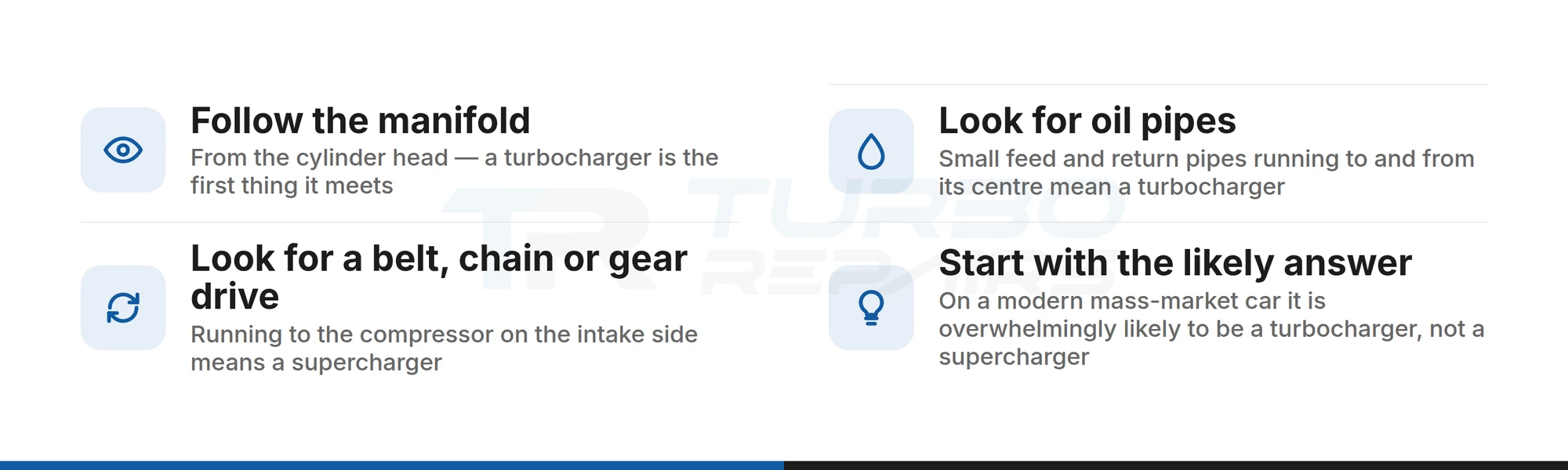
For most UK drivers this is already settled, and the manufacturer settled it. Carmakers now use turbocharging far more widely than supercharging, for the reason the mechanism gives it: recovering waste exhaust energy helps on both fuel consumption and emissions. Modern diesels are turbocharged as a matter of course and many petrol engines are too, while superchargers turn up mainly on performance and specialist applications.
To confirm it rather than assume it, the drive method tells you where to look. A turbocharger is on the exhaust side: follow the manifold away from the cylinder head and the turbocharger is the first thing it meets, with small oil pipes running to and from its centre. A supercharger is on the intake side and it is driven, so there is a belt, chain or gear drive going to it.
Which one you have changes what a symptom means. On a turbocharged engine, the parts that give trouble are the ones the drive method exposes — the bearings the oil feeds, the seals either side of them, and the boost-control mechanism sitting in the exhaust. Our guide to common turbocharger problems sorts those symptoms by where on the shaft they can physically start.
What Follows When the Turbocharger Is the One That Failed
Here the placement argument pays off practically. Because a turbocharger is one self-contained assembly bolted into the exhaust and plumbed into the oil system, the failed part can be taken off the car and sent away on its own. Removal, refitting and the first start afterwards are covered step by step in our guide to replacing a turbocharger.
What the unit meets on arrival is a measuring job rather than an inspection. The wear that matters is not visible — it is in clearances, in shaft float, in the resistance a vane ring is swung against — so the unit is stripped to component level and every part compared against the tolerances it was built to.
Worn parts are replaced with genuine OE or OEM-grade components, anything carrying a known design weakness is uprated rather than reinstated, and the rotating assembly is balanced before the unit is run up on the bench. You get your own turbocharger back rather than an exchange unit off a shelf. Electronic actuators are rebuilt at component level and recalibrated to the vane sweep they will work against, so they refit without programming; that work sits under electronic turbo actuator repairs.
It is a mail-in service throughout: the unit comes off the car and is posted to our Epsom workshop from anywhere in the UK or internationally, then comes back rebuilt, tested and ready to refit. Every repair carries a lifetime, unlimited-mileage warranty, and postage and packing are set out in our FAQs.
Turbo and Supercharger FAQ
Is a turbocharger or a supercharger better?
The question assumes a decision that is not yours. Both compress inlet air to the same end, and which one an engine uses was settled by the people who designed it. What is useful is knowing what the one in your car is like as a component: where it sits, what wears it, and what can be done when it stops working properly.
Why do most modern cars use turbochargers?
Because a turbocharger recovers energy the engine has already discarded. Driving the compressor on exhaust gas rather than on the crankshaft means the boost is not being paid for out of the engine’s own output, which helps on fuel consumption and on emissions. That is why manufacturers now use turbocharging far more often than supercharging.
Does a modern turbocharger still have lag?
In principle, yes — it is inherent in being driven by exhaust flow, because the turbine has to be spinning before it can compress anything. In practice it has been engineered down a long way, by wastegates that let the turbine be sized for response rather than only for peak flow, and by variable-geometry mechanisms that narrow the gas path at low engine speed.
Can an engine have both a turbocharger and a supercharger?
Yes. A small number of engines have been built with both, the crankshaft-driven unit covering the low-speed range where there is not yet enough exhaust flow, and the exhaust-driven unit taking over as flow builds. It is uncommon, and it exists because the two drive methods have opposite strengths.
Why does a turbocharger need the engine’s oil?
A turbocharger is not hung off an external drive: its shaft runs in bearings inside the unit, fed from the engine’s oil supply through a feed pipe, with a return pipe taking the oil back. That oil lubricates the bearings and carries heat out of the bearing housing, which is why an interrupted or contaminated supply is one of the commonest reasons a turbocharger fails.
Do you repair superchargers?
No. We rebuild turbochargers and electronic turbo actuators, and that is the whole of what this workshop does. Superchargers are not work we take on, so if that is the part you need attended to, this is not the workshop for it.
Final Thoughts
Almost everything published on this question is written as though the reader were about to buy one: pages weigh the two up, list what each is good at, and recommend one. Useful to somebody specifying an engine, and no use at all to somebody standing next to a car built years ago with the decision already made.
Turned around, it becomes answerable. The drive method is not a preference; it is a placement. It puts one of these devices into the exhaust stream at exhaust temperature, dependent on the engine’s oil to survive there, and keeps the other well clear of all that on the cool side. Every real difference between them — response, efficiency, working temperature, what wears — is downstream of it.
And it is why the turbocharger, of the two, is the one that comes off the car as a measurable assembly and goes back on rebuilt. The hardest working conditions on the engine produced the component most worth repairing.
Turbo Repairs · Epsom workshop
If it is a turbocharger, it comes off and goes back rebuilt
Tell us what the engine is doing and what you have already checked, then post the unit in. It is stripped to component level, measured against the specification it was built to, rebuilt on genuine OE or OEM-grade parts, balanced and run up on the bench — and the actuator is recalibrated to the vane sweep it will be working against.
Lifetime, unlimited-mileage warranty · Mail-in from the UK and internationally · Bench-tested and calibrated before it ships