

Summary We rebuild the turbochargers from MINI’s petrol and diesel engines: the Cooper S, the Cooper D and One D 1.6, and the 2.0 diesel fitted to the Cooper, Clubman, Countryman and Paceman. You or your garage take the turbo off and post it to us. We strip it to component level, rebuild it on genuine OE or OEM-grade parts, balance it, bench-test it and post it back ready to refit. Rebuilds start from £185 plus VAT, replacement units from £450 plus VAT, and every rebuild carries a lifetime, unlimited-mileage warranty.
The first question on a MINI is not which model you drive but which engine it carries, because that decides which turbocharger is bolted to it and whose failure history applies.
The MINI 1.6 diesel changed engine code during its life: our listings catalogue the earlier cars under the 9HZ and DV6TED4 codes of the 1.6 HDi, and the 2011 cars under N47C16A, with a different turbocharger.
This page is for owners and garages with a failing turbocharger on a MINI. It sorts the car by engine first, then covers what goes wrong on the Cooper S petrol turbo, where the diesel’s history is already written up under other badges, what a replacement costs, and how your own unit is rebuilt.
- Cooper S petrol: N14 engine on the earlier second-generation cars, N18 from the 2011 update; failures are most often reported as starting at the turbo’s oil feed line
- 1.6 diesel, earlier cars: catalogued under the 9HZ and DV6TED4 engine codes, the 1.6 diesel also found in Peugeot, Citroën and Ford models
- 1.6 diesel, 2011 cars: catalogued under N47C16A, with turbocharger 5435-970-0047
- 2.0 diesel: N47C20A, one turbocharger reference, 8512379, listed at 110, 134 and 141 bhp
- Diesel rebuilds by year and power: our listings for the MINI Cooper 1.6 diesel and MINI Cooper 2.0 diesel, with the One, Clubman, Countryman and Paceman linked below
- Price: rebuilds from £185 plus VAT; replacement units from £450 plus VAT; confirmed once the unit has been inspected
- Turnaround: typically one to three working days on the bench, plus postage each way
- Warranty: lifetime and unlimited mileage, with no time limit
- How it works: the turbo comes off, is packed and posted to us, and comes back rebuilt; start with the online Repair Form
Cooper S or Cooper D? Two Different Turbo Stories
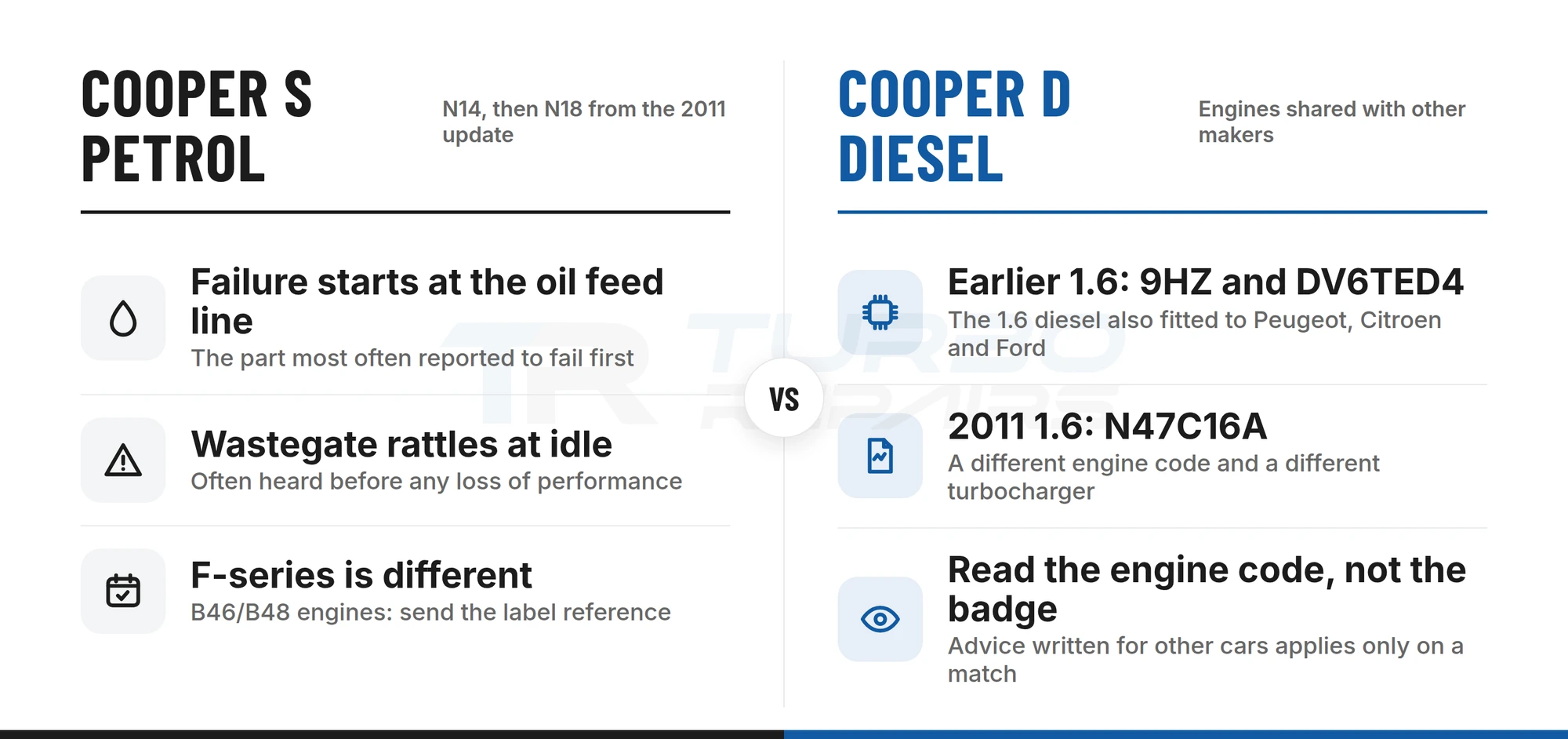
MINI has sold turbocharged petrol and diesel engines under the same model names, and they are not variations on one design. The petrol Cooper S and the diesel Cooper D carry different engines, different turbochargers and different failure histories. Even within the diesels, the engine under a 1.6 badge changed during the car’s life.
That matters more on a MINI than on most cars, because the diesel engines were shared with other manufacturers’ models. A good deal of what is published about a MINI diesel turbo was really written about a Peugeot, a Ford or a BMW, and it applies to your car only if your car carries that engine.
Read the engine code, not the badge
This is how the engines line up in our own listings and in trade catalogue data. Use it to find your row, then go to the section or page that row points to.
| MINI | Engine code | Turbocharger references | Where to read next |
|---|---|---|---|
| Cooper S petrol, second generation (R55 to R60 family) | N14; N18 from the 2011 update | Read the label on your unit | The Cooper S section below |
| Cooper S petrol, F-series (from the 2014 F56) | BMW-designed B46/B48 family | Read the label on your unit | The Repair Form, with the label reference |
| One D, Cooper D and Clubman 1.6 diesel, earlier cars | 9HZ; DV6TED4 | 740821-0002; 753420-0005; 753420-0006 | The Cooper D section below |
| One, Cooper, Clubman and Countryman 1.6 diesel, listed from 2011 | N47C16A | 5435-970-0047 | The Cooper D section below |
| Cooper, Clubman, Countryman and Paceman 2.0 diesel | N47C20A | 8512379 | The Cooper D section below |
| Later F-series diesels | B37 1.5; B47 2.0 | Read the label on your unit | The Repair Form, with the label reference |
The engine code is often in the service records, and a dealer or parts supplier can look it up from the registration. If the turbo is already off, the label on its housing settles the question on its own. Photograph it before the unit is cleaned or packed.
The Cooper S Turbo: Oil Feed, Bearings and a Rattling Wastegate
The Cooper S is the MINI whose turbo failures are discussed as a MINI problem, rather than as the problem of an engine borrowed from another car. The reports centre on the second-generation cars: the N14 engine in the earlier Cooper S, and the N18 that replaced it with the 2011 update across the hatch, Clubman, convertible, coupé, roadster and Countryman. The N18 attracts most of the attention, and the N14 has been prone to the same failures.
Where the failure starts: the oil feed line
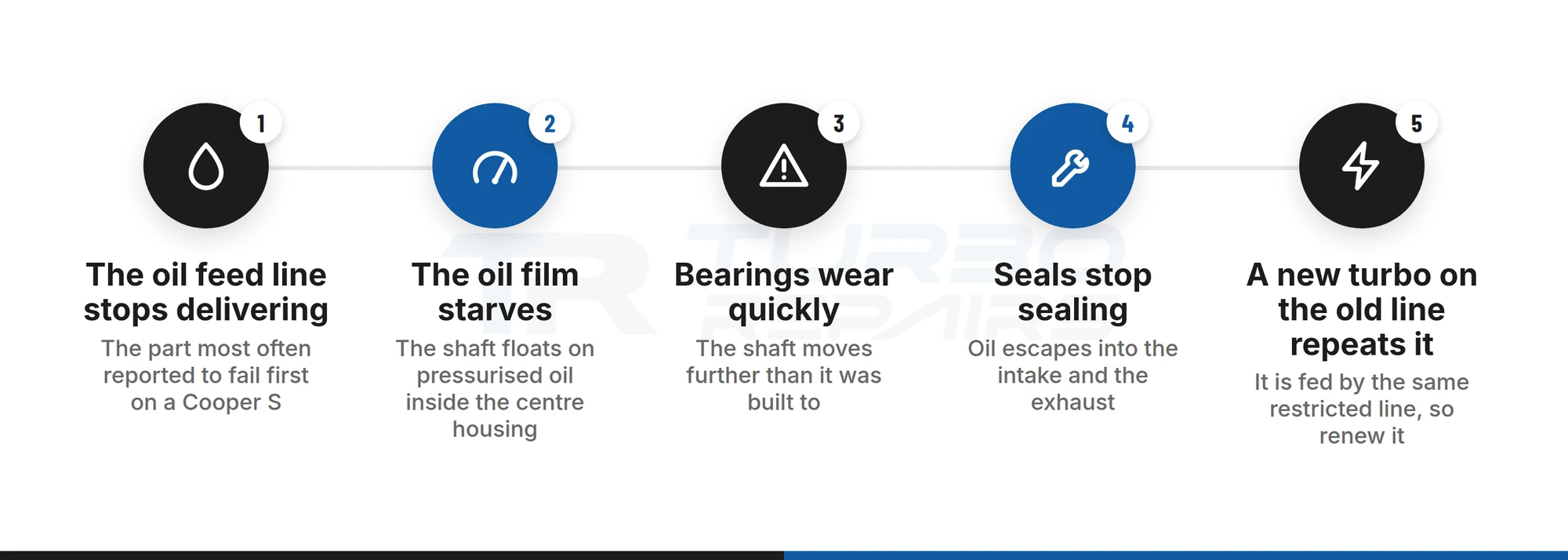
The part most often reported to fail first is not the turbocharger. It is the oil line that feeds it. Once that line can no longer deliver the oil the turbo needs, the bearings are next.
A turbocharger shaft does not run on bearings in the way a wheel does. It floats on a pressurised film of engine oil inside the centre housing, and that film is all that separates a shaft turning at very high speed from the metal around it. Starve the film and the bearings wear quickly. The shaft then moves further than it was built to, the seals stop sealing, and oil begins to escape into the intake and the exhaust.
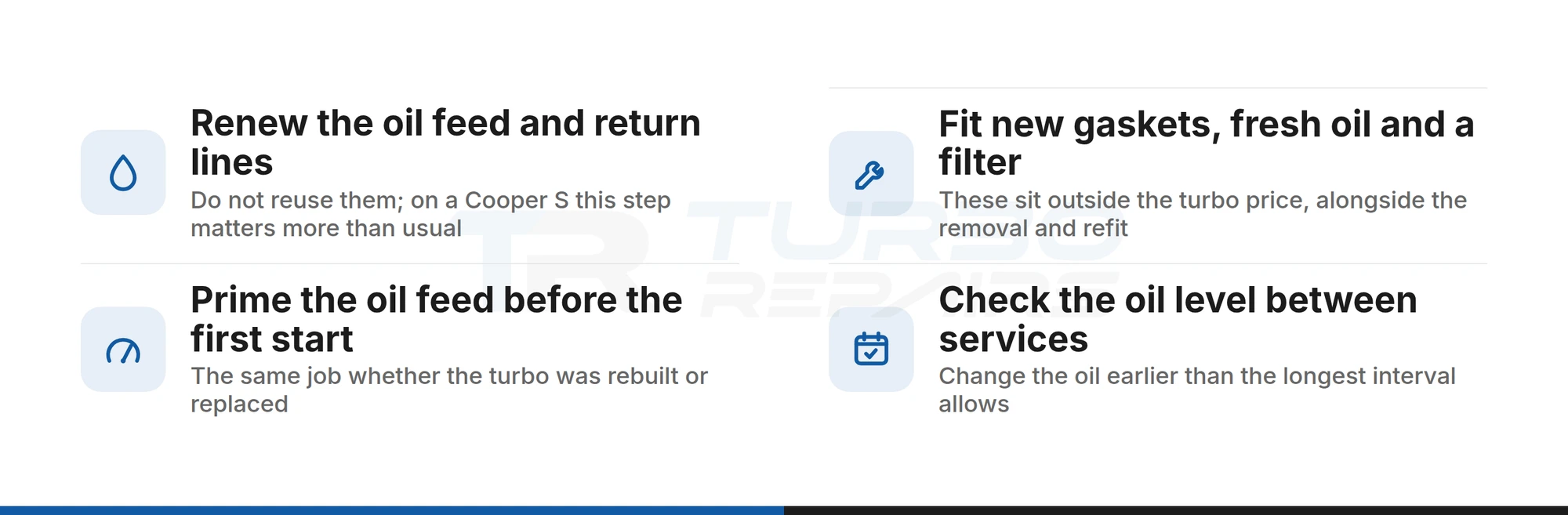
That order has a practical consequence. A rebuilt or replacement turbo fitted to a Cooper S whose feed line is still restricted or failing is being fed by the same line that starved the first one. Our refit advice on every turbo we return is to renew the oil feed and return lines rather than reuse them, and on this car that step matters more than usual.
The wastegate that rattles at idle
The second symptom reported on these cars is a wastegate that rattles when the engine is idling. The wastegate is a valve in the exhaust side of the turbo. It opens to let exhaust gas bypass the turbine when boost is high enough, and closes to make the turbine work when the engine needs boost.
A wastegate that rattles is one whose parts have worn loose, and one that no longer closes lets exhaust escape past the turbine even when boost is wanted. The engine cannot make the boost it asks for, and the engine warning light comes on. Because the rattle is heard at idle, standing still, it is often the first sign an owner notices, before any loss of performance on the road.
The can on the outside that moves the wastegate is a separate part with its own setting. If the flap itself is sound and the fault is in that can or its rod, our wastegate actuator repair page covers how it is set up.
Oil changes and hot shutdowns
Owner guidance on the N14 and N18 is consistent on one point: check the oil level between services, and change the oil earlier than the longest interval allows. MINI itself later shortened its recommended oil change intervals. On an engine whose turbo failures start with the oil supply, the oil is the one part of the problem an owner controls directly.
The other habit that shortens any turbo’s life is switching off straight after a hard drive, which leaves heat in the centre housing with no oil moving through it. Our guide to how long turbos last covers how that heat, short trips and oil changes decide a turbo’s life, whatever the car.
Later Cooper S models
The third-generation F-series cars, from the 2014 F56 hatch onwards, moved to BMW-designed engines from the B46 and B48 family, and MINI’s current Cooper S uses a 2.0-litre four-cylinder engine. The failure pattern above belongs to the second-generation N14 and N18 cars. If your Cooper S is an F-series car, the same rebuild service applies, but read the label on your turbo and put the reference on the Repair Form rather than matching it to anything on this page.
The Cooper D Turbo: What It Shares With Other 1.6 Diesels
The diesel side of the MINI range is where the engine borrowing matters most, because the turbo advice travels with the engine.
The earlier 1.6 diesel: the 1.6 HDi and TDCi engine
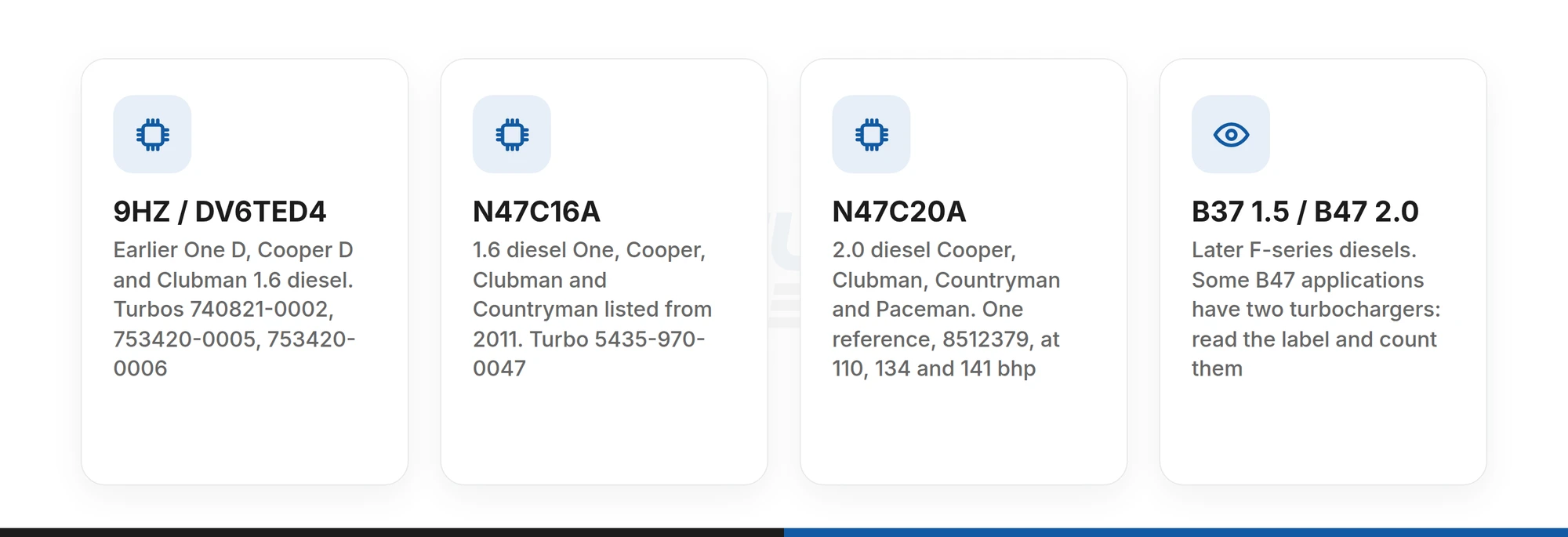
Our listings catalogue the earlier One D, Cooper D and Clubman 1.6 diesel under the engine codes 9HZ and DV6TED4. Those are the codes of the 1.6 diesel used by Peugeot, Citroën and Ford, and the turbochargers match. Turbocharger 753420-0005, listed against the MINI Cooper D, is catalogued by the trade for Peugeot, Citroën, Ford, Volvo and Mazda 1.6 HDi and TDCi engines as well. The other two references on these cars are 740821-0002 and 753420-0006.
Because the engine is shared, so is its turbo failure history, and we have already written it up in two places. For how the oil supply to the turbo gets restricted on this engine, see our Citroën 1.6 HDi turbo repair page. For where the carbon in the oil can come from in the first place, see our page on the same 1.6 diesel in the Ford Focus. If your MINI carries a 9HZ or DV6TED4 engine, both apply to it as written, and the parts that have to be dealt with on the engine are the same.
The 2011 1.6 diesel: a different code and a different turbo
This is the part that is easy to miss. Our listings catalogue the 1.6 diesel One, Cooper, Clubman and Countryman in 2011 under a different engine code, N47C16A, and give them a different turbocharger: 5435-970-0047. Trade listings put the same unit on MINI One D and Cooper D models across the R55, R56, R57, R60 and R61 bodies.
Two things follow for an owner. First, a “1.6 HDi turbo” or “Cooper D turbo” bought on the strength of the model name may be the earlier unit, which is not the right part for a car with the N47C16A engine. Second, the N47 in that code does not make it the 2.0 diesel. The C16 marks it as a 1.6, and it carries its own turbocharger.
Whether the oil-supply failures documented on the 9HZ and DV6TED4 engines apply to the N47C16A is not something the catalogue can tell you, and we do not assume it. The wear pattern on your own unit, once it is stripped, shows whether it ran short of oil or on contaminated oil, and that is read on the bench rather than guessed from the badge.
The 2.0 diesel: one reference across three outputs
The 2.0 diesel MINIs are catalogued under the engine code N47C20A, in the Cooper, Clubman, Countryman and Paceman. On these cars our listings carry a single turbocharger reference, 8512379, at 110, 134 and 141 bhp alike.
That is different from the BMW cars that share the N47 name, where the power output does most of the work of sorting several turbochargers. If you have a BMW-badged 2.0 diesel, our BMW N47 2.0d turbo repair page covers it. On the MINI 2.0 diesel, the output does not change the reference in our listings, so the engine code and the label on the unit are what matter.
Later MINI diesels
Trade listings put the F-series MINI diesels on BMW’s B37 1.5 and B47 2.0 engines, and list some B47 applications with a pair of turbochargers rather than one. If your MINI is one of these, check the engine code and count what is bolted to the exhaust before anything is ordered, and give us both on the Repair Form.
Ordering a diesel rebuild by year and power
If you know your car’s year and power output, you can order the rebuild directly from the listing for your model, with the price set for your car and the part numbers listed by year and engine code:
- MINI Cooper 1.6 diesel and MINI Cooper 2.0 diesel
- MINI One 1.6 diesel
- MINI Clubman 1.6 diesel and MINI Clubman 2.0 diesel
- MINI Countryman 1.6 diesel and MINI Countryman 2.0 diesel
- MINI Paceman 2.0 diesel
Whichever route you take, the unit is identified on the bench before any work starts.
Turbo Repairs · Epsom workshop
Not sure which engine your MINI has? Send the turbo and we will tell you
Put your registration and anything you can read on the turbo’s label on the Repair Form, then post the unit in complete. We identify it, strip and measure it, and tell you what the wear says about the oil supply before anything goes back on the car.
Lifetime, unlimited-mileage warranty · Mail-in from the UK and internationally · Bench-tested and calibrated before it ships
Symptoms on a MINI Turbo, and What Each Points To
Most turbo symptoms have cheaper imitators, so each one below says what it points to and what to rule out first. Our guide to turbo failure symptoms sorts the full set by where in the turbocharger each one starts.
A rattle from the turbo area at idle (Cooper S). The wastegate symptom described above. It points at worn wastegate parts on the turbocharger, and if the engine warning light and a loss of boost have come with it, the wastegate is probably no longer closing.
Loss of power, with the engine warning light on. This says the engine did not reach the boost it asked for, not which part is responsible. A split boost hose, a loose clip or a leaking intercooler pipe produces the same result for far less money, so check the pipework first.
A whine or siren that climbs with engine speed. A smooth whistle that rises with boost is usually air escaping from the pressure side. A harder, metallic note that follows the revs points at the rotating assembly inside the turbo, and that unit has to come off.
Blue or grey smoke, and oil used between services. Oil is getting past the turbo’s seals, or past something else in the engine. On a Cooper S, check the oil level often while you find out which, because the oil supply is where these failures begin.
Oil in the intake pipework or intercooler. Found with a pipe off, not from the driver’s seat. It confirms oil is passing the compressor-side seal, and it has to be cleaned out before a rebuilt unit goes on, or the first start pushes it into the engine.
What a MINI Cooper S Turbo Replacement Costs
Our published prices start from three floors, and on a MINI turbo two of them apply:
- Rebuild of your own turbocharger: from £185 plus VAT.
- Replacement turbocharger from us, reconditioned or new exchange: from £450 plus VAT.
Where a rebuild falls above that floor depends on what survived inside. A turbo taken off when it first started to rattle or whine is usually a bearings-and-seals job. One driven until it was blowing oil may need a wheel, the shaft or a housing as well, and each of those moves the price up. The price is confirmed once the unit has been stripped and inspected, before any work goes ahead. Our guide to turbo repair and replacement prices breaks the figures down by vehicle class.
Three things sit outside those figures, and they are where a MINI turbo bill grows:
- Removal and refitting, charged by whoever does the work on the car.
- The parts fitted alongside the turbo: the oil feed and return lines, gaskets, fresh oil and a filter. On a Cooper S the feed line is not optional; it is the part most often reported to fail first.
- Whatever caused the failure. On a diesel with a 9HZ or DV6TED4 engine, that list is set out on the Citroën and Focus pages linked above, and it can be longer than the turbo job itself.
Rebuild or replacement?
The labour on the car is the same either way: the turbo comes off, a turbo goes back on, and the oil feed is primed before the engine first runs. So the choice between a rebuild and a replacement can wait until the old unit is off and on a bench.
A replacement has to be matched to your car, and on a MINI the model name is a poor guide, as the 1.6 diesel shows. A rebuild has nothing to match, because the unit that goes back is the one that came off. When a core has too much damaged at once to be worth rebuilding, we say so and recommend a replacement instead.
Our MINI Turbo Rebuild
You, or the garage working on the car, take the turbocharger off and post it to us, and we rebuild it and post it back. This is how it runs:
- Complete the online Repair Form with the registration, the engine code if you have it, the mileage, the symptoms, any fault codes and the reference from the turbo’s label. On a Cooper S, say whether the oil feed line has been renewed, and when the oil was last changed.
- Remove the turbo. Our guide to refitting and priming a turbocharger covers removal and the first start.
- Pack and post it complete, with every port covered, to Unit 102 Reaver House, 12 East Street, Epsom, Surrey, KT17 1HX, United Kingdom. Packing and postage are covered on our FAQs page.
- Identification and strip. The unit is identified from its label, or on the bench if the label has gone, then stripped to component level by our team of turbo specialists.
- Measurement and rebuild. The shaft, wheels, bearing surfaces, wastegate and housings are cleaned and measured against original specification. Bearings, seals and thrust parts are renewed with genuine OE or OEM-grade components that meet or exceed the original. A part with a known design weakness is uprated rather than put back in the form that failed, and a wheel, shaft or housing that fails inspection is replaced.
- Balanced, bench-tested and returned. The rotating assembly is balanced, the unit is set up and run on the bench, then boxed and posted back ready to refit.
Bench time is typically one to three working days from arrival, plus postage each way. Every rebuild carries a lifetime, unlimited-mileage warranty, with no time limit and no mileage cap.
We rebuild MINI turbochargers to their original specification. We do not supply, build or fit upgraded or hybrid turbochargers for the Cooper S or any other MINI, so a power increase is outside what this service does.
MINI Cooper Turbo FAQ
How much does a MINI Cooper S turbo replacement cost?
Rebuilding your own turbo with us starts from £185 plus VAT, and a replacement unit from us starts from £450 plus VAT. Neither figure includes removal and refitting, or the oil feed line, gaskets, oil and filter fitted with it. Your exact price is confirmed after the unit has been inspected.
Why does my Cooper S rattle at idle?
On the N14 and N18 Cooper S, a rattle from the turbo area at idle is commonly the wastegate, worn loose. If it no longer closes, the engine cannot build boost and the warning light comes on. The rattle often appears before any loss of performance, so it is worth acting on early.
Is the Cooper D engine the same as the Peugeot, Citroën and Ford 1.6 diesel?
On the earlier cars, yes. Our listings catalogue them under the 9HZ and DV6TED4 codes of that engine, and turbocharger 753420-0005 is listed for all of those makes. The 1.6 diesel MINIs listed in 2011 carry the N47C16A code and a different turbocharger, 5435-970-0047, so check the engine code before relying on advice written for the others.
My MINI’s engine code starts N47. Is it the BMW 2.0 diesel?
Not necessarily. N47C16A is a 1.6 and N47C20A is a 2.0, and they carry different turbochargers. The characters after N47 give the size, so read the whole code.
Is the Cooper SD covered?
The Cooper SD is a 2.0 diesel. The earlier 2.0 diesel MINIs are catalogued under N47C20A with turbocharger 8512379, and trade listings put later ones on the B47 engine, sometimes with two turbochargers. All of them come through the same Repair Form; give us the engine code and the label reference.
Can you upgrade my Cooper S turbo while it is off?
No. We rebuild MINI turbochargers to their original specification and do not supply or fit upgraded or hybrid units.
The label on my turbo is unreadable. Can I still send it?
Yes. Put the registration and engine code on the Repair Form and send the unit complete. It is identified on the bench before any work starts.
How long does a rebuild take, and what is the warranty?
Bench time is typically one to three working days from arrival, plus postage each way. Every rebuild carries a lifetime, unlimited-mileage warranty with no time limit.
Final Thoughts
A MINI turbo is two different jobs sold under one name. The Cooper S petrol has a failure story that starts at its own oil feed line and announces itself with a rattle at idle. The diesels mostly carry engines from other cars, so their turbo advice has already been written, but for other badges, and it applies only when the engine code matches.
Start with the code, not the model. Renew the oil feed on a Cooper S, deal with the oil supply on an early 1.6 diesel, and let the label on the unit decide the turbocharger on everything else. Then the rebuilt turbo goes back onto an engine that can feed it.
Turbo Repairs · Epsom workshop
Have your MINI’s own turbo rebuilt to original specification
Complete the Repair Form with your registration, the engine code and the reference from the label, then post the turbocharger in complete. We strip it, measure it, rebuild it on genuine OE or OEM-grade parts, balance it and bench-test it before it goes back in the box.
Lifetime, unlimited-mileage warranty · Mail-in from the UK and internationally · Bench-tested and calibrated before it ships