

Summary A turbocharger has no fixed lifespan. Published figures run from “often well beyond 100,000 miles” to around 150,000, but what actually wears a turbo out is the condition of its oil, the heat it is left holding when the engine stops, and the hours it spends working under load — so two cars at the same mileage can have turbos in very different states.
Below is each of those factors, what shortens turbo life and what protects it, how diesel and petrol turbos differ, and what to do when yours is nearing the end.
A turbo’s bearings run on the engine’s own oil and it has no service schedule of its own, so the oil change is, in practice, the turbocharger’s service.
The honest answer to how long a turbo lasts is a set of conditions rather than a number. Whether a turbocharger reaches a high mileage is decided mostly by things the owner and the servicing garage control — the oil, the interval it is changed at, the last minute before the key is turned — and very little by the odometer.
That makes turbo life something that is spent rather than allotted. This page shows where it goes, so you can judge how much yours has left and what would make it last.
Why a Mileage Figure Is the Weakest Answer
The figures in circulation are easy to find. A UK exchange-turbo supplier says that with consistent servicing and good oil quality a turbo can stay reliable “often well beyond 100,000 miles”. A US diesel-parts supplier puts the average at up to 150,000 miles, and up to 200,000 with good care. Neither is published with the data behind it, and neither says what oil, servicing or driving produced it.
The trouble is less the numbers than the question they answer. Mileage measures how far the car has travelled. A turbocharger is not worn by distance: it is worn by time spent spinning hot under load, and by the state of the oil carrying heat away from its bearings while it does. A car cruising long distances at steady load and a car that never fully warms up can reach the same odometer reading with turbochargers that have lived entirely different lives.
So the useful question is not how many miles a turbo lasts, but what is consuming yours. The table is the answer in outline; the sections after it take each factor in turn.
| Factor | What it does inside the turbo | What shortens turbo life | What protects it |
|---|---|---|---|
| Oil condition | Lubricates the bearings and carries heat out of the centre housing | Oil that is degraded, diluted, or carrying carbon and metal particles | Fresh oil at an interval that suits how the car is used |
| Oil grade and specification | Decides how the oil film behaves hot and cold | An oil that does not meet the vehicle manufacturer’s specification | The grade and specification in the handbook, every time |
| Oil supply and drain | Delivers that oil to the bearings and lets it leave again | A coked feed pipe, a blocked strainer, a restricted return | Feed and return checked whenever the turbo is off; the feed pipe renewed at refit |
| Heat at shutdown | Leaves a hot bearing housing with no oil moving through it | Switching off straight from hard running | A spell of gentle running before the key is turned |
| Short, cold journeys | Oil never reaches temperature; carbon builds in the boost-control mechanism | A car used mostly for short trips | Regular runs at full temperature, and an oil interval to match |
| Load and running hours | Time spent at high shaft speed and exhaust temperature | Sustained heavy load, towing, boost raised beyond standard | Load kept within what the turbo was matched for |
| Air in, exhaust out | What the compressor draws in and what the turbine discharges into | Leaks after the compressor, an air filter that does not seal, a loading particulate filter | An airtight intake, a sealed filter, exhaust faults put right |
Nearly every row sits with the owner or the garage rather than inside the turbocharger. That is also why this page does not repeat the recognised causes of turbo failure: they are set out in our replacement guide, along with why the cause of failure stays on the car when the unit comes off.
Oil: Condition, Grade and Service Interval
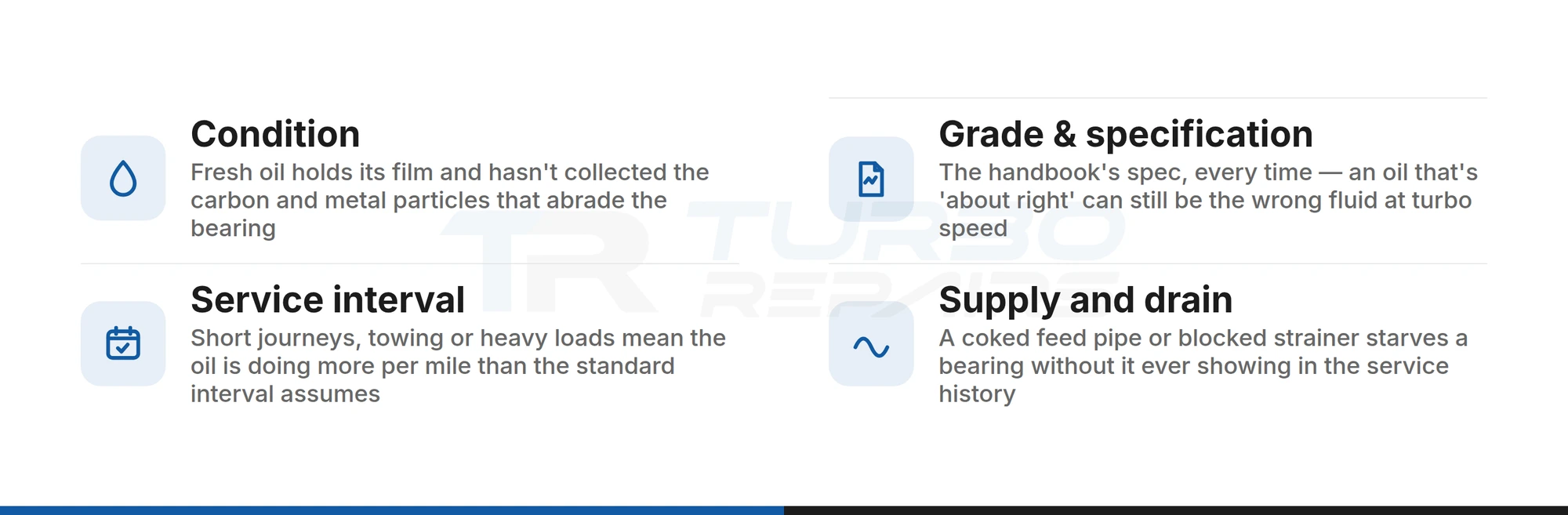
A turbocharger has no oil supply of its own. Its shaft runs in bearings fed with pressurised engine oil, and that same oil carries heat out of the centre housing. Whatever state the engine oil is in, the turbo is running on it.
Condition. Oil does two things badly as it ages. It loses some of its ability to hold a film between shaft and bearing, and it collects the carbon and metal particles that act as an abrasive on those surfaces. A turbo shaft turns far faster than anything else in the engine, which is why the bearing is often the first place tired or dirty oil shows.
Grade and specification. The grade and specification in your handbook are not a suggestion. They describe an oil that behaves correctly across the temperatures the engine sees, from a cold start to a heat-soaked shutdown. An oil that is “about right” can lubricate the engine acceptably and still be the wrong fluid for a bearing turning at turbo speed.
Interval. A service interval is written around the kind of use the manufacturer assumed. If the car spends most of its time on short journeys, towing or carrying heavy loads, the oil is being asked to do more per mile than that assumption allows. It is worth asking your garage whether a shorter interval suits the way the car is actually driven; an early oil change costs little against the part it protects.
Supply and drain. The oil also has to arrive, and then leave. Feed pipes can coke internally and gauze strainers can block, and a bearing starved for a moment is damaged in a way nobody connects to the service history. On the 1.6 HDi, for example, it is the feed pipe and strainer rather than the turbocharger that have to be renewed — our Citroen turbo repair page works through that engine. At the other end, oil that cannot drain freely from the centre housing is pushed past the seals instead.
Heat: Shutdown, Heat Soak and Short Journeys
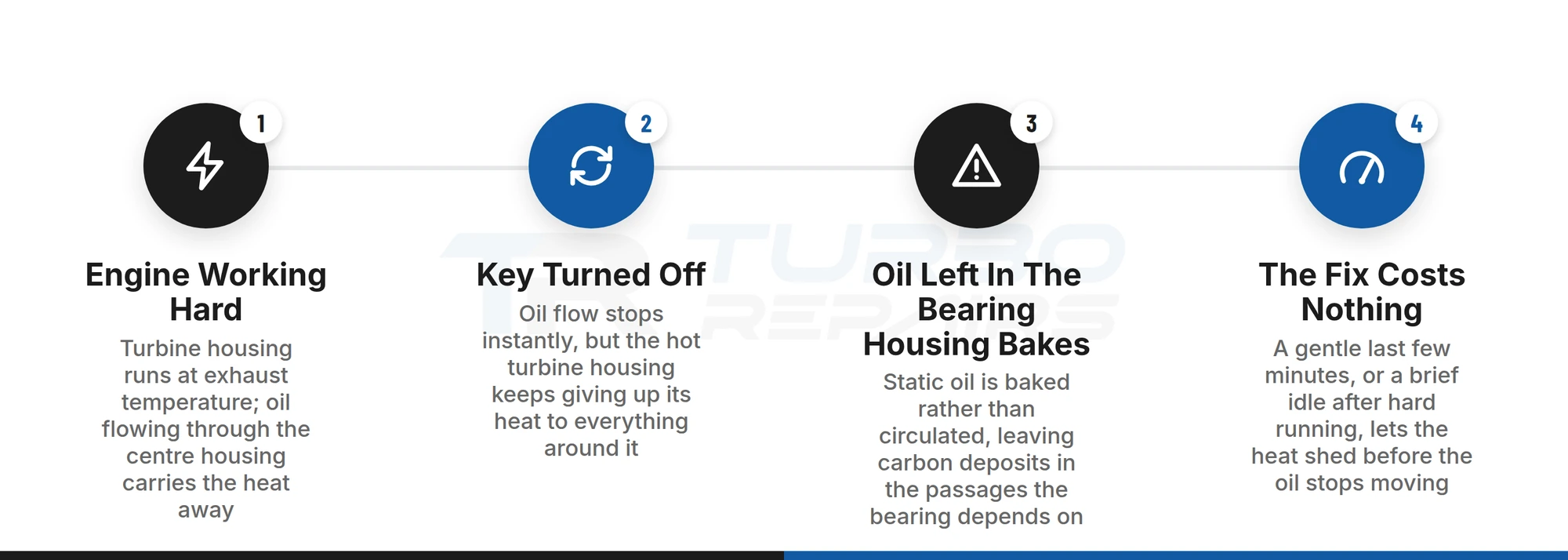
The turbine side of a turbocharger sits in the exhaust stream and runs at exhaust temperature. While the engine turns, oil flowing through the centre housing carries that heat away from the bearings. The moment the engine stops, the oil flow stops with it — but the turbine housing, which has just been working, keeps giving its heat up to everything around it. That is heat soak.
Switch off straight after a hard run and the oil left in a hot bearing housing is baked rather than circulated. Repeated often enough, that leaves carbon deposits in the passages the oil depends on, which is how a turbo can be gradually starved by its own oil. Some centre housings also carry a coolant circuit that keeps working after shutdown; our Garrett GT28R page explains why that matters on a ball-bearing unit.
The protection costs nothing. After motorway speed, a long climb or towing, drive the last part of the journey gently, or let the engine idle briefly before switching off. We do not publish a fixed number of seconds, because the right figure depends on what the engine has just been doing; after a gentle drive through town there is very little heat to shed.
Short journeys: the opposite problem
Heat is not only a problem when there is too much of it. A car that rarely reaches full operating temperature wears its turbo from the other direction. Cold oil reaches the bearings more slowly at start-up, when they need it most, and the moisture and fuel that a hot engine would drive off stay in the sump and shorten the oil’s useful life.
On a diesel there is a second process. Soot and oil residue from exhaust gas recirculation and breather vapour settle on the turbo’s variable-vane mechanism, and they build fastest on journeys that never bring the turbine housing up to heat. That does not wear the bearings at all. It stiffens the vanes that control boost until the engine can no longer hold the pressure it asks for — a failure with nothing to do with mileage, and one a low-mileage car is especially prone to.
How the Car Is Driven
A turbo is designed to make boost, and using it is not abuse. What shortens its life is load applied at the wrong moment, and load sustained beyond what the turbo was matched for.
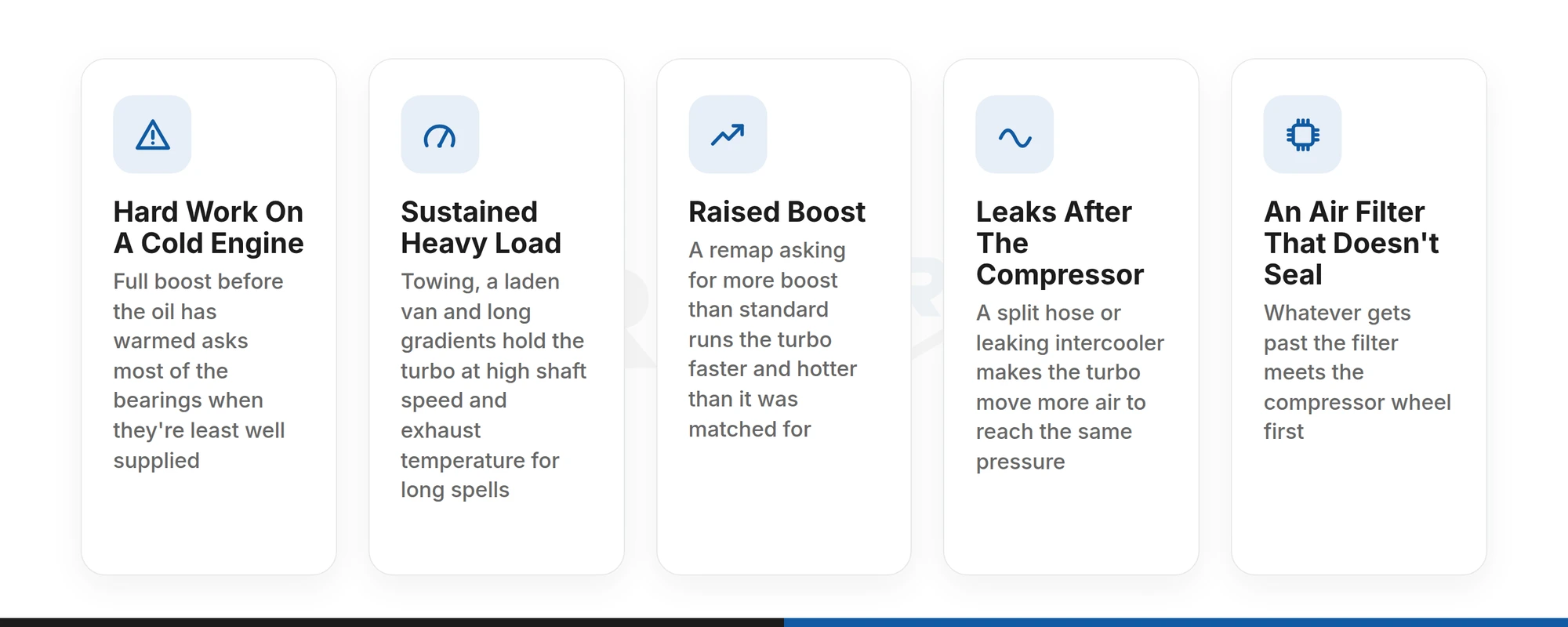
- Hard work on a cold engine. Full boost before the oil has warmed and is flowing freely asks the most of the bearings at the point they are least well supplied. Let the engine warm before you use all of it.
- Sustained heavy load. Towing, a fully laden van and long gradients keep the turbo at high shaft speed and exhaust temperature for long spells. Hours under load are what consume a turbocharger, and this is where they accumulate fastest.
- Raised boost. A remap that asks for more boost than standard runs the turbo faster and hotter than the engine maker matched it for. However well it is done, the turbo is working nearer its limits for every mile afterwards.
- Leaks after the compressor. A split charge hose or a leaking intercooler makes the turbo move more air to reach the same pressure, so it lives closer to its limits than it was designed to — often with no warning beyond a slight loss of performance.
- An air filter that does not seal. Whatever gets past the filter meets the compressor wheel first. A cheap filter that does not seat properly is an expensive saving.
Gentle driving does not protect a turbo whose oil is overdue, and spirited driving does not kill one that is warm, well oiled and allowed to cool. The habits around the drive matter more than the drive itself.
Diesel vs Petrol Turbo Life
The same US diesel-parts supplier that quotes up to 150,000 miles argues that diesel turbos may last longer because diesel engines run at lower engine speeds. That may help, but it leaves out everything else diesel and petrol engines do to a turbocharger. Neither has a longer turbo life by default; each has its own leading threats.
Diesel: carbon and what sits downstream
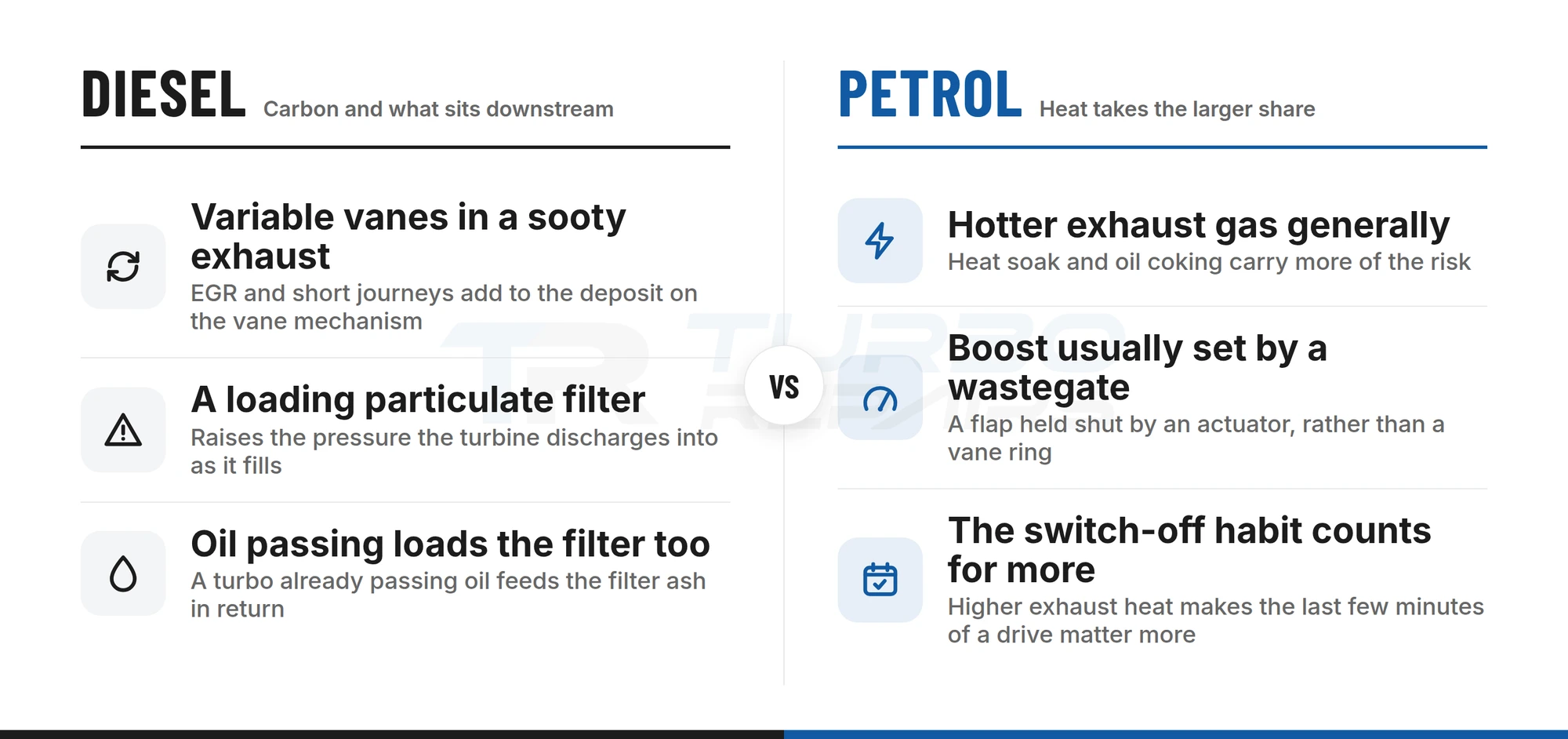
Most modern diesel turbochargers control boost with a ring of variable vanes around the turbine rather than a simple wastegate, and those vanes live in a soot-laden exhaust stream. Exhaust gas recirculation and short journeys add to the deposit, which is why a diesel used mainly around town is the classic case of a turbo that fails early on low mileage.
Diesels with a particulate filter carry a second factor downstream of the turbine. As the filter loads, the pressure the turbine discharges into rises, and a turbo passing oil loads the filter with ash in return. Our Audi A4 TDI page sets out how the two wear each other.
Petrol: heat
A petrol engine’s exhaust generally runs hotter than a diesel’s, so heat soak and oil coking take a larger share of the risk and the switch-off habit counts for more. Many petrol turbos control boost with a wastegate: a flap held shut by an actuator whose setting decides the boost, the subject of our wastegate actuator repair page.
So how long a turbo lasts on a diesel is decided by the same conditions as on a petrol, with different weights: carbon and exhaust after-treatment on one, heat on the other. Oil sits at the centre of both.
Turbo Repairs · Epsom workshop
Turbo already showing its age?
A turbocharger that has started to smoke, whine or lose boost is usually rebuildable rather than scrap. Post it to our Epsom workshop and we will strip it, measure what has worn, and tell you what that wear says about the oil and heat it was living with.
Lifetime, unlimited-mileage warranty · Mail-in from the UK and internationally · Bench-tested and calibrated before it ships
Signs a Turbo Is Nearing the End
A turbo rarely fails without warning: smoke, a whine, oil use or boost that will not build usually come first, and each has a cheaper cause that imitates it. Our guide to turbo failure symptoms sorts them by where in the unit they start and what to rule out before anything is bought. If your evidence is a fault code or limp mode rather than noise or smoke, turbo actuator symptoms is the better place to start.
Nearing the end is rarely the end. Bearings, seals, the shaft and wheel assembly and a carboned vane mechanism are all serviceable; what usually rules a turbo out is a cracked housing, or wheel damage severe enough that the geometry has gone. A turbo rebuild renews what has worn and returns the unit to specification.
What matters most is what changes on the car. A turbo worn out by the conditions on this page will wear its successor out the same way unless they change: fresh oil and filter, a clear feed and return, and a better switch-off habit. On some engines the fitting instructions also call for a second oil and filter change shortly after refit, as our Ford Transit turbo repair page explains.
How Long Do Turbos Last? FAQ
How many miles does a turbo last?
There is no fixed figure. Published numbers run from “often well beyond 100,000 miles”, from a UK supplier, to an average of up to 150,000, from a US diesel-parts supplier, and neither comes with the data behind it. Mileage is the weakest predictor available: oil condition and hours spent under load decide how long a turbo lasts.
How long does a turbo last on a diesel?
As long as its oil, heat and load allow, like any turbo. Diesel turbos have two extra threats: soot building on the variable-vane mechanism, worst on short journeys, and a loading particulate filter raising the pressure behind the turbine. A diesel used mostly for short trips is the one most likely to need a turbo at low mileage.
Do diesel turbos last longer than petrol turbos?
Not by default. Diesel engines turn more slowly, which is sometimes cited in their favour, but diesel turbos contend with soot and exhaust after-treatment, while petrol turbos generally see hotter exhaust gas. Each fails for its own reasons, and oil condition matters on both.
Can you make a turbo last longer?
Yes, and most of it is free. Use the oil grade and specification in the handbook and change it at an interval that suits how the car is used; let the engine warm before using full boost; drive gently or idle briefly before switching off after hard running; keep the intake airtight and the air filter properly sealed; and have the oil feed and return checked whenever the turbo is off.
Should a turbo be replaced at a set mileage?
No. There is no preventative replacement interval for a turbocharger, and a healthy one is best left alone. Keep its oil right, watch for the warning signs, and act when they appear rather than when the odometer passes a number.
Does a rebuilt turbo last as long as a new one?
A rebuilt turbo’s life is decided by the same conditions as a new one’s. We rebuild on genuine OE, OEM-grade or uprated components that meet or exceed original specification, balance the rotating assembly and bench-test the unit, and every rebuild carries a lifetime warranty with no mileage cap. What decides how long it lasts after that is whether the cause of the first failure was corrected on the car. Turbo rebuilds start from £185 + VAT; our guide to turbo repair costs has the detail.
Final Thoughts
How long a turbo lasts is one of the few questions in motoring where the owner writes most of the answer. The mileage figures in circulation describe someone else’s turbocharger, run on someone else’s oil, over someone else’s journeys.
Yours is being decided all the time: at each oil change, each short trip that never warms the engine through, and each switch-off after a hard run. Get those right and the turbo has the best chance of a long life. Get them wrong and no build quality will rescue it.
When one does wear out, the same logic runs the other way. Correct the conditions that wore it, and a rebuilt unit starts on a better footing than the first one ever had.
Turbo Repairs · Epsom workshop
Worn out is not written off
When your turbocharger reaches the end of its run, post it in with your registration and the references from its plate. We strip it to component level, rebuild it on genuine OE or OEM-grade parts, balance and bench-test it, and tell you what the wear says about the conditions it lived in.
Lifetime, unlimited-mileage warranty · Mail-in from the UK and internationally · Bench-tested and calibrated before it ships