

Summary We rebuild the turbocharger from the Vauxhall Insignia 2.0 CDTI, the single-turbo cars and the two-stage BiTurbo alike. You or your garage send the unit to our Epsom workshop, where it is stripped to component level, measured, rebuilt on genuine OE or OEM-grade parts, balanced and bench-tested, then returned ready to refit. Rebuilds start from £185 + VAT, bench time is typically one to three working days, and every rebuild carries a lifetime, unlimited-mileage warranty.
Identify the turbocharger by the label on its housing, not by the car’s power output. On the early 2.0 CDTI, the output narrows the choice to two different units at exactly the point where the parts trade cannot agree on its own dividing line.
At 129 bhp on the A20DTH engine, the fitment data lists two different Garrett turbochargers for the 2008 to 2010 Insignia: a GT1446SZ and a GTB1549V.
This page is for Insignia owners, and the garages that look after their cars, when a 2.0 CDTI has lost boost, dropped into limp mode, started smoking or begun to whistle. It sets out which turbocharger your car carries, what wears on it, what each symptom points to, what each route costs, and how we rebuild the unit. The 1.6 CDTI, the 1.5 diesel and the petrol Insignias carry different turbochargers; the 1.6 CDTI is covered in the FAQ.
- Cars covered: the Vauxhall Insignia 2.0 CDTI, single turbo and two-stage BiTurbo, catalogued from 2008
- Turbochargers catalogued: Garrett GT1446SZ, GTB1549V, GTD1449VZK and GTD1449VZKL units on the single-turbo cars; a BorgWarner KP35 and K04 two-stage assembly on the BiTurbo
- The overlap to watch: around 128 to 131 bhp on the early cars, the listings for two different Garrett units overlap, so read the label before ordering anything
- Know your year and power output? Choose them on our Vauxhall Insignia 2.0 CDTI turbocharger rebuild listing, and we confirm the unit on the bench
- Price: rebuilds from £185 + VAT; replacement turbochargers from £450; your price is confirmed once the unit has been inspected
- Turnaround: typically one to three working days on the bench, plus postage each way
- Warranty: lifetime and unlimited mileage, with no time limit
Single Turbo or BiTurbo? Which Insignia 2.0 CDTI You Have
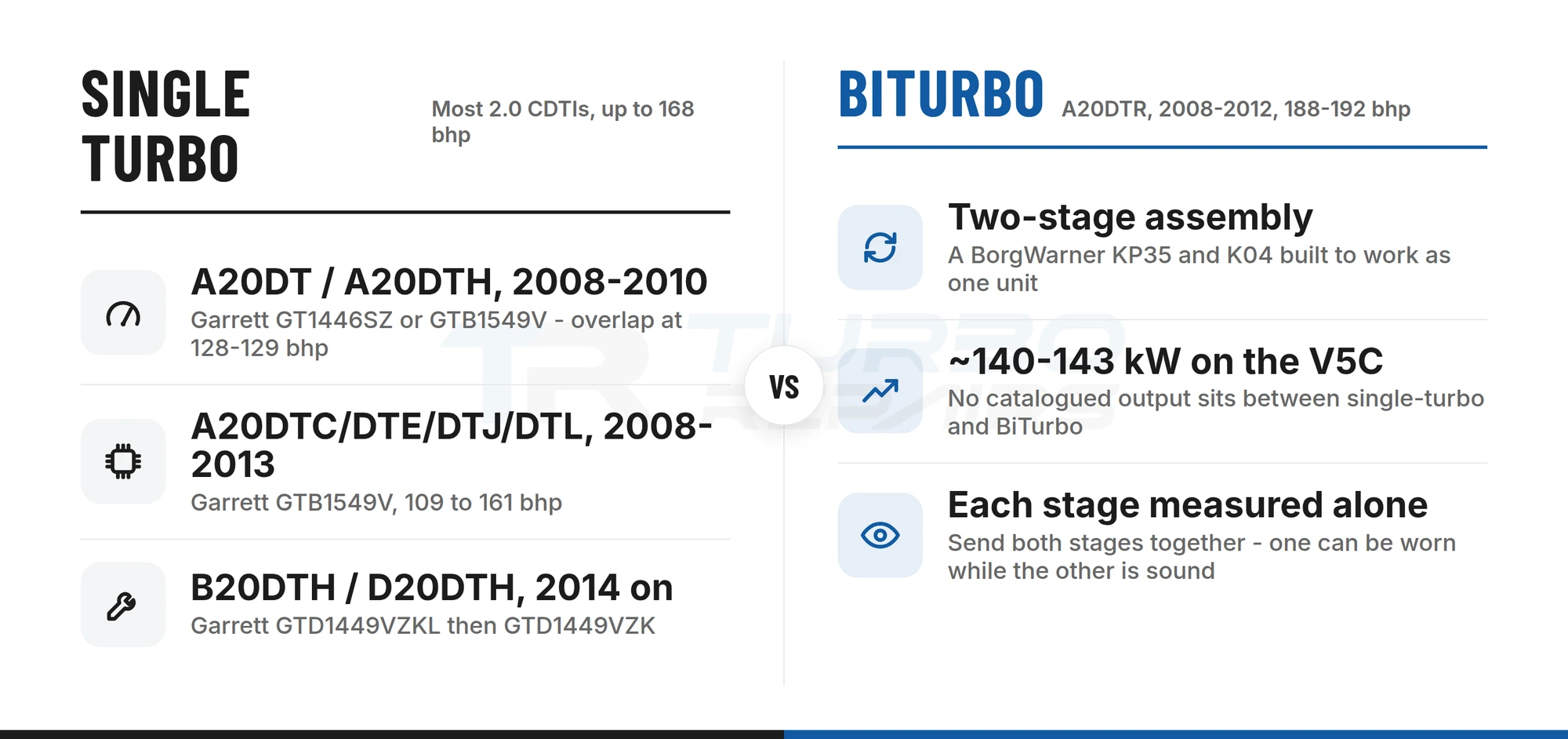
Most versions of the 2.0 CDTI in the fitment data we work from carry one turbocharger. The exception is the BiTurbo, catalogued at 188 to 192 bhp on the A20DTR engine against cars from 2008 to 2012. It carries a two-stage assembly: a BorgWarner KP35 and a BorgWarner K04, built to work together as one unit.
The quickest way to tell the two apart is the power output. Your V5C logbook gives it in kilowatts at section P.2, and one kilowatt is about 1.34 bhp. On the catalogued cars, the BiTurbo sits at roughly 140 to 143 kW. The highest single-turbo output listed before 2014 is 161 bhp, about 120 kW, and the later single-turbo 2.0 CDTI is listed at 168 bhp, about 125 kW. No output is catalogued in between, so the logbook separates the two layouts cleanly.
If the unit is already off the car, the difference is plain. A BiTurbo assembly is two turbochargers joined together, each with its own identification. Send it to us with both stages together, as it came off: each stage is measured in its own right, and you hear which of them needs the work.
The single-turbo cars are where identification needs more care, because more than one Garrett unit is catalogued across the range, and two of them overlap. The next section sets that out.
The Turbochargers Fitted to the Insignia, by Engine Code
The table summarises the turbochargers catalogued for the Insignia 2.0 CDTI. The years are the years each unit is listed against, not the production run of the car, and a power output can appear in more than one row.
| Catalogued years | Power (bhp) | Engine codes | Turbocharger | References |
|---|---|---|---|---|
| 2008 to 2010 | 128, 129 | A20DT, A20DTH | Garrett GT1446SZ | 788778-0001, 788778-0002, 788778-0003 |
| 2008 to 2013 | 109, 118, 129, 138, 158, 161 | A20DTC, A20DTE, A20DTH, A20DTJ, A20DTL | Garrett GTB1549V | 786137-0001, 786137-0003 |
| 2008 to 2012 | 188, 190, 192 (BiTurbo) | A20DTR | BorgWarner two-stage: KP35 and K04 | 1000-970-0062 (I) and (II); 1000-970-0018 (I) and (II) on the 190 bhp row |
| 2014 | 168 | B20DTH | Garrett GTD1449VZKL | 822072-0004 |
| 2014 to 2017 | 168 | B20DTH, D20DTH | Garrett GTD1449VZK | 844572-0004 |
| 2017 onwards | 168, 174, 207 | D20DTH, D20DTR, F20DVH | Not named in the fitment data | Vauxhall part numbers only |
Where the two early single-turbo units meet
Read the first two rows together. The GT1446SZ is listed at 128 and 129 bhp on the A20DT and A20DTH. The GTB1549V is listed across 109 to 161 bhp, and that range includes 129 bhp and the A20DTH, over the same years. A 2008 to 2010 Insignia at 129 bhp on an A20DTH therefore fits the description of either turbocharger, by output and by engine code alike.
Other catalogues draw the line in different places. One specialist lists the 788778 for 110 to 131 hp and the 786137 from 130 hp. Another puts the 788778 on a 129 bhp A20DTJ and the 786137 on a 156 bhp A20DTH, while the fitment data files the A20DTJ under the 786137. Three sources give three boundaries, and the cars they disagree about are the ones closest to the line.
None of that makes the car hard to repair. It means that when your Insignia sits near 129 bhp, the output gives you a shortlist rather than an answer. The part number on the turbocharger’s label is the answer, and where heat or grime has made it unreadable, we identify the unit on the bench before any work starts.
From 2014: different Garrett references
From 2014 the 168 bhp B20DTH is catalogued with the Garrett GTD1449VZKL, 822072-0004, and then the GTD1449VZK, 844572-0004, which is also listed against the D20DTH. Trade listings put the same references on the Zafira Tourer, Cascada and Antara 2.0 CDTI, so a unit advertised for one of those cars can carry the same number as yours. Match the number on your own label, not the model name in the advert.
The later cars
The rows catalogued from 2017, including the 207 bhp D20DTR and the 174 bhp F20DVH listed from 2020, carry Vauxhall part numbers but no turbocharger model. We still rebuild those units. For those cars the turbocharger itself is the most complete description available, so send it with the Vauxhall number from its label and we identify it on arrival.
What Fails on an Insignia Turbo
Every unit in the table shares the same core. A compressor wheel and a turbine wheel sit on one shaft, which turns in oil-fed journal bearings inside a centre housing, with a sealing ring at each end. The makers and frame sizes differ; the ways these cores wear do not.
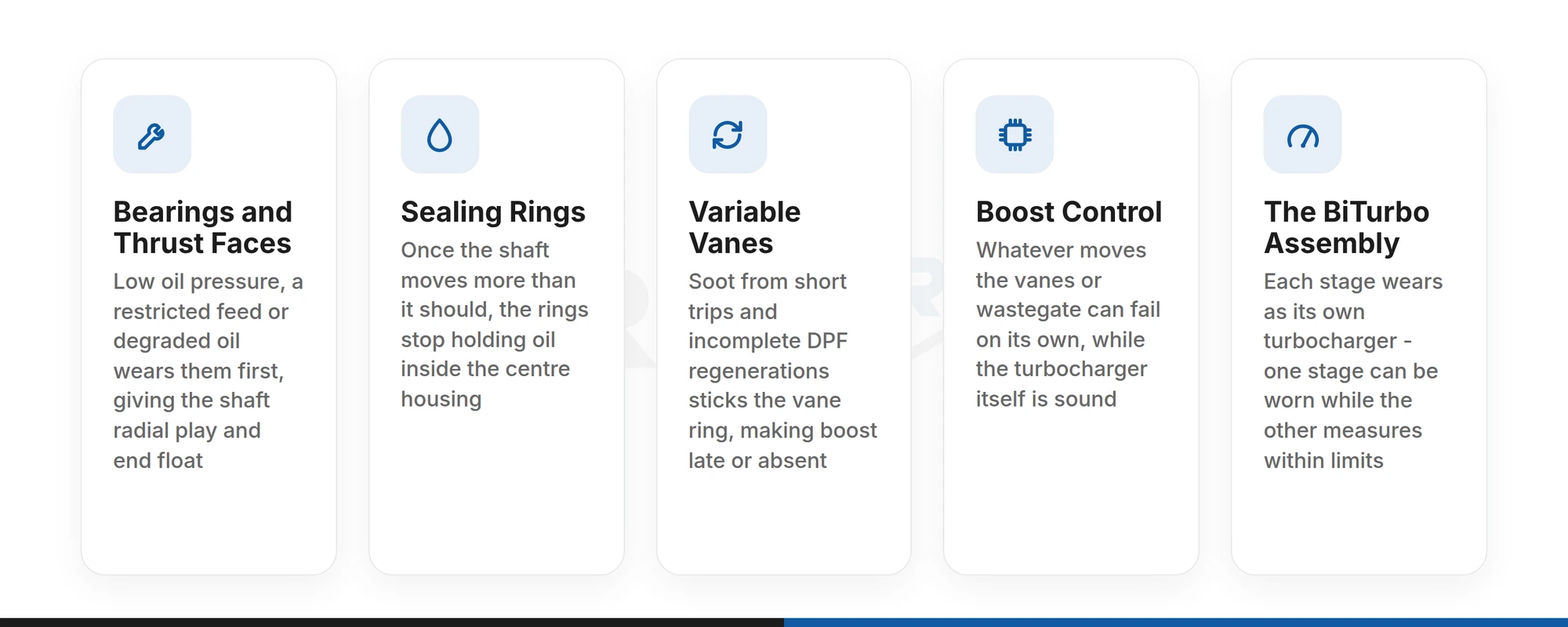
- Bearings and thrust faces. Low oil pressure, a restricted feed or degraded oil wears them first. Radial play lets the wheels move towards their housings, end float lets the shaft shift along its axis, and either one left running ends with a wheel touching its housing.
- Sealing rings. Once the shaft moves more than it should, the rings stop holding oil inside the centre housing, and it passes into the intake or the exhaust.
- Variable vanes. Trade accounts of the 2.0 CDTI describe a variable-geometry turbocharger whose vanes stick with soot, a problem they tie to short trips and incomplete particulate filter regenerations. Carbon on the vane ring makes boost late or absent while the rotating assembly is still sound. Our Garrett GT2052V turbo repair page explains how a vane mechanism works and fails, for readers who want the detail.
- Boost control. Whatever moves the vanes or wastegate can fail rather than the turbocharger itself. That is a separate repair, covered in the cost section below.
- The BiTurbo assembly. Each stage is a turbocharger in its own right and wears as one, so one stage can be worn while the other measures within limits. The assembly also carries the control hardware that shares the work between the stages, and a fault there can cost boost while both rotating assemblies are healthy. The K04 stage belongs to the family described on our BorgWarner K03 and K04 turbo repair page.
Most of these failures start on the car rather than in the turbocharger: a carboned or cracked oil feed pipe, a return line that drains slowly, a split intake hose that lets grit reach the compressor, or oil changes stretched too far. A rebuild renews what wore. It cannot correct the cause, and a cause left on the car wears the rebuilt unit the same way.
Symptoms, and What Each One Narrows Down
No symptom on its own condemns the turbocharger. Each one narrows the list of suspects, and some point away from the turbo altogether, so it pays to know which list you are looking at before anything is unbolted.
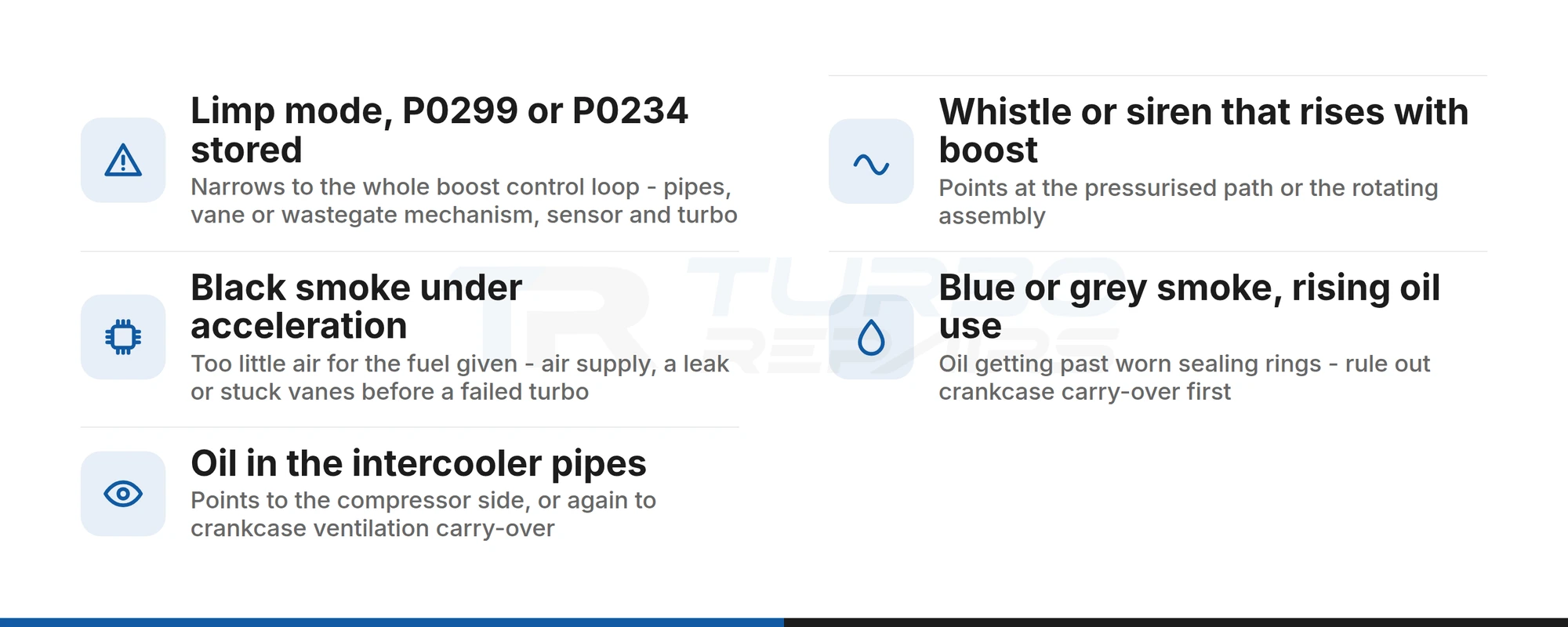
- Limp mode, often with P0299 or P0234 stored. This narrows the fault to the boost control loop: the charge pipes, the vane or wastegate mechanism, the part that moves it, the pressure sensor and the turbocharger. It does not name one of them. If switching off and restarting clears it for a while, the mechanism or its control is a stronger suspect than a worn rotating assembly. Our guide to turbo overboost and underboost codes explains what the two codes can and cannot tell you.
- A whistle or siren that rises with boost. This narrows the fault to the pressurised path or the rotating assembly: a leaking hose or joint, or bearing wear letting a wheel run out of true. Our guide to diagnosing a turbo whistle separates the noises that come from the unit from those that do not.
- Black smoke under acceleration. The engine is receiving too little air for the fuel it is given. That narrows the fault to air supply, a boost leak, stuck vanes or a restricted intake, before a failed turbocharger.
- Blue or grey smoke, or oil use climbing between services. This narrows the fault to oil getting where it should not, usually past worn sealing rings. Oil carried over from the crankcase ventilation system can look the same, so rule that out before the turbocharger comes off.
- Oil in the intercooler pipes. This points to the compressor side of the unit, or again to crankcase ventilation carry-over, and the two are worth separating before the turbocharger is blamed.
Two cheaper faults imitate turbocharger failure often enough to rule out first. A split charge hose or a leaking intercooler joint can stay closed at idle and open only under boost, so a loaded road test tells you more than a look under the bonnet. And a blocked air filter or intake starves the compressor, which can produce the same loss of pull and black smoke as a tired turbocharger.
Once the noise turns metallic or oil smoke is visible, stop driving the car hard. Every loaded mile after that point moves more of the unit from the rebuild column towards the replacement column. Our guide to turbo failure symptoms sorts the signs by where in the unit they start.
Rebuild Your Own Turbo or Fit a Replacement?
On most cars, this is a question of cost and condition. On the early Insignia it is also a question of identification, because a replacement is ordered on a part number, and the part number is precisely what the 129 bhp overlap puts in doubt.
- What has to be matched. A new or exchange unit has to be the right Garrett reference, or on the BiTurbo the right assembly or stage, bought from a trade that draws its dividing lines in different places. A rebuild returns the unit that came off your car, so there is nothing to match.
- How exchange units are sold. Remanufactured units are often sold on an exchange basis, against the return of your old turbocharger, with a surcharge held until it arrives. The unit that goes back is the one that failed, so its identity has to be right twice over.
- How much of the unit survived. When the turbine wheel, shaft and a housing have all failed inspection, little of the original is left to rebuild. In that case a replacement is often the better value, and we say so rather than rebuild a unit that should be replaced.
- On the BiTurbo, whether one stage or both need work. If one stage has worn and the other measures within limits, rebuilding the worn stage alone is usually the economical route.
- Whether the cause has been found. A restricted oil feed or a split intake hose will wear a new turbocharger as surely as a rebuilt one.
If the answer to the first point is uncertain, the rebuild route removes the question. What arrives is identified, measured and rebuilt, and it goes back onto the car it came off.
What an Insignia Turbo Replacement Costs
Rebuilding your own Insignia turbocharger starts from £185 + VAT. Replacement turbochargers from us start from £450. Neither figure includes removing and refitting the unit, which is the same job on the car whichever route you choose.
The rebuild price is confirmed once the unit has been stripped and measured, because it depends on how much of it is still within specification. Bearings, thrust parts and sealing rings are renewed on every rebuild; a damaged wheel, a worn shaft or a cracked housing adds to the work. On the BiTurbo, the price also depends on whether one stage or both need rebuilding. What moves a rebuild up its range is set out in our guide to turbo repair prices.
Sometimes the turbocharger is sound and the fault is in the part that controls it. If your unit carries an electronic actuator and the fault proves to be there, electronic actuator repairs start from £100 + VAT. Our electronic turbo actuator repairs page explains that service.
Turbo Repairs · Epsom workshop
Near 129 bhp and unsure which Garrett you have? Send the one on the car
Every Insignia turbocharger is identified on arrival, then stripped and measured before any price is confirmed. You hear what it is, and whether it is worth rebuilding, before any work is done.
Lifetime, unlimited-mileage warranty · Mail-in from the UK and internationally · Bench-tested and calibrated before it ships
Our Vauxhall Insignia Turbo Rebuild
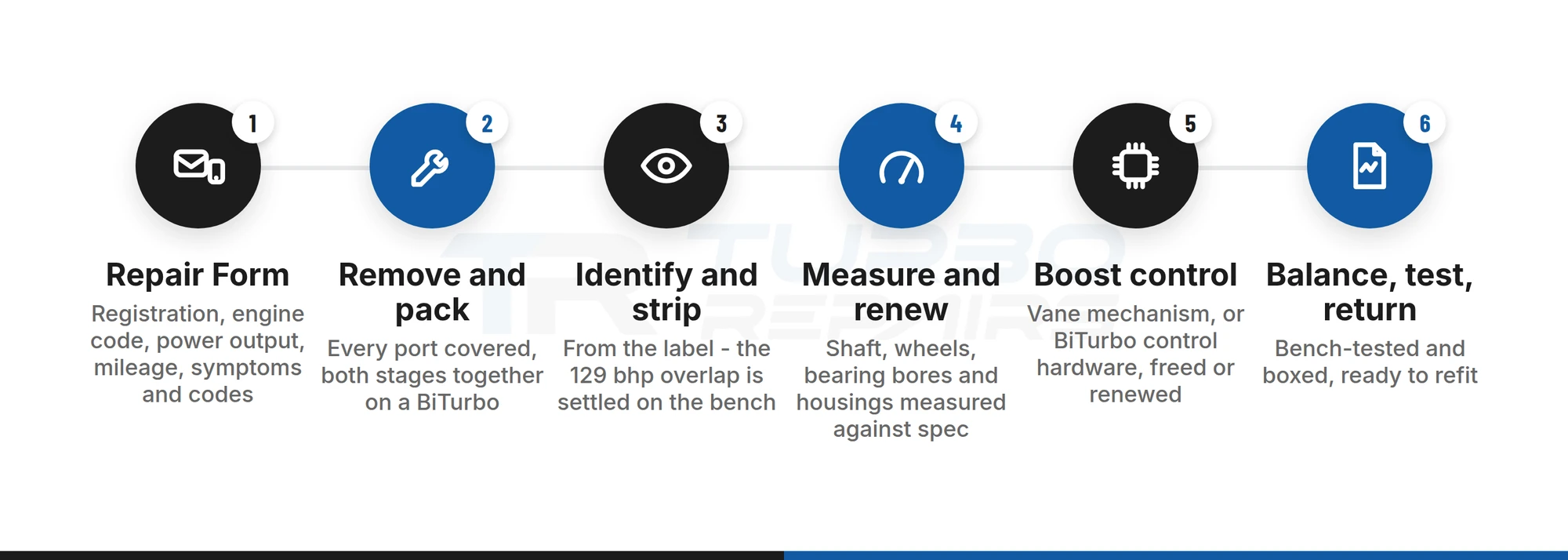
You, or the garage that looks after the car, remove the turbocharger and send it to us at Unit 102 Reaver House, 12 East Street, Epsom, Surrey, KT17 1HX, United Kingdom. Independent garages and main dealers send units in for their customers’ cars the same way. Our turbocharger rebuild service runs in this order.
- Complete the online Repair Form. Give the registration, the engine code if you have it, the power output from the V5C, the mileage, the symptoms and any fault codes. Copy every number from the turbocharger’s label, and on a BiTurbo, from both stages.
- Remove and pack the unit. Cover every port so nothing can get in, and pack the unit so it cannot move in the box. Our guide to removing, refitting and priming a turbocharger covers the work on the car, and packing and postage are on our FAQs page.
- Identification and strip. The unit is identified from its label, or on the bench where the label is unreadable, and at the 129 bhp overlap we tell you which of the two Garrett units arrived. It is then stripped to component level by turbo specialists who rebuild turbochargers and turbo actuators as their core work.
- Measurement and renewal. The shaft, wheels, bearing bores and housings are cleaned and measured against original specification. Bearings, thrust parts and sealing rings are renewed with genuine OE or OEM-grade components that meet or exceed the original, and a part with a known design weakness is uprated rather than put back.
- Boost control. The vane mechanism, or on the BiTurbo the control hardware between the stages, is cleaned and freed where sound and renewed where worn, so boost control moves as designed.
- Balanced, bench-tested and returned. The rotating assembly is balanced, and the unit is set up and run on the bench before it is boxed and sent back, ready to refit.
Bench time is typically one to three working days from arrival, with postage each way on top. Every rebuild carries a lifetime, unlimited-mileage warranty, with no time limit and no mileage cap. When the unit goes back on, renew the oil feed and return lines rather than reusing them, and prime the oil feed before the engine first runs, so the renewed bearings never turn dry.
Vauxhall Insignia Turbo FAQ
Does my Insignia 2.0 CDTI have a single turbo or a BiTurbo?
Check the power output on your V5C at section P.2. In the fitment data, the BiTurbo is the A20DTR at 188 to 192 bhp, roughly 140 to 143 kW, carrying a BorgWarner KP35 and K04 two-stage assembly. Every other 2.0 CDTI catalogued before 2017 is listed at 168 bhp or less with a single turbocharger, a Garrett unit wherever the data names the maker.
Why do different suppliers list different turbos for the same Insignia?
Because two Garrett units, the GT1446SZ (788778) and the GTB1549V (786137), overlap at around 129 bhp on the early cars, and catalogues place the dividing line differently. The fitment data lists both at 129 bhp on the A20DTH. The part number on your turbocharger’s label settles it.
Is the Insignia turbo the same as the Astra, Zafira or Cascada turbo?
Sometimes. Trade listings put the 786137 on the Astra J and Zafira Tourer as well as the Insignia, and the later 822072 and 844572 on the Zafira Tourer, Cascada and Antara. Other references belong to fewer cars, so match the number on your own unit rather than the model a part is sold for.
How much does a Vauxhall Insignia turbo replacement cost?
Rebuilding your own turbocharger starts from £185 + VAT, and a replacement turbocharger from us starts from £450. Removal and refitting are not included. The rebuild price is confirmed once the unit has been stripped and measured, because it depends on how many parts are still within specification.
Do you rebuild the 1.6 CDTI and the later Insignia turbos?
Yes. The 1.6 CDTI carries different turbochargers from the 2.0 and has its own Insignia 1.6 CDTI rebuild listing. For cars catalogued from 2017, where the fitment data gives Vauxhall numbers but no turbocharger model, complete the Repair Form with the number from the label and we identify the unit when it arrives.
How long will my car be off the road?
Bench time is typically one to three working days from the day the unit arrives, plus postage in each direction and the time taken to remove and refit it. The rebuilt unit comes back ready to refit, with a lifetime, unlimited-mileage warranty.
Final Thoughts
Most turbochargers on the Insignia 2.0 CDTI are easy to place. The BiTurbo stands apart by its output, and the later single-turbo cars carry their own Garrett references. The difficulty is concentrated in one narrow band of the early cars, where two different units share an output and an engine code, and where the catalogues meant to separate them each draw the line somewhere else.
That band only causes trouble when a part has to be chosen from a list. Read the label before you order anything, find out why the unit wore before another one goes on, and if you send the turbocharger itself, the question of which unit it is gets answered on the bench rather than guessed at from a catalogue.
Turbo Repairs · Epsom workshop
Single turbo or BiTurbo, the unit off your Insignia is the one to rebuild
Complete the Repair Form with your output and every number from the label, then send the turbocharger in as it came off. It is identified, stripped, measured, rebuilt, balanced and bench-tested, and returned ready to refit.
Lifetime, unlimited-mileage warranty · Mail-in from the UK and internationally · Bench-tested and calibrated before it ships