

Summary We rebuild the turbocharger from the 2.2 diesel shared by the Land Rover Freelander 2, the first-generation Range Rover Evoque and the Discovery Sport, badged TD4 or SD4. You or your garage remove the turbo and post it to us. It is stripped to component level, measured, rebuilt on genuine OE or OEM-grade parts, balanced and bench-tested, then posted back ready to refit. Rebuilds start from £185 + VAT, a replacement unit from £450 + VAT, bench time is typically one to three working days, and every rebuild carries a lifetime, unlimited-mileage warranty.
Later Evoque and Discovery Sport cars with the 2.0 Ingenium diesel carry different turbochargers and are not covered here. On the 2.2, Land Rover has renumbered the turbo several times over, so the number on your paperwork or your unit can differ from the one on a listing and still be the same part.
Land Rover has catalogued the later 2.2 turbocharger under six successive numbers, from LR022358 to LR065510, and treats each one as replaced by the next for all three cars.
A 2.2 diesel Freelander 2, Evoque or Discovery Sport that is smoking, whining or short of boost, with the actuator already ruled out, points at the turbocharger itself. This page covers which engine and which turbo your car carries, what wears out inside it, the cheaper faults that imitate it, and what a rebuild or a replacement costs.
- Covered here: the 2.2 diesel, badged TD4 or SD4, in the Freelander 2 (L359), the first-generation Range Rover Evoque (L538) and the Discovery Sport (L550)
- Not covered here: the 2.0 Ingenium diesels in later Evoque and Discovery Sport cars, the second-generation Evoque, and petrol engines
- Early Freelander 2 turbo: Garrett 753546, catalogued by Land Rover as LR024702 (superseding LR003578) and listed up to 2010
- Later turbo, all three cars: Land Rover LR065510, sold in the parts trade as a Mitsubishi unit, with turbo references in the 49477-012xx series
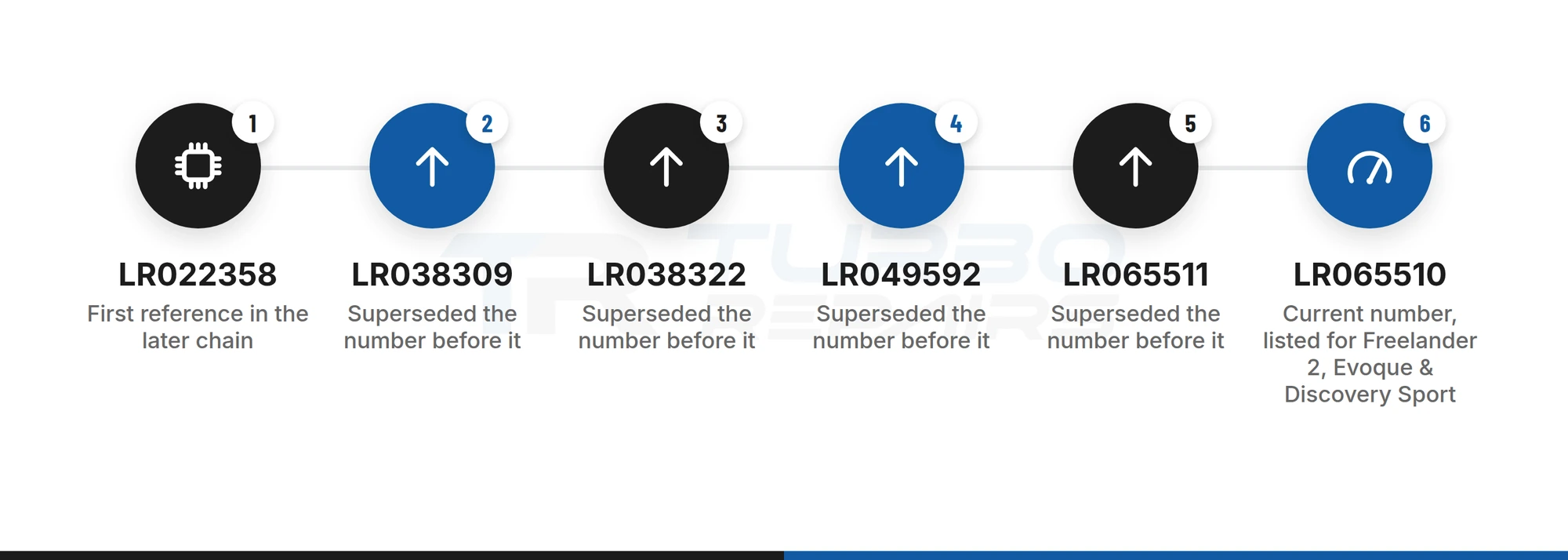
- Later turbo’s number chain: LR022358, LR038309, LR038322, LR049592, LR065511, LR065510
- Outputs listed for the 2.2: 150 to 200 hp
- Our service: mail-in rebuild of your own turbo from £185 + VAT, replacement from £450 + VAT, typically 1–3 working days on the bench, lifetime unlimited-mileage warranty
Three Badges, One 2.2 Diesel: Which Engine Is Yours?
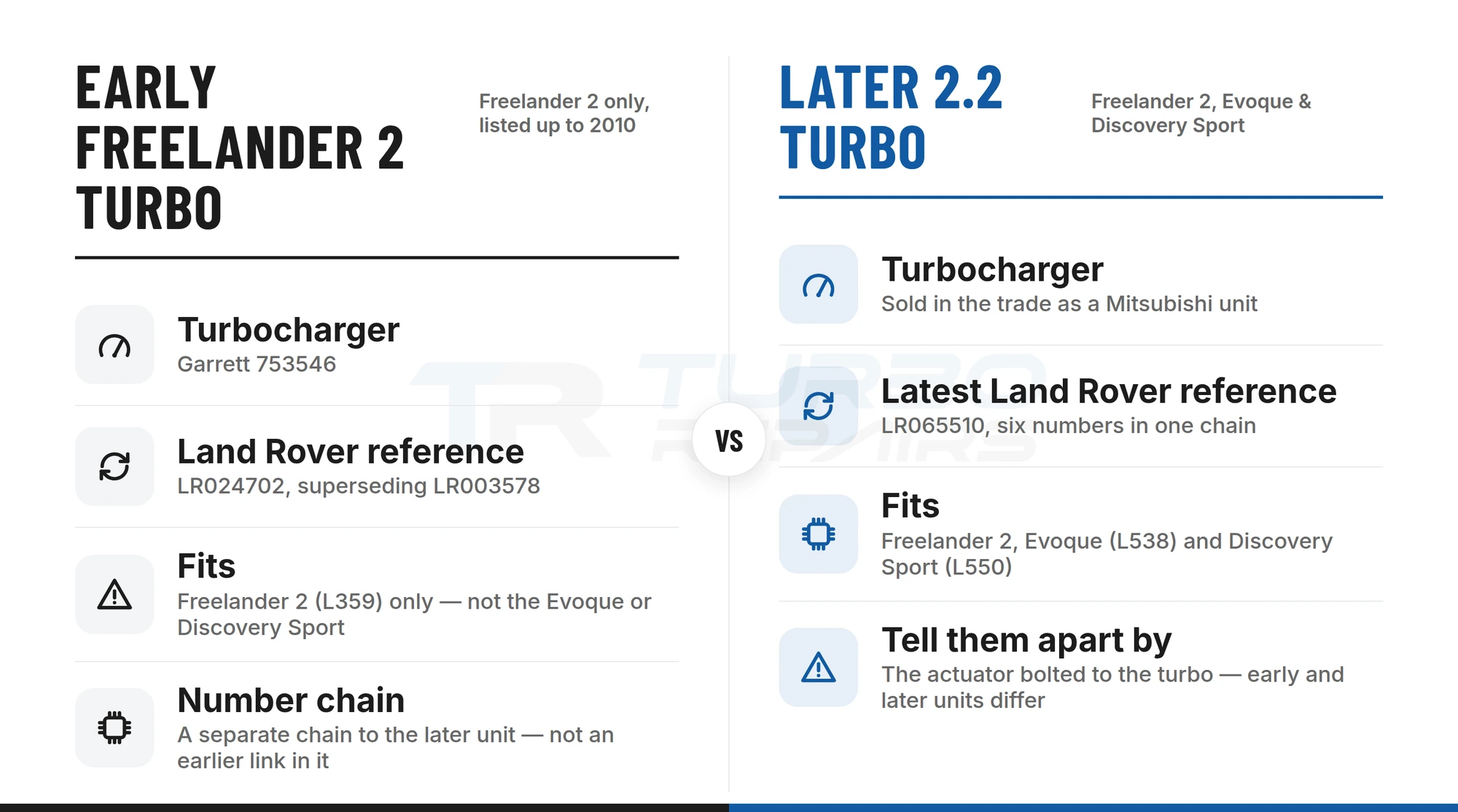
The same 2.2-litre diesel sits under three Land Rover badges, and parts catalogues list its turbocharger against all three. It is also listed for the Jaguar XF with the 2.2 diesel. What differs between the cars is the span of years each one carried the engine and, on the Freelander 2, which of two turbochargers it was built with.
| Vehicle | Model code | 2.2 diesel years as listed | Turbocharger listed |
|---|---|---|---|
| Land Rover Freelander 2 | L359 | 2006–2015 | Early cars: Garrett 753546 (LR024702), listed up to 2010. Later cars: LR065510 |
| Range Rover Evoque, first generation | L538 | 2011–2015 | LR065510 |
| Land Rover Discovery Sport | L550 | 2015–2016 | LR065510 |
Three things follow from that table. The Evoque and the Discovery Sport only ever appear with the later turbocharger, so on those two cars the 2.2 question is the only one to settle. The Freelander 2 is the one car with two turbo generations, and the years around 2010 do not separate them cleanly. And the Evoque built from 2019, which catalogues list as a separate generation, appears in none of the 2.2 turbo listings we have seen.
On an early Freelander 2 the engine is catalogued as DW12B, at 152 hp and, from 2007, 160 hp. The 2.2 as a whole is listed at outputs from 150 to 200 hp.
Early or later turbo on a Freelander 2
The quickest way to tell the two apart is the actuator bolted to the side of the turbo, because the early and later units carry completely different ones. Our Freelander 2 turbo actuator repair page sets out how to read that label, so it is not repeated here. If the plate on the turbocharger itself is readable, a 753546 reference or LR024702 puts you on the early Garrett unit, and any number in the LR065510 chain puts you on the later one.
Specialist listings do not agree on what to call these units. One names the Freelander 2 turbo as a Garrett GTB1752V for TD4 and SD4 alike, while another lists two different designs for the car. That disagreement is a good reason to work from the number on your own turbo rather than a description on someone else’s page.
The 2.2 Diesel and the Ingenium 2.0: Where This Page Stops
This page covers one engine, the 2.2 diesel. It does not cover the 2.0 diesels that later Evoque and Discovery Sport cars carry, and nothing below about the 2.2’s turbocharger applies to them.
The catalogues show the change, but they do not date it to a single month. One specialist lists the later 2.2 unit for the Evoque from 2011 to 2015 and for the Discovery Sport in 2015 and 2016. Turbochargers for a 2.0 diesel are listed for the Evoque, the Discovery and the Velar under the Ingenium name, and a twin-turbo 2.0 diesel of 240 hp appears in listings from 2017 for models including the Evoque. No catalogue we have seen gives a single changeover date for either car, so we will not print one.
In practice, treat any Evoque or Discovery Sport from around 2015 and 2016 as unconfirmed until you have checked. The engine size on the registration document settles it, and so does the reference on the turbo: a 2.2 turbo carries one of the references in the box above.
Are Ingenium cars covered? Not by this page. Their turbochargers are different units from the 2.2’s, and one 2.0 diesel version is listed with two turbochargers rather than one. If your car has an Ingenium engine, send the reference from the turbo through the online Repair Form and we will tell you what it is and whether it is a candidate for a rebuild.
What Fails on These Turbochargers
Both 2.2 turbochargers are variable-geometry units. A ring of vanes inside the turbine housing changes the angle at which exhaust gas meets the turbine wheel, and the actuator on the outside of the housing moves those vanes. Everything else is a conventional turbocharger: a turbine wheel and a compressor wheel on one shaft, running in oil-fed bearings inside a centre housing, with a seal at each end.
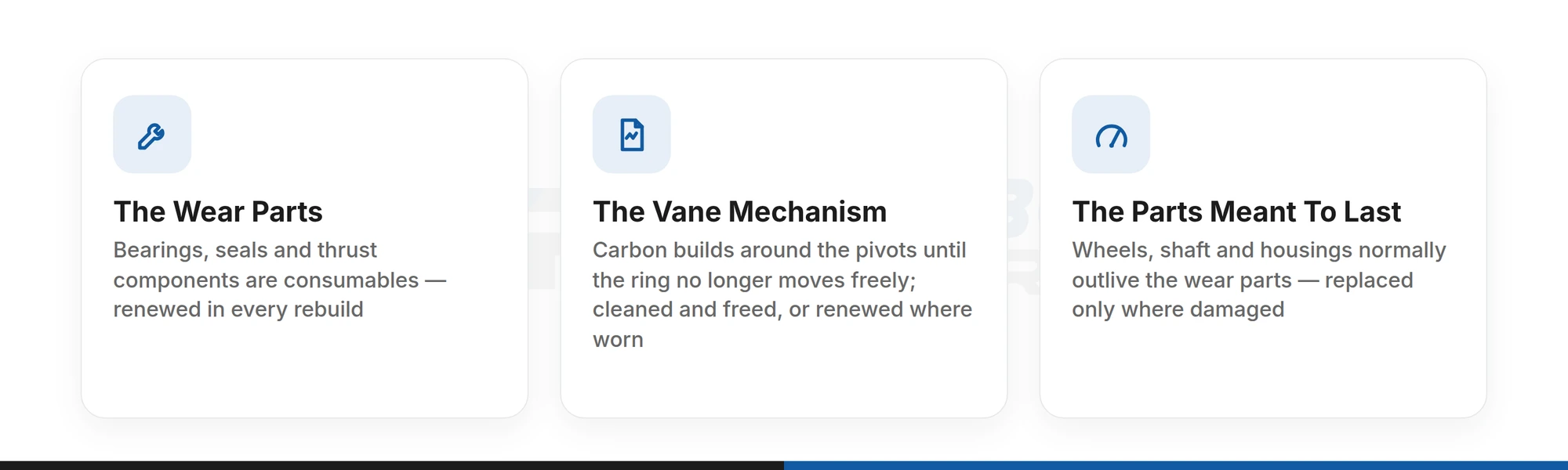
What wears on these units falls into three groups.
- The wear parts. Bearings, seals and the thrust components are consumables, designed to wear and renewed in every rebuild. Worn turbo seals are among the frequent faults specialist listings name for the Freelander 2. Left alone, bearing wear lets the wheels touch their housings, and that is when a consumables job becomes a bigger one.
- The vane mechanism. Carbon builds up around the vane pivots until the ring no longer moves freely. On these turbochargers the vanes are known to tighten at the ends of their travel, especially when hot. Where the parts are sound they are cleaned and freed; where they are worn or distorted they are renewed.
- The parts meant to last. The wheels, shaft and housings normally outlive the wear parts. A compressor wheel struck by debris is replaced rather than repaired, a damaged turbine wheel is replaced together with its shaft, and a cracked turbine housing can usually be replaced as a section with the rest of the turbo still rebuilt.
The vane ring: where the turbo and the actuator meet
A stiff vane ring is the fault most easily blamed on the wrong part, because the actuator is the thing that struggles against it. If the vane lever was checked with the actuator disconnected and it stuck, caught or stopped short, the fault is inside the turbocharger, and it is a turbo rebuild. If the lever swept freely and the car still shows actuator fault codes, the actuator is the suspect and the actuator rebuild is the repair, from £100 + VAT.
The oil supply has its own filter
Parts catalogues for this engine list a turbo filter assembly, along with a seal for the oil feed filter, separately from the feed pipe and its gaskets. That filter belongs to the turbocharger’s supply rather than to the turbocharger, so it never comes to us with the unit. Whoever refits the turbo should inspect or renew it along with the feed pipe, because a rebuilt turbo depends entirely on the oil reaching it.
What the Symptoms Point To on a 2.2 Diesel
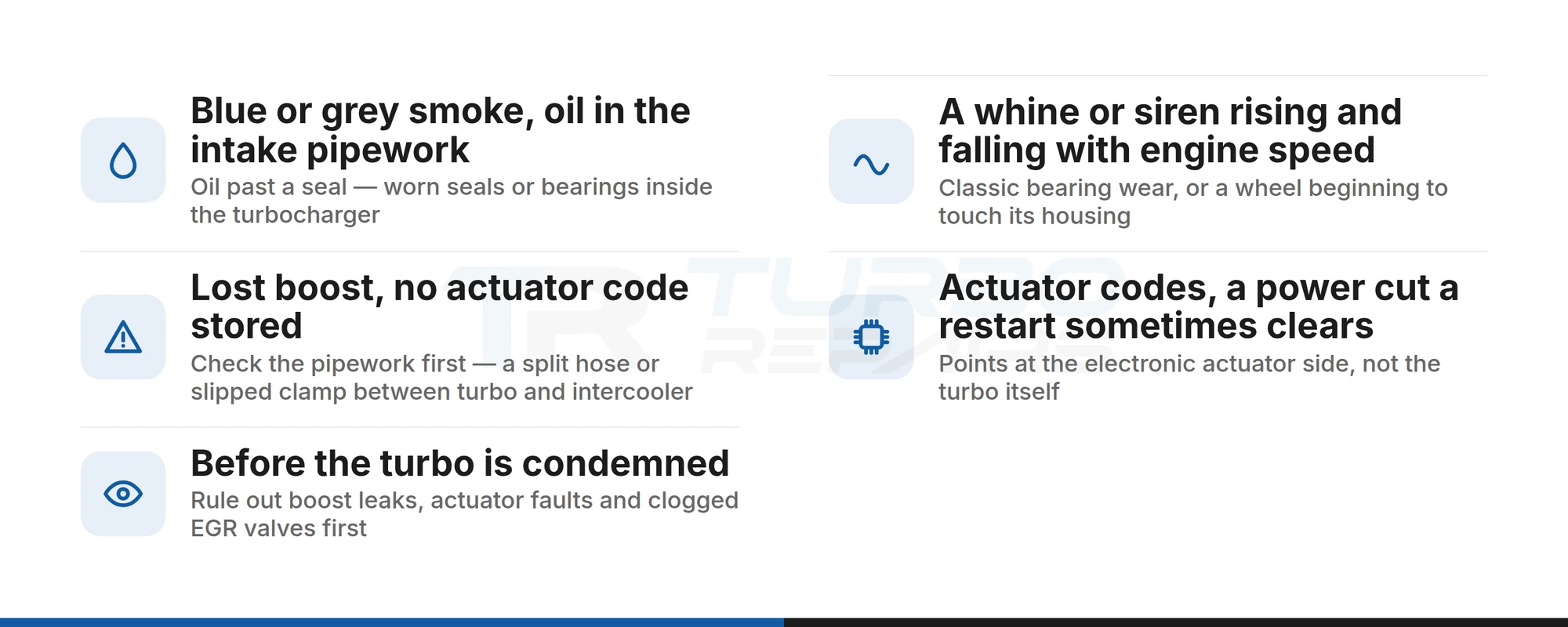
Several different faults on these cars feel the same from the driver’s seat: a flat engine and a warning. Each of the patterns below points in a different direction, so work out which one you have before anything comes off the car.
- Blue or grey smoke, or oil inside the intake pipework. Oil is getting past a seal, which points at worn seals or bearings in the turbocharger. It is also the pattern most worth acting on early, before bearing wear reaches the wheels.
- A whine or siren that rises and falls with engine speed. Classic bearing wear, or a wheel beginning to touch its housing. This is the turbo.
- Lost boost with no actuator code stored. Look at the pipework first. On the Freelander 2 2.2, the plastic hoses at either end of the metal pipe between the turbo and the intercooler are described by one supplier as prone to failing. A split hose or a slipped clamp costs boost and can store an underboost code such as P0299; our guide to turbo overboost and underboost explains what that code does and does not tell you.
- Actuator codes and a power cut that a restart sometimes clears. The electronic actuator side of the system rather than the turbo. The Freelander 2 actuator page covers that pattern on all three cars.
- Before the turbo is condemned. Specialist advice for this car is to check for boost leaks, actuator faults and clogged EGR valves before committing to a turbocharger, and it is sound advice.
Our guide to turbo failure symptoms goes through each symptom by where in the unit it starts, and which ones mean the car should not be driven further.
Rebuild Your Own Turbo or Fit a Replacement?
Most failed 2.2 turbochargers can be rebuilt, because what has usually failed is the set of parts designed to wear. A rebuild keeps your housings, wheels and shaft wherever they pass inspection, replaces what does not, and returns the unit that came off your engine. The route is a replacement only when so many major parts are damaged that little of the original would be re-used, and in that case we say so.
Six numbers for one later turbocharger
The number question only matters if you are buying a unit. Land Rover’s catalogue carries the later 2.2 turbo under a chain of numbers, LR022358, LR038309, LR038322, LR049592, LR065511 and LR065510, each one replaced by the next for the Freelander 2, Evoque and Discovery Sport. A new unit is sold under the latest number. A turbo fitted earlier in that run, or the paperwork that came with it, may carry an earlier one, and that on its own does not make it a different turbocharger.
The early Freelander 2 Garrett unit sits in a separate chain, LR003578 superseded by LR024702. The two chains are listed separately and do not meet, so a car on the early turbo is not simply an earlier link in the later one.
Two more things to watch if you shop for a unit. Several of the later chain’s numbers also appear on listings for the actuator alone, so read what is actually in the box. And the later actuator is coded at manufacture to its turbocharger and is not supplied separately through the dealer, which is why a replacement from that route arrives as a complete assembly.
A rebuild sidesteps all of it. The turbo that goes back on is the one that came off, so its number, its generation and its fit to your engine are already settled, and none of it has to be matched to a listing.
Turbo Repairs · Epsom workshop
Your own 2.2 turbo back, whatever number it carries
Post the turbocharger in with your registration and the reference from its label. It is stripped and measured before a route is recommended, and because a rebuild returns the same unit, a superseded number never needs matching to anything.
Lifetime, unlimited-mileage warranty · Mail-in from the UK and internationally · Bench-tested and calibrated before it ships
What a Freelander 2, Evoque or Discovery Sport Turbo Costs
On the 2.2, the later turbo is the same unit on all three cars, so the badge does not change what the work costs. What changes it is how much of the unit survived.
- Rebuild of your own turbocharger: from £185 + VAT, where the housings, wheels and shaft can be re-used and the wear parts renewed.
- Replacement turbocharger: from £450 + VAT, a reconditioned or new exchange unit for when your own is not worth rebuilding.
- Electronic actuator repair on its own: from £100 + VAT, when the actuator is the only part that failed.
Our price guide groups SUVs with large cars, and in that row rebuilds run from £210 to £450 excluding VAT, against a typical market price of £1,200 to £1,800 for a new turbocharger. A single-turbo four-cylinder unit like the 2.2 is priced on what the strip-down finds, so treat the row as a guide rather than a quote. The full breakdown is in our guide to turbo repair prices.
None of these figures covers taking the turbo off or putting it back, which your garage charges for and which is the same job whichever route you take. Expect the bill to include the parts fitted with it as well: gaskets for the exhaust manifold, the downpipe and the oil feed and drain, an oil feed pipe, fresh oil and a filter, and the turbo oil filter described above. Budget too for finding whatever caused the failure, because a rebuilt or new turbo fitted without that step fails the same way.
Our Land Rover 2.2 Turbo Rebuild
This is a mail-in service, so the car stays with you or your garage. The work is carried out at our workshop at Unit 102 Reaver House, 12 East Street, Epsom, Surrey, KT17 1HX, United Kingdom, by a team of turbo specialists and engineers.
- Complete the repair form. Give us the registration, the badge and the engine size, any stored fault codes, what the car did when it failed, the reference from the turbo’s label if you can read it, and whether the actuator is still fitted to the turbo.
- Remove the turbo and post it. Plug the oil and air openings, pack it in foam or bubble wrap inside a rigid box, and send it in. Our FAQs page covers packing and postage.
- We identify it. The reference is checked against your registration, so early Garrett, later unit or Ingenium is settled before any work starts.
- We strip and measure it. Every part is measured against original specification, and we tell you what we found and recommend a rebuild or a replacement before going ahead.
- We rebuild it. Bearings, seals and thrust components are renewed, damaged parts are replaced with genuine OE or OEM-grade components, or uprated parts where the original has a known weakness, and the vane mechanism is freed or renewed.
- We balance and test it. The rotating assembly is balanced and the unit is bench-tested before it is boxed and returned to you ready to refit.
Bench time is typically one to three working days from the unit reaching us, plus postage each way. Every rebuild carries a lifetime, unlimited-mileage warranty, with no mileage cap and no time limit, and we accept units from anywhere in the UK and from overseas.
At refit, renew the parts listed in the cost section and prime the oil supply before the engine runs. Our guide to removing and refitting a turbocharger sets out the priming procedure step by step.
Freelander 2, Evoque and Discovery Sport Turbo FAQ
How much does a Freelander 2 turbo replacement cost?
Rebuilding your own turbo with us starts from £185 + VAT, and a replacement unit from £450 + VAT. Our price guide places SUVs in its large-car row, where rebuilds run from £210 to £450 excluding VAT, against £1,200 to £1,800 for a typical new unit. Removal and refitting are extra, and your exact price is confirmed once the turbo has been stripped.
Does a Range Rover Evoque or Discovery Sport turbo cost more?
Not because of the badge. On the 2.2 diesel all three cars are listed with the same later turbocharger, so the price is set by the condition of the unit rather than the car it came off.
Is the Evoque 2.2 turbo the same as the Freelander 2’s?
The later Freelander 2 turbo, catalogued as LR065510, is listed for the first-generation Evoque and the Discovery Sport as well. Early Freelander 2 cars carry a different turbo, a Garrett 753546 (LR024702), which is not listed for the Evoque or the Discovery Sport.
My turbo’s number is not LR065510. Have I got the wrong one?
Not necessarily. LR065510 is the latest of six numbers in the same chain, running back through LR065511, LR049592, LR038322 and LR038309 to LR022358, and an older unit can carry any of them. A 753546 or LR024702 reference means the early Garrett turbo, which is a separate chain.
Do you rebuild the Ingenium 2.0 diesel turbo?
Those cars carry different turbochargers, and nothing on this page applies to them. Send the reference from the turbo through the Repair Form and we will tell you what the unit is and whether it is a candidate for a rebuild.
Could it be the actuator rather than the turbo?
Yes, and it is worth ruling out first. Oil smoke, oil in the intake pipework or a whine that follows the revs point at the turbocharger. Actuator fault codes with a power cut that a restart sometimes clears point at the actuator, which is repaired on its own from £100 + VAT.
How long does a rebuild take, and what is the warranty?
Bench time is typically one to three working days from arrival, plus postage each way. Every rebuild carries a lifetime, unlimited-mileage warranty with no time limit.
Final Thoughts
On these three cars the turbo question has fewer moving parts than it first appears. There is one 2.2 diesel and two turbo generations, and only the Freelander 2 was built with both. The later unit has carried six Land Rover numbers, and a number that differs from the one on a listing is usually an older link in that chain rather than a different part. The Ingenium cars sit outside all of it.
What decides the repair is inside the unit, and it is worth getting to before bearing wear reaches the wheels. Rule out the pipework and the actuator, take the turbo off while most of it is still worth keeping, and a rebuild returns the unit your engine was already running, with no number to match.
Turbo Repairs · Epsom workshop
Rebuild the 2.2 turbocharger off your Land Rover
Freelander 2, Evoque or Discovery Sport, early Garrett or later unit, send us the turbo with its label reference and your stored codes. It is identified, stripped, measured and rebuilt on OE-grade parts, then bench-tested and returned ready to refit.
Lifetime, unlimited-mileage warranty · Mail-in from the UK and internationally · Bench-tested and calibrated before it ships