

Summary The Hyundai Santa Fe and the Kia Sorento share a 2.2 CRDi diesel, the D4HB, and the parts listings put the same electronic turbo actuator on both badges. When it fails, the car loses boost and usually drops into limp mode while the turbocharger itself can be sound, so the part to repair is the actuator on its own. We rebuild your own unit from £100 + VAT: tested as it arrives, renewed at component level, calibrated on the bench and returned ready to refit, typically within one to two working days, with a lifetime, unlimited-mileage warranty.
“2.2 CRDi” is printed on more than one Santa Fe engine, so this page starts by placing your car, then sets out the references the trade uses for this actuator and the checks that separate an actuator fault from a turbocharger fault.
One electronic actuator is listed for the Kia Sorento 2.2 CRDi from 2009 and for the Hyundai Grand Santa Fe up to 2021, both on the D4HB engine and the same GTB1752VLK turbocharger.
The actuator is the electrically driven unit bolted to the side of the turbocharger. The engine management sends it a position, a motor and gear train inside it move the turbocharger’s boost-control mechanism to that position, and a sensor reports back where it ended up. It is a separate part with its own mounting and connector, which is why a failed actuator is a repair in its own right and not, on its own, a reason to buy a turbocharger.
- Cars covered: the Hyundai Santa Fe, Hyundai Grand Santa Fe and Kia Sorento 2.2 CRDi on the D4HB engine
- Outputs listed: 145 kW and 147 kW, roughly 197 and 200 PS
- References in the listings: actuator G-041 with Hella 6NW009543 and 763797; turbocharger GTB1752VLK, 780502; Hyundai number 28231-2F100
- Not on this page: the earlier Santa Fe 2.2 CRDi on the D4EB engine, the Sorento 2.5 CRDi, wastegate actuators on turbo engines other than the 2.2 CRDi, and vacuum-operated actuators
- Fault codes: explained in our turbo actuator fault code guide
- Our service: your own actuator rebuilt from £100 + VAT, typically 1–2 working days on the bench, actuators require no programming, lifetime unlimited-mileage warranty
Which Santa Fe and Sorento Engines This Covers (2.2 CRDi, Not the 2.5)
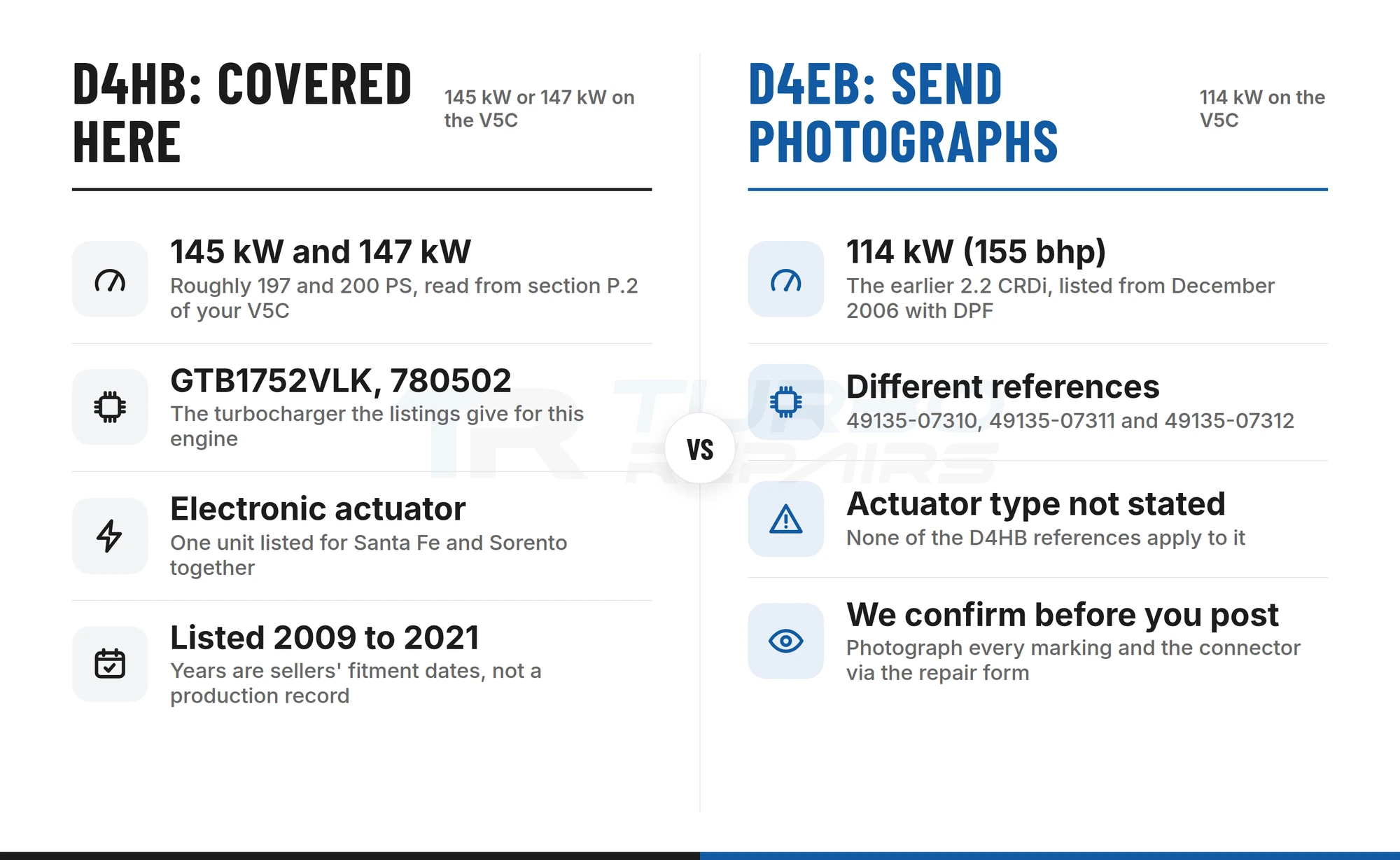
The badge on the tailgate is not enough to place the car. Two different Hyundai 2.2-litre diesels turn up under the same search, the D4EB and the D4HB, and the listings we reviewed sell different parts for each. One even catalogues the 2,188 cc D4EB car as a “2.0 CRDi”, so the badge and the listing title are both unreliable guides. Only the D4HB is listed with the electronic actuator this page is about.
The quickest way to tell them apart is the output. Section P.2 of your V5C gives it in kilowatts: 114 kW belongs to the earlier D4EB car, while 145 kW and 147 kW belong to the D4HB. The table sets out what the listings say. The years are the ones sellers catalogue each car against, not a production record.
| Car as listed | Engine code | Output | Years listed | Turbocharger as listed | What the listings say about the actuator |
|---|---|---|---|---|---|
| Kia Sorento 2.2 CRDi 4WD | D4HB | 145 kW | 2009 to 2015 | GTB1752VLK, 780502 | Electronic, sold for the Santa Fe and Sorento together |
| Hyundai Grand Santa Fe 2.2 CRDi AWD | D4HB | 145 kW and 147 kW | 2013 to 2021 | GTB1752VLK, 780502 | Electronic, same listing |
| Hyundai Santa Fe 2.2 CRDi | D4HB | 147 kW | 2018 to 2021 on one listing; a second lists the third-generation Santa Fe from 2013 | GTB1752VLK, 780502 | Electronic: “electrical regulation” on the second listing |
| Hyundai Santa Fe 2.0 CRDi (listed as such; 2,188 cc), earlier | D4EB, with DPF | 114 kW (155 bhp) | From December 2006 | References 49135-07310, 49135-07311, 49135-07312 | An actuator is sold for it; the type is not stated, and none of the D4HB references below apply |
The D4HB cars: the ones this page covers
One listing sells a single electronic actuator for the Kia Sorento 2.2 CRDi 4WD at 145 kW from 2009 to 2015, the Hyundai Grand Santa Fe 2.2 CRDi AWD at 145 kW and 147 kW from 2013 to 2021, and the Hyundai Santa Fe 2.2 CRDi at 147 kW from 2018 to 2021. It names the D4HB engine on every line and gives the turbocharger as a GTB1752VLK. A second listing sells an electronically operated actuator for the Grand Santa Fe 2.2 CRDi and dates the Santa Fe application from 2013, the third-generation car.
Between them, those listings put one part on two manufacturers’ badges from 2009 to 2021. If your Santa Fe or Sorento sits outside those dates but its V5C shows 145 kW or 147 kW, the actuator may well be the same unit, but no listing we hold says so. The label on your own casing is what settles it.
The earlier Santa Fe 2.2: the D4EB
The other “2.2 CRDi” is the D4EB, listed at 2188 cc and 114 kW, or 155 bhp, from December 2006, with a diesel particulate filter. The actuator sold for it is catalogued against the turbocharger references 49135-07310, 49135-07311 and 49135-07312 and against Hyundai numbers beginning 28231-27, none of which appear on the D4HB listings.
The same listing calls the car a 2.2 CRDi in its title and a 2.0 CRDi in its fitment table, which is exactly why the output and the engine code are worth more than the badge. It also does not say whether that actuator is electronic. If your car is a D4EB and the actuator on its turbocharger has a wiring connector, send us photographs of every marking through the repair form and we will confirm the unit before you post anything. If it is a can with a vacuum pipe, it is not a part we rebuild.
The Sorento 2.5 and other turbo engines
The earlier Kia Sorento 2.5 CRDi is a different engine, and none of the listings we reviewed for this page covers it, so it is out of scope here. Some of what a Santa Fe turbo actuator search returns also concerns a 2.0-litre turbo engine and its wastegate actuator, which swings a valve open to let exhaust bypass the turbine. That is a different part doing a different job on a different engine, and nothing on this page applies to it.
The Actuator on the 2.2 CRDi and Its References
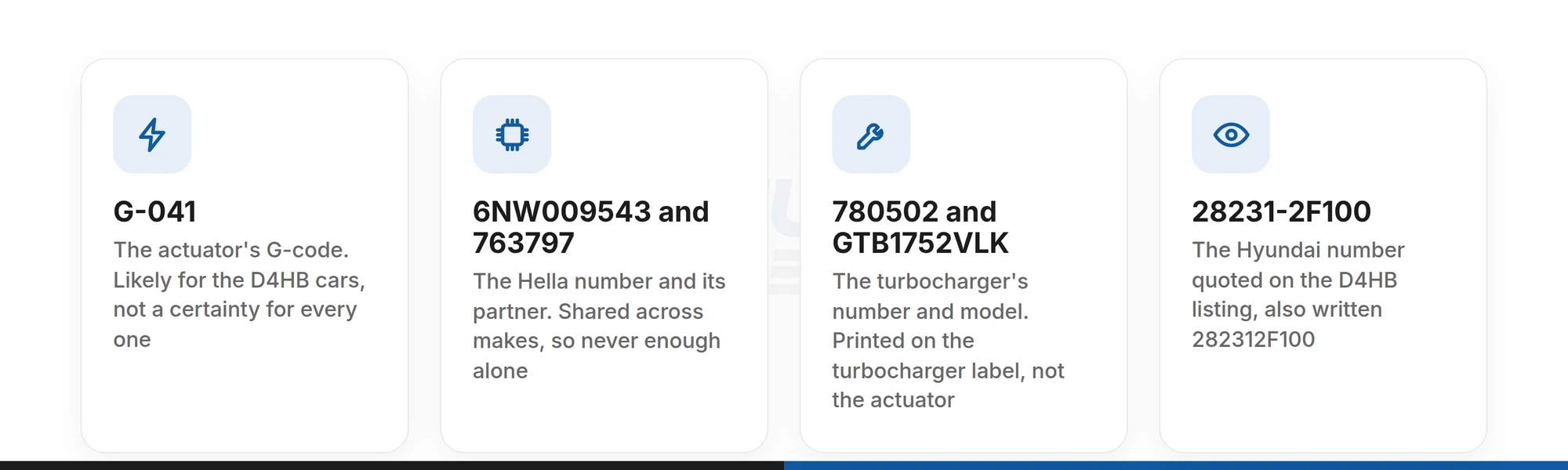
The D4HB actuator is catalogued under several numbers at once, and they do not all name the same object. Some belong to the actuator, some to the turbocharger it is bolted to, and one is Hyundai’s own. Knowing which is which stops a correct-looking number from leading you to the wrong part.
- G-041. The actuator’s G-code. One listing sells a G-041 actuator for the Santa Fe 2.2 and prints it together with 6NW009543, 763797 and 780502. It gives no years or outputs, so treat G-041 as the likely code for the D4HB cars rather than a certainty for every one of them.
- Hella 6NW009543, with 763797. The Hella number and the number printed alongside it on the same G-041 listing.
- 780502 and its suffixes. The turbocharger’s number, listed as 780502-0001, 780502-5001S and a run of shorter forms from 780502-1 to 780502-9. It is printed on the turbocharger’s label, not the actuator’s.
- GTB1752VLK. The turbocharger model the listings give for the D4HB.
- 28231-2F100. The Hyundai number the D4HB listing quotes, also written 282312F100.
- 8080315006S. An OEM reference one listing gives for the Grand Santa Fe actuator.
Why the Hella number alone is not enough
6NW009543 with 763797 is not a Hyundai-only combination. The listings behind our other pages place the same pair on the Volvo 2.4 D5 under G-38 and on the Mercedes Sprinter 2.2 under G-049, and our Hella actuator reference index sets out where else it appears. A Hella base number is shared across makes; the G-code is what marks the version set up for a particular turbocharger.
So if you are buying a replacement, match the G-code and the Hella number together, and check the turbocharger’s 780502 label as well. A unit listed for a Volvo or a Sprinter can carry the right Hella number and still be the wrong part for a Santa Fe.
What to record before anything comes off
- The output from your V5C. 145 kW or 147 kW places the car on the D4HB; 114 kW places it on the earlier D4EB.
- The turbocharger’s label. A 780502 number confirms the D4HB turbocharger the listings describe.
- Every marking on the actuator casing. Photograph the G-code, the Hella number, the number beside it and any date marks exactly as printed.
- The connector. A photograph of the plug on the housing answers the electronic-or-vacuum question on its own.
- The stored fault codes. Read them, with any freeze-frame data, before anyone clears them.
When your own actuator is being rebuilt, none of those numbers has to match a listing. The unit goes back onto the turbocharger it came off, and the photographs simply let us confirm what is coming before you post it.
What a Failing Actuator Does on These SUVs
A Santa Fe or Sorento is a large, heavy car, and when the actuator stops holding the position it is sent to, the lost boost is hard to miss. The engine feels flat from low revs, pulling away with a full load takes noticeably longer, and the engine management often cuts power to protect the engine and lights the warning lamp.
What gets stored is usually a generic boost code rather than anything that names the actuator: P0299 when boost is lower than requested, P0234 when it is higher. Each describes the result, not the part. A split charge hose, a corroded connector or a stiffened mechanism inside the turbocharger can set the same codes, and our fault code guide explains which signal each code reports on.
Patterns that lean towards the actuator
- Limp mode that clears when the engine is restarted, then returns. An intermittent fault points at the control side first: the actuator, its connector and the wiring between them.
- Boost that rises and falls on a steady throttle. The engine note stays the same while the pull comes and goes. That fits a unit hunting for a position it can no longer hold, and it also fits a small leak in the pressurised pipework.
- A fault that appears only on long climbs or once the engine is fully hot. Heat is hard on the motor and board inside the actuator. Note when it happens and read the codes while the car is still showing it.
- A ticking or buzzing from the turbocharger area with the engine running. This can be the actuator’s motor working against a worn gear train.
Signs that point somewhere else
Blue smoke, oil in the intercooler pipes or a whine that rises with engine speed point at the turbocharger itself. An actuator cannot put oil anywhere, and a turbocharger with worn bearings will not be cured by a new one. Our guide to common turbocharger problems covers those faults, the guide to the symptoms of a failing turbo actuator goes further into each actuator pattern, and what the actuator does explains why these parts wear.
Actuator or Turbocharger? The Checks That Settle It
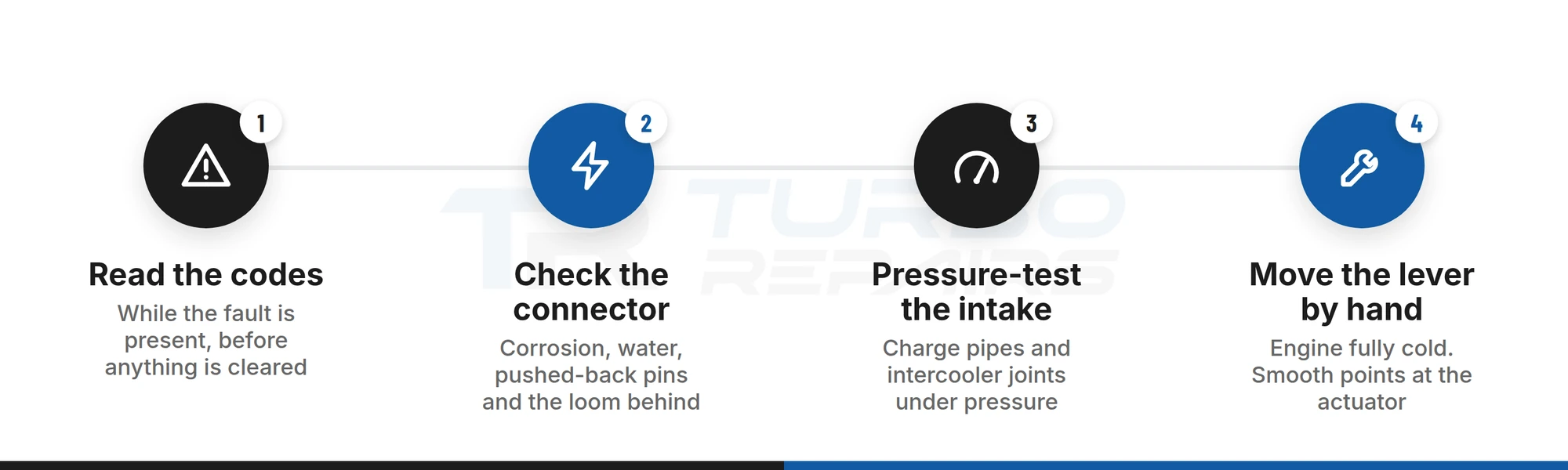
A garage report that says “actuator fault” can describe two different problems. Either the actuator has failed and can no longer move a healthy mechanism, or the mechanism inside the turbocharger has stiffened and the actuator can no longer move it. The first is an actuator repair. The second is a turbocharger repair, and a rebuilt or new actuator fitted to a stiff mechanism meets the same resistance from its first drive.
Work through these four checks in order. None needs special tools.
- Read the codes while the fault is present. Plug in with the car in limp mode, before anything is cleared, and save the freeze-frame data. A fault read on a cold car the following morning can look like nothing at all.
- Check the connector and the wiring. With the ignition off, unplug the actuator and look at both halves for corrosion, water and pushed-back pins, then follow the loom back for chafing. Refit the plug until it clicks home. A poor connection sets the same codes as a burnt-out motor.
- Pressure-test the intake. Have the charge pipes and intercooler joints tested under pressure. A hose that only opens under boost reads as a boost-control fault and is far cheaper to fix than either the actuator or the turbocharger.
- Move the mechanism by hand, with the engine cold. The turbine housing gets hot enough to burn, so let it cool completely. Where the actuator drives the turbocharger through an external link, free the link and move the turbocharger’s control lever gently through its full travel. Smooth, even movement points at the actuator; dragging, catching or stopping short points at the turbocharger.
Do not drive the car with the actuator unplugged to see what changes. The checks above tell you more, without the risk.
If the lever is stiff, the turbocharger needs the work, and our turbocharger repairs are the place to start.
If yours is a Sportage, Tucson or ix35 rather than a Santa Fe or Sorento, see our Sportage and Tucson turbo rebuilds. An actuator that has been straining against a stiff mechanism has worked harder than it was designed to, so mention it on the form and we will test the actuator as well.
Turbo Repairs · Epsom workshop
Lever free and connector clean? The actuator is the part to send
Photograph the G-code and every other marking on the casing, note the kilowatts from your V5C and the codes the car stored, then post the actuator in without the turbocharger. It is run on our bench before it is opened, and the price is confirmed before any work starts.
Lifetime, unlimited-mileage warranty · Mail-in from the UK and internationally · Bench-tested and calibrated before it ships
Our Santa Fe and Sorento Actuator Rebuild
You, or the garage that looks after the car, remove the actuator and send it to our workshop at Unit 102 Reaver House, 12 East Street, Epsom, Surrey, KT17 1HX, United Kingdom. Our team of turbo specialists and electronic engineers rebuilds it there, and the work runs in the same order every time.
- You tell us what is coming. On the online Repair Form, give the badge, the registration, the output from the V5C, the stored codes, photographs of the actuator’s markings and connector, and what you found when you moved the lever by hand.
- We confirm the unit. The markings are checked against the car before you post anything. If the photographs show a D4EB unit whose type we cannot confirm, or a vacuum can rather than an electronic actuator, we tell you at this stage.
- We test it as it arrives. The actuator is run on the bench before it is opened (see how the actuator is tested), so the fault we report is the one we measured rather than the one we expected.
- We rebuild it at component level. The motor, gear train, position sensor and seals are renewed as needed and the circuit board is reworked. Components with a known weakness in the original design are replaced with uprated parts rather than put back as they were, so the unit meets or exceeds original specification.
- We calibrate it and return it. Travel and position feedback are checked across the full sweep on dealer-level diagnostic and calibration tooling. Actuators require no programming, so it goes straight back onto the turbocharger; clear the stored codes once it is fitted.
Repairs start from £100 + VAT, and the exact price is confirmed once the unit has been identified and tested, before any work goes ahead. Turnaround is typically one to two working days from arrival, plus postage each way, and every rebuild carries a lifetime, unlimited-mileage warranty with no time limit.
The process is identical whichever badge the car wears, and independent garages send actuators in for their customers’ Santa Fes and Sorentos in the same way. Packing and postage are covered on our FAQs page, and the other vehicles whose actuators we rebuild are listed under our electronic turbo actuator repairs.
Santa Fe and Sorento Turbo Actuator FAQ
Is the Kia Sorento turbo actuator the same as the Hyundai Santa Fe one?
On the 2.2 CRDi D4HB, the listings say yes: one electronic actuator is sold for the Sorento 2.2 CRDi 4WD at 145 kW from 2009 to 2015 and for the Santa Fe and Grand Santa Fe 2.2 CRDi at 145 kW and 147 kW up to 2021, all on the same GTB1752VLK turbocharger. Confirm it from the markings on your own casing before buying anything.
What is a G-041 actuator?
G-041 is the G-code one listing gives for the Santa Fe 2.2 actuator, printed with the Hella number 6NW009543 and 763797 and sold for the 780502 turbocharger. The same Hella number appears under other G-codes on Volvo and Mercedes diesels, so the G-code is the part to match if you are buying a replacement. If your own unit is being rebuilt, nothing needs matching.
My Santa Fe is a 2.2 CRDi from 2007. Is this the right page?
Probably not. A Santa Fe 2.2 CRDi listed from December 2006 at 114 kW is the D4EB engine, and its actuator is catalogued under different references from the D4HB unit on this page. Check the kilowatts on your V5C. If the actuator on your turbocharger has a wiring connector, send us photographs through the repair form and we will tell you whether we can rebuild it.
Should I buy a new actuator instead of rebuilding mine?
New units are sold for this car, and one can be the right answer if it matches your G-code, Hella number and turbocharger. A rebuild avoids the matching question altogether: the unit that comes back is the one that came off your turbocharger. Either way, check that the turbocharger’s lever moves freely first, because neither a new nor a rebuilt actuator will fix a stiff mechanism.
Will a rebuilt actuator need programming on my Santa Fe or Sorento?
No. Actuators require no programming: your own unit is calibrated on our bench and returned ready to refit. Clear the stored fault codes with a diagnostic tool once it is back on the car.
Do you rebuild vacuum-operated turbo actuators?
No. We rebuild electronic turbo actuators, the motorised units with a wiring connector on the housing. A round can with a rod and a thin rubber pipe is a vacuum actuator, a different component, and not one we rebuild.
How much does a Santa Fe or Sorento actuator repair cost, and how long does it take?
Repairs start from £100 + VAT, with the exact price confirmed once the unit has been identified and tested. Turnaround is typically one to two working days from arrival, plus postage each way, and every rebuild carries a lifetime, unlimited-mileage warranty.
Final Thoughts
On these two SUVs the actuator is the easy part to describe and the badge is the hard part to trust. “2.2 CRDi” covers two Santa Fe engines, and only the D4HB is listed with the electronic G-041 unit, which the Kia and Hyundai versions of that engine share in listings running from 2009 to 2021. The kilowatts on the V5C sort the engine; the G-code and the turbocharger’s 780502 label confirm the part.
After that, the order of work is short. Read the codes while the fault is live, clear the connector and the intake, and move the lever by hand with the engine cold. If the lever is free, the actuator already on your turbocharger is the one unit already set up for it, and it is the one to rebuild.
Turbo Repairs · Epsom workshop
Hyundai or Kia badge, one D4HB actuator: send us yours
Complete the Repair Form with the kilowatts from your V5C, the stored codes and photographs of the casing, and we confirm the unit before it is posted. It comes back tested, rebuilt at component level and calibrated, ready to bolt on with no programming.
Lifetime, unlimited-mileage warranty · Mail-in from the UK and internationally · Bench-tested and calibrated before it ships