

Summary A replacement turbocharger for a Kia Sportage, Hyundai Tucson or ix35 diesel starts from £450 + VAT with us, and rebuilding the one already on the car starts from £185 + VAT. Neither figure includes taking the old unit off, fitting the new one or the parts that go on with it, and those lines are the same whichever unit you choose.
This page covers the 1.6, 1.7 and 2.0 CRDi diesels in all three cars: the turbochargers the trade lists for each, what wears inside them, the checks to make before you pay for any unit, and how we rebuild your own turbo, typically in one to three working days, with a lifetime, unlimited-mileage warranty.
On these Kia and Hyundai diesels 136 hp is listed for the 1.6, the 1.7 and the 2.0 CRDi alike, so the power figure is the one number that cannot tell their turbochargers apart.
Most people who search for a Sportage turbo price are holding a quote, or expecting one. This page explains what that quote is made of, which of its lines change when you choose a rebuild over a replacement, and which turbocharger your car is likely to carry.
- Cars covered: the Kia Sportage, Hyundai Tucson and Hyundai ix35 with the 1.6, 1.7 or 2.0 CRDi diesel
- Engine codes in the listings: D4FE and D4FB (1.6), D4FD (1.7), and two different 2.0 engines, D4HA and D4EA
- Turbochargers: nine references listed across the three engine sizes, four of them on the 2.0 D4HA alone; the label on your unit identifies it
- Not on this page: the 1.6 turbo petrol, and the 2.2 CRDi in the Santa Fe and Sorento
- Price: rebuilds from £185 + VAT; replacement turbochargers from £450 + VAT; the unit only, confirmed once it has been inspected
- Turnaround: typically one to three working days on the bench, plus postage each way
- Warranty: lifetime and unlimited mileage, with no time limit
- How it works: the turbo comes off, is packed and posted to us, and comes back rebuilt; start with the online Repair Form
Which Sportage, Tucson and ix35 Engines This Covers
Kia and Hyundai fitted these SUVs with three turbocharged diesels sold under the CRDi name: a 1.6, a 1.7 and a 2.0. The Sportage and the Tucson share these engines, and the trade listings we reviewed name the Kia and the Hyundai together on every diesel turbocharger in the table further down.
The ix35 is the name Hyundai used for the model between two generations of Tucson. The parts listings file the ix35 and the Tucson side by side, so an ix35 owner is reading the right page.
The engine size is the starting point, with one catch
The badge or the logbook will tell you whether the car is a 1.6, a 1.7 or a 2.0. For the 1.6 and the 1.7 that narrows the search to one engine. For the 2.0 it does not, because two different 2.0 CRDi engines appear in the listings.
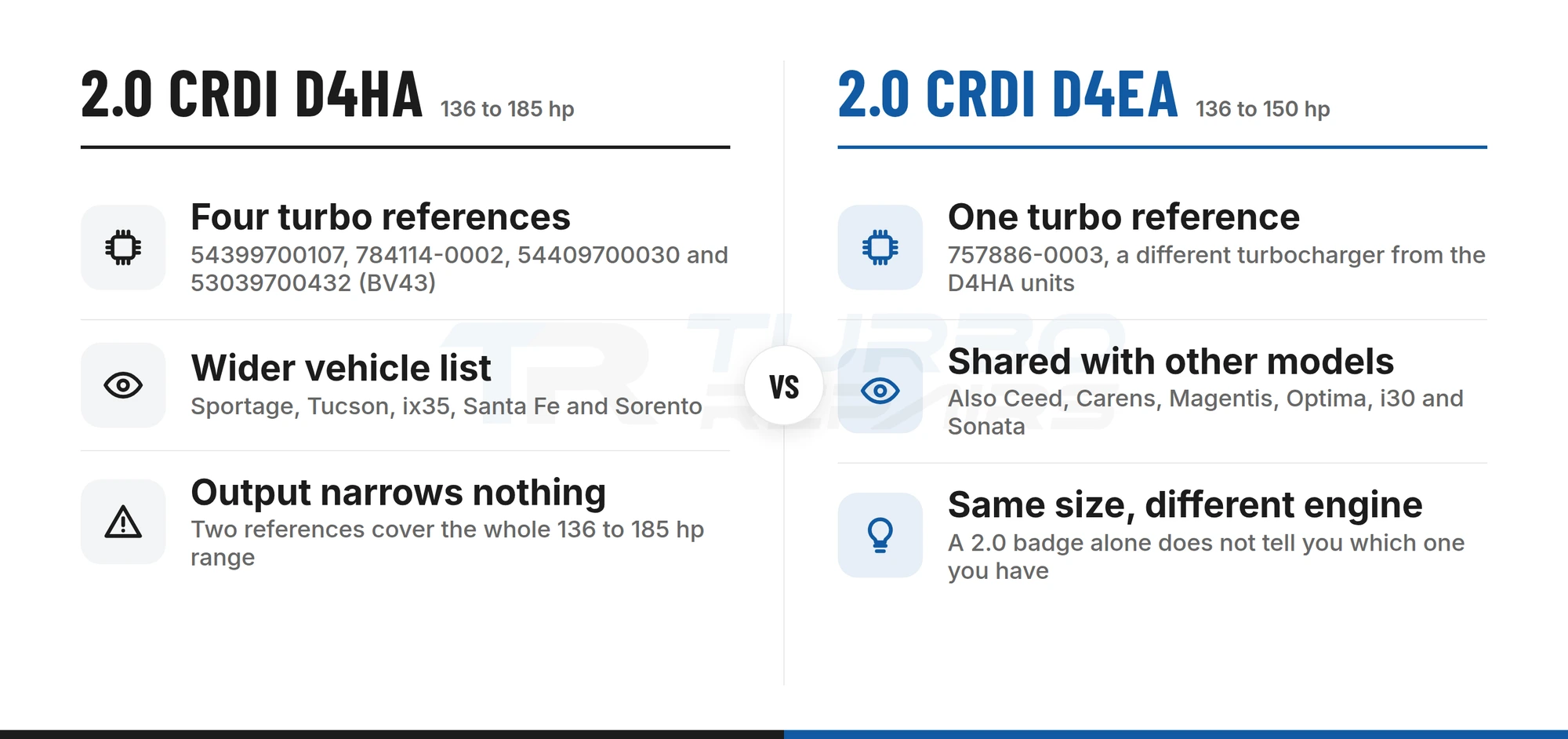
The D4HA is listed across the Sportage, Tucson, ix35, Santa Fe and Sorento at outputs from 136 to 185 hp. The D4EA is listed with the Sportage and Tucson as well, but alongside a longer run of other Kia and Hyundai models, among them the Ceed, Carens, Magentis, Optima, i30 and Sonata, at 136 to 150 hp. They take different turbochargers.
What this page does not cover
- The 1.6 turbo petrol. The Sportage and Tucson were also sold with a 1.6 petrol turbo engine, listed under the code G4FJ at 177 hp, including GT-Line versions. Its turbocharger, listed as 16399700010, is a different unit from any of the diesel turbos here.
- The Santa Fe and Sorento 2.2 CRDi. The Santa Fe and Sorento appear on some of the 2.0 D4HA listings below, and on that engine their turbochargers are covered here. Their larger 2.2 CRDi is a different engine, and the electronic actuator it carries has its own page: Santa Fe and Sorento 2.2 CRDi actuator.
The Turbochargers on the 1.6, 1.7 and 2.0 CRDi
The table sets out the turbocharger references we found listed for these engines, with the outputs, engine codes and vehicles each listing names. The outputs are given in hp exactly as the listings print them. Where a listing names no engine code, the table says so rather than guessing one.
| Engine | Engine code as listed | Turbocharger reference | Output as listed | Vehicles the listing names |
|---|---|---|---|---|
| 1.6 CRDi | D4FE, D4FB | 843814-0008 | 116 to 136 hp | Sportage, Ceed, Optima, Tucson, i30, i40, Kona; from 2017 |
| 1.6 CRDi | Not stated | 16359700028 | 136 hp | Sportage, Tucson, Ceed, Optima, i30, i40; from 2018 |
| 1.7 CRDi | D4FD | 794097-0003 | 115 to 136 hp | ix35, Tucson, Sportage, i40, Optima |
| 1.7 CRDi | Not stated | 824168-0001 | 115 to 136 hp | Sportage, Tucson, i30, i40, Optima, Carens |
| 2.0 CRDi | D4HA | 54399700107 | 136 hp | Tucson, ix35, Sportage, Santa Fe, Sorento |
| 2.0 CRDi | D4HA | 784114-0002 | 171 to 184 hp | ix35, Tucson, Sportage |
| 2.0 CRDi | D4HA | 54409700030 | 136 to 185 hp | Tucson, Sportage; from 2015 |
| 2.0 CRDi | D4HA | 53039700432 (BV43) | 136 to 185 hp | Sportage (fourth generation), Tucson, Santa Fe (third generation), Sorento (third generation) |
| 2.0 CRDi | D4EA | 757886-0003 | 136 to 150 hp | Sportage, Tucson, Santa Fe, Ceed, Carens, i30, Sonata, Magentis, Optima |
Why the label decides, not the output
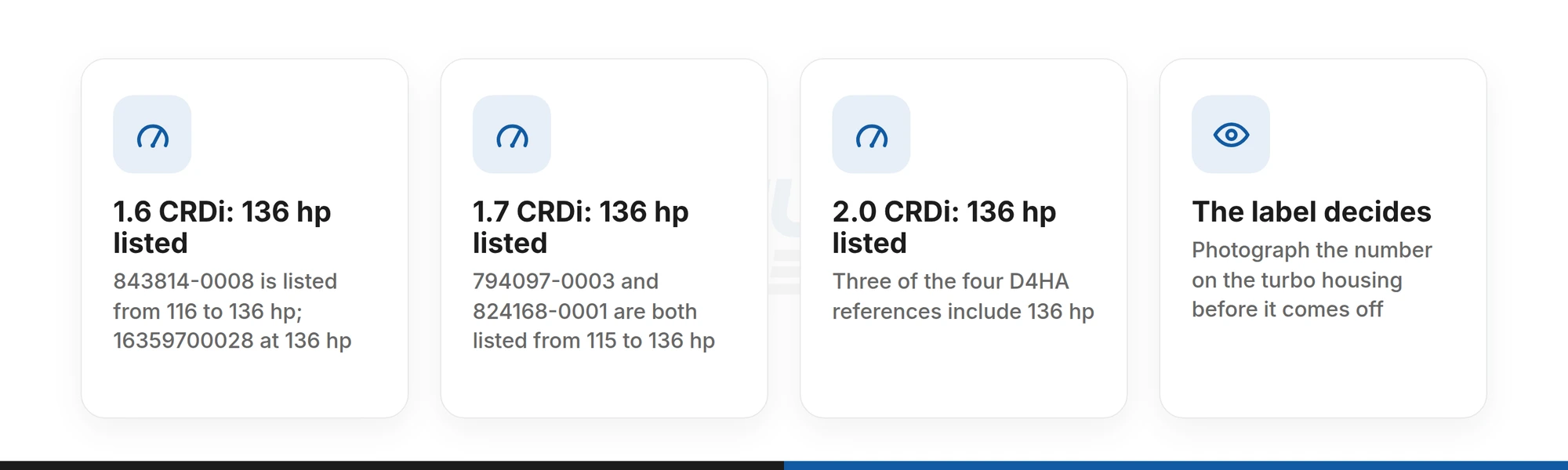
Read down the output column and one figure keeps appearing. Every engine size has a version listed at 136 hp, and on the 2.0 D4HA three of the four references include it. Two of those D4HA references cover the whole range from 136 to 185 hp, so on that engine the output narrows nothing at all.
The 1.7 is no easier: its two references are listed across exactly the same output range. What separates them is the number on the turbocharger itself, printed on a label or plate on the housing. Photograph it before the unit comes off, because heat and oil can make it hard to read later.
If you are having your own turbocharger rebuilt, none of this matching has to be done by you. The unit that comes back is the one that came off your engine. The references matter when you are buying a replacement, because a unit listed for the right car and the wrong output band is still the wrong unit.
What Fails on These Turbos
The listings describe these turbochargers by fitment, not by fault, and no source we reviewed records a failure peculiar to the Kia and Hyundai units. What follows is what wears in any oil-fed diesel turbocharger of this size, and what each finding means for the car it came off. That second part is the one that affects your bill.
Bearings, and the oil that feeds them
The turbocharger’s shaft spins on a film of engine oil delivered through a feed pipe from the engine. When that supply is restricted, whether by a part-blocked feed pipe, a low oil level or oil that has broken down between changes, the bearings wear and the shaft starts to move further than it should. Left long enough, the compressor wheel touches its housing.
Switching off straight after a hard run is the other common drain on bearing life, because the oil stops flowing while the housing is still at its hottest. Our guide to how long turbos last covers those habits. The point for this page is that the cause sits on the car, not in the turbocharger, and it is still there when the rebuilt or replacement unit goes on.
Seals, and the oil that gets past them
Oil in the charge pipes or blue smoke from the exhaust is often put down to failed turbo seals. Sometimes it is. But oil is also pushed past sound seals when the drain back to the sump through the return pipe is restricted, or when crankcase pressure is high. A garage should rule out the return pipe and the crankcase ventilation before a turbocharger is condemned for leaking.
Damage to the wheels
The compressor wheel spins at very high speed and is damaged by anything the intake lets through: debris past a split air filter housing, or a fragment of a failed pipe or clip. Chipped or bent fins are visible with the intake pipe off. The cause has to be found before refitting, or the next wheel meets the same debris.
Boost control
One of the 2.0 D4HA references is sold as a BorgWarner BV43, a variable-geometry design whose vanes are moved to control boost. Carbon from short, cool journeys can stiffen that mechanism; our guide to the VNT turbo explains how it happens and why a fault that clears on a long run has not gone away. The listings do not state the boost-control type for the other references, so the inspection on our bench confirms it for your unit.
Symptoms and the Checks That Come First
A failing turbo on these cars shows itself in the familiar ways: a loss of power, often with the engine management dropping the car into a reduced-power mode, a whistle or whine that rises as boost builds, blue or grey smoke, rising oil consumption and a warning light. A code such as P0299, boost lower than requested, is common. Our guide to turbo failure symptoms sorts each one by where in the unit it starts.
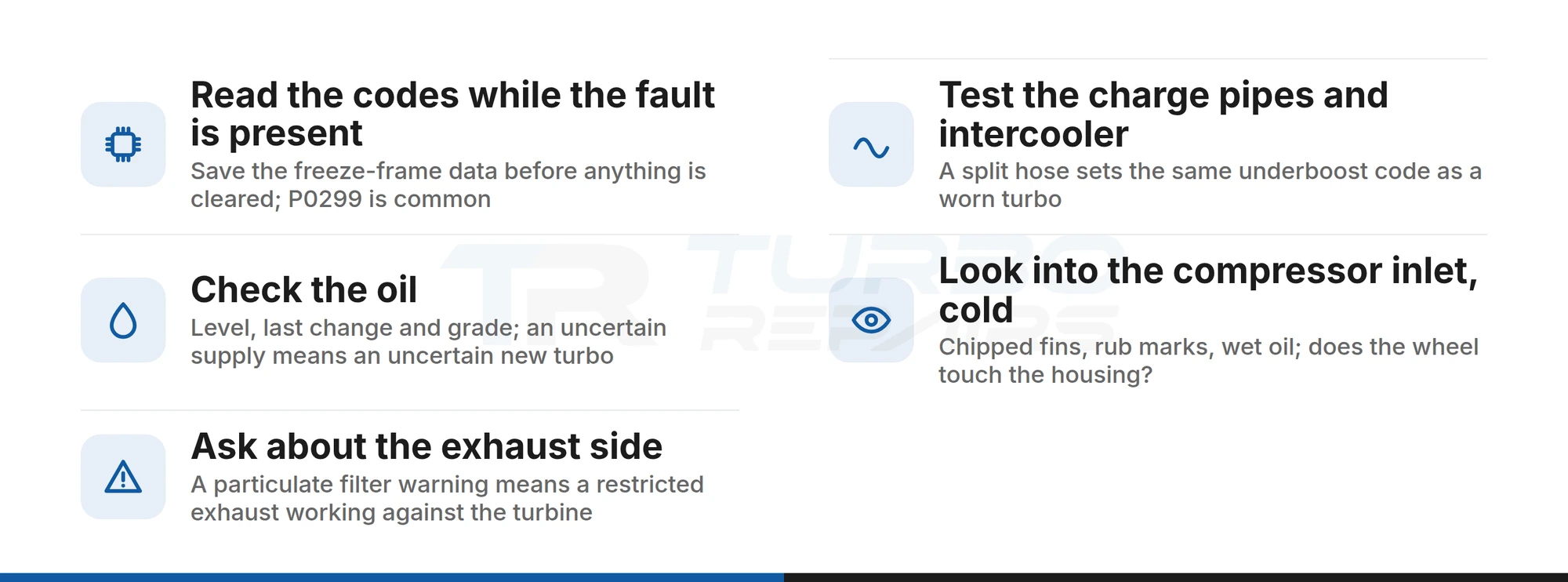
Several cheaper faults produce exactly the same symptoms, and each one sits on the line of a quote that does not change between a rebuild and a replacement. So these checks come before anyone prices a turbocharger:
- Read the codes while the fault is present. Plug in with the car still showing the problem, and save the freeze-frame data before anything is cleared.
- Test the charge pipes and intercooler. A split hose or a loose joint loses boost only under pressure and sets the same underboost code as a worn turbo. A pressure test finds it.
- Check the oil. Note the level, when it was last changed and whether it is the grade the handbook calls for. If the answer to any of those is uncertain, the new turbo’s supply is uncertain too.
- Look into the compressor inlet, engine off and cold. With the intake pipe removed, check for chipped fins, rub marks on the housing and wet oil. Some shaft movement can be normal, so judge it by whether the wheel touches the housing when gently pushed, not by whether it moves at all.
- Ask about the exhaust side. If the car has also been showing a particulate filter warning, read whether a blocked DPF can cause turbo failure before the turbo is ordered, because a restricted exhaust works against the turbine.
What a Kia Sportage Turbo Replacement Costs
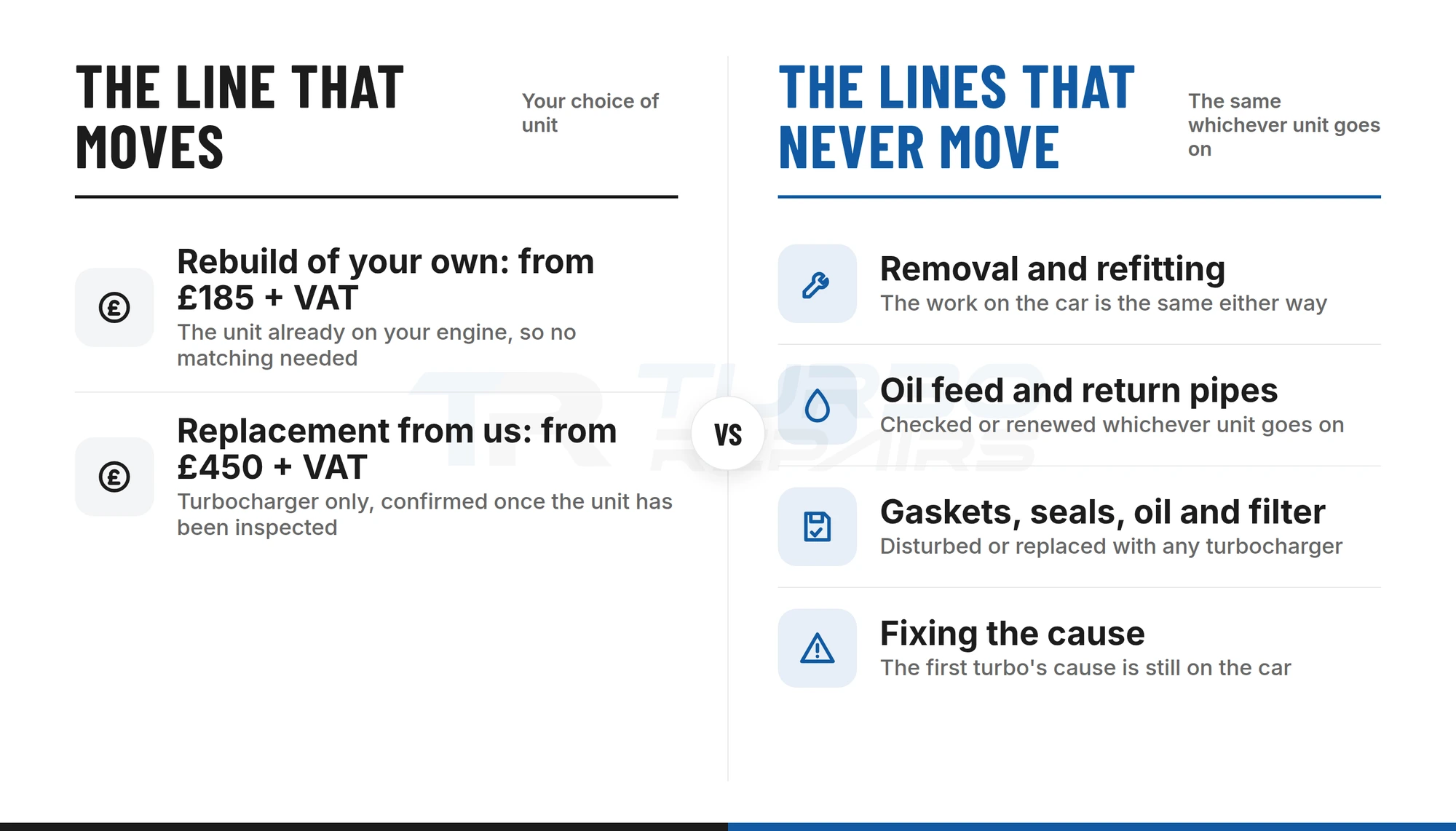
From us, a replacement turbocharger starts from £450 + VAT and a rebuild of your own starts from £185 + VAT. Your exact price is confirmed once the unit has been identified and inspected, before any work goes ahead. Both figures are for the turbocharger only.
That last point is why published prices for this job vary so widely. Some figures are for a unit in a box; others are for a fitted job with the oil, gaskets and labour already added. They are not measuring the same thing, and comparing one against the other tells you very little.
A quote is a list, not a figure
A fitted turbo replacement is made of several lines. Only one of them changes when you choose between a new unit, an exchange unit and your own rebuilt.
| Line on the quote | Changes with the route you choose? |
|---|---|
| The turbocharger | Yes. A rebuild of yours from £185 + VAT; a replacement from us from £450 + VAT |
| Removal and refitting | No. The work on the car is the same whichever unit goes on |
| Oil feed and return pipes | No. They are checked or renewed whichever unit goes on |
| Gaskets and seals | No. The joints at the exhaust manifold, the air intake and the intercooler pipe are disturbed either way |
| Engine oil and filter | No. A fresh supply goes in with any turbocharger |
| Fixing the cause | No. Whatever wore out the first turbo is still on the car |
The lines that never move are the ones that decide how long it lasts
When a quote is too high, the temptation is to trim the small lines to pay for the big one: keep the old feed pipe, skip the oil change, leave the return pipe alone. Those are the lines that feed the new turbocharger. A new unit bolted to a part-blocked feed pipe runs on the same restricted supply that wore out the old one, and it wears the same way.
So if the budget is tight, the saving belongs on the one line that does move. Rebuilding the unit you already have costs less than buying another, and it leaves the rest of the quote intact.
Rebuild or replacement: which suits your car
A rebuild is usually the better answer when the car can wait a few working days and the unit is repairable. It also removes the matching problem: with nine references across these engines and several of them sharing output bands, the turbocharger already bolted to your engine is the one unit certain to fit it.
A replacement makes sense when the inspection shows damage that makes a rebuild the wrong answer. If our bench finds that, we tell you before any work starts. Our guide to turbo repair and replacement prices sets out the wider price picture across makes.
Turbo Repairs · Epsom workshop
Move the one line that can move: rebuild your own turbo
Tell us the car, the engine size and what the label on the turbo says, then post the unit in. It is inspected before any work is agreed, and the price is confirmed before we start.
Lifetime, unlimited-mileage warranty · Mail-in from the UK and internationally · Bench-tested and calibrated before it ships
Our Kia and Hyundai CRDi Turbo Rebuild
You, or the garage that looks after the car, remove the turbocharger and send it to our workshop at Unit 102 Reaver House, 12 East Street, Epsom, Surrey, KT17 1HX, United Kingdom. Our team of turbo specialists rebuilds it there, in the same order every time.
- You tell us what is coming. On the online Repair Form, give the model, the registration, the engine size, any fault codes, and a photograph of the label on the turbocharger.
- We identify and inspect it. The unit is checked against your car when it arrives and examined before it is taken apart, so the report you get describes what we found rather than what we expected.
- We strip it to component level. Bearings, seals, shaft and wheels are measured against specification. Worn parts are renewed with genuine OE or OEM-grade components, or uprated ones where the original design has a known weakness, so the rebuilt unit meets or exceeds the original.
- We balance and test it. The rotating assembly is balanced, the boost-control mechanism is set up, and the unit is run on the bench before it is packed.
- We send it back ready to refit. Renew or clean the oil feed and return pipes, change the oil and filter, and prime the turbocharger before the first start. Our guide to refitting and priming a turbocharger sets out that sequence.
Bench time is typically one to three working days from arrival, plus postage each way. Every rebuild carries a lifetime, unlimited-mileage warranty with no time limit, and independent garages send turbos from their customers’ Sportages and Tucsons in exactly the same way. Packing and postage are covered on our FAQs page.
Kia Sportage and Hyundai Tucson Turbo FAQ
How much does a Kia Sportage turbo replacement cost?
From us, a replacement turbocharger starts from £450 + VAT and a rebuild of your own unit starts from £185 + VAT. Neither figure includes removal and refitting, or the oil pipes, gaskets, oil and filter fitted with the turbo. Your exact price is confirmed once the unit has been inspected.
Is the Hyundai Tucson turbo the same as the Kia Sportage turbo?
For the same engine, usually yes. Every diesel turbocharger reference we found for these cars is listed for the Sportage and the Tucson together. But each engine size carries more than one reference, so match the number on your own unit’s label rather than the model name.
Is an ix35 turbo the same as a Tucson turbo?
The ix35 is the name Hyundai gave the model between two Tucson generations, and the listings file the two together. The 1.7 reference 794097-0003 and the 2.0 references 54399700107 and 784114-0002 are listed for both. Check the label on your unit to confirm which one you have.
Does the Kia Ceed CRDi use the same turbo?
Some do. The Ceed is named on the 1.6 CRDi references 843814-0008 and 16359700028, and on the D4EA 2.0 reference 757886-0003. It does not appear on the 1.7 listings we reviewed. The rebuild process is the same; start with the Repair Form and the label reference.
My garage says the fault is the actuator, not the turbo. What now?
Look at the unit mounted on the side of the turbocharger. If it has a wiring connector, it is an electronic actuator, a separate part that can be rebuilt on its own; send us photographs of its markings through the Repair Form. If it is a round can with a small rubber pipe, it is a vacuum-operated part, which we do not rebuild.
Do you cover the 1.6 turbo petrol Sportage and Tucson?
Not on this page. The 1.6 petrol, listed as G4FJ at 177 hp, uses a different turbocharger from the diesels here. Put the reference from its label on the Repair Form and we will confirm what we can do before you post anything.
How long does a rebuild take, and what is the warranty?
Bench time is typically one to three working days from arrival, plus postage each way. Every rebuild carries a lifetime, unlimited-mileage warranty with no time limit.
Final Thoughts
The price of a Sportage or Tucson turbo job is not one number. It is the turbocharger plus the labour, the pipes, the gaskets, the oil and whatever caused the failure, and only the first of those depends on whether the unit is new, exchanged or your own. The rest is the same bill either way, and it is the part of the bill that decides whether the next turbo lasts.
So start with the checks that cost least, keep the lines that feed the turbocharger, and make the saving on the unit itself. With nine references spread across three engine sizes, the turbo already on your engine is also the one that needs no matching.
Turbo Repairs · Epsom workshop
Sportage, Tucson or ix35: send us the turbo you already have
Complete the Repair Form with the engine size, the fault codes and a photograph of the label, and we confirm the unit before you post it. It comes back stripped, rebuilt on OE-grade or uprated parts, balanced and bench-tested, ready for fresh oil and a primed first start.
Lifetime, unlimited-mileage warranty · Mail-in from the UK and internationally · Bench-tested and calibrated before it ships