

Summary Turbo actuator testing establishes whether an electronic turbo actuator still does its one job: moving to the position the engine management commands, and reporting accurately where it went. We put that question to your unit as it arrives, before anything is opened, and put it again to the rebuilt unit before it is packed. The first answer decides what the repair is; the second signs it off.
This page sets out what the arrival test establishes, the three results it can return, where calibration fits, what the sign-off test proves and what comes back to you. Electronic turbo actuator repairs start from £100 + VAT.
Our bench only ever sees the actuator you send, which is why a stiff vane mechanism on the turbocharger left on your engine is the one fault we read from the wear inside the unit rather than measure directly.
- What the test asks: does the actuator move where it is commanded, across its full sweep, and report its own position correctly while it does?
- When it runs: twice. Once on the unit as received, before it is opened; once on the rebuilt, calibrated unit, before it is packed.
- What the first test can return: the actuator has failed on its own account; the actuator is healthy and the fault is on the car; or the actuator failed because the vanes it drives had stiffened.
- What the bench cannot see: the turbocharger, the wiring and the control unit all stay on the car, so your notes and your by-hand check of the vane lever are read alongside the result.
- Calibration: travel and feedback range are set to the specification the unit’s own reference demands, after the rebuild and before the sign-off test.
- What you are told: what genuinely failed, and the exact price, before any work goes ahead.
- What comes back: your own actuator, ready to refit with no programming, typically one to two working days from arrival, under a lifetime, unlimited-mileage warranty.
Most of what is written about actuator testing is either a routine for the driveway or a line promising that the unit “will be tested”. Neither tells you what a test on a bench can settle and what it cannot, and that is the thing worth knowing before a part goes in the post.
Why an Actuator Is Tested Before Anyone Opens It
The fault code that arrives with an actuator is an accusation, not a verdict. A boost-control code records that one of three signals disagreed — the command sent to the actuator, the position it reported back, or the boost that finally arrived — and a seized vane mechanism, a wiring fault, a split charge pipe or the actuator itself can each cause that disagreement. Our guide to what the fault codes mean sorts the common codes by which signal they report on.
So the code is the reason the unit is on the bench, not the finding. Running the actuator as it came off the car turns the accusation into a measurement: what the unit does, before anyone has touched it, is the evidence.
The order matters for a plain reason. Once an actuator has been stripped, whatever it was doing when it came off the car has gone with the parts that were removed, and any test after that point is a test of the reassembly rather than of the fault.
Testing first is also what makes “there is nothing wrong with this actuator” a possible answer. On a boost fault that answer is sometimes the right one, and a unit that has already been opened can no longer give it.
What the As-Received Test Establishes
Before the unit is run, it is identified from the references on its own casing and cross-checked against the engine it came off. On a Hella unit that means the G-reference and the 6NW number, and our Hella reference lookup shows which vehicles each number covers. Identification comes first because every later judgement is made against the specification that reference demands.
The arrival test then establishes four things about the unit in the condition you sent it:
- Whether it responds at all. A unit that does not move when commanded has a fault in its motor, its drive or its electronics, and the test separates a dead unit from one that is merely struggling.
- Whether it covers its full sweep. Worn motor brushes usually show first as a sluggish or incomplete sweep rather than a dead unit, and a stripped gear shows as a motor that runs while the output does not follow.
- Whether what it reports matches where it is. The position sensor is what makes the actuator closed-loop. A sensor that has drifted reports positions the output is not at, which the engine management reads as a command that was never confirmed.
- Whether the fault you described is the one it shows. A unit that failed on the car can behave differently on the bench, which is why the result is always read against what you recorded, not in isolation.
That last point is where the test meets its limit. The actuator arrives on its own: the turbocharger stays on your engine, and the loom, the connector and the control unit stay in the car. Three things you can record fill most of that gap, and we read them against what the bench test finds:
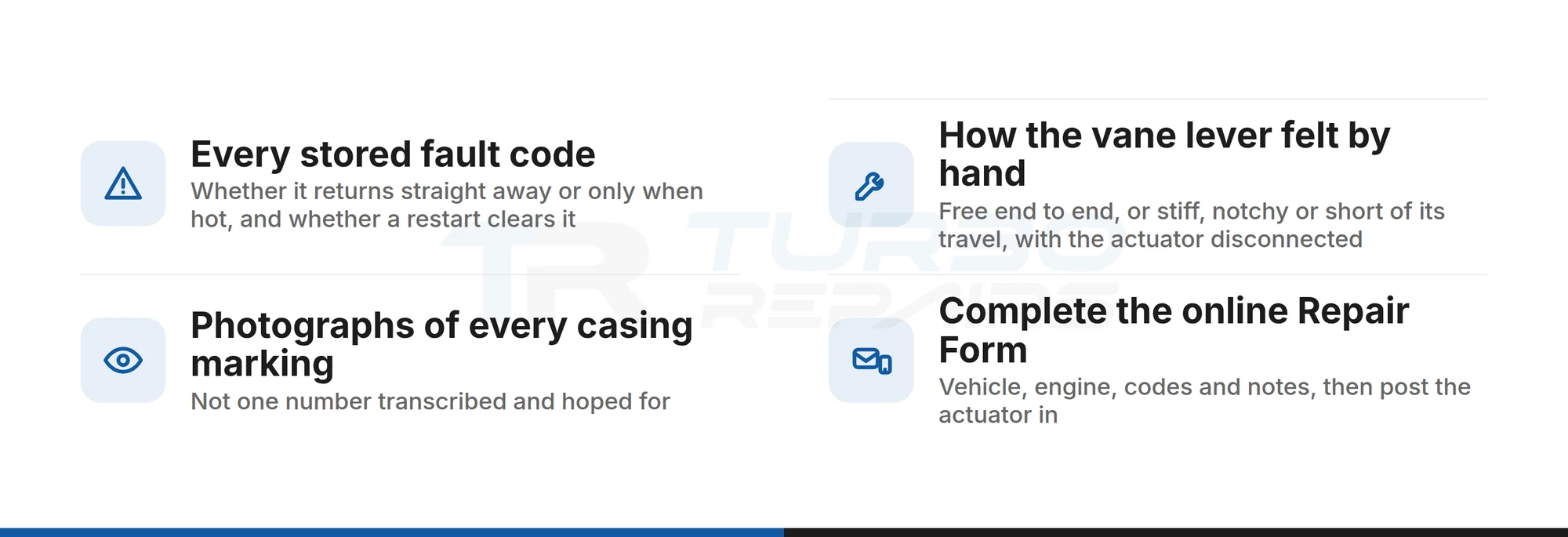
- Every stored code, whether it returns straight away or only once the engine is hot, and whether a restart clears it for a while.
- What the vane lever felt like when you moved it by hand with the actuator disconnected — free end to end, or stiff, notchy or short of its travel. The checks you can do on the car first set out how to do that safely.
- Photographs of every marking on the casing, rather than one number transcribed and hoped for.
The Three Results a Test Can Return
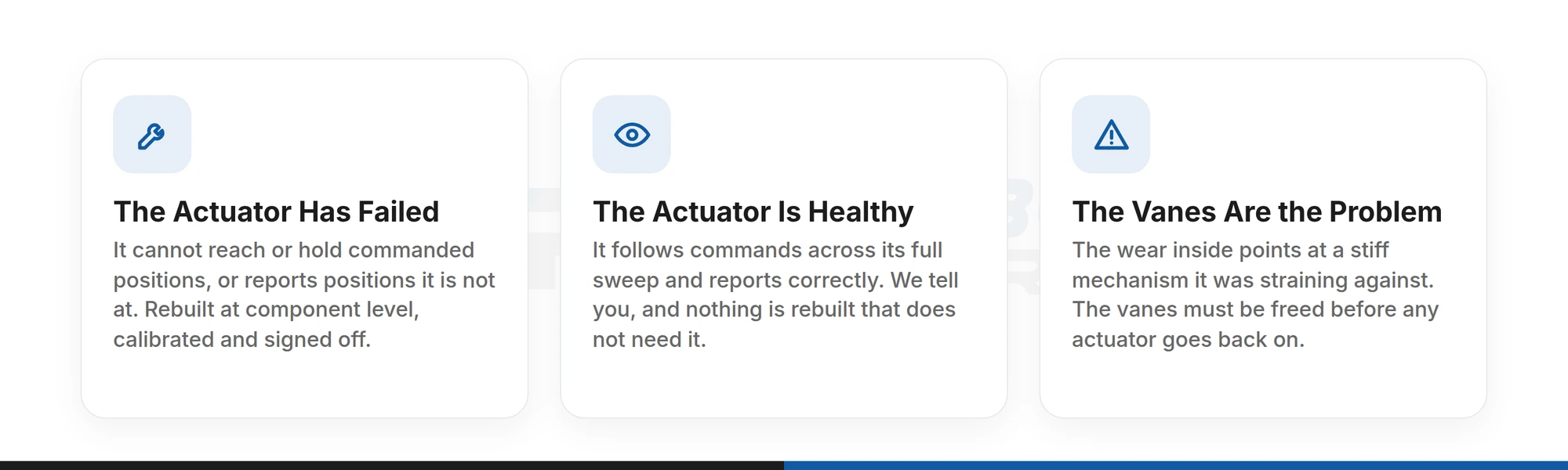
Everything the arrival test finds, read with the teardown that follows it and the notes that came with the unit, resolves into one of three results. Each sends the job somewhere different.
| Result | What the evidence shows | What happens next |
|---|---|---|
| The actuator has failed on its own account | It cannot reach or hold commanded positions, or it reports positions it is not at; once stripped, the wear sits in the motor, gear train, position sensor, seals or board, and your by-hand check found the lever free. | You are told what failed and the exact price before work goes ahead. It is then rebuilt at component level, calibrated and put through the sign-off test. |
| The actuator is healthy | It follows its commands across the full sweep and reports its position correctly. | We tell you, and nothing is rebuilt that does not need it. The search moves back to the car: the loom, the connector, an earth, the driver stage, the charge pipework or the vane mechanism. |
| The vanes are the problem | The actuator has failed, but the wear inside it — stripped gear teeth, a motor that has been worked hard — points at a mechanism it was straining against, or your by-hand check found the lever binding. | You are told before any work goes ahead. The vane mechanism has to be freed before any actuator, rebuilt or new, goes back onto it. |
The actuator has failed on its own account
This is the result most units arrive expecting, and when the evidence supports it the rebuild goes ahead. Worn parts are renewed rather than cleaned and refitted, the board is reworked, and components with a known weakness in the original design are uprated rather than reinstalled, so the unit meets or exceeds original specification. The BMW 3 Series actuator rebuild page follows that sequence on one application in detail.
The actuator is healthy
A healthy result is not a wasted test. It removes one suspect from a short list and sends the search back to the parts that never left the car — and it is the result that stops a good actuator being condemned and a second one bought for the same fault. Air escaping from a split intercooler hose or a slipped clamp, for example, stores the same boost codes as a failing actuator and costs nothing to post.
The vanes are the problem
On a variable-nozzle (VNT) turbocharger, soot and carbon stiffen the vane ring over time, and the actuator applies more force on every movement until its gears strip or its motor gives out. When the wear inside the unit tells that story, rebuilding the actuator is only half the job: bolted back onto the same stiff mechanism, it would strain against it again. How vane rings stick, and why a ring that frees itself has not been repaired, is covered in our guide to the VNT turbo; freeing the mechanism usually means the turbocharger comes off for a turbocharger rebuild in its own right.
Turbo Repairs · Epsom workshop
Let the bench settle what the fault code cannot
Send the actuator in with its codes, your notes and a photograph of every marking on the casing. It is tested as received, before anything is opened, and you hear which of the three results it returned before any work goes ahead.
Lifetime, unlimited-mileage warranty · Mail-in from the UK and internationally · Bench-tested and calibrated before it ships
Calibration: Matching the Actuator to Your Own Turbocharger
Calibration is what gives an actuator’s feedback its meaning: the position sensor reports a raw electrical signal, and calibration sets the travel and feedback range to the specification the unit’s own reference demands, so the engine management reads the values it expects from the turbocharger that unit belongs to — the reasoning is set out in full under why calibration belongs to your turbocharger, and whether a replacement actuator needs calibrating is answered on our Jaguar X-Type page. On a rebuild, calibration comes after the worn parts are renewed and before the sign-off test, and that order is the point here: the test that closes the job is run on the unit as it has been set up, not merely as it was reassembled. Because the actuator that goes back on your turbocharger is the one that came off it, nothing is left to set up on the car.
The Sign-Off Test Before It Ships
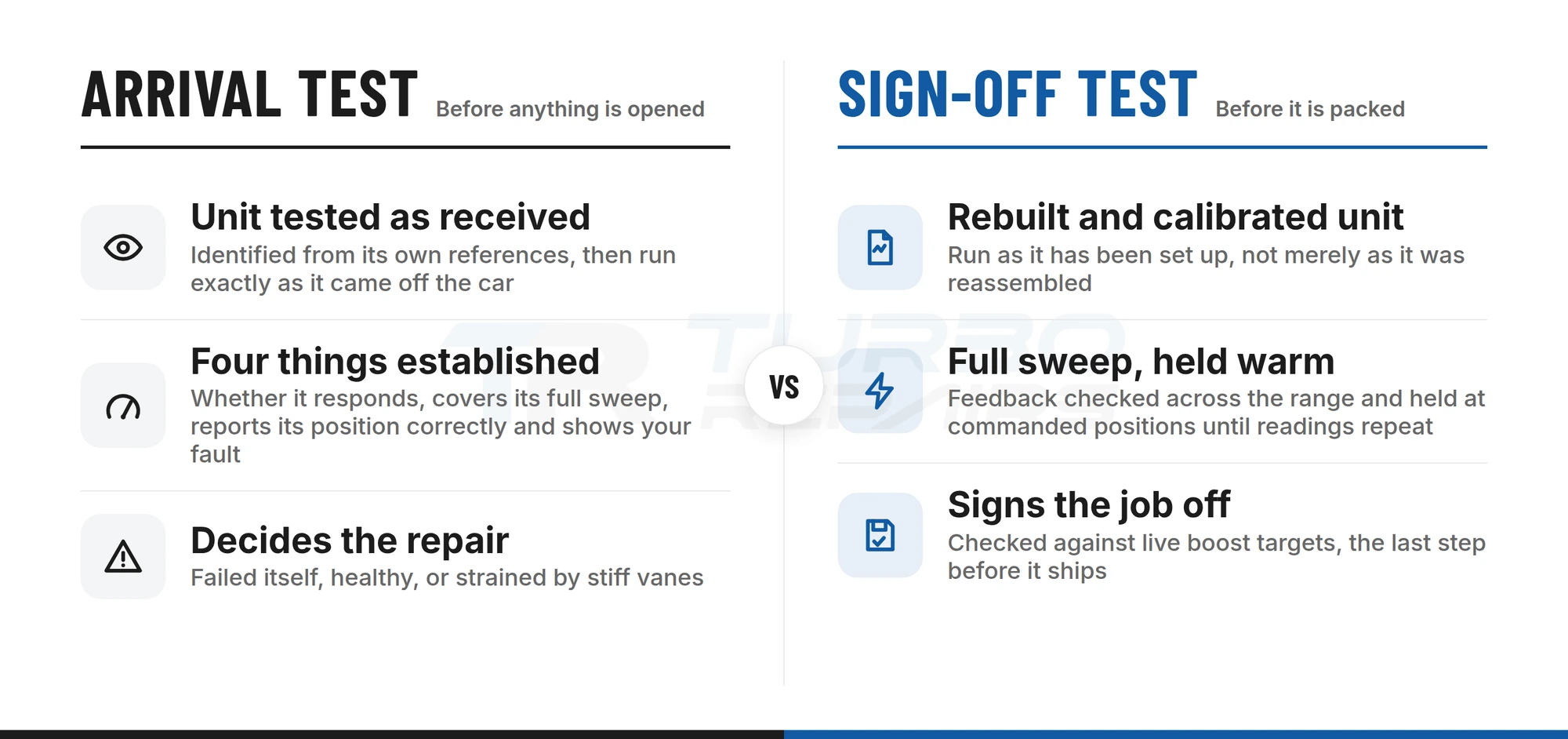
The rebuilt, calibrated unit is asked the same question it was asked on arrival. It is driven through its full sweep and checked for correct feedback across the range, and it is held at commanded positions with the unit warm until the readings repeat. Warmth matters because a unit bolted to a turbocharger spends its working life hot, and some faults only exist at temperature.
It is then checked against live boost targets before sign-off. Our Ford Transit actuator repair page describes the same step as the unit being bench-proven under live boost targets, with the position sensor recalibrated to the vane end-stops beforehand. The work is carried out on dealer-level diagnostic and calibration tooling and bespoke in-house test platforms before a unit leaves the workshop.
The two tests are read together. The arrival result records what the unit could not do; the sign-off result records that it now does it, across the range and at temperature. Sign-off is the last thing that happens before the unit is packed.
What You Get Back With Your Actuator
- Your own actuator. Not an exchange unit from a shelf, but the unit that came off your turbocharger, rebuilt at component level.
- The finding, before the work. What genuinely failed, and the exact price, are confirmed once the unit has been identified and tested — before any work goes ahead. Repairs start from £100 + VAT.
- A unit ready to refit. Actuators require no programming. Clear the codes stored while the fault was present with a diagnostic tool once it is back on the car.
- A short turnaround. Typically one to two working days from the unit arriving, plus postage each way.
- A lifetime, unlimited-mileage warranty. No mileage cap and no time limit; the conditions are set out in our terms of service.
To start, complete the online Repair Form with the vehicle, the engine, the stored codes and your notes on the vane lever, then post the actuator to Unit 102 Reaver House, 12 East Street, Epsom, Surrey, KT17 1HX, United Kingdom. Units are accepted from anywhere in the UK and internationally, and packing advice is on our FAQs page. Independent garages and workshops send units in for their customers’ cars the same way, and every vehicle we cover is listed under our electronic turbo actuator repairs.
Turbo Actuator Testing FAQ
What is turbo actuator testing?
It is a check of whether an electronic turbo actuator moves to the position it is commanded to, across its full sweep, and reports that position correctly. We test each unit as it arrives, before it is opened, to establish the fault, and test it again after the rebuild and calibration to sign it off.
Can a turbo actuator be tested with electronic diagnostics on the car?
Partly. Live data on a suitable diagnostic tool shows commanded position beside actual position, and a wide, persistent gap points at the actuator or the mechanism it drives. It cannot separate those two, which is what taking the unit off and testing it on its own does.
What happens if my actuator tests healthy?
We tell you, and the unit is not rebuilt for the sake of it. The fault then lies with something that stayed on the car — the wiring, the connector, the charge pipework or the vane mechanism — and knowing that stops a good actuator being replaced.
Do you need the whole turbocharger to test or calibrate the actuator?
No. The actuator comes to us on its own and the turbocharger stays on the engine. If the test and your by-hand check point at the vane mechanism instead, we tell you, and the turbocharger is dealt with as a separate job.
Will the actuator need programming or setting up on the car after it has been tested?
No. Actuators require no programming: your own unit is calibrated on our bench to the specification its reference demands and signed off before it ships. Clear the stored fault codes once it is refitted.
How long does testing take, and what does the repair cost?
Testing is the first step of every actuator repair we carry out, and the whole job typically takes one to two working days from arrival, plus postage each way. Repairs start from £100 + VAT, with the exact price confirmed once the unit has been identified and tested, before any work goes ahead.
Final Thoughts
An electronic actuator has one job, so testing it comes down to one question: does it go where it is told and say truthfully where it went? Asked of the unit as it arrives, that question decides whether the actuator is the fault, whether the fault is on the car, or whether the vanes it drives are what broke it. Asked again after the rebuild, it is the proof that the answer has changed.
The bench cannot see your turbocharger or your wiring, which is why the notes you send carry real weight. A record of the codes, when they appear and how the vane lever felt by hand is what turns a bench result into a diagnosis of your car rather than of a part in isolation.
Turbo Repairs · Epsom workshop
Send the actuator, and the answer comes back with it
Complete the Repair Form with your codes and notes, and post the unit in. You hear what the arrival test found before any work goes ahead, and the actuator returns calibrated, signed off and ready to refit.
Lifetime, unlimited-mileage warranty · Mail-in from the UK and internationally · Bench-tested and calibrated before it ships