

Summary A Vauxhall 1.4 Turbo petrol turbocharger that has started to whine, smoke or run short of boost can usually be rebuilt rather than replaced. Rebuilding your own unit starts from £185 + VAT, a replacement turbocharger from us starts from £450 + VAT, and removing and refitting it is charged separately by whoever does that work. That is the honest starting answer to what a Mokka 1.4 turbo replacement costs before anyone has looked inside the unit.
The same engine went into the Astra, Corsa, Meriva, Zafira, Adam, Cascada and Insignia, and the trade lists its turbocharger across all of them. So on this engine the size of the car tells you very little about the size of the job: what has worn inside the turbo decides where the price lands. Every rebuild is bench-tested before it goes back, typically one to three working days after it arrives, and carries a lifetime, unlimited-mileage warranty.
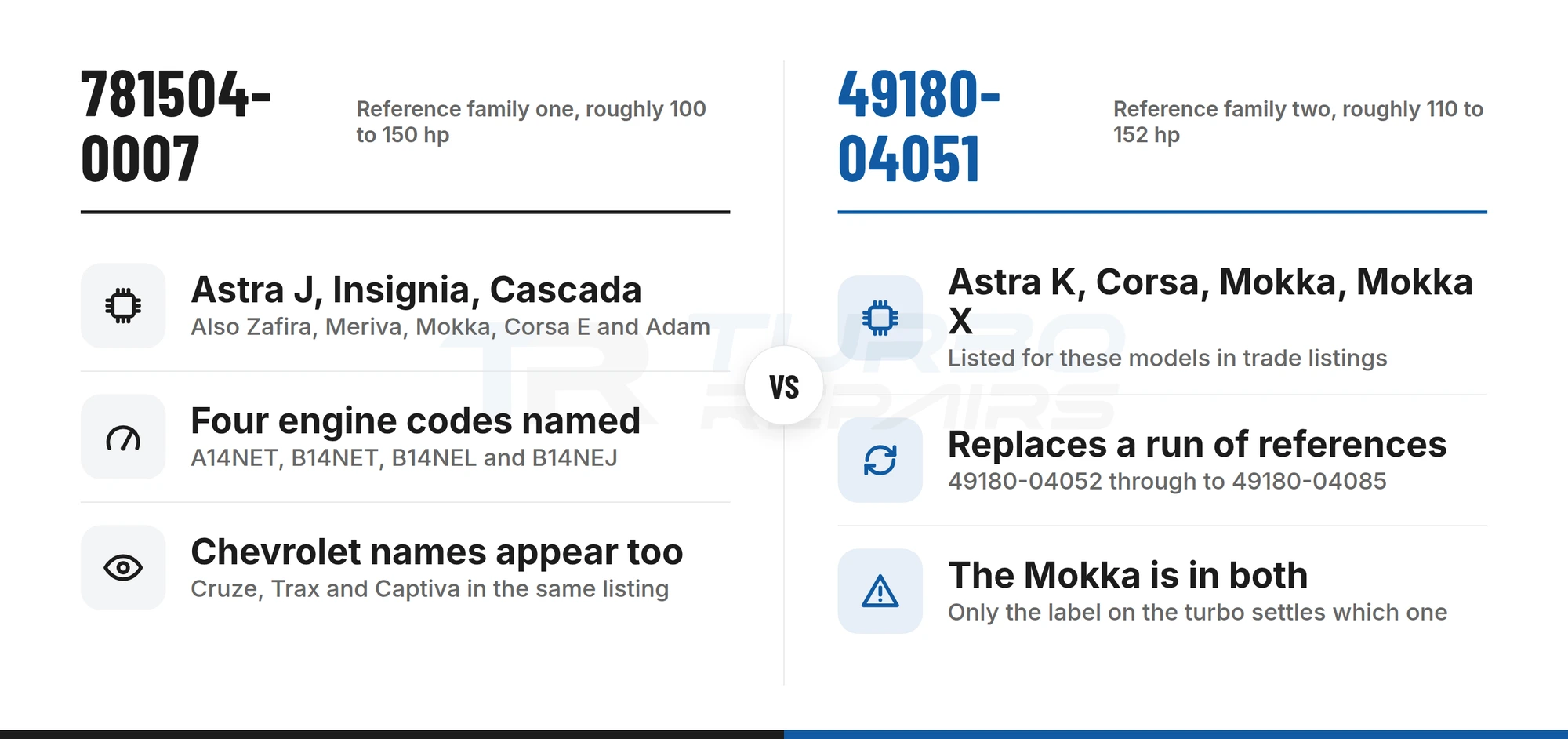
One trade listing puts a single turbocharger reference, 781504-0007, on the Adam city car and the Insignia alike, with the Mokka, Meriva, Zafira and Astra J in between.
- Engine: Vauxhall’s 1.4 Turbo petrol, catalogued under the engine codes A14NET, B14NET, B14NEL and B14NEJ
- Cars in the turbo listings: Astra J and Astra K, Corsa E, Adam, Meriva, Zafira, Mokka and Mokka X, Cascada and Insignia
- Turbo references in trade listings: 781504-0007 and the 49180-04051 series, with the Mokka listed under both
- Boost control: a wastegate flap that lets exhaust bypass the turbine; there is no variable-vane mechanism to carbon up
- Price: rebuilds from £185 + VAT; replacement turbochargers from £450 + VAT; your price is confirmed once the unit has been inspected
- Not covered here: the diesel Mokka and Astra, the Mokka 1.2 petrol and the Astra 1.6 Turbo petrol
- Turnaround: typically one to three working days on the bench, plus postage each way
- Warranty: lifetime, with no mileage cap
Which Vauxhall 1.4 Turbo Engine Is Yours?
Vauxhall’s 1.4 Turbo is a four-cylinder petrol engine that the parts trade catalogues under four engine codes: A14NET, B14NET, B14NEL and B14NEJ. Turbocharger listings match it to a long run of cars, from the Adam and the Corsa E through the Astra, Meriva, Zafira and Mokka to the Cascada and the Insignia.
Power outputs in those listings run from about 100 hp to a little over 150 hp. That spread matters less than it looks, because the turbo references do not divide neatly by output or by model. What you actually need is the reference on the turbocharger’s own label.
Two reference families in the listings
Trade listings for this engine sort into two turbocharger families. The first, under the reference 781504-0007, is catalogued for the Astra J, Insignia, Cascada, Zafira, Meriva, Mokka, Corsa E and Adam, across roughly 100 to 150 hp, and names the A14NET, B14NET, B14NEL and B14NEJ engine codes.
The second is listed under 49180-04051 for the Astra K, the Corsa and the Mokka and Mokka X, at roughly 110 to 152 hp. The same listing states that it also replaces a run of references from 49180-04052 through to 49180-04085. So the number on a label from this family can be any one of more than thirty and still point to the same replacement.
The Mokka turns up under both families. That is the practical reason a Mokka owner cannot buy a replacement turbocharger on the model name alone, and it is also why a rebuild of the unit already on the car sidesteps the question: the turbo that comes back is the one that came off.
The same engine under Chevrolet badges
The engine was also fitted to Chevrolet models, where the listings catalogue it under the engine code LUJ, and the 781504 listing names the Cruze, Trax and Captiva alongside the Vauxhalls. If a search for your turbo returns Chevrolet names, that is why. A Chevrolet listing is not proof that a unit fits your car, and it is not proof that it doesn’t; the reference on the label settles it.
What this page does not cover
Plenty of searches for a Mokka turbo are about a diesel car. The 1.6 and 1.7 CDTi Mokkas carry different turbochargers from the petrol cars and have their own rebuild listings: the Mokka 1.6 CDTi diesel and the Mokka 1.7 CDTi diesel. Neither fits a 1.4 Turbo petrol, and nothing below applies to them.
The Mokka has also been sold with a 1.2 petrol turbo, and the Astra with a 1.6 Turbo petrol. They are separate engines, none of the references on this page is listed against them, and they are not covered here. The diesel Insignia has its own page, our Vauxhall Insignia turbo repair guide to the 2.0 CDTI.
The Turbocharger on the 1.4T: A Wastegated Petrol Unit
The turbo on a 1.4 Turbo does the same basic job as any other. Exhaust gas spins a turbine wheel, the turbine turns a compressor wheel on the same shaft, and the compressor pushes air into the engine so it can burn more fuel on each stroke.
What stops boost climbing past its limit is a wastegate. It is a small flap in the turbine housing that swings open to let part of the exhaust run past the turbine instead of through it. The turbine slows, and the boost with it. There is no ring of pivoting vanes on this unit, so the carbon-bound vane faults you read about on diesel turbo pages do not apply to a 1.4 Turbo.
The actuator that opens the flap
The flap is opened by an actuator acting on a rod, and the rod’s setting decides the point at which the flap starts to move. Our page on wastegate actuator repair explains why that setting matters as much as the condition of the parts.
The listings we hold for this engine do not say whether a given 1.4 Turbo’s actuator is worked by pressure or controlled electronically, so we do not assume either. The unit on the bench shows which it has, and the actuator is checked with the rest of the turbo whichever type it is.
Why a petrol turbo lives hotter
Petrol exhaust reaches the turbine hotter than a diesel’s does, and a small turbo on a small engine works hard for a lot of its life. That heat is shared with the centre housing, where the shaft runs in engine oil.
When the engine is switched off straight after a motorway run or a long climb, the oil stops flowing but the housing stays hot. Oil left in the bearing area can bake onto the surfaces it is meant to protect. Do that often enough and the deposit starts to restrict the oil the bearings depend on.
What Fails: Wastegate, Bearings and Oil Supply
Most 1.4 Turbo turbocharger failures fall into three groups. Two sit inside the unit, and the third sits on the car and decides whether a rebuilt turbo will last.
Bearings and seals
The shaft spins in oil-fed bearings, with a seal at each end holding that oil inside the centre housing. Oil that is overdue, the wrong grade, contaminated or baked on by hot shutdowns wears the bearings first.
Once the shaft has room to move, the seals can no longer do their job. Oil gets into the intake on one side and the exhaust on the other, which is where blue smoke and a falling dipstick come from. Left running, a wheel eventually touches its housing, and a compressor wheel that has rubbed can shed metal into the intake.
The wastegate
The wastegate flap swings on a spindle that runs through a bush in the turbine housing, and every heat cycle works that joint. Wear lets the flap move when it should not, which is the root of the rattle so many owners describe. A worn flap can also fail to seal, so exhaust leaks past the turbine and boost falls short.
The opposite fault is rarer but more serious. A flap that sticks shut, or an actuator that has lost its setting, cannot bleed off exhaust, so boost runs past its limit until the engine management steps in.
Oil supply and air intake
The turbo is only as healthy as the oil reaching it. A feed line that is partly blocked starves the bearings. A return line that is kinked or restricted stops oil draining back to the sump, so it backs up in the centre housing and escapes past seals that are in good order. A crankcase breather that is not working adds to that back-pressure.
The compressor side is exposed too. Anything that gets past the air filter, such as a piece of a split hose or a loose clip, can chip the compressor blades on its way in. A rebuilt turbo refitted to the same restricted feed or the same dirty intake will fail for the same reason the first one did.
Rattles, Hisses and Underboost: Reading the Symptoms
A failing 1.4 Turbo turbocharger tends to announce itself in one of a few ways. Most point to the rotating assembly, some to boost control, and a few to faults outside the turbo altogether.
Signs from inside the turbo
- A high-pitched whine under acceleration. A note that rises and falls with the revs usually comes from the rotating assembly rather than the pipework.
- Blue or grey smoke, and oil to top up between services. Oil is getting past a seal, although an engine burning oil through its own wear shows the same sign.
- Oil in the intake pipework after the turbo. With the pipe off, a wet film points to wear on the compressor side.
- Play at the compressor nut, or rub marks in the housing. Either one means the turbo has to come off.
Signs from boost control
- A metallic rattle from the turbo area. On a wastegated turbo this is often the flap and its linkage; our wastegate actuator repair page covers how that noise arises and how it is put right.
- Sluggish pick-up and a car that will not pull as it did. A flap that leaks or opens too early leaves the turbo short of boost.
- A warning light with reduced power. The engine management has seen boost it did not ask for, in one direction or the other.
- Worse fuel economy. An engine short of boost is driven harder to keep up, and uses more fuel doing it.
A stored underboost code (P0299) or overboost code (P0234) records which way the boost was wrong, not which part made it so. Our guide to turbo overboost and underboost explains how far those codes can take you.
Hisses and faults that only look like the turbo
A hiss or a chuff under load is more often a leak in the pressurised pipework than a fault in the turbo itself. A split intercooler hose, a clip that has worked loose or a failing sensor can all imitate a dying turbocharger. Our guide to turbo failure symptoms lists those cheaper faults and how to rule them out before the turbo comes off.
What a Vauxhall Mokka Turbo Replacement Costs
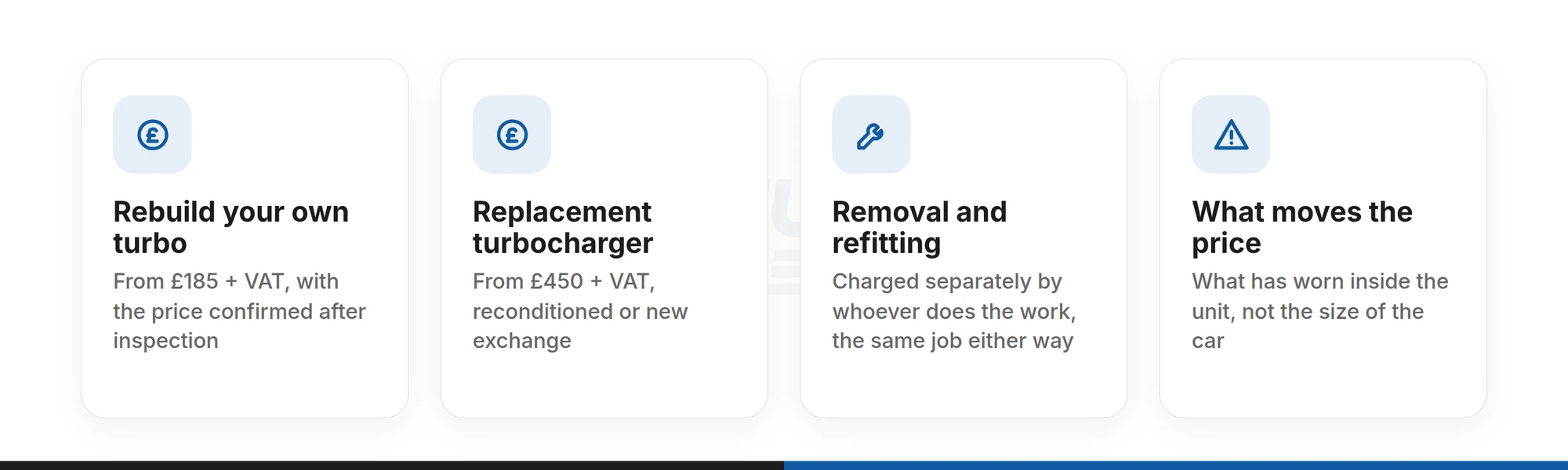
There are three figures to know, and they apply to every 1.4 Turbo car on this page, the Mokka included. Our prices exclude VAT.
- Rebuilding your own turbocharger: from £185.
- A replacement turbocharger from us, reconditioned or new exchange: from £450.
- Removing and refitting it: charged separately by whoever does the work, and the same job whichever route you choose.
Where a rebuild lands in the range
Our price guide sets rebuild ranges by class of vehicle as a starting point. Small cars run from £185 to £285, and mid-size cars from £185 to £350. The same guide puts the typical market price of a new turbocharger for those two classes at £700 to £1,000 and £900 to £1,300.
The 1.4 Turbo shows why the class is only a starting point. When an Adam, a Mokka and an Insignia can be listed against the same turbocharger reference, the size of the car cannot tell you much about the job. What moves a rebuild up its range is what has worn inside: a unit that needs only bearings, seals and thrust parts sits at the bottom, and one that also needs a wheel, the shaft or a housing sits higher. The full table and the reasoning behind it are in our guide to turbo repair and replacement prices.
Why a replacement has to match a reference, not a model
A replacement unit is a different turbocharger from yours, so it has to be the right one. With the Mokka listed under two reference families, a unit bought on “Mokka 1.4 Turbo” alone can be the wrong family. The label on your old turbo, or the unit on our bench, is what makes a replacement safe to order.
A rebuild has nothing to match. The turbo that goes back on is the one that came off, so its reference and its wastegate setting are already your car’s.
When a replacement is the better buy
If a wheel, the shaft and a housing have all failed on top of the bearings and seals, very little of the original unit is left to rebuild. The inspection shows that, and when a turbo is not worth rebuilding we say so and quote a replacement instead. Taking the unit off at the first sign of trouble, before worn bearings damage the parts around them, is the surest way to keep a 1.4 Turbo repair near the bottom of the range.
Turbo Repairs · Epsom workshop
Find out what your 1.4 Turbo’s turbocharger actually needs
Post the unit in and it is identified from its label or on the bench, then stripped and measured before a price is confirmed. If it is worth rebuilding, the turbo that comes back is your own, with its wastegate set to suit it.
Lifetime, unlimited-mileage warranty · Mail-in from the UK and internationally · Bench-tested and calibrated before it ships
Our Vauxhall 1.4 Turbo Rebuild
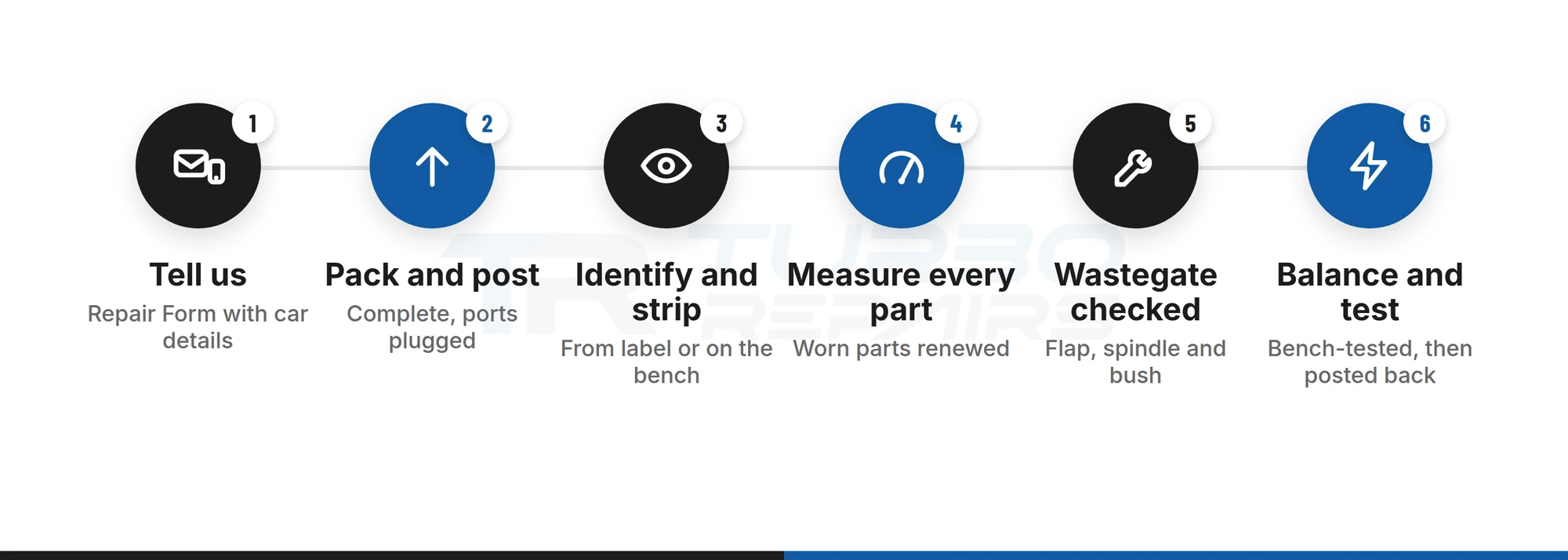
You, or the garage looking after the car, remove the turbocharger and post it to our in-house workshop. From there our turbocharger rebuild service follows the same order on every 1.4 Turbo unit.
- Tell us about the car. Complete the online Repair Form with the registration, mileage, the symptoms, any stored fault codes and, if you can read it, the reference on the turbo’s label.
- Pack and post it. Send the turbocharger complete, with its actuator still attached and every port plugged or taped over, to Unit 102 Reaver House, 12 East Street, Epsom, Surrey, KT17 1HX, United Kingdom. Our FAQs page covers packing and postage.
- Identify and strip. The unit is identified from its label or, where the label has faded, on the bench, then stripped to component level.
- Measure every part. The shaft, wheels, bearing bores and housings are cleaned and measured against the original specification. Bearings, seals and thrust parts are renewed as standard with genuine OE or OEM-grade components, uprated where the original has a known weakness, and any wheel, shaft or housing that fails inspection is replaced.
- Put the wastegate right. The flap, spindle and bush are checked for wear and renewed where worn, so the rattle and the boost leak do not come back with the turbo. The actuator’s setting is then checked against the turbo it belongs to.
- Balance and test. The rotating assembly is balanced, and the finished unit is set up and run on the bench before it is boxed and posted back, ready to refit.
Bench time is typically one to three working days from arrival, plus postage each way, and the rebuild carries a lifetime, unlimited-mileage warranty. Independent garages and dealers send 1.4 Turbo units in for their customers in exactly the same way that owners do.
Before the rebuilt turbo goes back on
Whoever refits the turbo should put the car right first. That means fresh oil and a new filter to the grade in the handbook, new oil feed and return lines rather than the old ones, a working crankcase breather, and an intake and intercooler cleared of oil and debris. Our guide to refitting and priming a turbocharger sets out the order, including how to prime the oil feed before the first start.
Vauxhall 1.4 Turbo FAQ
How much does a Vauxhall Mokka 1.4 turbo replacement cost?
Rebuilding your own turbocharger starts from £185 + VAT, and a replacement turbocharger from us starts from £450 + VAT. Our price guide puts small-car rebuilds at £185 to £285 and mid-size cars at £185 to £350, with the exact figure set by what has worn inside the unit. Removal and refitting are not included, and your price is confirmed after inspection.
Is the Mokka 1.4 turbo the same as the Astra 1.4 turbo?
Often, yes. Both reference families in the trade listings name the Mokka and an Astra: the 781504 family alongside the Astra J, and the 49180-04051 family alongside the Astra K. Which one your car carries is decided by the label on the turbo, not by the model name.
Why does my 1.4 Turbo rattle?
On a wastegated turbo a metallic rattle is often the wastegate flap moving on a worn spindle and bush. A loose heat shield can sound similar, so check that first. If it is the wastegate, the rebuild renews the worn parts and checks the actuator’s setting.
Should I keep driving a car with a failing turbo?
Keep it to a minimum. Blue smoke, oil loss or a metallic whine mean the turbo is wearing, and each mile adds to the damage and to the parts a rebuild has to replace. Oil getting past the seals also ends up in the exhaust and the intake, where it causes problems of its own.
Do you repair the wastegate actuator separately?
Our standalone actuator repairs cover electronic turbo actuators. On a 1.4 Turbo we check the actuator and its setting as part of the turbocharger rebuild, so send the turbo complete with the actuator attached.
Does it matter whether my Mokka is a Mokka or a Mokka X?
Not for a rebuild. The 49180-04051 listing names both, and the 781504 listing names the Mokka as well, so the model name narrows the search without deciding it. Rebuilding the turbo already on the car removes the question altogether.
How long does a rebuild take, and what is the warranty?
Typically one to three working days on the bench from arrival, plus postage each way. Every rebuild carries a lifetime, unlimited-mileage warranty.
Final Thoughts
A 1.4 Turbo in a Corsa and a 1.4 Turbo in an Insignia can be carrying the same turbocharger. That is the useful thing to take from this page: when you ask what a Mokka turbo will cost, the car narrows the answer, but the unit decides it. How much has worn, and how early it came off, matter far more than the badge.
So act on the first whine, rattle or puff of smoke, have the cheaper look-alike faults ruled out, and put the oil supply right before anything goes back on. Rebuilding the turbo you already have keeps the reference, the wastegate setting and the fit exactly as the car expects them.
Turbo Repairs · Epsom workshop
Have your own 1.4 Turbo turbocharger rebuilt
Fill in the Repair Form with the car’s details and the label reference if you have it, then post the turbo in complete. It is stripped, measured, rebuilt, balanced and bench-tested, and comes back ready to go on.
Lifetime, unlimited-mileage warranty · Mail-in from the UK and internationally · Bench-tested and calibrated before it ships