

Summary The BorgWarner KP35, KP39 and BV39 are one family of small turbochargers, and it reaches far beyond the Renault 1.5 dCi it is best known for. Our fitment data lists it on VW-group 1.9, 1.6 and 1.4 TDI diesels, the 1.4 HDi and TDCi, the Vauxhall 1.3 CDTi, Mercedes-Benz and BMW diesels, and on 1.4 TSI and 1.6 EcoBoost petrol engines too. We rebuild your own unit from £185 + VAT, typically in one to three working days on the bench, with a lifetime, unlimited-mileage warranty.
The name on a listing matters less than it looks. What decides how one of these turbos is rebuilt sits at the compressor end of the shaft, in a small part called the thrust flinger.
The original KP35 sealed its compressor end with a single piston ring on the thrust flinger, a design Melett describes as prone to oil leaks; later units carry two rings.
- The family: BorgWarner KP35, KP39 and BV39, with the closely related BV35 on some engines
- Where it is fitted: diesel and petrol engines from Renault, Nissan, Dacia, Peugeot, Citroen, Ford, Volvo, Vauxhall, the VW group, Mercedes-Benz and BMW
- On the label: a reference beginning 5435 or 5439; the first four digits do not tell you whether the unit is a KP or a BV
- The family’s known weak point: compressor-end oil sealing on the original single-ring thrust flinger
- Price: rebuilds from £185 + VAT; replacement units from £450 + VAT; your price is confirmed once the unit has been inspected
- Turnaround: typically one to three working days on the bench, plus postage each way
- Warranty: lifetime and unlimited mileage
- Getting started: the online Repair Form
KP35, KP39 or BV39: What the Number on the Label Tells You
Every turbo in this family carries a BorgWarner reference on its label, written as 5435-970-0012 or 5439-970-0127, and often typed without the dashes as 54359700012. Read the first four digits first. A 5435 reference belongs with the 35-series units and a 5439 reference with the 39-series.
What those four digits do not give you is the letters. In our fitment data, 5439 references are catalogued as KP39s on some engines and BV39s on others. And not every 5435 is a KP35: 5435-970-0014 is catalogued as a BV35 on the 89 and 90 hp Vauxhall Corsa 1.3 CDTi, while 5435-970-0005 and 5435-970-0006 on the lower-output 1.3 CDTi are KP35s.
The catalogue does not always keep the letters apart either. On VW-group 1.9 TDI engines one build code, 1873CCB426.10AVAXC, is filed as a KP39 on most of the rows dated 2000 to 2002 and as a BV39 on most of the rows from 2003. Same build, two names, depending on the date of the listing.
On one engine the prefix does settle the question. Across the Renault and Dacia 1.5 dCi every 5435 reference is a KP35, and our Renault and Dacia 1.5 dCi page explains what that means for diagnosis. Carry that rule to another engine, though, and it stops holding. Anywhere else, read the full designation on the label, or send the unit and let the bench decide.
The middle group of digits moves around as well. One seller lists 5435-970-0002, 5435-971-0002 and 5435-988-0002 against a single remanufactured KP35, and another lists 5435-970-0012 beside 5435-988-0012. A quote whose middle three digits differ from your label is not, on that evidence alone, a different turbo.
None of this is unique to BorgWarner’s small units. As our page on the BorgWarner K03 and K04 sets out for that family, the name is where identification starts, not where it finishes.
The Engines That Carry Them
The 1.5 dCi is where most people meet this family, but it is one row of many. The table lists engines against which our fitment data catalogues KP35, KP39 or BV39 references, with BV35 where it sits alongside them. It maps where the family turns up. It is not a fitment guide: the reference on your own unit decides what that unit is.
| Engine | Fuel | Names catalogued | Example references | Vehicles listed (examples) |
|---|---|---|---|---|
| Renault / Nissan 1.5 dCi (K9K) | Diesel | KP35, BV39 | 5435-970-0012, 5435-970-0028, 5439-970-0127 | Renault Clio and Megane, Dacia Duster, Nissan Note and NV200 |
| PSA 1.4 HDi / Ford 1.4 TDCi (DV4TD) | Diesel | KP35 | 5435-970-0001, 5435-970-0007, 5435-970-0009, 5435-970-0021 | Citroen C3, Peugeot 207 and Partner, Ford Fiesta |
| Vauxhall 1.3 CDTi (Z13DT, Z13DTJ, Z13DTH) | Diesel | KP35, BV35 | 5435-970-0005, 5435-970-0006, 5435-970-0014 | Vauxhall Corsa and Combo |
| VW group 1.9 TDI (ATD, AXR, ASZ, BKC, BXE, BLS and others) | Diesel | KP39, BV39 | 5439-970-0011, 5439-970-0022, 5439-970-0072 | VW Polo, Jetta and Transporter, Audi A3, SEAT Toledo, Skoda Superb |
| VW group 1.4 TDI three-cylinder (BMS, BNV, BWB) | Diesel | BV39 | 5439-970-0054 | VW Polo |
| VW group 1.6 TDI (CAYA, CAYB, CAYC, CLNA) | Diesel | BV39 | 5439-970-0114, 5439-970-0136 | VW Polo, SEAT Toledo |
| VW group 1.4 TSI (CAXA, CAXC, CMSA, CMSB) | Petrol | KP39 | 5439-970-0139 | VW Jetta and Scirocco, Audi A3, SEAT Toledo, Skoda Superb |
| Ford and Volvo 1.6 EcoBoost (Ford JQDA, JTDA, JTBA, JTJA; Volvo B4164T) | Petrol | KP39 | 5439-970-0034, 5439-970-0124, 5439-970-0131 | Ford Fiesta, C-Max, Mondeo and Tourneo, Volvo V40 |
| Mercedes-Benz OM651 four-cylinder CDI | Diesel | KP39 | 5439-970-0099, 5439-970-0120 | C-Class, E-Class, GLK, CLS |
| Mercedes-Benz OM646 2.2 CDI | Diesel | KP39 | 5439-970-0049 | Sprinter |
| BMW M57 3.0 six-cylinder | Diesel | KP39 | 5439-970-0065, 5439-970-0088 | 5 Series, listed at 261 to 285 hp |
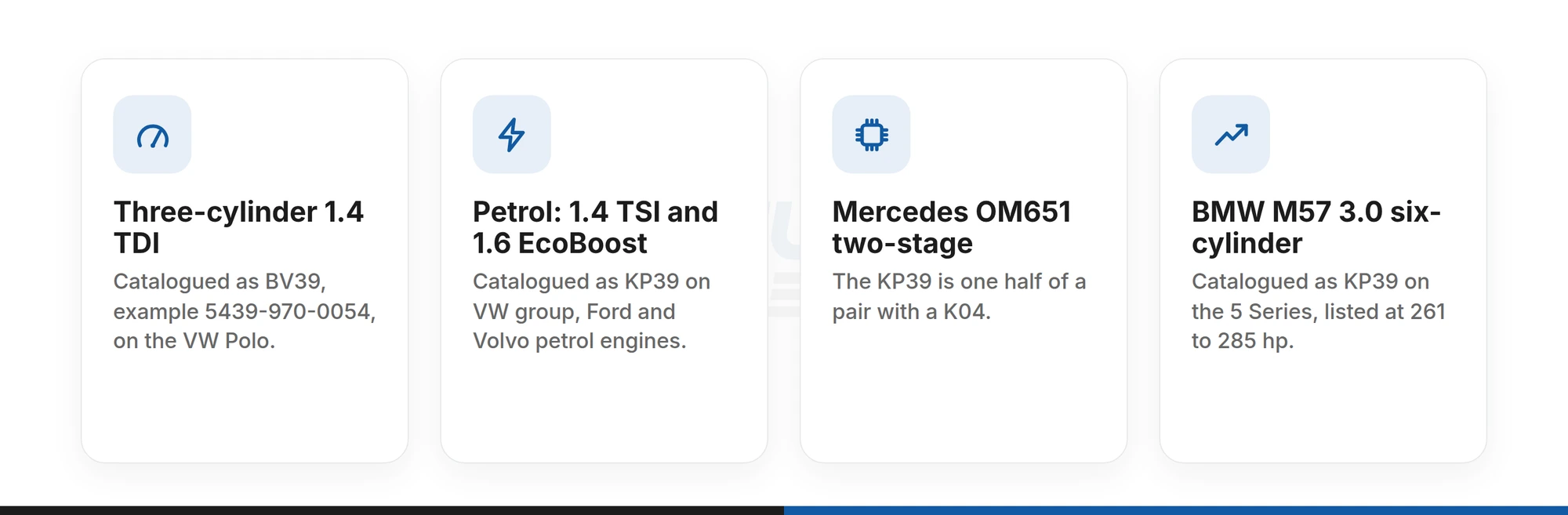
Three things stand out. The family is not a diesel part: the KP39 is catalogued on petrol engines from two separate groups. It is not tied to one engine size either, running from a three-cylinder 1.4 TDI to BMW’s 3.0-litre six. And on some engines it is not the only turbo. On the two-stage version of the Mercedes OM651 the KP39 is one half of a pair with a K04, and our Mercedes Sprinter and Vito turbo repair page explains how that pair is numbered.
Several of these engines have their own pages, and those pages carry the engine-specific detail this one leaves out:
- 1.5 dCi: our Renault and Dacia 1.5 dCi turbo repair and Nissan Qashqai 1.5 dCi turbo repair pages.
- 1.4 HDi: our Citroen 1.4 HDi and wider Citroen turbo repair page.
- Mercedes four-cylinder CDI: our Mercedes turbo repair page, which sorts every Mercedes diesel by engine family.
What Fails on a KP35, KP39 or BV39
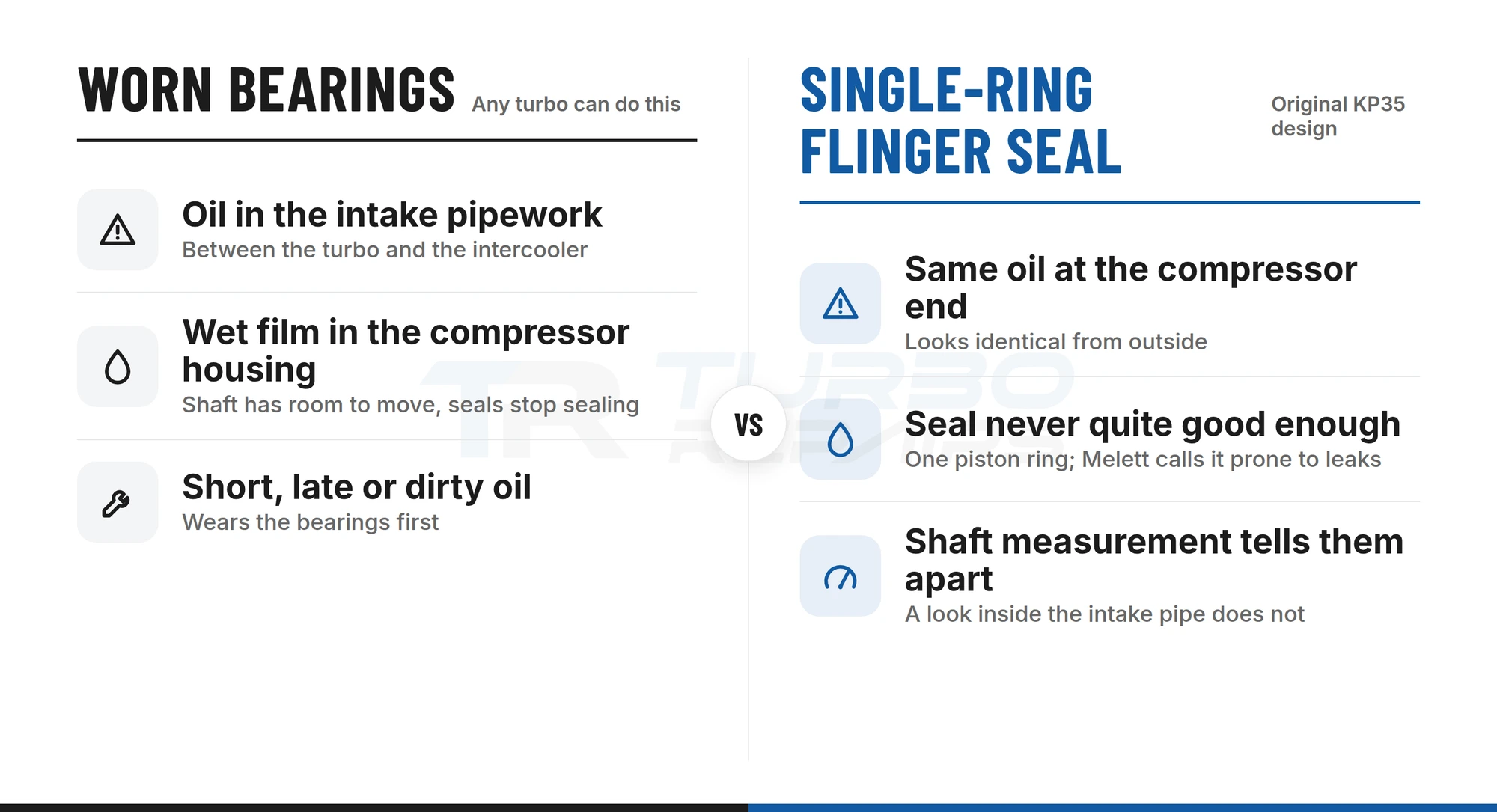
The same three areas wear on every unit in the family, whatever engine it sits on. The first is where this family has a history of its own; the other two follow the engine and the build.
Oil at the compressor end
Oil in the intake pipework between the turbo and the intercooler, or a wet film inside the compressor housing, can mean worn bearings, as it would on any turbo. On an older unit in this family it can also mean the seal at the compressor end was never quite good enough, which is the subject of the next section.
Bearings and thrust surfaces
The shaft runs in two oil-fed journal bearings, with a thrust bearing and thrust collar taking the load along its length. Short, late or dirty oil wears these first. Once the shaft has room to move, the seals at both ends stop sealing, and in time a wheel can touch its housing. Our guide to turbo failure symptoms sorts the signs by where in the unit they start, and lists the cheaper faults that imitate them.
Boost control, which depends on the build
Some builds in the family control boost with a wastegate and others with a ring of variable vanes around the turbine. The wastegate’s spindle and bush wear with heat; the vanes collect carbon and stiffen. Because the letters on a listing do not always tell you which a unit has, the build is confirmed on the bench before either is diagnosed. Our guides to wastegate actuator repair and VNT turbos explain each mechanism.
Thrust Flingers: One Piston Ring or Two
The thrust flinger, also sold as the thrust collar, sits on the shaft just behind the compressor wheel. It runs against the thrust bearing, throws oil outwards and away from the seal, and carries the piston ring that seals the compressor end of the centre housing. It is small, it is hidden, and on this family it matters more than anything printed on the label.
What changed
Turbo component maker Melett has published the history. The original KP35, introduced in the early 2000s, had a flat-back compressor wheel and a flinger with a single piston-ring groove. Melett describes that design as prone to oil leaks at the compressor end, because the single ring did not seal well enough.
The answer was a second ring. According to the same note, the twin-ring flinger is available on new complete OE turbos for most newer applications, Melett makes a twin-ring flat-back flinger to upgrade the older design, and every KP35 and KP39 core assembly it builds now uses a twin-ring flinger.
What that means for your turbo
- Oil at the compressor end of a single-ring unit is not, by itself, proof of worn bearings. On that design the seal was the recognised weak point from the start. Measuring the shaft tells the two causes apart; a look inside the intake pipe does not.
- Flat back or superback. The family was built with two compressor-wheel back designs, flat back and superback, and the flinger has to suit the wheel. Repair kits are sold by back style, with a single kit listed for KP35, KP39, BV35 and BV39 alike, so the back of the wheel says more about the parts a unit needs than the letters on its label do.
- The ring arrangement is part of the parts list. Bearings and seals are renewed on any rebuild, but the flinger and its piston rings have to be right for that unit’s wheel and design. That is why they are identified before any parts are chosen.
None of this can be seen from outside. The flinger sits behind the compressor wheel, so which ring design a unit carries, and which back style its wheel has, only becomes known once the unit is stripped. That is one more reason a rebuild of your own turbo starts with the unit on the bench rather than with a part number on a screen.
Turbo Repairs · Epsom workshop
Find out what is behind your compressor wheel
Post your turbocharger in and it is stripped, measured and identified by what is actually inside it: the build, the wheel’s back style and the flinger. You get a price for the work it needs, and your own unit back, rebuilt with the parts that suit it.
Lifetime, unlimited-mileage warranty · Mail-in from the UK and internationally · Bench-tested and calibrated before it ships
Our KP35, KP39 and BV39 Rebuild
You, or the garage working on the car, remove the turbocharger and post it to us. The turbocharger rebuild service then runs in this order:
- Repair Form. Complete the online Repair Form with the registration, mileage, symptoms and any stored fault codes. Add the full reference from the label, all three groups of digits, and a photograph of it if you can.
- Packing and posting. Send the turbo complete, with its actuator attached and every port plugged or taped, to Unit 102 Reaver House, 12 East Street, Epsom, Surrey, KT17 1HX, United Kingdom. Our FAQs page covers packing and postage.
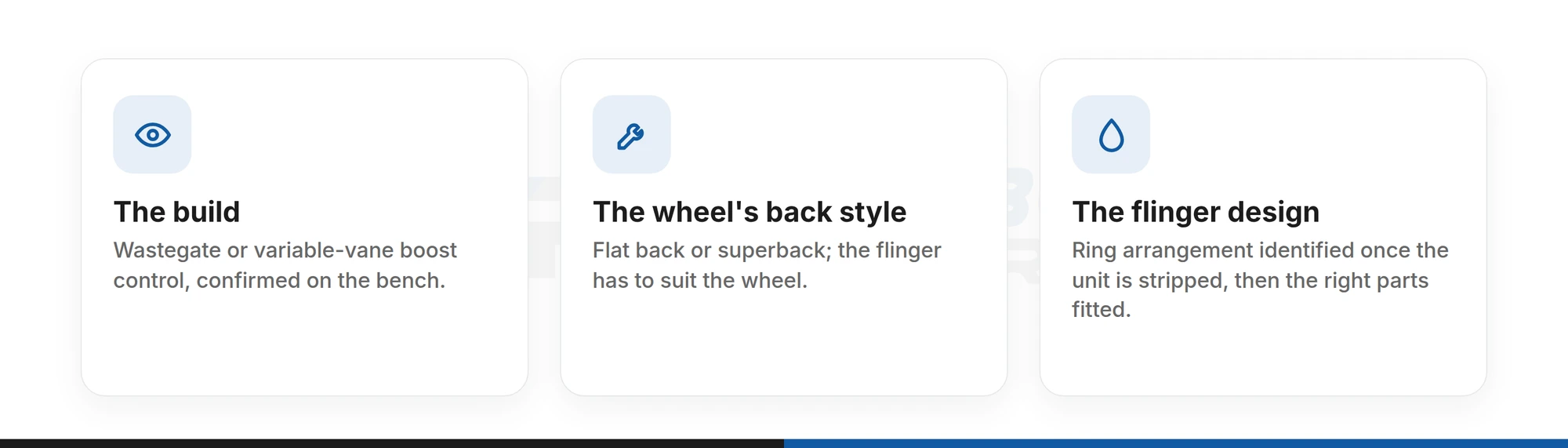
- Identification and strip. The unit is identified from its label, or on the bench where the label has gone, then stripped to component level. The build, the compressor wheel’s back style and the flinger design are recorded before anything is ordered.
- Measurement. The shaft, journal and thrust surfaces, bearing bores and housings are cleaned and measured against the original specification.
- Rebuild. Bearings, thrust parts and seals are renewed with genuine OE or OEM-grade components, uprated where the original has a known weakness. The flinger and its ring arrangement are identified on the bench and the correct parts fitted for that unit, matched to its wheel’s back style. A wheel, shaft or housing that fails inspection is replaced.
- Boost control. On a wastegated build the flap, spindle and bush are checked and renewed where worn, and the actuator’s setting is checked. On a variable-vane build the vane ring is stripped, cleaned of carbon, freed or renewed, and its travel set.
- Balance and bench test. The rotating assembly is balanced, and the finished unit is set up and run on the bench with dealer-level diagnostic and calibration tooling before it is boxed and posted back, ready to refit.
Bench time is typically one to three working days from arrival, plus postage each way, and every rebuild carries a lifetime, unlimited-mileage warranty. Independent garages and dealers send units in for their customers in exactly the same way owners do.
Rebuild or replace
Rebuilds start from £185 + VAT, and a replacement unit from us starts from £450 + VAT. Neither includes removing and refitting the turbo, which is charged by whoever does that work. Where a rebuild lands depends on what survived inside, and our guide to turbo repair and replacement prices sets out the ranges.
A rebuild is the sensible default whenever the wheels, shaft and housings pass inspection, because the unit that goes back on is the one that came off: its build, its reference and its boost-control setting are already your engine’s. If a wheel, the shaft and a housing have all failed on top of the bearings, little of the original is left, and we will say so and recommend a replacement instead.
Whichever unit goes back on, fix what the old one was telling you first, and prime the oil feed before the first start. Our guide to refitting and priming a turbocharger covers both.
BorgWarner KP35 and BV39 FAQ
Is 54359700014 a KP35?
Not in our fitment data. 5435-970-0014 is catalogued as a BV35, on the 89 and 90 hp Vauxhall Corsa 1.3 CDTi. KP35 and BV35 units share the 5435 prefix, which is why the full designation on the label, or the bench, settles what a unit is. We rebuild it either way.
Is a KP39 the same turbo as a BV39?
They share the 5439 prefix and repair kits are sold for both, but they are catalogued as different units, and different builds in the family control boost in different ways. The catalogue even files one VW-group 1.9 TDI build under both names at different dates. Treat the name as a starting point and the label reference as the identification.
Can you rebuild a KP39 from a petrol engine?
Yes. The KP39 is catalogued on VW-group 1.4 TSI engines and on Ford and Volvo 1.6 EcoBoost engines, and those units go through the same strip, measurement, rebuild and bench test as the diesel ones.
How do I know whether my turbo has a single-ring or twin-ring flinger?
You cannot tell from outside, because the flinger sits behind the compressor wheel. The flinger and its ring arrangement are identified on the bench when the unit is stripped, and the correct parts are fitted for that unit.
Should I send the actuator with the turbo?
Yes. Send the complete turbocharger as it came off the engine, with the actuator attached. Its setting is part of how the unit controls boost, so it is checked alongside the turbo.
My Mercedes has two turbochargers. Do I send both?
On the two-stage OM651 the KP39 is one half of a pair with a K04, and how that assembly is numbered decides what you are sending. Our Mercedes Sprinter and Vito turbo repair page explains it; if you are unsure, describe the unit on the Repair Form and we will tell you before anything is posted.
How much does a rebuild cost, and how long does it take?
Rebuilds start from £185 + VAT and replacement units from £450 + VAT, with your exact price confirmed after inspection. Bench time is typically one to three working days, plus postage each way, and every rebuild carries a lifetime, unlimited-mileage warranty.
Final Thoughts
KP35, KP39 and BV39 are catalogue names, and on this family they are less reliable than they look: a 5435 prefix can be a BV35, and one VW-group build has been filed under both KP39 and BV39. The engines are just as varied, from a three-cylinder diesel to a 1.6 petrol to a BMW six.
What runs through all of them is the compressor end. A flinger with one piston ring was the original design and its known weak point; two rings is the design that replaced it. Post the turbo rather than chasing the part number, and the rebuild starts from what is actually inside it.
Turbo Repairs · Epsom workshop
Post in the turbo, not the part number
Complete the Repair Form with your vehicle and the reference from the label, then send the turbocharger in complete. It is identified on the bench down to the flinger, rebuilt with the parts that unit takes, balanced and tested, and posted back ready to refit.
Lifetime, unlimited-mileage warranty · Mail-in from the UK and internationally · Bench-tested and calibrated before it ships